

Informational content only. Not legal, tax, or financial advice. Private Student Relief is a consulting organization, not a law firm. Debt validation services are executed by an attorney-backed partner provider. Student loan dismissal availability depends on case specifics, jurisdiction, plaintiff identity, loan documentation, and timing. Last reviewed: October 2026.
Written by Henry Silva
Private Student Loan Debt Specialist · 10+ years analyzing how to get your student loans dismissed through chain of assignment challenges under Article III standing (Lujan/Spokeo/TransUnion), statute of limitations defenses across all 50 states, FRCP 12(b)(6) motions to dismiss for failure to state a claim, service of process challenges under state civil procedure, bankruptcy discharge under 11 U.S.C. §523(a)(8) with Homaidan v. Sallie Mae Second Circuit precedent, and coordinated defensive framework application against major private lenders (Sallie Mae Bank NYSE:SLM, Navient/Earnest Operations LLC, Discover/Firstmark Services, SoFi Bank NA, Citizens Bank NA, Ascent) and NCSLT trusts. Last reviewed: October 2026.
If you’ve been served with a private student loan lawsuit, understanding how to get your student loans dismissed can be the difference between a devastating default judgment with wage garnishment and complete case dismissal with no debt owed. Private student loan lawsuits often have substantial legal vulnerabilities that borrowers can exploit through properly filed motions and defenses. This complete 2026 guide covers the 6 proven paths to student loan dismissal: motion to dismiss on Article III standing grounds, statute of limitations defense, FRCP 12(b)(6) pleading challenges, service of process defects, chain of assignment challenges against debt buyers, and bankruptcy automatic stay with discharge analysis. Each path produces real dismissal outcomes when applied correctly. Most private student loan lawsuits have at least one exploitable vulnerability — the key is identifying which defense fits your specific case and acting within required deadlines.
Quick Answer
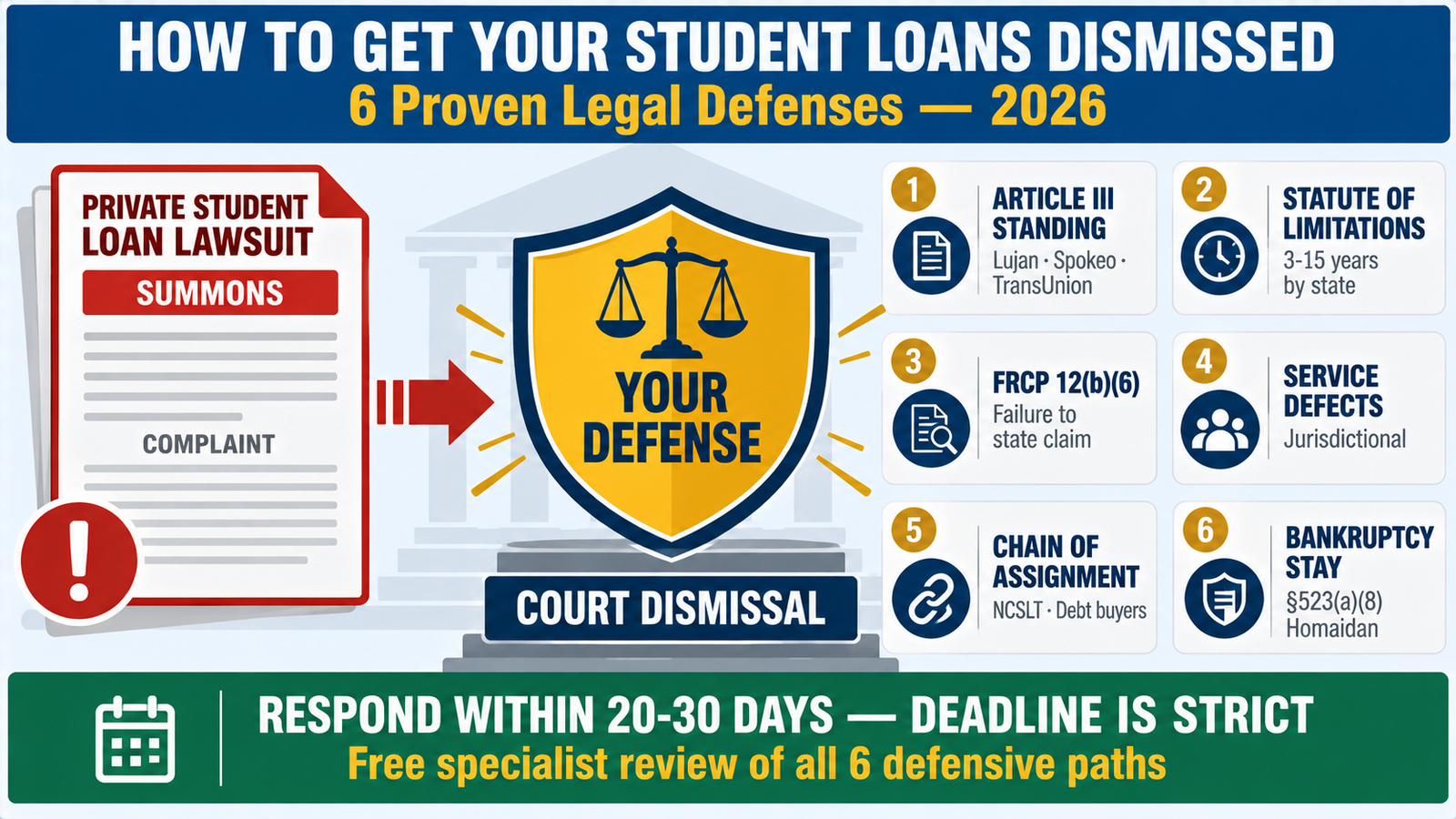
How to get your student loans dismissed in court works through 6 proven legal defenses applicable to private student loan lawsuits: (1) Motion to dismiss on Article III standing grounds — plaintiff must prove complete chain of ownership from original lender under Lujan v. Defenders of Wildlife 504 U.S. 555 (1992), Spokeo v. Robins 578 U.S. 330 (2016), TransUnion LLC v. Ramirez 594 U.S. 413 (2021); failure to produce proper documentation typically produces dismissal. (2) Statute of limitations defense — if state SOL has expired (3-15 years by state), motion to dismiss typically succeeds and may support FDCPA counterclaim under 15 U.S.C. §1692e. (3) FRCP 12(b)(6) motion to dismiss for failure to state a claim — complaint missing essential elements like account number, loan amount, assignment chain, or borrower identification. (4) Service of process challenges — improper service under state civil procedure rules invalidates the lawsuit; proper notice required for court jurisdiction. (5) Chain of assignment challenges against debt buyers — missing intermediate assignments, blank endorsements, bulk sale documentation gaps between NCSLT, debt buyers, and original lenders. (6) Bankruptcy automatic stay under 11 U.S.C. §362 immediately halting litigation plus bankruptcy discharge under §523(a)(8) with Homaidan v. Sallie Mae 992 F.3d 100 (2d Cir. 2021) precedent making non-qualified private loans dischargeable without undue hardship. Most private student loan lawsuits have at least one exploitable vulnerability. Deadlines for responsive motions are strict (typically 20-30 days from service). Legal representation is strongly recommended.
Read the complete dismissal framework below.
In this complete student loan dismissal guide:
Why private student loan lawsuits are often vulnerable to dismissal
The structural weaknesses in private loan collection litigation
Defense 1: Article III standing challenges
The most powerful dismissal mechanism for debt-buyer-held loans
Defense 2: Statute of limitations
Time-barred lawsuits and FDCPA counterclaim leverage
Defense 3: FRCP 12(b)(6) failure to state a claim
Pleading defects that doom collection complaints
Defense 4: Service of process challenges
Improper service and jurisdictional defects
Defense 5: Chain of assignment challenges
NCSLT trusts and debt buyer documentation defects
Defense 6: Bankruptcy stay and §523(a)(8) discharge
Automatic stay plus Homaidan discharge precedent
Why private student loan lawsuits are often vulnerable to dismissal
Understanding how to get your student loans dismissed starts with recognizing why private student loan collection lawsuits are frequently vulnerable to defense motions. Unlike original creditors suing on well-documented recent debt, most private student loan lawsuits come from debt buyers or trusts holding charged-off accounts with documentation gaps, old facts, and complex ownership chains. These structural weaknesses create multiple vulnerabilities that properly represented defendants can exploit.
The documentation problem
Private student loan debt is frequently sold multiple times after charge-off — from original lender (Sallie Mae Bank, Navient/Earnest, Discover, etc.) to intermediate debt buyers to current plaintiff. Each sale typically transfers thousands of accounts in bulk portfolios with minimal account-specific documentation. Original loan documents (promissory notes, truth in lending disclosures, cost of attendance certifications) often cannot be produced by current plaintiffs when challenged. This creates vulnerabilities for student loan dismissal motions.
The timing problem
Many private student loan lawsuits involve old debt — accounts that defaulted years ago, were sold through multiple hands, and are now being litigated near or past statute of limitations expiration. State SOL for written contract debt ranges from 3-15 years. When plaintiffs file suits on debt approaching or past SOL, defense motions on SOL grounds typically succeed. The pressure to litigate before SOL expires sometimes causes plaintiffs to file on debt where SOL has already expired, creating immediate dismissal opportunities.
The identification problem
NCSLT trusts and debt buyers often cannot clearly establish their identity as proper plaintiffs. NCSLT is actually multiple distinct trusts (NCSLT 2003-1, NCSLT 2004-1, etc.) with different beneficial ownership and documentation. Complaints often name the wrong trust, use generic “NCSLT” without specifying which trust, or fail to produce beneficial ownership documentation. These identification defects support both Article III standing challenges and FRCP 12(b)(6) motions.
The resource asymmetry opportunity
Plaintiffs in private student loan collection often invest minimally in each individual case — relying on default judgments when defendants don’t respond. When defendants actually appear and raise substantive defenses, many plaintiffs lack the willingness or ability to litigate aggressively. This creates practical leverage: a well-prepared motion to dismiss often prompts plaintiff dismissal (voluntary withdrawal) rather than full litigation of the defense. The key is appearing and raising defenses promptly within deadline.
Defense 1: Article III standing challenges — the most powerful dismissal mechanism
Article III standing challenges produce the most powerful mechanism for how to get your student loans dismissed. Under the U.S. Constitution, plaintiffs must have standing to bring a lawsuit. For private student loan collection, this requires proof of complete chain of ownership from original lender to current plaintiff — a requirement that debt buyers and NCSLT trusts frequently fail to meet.
The Article III framework
Article III standing requires three elements: (1) concrete and particularized injury; (2) causally connected to defendant’s conduct; (3) redressable by court decision. Established in Lujan v. Defenders of Wildlife 504 U.S. 555 (1992), refined in Spokeo, Inc. v. Robins 578 U.S. 330 (2016), and further developed in TransUnion LLC v. Ramirez 594 U.S. 413 (2021). For private student loan collection, “concrete and particularized injury” requires proof that THIS plaintiff owns THIS specific debt. Without proper chain of ownership documentation, no standing exists.
What proper standing documentation requires
Proper Article III standing requires plaintiff to produce: (1) original promissory note between borrower and original lender (Sallie Mae Bank NYSE:SLM, Navient/Earnest Operations LLC, Discover/Firstmark Services, SoFi Bank NA, Citizens Bank NA, Ascent, or other); (2) complete chain of assignment documents showing each transfer from original lender through intermediate owners to current plaintiff; (3) specific identification of THIS account within each bulk transfer (not just that account was part of a larger portfolio sale); (4) authority of each signatory executing assignment documents; (5) current plaintiff’s actual ownership of this specific debt. Failure of any element supports standing dismissal.
Standing is jurisdictional and preserved
Because Article III standing is jurisdictional (not merely a defense), it can be raised at any stage of litigation — including pre-trial motion to dismiss, during trial, post-trial motion, appellate review, and even post-judgment through motion to vacate under FRCP 60(b)(4) (void judgment). This provides a student loan dismissal pathway even for borrowers who have default judgments entered years ago. Standing challenges on older default judgments remain available and routinely succeed when documentation defects are properly documented.
NCSLT-specific standing issues
National Collegiate Student Loan Trusts (NCSLT) hold substantial portfolios of pre-2014 Sallie Mae-originated loans. Standing issues specific to NCSLT: (1) multiple distinct trusts (NCSLT 2003-1, NCSLT 2004-1, etc.) must be properly identified in complaint; (2) chain from original lender through intermediate holders to specific trust must be documented; (3) Third Circuit’s March 19, 2024 decision established “covered persons” analysis under Consumer Financial Protection Act; (4) SCOTUS cert denial December 2024 left Third Circuit precedent in place. NCSLT standing challenges have documented success rates for dismissing collection actions.
How to raise standing in your case
To raise standing to dismiss student loan debt: (1) file timely answer within deadline (typically 20-30 days from service, varies by state); (2) include affirmative defense of lack of standing in answer; (3) file motion to dismiss based on lack of Article III standing with specific documentation challenges; (4) if case proceeds, use discovery to force plaintiff to produce chain of ownership documents; (5) raise standing again in summary judgment motion if plaintiff fails to produce proper documentation. Legal representation strongly recommended given technical requirements.
Defense 2: Statute of limitations — time-barred lawsuits
Statute of limitations defense is one of the most straightforward paths to student loans dismissed in court. When state SOL has expired, lawsuits on the time-barred debt are subject to dismissal, often with potential FDCPA counterclaim leverage for the defendant.
State SOL periods for private student loan debt
SOL periods for written contract debt (private student loans) vary significantly by state: Texas 4 years under Tex. Civ. Prac. & Rem. Code §16.004(a)(3); New York 3 years under CPLR §214(2) per Consumer Credit Fairness Act (CCFA) effective April 7, 2022; Pennsylvania 4 years under 42 Pa.C.S. §5525; Ohio 6 years under R.C. §2305.06 (reduced 2021); Illinois 10 years under 735 ILCS 5/13-206; Georgia 6 years under O.C.G.A. §9-3-24; California 4 years under CCP §337; Florida 5 years under Fla. Stat. §95.11(2)(b); Delaware 3 years under 10 Del. C. §8106. Accrual typically starts on date of first default or last payment, depending on state.
How SOL dismissal works procedurally
To invoke SOL defense: (1) analyze accrual date (typically first default or last payment); (2) compare to date lawsuit was filed in court (not date served on defendant); (3) if filing date exceeds state SOL period from accrual date, SOL defense applies; (4) raise SOL as affirmative defense in answer within deadline; (5) file motion to dismiss or motion for judgment on pleadings based on SOL expiration; (6) consider FDCPA counterclaim under 15 U.S.C. §1692e for misrepresentation if third-party collector involved. SOL is typically an affirmative defense that must be raised promptly or waived.
FDCPA counterclaim leverage
When third-party debt collector files lawsuit on time-barred debt, FDCPA counterclaim becomes available under 15 U.S.C. §1692e (misleading representations) and §1692f (unfair practices). FDCPA counterclaims support not only dismissal but also actual damages, statutory damages up to $1,000, and attorney fees. This converts a dismissal from pure defensive outcome into offensive leverage — plaintiff risks counterclaim judgment plus fees if they continue the time-barred collection. Many plaintiffs voluntarily dismiss time-barred cases rather than face FDCPA exposure.
Revival considerations
Borrowers must be careful about actions that could restart the SOL clock before the lawsuit is filed: any payment (even small “goodwill” payments) may restart; written acknowledgment of the debt may create restart; new agreement or settlement with payment plan resets timing. If SOL has already expired at time of lawsuit filing, defendant should NOT make payments or send acknowledgment letters without legal advice — any revival action after suit filing is also problematic. Consulting counsel before any communication with plaintiff ensures no inadvertent revival.
Defense 3: FRCP 12(b)(6) — failure to state a claim
Federal Rules of Civil Procedure 12(b)(6) (and equivalent state rules) provide for dismissal when the plaintiff’s complaint fails to state a claim upon which relief can be granted. Private student loan collection complaints frequently have pleading defects that support motion to dismiss student loan lawsuits on this ground.
Pleading requirements for debt collection
Proper debt collection complaint must plead: (1) specific identification of the account at issue (account number, loan amount, origination date); (2) specific identification of the borrower (name, cosigner status if any); (3) plaintiff’s ownership of the debt (chain of assignment summary); (4) specific breach alleged (default date, amount in default); (5) damages calculation (principal, interest, fees breakdown); (6) basis for jurisdiction and venue. Missing or inadequate pleading on any required element supports FRCP 12(b)(6) dismissal.
Common pleading defects in private student loan complaints
Private student loan complaints frequently show these defects: (1) vague account identification using generic descriptions rather than specific loan numbers; (2) missing specifics about original lender versus current holder; (3) incomplete chain of assignment pleading (just stating “plaintiff is owner” without supporting facts); (4) damage calculations that don’t match attached documents; (5) failure to attach promissory note or other foundational documents; (6) use of boilerplate language that doesn’t apply to this specific loan. Each defect supports targeted motion to dismiss.
The Twombly/Iqbal plausibility standard
In federal court (and many state courts following similar standards), complaints must meet the plausibility standard from Bell Atlantic Corp. v. Twombly 550 U.S. 544 (2007) and Ashcroft v. Iqbal 556 U.S. 662 (2009). Mere conclusory allegations (“plaintiff owns the debt,” “defendant defaulted”) without supporting factual content are insufficient. Complaints that lack specific factual allegations about chain of ownership, default circumstances, and damage calculation are vulnerable to Twombly/Iqbal challenges supporting dismissal.
Amendment opportunities for plaintiff
When FRCP 12(b)(6) motion succeeds, courts typically grant plaintiff opportunity to amend the complaint rather than entering dismissal with prejudice. However, if plaintiff cannot cure pleading defects (because the underlying documentation genuinely doesn’t exist), the amendment opportunity ultimately leads to dismissal. Even when amendment is permitted, each round of motion practice costs plaintiff time and resources, often leading to voluntary dismissal when continued litigation becomes economically unviable.
Defense 4: Service of process challenges
Service of process defects provide another path to how to get your student loans dismissed. Courts cannot exercise jurisdiction over defendants who were not properly served according to state civil procedure rules. Private student loan plaintiffs sometimes cut corners on service, creating dismissal opportunities for defendants who challenge service.
Service requirements vary by state
Service of process requirements vary by state: personal service on defendant typically preferred; substitute service on competent household member in some circumstances; service by posting and mailing in limited situations; service by publication only after demonstrating diligent efforts failed. State rules specify who may serve process (sheriff, process server, authorized individual), where service must occur, how it must be documented (affidavit of service), and what proof must be filed with the court.
Common service defects in debt collection cases
Debt collection plaintiffs sometimes have service problems: (1) “sewer service” where process server claims service that didn’t actually occur; (2) service at outdated address when borrower has moved; (3) service on person who isn’t actually a household member or authorized to accept service; (4) incomplete service documents (summons without complaint, or vice versa); (5) service outside required timeframe; (6) failure to file proper affidavit of service with court. Any defect can support motion to dismiss for lack of personal jurisdiction.
How to challenge improper service
To challenge service: (1) file motion to quash service and/or motion to dismiss for lack of personal jurisdiction; (2) raise lack of jurisdiction as affirmative defense in answer (if answering); (3) include affidavit explaining what did NOT happen (no service received, service at wrong address, etc.); (4) request evidentiary hearing if facts are disputed; (5) if dismissal granted, plaintiff must re-serve properly if they want to continue — adding delay that may push into SOL territory. Challenging service also preserves jurisdiction defense if default judgment is later entered.
Default judgment vacatur for service defects
If default judgment has already been entered because defendant was never served (or improperly served), motion to vacate can be filed under state procedural rules (typically allowing vacation for improperly obtained defaults). Combined with FRCP 60(b)(4) (void judgment) when standing was also lacking, this provides pathway to student loan dismissal even for older default judgments where defendant was unaware of the case. Important: file motion to vacate as soon as defect is discovered — states have varying time limits.
Defense 5: Chain of assignment challenges against debt buyers
Chain of assignment challenges apply particularly to private student loan dismissed cases involving debt buyers or NCSLT trusts. While related to Article III standing (Defense 1), chain of assignment analysis focuses specifically on the evidentiary adequacy of ownership documentation.
What chain of assignment documentation requires
Proper chain of assignment requires: (1) original promissory note identifying borrower and lender; (2) each transfer documented with specific assignment showing the transferred account; (3) authority of each signatory to execute assignment on behalf of transferring entity; (4) bulk sale documentation including specific schedules showing THIS account was included; (5) consideration documented for each transfer; (6) current plaintiff’s beneficial ownership (not just servicing rights). Many debt buyer cases cannot produce this complete chain when properly challenged.
Common chain defects in private student loan cases
Common chain defects: (1) missing intermediate assignments (gaps in ownership chain); (2) blank endorsements without proper allonge chain back to original lender; (3) bulk sale schedules that don’t specifically list this account; (4) assignments executed by entities without demonstrated authority; (5) discrepancies between loan servicer records and asserted beneficial ownership; (6) multiple assignments of same debt (double-assignment problems); (7) assignments to entities that no longer exist. Each defect supports chain challenge.
Discovery strategy for chain challenges
Chain challenges often develop through discovery: (1) request for production of original promissory note; (2) request for all assignment documents in chain; (3) request for bulk sale documentation with account-specific schedules; (4) depositions of witnesses regarding assignment execution; (5) requests for admission on chain elements. Plaintiffs often cannot produce complete documentation when pressed through discovery, leading to summary judgment motion for defendant on standing/chain grounds.
NCSLT chain of assignment issues
NCSLT chain issues are well-documented: original Sallie Mae loans transferred through SLM Education Credit Finance Corp to The National Collegiate Funding LLC to specific NCSLT trusts (NCSLT 2003-1, 2004-1, 2004-2, 2005-1, 2005-2, 2005-3, 2006-1, 2006-2, 2006-3, 2006-4, 2007-1, 2007-2, 2007-3, 2007-4). Each transfer requires documentation. Third Circuit’s March 19, 2024 decision addressed NCSLT trusts’ status under Consumer Financial Protection Act; SCOTUS cert denial December 2024. NCSLT chain challenges have documented success in producing dismissals and settlement leverage.
Related resources — complete defensive framework ecosystem
The 7-path master framework covering all private student loan forgiveness mechanisms available in 2026.
How to Get Rid of Private Student Loans 2026
5-path framework for getting rid of private student loans with decision framework by loan status.
Private Student Loan Debt Help: Your Options 2026
Complete help framework with 6 real options for borrowers facing private student loan debt.
Defense 6: Bankruptcy stay and §523(a)(8) discharge
Bankruptcy provides two mechanisms for addressing private student loan lawsuits: (1) immediate automatic stay under 11 U.S.C. §362 halting all collection litigation; (2) complete discharge analysis under 11 U.S.C. §523(a)(8) with Homaidan precedent. For borrowers facing lawsuits with limited other defenses, bankruptcy can produce student loan dismissal through discharge of the underlying debt.
Automatic stay — immediate litigation halt
11 U.S.C. §362 automatic stay goes into effect immediately upon bankruptcy filing — stopping all collection activities, including pending lawsuits. For borrowers facing imminent trial, default deadline, or wage garnishment, Chapter 7 or Chapter 13 filing provides immediate protection. The pending lawsuit cannot proceed while the stay is in effect. Plaintiffs must file motion for relief from stay to continue — but typically bankruptcy proceeding resolves the underlying debt before relief is granted.
Chapter 7 discharge with §523(a)(8) analysis
In Chapter 7 bankruptcy, the §523(a)(8) analysis determines whether the private student loan debt discharges. Non-qualified private loans (those not meeting any of §523(a)(8)(A)(i), §523(a)(8)(A)(ii), or §523(a)(8)(B) categories) discharge WITHOUT undue hardship showing following Homaidan v. Sallie Mae 992 F.3d 100 (2d Cir. 2021), Crocker v. Navient 941 F.3d 206 (5th Cir. 2019), and McDaniel v. Navient 973 F.3d 1083 (10th Cir. 2020). Qualified loans require undue hardship showing under Brunner v. New York State HESC 831 F.2d 395 (2d Cir. 1987), moderated by In re Rosenberg 594 B.R. 22 (Bankr. S.D.N.Y. 2020) and DOJ November 2022 guidance.
The §523(a)(8) adversary proceeding
To discharge private student loans in bankruptcy, debtor typically must file adversary proceeding (separate lawsuit within the bankruptcy case) seeking determination that the loans are dischargeable. For non-qualified loans under Homaidan, the adversary proceeding establishes that the loan doesn’t meet §523(a)(8) protection. For qualified loans, the adversary proceeding presents undue hardship evidence. Many adversary proceedings resolve through default or settlement when creditor cannot defend the loan’s §523(a)(8) status.
Chapter 13 — payment plan with discharge
Chapter 13 involves 3-5 year payment plan with discharge under 11 U.S.C. §1328 at completion. For private student loan context: Chapter 13 can provide payment plan addressing the loans; discharge analysis still applies at plan completion; automatic stay protects throughout plan period; adversary proceeding for §523(a)(8) can be filed. Chapter 13 may suit borrowers who don’t qualify for Chapter 7 (fail means test under 11 U.S.C. §707(b)(2)) or who want structured payment resolution with asset preservation.
What to do when served with a private student loan lawsuit
The critical first 20-30 days
The most important factor in how to get your student loans dismissed is responding within the deadline. State rules typically require answer within 20-30 days from service (varies by state and court). Missing this deadline results in default judgment — the WORST outcome, leading to wage garnishment, bank account levies, and property liens. Even if you have strong defenses, missing the answer deadline waives them. Day one priority upon receiving service: calendar the answer deadline and contact an attorney immediately.
Step-by-step response framework
Response framework: (1) note deadline for answer on calendar immediately; (2) consult attorney within first week; (3) analyze all 6 potential defenses (standing, SOL, pleading, service, chain of assignment, bankruptcy); (4) identify strongest defense(s) for your specific case; (5) file timely answer with all affirmative defenses preserved; (6) file strategic motion to dismiss based on strongest defense; (7) conduct discovery if case proceeds; (8) continue to raise defenses throughout litigation; (9) evaluate settlement opportunities from defensive leverage; (10) take case to trial if settlement isn’t favorable.
What NOT to do
Critical mistakes to avoid: (1) ignoring the lawsuit (results in default judgment); (2) communicating with plaintiff without legal advice (may inadvertently revive SOL or waive defenses); (3) making partial payments on the debt (may restart SOL and acknowledge debt); (4) signing anything plaintiff sends without attorney review; (5) failing to appear at scheduled hearings; (6) accepting settlement without evaluating all defensive leverage; (7) missing responsive motion deadlines; (8) attempting to represent yourself in complex standing or §523(a)(8) matters without proper preparation.
Legal representation options
Legal representation options: (1) consumer debt attorney specializing in debt defense (often on contingency, flat fee, or hybrid); (2) bankruptcy attorney for Chapter 7/13 with §523(a)(8) adversary proceeding experience; (3) legal aid organizations for income-qualified borrowers; (4) law school clinics in some areas; (5) private attorneys through state bar referral services. For student loans dismissed in court, attorney familiar with chain of assignment challenges and §523(a)(8) analysis is essential — not all consumer attorneys have this specific expertise.
Coordinated defense strategy
Multiple defenses stronger than single defense
Effective student loan dismissal typically involves raising multiple defenses simultaneously rather than relying on any single theory: Article III standing challenge PLUS SOL defense PLUS pleading defects together create far stronger position than any single defense alone. Each defense that succeeds produces dismissal; each defense that doesn’t succeed may still weaken plaintiff’s case and support settlement from defensive leverage. Multi-defense answer and motion practice is standard approach for sophisticated debt defense attorneys.
Settlement from defensive leverage
Even when outright dismissal isn’t immediately available, defensive leverage from motion practice creates settlement opportunities. Plaintiffs facing credible standing challenges, SOL concerns, or §523(a)(8) discharge risk often prefer settlement at substantial discount over continued litigation. For borrowers whose primary goal is debt resolution rather than dismissal per se, settlement from defensive position often produces best overall outcome — often 20-40% of balance when strong defenses are properly raised.
Combining with bankruptcy for maximum effect
For borrowers with multiple private loans or substantial unsecured debt beyond student loans, bankruptcy may provide most comprehensive resolution: automatic stay stops the pending lawsuit immediately; §523(a)(8) discharge analysis addresses the student loans; Chapter 7 discharges other unsecured debt; comprehensive financial restart. Bankruptcy counsel can evaluate whether this is the optimal path versus narrow motion practice in the pending lawsuit.
Common student loan dismissal myths
Myth 1
“If I ignore the lawsuit, it will go away”
Reality: Ignoring a private student loan lawsuit is the WORST possible response. Missing the answer deadline (typically 20-30 days from service) results in default judgment — meaning the plaintiff wins automatically without having to prove any of their case. Default judgments lead to wage garnishment, bank account levies, property liens, and credit damage. Even strong defenses like SOL expiration or standing challenges are waived when answer deadline passes. The how to get your student loans dismissed process requires appearing and responding within deadlines.
Myth 2
“Private student loan lawsuits can’t be defeated — plaintiff always wins”
Reality: Private student loan lawsuits are regularly dismissed through the 6 defenses in this guide. Standing challenges against debt buyers and NCSLT trusts have documented success rates. SOL defenses succeed when applicable. Chain of assignment challenges force plaintiffs to produce documentation they often don’t have. §523(a)(8) adversary proceedings result in discharge of non-qualified loans under Homaidan precedent. The plaintiff-always-wins myth benefits lenders and collectors who prefer defendants not challenge their lawsuits — but the actual data shows substantial defendant success when defenses are properly raised.
Myth 3
“I can represent myself without an attorney”
Reality: While defendants have the right to represent themselves (pro se), private student loan litigation involves technical procedural rules, specific pleading standards, chain of assignment analysis, standing doctrine, and often §523(a)(8) bankruptcy analysis. Pro se defendants frequently miss defenses that trained attorneys would raise, make procedural mistakes that waive strong arguments, and settle for amounts that proper representation would have avoided entirely. Legal aid organizations, law school clinics, and consumer debt attorneys on contingency or flat fee make representation accessible even for borrowers with limited resources. The cost of proper representation is almost always less than the cost of losing with poor representation.
Myth 4
“Case dismissal means I never have to worry about this debt again”
Reality: Not all dismissals are equal. Dismissal “with prejudice” means plaintiff cannot refile the same case — this is the strongest form of dismissal. Dismissal “without prejudice” means plaintiff may potentially refile (though SOL may have expired by then). Dismissal on standing grounds doesn’t necessarily prevent a different plaintiff (one with proper standing) from suing on the same debt. Dismissal on SOL grounds effectively ends collection litigation since SOL has already expired. §523(a)(8) discharge in bankruptcy permanently eliminates the debt. Understanding what type of dismissal you achieved is essential for knowing whether the debt is truly resolved.
Frequently asked questions
1. How do I get my student loans dismissed in court?
How to get your student loans dismissed in court works through 6 proven legal defenses: (1) motion to dismiss on Article III standing grounds (plaintiff must prove complete chain of ownership from original lender under Lujan/Spokeo/TransUnion); (2) statute of limitations defense when state SOL has expired (3-15 years by state); (3) FRCP 12(b)(6) motion to dismiss for failure to state a claim when complaint has pleading defects; (4) service of process challenges when service was improper; (5) chain of assignment challenges against debt buyers and NCSLT trusts; (6) bankruptcy automatic stay under 11 U.S.C. §362 plus §523(a)(8) discharge analysis with Homaidan precedent. Response must be filed within deadline (typically 20-30 days from service). Legal representation strongly recommended.
2. What is student loan dismissal?
Student loan dismissal refers to court order ending a private student loan collection lawsuit without judgment for the plaintiff. Dismissal can occur on various grounds: lack of Article III standing (plaintiff can’t prove ownership); statute of limitations expiration (debt too old to sue on); failure to state a claim under FRCP 12(b)(6) (pleading defects); improper service of process (court lacks jurisdiction); chain of assignment defects (plaintiff lacks proper documentation); bankruptcy discharge under 11 U.S.C. §523(a)(8). Dismissal “with prejudice” prevents plaintiff from refiling the same case; “without prejudice” allows potential refiling. SOL dismissal effectively ends collection litigation since SOL has already expired.
3. Can I dismiss student loan debt entirely?
Yes, several mechanisms can dismiss student loan debt entirely for private student loans: (1) chain of assignment challenges producing case dismissal and effective debt elimination when plaintiff cannot establish ownership; (2) bankruptcy discharge under 11 U.S.C. §523(a)(8) with Homaidan v. Sallie Mae 992 F.3d 100 (2d Cir. 2021) precedent for non-qualified private loans and Brunner undue hardship test for qualified loans; (3) statute of limitations expiration making debt uncollectible through litigation; (4) death and disability discharge from most private lenders. Federal loans have additional federal programs (PSLF, IDR forgiveness) that don’t apply to private loans. Settlement reduces but doesn’t fully eliminate debt — only the 4 mechanisms above produce complete elimination.
4. What is a motion to dismiss for a student loan?
A motion to dismiss student loan is a formal court filing asking the judge to dismiss the plaintiff’s lawsuit without proceeding to trial. Common grounds for motion to dismiss in private student loan cases: lack of Article III standing (plaintiff cannot prove ownership of debt); statute of limitations expiration; FRCP 12(b)(6) failure to state a claim (pleading defects); lack of personal jurisdiction due to improper service; chain of assignment defects. Motion to dismiss must be filed within strict procedural deadlines (typically within or alongside the answer deadline). Successful motion to dismiss ends the lawsuit without the defendant having to proceed through full trial. Legal representation strongly recommended for proper motion preparation.
5. How long does it take to get a student loan lawsuit dismissed?
Timeline varies by defense type and jurisdiction: motion to dismiss on standing or SOL grounds typically decided within 2-6 months of filing; chain of assignment challenges through discovery and summary judgment typically 6-18 months; bankruptcy automatic stay effective immediately upon filing with §523(a)(8) adversary proceeding completing within 60-90 days of Chapter 7 filing. Faster dismissals occur when defenses are strong and clearly presented. Plaintiffs sometimes voluntarily dismiss cases when faced with credible defense motions rather than continuing to litigate — this can produce dismissal within 30-60 days of filing defensive motions.
6. What if the student loan lawsuit was already decided against me?
Even default judgments entered years ago can potentially be vacated through: motion to vacate under FRCP 60(b)(4) (void judgment) when standing was lacking at time of judgment — this challenge is preserved indefinitely because standing is jurisdictional; motion to vacate under state rules for improper service when defendant was never properly served; bankruptcy filing with §523(a)(8) adversary proceeding to discharge the underlying debt (judgment is dischargeable along with underlying debt). Post-judgment relief requires careful analysis of what grounds exist and procedural requirements for vacating. Legal representation essential given technical requirements and strict standards.
7. Do I need an attorney to dismiss my student loans in court?
While defendants can legally represent themselves (pro se), legal representation is strongly recommended for private student loan dismissed outcomes. Private student loan litigation involves: technical procedural rules with strict deadlines; specific pleading standards under FRCP or state equivalent; complex Article III standing doctrine; chain of assignment analysis across multiple transfers; §523(a)(8) bankruptcy analysis with evolving case law; FDCPA counterclaim identification and preservation. Pro se defendants frequently miss defenses, make procedural mistakes, or settle for amounts that proper representation would have avoided. Options for affordable representation: consumer debt attorneys on contingency or flat fee; legal aid organizations for income-qualified borrowers; law school clinics; state bar referral services. Investment in proper representation almost always produces better outcome than pro se defense.
Facing a Private Student Loan Lawsuit?
Free specialist review of all 6 defensive paths for your case.
Article III standing analysis against NCSLT trusts and debt buyers, statute of limitations by state, FRCP 12(b)(6) pleading defect identification, service of process challenges, chain of assignment documentation analysis, bankruptcy automatic stay plus §523(a)(8) discharge evaluation under Homaidan precedent. Rapid response for borrowers with lawsuits already filed — deadlines are strict. Free eligibility review with attorney-backed partner provider — no upfront fees.
Get a free eligibility review →
5-minute review · No obligation · Zero upfront fees · Since 2015 · 48 states served
About the author
Henry Silva — Private Student Loan Debt Specialist
10+ years experience analyzing how to get your student loans dismissed through chain of assignment challenges under Article III standing doctrine (Lujan v. Defenders of Wildlife 504 U.S. 555 (1992), Spokeo, Inc. v. Robins 578 U.S. 330 (2016), TransUnion LLC v. Ramirez 594 U.S. 413 (2021)), statute of limitations defenses across all 50 states, FRCP 12(b)(6) motions to dismiss for failure to state a claim (Bell Atlantic Corp. v. Twombly 550 U.S. 544 (2007), Ashcroft v. Iqbal 556 U.S. 662 (2009)), service of process challenges under state civil procedure, bankruptcy discharge analysis under 11 U.S.C. §523(a)(8) with Homaidan v. Sallie Mae 992 F.3d 100 (2d Cir. 2021) precedent, Crocker v. Navient 941 F.3d 206 (5th Cir. 2019), McDaniel v. Navient 973 F.3d 1083 (10th Cir. 2020), Brunner v. New York State Higher Education Services Corp. 831 F.2d 395 (2d Cir. 1987) framework for qualified loans, In re Rosenberg 594 B.R. 22 (Bankr. S.D.N.Y. 2020) updated application, 11 U.S.C. §362 automatic stay application, NCSLT Third Circuit March 19, 2024 “covered persons” analysis, and coordinated defensive framework application against major private lenders (Sallie Mae Bank NYSE:SLM, Navient/Earnest Operations LLC, Discover/Firstmark Services, SoFi Bank NA, Citizens Bank NA, Ascent). Henry works with Private Student Relief’s attorney-backed partner provider network to review individual scenarios across all 6 defensive mechanisms for student loan dismissal.
Legal Disclaimer and Sources
This article is provided for informational purposes only and does not constitute legal, tax, or financial advice. Private Student Relief is a consulting and matching organization operated by Joco (555 Anton Blvd, Suite 368, Costa Mesa, CA 92626) — not a law firm, debt settlement company, debt consolidation company, or loan provider. Debt validation services are performed by an attorney-backed partner provider (Panamerican Consulting LLC, Las Vegas, NV) under independent business credentials. Ratings, BBB accreditation, and AADR membership referenced on the PSR website belong to the partner provider. Student loan dismissal availability depends on case specifics, jurisdiction, plaintiff identity, loan documentation, and timing. Individual results vary. Since 2015. 48 states served. Not available in South Carolina or Mississippi.
Procedural rules: Federal Rules of Civil Procedure (FRCP) 12(b)(6) (failure to state a claim); FRCP 12(b)(2) (lack of personal jurisdiction); FRCP 60(b)(4) (void judgment vacation); state civil procedure rules governing answer deadlines, motion practice, service of process, and default judgment vacation. Pleading standards: Bell Atlantic Corp. v. Twombly 550 U.S. 544 (2007); Ashcroft v. Iqbal 556 U.S. 662 (2009). Article III standing precedent: Lujan v. Defenders of Wildlife 504 U.S. 555 (1992); Spokeo, Inc. v. Robins 578 U.S. 330 (2016); TransUnion LLC v. Ramirez 594 U.S. 413 (2021).
Bankruptcy Code references: 11 U.S.C. §362 (automatic stay); 11 U.S.C. §523(a)(8) (student loan discharge exceptions with §523(a)(8)(A)(i) governmental unit, §523(a)(8)(A)(ii) educational benefit, §523(a)(8)(B) qualified education loan categories); 11 U.S.C. §707(b)(2) (means test); 11 U.S.C. §1328 (Chapter 13 discharge). Key bankruptcy precedent: Homaidan v. Sallie Mae 992 F.3d 100 (2d Cir. 2021) — direct-to-consumer private education loans dischargeable without undue hardship; Brunner v. New York State Higher Education Services Corp. 831 F.2d 395 (2d Cir. 1987) — undue hardship test; Crocker v. Navient Solutions LLC 941 F.3d 206 (5th Cir. 2019); McDaniel v. Navient Solutions LLC 973 F.3d 1083 (10th Cir. 2020); In re Rosenberg 594 B.R. 22 (Bankr. S.D.N.Y. 2020). Internal Revenue Code: IRC §221(d)(1) (qualified education loan definition); IRC §108(a)(1)(A) (bankruptcy exclusion); IRC §108(a)(1)(B) (insolvency exclusion). FDCPA: 15 U.S.C. §1692g (debt validation); 15 U.S.C. §1692e (deceptive practices); 15 U.S.C. §1692f (unfair practices).
Statute of limitations for written contract debt (private student loans) by state: Texas 4 years under Tex. Civ. Prac. & Rem. Code §16.004(a)(3); New York 3 years under CPLR §214(2) per Consumer Credit Fairness Act (CCFA) effective April 7, 2022; Pennsylvania 4 years under 42 Pa.C.S. §5525; Ohio 6 years under Ohio R.C. §2305.06 (reduced 2021); Illinois 10 years under 735 ILCS 5/13-206; Georgia 6 years under O.C.G.A. §9-3-24; California 4 years under CCP §337; Florida 5 years under Fla. Stat. §95.11(2)(b); Delaware 3 years under 10 Del. C. §8106. Complete state SOL analysis should be verified against current statutes for each specific borrower situation.
Lender and plaintiff information current as of October 2026 per publicly available documentation: Sallie Mae Bank NYSE:SLM; Navient Corporation NYSE:NAVI; Earnest Operations LLC (Navient subsidiary since 2017); Discover student loans acquired by Carlyle Group and KKR July 2024 with servicing transitioned to Firstmark Services (Nelnet NYSE:NNI subsidiary); SoFi Bank NA NMLS #696891; Citizens Bank NA NYSE:CFG; Ascent Student Loans. National Collegiate Student Loan Trusts (NCSLT) consist of multiple distinct trusts (NCSLT 2003-1 through NCSLT 2007-4) holding pre-2014 Sallie Mae-originated loans. Third Circuit’s March 19, 2024 decision addressed NCSLT “covered persons” status under Consumer Financial Protection Act; SCOTUS cert denial December 2024.
Student loan dismissal strategy requires case-by-case analysis coordinating case specifics, plaintiff identity, jurisdiction, applicable procedural rules, service documentation, chain of assignment history, SOL calculation, and defensive framework opportunities. This article provides general framework information; specific motion practice, discovery, bankruptcy filings under Homaidan precedent, chain of assignment challenges, and coordinated multi-defense approaches must be evaluated for each borrower’s individual lawsuit by counsel familiar with the complete how to get your student loans dismissed framework. Response deadlines are strict — contact counsel immediately upon service. Last reviewed: October 2026.