

Informational content only. Not legal, tax, or financial advice. Private Student Relief is a consulting organization, not a law firm. Debt validation services are executed by an attorney-backed partner provider. Divorce-related private student loan analysis requires coordination between family law counsel in the applicable state and creditor rights analysis. Last reviewed: September 2026.
Written by Henry Silva
Private Student Loan Debt Specialist · 10+ years experience analyzing private student loan relief frameworks in divorce contexts: community property state analysis (California, Texas, Washington, Arizona, Nevada, New Mexico, Idaho, Louisiana, Wisconsin) versus equitable distribution state analysis (41 states plus DC), cosigner spouse continuing liability after divorce, distinction between divorce decree obligations (binding on spouses) versus creditor rights (unaffected by decree), refinance qualification challenges from dual-income to single-income, coordination with alimony/spousal support and child support obligations, bankruptcy analysis under 11 U.S.C. §523(a)(5) domestic support and §523(a)(15) property settlement non-dischargeability provisions, and post-divorce collection scenario planning. Last reviewed: September 2026.
Divorce creates specific complications for private student loan borrowers that reach beyond the standard defensive framework: state property law determines how loans acquired during marriage are classified, cosigner spouses remain contractually liable even after divorce regardless of decree provisions, refinance qualification changes dramatically from dual-income to single-income, and divorce decree provisions bind spouses but do NOT bind private student loan creditors. Understanding the distinction between what the divorce decree can accomplish and what remains a creditor rights question is essential to navigating this intersection effectively. This guide walks through the complete divorce and private student loan framework.
Quick Answer
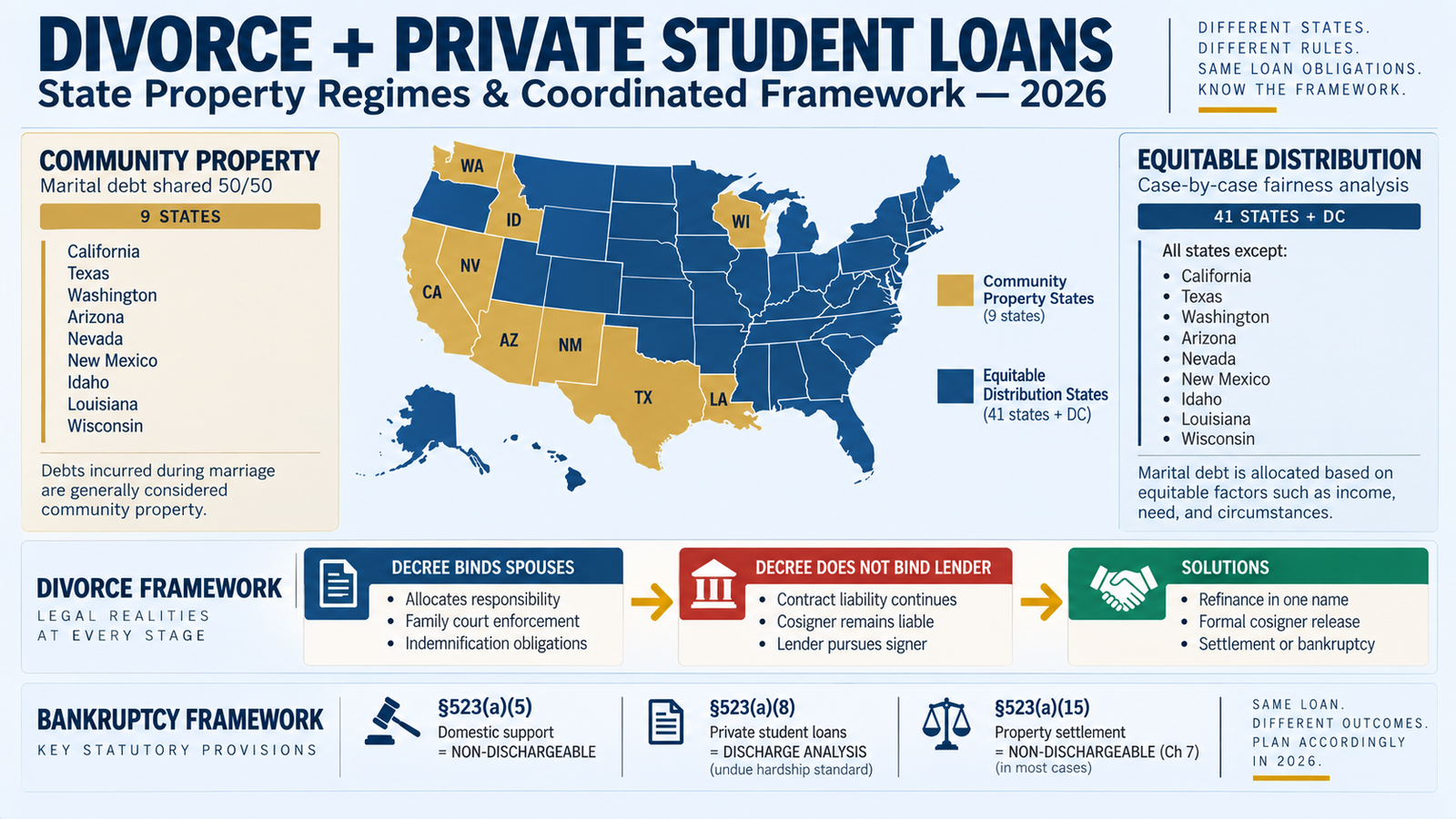
Divorce and private student loan analysis operates through five layers: (1) state property regime — 9 community property states (California, Texas, Washington, Arizona, Nevada, New Mexico, Idaho, Louisiana, Wisconsin) generally treat debt incurred during marriage as community property shared 50/50; 41 equitable distribution states plus DC apply case-by-case fairness analysis with the borrower typically retaining primary responsibility; (2) cosigner spouse liability — a spouse who cosigned the loan remains contractually liable regardless of divorce decree provisions; the decree can allocate responsibility between spouses but cannot release the cosigner from contract obligation to the lender; (3) decree versus creditor rights distinction — divorce decrees bind ex-spouses (creating obligations enforceable in family court) but do NOT bind private student loan creditors (who remain able to pursue whichever spouse is contractually liable); (4) refinance analysis — divorced borrower transitioning from dual-income household to single-income faces DTI and qualification challenges, particularly if new obligations (alimony, child support) reduce available income; (5) bankruptcy interaction — private student loans dischargeable under §523(a)(8) analysis (Day 18); domestic support obligations non-dischargeable under §523(a)(5); property settlement obligations non-dischargeable in Ch 7 under §523(a)(15) but variable treatment in Ch 13.
Read the complete framework below.
In this article:
The divorce and private student loan intersection
Why divorce creates distinct considerations for private student loan borrowers
Community property states versus equitable distribution states
Nine community property jurisdictions and 41 equitable distribution jurisdictions
Cosigner spouse continuing liability
Why a cosigner spouse remains liable regardless of divorce decree allocation
Divorce decree obligations versus creditor rights
Critical distinction: decree binds spouses, creditor pursues contractual borrower
Post-divorce refinance analysis
Dual-income to single-income transition and cosigner spouse removal
Alimony and child support impact on ability to pay
DTI calculation with support obligations and priority ordering
Bankruptcy analysis during and after divorce
§523(a)(5), §523(a)(8), §523(a)(15) coordination and timing
Settlement negotiation during and after divorce
Coordination of debt settlement with divorce proceedings
Common divorce and student loan myths and frequently asked questions
Widespread misconceptions and practical defensive questions
The divorce and private student loan intersection
Divorce affects private student loan analysis across multiple dimensions that require coordinated attention. Unlike straightforward personal debt matters, divorce introduces state family law considerations, dual-liability questions when a spouse cosigned, and the critical distinction between divorce decree obligations (binding on spouses in family court) versus creditor rights (binding the borrower who signed the original loan contract).
Loans incurred before marriage
Private student loans incurred by one spouse before marriage are generally treated as the separate debt of the borrowing spouse regardless of state property regime. The non-borrowing spouse has no legal liability for these loans absent voluntary cosigner status. In divorce, the borrowing spouse retains responsibility for pre-marital loans. Complications arise when marital funds have been used to make payments on pre-marital loans — this may create reimbursement claims or characterization questions in specific jurisdictions but generally does not convert the underlying debt into marital debt.
Loans incurred during marriage
Loans incurred during marriage are where state property law becomes determinative. In community property states, debt incurred during marriage is generally community debt shared between spouses regardless of which spouse signed the loan documents. In equitable distribution states, loans incurred during marriage are typically the responsibility of the borrowing spouse, though courts may consider the loan in overall property division analysis. The distinction matters substantially for divorce outcomes — the same loan may be treated very differently depending on state.
Cosigner spouse loans
When one spouse cosigned the other’s private student loan, both spouses have direct contractual liability to the lender regardless of state property regime and regardless of divorce decree provisions. The cosigner spouse remains liable until the loan is paid, refinanced without the cosigner, or discharged through bankruptcy. Divorce decree provisions allocating the debt to the borrowing spouse can create indemnification obligations enforceable in family court but do NOT release the cosigner from lender contract liability.
Practical timing of divorce and student loans
The practical timing question — should the borrower resolve private student loan matters before, during, or after divorce — depends on: current loan status (current, delinquent, in collection, judgment entered); financial position of each spouse; state property regime; whether spouse is a cosigner; potential bankruptcy considerations; and settlement negotiation opportunities. Different timing produces different outcomes. Coordination between family law counsel and consulting resources familiar with private student loan defensive framework produces better outcomes than treating the two matters as separate.
Community property states versus equitable distribution states
The most fundamental divorce and private student loan question — how loans acquired during marriage are classified for divorce purposes — depends on state property regime. The United States has two primary systems that produce materially different outcomes for identical loan situations.
Community property states framework
Nine states apply community property principles: California under Cal. Family Code §§2620-2626; Texas under Tex. Family Code §§3.001-3.410; Washington under RCW 26.16; Arizona under A.R.S. §25-211 et seq.; Nevada under NRS 123; New Mexico under N.M. Stat. §40-3-8; Idaho under Idaho Code §32-903; Louisiana under La. Civ. Code Art. 2334; Wisconsin under Wis. Stat. §766 (marital property act). In community property states, property and debt acquired during marriage is generally community property/community debt owned or owed equally by both spouses regardless of whose name is on the title or contract. Private student loans incurred during marriage may be classified as community debt shared between spouses, though specific state doctrines create variations (California’s characterization of student loan debt has specific case law addressing when educational debt benefits the community vs. only the borrower).
Equitable distribution states framework
Forty-one states plus the District of Columbia apply equitable distribution principles, dividing marital property and debt on a fairness basis rather than strict 50/50 rule. Courts consider factors including: length of marriage; each spouse’s contribution to acquiring the debt; each spouse’s earning capacity; each spouse’s non-monetary contributions to the marriage; each spouse’s health and age; each spouse’s future economic circumstances. Private student loans in equitable distribution states are typically the responsibility of the borrowing spouse, though courts may consider the loan in overall property division. The borrowing spouse’s argument that educational debt should be allocated only to the borrower who benefits from the education often prevails.
California specific analysis
California, the largest community property state, has specific rules for student loans under Cal. Family Code §2641. Student loans incurred during marriage that “substantially benefits the community” (typically demonstrated by post-education earnings during marriage) may be treated differently than loans where the education has not substantially benefited the community. The community can be reimbursed for community funds used to make payments during marriage on the borrower’s student loans, and the borrower may be assigned responsibility for the debt as the primary beneficiary of the education. This nuanced framework requires California-specific analysis.
Texas specific analysis
Texas follows community property principles under Tex. Family Code but with characterization rules that distinguish separate property/debt from community property/debt. Student loans incurred during marriage are generally community debt, though the education primarily benefits the borrowing spouse. Texas courts may assign responsibility based on which spouse primarily benefits from the education and each spouse’s ability to service the debt. Additionally, Texas’s constitutional wage garnishment prohibition (see Day 1 Texas and Day 22 wage garnishment) applies regardless of divorce status — an important defensive framework element for Texas residents.
Coordinated state analysis
Coordinated state analysis is essential when: spouses reside in different states (jurisdictional and choice of law analysis); marriage was in one state and divorce in another (which state’s law applies); assets are located across multiple states. Consultation with family law counsel licensed in the applicable state is essential — state family law varies substantially and general framework information cannot substitute for state-specific analysis.
Cosigner spouse continuing liability
Contract liability survives divorce
When a spouse cosigned the borrower’s private student loan, the cosigner spouse has direct contractual liability to the lender under joint and several liability principles. This liability is independent of marital status — it began when the cosigner signed the loan documents and continues until the loan is paid in full, refinanced without the cosigner, discharged in bankruptcy, or released through specific lender cosigner release procedure. Divorce does not terminate this liability. The lender’s contract is with both borrower and cosigner as separate liable parties, and the lender retains full rights against both regardless of what the borrowing couple agrees between themselves.
Practical exposure for cosigner spouse post-divorce
A cosigner ex-spouse faces the same exposure as any other cosigner: (1) if the primary borrower stops paying, the lender can collect from the cosigner; (2) credit reporting to the cosigner’s credit file continues (see Day 19 for detailed cosigner framework); (3) potential wage garnishment if the debt goes to judgment and the cosigner is a garnishable state resident; (4) bank account levy exposure on the cosigner’s accounts; (5) potential lawsuit and judgment naming the cosigner. All the defensive frameworks in Days 22-24 (wage garnishment, bank levy, judgment enforcement) apply to the cosigner ex-spouse if the lender pursues collection against them.
Cosigner release strategies
As discussed in Day 19, cosigner release strategies include: (1) formal cosigner release through the lender’s specific program (available at some lenders like Sallie Mae after 12 consecutive on-time payments plus other criteria; NOT available at some lenders like SoFi where cosigner is permanent absent refinance); (2) refinance in the borrower’s name only, eliminating the cosigner entirely; (3) payoff of the loan through settlement or lump sum; (4) bankruptcy discharge of the loan (rendering the cosigner’s liability moot if the discharge is comprehensive). For divorcing couples where one spouse is cosigner, active cosigner release strategy should be part of divorce planning — leaving cosigner liability in place after divorce creates ongoing exposure that can affect the cosigner ex-spouse for years or decades.
Divorce decree indemnification provisions
Divorce decrees typically include indemnification provisions requiring one spouse to hold the other harmless from specific debts. If the divorce decree assigns the private student loan to the borrower with an indemnification obligation to hold the cosigner ex-spouse harmless, this provides family court remedy for the cosigner ex-spouse if they are pursued by the lender. However, the indemnification does NOT prevent the lender from pursuing the cosigner directly — the cosigner must pay the lender and then seek reimbursement from the borrower ex-spouse under the decree. In practice, this indemnification is only as valuable as the borrower ex-spouse’s ability and willingness to reimburse.
Divorce decree obligations versus creditor rights
The most commonly misunderstood aspect of divorce and private student loan analysis is the fundamental distinction between what the divorce decree can accomplish (allocating responsibility between spouses in family court) versus what remains a creditor rights question (the lender’s contractual claim against the party who signed the loan documents). Understanding this distinction is essential to setting realistic expectations for divorce outcomes.
What the divorce decree can do
A divorce decree operates in family court and binds the ex-spouses to each other. The decree can: allocate responsibility for specific debts between spouses; require one spouse to pay a specific debt with an indemnification obligation to the other; require one spouse to refinance debt into their name only; establish support obligations (alimony, child support); divide marital property; establish enforcement mechanisms in family court for these obligations. All of these are enforceable in family court through contempt proceedings, wage attachment for support, and other family court remedies.
What the divorce decree cannot do
The divorce decree cannot: modify the underlying loan contract between borrower/cosigner and lender; release a cosigner from lender liability; prevent the lender from pursuing whichever spouse is contractually liable; discharge the debt entirely; change credit reporting obligations to the CRAs; alter any of the defensive frameworks (statute of limitations, chain of assignment, judgment enforcement rules). The lender was not a party to the divorce proceedings and is not bound by the decree — the lender’s contract rights are unaffected by whatever the divorcing spouses agree to.
Practical implications of the distinction
Practical implications include: (1) if the decree assigns the loan to the borrower but the cosigner ex-spouse is a cosigner, the lender can still pursue the cosigner ex-spouse if the borrower stops paying — the cosigner ex-spouse’s remedy is family court indemnification against the borrower, not defense against the lender; (2) if the decree requires the borrower to refinance to remove the cosigner but the borrower cannot qualify, the cosigner ex-spouse remains liable indefinitely — the decree obligation to refinance cannot force the lender to accept a refinance that doesn’t qualify; (3) if both spouses have private student loans and the decree assigns each spouse’s loans to themselves, that assignment does not change the underlying separate liability that already existed (each spouse was liable for their own loan regardless); (4) if a spouse cosigned during marriage and the couple divorces, the cosigner spouse remains liable regardless of what the decree provides.
Coordinating decree provisions with creditor reality
Effective divorce planning coordinates decree provisions with creditor reality: (1) obtain lender-provided cosigner release before or during divorce where possible; (2) refinance to eliminate cosigner liability before finalizing divorce; (3) if refinance is not possible, structure decree indemnification with specific remedies; (4) consider settlement negotiation to pay off loans during divorce to eliminate future exposure; (5) coordinate with bankruptcy analysis if discharge is potentially available. Working through both family law counsel and private student loan consulting resources produces better coordinated outcomes than treating the two matters separately.
Post-divorce refinance analysis
Dual-income to single-income transition
Divorce transforms a dual-income household into two single-income households, materially affecting refinance qualification analysis. Post-divorce refinance qualification uses only the applying borrower’s income — the ex-spouse’s income no longer supports qualification even if the loans were previously refinanced based on combined income. If the original loan required cosigner qualification due to insufficient borrower income, single-income post-divorce may not qualify for refinance to remove the cosigner. This creates the scenario where cosigner liability may continue indefinitely because refinance-without-cosigner isn’t achievable.
Cosigner ex-spouse removal through refinance
Refinance in the borrower’s name only is often the cleanest way to remove a cosigner ex-spouse from ongoing liability. Requirements typically include: adequate borrower income to qualify independently (2-year documentation for self-employed, W-2 for employees); acceptable credit profile; debt-to-income ratio within lender parameters (typically under 40-50%); no significant delinquencies on the loan being refinanced. Post-divorce refinance may be complicated by: reduced income from single-income transition; additional obligations (alimony, child support) reducing DTI; credit impact from any divorce-related financial stress; and the general difficulty of qualifying for refinance when the loans were originally cosigned because independent qualification was insufficient.
Alimony and child support in refinance analysis
Alimony and child support obligations affect refinance analysis in specific ways: Payer perspective — support obligations reduce available income for debt service and increase DTI, potentially disqualifying refinance applications; Recipient perspective — some lenders accept alimony and child support as income for qualification purposes (typically requiring documentation of consistent history and continued obligation for adequate duration — often 3+ years remaining); Cosigner release timing — support obligation stability may need to be established before qualification improves; Refinance rate impact — DTI changes from support obligations may affect rate tier assignment.
Refinance lender considerations for divorced borrowers
Different refinance lenders have varying approaches to divorced borrower situations. Documentation should include: recent divorce decree; support order details; any modification history; asset division outcomes. Lenders may adjust underwriting based on the specific divorce situation. Working with lenders familiar with post-divorce refinance (some lenders more accommodating than others) can produce better outcomes. Consider timing refinance applications after divorce is fully finalized and initial post-divorce financial patterns are established, rather than during pending divorce proceedings.
Related resources
Complete cosigner framework including cosigner release strategies particularly relevant for divorcing couples with cosigner spouse arrangements.
Private Student Loan Refinance Risk Analysis 2026
Refinance framework — critical for post-divorce single-income qualification analysis and cosigner ex-spouse removal strategy.
Private Student Loan Bankruptcy Discharge Guide 2026
§523(a)(8) discharge framework — coordinated analysis with §523(a)(5) domestic support and §523(a)(15) property settlement non-dischargeability provisions.
Alimony and child support impact on ability to pay
Support obligation priority
Alimony and child support obligations have priority over most other debts in several important respects: (1) family court can enforce support obligations through wage attachment, license suspension, contempt proceedings, and other remedies not available to typical creditors; (2) support obligations survive bankruptcy under 11 U.S.C. §523(a)(5); (3) support obligations are among the debts that reduce disposable income for other creditor purposes; (4) failure to pay support has additional legal consequences beyond typical debt default (contempt, criminal enforcement in some cases). The priority of support obligations affects the private student loan analysis by reducing available resources for private student loan service.
DTI calculation with support obligations
For DTI calculation purposes, support obligations affect both sides: Support payer — alimony and child support payments are treated as debt obligations reducing disposable income; a payer with $60,000 income paying $1,500/month combined support (18,000/year) has effective disposable income of $42,000 for other debt service; Support recipient — alimony and child support may be counted as income for lender qualification purposes if properly documented (typically requires 3+ years remaining on obligation and consistent payment history). This dual treatment affects both spouses’ post-divorce refinance and hardship program qualification differently.
Enforcement dynamics between support and other debts
When multiple creditors compete for the same debtor’s limited resources, support obligations typically win the priority contest: (1) child support has specific wage garnishment framework that can exceed the 25% CCPA cap (up to 50% or 60% depending on family status per 15 U.S.C. §1673(b)); (2) family court remedies are more aggressive than typical creditor remedies (contempt, license suspension); (3) support obligations are non-dischargeable in bankruptcy. Private student loan creditors evaluating collection prospects consider the priority position of support obligations — a borrower whose disposable income is largely committed to support may face limited collection potential, supporting settlement discount opportunities.
Hardship program applications post-divorce
Hardship program applications post-divorce should document the specific financial impact of divorce: reduced household income; increased housing costs (from shared to separate households); support obligations; potentially reduced retirement savings capacity; and any specific hardship factors. Documentation should include divorce decree, support order, updated income analysis, and monthly expense breakdown reflecting the post-divorce financial reality. Hardship programs from major servicers (Sallie Mae, Citizens, SoFi, Earnest, Ascent, Discover/Firstmark per Day 25) accept post-divorce applications with appropriate documentation.
Bankruptcy analysis during and after divorce
§523(a)(5) domestic support non-dischargeability
Under 11 U.S.C. §523(a)(5), domestic support obligations — including alimony, child support, and similar family court-ordered support — are non-dischargeable in bankruptcy. This applies to both Chapter 7 and Chapter 13. Filing bankruptcy does not eliminate ongoing or past-due support obligations. The automatic stay under §362 does NOT apply to actions to establish or modify domestic support orders or to collect support from property not part of the bankruptcy estate. Support obligations continue and remain enforceable through bankruptcy proceedings.
§523(a)(15) property settlement non-dischargeability
Under 11 U.S.C. §523(a)(15), debts to a spouse, former spouse, or child of the debtor incurred in the course of divorce or separation or in connection with a separation agreement or divorce decree are non-dischargeable in Chapter 7. This includes property settlement obligations, hold-harmless (indemnification) obligations, and debts assumed by one spouse in the divorce that the other spouse retains liability for. In Chapter 13, these obligations may be treated differently — Chapter 13 discharge under 11 U.S.C. §1328 excludes §523(a)(5) obligations but historically has treated §523(a)(15) obligations differently, allowing potential discharge in successful Chapter 13 cases (though this varies by circumstance and legal analysis).
Private student loan §523(a)(8) discharge coordination
Private student loans remain subject to §523(a)(8) discharge analysis (see Day 18) regardless of divorce status. Loans qualifying as “qualified education loan” or “educational benefit overpayment or loan” require undue hardship showing through adversary proceeding (Brunner or totality of circumstances). Loans NOT qualifying under these definitions (many private lender loans per Homaidan analysis) are dischargeable without undue hardship. Post-divorce circumstances (reduced income, support obligations, altered household economics) may support undue hardship showing in circuits where that showing is required.
Timing of divorce and bankruptcy
Timing coordination between divorce and bankruptcy affects outcomes: (1) filing bankruptcy before divorce may allow for coordinated discharge planning across both spouses’ debts; (2) filing bankruptcy after divorce allows post-divorce economic circumstances to support hardship showings and separates each spouse’s bankruptcy analysis; (3) simultaneous bankruptcy and divorce is complex — the bankruptcy automatic stay may complicate divorce property division; (4) exemption analysis differs based on marital status and household composition. Bankruptcy counsel coordinating with divorce counsel produces better outcomes than sequential uncoordinated proceedings.
Settlement negotiation during and after divorce
Settlement during divorce proceedings
Negotiating private student loan settlement during divorce proceedings can produce coordinated benefits: (1) resolving the debt before final divorce decree simplifies the property division analysis; (2) eliminating cosigner ex-spouse liability from settlement rather than requiring post-divorce refinance; (3) using marital assets or joint funds for settlement lump sum before division; (4) coordinating tax implications of §108 exclusions with divorce filing status considerations; (5) reducing total marital debt improves post-divorce financial position for both parties. Divorce counsel should coordinate with private student loan consulting resources for optimal integrated planning.
Settlement after divorce finalization
Post-divorce settlement operates in the specific post-divorce financial reality: single-income analysis; support obligations affecting ability to pay; specific spouse responsibility per decree provisions; individual bankruptcy analysis. Settlement leverage post-divorce may include: reduced ability to pay from single-income transition; support obligation priority reducing available resources; potential bankruptcy alternative. Creditors evaluating post-divorce settlement often accept larger discounts recognizing the material change in the borrower’s economic position.
Coordination with cosigner ex-spouse
Settlement negotiation when a cosigner ex-spouse is involved requires additional coordination: (1) the settlement must resolve the debt for both borrower and cosigner (or the cosigner remains liable if settlement is only with borrower); (2) both parties’ consent may be required for settlement acceptance; (3) release of cosigner liability should be documented in settlement agreement; (4) family court decree indemnification obligations continue independent of settlement; (5) tax implications under §108 may affect both parties differently. Even after divorce, communication between ex-spouses may be necessary for effective settlement of cosigned debts.
Post-settlement tax implications
As discussed in Day 21, forgiven debt is reported on Form 1099-C as taxable income. For divorced or divorcing borrowers, additional considerations apply: (1) which ex-spouse receives the 1099-C affects tax liability; (2) IRC §108 insolvency exclusion analysis is based on individual (not household) circumstances post-divorce; (3) filing status (single vs married filing separately vs joint if still married in tax year) affects tax treatment; (4) support obligations continue regardless of debt settlement outcomes. Coordination with a CPA experienced in divorce tax matters is essential for planning around settlement.
Common divorce and student loan myths and misconceptions
Myth 1
“The divorce decree can force my ex-spouse to take responsibility for our student loans”
Reality: The divorce decree can allocate responsibility between ex-spouses and create indemnification obligations enforceable in family court. However, the decree does NOT bind the lender or modify the underlying loan contract. If both spouses are contractually liable (as borrower and cosigner), both remain liable to the lender regardless of decree allocation. The lender can pursue whichever spouse is liable, and the assigned spouse’s failure to pay creates family court remedies but does not shield the other spouse from lender pursuit. Effective divorce planning requires refinance or settlement to actually change lender contract liability.
Myth 2
“I’m not liable for my ex-spouse’s student loans if I didn’t sign them”
Reality: In non-community property states, this is generally correct — spouses who did not sign or cosign the loan have no direct liability. In community property states (California, Texas, Washington, Arizona, Nevada, New Mexico, Idaho, Louisiana, Wisconsin), loans incurred during marriage may be treated as community debt subject to specific state law analysis, potentially creating shared responsibility even without signing. The distinction between borrower liability, cosigner liability, and community property exposure requires state-specific analysis with family law counsel.
Myth 3
“Bankruptcy will discharge both my student loans and my divorce obligations”
Reality: Bankruptcy discharge of private student loans depends on §523(a)(8) analysis (see Day 18). Divorce-related obligations have specific non-dischargeability provisions: domestic support (alimony, child support) is non-dischargeable under §523(a)(5) in both Chapter 7 and Chapter 13; property settlement obligations are non-dischargeable in Chapter 7 under §523(a)(15) but may be treated differently in Chapter 13. Bankruptcy is not a comprehensive solution to divorce financial obligations — support and many property settlement obligations survive bankruptcy.
Myth 4
“Refinance will solve the cosigner ex-spouse problem”
Reality: Refinance to remove a cosigner ex-spouse works only if the borrower qualifies independently on single-income basis. Post-divorce single-income qualification is often more difficult than the original dual-income qualification — if the original loan required cosigner because independent qualification was insufficient, single-income refinance may not be achievable. Alternatives include cosigner release programs at specific lenders (Sallie Mae has one; SoFi does not), settlement to eliminate the debt entirely, or bankruptcy discharge if the loan qualifies for §523(a)(8) treatment.
Frequently asked questions about divorce and private student loans
1. Am I responsible for my spouse’s private student loans if we divorce?
Depends on: (1) whether you cosigned — if you cosigned, you remain liable regardless of divorce; (2) state property regime — in community property states (California, Texas, Washington, Arizona, Nevada, New Mexico, Idaho, Louisiana, Wisconsin), loans incurred during marriage may be community debt shared between spouses; in equitable distribution states (41 states plus DC), loans typically remain the borrower’s responsibility; (3) when loans were incurred (before vs during marriage); (4) how divorce decree allocates responsibility (though this binds spouses, not the lender). State-specific family law analysis is essential.
2. If the divorce decree says my ex is responsible for the loan, why is the lender still coming after me?
The divorce decree binds ex-spouses (creating family court obligations) but does NOT bind the lender or modify the underlying loan contract. If you signed as borrower or cosigner, the lender retains full contract rights against you regardless of decree allocation. Your remedy is family court indemnification against your ex-spouse under the decree — but you must first pay the lender if pursued, then seek reimbursement. This is why effective divorce planning includes refinance or settlement to actually change lender contract liability, not just decree allocation.
3. Can I remove my ex-spouse as cosigner after divorce?
Options include: (1) formal cosigner release through the lender’s specific program (available at some lenders like Sallie Mae after 12 consecutive on-time payments plus criteria; NOT available at lenders like SoFi); (2) refinance in your name only, eliminating the cosigner (requires independent qualification on single income); (3) payoff through settlement or lump sum. Post-divorce single-income refinance qualification is often difficult if the original loan required cosigner because independent qualification was insufficient. Active planning for cosigner removal should be part of divorce preparation.
4. How does alimony or child support affect my private student loan refinance qualification?
Support obligations affect DTI calculation on both sides. Support payer: alimony and child support are treated as debt obligations reducing available income for refinance qualification. Support recipient: some lenders accept alimony and child support as income if documented with consistent history and adequate remaining duration (typically 3+ years). Both spouses should consider timing refinance applications after divorce is finalized and post-divorce financial patterns are established. Some lenders more accommodating of post-divorce situations than others.
5. Should I file bankruptcy before or after divorce?
Timing depends on specific circumstances. Filing bankruptcy before divorce may allow coordinated discharge planning across both spouses’ debts and coordinated exemption analysis. Filing after divorce separates each spouse’s bankruptcy analysis and reflects post-divorce economic circumstances (potentially supporting undue hardship showings for §523(a)(8) analysis). Simultaneous bankruptcy and divorce is complex — the bankruptcy automatic stay may complicate divorce property division. Bankruptcy counsel coordinating with divorce counsel produces better outcomes than sequential uncoordinated proceedings. Remember: domestic support obligations are non-dischargeable under §523(a)(5) regardless of timing.
6. In California, how are student loans treated in divorce under community property law?
California has specific rules under Cal. Family Code §2641. Student loans incurred during marriage that “substantially benefits the community” (typically demonstrated by post-education earnings during marriage) may be treated differently than loans where the education has not substantially benefited the community. The community can be reimbursed for community funds used to make payments during marriage on the borrower’s student loans. The borrower may be assigned responsibility as the primary beneficiary of the education. California-specific analysis with family law counsel licensed in California is essential — the general community property rule does not fully capture California’s nuanced student loan framework.
7. Can I negotiate settlement of a joint private student loan during divorce?
Yes, and settlement during divorce may produce coordinated benefits: (1) resolving debt before final decree simplifies property division; (2) eliminating cosigner ex-spouse liability from settlement rather than requiring post-divorce refinance; (3) using marital assets or joint funds for lump sum before division; (4) coordinating tax implications with divorce filing status. Both parties’ consent may be required for settlement. Coordination between divorce counsel and private student loan consulting resources produces better integrated planning than treating matters separately.
Divorcing with Private Student Loan Debt?
Free specialist review coordinating divorce and student loan analysis.
State property regime analysis (community property vs equitable distribution), cosigner ex-spouse liability review, refinance qualification analysis with post-divorce income, and coordinated defensive framework across the intersection of divorce and private student loan matters. Get a free eligibility review with a partner provider familiar with divorce and debt coordination.
Get a free eligibility review →
5-minute review · No obligation · Zero upfront fees
About the author
Henry Silva — Private Student Loan Debt Specialist
10+ years experience analyzing private student loan relief frameworks at the intersection of divorce and creditor rights: community property state analysis (California Cal. Family Code §§2620-2626 with §2641 educational debt provisions, Texas Tex. Family Code §§3.001-3.410, Washington RCW 26.16, Arizona A.R.S. §25-211, Nevada NRS 123, New Mexico N.M. Stat. §40-3-8, Idaho Code §32-903, Louisiana Civ. Code Art. 2334, Wisconsin Stat. §766), equitable distribution state analysis, cosigner spouse continuing contract liability, divorce decree obligations versus creditor rights distinction, refinance qualification with post-divorce single-income analysis, alimony and child support DTI treatment, bankruptcy coordination under 11 U.S.C. §523(a)(5) domestic support and §523(a)(15) property settlement non-dischargeability provisions, and integrated settlement negotiation strategies. Henry works with Private Student Relief’s partner provider network to review divorce-related private student loan scenarios coordinating family law considerations with creditor rights analysis.
Legal Disclaimer and Sources
This article is provided for informational purposes only and does not constitute legal, tax, or financial advice. Private Student Relief is a consulting and matching organization operated by Joco (555 Anton Blvd, Suite 368, Costa Mesa, CA 92626) — not a law firm, debt settlement company, debt consolidation company, or loan provider. Debt validation services are performed by an attorney-backed partner provider (Panamerican Consulting LLC, Las Vegas, NV) under independent business credentials. Ratings, BBB accreditation, and AADR membership referenced on the PSR website belong to the partner provider. Individual results vary based on state property regime, marital status, cosigner arrangements, support obligations, asset structure, and specific loan characteristics. Not available in South Carolina or Mississippi.
Community property state statutes: California Cal. Family Code §§2620-2626 (community property/debt), §2641 (educational debt specific provisions); Texas Tex. Family Code §§3.001-3.410 (community/separate property characterization); Washington RCW 26.16 (community property act); Arizona A.R.S. §25-211 et seq.; Nevada NRS 123 (community property act); New Mexico N.M. Stat. §40-3-8; Idaho Code §32-903; Louisiana La. Civ. Code Art. 2334; Wisconsin Wis. Stat. §766 (marital property act). Equitable distribution: 41 states plus DC apply case-by-case fairness analysis under state-specific family law statutes and case law.
Bankruptcy Code references: 11 U.S.C. §523(a)(5) (domestic support obligations non-dischargeable in Chapter 7 and Chapter 13); 11 U.S.C. §523(a)(8) (student loan discharge exceptions requiring undue hardship analysis under Brunner or totality of circumstances depending on circuit — see Day 18 for detailed framework); 11 U.S.C. §523(a)(15) (property settlement obligations non-dischargeable in Chapter 7, treated differently in Chapter 13 per §1328 discharge); 11 U.S.C. §362 (automatic stay with §362(b)(2) exceptions for domestic support proceedings); 15 U.S.C. §1673(b) (CCPA wage garnishment cap increased for support obligations to 50% or 60% depending on family status).
Divorce and private student loan analysis requires coordination between family law counsel in the applicable state (particularly for state property regime analysis and decree provision drafting) and consulting resources familiar with creditor rights framework and private student loan defensive analysis. This article provides general framework information; specific decree provisions, refinance qualification analysis, hardship program applications, bankruptcy chapter selection, and settlement negotiations must be evaluated for each borrower’s individual situation, state of residence, marital and cosigner status, and specific circumstances. Last reviewed: September 2026.