

Informational content only. Not legal, tax, or financial advice. Private Student Relief is a consulting organization, not a law firm. Debt validation services are executed by an attorney-backed partner provider. Prenuptial and postnuptial agreements require case-by-case drafting by family law counsel licensed in the applicable state to ensure enforceability under state-specific requirements. Last reviewed: September 2026.
Written by Henry Silva
Private Student Loan Debt Specialist · 10+ years experience analyzing private student loan planning frameworks in marriage and prenuptial contexts: Uniform Premarital Agreement Act (UPAA) enforceability requirements adopted in 28+ states, Uniform Premarital and Marital Agreements Act (UPMAA) updated framework in Colorado/North Dakota/other adopting states, state-specific prenuptial statutes with community property (California Cal. Family Code §1615, Texas Tex. Family Code §4.006) and equitable distribution variations, full disclosure requirements, voluntariness requirements, unconscionability doctrine, postnuptial agreements for existing debt allocation, joint refinance qualification with combined household income, and coordination between family law planning and private student loan defensive framework. Last reviewed: September 2026.
Marriage creates specific planning opportunities and considerations for private student loan borrowers: pre-marital disclosure of debt establishes the foundation for spousal understanding, prenuptial agreements can allocate responsibility for existing and future student loan debt (subject to state-specific enforceability requirements), joint refinance with combined household income may improve qualification and rate outcomes, and coordinated financial planning throughout marriage produces better long-term outcomes. Understanding what prenups can and cannot accomplish, alongside the interaction between marriage and creditor rights, is essential to effective pre-marital and marital planning. This guide walks through the complete marriage, prenup, and private student loan framework.
Quick Answer
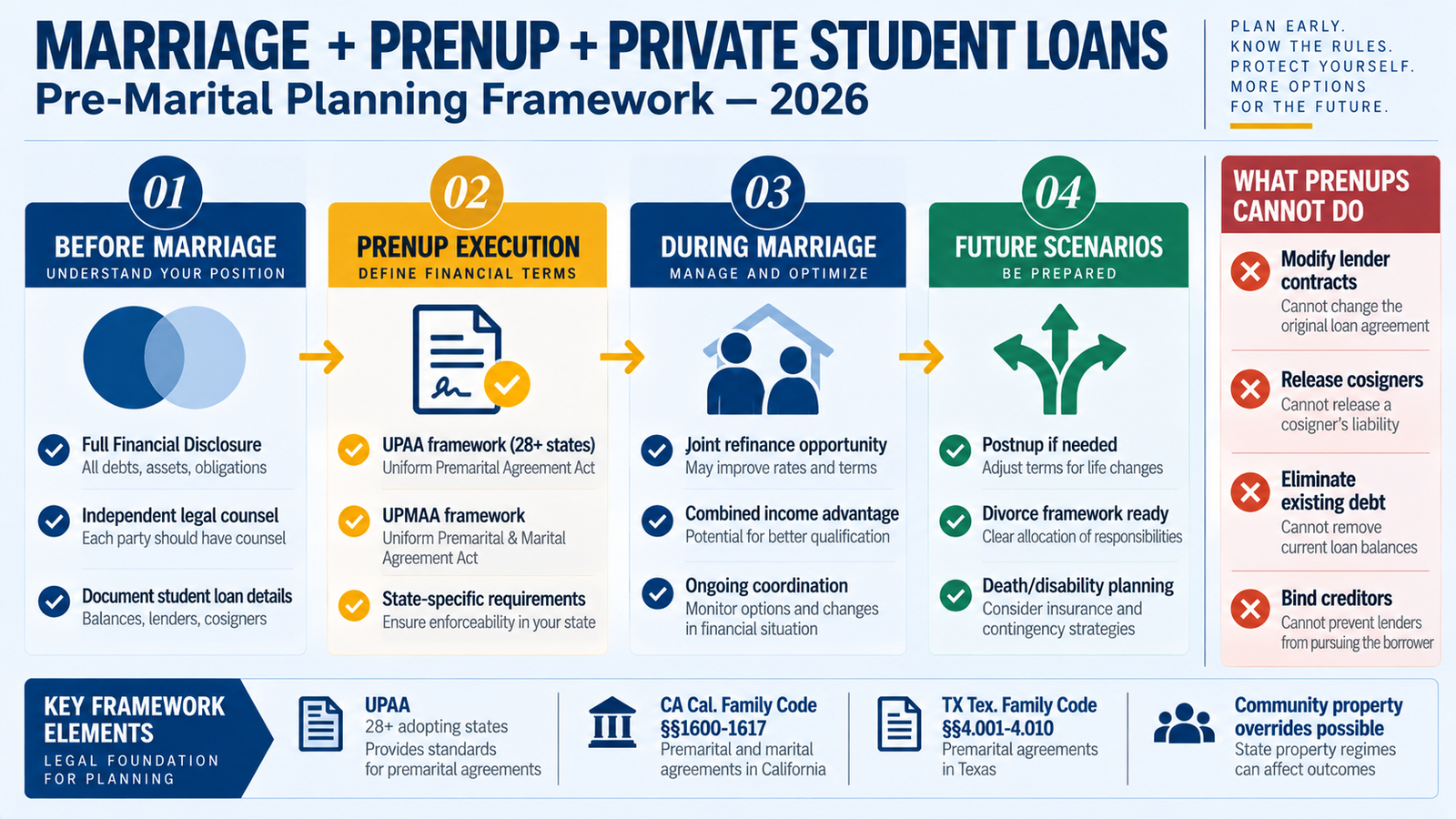
Marriage, prenup, and private student loan planning operates through five layers: (1) pre-marital disclosure — both prospective spouses should exchange complete financial disclosure including all student loan debt (balances, servicers, cosigner status, payment history) as the foundation for informed decision-making and prenup enforceability if applicable; (2) prenuptial agreement framework — the Uniform Premarital Agreement Act (UPAA) adopted in 28+ states establishes enforceability requirements including voluntary execution, full disclosure, and non-unconscionability; UPAA updated versions (UPMAA — Uniform Premarital and Marital Agreements Act) adopted in some states extend framework to postnuptial agreements; (3) debt allocation clauses — prenups can allocate responsibility for pre-marital debt to the borrowing spouse and address treatment of future debt incurred during marriage; enforceability against creditors is limited but enforceability between spouses is generally strong for properly drafted agreements; (4) joint refinance opportunity — married couples with dual income may qualify for refinance rates and terms not available to single borrowers, and one spouse cosigning the other’s refinance leverages combined qualification; (5) state property regime interaction — in community property states (California, Texas, Washington, Arizona, Nevada, New Mexico, Idaho, Louisiana, Wisconsin), prenup provisions establishing separate character for pre-marital and future debt override the default community property analysis and are enforceable between spouses in divorce.
Read the complete framework below.
In this article:
Pre-marital financial disclosure
The foundation of informed decision-making and prenup enforceability
Prenuptial agreement framework (UPAA and UPMAA)
Uniform statutes, enforceability requirements, and state-specific variations
Debt allocation clauses in prenups
Pre-marital debt, future debt, and separate property character clauses
Community property state prenup interaction
How prenups modify default community property treatment of student loans
Postnuptial agreements for existing debt
Modifying financial arrangements after marriage with UPMAA framework
Prenup limitations against creditors
Why prenups bind spouses but not lenders — same distinction as divorce decrees
Joint refinance opportunity with combined income
Dual-income refinance advantages and spouse cosigner considerations
Coordinated marital financial planning
Long-term financial coordination with student loans as ongoing consideration
Common marriage and student loan myths and frequently asked questions
Widespread misconceptions and practical planning questions
Pre-marital financial disclosure
Complete pre-marital financial disclosure serves two essential functions: providing each prospective spouse with the information necessary for informed decision-making about the marriage, and establishing the disclosure foundation that supports prenuptial agreement enforceability under state law. For couples where at least one partner has significant private student loan debt, this disclosure is particularly important.
What should be disclosed
Complete pre-marital disclosure typically includes: Assets — bank accounts, investment accounts, retirement accounts, real property, business interests, valuable personal property; Debts — all outstanding obligations including student loans (federal AND private, with balances, servicers, payment status, cosigner information), credit card debt, auto loans, mortgages, personal loans, medical debt, tax obligations, business debt, personal guarantees on business obligations; Income — employment income, self-employment income, investment income, rental income, alimony/child support received; Obligations — support obligations from prior relationships, ongoing contractual obligations, potential legal exposures. The disclosure should be documented in writing with supporting documentation attached.
Specific private student loan disclosure elements
Complete private student loan disclosure should include: (1) list of all outstanding loans with servicer name (Sallie Mae, Nelnet, Firstmark Services, Aidvantage, MOHELA, etc.); (2) current balance and interest rate for each loan; (3) monthly payment obligation and payment history; (4) cosigner status and identity of any cosigner; (5) collection status if any loans are delinquent or in collection; (6) any judgments entered on any of the loans; (7) any bankruptcy history relating to the loans; (8) any hardship or forbearance programs currently active; (9) any pending settlement discussions or legal proceedings.
Why disclosure matters legally
Under UPAA §6 (and equivalent provisions in adopting states), a prenuptial agreement is not enforceable if the party against whom enforcement is sought proves: (1) the party did not execute the agreement voluntarily; OR (2) the agreement was unconscionable when executed and, before execution, the party was not provided a fair and reasonable disclosure of property or financial obligations of the other party; did not voluntarily waive right to disclosure; and did not have or reasonably could not have had adequate knowledge of the property or financial obligations. Failure to provide complete disclosure creates a foundation for future challenge to the agreement. For couples with student loan debt, incomplete disclosure of loan obligations may support later argument that the agreement is unenforceable.
Practical disclosure process
Effective pre-marital disclosure process typically includes: (1) each party independently prepares written financial statement with supporting documentation; (2) exchange of statements with adequate time for review before agreement execution (typically weeks or months, not days); (3) opportunity for each party to consult independent legal counsel about the disclosed information and any agreement provisions; (4) written acknowledgment by each party that disclosure was received and reviewed. This process supports both the informed decision-making function and the legal enforceability requirements for any prenuptial agreement.
Prenuptial agreement framework (UPAA and UPMAA)
Prenuptial agreements — contracts between prospective spouses executed before marriage that govern property, debt, and other financial matters — are enforceable in all 50 states subject to state-specific requirements. The Uniform Premarital Agreement Act (UPAA) and its updated version the Uniform Premarital and Marital Agreements Act (UPMAA) establish standardized frameworks in adopting states, while other states apply their own statutory or common law requirements.
UPAA framework and adopting states
The Uniform Premarital Agreement Act, promulgated by the Uniform Law Commission in 1983, has been adopted with variations by 28+ states including Arizona, Arkansas, California, Connecticut, Delaware, Hawaii, Idaho, Illinois, Indiana, Iowa, Kansas, Maine, Montana, Nebraska, Nevada, New Jersey, New Mexico, North Carolina, North Dakota, Oregon, Rhode Island, South Dakota, Texas, Utah, Virginia, and others. UPAA establishes: written agreement requirement; content that can be covered (property rights, spousal support subject to limits, other matters); enforcement requirements (voluntary execution, adequate disclosure); grounds for non-enforcement (voluntary execution failure, unconscionability with disclosure failure).
UPMAA framework and adopting states
The Uniform Premarital and Marital Agreements Act (UPMAA), promulgated in 2012, updates the UPAA framework and extends it to postnuptial (marital) agreements. UPMAA has been adopted in Colorado, North Dakota, and select other states with continued expansion. UPMAA adds: enhanced disclosure requirements; explicit voluntariness safeguards; independent legal counsel considerations; and consistent framework for both prenuptial and postnuptial agreements. States adopting UPMAA provide a more modern and clearer framework for both types of agreements.
Non-uniform state frameworks
States that have not adopted UPAA or UPMAA apply their own statutory frameworks: New York under DRL §236(B)(3); Florida under Fla. Stat. §61.079 (Florida Premarital Agreement Act); Pennsylvania under 23 Pa.C.S. §3106 (though PA has adopted UPAA principles through case law); Ohio under Ohio R.C. §3103.06 and case law; Michigan under MCL §557.28 and case law. These non-uniform frameworks generally require similar elements (writing, voluntariness, disclosure, non-unconscionability) but with state-specific variations that require state-specific analysis with family law counsel.
Enforceability requirements common across frameworks
Despite state variations, common enforceability requirements across most frameworks include: Written agreement — oral prenups are generally unenforceable; Signed by both parties — each party must sign the agreement; Voluntary execution — no duress, coercion, or undue influence; Adequate disclosure — full and fair disclosure of assets, debts, and financial obligations (unless expressly waived with adequate knowledge); Non-unconscionability — the agreement must not be unconscionable at time of execution and, in some states, at time of enforcement; Independent counsel — while not always strictly required, independent legal counsel for each party strengthens enforceability; Adequate time before marriage — agreements executed shortly before wedding (days) face heightened voluntariness scrutiny compared to agreements executed months in advance.
Grounds for non-enforcement
Common grounds for challenging prenup enforceability include: fraud or misrepresentation regarding assets or obligations; duress or coercion at time of execution (particularly agreements executed close to wedding date); lack of adequate disclosure of material financial information; unconscionability of specific provisions or agreement as whole; lack of independent counsel (in states requiring or strongly favoring it); improper execution formalities; violation of public policy (child support waivers, alimony waivers in some states); modification through subsequent conduct or agreement.
Debt allocation clauses in prenups
Prenuptial agreements can include specific provisions addressing student loan debt and other financial obligations. These clauses are the primary tool for allocating responsibility between spouses in ways that override or modify default state law treatment.
Pre-marital debt allocation
Prenups typically include a clause establishing that pre-marital debt of each party remains the separate obligation of that party. Example provision: “Each party shall retain sole and separate responsibility for all debts and obligations incurred by that party prior to the date of marriage, including without limitation student loan obligations, credit card debt, personal loans, and any other debt existing as of the date of marriage. The other party shall have no responsibility for such debt.” This clause is typically enforceable and reinforces the general rule that pre-marital debt is separate obligation, providing clarity and defense against later community characterization arguments in community property states.
Future debt allocation
Prenups can also address debt incurred during marriage. In community property states, this override default community property treatment: “Debts incurred by either party during marriage in the individual name of one party for that party’s benefit shall be the separate obligation of that party, notwithstanding the community property presumption otherwise applicable. This provision includes any student loans or other educational debt incurred by either party during marriage.” This clause preserves the individual character of debt that would otherwise be community property in the applicable states.
Payments from marital funds
Prenups often address the situation where marital or community funds are used to pay separate debt: “Payments made from community/marital funds toward the separate debt of either party shall not create any reimbursement obligation between the parties, notwithstanding any presumption or statutory rule to the contrary.” Alternative provision: “Payments made from community/marital funds toward the separate debt of either party shall create a reimbursement obligation from the benefiting party’s separate estate to the community/marital estate equal to the amount so paid.” The specific approach depends on the couple’s intentions and state law defaults.
Cosigner limitation clauses
Prenups can address cosigning arrangements between spouses: “Neither party shall cosign, guarantee, or otherwise become secondarily liable on any debt of the other party without express written consent of the party being asked to cosign. Any cosigner arrangement entered into shall include specific indemnification and repayment provisions between the parties.” This provision prevents casual cosigning that later creates joint liability issues, particularly relevant given the difficulty of removing cosigner status once established.
Cross-reference to divorce provisions
Prenups typically include divorce-related provisions addressing property division, spousal support, and debt allocation in the event of divorce. These provisions establish the framework that will govern if divorce occurs, providing predictability and reducing litigation exposure. Effective divorce provisions coordinate with the debt allocation clauses to establish consistent treatment of student loans and other debts if the marriage ends. See Day 29 for the divorce framework analysis that these prenup provisions can modify.
Community property state prenup interaction
In community property states, prenuptial agreements have particular importance because the default community property treatment of debt incurred during marriage may not match couples’ preferences. Prenups can modify these defaults through specific provisions.
California prenup framework
California adopted UPAA as Cal. Family Code §§1600-1617. Cal. Family Code §1615 establishes enforceability requirements including voluntary execution with independent counsel or waiver, adequate disclosure, and non-unconscionability. California case law (In re Marriage of Bonds 24 Cal.4th 1 (2000)) established heightened voluntariness scrutiny, subsequently addressed by 2002 statutory amendments requiring specific procedural safeguards for enforceability. California prenups can override community property treatment of student loan debt through specific separate property clauses coordinated with Cal. Family Code §2641 educational debt analysis discussed in Day 29.
Texas prenup framework
Texas adopted UPAA as Tex. Family Code §§4.001-4.010 (Chapter 4 — Premarital and Marital Property Agreements). Tex. Family Code §4.006 addresses enforceability requirements. Texas prenups can establish that certain property or debt remains separate property/debt notwithstanding community property presumptions. Texas prenup provisions preserving separate character of pre-marital or during-marriage student loan debt are generally enforceable when properly executed. Texas also allows postnuptial partition or exchange agreements under §4.102 that convert community property to separate property.
Other community property state considerations
Other community property states — Washington, Arizona, Nevada, New Mexico, Idaho, Louisiana, Wisconsin — each have specific prenup statutory frameworks. Washington under RCW 26.16.220; Arizona under A.R.S. §25-201 et seq. (adopted UPAA); Nevada under NRS 123A (adopted UPAA); New Mexico under N.M. Stat. §40-3A-1 et seq. (adopted UPAA); Idaho under Idaho Code §32-921 et seq. (adopted UPAA); Louisiana under La. Civ. Code Art. 2325-2331; Wisconsin under Wis. Stat. §766.58 (marital property agreements). Each requires state-specific analysis with family law counsel licensed in the applicable state.
Strategic value in community property states
Prenups have particular strategic value in community property states because they can prevent the automatic community characterization of debt that would otherwise apply. For a borrower with substantial pre-marital private student loan debt marrying in a community property state, prenup provisions ensure the debt remains separate obligation and prevents any argument that marital funds used for payments create community interest or reimbursement claims. Without a prenup, these questions default to state-specific case law analysis that may or may not produce the desired outcome.
Postnuptial agreements for existing debt
Postnuptial agreement framework
Postnuptial agreements (sometimes called “postnups” or “marital agreements”) are agreements between spouses executed after marriage that govern property, debt, and financial matters. Enforceability standards for postnups vary more substantially than prenups because of the fiduciary duty between married spouses that does not exist between prospective spouses. States adopting UPMAA (Colorado, North Dakota, others) apply consistent framework to both prenups and postnups. Non-UPMAA states apply various frameworks — some enforce postnups similarly to prenups with heightened disclosure standards; others apply more stringent enforcement requirements.
When postnups may be appropriate
Postnups may be appropriate when: (1) the couple did not execute a prenup before marriage but wants to establish financial framework now; (2) financial circumstances have materially changed (large debt incurred, business started, inheritance received); (3) the couple wants to address specific student loan issues that have emerged during marriage; (4) reconciliation after separation includes financial restructuring; (5) estate planning considerations require specific spousal arrangements. Each situation requires evaluation with family law counsel to assess enforceability and appropriateness in the specific state.
Consideration requirements
Postnuptial agreements face specific consideration challenges. Prenups have inherent consideration in the marriage itself — each party gives consideration to the other in the form of entering the marriage. Postnups executed after marriage require separate consideration because the marriage already exists. Some states accept mutual promises within the agreement as adequate consideration; other states require additional consideration such as property transfers or specific benefits exchanged. Consultation with counsel in the specific state is essential to ensure adequate consideration structure.
Postnup provisions for existing private student loan debt
Postnup provisions addressing existing private student loan debt might include: (1) allocation of responsibility between spouses for existing loans (particularly relevant if one spouse is cosigner); (2) reimbursement arrangements if marital funds are used for payments; (3) indemnification provisions if creditors pursue one spouse for the other’s loan; (4) plans for refinance or resolution of the loans; (5) coordination with divorce provisions if divorce occurs. Postnups can be particularly useful when private student loan issues emerge during marriage that were not addressed at time of prenup or if no prenup was executed.
Prenup limitations against creditors
Same distinction as divorce decrees
Prenuptial agreements have the same critical limitation as divorce decrees discussed in Day 29: they bind the spouses to each other but do NOT bind creditors. A prenup can allocate student loan responsibility between spouses, but the lender’s contractual claim against whoever signed the loan documents is unaffected. If both spouses signed as borrower and cosigner, both remain liable to the lender regardless of prenup provisions. The prenup provides remedy between the spouses through contract enforcement, but does not shield either spouse from the lender’s direct claim.
What prenups CAN accomplish with creditors
While prenups cannot modify existing lender contracts, they can affect creditor exposure indirectly: (1) preventing new cosigner arrangements limits future creditor exposure of the non-borrowing spouse; (2) in community property states, prenup provisions preserving separate character of debt may limit community property exposure to creditors of the borrowing spouse; (3) clear allocation of responsibility supports indemnification enforcement between spouses if creditor pursues the non-borrowing spouse; (4) documentation of separate property character supports arguments in later divorce or bankruptcy proceedings about which spouse should retain debt responsibility.
Community property creditor exposure
In community property states, creditors of one spouse may have community property exposure — the ability to reach community property assets to satisfy the debt even though only one spouse signed. State-specific analysis determines the exact scope of this exposure. Prenups establishing separate property character can limit this exposure prospectively but may not affect debts existing at time of marriage. Creditors’ rights against community property vary by state and by whether the debt was incurred for community benefit versus separate benefit of one spouse.
Practical limitations to keep in mind
Practical limitations to keep in mind include: (1) prenups cannot discharge existing debt; (2) prenups cannot release cosigners from lender contracts; (3) prenups cannot modify credit reporting obligations; (4) prenups cannot alter statute of limitations or judgment revival deadlines; (5) prenups cannot prevent creditors from filing suit or obtaining judgments. The prenup’s power is between the spouses, not between the spouses and their creditors. Effective planning combines prenup provisions with active loan management (refinance, cosigner release, settlement, or discharge when appropriate) to actually change creditor exposure.
Related resources
Divorce and Private Student Loans 2026
Complete divorce framework — community property vs equitable distribution, cosigner spouse liability, decree versus creditor rights, refinance qualification, bankruptcy coordination.
When Your Cosigner Refuses to Pay a Private Student Loan 2026
Cosigner framework — particularly relevant when marriage introduces potential spouse cosigner arrangements or existing cosigner situations.
Private Student Loan Refinance Risk Analysis 2026
Refinance framework — dual-income joint refinance opportunity for married couples and complete risk analysis before refinance decision.
Joint refinance opportunity with combined income
Combined household income advantages
Marriage creates specific refinance opportunities through combined household income analysis. A borrower whose individual income was insufficient for optimal refinance rates may qualify for better terms when spousal income supports the application through joint refinance or spouse cosigning arrangement. Combined household income also improves debt-to-income ratio calculation (if the spouse has minimal debt) and demonstrates household financial stability that lenders value.
Spouse cosigner considerations
Having a spouse cosign a refinance loan is a common approach but requires careful consideration of Day 19’s cosigner framework: (1) the cosigner spouse becomes fully liable for the loan under joint and several liability; (2) removing the cosigner later requires refinance in the borrower’s name only, which may not be achievable; (3) cosigner spouse credit is affected by the loan performance; (4) divorce complications discussed in Day 29 — cosigner spouse remains liable regardless of divorce decree provisions; (5) some lenders like SoFi do not offer any cosigner release program, making cosigner status permanent absent full refinance. The convenience of spouse cosigner for qualification should be weighed against the long-term implications.
Refinance timing relative to marriage
Refinance timing relative to marriage affects the analysis: Before marriage — borrower qualifies on individual income; if qualification is marginal, waiting for marriage may improve rates through spouse cosigning; if individual qualification is strong, pre-marital refinance keeps the loan clearly separate; Shortly after marriage — spousal income can be documented for combined analysis; loans clearly separate before marriage may become community-adjacent depending on state (though prenup provisions can preserve separate character); Later in marriage — established combined financial history supports strong applications; refinance during marriage in community property state may create community characterization issues that prenup provisions should address.
Prenup provisions supporting refinance
Prenup provisions can facilitate joint refinance while preserving separate property character. Example provisions: (1) allowing spouse cosigning subject to specific indemnification and reimbursement arrangements; (2) establishing that any refinanced loan retains the character (separate or community) of the original loan being refinanced; (3) coordinating refinance decisions with broader financial planning provisions; (4) addressing what happens if refinance is desired but not achievable due to individual qualification limitations. These provisions provide clarity for future refinance decisions.
Coordinated marital financial planning
Ongoing coordination beyond initial planning
Effective marital financial planning with private student loan debt extends beyond initial prenup or postnup execution. Ongoing coordination includes: annual financial reviews addressing loan status, payment progress, and any changes in circumstances; coordination of hardship program applications if warranted by changes in household financial situation; refinance evaluation as rates and qualification profiles evolve; retirement planning coordination with student loan debt service; estate planning coordination addressing spousal considerations if either spouse dies with outstanding debt; and periodic prenup or postnup review to ensure agreements remain aligned with current circumstances and law.
Tax planning integration
Married couples have specific tax considerations affecting student loan analysis: Filing status — married filing jointly vs married filing separately affects various tax calculations; Student loan interest deduction — under IRC §221 with income phase-out limits; Employer education assistance — under IRC §127 excluding up to $5,250 annually of employer-paid student loan assistance (temporary provision periodically extended); Public Service Loan Forgiveness — coordination with spouse income for federal loans in income-driven repayment plans (though this article focuses on private loans, federal loan interaction affects household planning); Cancellation of debt income — under IRC §108 if settlement produces forgiven debt.
Insurance and beneficiary planning
Insurance and beneficiary planning for married couples with private student loan debt should consider: (1) life insurance to cover outstanding loans if the borrower dies (particularly if spouse is cosigner or would inherit responsibility); (2) private student loan death and disability discharge provisions vary by lender — some private lenders discharge on death or permanent disability, others do not (contrast with federal loans which have statutory discharge under 20 U.S.C. §§1087, 1087dd); (3) retirement plan beneficiary designations coordinated with debt considerations; (4) will and estate planning addressing debt allocation upon death; (5) potential surviving spouse or estate exposure if the borrower dies with outstanding debt.
Real estate planning
Real estate planning for married couples affects private student loan analysis: (1) how real property is titled (joint tenancy with right of survivorship, tenancy by the entireties in specific states, community property, tenants in common) affects creditor exposure; (2) tenancy by the entireties (available in specific states including Florida, Michigan, Ohio, Pennsylvania, Virginia, Delaware, others) provides strong creditor protection where only one spouse is debtor; (3) homestead exemptions apply based on state law; (4) mortgage financing considerations if student loan debt affects DTI. Coordination between real estate decisions and student loan considerations produces better long-term outcomes.
Communication and mutual understanding
Beyond the legal and financial structures, ongoing communication between spouses about student loan matters is essential. This includes: transparent discussion of loan status, payment challenges if any, and relief strategies being pursued; joint decision-making about refinance, hardship applications, or settlement negotiations; coordinated response if collection activity emerges; and consistent alignment on financial priorities that affect debt service capacity. Marriages navigating substantial student loan debt benefit from treating the debt as a shared challenge (even when legally separate) rather than as one spouse’s isolated problem.
Common marriage and student loan myths and misconceptions
Myth 1
“I automatically become responsible for my spouse’s student loans when we marry”
Reality: Marriage alone does not create legal liability for a spouse’s pre-marital debt. In non-community property states, spouses have no direct liability for each other’s pre-marital or during-marriage loans absent cosigner status. In community property states (California, Texas, Washington, Arizona, Nevada, New Mexico, Idaho, Louisiana, Wisconsin), loans incurred during marriage may be treated as community debt, but pre-marital loans remain separate obligation of the borrowing spouse. Prenups can further establish clear separate character. Cosigner status creates direct liability regardless of marital status.
Myth 2
“A prenup can eliminate my student loan debt”
Reality: Prenups cannot eliminate, discharge, or modify existing debt to lenders. Prenups only govern the legal relationship between spouses regarding property and debt allocation. The lender’s contractual claim against the borrower who signed the loan documents is unaffected by any prenup provision. Prenups can allocate responsibility between spouses (with family court enforcement) but cannot bind the lender. Actual debt elimination requires payment, refinance, settlement, or bankruptcy discharge — not prenup provisions.
Myth 3
“Prenups are only for wealthy couples”
Reality: Prenups can benefit couples across all financial levels, particularly when one or both parties have substantial student loan debt. For couples where one party has significant pre-marital private student loan debt marrying in a community property state, a prenup establishing separate character of the debt provides material protection for the non-borrowing spouse and clarity for both parties. Prenup costs are typically modest relative to the value provided. The “prenups are for the wealthy” myth prevents many couples from obtaining useful legal protection.
Myth 4
“Cosigning my spouse’s refinance is safe because we’re married”
Reality: Cosigning a spouse’s refinance creates full contractual liability under joint and several liability principles — the cosigner spouse is directly liable to the lender independent of marital status. If divorce occurs (see Day 29), the cosigner remains liable regardless of divorce decree allocation. Some lenders like SoFi do not offer any cosigner release program, making cosigner status permanent absent full refinance. Marriage does not reduce the legal implications of cosigning — it may only make the practical exposure feel more acceptable, which is a different matter from legal liability.
Frequently asked questions about marriage, prenups, and private student loans
1. Am I automatically liable for my fiancé’s private student loans when we get married?
No. Marriage alone does not create legal liability for a spouse’s pre-marital debt. Pre-marital private student loans remain separate obligations of the borrowing spouse. In non-community property states, this treatment continues throughout marriage. In community property states (California, Texas, Washington, Arizona, Nevada, New Mexico, Idaho, Louisiana, Wisconsin), loans incurred during marriage may be treated as community debt, but pre-marital loans remain separate. A prenup can further establish and preserve separate character. Cosigner status — voluntarily assumed — is the primary way to create direct spousal liability.
2. Do we need a prenup if my fiancé has substantial private student loan debt?
Not required, but often advisable — particularly if you’re marrying in a community property state or if the debt is significant relative to your combined assets. Benefits include: clear allocation of pre-marital debt as separate obligation; protection against community characterization of during-marriage loan payments in community property states; established framework for how joint financial decisions will be made regarding the debt; predictability if divorce occurs. Consult family law counsel licensed in your state to evaluate whether a prenup addressing your specific circumstances would provide value.
3. What are the requirements for an enforceable prenuptial agreement?
Common requirements across most states (UPAA, UPMAA, and non-uniform state frameworks) include: written agreement signed by both parties; voluntary execution without duress or coercion; adequate disclosure of assets, debts, and financial obligations (unless expressly waived with adequate knowledge); non-unconscionability at time of execution; independent legal counsel for each party (strongly favored, sometimes required); adequate time before wedding for consideration and legal review. State-specific requirements vary — consultation with family law counsel licensed in the applicable state is essential for enforceability.
4. Can I execute a postnuptial agreement after marriage if we didn’t do a prenup?
Yes, postnuptial agreements are enforceable in most states with state-specific requirements. States adopting UPMAA (Colorado, North Dakota, others) apply consistent framework to both prenups and postnups. Non-UPMAA states apply various frameworks — some enforce postnups similarly to prenups; others apply more stringent requirements including specific consideration structure. Postnups may be particularly useful when financial circumstances change materially during marriage (large debt incurred, business started, inheritance received) or when specific student loan issues emerge that were not addressed at time of marriage.
5. Should I cosign my spouse’s refinance loan to help get a better rate?
Cosigning creates full contractual liability under joint and several liability principles — you become directly liable to the lender for the entire loan regardless of your marital relationship to the borrower. Considerations before cosigning: (1) whether the improved rate is worth the ongoing exposure; (2) cosigner release availability at the specific lender (some like Sallie Mae offer release programs; some like SoFi do not offer release at all); (3) divorce implications if the marriage doesn’t last; (4) impact on your credit; (5) prenup provisions if you’re considering cosigning to establish indemnification arrangements. Careful evaluation before cosigning is essential — the convenience of qualification may create long-term exposure.
6. In California or another community property state, do we need a prenup if only one of us has student loan debt?
Prenups have particular value in community property states because they can preserve separate character of pre-marital and during-marriage debt that would otherwise be subject to community property analysis. Cal. Family Code §2641 (California) has specific rules for educational debt that may allocate responsibility to the borrower as primary beneficiary of the education, but a prenup provides clearer and more predictable outcomes. Without a prenup, characterization questions default to state-specific case law that may or may not produce the desired result. Consultation with family law counsel licensed in your community property state is recommended.
7. What happens to my private student loans if my spouse dies?
Depends on: (1) whether spouse was borrower, cosigner, or unrelated to the loans; (2) private lender’s specific death and disability discharge provisions (some private lenders discharge on borrower death, others do not — contrast with federal loans which have statutory discharge under 20 U.S.C. §§1087, 1087dd); (3) estate treatment of surviving debts. If the spouse who died was the borrower and the lender’s terms provide death discharge, the debt is eliminated. If the spouse who died was cosigner, the surviving borrower typically remains liable, and the estate may have residual exposure. Life insurance planning coordinated with debt considerations helps protect the surviving spouse from unexpected exposure.
Planning Marriage with Private Student Loan Debt?
Free specialist review coordinating marriage planning with student loans.
Pre-marital disclosure analysis, state property regime evaluation (community property vs equitable distribution), joint refinance qualification review with combined household income, cosigner spouse considerations, and coordinated defensive framework across the intersection of marriage and private student loan matters. Get a free eligibility review with a partner provider familiar with marriage and debt coordination.
Get a free eligibility review →
5-minute review · No obligation · Zero upfront fees
About the author
Henry Silva — Private Student Loan Debt Specialist
10+ years experience analyzing private student loan planning frameworks in marriage and prenuptial contexts: Uniform Premarital Agreement Act (UPAA) enforceability in 28+ adopting states, Uniform Premarital and Marital Agreements Act (UPMAA) framework, state-specific prenup statutes including community property state provisions (California Cal. Family Code §§1600-1617 with §2641 educational debt, Texas Tex. Family Code §§4.001-4.010 with §4.102 partition), postnuptial agreement analysis, pre-marital disclosure requirements, joint refinance qualification with combined household income, spouse cosigner risk analysis under Day 19 framework, coordination with community property versus equitable distribution states, tax planning integration under IRC §221 (student loan interest) and IRC §127 (employer education assistance), insurance and beneficiary planning coordinated with private lender death and disability discharge terms. Henry works with Private Student Relief’s partner provider network to review pre-marital and marital planning scenarios coordinating family law considerations with creditor rights analysis and refinance strategy.
Legal Disclaimer and Sources
This article is provided for informational purposes only and does not constitute legal, tax, or financial advice. Private Student Relief is a consulting and matching organization operated by Joco (555 Anton Blvd, Suite 368, Costa Mesa, CA 92626) — not a law firm, debt settlement company, debt consolidation company, or loan provider. Debt validation services are performed by an attorney-backed partner provider (Panamerican Consulting LLC, Las Vegas, NV) under independent business credentials. Ratings, BBB accreditation, and AADR membership referenced on the PSR website belong to the partner provider. Prenuptial and postnuptial agreement drafting and enforceability require case-by-case analysis by family law counsel licensed in the applicable state. Individual results vary based on state of residence, marital status, financial circumstances, and specific agreement provisions. Not available in South Carolina or Mississippi.
Uniform statute references: Uniform Premarital Agreement Act (UPAA) promulgated 1983 — adopted with variations by 28+ states including Arizona, Arkansas, California, Connecticut, Delaware, Hawaii, Idaho, Illinois, Indiana, Iowa, Kansas, Maine, Montana, Nebraska, Nevada, New Jersey, New Mexico, North Carolina, North Dakota, Oregon, Rhode Island, South Dakota, Texas, Utah, Virginia; Uniform Premarital and Marital Agreements Act (UPMAA) promulgated 2012 — adopted by Colorado, North Dakota, and select other states. Non-uniform state prenup statutes: New York DRL §236(B)(3); Florida Fla. Stat. §61.079 (Florida Premarital Agreement Act); Pennsylvania 23 Pa.C.S. §3106; Ohio Ohio R.C. §3103.06; Michigan MCL §557.28. State prenup statutes in community property states: California Cal. Family Code §§1600-1617 (with §2641 educational debt provisions); Texas Tex. Family Code §§4.001-4.010 (with §4.102 postnuptial partition); Washington RCW 26.16.220; Arizona A.R.S. §25-201 et seq.; Nevada NRS 123A; New Mexico N.M. Stat. §40-3A-1 et seq.; Idaho Code §32-921 et seq.; Louisiana La. Civ. Code Art. 2325-2331; Wisconsin Wis. Stat. §766.58.
Federal law references: Internal Revenue Code — IRC §221 (student loan interest deduction with income phase-out limits); IRC §127 (employer education assistance excluding up to $5,250 annually); IRC §108 (income exclusions for cancellation of debt including insolvency and bankruptcy exclusions). Higher Education Act — 20 U.S.C. §§1087, 1087dd (federal loan death and disability discharge provisions — contrast with private lender terms which vary by lender). Common law joint and several liability principles applicable to cosigner arrangements. Case law reference: In re Marriage of Bonds 24 Cal.4th 1 (2000) — California prenup enforceability voluntariness standard, subsequently addressed by 2002 California statutory amendments requiring specific procedural safeguards.
Marriage and private student loan planning requires coordination between family law counsel (particularly for prenuptial and postnuptial agreement drafting under state-specific requirements) and consulting resources familiar with creditor rights framework, refinance qualification analysis, and private student loan defensive strategies. This article provides general framework information; specific agreement provisions, refinance qualification analysis, cosigner arrangements, hardship program applications, and coordinated financial planning must be evaluated for each borrower’s individual situation, state of residence, marital status, and specific circumstances. Last reviewed: September 2026.