

Informational content only. Not legal, tax, or financial advice. Private Student Relief is a consulting organization, not a law firm. Case analysis provided for educational purposes — specific bankruptcy filing applying Homaidan framework requires licensed bankruptcy attorney in borrower’s jurisdiction. Case outcomes depend on specific loan characteristics, Circuit jurisdiction, and other factors. Last reviewed: October 2026.
Written by Henry Silva
Private Student Loan Debt Specialist · 10+ years analyzing Homaidan v Sallie Mae 992 F.3d 100 (2d Cir. 2021) and related appellate precedent across all federal Circuits. Deep expertise in Second Circuit statutory interpretation framework for 11 U.S.C. §523(a)(8)(A)(ii) “educational benefit, scholarship, or stipend” narrow construction, procedural history from Bankr. E.D.N.Y. through Second Circuit, related precedent application (Crocker v. Navient 941 F.3d 206 (5th Cir. 2019), McDaniel v. Navient 973 F.3d 1083 (10th Cir. 2020), In re Page 592 B.R. 334 (Bankr. N.D. Ill. 2018)), post-decision settlement impact including $198 million Navient multi-state settlement January 2022, SCOTUS cert denial implications, bankruptcy adversary proceeding application framework under Federal Rules of Bankruptcy Procedure 7001. Last reviewed: October 2026.
Homaidan v Sallie Mae Inc. 992 F.3d 100 (2d Cir. 2021) represents the most consequential appellate decision for private student loan bankruptcy discharge in the past decade. The Second Circuit’s March 24, 2021 decision by Judge Carney established definitively that 11 U.S.C. §523(a)(8)(A)(ii)’s “obligation to repay funds received as an educational benefit, scholarship, or stipend” language is NARROW — it does NOT encompass private student loans generally. The decision transformed bankruptcy discharge analysis for millions of private student loan borrowers, particularly those with direct-to-consumer loans made without school certification of cost of attendance. Combined with Crocker v. Navient Solutions LLC 941 F.3d 206 (5th Cir. 2019) and McDaniel v. Navient Solutions LLC 973 F.3d 1083 (10th Cir. 2020), Homaidan v Sallie Mae created substantial national framework establishing that many private student loans ARE dischargeable in Chapter 7 or Chapter 13 bankruptcy WITHOUT undue hardship showing. SCOTUS denied certiorari leaving Second Circuit holding intact. Post-decision impact includes the January 2022 $198 million multi-state Navient settlement with 39 state attorneys general. This complete 2026 guide covers the actual homaidan v. sallie mae case facts, procedural history from Bankr. E.D.N.Y. through Second Circuit, statutory interpretation analysis and reasoning, Circuit-by-Circuit application, related precedent evolution, post-decision settlement framework, and practical application for current borrower bankruptcy analysis.
Quick Answer
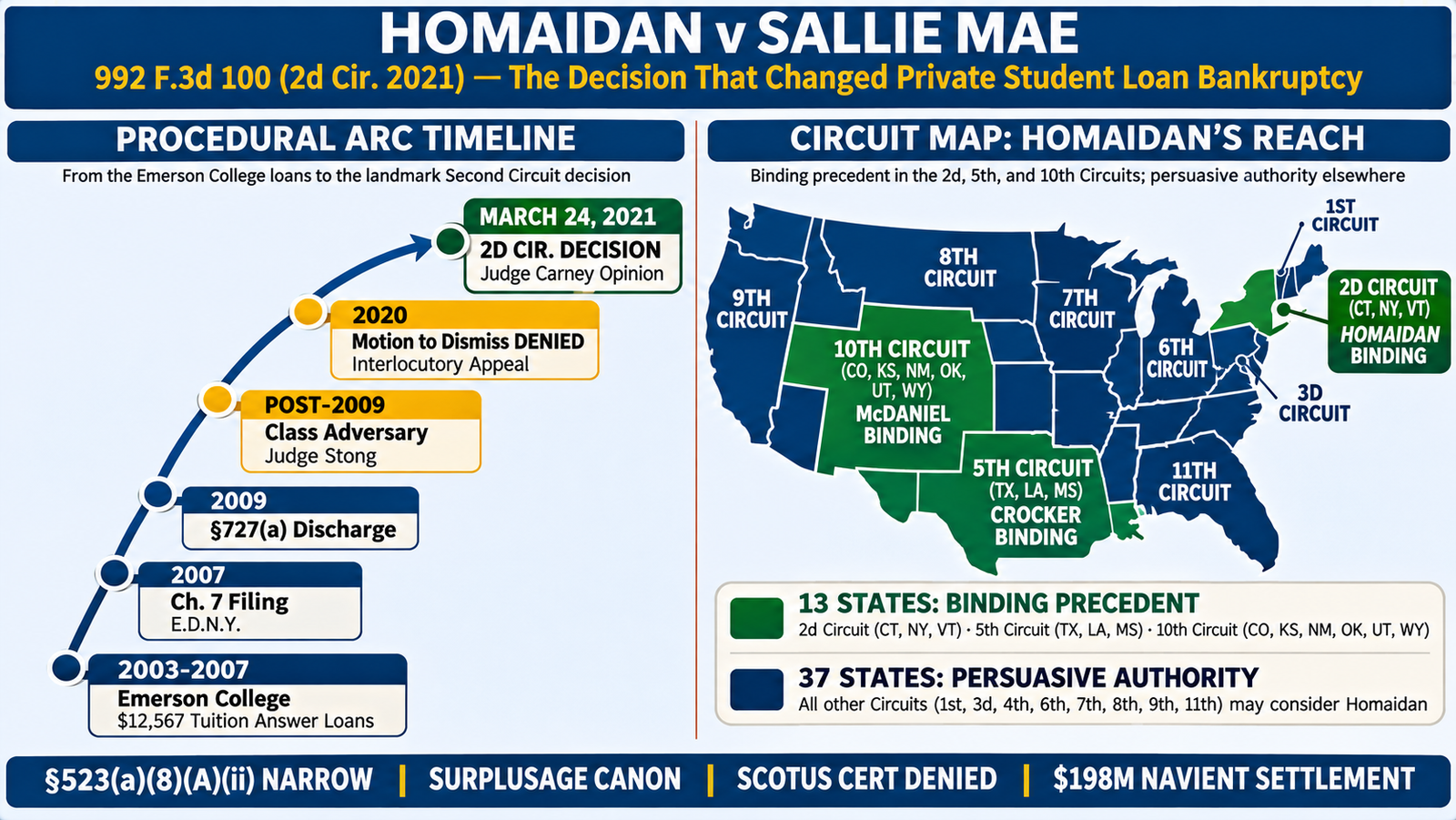
Homaidan v Sallie Mae Inc. 992 F.3d 100 (2d Cir. 2021): Second Circuit decision issued March 24, 2021 holding that 11 U.S.C. §523(a)(8)(A)(ii)’s language excepting from discharge “an obligation to repay funds received as an educational benefit, scholarship, or stipend” is NARROW and does NOT encompass private student loans generally. Case facts: Hilal Homaidan borrowed approximately $12.567 in direct-to-consumer “Tuition Answer Loans” from Sallie Mae Inc. in 2003-2007 to attend Emerson College in Boston; the loans were made directly to Homaidan without school certification of cost of attendance; Homaidan filed Chapter 7 bankruptcy in 2007 receiving discharge in 2009 under 11 U.S.C. §727(a); Sallie Mae and successor Navient continued collection post-discharge claiming loans excepted under §523(a)(8); Homaidan filed adversary proceeding in Bankruptcy Court for Eastern District of New York seeking determination of non-dischargeability; case certified for interlocutory appeal to Second Circuit. Holding: §523(a)(8)(A)(ii) language refers specifically to educational grants that may be forgivable under certain conditions — conditional educational benefits distinct from private student loans; the subsequent §523(a)(8)(B) qualified education loan category would be superfluous if §523(a)(8)(A)(ii) encompassed all educational loans; statutory interpretation canons require giving effect to all statutory provisions. Impact: Binding in Second Circuit (Connecticut, New York, Vermont); persuasive in other Circuits; established narrow interpretation framework now adopted by multiple other courts; SCOTUS denied certiorari leaving Second Circuit holding intact. Post-decision $198 million January 2022 Navient multi-state settlement with 39 state attorneys general. For many borrowers, Homaidan framework means private student loans dischargeable in Chapter 7 WITHOUT undue hardship showing — transforming decades of misconception about non-dischargeability.
Read the complete Homaidan case analysis below.
In this complete Homaidan analysis:
Case facts and background
Hilal Homaidan, Emerson College, Tuition Answer Loans
Procedural history Bankr. E.D.N.Y. to 2d Cir.
2007 bankruptcy filing through 2021 Second Circuit decision
Statutory interpretation of §523(a)(8)(A)(ii)
Narrow construction of “educational benefit, scholarship, or stipend”
Judge Carney reasoning and canons
Statutory construction canons, surplusage doctrine
Circuit-by-Circuit application
Second Circuit binding, persuasive authority elsewhere
Related precedent and complementary rulings
Crocker 5th Cir., McDaniel 10th Cir., In re Page
Post-decision impact and $198M settlement
January 2022 Navient multi-state attorney general settlement
Case facts and background
Understanding the actual homaidan case facts is essential to applying its framework to current borrower situations. The case involved direct-to-consumer private student loans with specific characteristics that drove the Second Circuit’s analysis.
The borrower and loan origination
Hilal Homaidan attended Emerson College in Boston, Massachusetts beginning in approximately 2003. During his undergraduate studies, Homaidan took out approximately $12.567 in private student loans from Sallie Mae Inc. through what Sallie Mae marketed as “Tuition Answer Loans.” Critical loan characteristics: (1) loans were marketed and originated as direct-to-consumer private student loans; (2) loans were NOT certified by Emerson College as to cost of attendance; (3) loans did not go through standard school financial aid office channels; (4) loan amounts were not limited to certified cost of attendance; (5) loans were disbursed directly to Homaidan rather than to the school; (6) loans carried commercial interest rates substantially higher than federal student loans available at the time. The direct-to-consumer loan structure distinguished these loans from traditional school-certified private student loans.
Tuition Answer Loan product characteristics
Sallie Mae’s “Tuition Answer Loan” product characteristics (relevant to understanding why Homaidan framework may apply to similar loans): (1) marketed as supplemental private education loans beyond federal loan amounts; (2) available for any educational purpose including non-degree programs; (3) often used for career schools, vocational programs, bar exam preparation, and other non-title IV eligible programs; (4) origination process bypassed school financial aid office cost of attendance certification; (5) loan amount determined by borrower request and credit underwriting rather than certified need; (6) loans could exceed total cost of attendance; (7) similar products marketed by other lenders during same period (Navient inherited Sallie Mae loan book in 2014 separation). Direct-to-consumer loan products from multiple lenders during 2000s-2010s period share these characteristics.
Post-graduation financial situation
Post-graduation Homaidan financial situation: (1) after Emerson College graduation, Homaidan faced substantial debt burden from combined federal and private student loans; (2) financial difficulties led to Chapter 7 bankruptcy filing in 2007; (3) petition listed Sallie Mae loans among debts; (4) bankruptcy proceeded as typical Chapter 7 case; (5) discharge order entered in 2009 under 11 U.S.C. §727(a); (6) no adversary proceeding filed during initial bankruptcy specifically determining dischargeability of Sallie Mae loans; (7) Homaidan believed discharge covered all unsecured debts including private student loans; (8) post-discharge, Sallie Mae continued collection activity on the loans contending they were excepted from discharge under §523(a)(8). This post-discharge collection activity triggered the adversary proceeding that eventually reached the Second Circuit.
Procedural history from Bankr. E.D.N.Y. to 2d Cir.
The homaidan bankruptcy procedural history spans over a decade from initial Chapter 7 filing through Second Circuit resolution, involving multiple procedural stages that shaped the ultimate framework.
Initial Chapter 7 bankruptcy and discharge
Initial bankruptcy proceedings: (1) Homaidan filed Chapter 7 petition in United States Bankruptcy Court for the Eastern District of New York in 2007; (2) case proceeded through standard Chapter 7 framework; (3) 341 meeting held, trustee report filed; (4) general discharge entered in 2009 under 11 U.S.C. §727(a); (5) no §523(a)(8) adversary proceeding filed during initial case regarding Sallie Mae loans; (6) discharge order included standard language discharging all debts except those specifically excepted under §523(a); (7) Homaidan believed discharge covered Sallie Mae private student loans; (8) post-discharge, Sallie Mae and later Navient (which acquired Sallie Mae loan book in 2014 separation) continued collection activity. The initial discharge without specific §523(a)(8) adversary proceeding was consistent with routine Chapter 7 practice — issue of private student loan dischargeability was not directly litigated.
Post-discharge adversary proceeding
Post-discharge adversary proceeding: (1) after years of continued Sallie Mae/Navient collection post-discharge, Homaidan sought legal representation; (2) class action adversary proceeding filed in Bankruptcy Court for Eastern District of New York; (3) Homaidan served as class representative for proposed class of borrowers with similar direct-to-consumer loans; (4) complaint sought determination that private student loans NOT excepted from discharge under §523(a)(8); (5) key argument: direct-to-consumer loans without school certification don’t qualify as “educational benefit” under §523(a)(8)(A)(ii); (6) alternative argument: loans don’t qualify as §523(a)(8)(B) qualified education loans under IRC §221(d)(1) requirements; (7) also alleged violations of discharge injunction under §524(a)(2); (8) case assigned to Judge Elizabeth S. Stong. Adversary proceeding framework provided vehicle for Second Circuit review.
Bankruptcy court motion to dismiss
Navient’s motion to dismiss adversary proceeding: (1) Navient (defendant as Sallie Mae successor) filed motion to dismiss arguing all Sallie Mae private student loans categorically excepted from discharge under §523(a)(8)(A)(ii); (2) argued broad interpretation of “educational benefit” encompassing all educational loans; (3) argued statutory language and legislative history supported broad reading; (4) bankruptcy court denied motion to dismiss in significant decision; (5) court held statutory language ambiguous and declined to accept Navient’s broad construction without full evidentiary record; (6) court concluded §523(a)(8)(A)(ii) “educational benefit” category likely narrow and does not categorically encompass all private student loans; (7) decision provided foundation for subsequent Second Circuit affirmation. Bankruptcy court analysis presaged Second Circuit statutory interpretation framework.
Interlocutory appeal to Second Circuit
Interlocutory appeal to Second Circuit: (1) Navient sought interlocutory appeal of bankruptcy court denial of motion to dismiss under 28 U.S.C. §158(d)(2); (2) appeal certified to Second Circuit for direct review bypassing district court; (3) interlocutory appeal appropriate for important question of statutory interpretation; (4) full briefing before Second Circuit with substantial amicus participation; (5) oral argument held before Second Circuit panel; (6) panel included Judge Carney who authored the opinion; (7) decision issued March 24, 2021 as Homaidan v. Sallie Mae Inc. 992 F.3d 100 (2d Cir. 2021); (8) Second Circuit affirmed bankruptcy court holding that §523(a)(8)(A)(ii) does not categorically encompass all private student loans. Second Circuit decision established binding precedent for Second Circuit and persuasive authority nationally.
SCOTUS cert denial
Supreme Court certiorari petition and denial: (1) Navient filed petition for writ of certiorari seeking Supreme Court review; (2) petition argued Second Circuit interpretation created Circuit split or warranted Supreme Court clarification; (3) Supreme Court denied certiorari leaving Second Circuit decision intact; (4) cert denial does not constitute Supreme Court endorsement but leaves Second Circuit framework as governing precedent in Second Circuit (CT, NY, VT); (5) cert denial also signals Supreme Court saw no need to intervene given clarity of statutory analysis; (6) with Crocker (5th Cir. 2019) and McDaniel (10th Cir. 2020) reaching similar conclusions, no genuine Circuit split warranted Supreme Court review; (7) Homaidan framework remains binding Second Circuit precedent and highly persuasive nationally. Cert denial solidified framework’s current status.
Statutory interpretation of §523(a)(8)(A)(ii)
The heart of the homaidan decision is the Second Circuit’s interpretation of 11 U.S.C. §523(a)(8)(A)(ii). Understanding the statutory interpretation is essential to applying Homaidan framework to specific borrower loans.
The statutory language at issue
11 U.S.C. §523(a)(8) complete structure excepts from discharge (absent undue hardship): §523(a)(8)(A)(i) — “an educational benefit overpayment or loan made, insured, or guaranteed by a governmental unit, or made under any program funded in whole or in part by a governmental unit or nonprofit institution”; §523(a)(8)(A)(ii) — “an obligation to repay funds received as an educational benefit, scholarship, or stipend”; §523(a)(8)(B) — “any other educational loan that is a qualified education loan, as defined in section 221(d)(1) of the Internal Revenue Code of 1986, incurred by a debtor who is an individual.” The three categories together establish the complete framework for student loan non-dischargeability. Statutory interpretation of specific categories determines which loans fall within or outside non-dischargeability protection.
Navient’s broad interpretation argument
Navient’s broad interpretation argument: (1) “educational benefit” in §523(a)(8)(A)(ii) should be read broadly to encompass any loan used for educational purposes; (2) private student loans provide educational benefits (access to education) to borrowers; (3) therefore all private student loans fall within §523(a)(8)(A)(ii); (4) legislative history purportedly supported broad reading to protect lenders providing educational financing; (5) policy argument: discharging private student loans would harm availability of educational financing; (6) similar broad interpretation adopted by some earlier bankruptcy courts and contested in other courts. Second Circuit rejected this broad interpretation through detailed statutory analysis.
The Second Circuit’s narrow interpretation
Second Circuit narrow interpretation: (1) §523(a)(8)(A)(ii) “educational benefit, scholarship, or stipend” refers to SPECIFIC types of educational financial assistance — conditional grants that may be forgivable; (2) examples: ROTC stipends (forgivable if military service completed), medical school scholarships requiring service in underserved areas (forgivable if service completed), Teach for America stipends (forgivable upon program completion); (3) these are conditional educational benefits distinct from ordinary loans; (4) “obligation to repay funds received as an educational benefit” refers to repayment obligation arising from failure to meet condition of conditional educational benefit; (5) private student loans don’t fit this framework — they are loans requiring repayment regardless of any conditions beyond standard loan terms; (6) private student loans fall within §523(a)(8)(B) analysis instead if they meet IRC §221(d)(1) qualified education loan definition.
The dispositive statutory structure
The dispositive statutory structure argument: (1) §523(a)(8)(B) specifically addresses “any other educational loan that is a qualified education loan” under IRC §221(d)(1); (2) if §523(a)(8)(A)(ii) encompassed all educational loans, the subsequent §523(a)(8)(B) category would be surplusage; (3) surplusage doctrine (canon against statutory surplusage) requires giving effect to all statutory provisions; (4) therefore §523(a)(8)(A)(ii) must mean something distinct from §523(a)(8)(B); (5) only narrow interpretation of §523(a)(8)(A)(ii) as conditional educational benefits distinct from loans gives effect to both categories; (6) narrow interpretation consistent with ordinary meaning of “educational benefit, scholarship, or stipend” as distinct from ordinary loans. Statutory structure analysis was decisive in Second Circuit’s reasoning.
Judge Carney reasoning and canons
The homaidan ruling by Judge Carney applied specific statutory interpretation canons that provide framework for similar analyses in future cases.
Canon against surplusage
Canon against statutory surplusage application: (1) traditional statutory interpretation canon requiring courts to give effect to every provision if possible; (2) Supreme Court application: Duncan v. Walker 533 U.S. 167, 174 (2001) — “we are reluctant to treat statutory terms as surplusage in any setting”; (3) applied to §523(a)(8) framework: if §523(a)(8)(A)(ii) encompassed all educational loans, §523(a)(8)(B) would be unnecessary; (4) Congress would not have enacted §523(a)(8)(B) in 2005 BAPCPA amendments if existing §523(a)(8)(A)(ii) already covered the same ground; (5) distinct §523(a)(8)(A)(ii) and §523(a)(8)(B) categories must address distinct types of obligations; (6) narrow interpretation of §523(a)(8)(A)(ii) as conditional educational benefits distinct from §523(a)(8)(B) qualified education loans gives effect to both. Surplusage canon drove Second Circuit’s narrow interpretation.
Noscitur a sociis (associated words)
Noscitur a sociis canon application: (1) Latin canon meaning “it is known by its associates” — words in list interpreted by reference to surrounding words; (2) §523(a)(8)(A)(ii) uses phrase “educational benefit, scholarship, or stipend” — three specific terms in series; (3) “scholarship” refers to grant of funds for educational purposes (not loan); (4) “stipend” refers to fixed periodic payment for specific purpose (not loan); (5) “educational benefit” between “scholarship” and “stipend” should be interpreted consistently with those terms — as conditional educational assistance rather than loans; (6) if Congress intended to include loans, would have said “educational benefit, loan, scholarship, or stipend”; (7) absence of “loan” from list supports narrow interpretation. Associated words canon reinforces narrow interpretation.
Expressio unius est exclusio alterius
Expressio unius canon application: (1) Latin canon meaning “expression of one is exclusion of others”; (2) §523(a)(8)(A)(i) specifically addresses “educational benefit overpayment or loan made, insured, or guaranteed by a governmental unit”; (3) §523(a)(8)(A)(ii) uses only “educational benefit, scholarship, or stipend” without mentioning “loan”; (4) different language between adjacent subsections indicates Congress distinguished between “educational benefit” (which may be a type of grant) and “loan” (which is categorically different); (5) if Congress intended §523(a)(8)(A)(ii) to include loans, would have used “educational benefit or loan” similar to §523(a)(8)(A)(i); (6) deliberate omission of “loan” from §523(a)(8)(A)(ii) supports narrow interpretation excluding ordinary loans. Expressio unius canon supports Second Circuit framework.
Discharge exception narrow construction principle
General principle of narrow construction of discharge exceptions: (1) bankruptcy law favors debtor fresh start; (2) exceptions to discharge are construed narrowly in favor of debtor; (3) Supreme Court principle: Kawaauhau v. Geiger 523 U.S. 57 (1998) — “exceptions to discharge should be confined to those plainly expressed”; (4) consistent with overall bankruptcy policy of providing fresh start to honest debtors; (5) narrow construction of §523(a)(8)(A)(ii) consistent with this overarching principle; (6) broader interpretations create categorical non-dischargeability without specific statutory support; (7) Second Circuit framework aligns with established discharge exception interpretation principles. Overarching bankruptcy policy supports narrow interpretation.
Circuit-by-Circuit application
Homaidan 2d Circuit precedent has specific binding effect in the Second Circuit and persuasive authority elsewhere. Understanding Circuit-by-Circuit application is essential for borrower bankruptcy strategy.
Binding in Second Circuit
Second Circuit binding application: (1) Homaidan v. Sallie Mae Inc. 992 F.3d 100 (2d Cir. 2021) is binding precedent for all bankruptcy courts and district courts within Second Circuit; (2) Second Circuit encompasses Connecticut, New York, and Vermont; (3) all federal courts in these states must apply Homaidan framework to §523(a)(8)(A)(ii) analysis; (4) bankruptcy courts in E.D.N.Y., S.D.N.Y., N.D.N.Y., W.D.N.Y., D. Conn., D. Vt. must follow; (5) Second Circuit panel decisions binding until overruled by en banc Second Circuit or Supreme Court (neither has occurred); (6) district courts in Second Circuit also bound on appeal from bankruptcy courts; (7) strongest framework application for borrowers filing in Second Circuit. Second Circuit borrowers have highest confidence in Homaidan framework application.
Fifth Circuit parallel framework
Fifth Circuit Crocker v. Navient Solutions LLC 941 F.3d 206 (5th Cir. 2019): (1) decided BEFORE Homaidan (October 2019); (2) reached substantially similar conclusion that §523(a)(8)(A)(ii) does not categorically encompass private student loans; (3) binding in Fifth Circuit (Texas, Louisiana, Mississippi); (4) Texas bankruptcy courts in E.D. Tex., N.D. Tex., S.D. Tex., W.D. Tex. must apply Crocker; (5) Crocker framework parallels Homaidan reasoning with similar statutory interpretation analysis; (6) combined Second and Fifth Circuit precedent provides binding framework covering six states; (7) nearly identical framework application with slight variations in specific reasoning. Fifth Circuit Crocker provides equivalent protection to Homaidan in different geographic area.
Tenth Circuit parallel framework
Tenth Circuit McDaniel v. Navient Solutions LLC 973 F.3d 1083 (10th Cir. 2020): (1) decided August 2020 — between Crocker and Homaidan; (2) reached substantially similar conclusion to Homaidan on §523(a)(8)(A)(ii) narrow interpretation; (3) binding in Tenth Circuit (Colorado, Kansas, New Mexico, Oklahoma, Utah, Wyoming); (4) bankruptcy courts in D. Colo., D. Kan., D.N.M., N.D. Okla., E.D. Okla., W.D. Okla., D. Utah, D. Wyo. must apply McDaniel; (5) McDaniel reasoning aligns with Homaidan and Crocker; (6) three Circuit decisions covering combined thirteen states establishes substantial national framework; (7) framework alignment across three Circuits signals strong national trend. Combined Second, Fifth, and Tenth Circuit framework covers substantial geographic area.
Persuasive authority in other Circuits
Other Circuit persuasive authority: (1) in Circuits without binding precedent (First, Third, Fourth, Sixth, Seventh, Eighth, Ninth, Eleventh, D.C., Federal Circuits), Homaidan, Crocker, and McDaniel are persuasive authority; (2) bankruptcy courts in these Circuits routinely cite and follow Homaidan framework; (3) district courts and Circuit panels have increasingly adopted Homaidan reasoning; (4) absence of contrary Circuit decisions suggests emerging national consensus; (5) borrowers in other Circuits can present Homaidan framework arguments with strong likelihood of court adoption; (6) individual district and bankruptcy judges may vary in receptiveness; (7) specific jurisdiction analysis essential for strategy. Non-binding Circuits provide somewhat lower certainty but substantial framework availability.
Related precedent and complementary rulings
Beyond the three Circuit decisions, numerous bankruptcy court decisions have applied and extended the Homaidan framework. Understanding the broader precedential landscape is essential for complete sallie mae bankruptcy case framework application.
Crocker v. Navient Solutions LLC (5th Cir. 2019)
Crocker v. Navient Solutions LLC 941 F.3d 206 (5th Cir. 2019) analysis: (1) Judge Jerry E. Smith opinion; (2) debtors Evan Crocker and Raymond Shaffer sought declaration that private student loans dischargeable; (3) loans from Navient (formerly Sallie Mae) with similar direct-to-consumer characteristics as Homaidan; (4) Fifth Circuit held §523(a)(8)(A)(ii) narrow interpretation — doesn’t encompass all private student loans; (5) similar statutory interpretation reasoning: surplusage canon, statutory structure, narrow construction of discharge exceptions; (6) binding in Fifth Circuit (TX, LA, MS); (7) cited by Second Circuit in Homaidan as persuasive authority; (8) established framework pattern that Homaidan subsequently reinforced in Second Circuit. Crocker provided foundational Circuit-level framework that Homaidan built upon.
McDaniel v. Navient Solutions LLC (10th Cir. 2020)
McDaniel v. Navient Solutions LLC 973 F.3d 1083 (10th Cir. 2020) analysis: (1) debtors Byron McDaniel and Laura McDaniel sought dischargeability determination; (2) similar direct-to-consumer private student loans from Navient; (3) Tenth Circuit held §523(a)(8)(A)(ii) narrow interpretation matching Crocker framework; (4) explicit statutory interpretation reasoning following similar canons; (5) binding in Tenth Circuit (CO, KS, NM, OK, UT, WY); (6) decided August 2020 before Homaidan, reinforcing emerging Circuit framework; (7) combined with Crocker provided substantial precedent that informed Second Circuit analysis; (8) McDaniel panel included multiple judges strengthening precedential weight. McDaniel solidified multi-Circuit framework before Homaidan.
In re Page bankruptcy court decision
In re Page 592 B.R. 334 (Bankr. N.D. Ill. 2018) and similar bankruptcy court decisions: (1) early bankruptcy court decisions applying narrow §523(a)(8)(A)(ii) interpretation before Circuit-level framework established; (2) Judge Jacqueline P. Cox analysis in Northern District of Illinois; (3) similar statutory interpretation reasoning foreshadowing Circuit framework; (4) bankruptcy court decisions provided foundation that Circuit courts built upon; (5) numerous similar bankruptcy court decisions across country since 2018; (6) persuasive authority within and beyond specific districts; (7) continuing emergence of bankruptcy court applications of narrow §523(a)(8)(A)(ii) framework; (8) demonstrates widespread judicial acceptance of narrow interpretation. Bankruptcy court decisions provide granular framework application across multiple jurisdictions.
§523(a)(8)(B) qualified education loan cases
§523(a)(8)(B) qualified education loan cases: (1) separate line of cases analyzing IRC §221(d)(1) qualified education loan definition requirements; (2) loans failing §221(d)(1) requirements (not for qualified higher education expenses, exceeding cost of attendance, non-eligible educational institutions, non-half-time enrollment) excluded from §523(a)(8)(B) protection; (3) In re Oliver and similar cases analyzing specific loan characteristics; (4) complementary framework to Homaidan — provides second path for dischargeability; (5) loans may fail BOTH §523(a)(8)(A)(ii) educational benefit test AND §523(a)(8)(B) qualified education loan test; (6) bar exam preparation loans, loans to students below half-time enrollment, loans for non-title IV eligible programs particularly susceptible to §523(a)(8)(B) failure; (7) combined with Homaidan framework provides comprehensive discharge analysis. Multiple statutory paths maximize discharge opportunity.
Post-decision impact and $198M settlement
The Homaidan decision triggered significant post-decision developments including a major multi-state attorney general settlement with Navient. Understanding post-decision impact illuminates the framework’s practical consequences.
Navient $198M multi-state settlement January 2022
Navient January 2022 multi-state settlement: (1) announced January 13, 2022 by 39 state attorneys general; (2) $1.85 billion total settlement value; (3) $1.7 billion in private student loan debt cancellation for approximately 66.000 borrowers nationwide; (4) $95 million in restitution payments; (5) addressed various alleged practices including loans that attorneys general argued Navient should have known borrowers wouldn’t repay; (6) targeted particular loan categories: loans to borrowers at schools with low graduation rates, subprime loans, loans borrowers couldn’t afford; (7) settlement did NOT specifically require Homaidan analysis but reflected post-Homaidan environment where private student loan discharge framework had shifted; (8) demonstrated significant lender exposure under evolving framework. Navient settlement illustrated shifted legal and operational landscape post-Homaidan.
Industry practice changes
Industry practice changes post-Homaidan: (1) private student loan lenders increasingly careful about §523(a)(8)(A)(ii) claims in bankruptcy cases; (2) some lenders adopting school certification requirements to strengthen §523(a)(8)(B) qualification; (3) debt buyers specifically evaluating purchased loan portfolios for Homaidan dischargeability risk; (4) settlement companies developing Homaidan-informed negotiation strategies; (5) bankruptcy attorneys routinely raising Homaidan framework in private student loan cases; (6) lender collections practices modified to reduce §524(a)(2) discharge injunction violation risk; (7) emerging secondary market valuation adjustments for private student loan portfolios reflecting Homaidan dischargeability; (8) ongoing evolution of industry practices as framework continues application. Market-wide behavioral shifts followed legal framework shift.
Discharge injunction enforcement
Discharge injunction enforcement under 11 U.S.C. §524(a)(2): (1) once loan determined dischargeable through Homaidan framework, discharge injunction prohibits creditor collection; (2) violations of discharge injunction can result in contempt sanctions under §105(a); (3) damages available include actual damages, attorney fees, and in some cases punitive damages; (4) Taggart v. Lorenzen 587 U.S. 554 (2019) established “no fair ground of doubt” standard for civil contempt; (5) post-Homaidan, lenders face substantial contempt risk for continued collection on Homaidan-qualifying loans post-discharge; (6) class action §524(a)(2) enforcement cases emerging; (7) Homaidan itself was fundamentally §524(a)(2) enforcement adversary proceeding. Discharge injunction enforcement provides remedy for borrowers whose discharge was violated.
Related resources — complete bankruptcy cluster
The 7-path master framework covering all private student loan bankruptcy mechanisms including Chapter 7 and Chapter 13.
Chapter 7 Private Student Loans 2026 Guide
Complete Chapter 7 framework for applying Homaidan framework to private student loan discharge.
Chapter 13 Private Student Loans 2026 Guide
Chapter 13 plan structure with §1328 discharge applying Homaidan at plan completion.
Applying Homaidan to specific loan analysis
Loan characteristics supporting Homaidan application
Specific loan characteristics supporting homaidan v. sallie mae framework application: (1) Direct-to-consumer origination — loans made directly to borrower without school as party to transaction; (2) No school certification of cost of attendance — school didn’t certify specific amount as within cost of attendance; (3) Loan exceeded cost of attendance — loan amount larger than school-certified cost of attendance for enrollment period; (4) Non-title IV eligible program — program not eligible for federal student aid (bar exam preparation, vocational training, non-degree programs); (5) Not enrolled at least half-time — borrower below half-time enrollment during relevant period; (6) Consolidation loans — some consolidation loans include non-qualifying components; (7) Marketing as direct-to-consumer product — loan marketed through non-school channels; (8) Pre-2008 origination — earlier loans more likely to have been direct-to-consumer before industry standardization.
Common lenders with Homaidan-qualifying loan characteristics
Common lenders with portfolios containing potentially Homaidan-qualifying loans: (1) Sallie Mae (pre-2014 separation) — Tuition Answer Loans and similar direct-to-consumer products; (2) Navient (post-2014 Sallie Mae separation) — inherited Sallie Mae direct-to-consumer loan portfolio; (3) NCSLT trusts (2003-1 through 2007-4) — pre-2014 Sallie Mae-originated loans held in 15 trust structure; (4) Discover Financial Services — some direct-to-consumer product originations; (5) Earlier bar exam preparation loans from various lenders; (6) Career training loans for non-title IV programs; (7) Debt buyers who purchased loan portfolios containing qualifying loans. Attorney documentation review determines specific loan characteristics for Homaidan analysis.
Adversary proceeding strategy
Adversary proceeding strategy applying Homaidan framework: (1) comprehensive loan documentation review identifying specific Homaidan-qualifying characteristics; (2) adversary complaint filed under Federal Rules of Bankruptcy Procedure 7001; (3) detailed factual allegations supporting §523(a)(8)(A)(ii) narrow interpretation application; (4) alternative allegations under §523(a)(8)(B) for loans failing IRC §221(d)(1); (5) legal citations to Homaidan in Second Circuit, Crocker in Fifth Circuit, McDaniel in Tenth Circuit, persuasive authority elsewhere; (6) discovery to obtain loan origination documentation from lender; (7) summary judgment motion if clear qualification demonstrated; (8) trial on specific loan characteristics if summary judgment denied; (9) coordination with Chapter 7 main case for discharge coordination. Systematic strategy maximizes Homaidan framework effectiveness.
Common Homaidan v Sallie Mae myths
Myth 1
“Homaidan only applies to loans from Sallie Mae”
Reality: Homaidan v. Sallie Mae Inc. 992 F.3d 100 (2d Cir. 2021) involved Sallie Mae loans as the specific case before the court, but the statutory interpretation framework established applies to ALL private student loans with similar characteristics regardless of lender. The Second Circuit interpreted 11 U.S.C. §523(a)(8)(A)(ii) statutory language — the interpretation applies to any loan being analyzed under that statutory provision. Loans from Navient, Discover, SoFi, Citizens Bank, Ascent, NCSLT trusts, debt buyers, and any other lender can potentially qualify for Homaidan framework application IF the specific loan has qualifying characteristics (direct-to-consumer origination without school certification, non-qualified under IRC §221(d)(1), etc.). The Second Circuit was interpreting the statute, not ruling only on Sallie Mae’s practices. Attorney analysis of specific loan characteristics determines qualification regardless of lender name.
Myth 2
“Homaidan only applies in New York”
Reality: Homaidan v. Sallie Mae Inc. 992 F.3d 100 (2d Cir. 2021) is binding precedent throughout the Second Circuit, which includes Connecticut, New York, and Vermont — not just New York. Beyond the Second Circuit, Homaidan is persuasive authority in all other Circuits. The Fifth Circuit’s Crocker v. Navient Solutions LLC 941 F.3d 206 (5th Cir. 2019) established substantially identical framework binding in Texas, Louisiana, and Mississippi. The Tenth Circuit’s McDaniel v. Navient Solutions LLC 973 F.3d 1083 (10th Cir. 2020) established similar framework binding in Colorado, Kansas, New Mexico, Oklahoma, Utah, and Wyoming. Combined framework covers 13 states with binding precedent and remainder as persuasive authority. Bankruptcy courts across the country routinely apply narrow §523(a)(8)(A)(ii) interpretation. Framework application has substantial national scope.
Myth 3
“Homaidan means all private student loans are dischargeable”
Reality: Homaidan v. Sallie Mae Inc. 992 F.3d 100 (2d Cir. 2021) established that §523(a)(8)(A)(ii) “educational benefit” category is narrow and doesn’t categorically encompass private student loans — but 11 U.S.C. §523(a)(8)(B) still protects loans qualifying as “qualified education loans” under IRC §221(d)(1). A traditional private student loan that meets ALL IRC §221(d)(1) requirements (loan to pay qualified higher education expenses, school certification of cost of attendance, eligible educational institution, half-time enrollment, borrower as eligible student) likely falls within §523(a)(8)(B) protection and requires Brunner undue hardship adversary proceeding for discharge. Homaidan creates significant opportunity for discharge of direct-to-consumer loans without school certification and loans failing IRC §221(d)(1) requirements — but doesn’t categorically dischargeable all private student loans. Loan-specific analysis determines which framework applies.
Myth 4
“Homaidan automatically discharges qualifying loans without any court action”
Reality: Homaidan framework requires affirmative judicial determination through adversary proceeding or similar court action for specific loans. While some bankruptcy courts have held that general Chapter 7 discharge order under §727(a) covers Homaidan-qualifying loans without separate adversary proceeding, many lenders continue collection activity post-discharge disputing dischargeability. Best practice: file §523(a)(8) adversary proceeding under Federal Rules of Bankruptcy Procedure 7001 during Chapter 7 or before Chapter 13 plan completion seeking court determination of dischargeability. Adversary proceeding presents Homaidan framework arguments with documented loan characteristics. Court order specifically determining dischargeability provides strongest protection against post-discharge collection activity. Without specific court order, borrower may face continued collection and need to defend against lender collection actions. Attorney representation essential for adversary proceeding strategy.
Frequently asked questions
1. What is Homaidan v Sallie Mae?
Homaidan v Sallie Mae Inc. 992 F.3d 100 (2d Cir. 2021) is landmark Second Circuit decision issued March 24, 2021 establishing that 11 U.S.C. §523(a)(8)(A)(ii)’s “educational benefit, scholarship, or stipend” language is narrow and does NOT categorically encompass private student loans. The case involved Hilal Homaidan who had borrowed approximately $12.567 in direct-to-consumer “Tuition Answer Loans” from Sallie Mae Inc. to attend Emerson College. After Chapter 7 bankruptcy discharge in 2009, Sallie Mae/Navient continued collection claiming loans excepted from discharge. Homaidan filed class action adversary proceeding seeking dischargeability determination. Second Circuit held direct-to-consumer private student loans without school certification of cost of attendance do NOT qualify as “educational benefit” under §523(a)(8)(A)(ii). Decision is binding in Second Circuit (CT, NY, VT) and persuasive elsewhere. SCOTUS denied certiorari leaving Second Circuit holding intact.
2. Do my loans qualify under Homaidan?
Homaidan qualification analysis depends on specific loan characteristics: (1) direct-to-consumer origination without school as party to transaction; (2) no school certification of cost of attendance for enrollment period; (3) loan amount exceeded cost of attendance; (4) non-title IV eligible program (bar exam preparation, vocational training, non-degree programs); (5) borrower not enrolled at least half-time during relevant period; (6) loan marketed through direct-to-consumer channels; (7) pre-2008 origination (earlier loans more likely direct-to-consumer before industry standardization). Analysis requires comprehensive loan documentation review including original loan application, promissory note, disclosure statements, school certification documentation (or absence), enrollment verification. Attorney review typically identifies qualification factors. Many Sallie Mae-originated loans (including in NCSLT trusts), Navient loans, Discover loans, and loans from other lenders during 2000s-2010s period may qualify.
3. How do I use Homaidan to discharge my loans?
Homaidan framework application requires bankruptcy process: (1) file Chapter 7 or Chapter 13 bankruptcy with licensed bankruptcy attorney; (2) pass means test under 11 U.S.C. §707(b)(2) for Chapter 7, or qualify under §109(e) debt limits for Chapter 13; (3) file §523(a)(8) adversary proceeding under Federal Rules of Bankruptcy Procedure 7001 seeking dischargeability determination; (4) adversary complaint alleges specific Homaidan-qualifying loan characteristics; (5) discovery to obtain loan origination documentation; (6) legal argument citing Homaidan (Second Circuit binding), Crocker (Fifth Circuit binding), McDaniel (Tenth Circuit binding), or persuasive authority depending on Circuit; (7) court determination of dischargeability through summary judgment or trial; (8) discharge order coordinated with Chapter 7 general discharge or Chapter 13 §1328 plan completion discharge. For complete framework see our Private Student Loan Bankruptcy guide.
4. Does Homaidan apply in my state?
Homaidan geographic application: Binding precedent — Second Circuit (Connecticut, New York, Vermont). Parallel binding precedent — Fifth Circuit (Texas, Louisiana, Mississippi) through Crocker v. Navient Solutions LLC 941 F.3d 206 (5th Cir. 2019); Tenth Circuit (Colorado, Kansas, New Mexico, Oklahoma, Utah, Wyoming) through McDaniel v. Navient Solutions LLC 973 F.3d 1083 (10th Cir. 2020). Persuasive authority — All other states including First Circuit, Third Circuit, Fourth Circuit, Sixth Circuit, Seventh Circuit, Eighth Circuit, Ninth Circuit, Eleventh Circuit, D.C. Circuit. In persuasive authority Circuits, bankruptcy courts frequently apply Homaidan framework when properly presented. Combined binding precedent covers 13 states; persuasive authority covers remaining 37 states. Attorney analysis in specific jurisdiction determines framework strength for strategy.
5. What about NCSLT trust loans?
NCSLT (National Collegiate Student Loan Trust) loans and Homaidan: NCSLT trusts hold pre-2014 Sallie Mae-originated private student loans in 15 trust structure (NCSLT 2003-1 through NCSLT 2007-4). Many NCSLT loans share direct-to-consumer characteristics of loans in Homaidan case because they originated from same Sallie Mae loan programs during overlapping time period. Specific NCSLT loans may qualify for Homaidan framework application based on individual loan characteristics: (1) direct-to-consumer origination through “Tuition Answer” or similar programs; (2) absence of school certification; (3) loans exceeding cost of attendance; (4) non-title IV eligible programs. NCSLT loans also face independent challenges including Article III standing issues (Lujan 504 U.S. 555, Spokeo 578 U.S. 330, TransUnion 594 U.S. 413 framework), Third Circuit March 2024 “covered persons” decision with SCOTUS cert denial December 2024, and chain of assignment documentation challenges. Homaidan analysis combined with NCSLT-specific challenges often produces favorable outcomes.
6. Can my loans still be discharged if Homaidan doesn’t apply?
Yes, even without Homaidan framework application, private student loans may be dischargeable through alternative paths: (1) §523(a)(8)(B) non-qualified education loan analysis — loans failing IRC §221(d)(1) qualified education loan definition (not for qualified higher education expenses, exceeding cost of attendance, non-eligible educational institutions, non-half-time enrollment) are not protected and can be discharged without undue hardship; (2) Brunner undue hardship adversary proceeding for loans qualifying under §523(a)(8) — three-part test from Brunner v. New York State Higher Education Services Corp. 831 F.2d 395 (2d Cir. 1987) modernized through In re Rosenberg 594 B.R. 22 (Bankr. S.D.N.Y. 2020) and DOJ November 2022 guidance; (3) Partial discharge under Rosenberg framework for mixed hardship cases; (4) Chapter 13 plan completion with §1328 discharge providing enhanced Brunner analysis after demonstrated good faith plan payments. Multiple framework paths provide comprehensive discharge opportunity.
7. Did the Supreme Court approve Homaidan?
Supreme Court action on Homaidan: Navient filed petition for writ of certiorari seeking Supreme Court review of Second Circuit decision. Supreme Court DENIED certiorari leaving Second Circuit decision as binding precedent in Second Circuit (CT, NY, VT) and persuasive authority elsewhere. Cert denial does NOT constitute Supreme Court endorsement of Second Circuit reasoning — it simply means the Court declined to review. Cert denial has effect of leaving lower court decision intact as controlling authority within that Circuit. Importantly, with Crocker (5th Cir. 2019) and McDaniel (10th Cir. 2020) reaching similar conclusions, no genuine Circuit split exists warranting Supreme Court intervention. Three Circuit decisions aligned on narrow §523(a)(8)(A)(ii) interpretation establishes robust framework without Supreme Court action. Homaidan framework remains binding Second Circuit precedent, parallel binding precedent in Fifth and Tenth Circuits through Crocker and McDaniel, and highly persuasive authority nationally.
Think Your Loans Qualify Under Homaidan?
Free specialist review analyzing Homaidan framework application for your private student loans.
Complete Homaidan framework analysis: loan documentation review identifying direct-to-consumer origination characteristics, school certification analysis determining IRC §221(d)(1) qualified education loan status under §523(a)(8)(B), Circuit-specific application assessment (Second Circuit Homaidan binding, Fifth Circuit Crocker binding, Tenth Circuit McDaniel binding, persuasive authority elsewhere), adversary proceeding preparation framework under Federal Rules of Bankruptcy Procedure 7001, discovery strategy for loan origination documentation, Brunner undue hardship alternative framework if Homaidan doesn’t apply, §524(a)(2) discharge injunction enforcement for post-discharge collection violations, NCSLT-specific framework coordination with Article III standing challenges, coordination with Chapter 7 or Chapter 13 bankruptcy filing strategy, IRC §108(a)(1)(A) complete bankruptcy tax exclusion coordination. All major lenders analyzed (Sallie Mae Bank NYSE:SLM, Navient/Earnest Operations LLC, Discover/Firstmark Services, SoFi Bank NA NMLS #696891, Citizens Bank NA NYSE:CFG, Ascent, NCSLT trusts 2003-1 through 2007-4, third-party debt buyers). Free eligibility review with attorney-backed partner provider — no upfront fees. Bankruptcy filing coordinated through qualified bankruptcy attorney referral.
Get a free eligibility review →
5-minute review · No obligation · Zero upfront fees · Since 2015 · 48 states served
About the author
Henry Silva — Private Student Loan Debt Specialist
10+ years analyzing Homaidan v Sallie Mae framework and related appellate precedent across all federal Circuits. Deep expertise in Second Circuit statutory interpretation framework for 11 U.S.C. §523(a)(8)(A)(ii) including: case facts and procedural history (Hilal Homaidan, Emerson College, approximately $12.567 in Sallie Mae Tuition Answer Loans, Chapter 7 filing 2007 with 2009 discharge, post-discharge adversary proceeding in Bankruptcy Court for Eastern District of New York before Judge Elizabeth S. Stong, bankruptcy court denial of Navient’s motion to dismiss, interlocutory appeal to Second Circuit, Judge Carney opinion March 24, 2021, SCOTUS cert denial); statutory interpretation analysis with specific canons (canon against surplusage under Duncan v. Walker 533 U.S. 167, 174 (2001), noscitur a sociis associated words canon, expressio unius est exclusio alterius canon, discharge exception narrow construction principle under Kawaauhau v. Geiger 523 U.S. 57 (1998)); §523(a)(8) complete statutory framework analysis including §523(a)(8)(A)(i) governmental unit loans, §523(a)(8)(A)(ii) “educational benefit, scholarship, or stipend” narrow construction, §523(a)(8)(B) qualified education loan analysis under IRC §221(d)(1); parallel Circuit precedent including Crocker v. Navient Solutions LLC 941 F.3d 206 (5th Cir. 2019) binding in Fifth Circuit (Texas, Louisiana, Mississippi) with Judge Jerry E. Smith opinion establishing substantially identical framework, McDaniel v. Navient Solutions LLC 973 F.3d 1083 (10th Cir. 2020) binding in Tenth Circuit (Colorado, Kansas, New Mexico, Oklahoma, Utah, Wyoming) reinforcing framework pattern, In re Page 592 B.R. 334 (Bankr. N.D. Ill. 2018) foreshadowing Circuit framework; post-decision impact including January 13, 2022 Navient $1.85 billion multi-state settlement with 39 state attorneys general cancelling $1.7 billion in private student loan debt for approximately 66.000 borrowers plus $95 million in restitution, industry practice changes in private student loan origination and collection, 11 U.S.C. §524(a)(2) discharge injunction enforcement framework under Taggart v. Lorenzen 587 U.S. 554 (2019) “no fair ground of doubt” civil contempt standard; practical application framework including loan characteristic analysis for Homaidan qualification (direct-to-consumer origination without school certification, non-title IV eligible programs, non-half-time enrollment, loans exceeding cost of attendance), common lender portfolio analysis (Sallie Mae pre-2014 separation Tuition Answer Loans, Navient post-separation inherited portfolio, NCSLT trusts 2003-1 through 2007-4 holding pre-2014 Sallie Mae-originated loans, Discover direct-to-consumer products, bar exam preparation loans, career training loans for non-title IV programs), adversary proceeding strategy under Federal Rules of Bankruptcy Procedure 7001 with comprehensive discovery and summary judgment framework; coordination with Chapter 7 or Chapter 13 bankruptcy filing strategy; IRC §108(a)(1)(A) complete bankruptcy tax exclusion coordination with Form 982 preparation at Homaidan-based discharge. Henry works with Private Student Relief’s attorney-backed partner provider network for settlement path analysis and coordinates bankruptcy attorney referrals through partner network for Homaidan framework adversary proceeding representation, ensuring borrowers have access to complete Homaidan framework analysis with proper professional representation across loan documentation review, Circuit-specific strategy, adversary proceeding litigation, and discharge coordination.
Legal Disclaimer and Sources
This article is provided for informational purposes only and does not constitute legal, tax, or financial advice. Private Student Relief is a consulting and matching organization operated by Joco (555 Anton Blvd, Suite 368, Costa Mesa, CA 92626) — not a law firm, bankruptcy filing service, debt settlement company, debt consolidation company, or loan provider. Debt validation services for settlement path are performed by an attorney-backed partner provider (Panamerican Consulting LLC, Las Vegas, NV) under independent business credentials. Ratings, BBB accreditation, and AADR (American Association for Debt Resolution) membership referenced on the PSR website belong to the partner provider. Case analysis provided for educational purposes — specific bankruptcy filing applying Homaidan framework requires licensed bankruptcy attorney in borrower’s jurisdiction. Discharge outcomes depend on specific loan characteristics, Circuit jurisdiction, specific judge assigned, and other factors. Individual results vary. Since 2015. 48 states served. Not available in South Carolina or Mississippi.
Primary case: Homaidan v. Sallie Mae, Inc. 992 F.3d 100 (2d Cir. 2021) — Second Circuit decision by Judge Carney issued March 24, 2021 establishing narrow interpretation of 11 U.S.C. §523(a)(8)(A)(ii) “educational benefit, scholarship, or stipend” language; binding precedent in Second Circuit (Connecticut, New York, Vermont); SCOTUS denied certiorari leaving Second Circuit decision as controlling authority. Parallel Circuit precedent: Crocker v. Navient Solutions LLC 941 F.3d 206 (5th Cir. 2019) — Judge Jerry E. Smith opinion, binding in Fifth Circuit (Texas, Louisiana, Mississippi); McDaniel v. Navient Solutions LLC 973 F.3d 1083 (10th Cir. 2020) — binding in Tenth Circuit (Colorado, Kansas, New Mexico, Oklahoma, Utah, Wyoming). Bankruptcy court precedent: In re Page 592 B.R. 334 (Bankr. N.D. Ill. 2018) and similar bankruptcy court decisions. Discharge framework: Brunner v. New York State Higher Education Services Corp. 831 F.2d 395 (2d Cir. 1987) undue hardship three-part test for §523(a)(8) qualifying loans; In re Rosenberg 594 B.R. 22 (Bankr. S.D.N.Y. 2020) modernized Brunner application; DOJ November 17, 2022 undue hardship guidance. Discharge exception interpretation: Kawaauhau v. Geiger 523 U.S. 57 (1998) — “exceptions to discharge should be confined to those plainly expressed.” Discharge injunction enforcement: Taggart v. Lorenzen 587 U.S. 554 (2019) — “no fair ground of doubt” civil contempt standard. Statutory interpretation canons: Duncan v. Walker 533 U.S. 167, 174 (2001) — canon against statutory surplusage.
Bankruptcy Code references: 11 U.S.C. §105(a) (general equitable authority including contempt sanctions); 11 U.S.C. §523(a)(8) (student loan discharge exceptions with §523(a)(8)(A)(i) governmental unit, §523(a)(8)(A)(ii) educational benefit per Homaidan narrow interpretation, §523(a)(8)(B) qualified education loan per IRC §221(d)(1)); 11 U.S.C. §524(a)(2) (discharge injunction prohibiting creditor collection on discharged debts); 11 U.S.C. §727(a) (Chapter 7 general discharge); 11 U.S.C. §1328 (Chapter 13 discharge framework). Federal Rules of Bankruptcy Procedure: FRBP 7001 (adversary proceeding scope). 28 U.S.C. §158(d)(2) (interlocutory appeal certification to Circuit Court). Internal Revenue Code: IRC §221(d)(1) (qualified education loan definition for §523(a)(8)(B) analysis); IRC §108(a)(1)(A) (bankruptcy tax exclusion — complete exclusion for Homaidan-based discharge); IRC §108(b) (tax attribute reduction ordering); Form 982 (reduction of tax attributes due to discharge of indebtedness). Fair Credit Reporting Act 15 U.S.C. §1681 et seq. for credit reporting implications post-discharge.
Post-decision developments: Navient $1.85 billion multi-state settlement announced January 13, 2022 with 39 state attorneys general cancelling $1.7 billion in private student loan debt for approximately 66.000 borrowers nationwide plus $95 million in restitution payments. Settlement available information published by participating state attorneys general offices. Settlement targeted particular loan categories including loans to borrowers at schools with low graduation rates, subprime loans, and loans borrowers couldn’t afford. Settlement did not explicitly require Homaidan framework application but reflected post-Homaidan environment of shifted discharge framework. Navient structural changes: 2014 separation from Sallie Mae (Sallie Mae Bank remained; Navient inherited pre-2014 loan servicing portfolio); 2017 Earnest Operations LLC acquisition; December 2021 federal loan transfer to Aidvantage; continued operation in private student loan collection and servicing.
Homaidan v Sallie Mae framework application requires case-by-case analysis coordinating specific loan documentation review for Homaidan-qualifying characteristics (direct-to-consumer origination, absence of school certification of cost of attendance, non-title IV eligible programs, non-half-time enrollment), Circuit-specific binding precedent assessment (Second Circuit Homaidan direct, Fifth Circuit Crocker parallel, Tenth Circuit McDaniel parallel, persuasive authority elsewhere), adversary proceeding preparation and litigation strategy under Federal Rules of Bankruptcy Procedure 7001, alternative §523(a)(8)(B) non-qualified education loan analysis under IRC §221(d)(1), Brunner undue hardship adversary alternative for qualified loans, coordination with Chapter 7 or Chapter 13 bankruptcy filing framework, discharge injunction enforcement under §524(a)(2), IRC §108(a)(1)(A) complete bankruptcy tax exclusion. This article provides general framework information; specific bankruptcy filing applying Homaidan framework requires consultation with licensed bankruptcy attorney in borrower’s jurisdiction familiar with complete Homaidan framework analysis. Attorney representation essential given complexity of loan documentation analysis, Circuit-specific application strategy, adversary proceeding litigation, and discharge coordination requirements. Last reviewed: October 2026.