

Informational content only. Not legal, tax, or financial advice. Private Student Relief is a consulting organization, not a law firm. Chapter 13 bankruptcy filing requires licensed bankruptcy attorney in borrower’s jurisdiction. Chapter 13 discharge outcomes depend on plan completion, loan characteristics, Circuit jurisdiction, and other factors. Last reviewed: October 2026.
Written by Henry Silva
Private Student Loan Debt Specialist · 10+ years analyzing chapter 13 private student loans plan structure and §1328 discharge mechanics across all federal Circuits. Deep expertise in 11 U.S.C. §1301 et seq. Chapter 13 framework including §1322 plan requirements with mandatory and permissive provisions, §1322(d) plan duration determination by state median income, §1325 plan confirmation standards, §1326 trustee payment distribution, §1328(a) plan completion discharge, §1328(b) hardship discharge, debt eligibility limits ($465.275 unsecured / $1.395.875 secured as of 2024), 11 U.S.C. §523(a)(8) framework with Homaidan v. Sallie Mae 992 F.3d 100 (2d Cir. 2021), Crocker v. Navient 941 F.3d 206 (5th Cir. 2019), McDaniel v. Navient 973 F.3d 1083 (10th Cir. 2020), Brunner v. New York State HESC 831 F.2d 395 (2d Cir. 1987) undue hardship test, In re Rosenberg 594 B.R. 22 (Bankr. S.D.N.Y. 2020) modernized Brunner application, mortgage cure provisions under §1322(b)(5), trustee percentage under 28 U.S.C. §586. Last reviewed: October 2026.
Chapter 13 private student loans framework operates fundamentally different from Chapter 7 — through court-supervised 3-5 year repayment plan under 11 U.S.C. §1322 culminating in discharge under 11 U.S.C. §1328 at plan completion. For borrowers who fail Chapter 7 means test under §707(b)(2), have significant non-exempt assets requiring protection, need to cure mortgage or auto arrears, or benefit from extended court protection during financial recovery, Chapter 13 provides essential bankruptcy alternative. The §523(a)(8) discharge framework with Homaidan v. Sallie Mae 992 F.3d 100 (2d Cir. 2021), Crocker v. Navient 941 F.3d 206 (5th Cir. 2019), McDaniel v. Navient 973 F.3d 1083 (10th Cir. 2020), and modernized Brunner analysis through In re Rosenberg 594 B.R. 22 (Bankr. S.D.N.Y. 2020) applies equally at §1328(a) plan completion discharge. This complete 2026 guide covers how chapter 13 private student loans discharge actually works: §1322 plan requirements with mandatory and permissive provisions, §1322(d) 3-5 year plan duration determination by state median income, debt eligibility limits ($465.275 unsecured / $1.395.875 secured as of 2024 with periodic adjustments), trustee percentage under 28 U.S.C. §586, mortgage/auto cure mechanics, §1328(a) plan completion discharge with §523(a)(8) application, mid-plan settlement opportunities, business ownership preservation, and complete operational framework for Chapter 13 execution.
Quick Answer
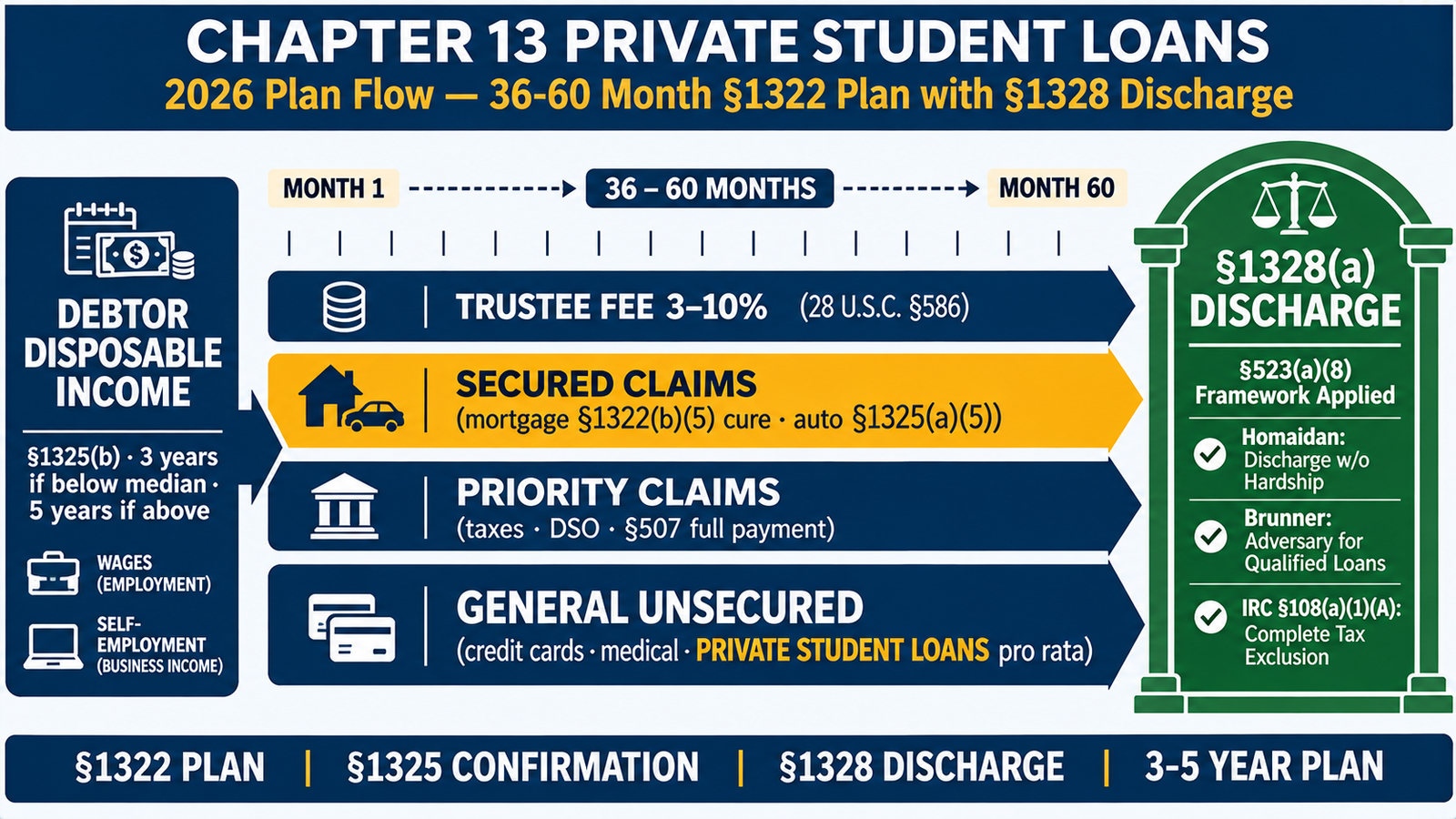
Chapter 13 private student loans discharge: Chapter 13 bankruptcy under 11 U.S.C. §1301 et seq. provides court-supervised 3-5 year repayment plan culminating in discharge under §1328 at plan completion — fundamentally different from Chapter 7 immediate discharge. Required steps: (1) debt eligibility verification — unsecured debt below $465.275 and secured debt below $1.395.875 as of 2024 with periodic adjustments; (2) regular income sufficient to support plan payments; (3) file Chapter 13 petition triggering automatic stay under §362 stopping all creditor collection; (4) propose plan under §1322 within 14 days of filing including mandatory provisions (submit sufficient future earnings, pay priority claims in full, provide equal treatment within classes) and permissive provisions (modify rights of certain creditors, cure defaults, assume executory contracts); (5) plan duration under §1322(d) — 3 years if below state median income, 5 years if above state median income; (6) §341 meeting of creditors typically 20-40 days post-filing; (7) plan confirmation hearing under §1325 — court approval requires feasibility, good faith, best interests of creditors test; (8) make plan payments through Chapter 13 trustee for 3-5 years with trustee percentage under 28 U.S.C. §586; (9) private student loans typically treated as unsecured receiving pro rata distribution during plan; (10) at plan completion, §1328(a) discharge order entered with §523(a)(8) framework application — Homaidan-qualifying private student loans discharged without undue hardship, loans within §523(a)(8) categories require Brunner adversary proceeding. Typical cost: $3.000-$6.000 attorney fees + $313 filing fee + plan payments. Attorney essential throughout 3-5 year plan period.
Read the complete Chapter 13 framework below.
In this complete Chapter 13 guide:
Chapter 13 eligibility and debt limits
$465.275 unsecured / $1.395.875 secured thresholds
§1322 plan requirements and structure
Mandatory + permissive provisions, plan duration
Plan confirmation under §1325
Feasibility, good faith, best interests test
Trustee payments and plan administration
28 U.S.C. §586 trustee percentage, distribution
Private student loans during Chapter 13 plan
Unsecured treatment, pro rata distribution
§1328 discharge at plan completion
§523(a)(8) framework application at discharge
Mortgage, auto cure, and asset protection
§1322(b)(5) cure provisions, business preservation
Chapter 13 eligibility and debt limits
Before pursuing chapter 13 bankruptcy private student loans discharge, borrower must meet specific eligibility requirements including income, debt limits, and prior bankruptcy history considerations.
Regular income requirement
Chapter 13 eligibility requires “regular income” sufficient to fund plan payments under 11 U.S.C. §109(e). Regular income can include: (1) wages and salary from employment; (2) self-employment income from established business; (3) pension income; (4) Social Security benefits; (5) rental income; (6) unemployment benefits (if ongoing eligibility); (7) regular family financial support; (8) investment income if consistent. Income must be sufficient to pay plan obligations while maintaining necessary living expenses. Unlike Chapter 7 which can accommodate zero-income debtors, Chapter 13 requires funding source for plan payments throughout 3-5 year period.
Debt eligibility limits
Chapter 13 debt eligibility limits under 11 U.S.C. §109(e) as of 2024 (periodic adjustments): (1) noncontingent, liquidated unsecured debt below $465.275; (2) noncontingent, liquidated secured debt below $1.395.875; (3) debt limits adjusted periodically by Judicial Conference of United States (typically every 3 years); (4) combined business and personal debt counts toward limits for individual debtors; (5) if debt exceeds either limit, Chapter 11 required instead (with significantly higher costs and complexity); (6) private student loan debt counts as unsecured for limit calculation. For borrowers with very large private student loan balances approaching or exceeding $465.275 unsecured limit, Chapter 11 becomes necessary — attorney analysis essential.
Prior bankruptcy considerations
Prior bankruptcy filing affects Chapter 13 availability: (1) Chapter 13 generally available regardless of prior Chapter 7 discharge, BUT §1328(f) limits discharge availability — no §1328(a) discharge if debtor received Chapter 7 discharge within 4 years of Chapter 13 filing, or Chapter 13 discharge within 2 years of current filing; (2) Chapter 13 filing itself is available even when discharge is limited; (3) “Chapter 20” strategy — Chapter 7 followed by Chapter 13 — specifically used to combine Chapter 7 discharge with Chapter 13 plan for lien stripping and plan restructuring even without second discharge; (4) automatic stay under §362(c)(3) limited to 30 days if prior case dismissed within 1 year (unless court extends); (5) automatic stay under §362(c)(4) not available if two or more prior cases dismissed within 1 year. Timing analysis essential for borrowers with bankruptcy history.
Individual vs joint filing
Chapter 13 filing options: (1) individual debtor filing — spouse’s income may be included in plan calculation (marital adjustment) but spouse not personally liable on discharge; (2) joint filing with spouse — both debtors receive discharge with one case, one filing fee; (3) for private student loans with cosigner spouse, joint filing provides coordinated discharge analysis; (4) non-filing spouse’s income included in CMI calculation but non-filing spouse not bound by discharge injunction (creditor may still pursue non-filing spouse on joint debts); (5) sole individual filing works when spouse income and debt analysis unfavorable or spouse unavailable to file. Attorney analysis determines optimal individual vs joint approach.
§1322 plan requirements and structure
The Chapter 13 plan under 11 U.S.C. §1322 is the central document in chapter 13 plan private student loans framework. Plan must include mandatory provisions and may include permissive provisions tailored to borrower’s specific circumstances.
Mandatory plan provisions under §1322(a)
11 U.S.C. §1322(a) mandatory plan requirements: (1) §1322(a)(1) — provide for submission of all or portion of future earnings or other future income to supervision and control of trustee as necessary for plan execution; (2) §1322(a)(2) — provide for full payment, in deferred cash payments, of all priority claims under §507 (unless holder agrees otherwise); (3) §1322(a)(3) — provide same treatment for each claim within a particular class; (4) §1322(a)(4) — special provision regarding domestic support obligations. These mandatory provisions ensure plan provides consistent framework for creditor treatment while maintaining debtor’s income contribution to plan funding.
Permissive plan provisions under §1322(b)
11 U.S.C. §1322(b) permissive plan provisions: (1) designate classes of unsecured claims; (2) modify rights of holders of secured claims (except mortgage secured by debtor’s principal residence) or holders of unsecured claims; (3) provide for curing of any default; (4) provide for payments on unsecured claims concurrently with other claims; (5) §1322(b)(5) — cure any default and maintain payments on secured claim while case pending (critical for mortgage arrears); (6) provide for payment of post-petition claims; (7) assume, reject, or assign executory contracts; (8) provide for payment of claims from property of estate or future income; (9) provide for less than full payment of unsecured claims. Permissive provisions allow substantial plan customization for borrower’s specific circumstances.
Plan duration under §1322(d)
11 U.S.C. §1322(d) plan duration determination: (1) 3-year applicable commitment period if debtor’s CMI (current monthly income) × 12 is less than state median income for household size; (2) 5-year applicable commitment period if debtor’s CMI × 12 is equal to or greater than state median income; (3) plan can be shorter than applicable commitment period only if unsecured creditors paid in full; (4) plan cannot exceed 5 years regardless of circumstances; (5) duration determination uses same state median income tables as Chapter 7 means test; (6) critical implication: borrowers below state median income have shorter commitment and lower total payment requirement than above-median borrowers. Duration determination made at plan proposal.
Claim classification and private student loans
Claim classification in Chapter 13 plan: (1) Secured claims — mortgages, auto loans, other debt secured by collateral; separate class, typically paid in full with interest; (2) Priority unsecured claims — tax debt within specific periods, child support arrears, administrative expenses; must be paid in full under §1322(a)(2); (3) General unsecured claims — credit cards, medical debt, deficiency balances, PRIVATE STUDENT LOANS; receive pro rata distribution from remaining plan funds; (4) Section 1322(b)(1) classification — unsecured claims can be classified separately when justified (student loans sometimes classified separately for payment purposes). Private student loan treatment in plan affects distribution percentage and total debt reduction.
Plan confirmation under §1325
After plan proposal, confirmation hearing under 11 U.S.C. §1325 determines whether plan proceeds. This is critical milestone for chapter 13 discharge private student loans process — court must approve plan before 3-5 year execution begins.
Feasibility test
11 U.S.C. §1325(a)(6) feasibility test: (1) court must find debtor will be able to make all payments under plan and comply with plan terms; (2) analysis includes current income stability, projected future income, essential living expenses, plan payment requirements; (3) feasibility must be demonstrated for entire plan duration (3-5 years); (4) overly ambitious plans fail feasibility test; (5) plan with insufficient cushion for income fluctuation or unexpected expenses may fail; (6) feasibility analysis considers all debtor’s obligations including plan payments, ongoing secured debt (mortgage), and essential living expenses. Realistic plan structure essential for confirmation.
Good faith requirement
11 U.S.C. §1325(a)(3) good faith plan proposal requirement: (1) plan must be proposed in good faith and not by any means forbidden by law; (2) good faith analysis considers debtor’s honesty, plan commitment, and overall bankruptcy purpose; (3) Chapter 13 filed primarily to discharge debts that would be non-dischargeable in Chapter 7 may face good faith scrutiny; (4) adequate commitment of disposable income to plan payments supports good faith; (5) full disclosure of assets, income, and expenses essential for good faith; (6) prior bankruptcy history may affect good faith analysis. For private student loan borrowers, legitimate financial restructuring purpose supports good faith finding.
Best interests of creditors test
11 U.S.C. §1325(a)(4) best interests of creditors test: (1) unsecured creditors must receive at least as much under plan as they would in hypothetical Chapter 7 liquidation; (2) analysis requires hypothetical Chapter 7 calculation — what would trustee realize from liquidation of non-exempt assets; (3) if debtor has substantial non-exempt assets, plan must pay unsecured creditors equivalent amount; (4) if no non-exempt assets (most Chapter 13 cases), test easily met with minimal distribution; (5) test protects unsecured creditors from Chapter 13 producing worse outcome than Chapter 7. For private student loan borrowers, best interests test typically doesn’t require substantial payment given minimal non-exempt assets in most cases.
Disposable income test under §1325(b)
11 U.S.C. §1325(b) disposable income test (applies when unsecured creditor objects or trustee requests): (1) Below state median — plan must commit all projected disposable income for 3-year period; disposable income defined as income less amounts reasonably necessary for maintenance and support; (2) Above state median — plan must commit all projected disposable income for 5-year period; disposable income calculated using same IRS collection financial standards framework as Chapter 7 means test; (3) critical implication: above-median borrowers face both longer commitment period AND higher required payment calculated with specific allowed expense standards. Disposable income commitment is central plan payment driver.
Trustee payments and plan administration
Chapter 13 plan administration operates through court-appointed trustee receiving debtor payments and distributing to creditors. Understanding trustee role is essential for private student loans chapter 13 execution.
Trustee role and responsibilities
Chapter 13 trustee responsibilities under 11 U.S.C. §1302: (1) review debtor financial condition and plan; (2) object to improper plans or claims; (3) chair §341 meeting of creditors; (4) collect plan payments from debtor; (5) distribute payments to creditors according to plan terms; (6) monitor debtor compliance throughout plan period; (7) file annual reports; (8) seek dismissal or conversion if debtor fails plan obligations; (9) provide advice and counsel to debtor as appropriate. Trustee is quasi-judicial officer overseeing plan execution for 3-5 year period — ongoing relationship throughout case.
Trustee percentage under 28 U.S.C. §586
Chapter 13 trustee compensation under 28 U.S.C. §586: (1) percentage of plan payments collected; (2) rate varies by district and trustee; (3) typical range 3-10% of plan payments; (4) maximum rate 10% statutorily; (5) rate deducted from plan payments before creditor distribution; (6) trustee percentage reduces amount available for unsecured creditor distribution (including private student loan creditors); (7) higher trustee percentage means lower percentage distribution to unsecured creditors. Trustee percentage is factor in overall plan economics — same monthly payment produces different creditor distribution depending on trustee rate.
Plan payment mechanics
Plan payment mechanics: (1) debtor makes plan payments to trustee monthly (or more frequently); (2) first payment due within 30 days of filing (even before confirmation); (3) payment methods typically wage deduction (preferred), automatic bank draft, or money order; (4) wage deduction orders under 11 U.S.C. §1325(c) require employer cooperation; (5) trustee holds payments until plan confirmation then distributes; (6) pre-confirmation payments can be returned if plan not confirmed; (7) post-confirmation payments distributed according to plan terms; (8) failure to make timely payments can result in case dismissal under §1307(c)(1). Consistent payment compliance essential for plan success.
Distribution priorities
Trustee distribution priorities during plan: (1) trustee fee first (percentage of each payment); (2) administrative expenses including attorney fees often paid first with priority classification; (3) priority tax and other priority claims paid in full before general unsecured; (4) secured claims paid according to plan (typically adequate protection payments plus principal/interest or cure and maintain); (5) general unsecured claims (including private student loans) receive pro rata distribution from remaining funds; (6) distribution frequency typically monthly or quarterly depending on trustee. Private student loan creditors receive pro rata share of general unsecured distribution — amount varies based on total unsecured debt and plan funding.
Private student loans during Chapter 13 plan
Private student loan treatment during Chapter 13 plan period is critical to file chapter 13 for private student loans analysis. Treatment affects both monthly payment calculation and final discharge analysis.
Unsecured general classification
Private student loans typically classified as general unsecured debt in Chapter 13: (1) not secured by collateral (unlike mortgage, auto); (2) not priority under §507 (no special priority treatment); (3) classified with other general unsecured debt (credit cards, medical, deficiency balances); (4) receive pro rata distribution from remaining plan funds after trustee fee, administrative expenses, secured claims, and priority claims; (5) pro rata percentage varies dramatically by case — can range from 1-100% depending on plan funding and total unsecured debt; (6) partial payment during plan does NOT satisfy debt — remaining balance addressed at §1328 discharge analysis.
Separate classification under §1322(b)(1)
11 U.S.C. §1322(b)(1) allows separate classification of unsecured claims — sometimes used for student loans: (1) plan may propose separate class for student loans with enhanced payment; (2) requires showing separate classification doesn’t unfairly discriminate against other unsecured creditors; (3) common justification: maintaining ongoing payments on long-term debt during plan prevents collection action and interest accrual outside plan protection; (4) courts split on permissibility — some allow enhanced student loan payments, others view as unfair discrimination; (5) separate classification can help manage non-dischargeable student loan debt during plan; (6) analysis fact-specific to particular case circumstances. Attorney analysis essential for separate classification strategy.
Interest accrual during plan
Interest accrual during Chapter 13 plan for private student loans: (1) general rule — interest continues to accrue on unsecured debt during plan (unlike Chapter 11 where plan can modify interest); (2) BUT creditor can only claim pre-petition balance in bankruptcy case; (3) post-petition interest accrues as separate obligation NOT part of plan; (4) if private student loan ultimately not discharged (§523(a)(8) qualifying loan failing Brunner), full balance plus accumulated interest becomes due at plan completion; (5) partial payments during plan reduce both principal balance and future interest accrual; (6) long plan periods (5 years) can see substantial interest accumulation on unpaid balance. Interest accrual significantly affects post-discharge economics for non-dischargeable private student loans.
Mid-plan settlement opportunities
Mid-plan settlement opportunities with private student loan creditors: (1) borrowers in Chapter 13 can attempt settlement with private student loan creditors during plan period; (2) requires court approval under 11 U.S.C. §363(b) or plan modification under §1329; (3) lump sum funding typically from third-party source (family loan, 401(k) withdrawal with hardship provisions, inheritance); (4) settlement structure must be compatible with plan — typically pays settlement from outside funds without affecting plan payments; (5) creditor motivation similar to pre-bankruptcy settlement — accept reduced amount versus pro rata plan distribution plus discharge uncertainty; (6) typical settlement range 20-40% depending on creditor, Circuit Homaidan strength, and plan posture; (7) successful settlement reduces §1328 discharge complexity by eliminating specific creditor claims. For complete settlement framework see our Private Student Loan Settlement guide.
§1328 discharge at plan completion
The culmination of how to file chapter 13 for student loans framework is 11 U.S.C. §1328 discharge at plan completion. Discharge analysis applies the same §523(a)(8) framework as Chapter 7 with Homaidan and Brunner frameworks determining private student loan outcome.
§1328(a) plan completion discharge
11 U.S.C. §1328(a) plan completion discharge: (1) available upon successful plan completion (all required payments made); (2) debtor must certify compliance with domestic support obligations; (3) debtor must complete financial management course; (4) discharge covers debts provided for in plan except specified non-dischargeable categories including §523(a) exceptions; (5) §523(a)(8) framework applies — private student loans discharged or not based on loan characteristics and undue hardship analysis; (6) Homaidan-qualifying private student loans discharged without undue hardship showing; (7) §523(a)(8) qualifying loans require adversary proceeding for undue hardship determination; (8) discharge entered as court order with discharge injunction prohibiting creditor collection.
§523(a)(8) framework application at §1328 discharge
§523(a)(8) framework application at Chapter 13 plan completion: (1) same statutory framework as Chapter 7 — §523(a)(8)(A)(i) governmental loans, §523(a)(8)(A)(ii) educational benefit per Homaidan, §523(a)(8)(B) qualified education loans per IRC §221(d)(1); (2) Homaidan analysis for direct-to-consumer loans without school certification; (3) §523(a)(8)(B) analysis for loans failing IRC §221(d)(1) qualified education loan definition; (4) Brunner undue hardship analysis for loans within §523(a)(8) categories; (5) Rosenberg and DOJ 2022 framework moderation applies; (6) 3-5 year plan period often supports stronger undue hardship showing by demonstrating sustained financial difficulty despite good faith plan completion; (7) adversary proceeding typically filed shortly before plan completion for discharge determination coordination. Chapter 13 plan completion often produces favorable Brunner analysis.
Brunner advantage at plan completion
Chapter 13 plan completion provides specific Brunner advantages: (1) 3-5 years of plan payments demonstrates “good faith efforts to repay” under third Brunner element; (2) extended financial difficulty during plan (continuing to struggle despite plan commitment) supports “persistence” under second Brunner element; (3) post-plan financial analysis more complete than at Chapter 7 filing — actual demonstrated capacity rather than projected capacity; (4) court familiarity with case through 3-5 years of plan administration supports credibility; (5) partial payment during plan can be factor in partial discharge analysis under Rosenberg framework; (6) In re Rosenberg 594 B.R. 22 (Bankr. S.D.N.Y. 2020) modernized Brunner framework applies; (7) DOJ 2022 guidance considered where relevant. Chapter 13 structural advantages often produce Brunner outcomes superior to Chapter 7 adversary at filing.
§1328(b) hardship discharge
11 U.S.C. §1328(b) hardship discharge for incomplete plans: (1) available when debtor fails to complete plan due to circumstances for which debtor should not justly be held accountable; (2) requires substantial payment already made (unsecured creditors received at least as much as in Chapter 7); (3) modification of plan not practicable; (4) hardship discharge is partial — doesn’t cover all debts (§523 exceptions still apply); (5) §523(a)(8) framework still applies — private student loan discharge analysis same as §1328(a); (6) typical scenarios: serious illness, permanent disability, death of primary income earner, major injury affecting earning capacity; (7) requires motion with evidentiary showing of qualifying hardship. §1328(b) provides safety valve for plans disrupted by uncontrollable circumstances.
Related resources — complete bankruptcy cluster
Private Student Loan Bankruptcy 2026: Complete Guide (PILAR)
The 7-path master framework covering all private student loan bankruptcy mechanisms including Chapter 7 and Chapter 13.
Chapter 7 Private Student Loans 2026 Guide
Complete Chapter 7 framework — alternative to Chapter 13 for borrowers passing means test.
Settlement vs Bankruptcy Student Loans 2026
Comparative framework for choosing between bankruptcy and settlement paths.
Mortgage, auto cure, and asset protection
Chapter 13 provides powerful asset protection and cure mechanisms unavailable in Chapter 7 — key reasons many borrowers choose Chapter 13 over Chapter 7 even when both are available.
§1322(b)(5) mortgage cure provisions
11 U.S.C. §1322(b)(5) mortgage cure provisions: (1) plan may cure default on mortgage and maintain ongoing payments while case pending; (2) cure spread over 3-5 year plan period rather than immediate catch-up required; (3) homeowner retains home despite pre-filing arrears; (4) ongoing monthly payments resume; (5) particularly valuable for borrowers facing foreclosure; (6) mortgage principal and interest rate NOT modified (anti-modification protection under §1322(b)(2) for principal residence); (7) cure includes all arrears including late fees, escrow deficits, attorney fees; (8) post-petition ongoing payments typically made directly to lender (though some districts require trustee pass-through). Cure provisions stop foreclosure and preserve homeownership — major Chapter 13 advantage.
Auto loan cram-down and cure
Auto loan treatment in Chapter 13: (1) Cram-down for older vehicles — 11 U.S.C. §1325(a)(5)(B) with §1325(a)(5)(B)(ii) 910-day rule allows reduction of loan balance to current vehicle value for vehicles acquired more than 910 days before filing; (2) Cure for recent vehicles — vehicles within 910-day rule not subject to cram-down but arrears can be cured over plan; (3) Interest rate modification — Till rate (prime plus risk premium) can replace higher contract rate; (4) Payment restructuring — plan can stretch remaining payments over 3-5 year plan; (5) Lien stripping on wholly unsecured junior liens — second/third auto loans with no collateral value can be stripped. Chapter 13 provides substantial auto debt restructuring unavailable elsewhere.
Asset protection beyond exemptions
Chapter 13 provides asset protection beyond state exemption framework: (1) non-exempt assets NOT liquidated (unlike Chapter 7 where trustee may liquidate); (2) debtor retains all assets throughout plan; (3) plan payments compensate unsecured creditors for what they would have received from hypothetical liquidation (best interests of creditors test under §1325(a)(4)); (4) high-equity home retained even if equity exceeds homestead exemption; (5) valuable personal property retained even if exceeds personal property exemption; (6) business assets retained for continued business operation; (7) inheritance received during plan may or may not be subject to plan modification requiring additional payments. Asset preservation is central Chapter 13 advantage over Chapter 7.
Business ownership preservation
Business ownership preservation in Chapter 13: (1) sole proprietorship can continue operating throughout plan; (2) LLC/corporation ownership interests retained (though corporate debts require corporate bankruptcy if needed); (3) business assets protected from liquidation; (4) self-employment income continues funding plan payments; (5) business-related debt can be addressed through plan; (6) particularly valuable for professional practice (medical, legal, consulting), retail business, service business where liquidation would destroy ongoing enterprise value; (7) requires accurate business financial reporting throughout plan; (8) business valuation may affect best interests test calculation. For business owner borrowers, Chapter 13 often preferred over Chapter 7 to preserve enterprise.
Chapter 13 vs Chapter 7 decision framework
When Chapter 13 is optimal
Chapter 13 typically optimal when: (1) failing Chapter 7 means test under §707(b)(2) — above state median income with insufficient allowed deductions; (2) significant non-exempt assets above Chapter 7 exemption limits requiring protection; (3) mortgage arrears to cure and preserve homeownership — foreclosure prevention; (4) auto arrears to cure or vehicle requiring cram-down; (5) business ownership requiring continued operation during financial recovery; (6) recent Chapter 7 discharge within 8 years — Chapter 7 not available again, Chapter 13 provides alternative; (7) stronger Brunner position at plan completion — borrowers with uncertain current Brunner analysis may benefit from 3-5 years of plan payments demonstrating good faith; (8) partial payment to private student loan creditors preferred over no payment with discharge uncertainty.
When Chapter 7 is preferable
Chapter 7 preferable to Chapter 13 when: (1) passes means test under §707(b)(2) — below state median or passing above-median analysis; (2) no significant non-exempt assets — state exemptions cover all debtor property; (3) no mortgage or auto arrears to cure; (4) strong Homaidan position — loans clearly qualify for Chapter 7 discharge without undue hardship; (5) faster timeline needed — Chapter 7 4-6 months vs Chapter 13 3-5 years; (6) lower total cost — Chapter 7 approximately $2.000-$8.500 total vs Chapter 13 $3.000-$6.000 attorney fees plus 3-5 years of plan payments; (7) wanting immediate fresh start rather than extended court supervision; (8) no business ownership requiring preservation. For complete Chapter 7 analysis see our Chapter 7 Private Student Loans Guide.
Hybrid Chapter 20 strategy
“Chapter 20” strategy combining Chapter 7 then Chapter 13: (1) file Chapter 7 for immediate discharge of dischargeable debt; (2) file Chapter 13 shortly after Chapter 7 discharge for plan addressing non-dischargeable debt and asset protection; (3) Chapter 13 discharge not available (prior Chapter 7 within 4 years prevents §1328(a) discharge under §1328(f)) but Chapter 13 plan still useful; (4) used for cases requiring both Chapter 7 discharge AND Chapter 13 plan features; (5) particularly useful for borrowers with tax debt, mortgage arrears, or need for secured creditor cram-down after Chapter 7 discharge of unsecured debt; (6) sophisticated strategy requiring experienced bankruptcy attorney. Chapter 20 provides specific tactical advantages in complex cases.
Common Chapter 13 private student loans myths
Myth 1
“Chapter 13 doesn’t discharge private student loans”
Reality: Chapter 13 discharge under 11 U.S.C. §1328(a) applies the SAME §523(a)(8) framework as Chapter 7 discharge. Homaidan-qualifying private student loans (direct-to-consumer loans without school certification, non-qualified loans failing IRC §221(d)(1) test) are discharged in Chapter 13 WITHOUT undue hardship showing — same as Chapter 7. Loans qualifying under §523(a)(8) require Brunner adversary proceeding — same as Chapter 7. Chapter 13 provides ADDITIONAL advantages for Brunner analysis: 3-5 years of plan payments demonstrates “good faith efforts to repay” (third Brunner element); extended financial difficulty during plan supports “persistence” (second Brunner element); demonstrated capacity more credible than projected capacity. Chapter 13 often produces SUPERIOR private student loan discharge outcomes compared to Chapter 7 due to these structural advantages at plan completion.
Myth 2
“I’ll have to pay 100% of my private student loans in Chapter 13”
Reality: Chapter 13 plan payment to unsecured creditors (including private student loans) is calculated based on disposable income under §1325(b), not based on total debt amount. Payment percentage can range from 1% to 100% depending on disposable income calculation and plan duration. Many Chapter 13 plans pay unsecured creditors less than 10% of claim balances. Below-median borrowers commit disposable income for 3 years; above-median borrowers commit for 5 years. Factors reducing payment percentage: high secured debt payments reducing available disposable income, substantial priority tax debt requiring full payment, allowed expense deductions reducing disposable income calculation. Private student loan remaining balance after plan addressed at §1328 discharge analysis — Homaidan-qualifying loans fully discharged, qualifying §523(a)(8) loans require Brunner analysis for remaining balance.
Myth 3
“Chapter 13 plans always fail”
Reality: Chapter 13 plan completion rates vary significantly but with proper plan structure and ongoing financial stability, plans can be completed successfully. Factors supporting plan success: (1) realistic plan structure based on actual income and expenses rather than optimistic projections; (2) adequate cushion for income fluctuation or unexpected expenses; (3) wage deduction for automatic payment (rather than manual payment prone to missed deadlines); (4) prompt communication with attorney when financial changes occur (plan modification under §1329 available); (5) commitment to budget discipline throughout 3-5 year period; (6) §1328(b) hardship discharge available if circumstances beyond debtor control prevent completion. Chapter 13 failure often results from unrealistic initial plan structure — proper attorney planning dramatically improves completion likelihood. Modification under §1329 provides flexibility for changed circumstances during plan.
Myth 4
“Chapter 13 is just a more expensive version of Chapter 7”
Reality: Chapter 13 provides fundamentally different and powerful features unavailable in Chapter 7: (1) Mortgage cure under §1322(b)(5) preserves homeownership despite pre-filing arrears — Chapter 7 cannot cure mortgage arrears; (2) Auto cram-down under §1325(a)(5) reduces loan balance to vehicle value for vehicles beyond 910-day rule — Chapter 7 cannot modify auto loans; (3) Asset protection beyond exemptions — Chapter 13 preserves all assets while Chapter 7 may liquidate non-exempt assets; (4) Business ownership preservation — Chapter 13 allows continued business operation; (5) Lien stripping on wholly unsecured junior liens — second mortgages, junior auto loans with no collateral value can be stripped; (6) Enhanced Brunner analysis at plan completion through demonstrated good faith payments. For borrowers needing any of these features, Chapter 13 provides unique framework unavailable in Chapter 7 — not substitute but genuine alternative.
Frequently asked questions
1. How long does Chapter 13 take for private student loan discharge?
Chapter 13 private student loans timeline: Chapter 13 plan duration determined by 11 U.S.C. §1322(d) — 3 years if debtor CMI below state median income for household size, 5 years if above state median. Pre-filing preparation typically 4-6 weeks. Petition filing triggers immediate automatic stay under §362. Plan proposal within 14 days of filing. Confirmation hearing typically 45-90 days after filing. §341 meeting typically 20-40 days after filing. §523(a)(8) adversary proceeding for private student loan dischargeability typically filed shortly before plan completion (last 60-90 days of plan period) — allows court to coordinate discharge timing. Discharge order under §1328 typically entered 30-60 days after successful plan completion. Total timeline from filing to final discharge typically 3.5-5.5 years. Significantly longer than Chapter 7 (4-6 months) but provides extended court protection and asset preservation throughout period.
2. What are Chapter 13 debt limits?
Chapter 13 debt eligibility limits under 11 U.S.C. §109(e) as of 2024 (periodic adjustments by Judicial Conference of United States, typically every 3 years): noncontingent liquidated unsecured debt below $465.275, noncontingent liquidated secured debt below $1.395.875. Private student loan debt counts as unsecured for limit calculation. Combined business and personal debt counts toward limits for individual debtors. If either limit exceeded, Chapter 11 required instead (significantly higher cost and complexity). For borrowers with very large private student loan balances approaching unsecured limit, attorney analysis essential. Contingent or unliquidated debt may not count toward limits (e.g., disputed amounts, debt subject to pending litigation). Debt limit adjustments posted at uscourts.gov with effective dates typically April 1 of adjustment year.
3. How much does Chapter 13 cost for private student loans?
Chapter 13 cost structure: attorney fees typically $3.000-$6.000 depending on jurisdiction and case complexity (higher than Chapter 7 due to 3-5 year plan supervision); filing fee $313; credit counseling course $25-$50; debtor education course $25-$50; §523(a)(8) adversary proceeding typically additional $2.000-$5.000 if required; trustee percentage 3-10% of plan payments throughout 3-5 year plan; CPA fees for tax coordination $300-$1.500. For Chapter 13 plan with private student loan discharge: total professional fees approximately $5.000-$12.000 plus ongoing plan payments over 3-5 years. Monthly plan payments depend on disposable income calculation under §1325(b). Plan payment and total cost analysis requires detailed attorney calculation based on specific borrower circumstances. Attorney fees typically included in plan payments with priority classification — paid through plan rather than separately.
4. Can I settle private student loans during Chapter 13 plan?
Yes, mid-plan settlement with private student loan creditors is possible in Chapter 13: (1) requires court approval under 11 U.S.C. §363(b) for settlement compromise, or plan modification under §1329 if settlement affects plan payment structure; (2) lump sum funding typically from third-party source (family loan, 401(k) hardship withdrawal, inheritance, home equity if plan permits); (3) settlement structure must be compatible with plan — typically pays settlement from outside plan funds without affecting plan payments to other creditors; (4) creditor motivation similar to pre-bankruptcy settlement — accept reduced amount versus pro rata plan distribution plus discharge uncertainty at §1328; (5) typical settlement range 20-40% depending on creditor, Circuit Homaidan strength, and plan posture; (6) successful mid-plan settlement reduces §1328 discharge complexity for specific creditor; (7) attorney representation essential for proper settlement structure and court approval. For complete settlement framework see our Private Student Loan Settlement guide.
5. Does Chapter 13 affect my credit differently than Chapter 7?
Chapter 13 vs Chapter 7 credit impact: Chapter 13 shows on credit report 7 years from filing date (vs Chapter 7 10 years) under Fair Credit Reporting Act 15 U.S.C. §1681c; both show as “bankruptcy” with similar initial credit score impact (typically 100-200 point reduction); individual debts show as “included in bankruptcy” status throughout plan and after discharge; credit score typically bottoms within 6-12 months of filing for either Chapter; rebuilding mechanics similar — secured credit cards, credit builder loans, consistent on-time payments; Chapter 13 debtors can often access some credit DURING plan period with trustee approval for necessary purchases (auto financing, mortgage); Chapter 13 completion provides positive marker — demonstrated 3-5 year payment commitment that some lenders view favorably; overall credit recovery timeline similar to Chapter 7 (2-5 years to significant recovery). Chapter 13 shorter reporting period provides modest advantage but practical impact minimal.
6. What if I can’t complete my Chapter 13 plan?
Options if Chapter 13 plan completion becomes impossible: (1) Plan modification under §1329 — modify plan to reduce payments, extend duration (within 5-year limit), or adjust creditor treatment based on changed circumstances; (2) §1328(b) hardship discharge — available when debtor fails to complete plan due to circumstances for which debtor should not justly be held accountable (serious illness, permanent disability, death of income earner); requires substantial payment already made and modification not practicable; provides partial discharge; (3) Conversion to Chapter 7 under §1307(a) — convert to Chapter 7 if eligible; provides immediate discharge rather than plan completion; requires means test qualification; (4) Dismissal — voluntary dismissal under §1307(b) ends case without discharge; all pre-filing debt becomes immediately due; prior payments to trustee lost. Attorney consultation essential when plan completion becomes uncertain — multiple options available depending on specific circumstances.
7. Should I file Chapter 7 or Chapter 13 for private student loans?
Chapter choice depends on specific circumstances: Chapter 7 optimal when: passes means test under §707(b)(2); no significant non-exempt assets; no mortgage/auto arrears to cure; no business to preserve; strong Homaidan analysis supporting immediate discharge; faster timeline preferred; lower total cost desired. Chapter 13 optimal when: fails Chapter 7 means test; significant non-exempt assets requiring protection; mortgage arrears to cure preserving homeownership; auto arrears or cram-down needed; business ownership requiring preservation; recent Chapter 7 discharge within 8 years preventing new Chapter 7; stronger Brunner position developed during 3-5 year plan period. Both Chapters apply §523(a)(8) framework for private student loan discharge — Homaidan-qualifying loans discharged in either without undue hardship. Chapter choice primarily affects asset protection, timeline, cost, and ongoing court supervision — not fundamental dischargeability analysis. Attorney analysis essential for Chapter choice given specific circumstances.
Considering Chapter 13 for Private Student Loans?
Free specialist review of Chapter 13 plan structure and §1328 discharge path for your private student loans.
Complete Chapter 13 analysis: debt eligibility under 11 U.S.C. §109(e) with current limits ($465.275 unsecured / $1.395.875 secured as of 2024 with periodic adjustments), §1322 plan structure with mandatory and permissive provisions, §1322(d) plan duration determination by state median income (3 years below median, 5 years above median), §1325 plan confirmation with feasibility, good faith, best interests of creditors, and disposable income tests, trustee percentage under 28 U.S.C. §586 (3-10% range), §1322(b)(5) mortgage cure provisions for foreclosure prevention, §1325(a)(5) auto cram-down for vehicles beyond 910-day rule, lien stripping on wholly unsecured junior liens, business ownership preservation, §1328(a) plan completion discharge with §523(a)(8) framework application (Homaidan v. Sallie Mae 992 F.3d 100 Second Circuit framework for direct-to-consumer loans, Brunner undue hardship with In re Rosenberg 594 B.R. 22 and DOJ 2022 moderation for qualified loans, Brunner advantage at plan completion through demonstrated good faith payments), §1328(b) hardship discharge safety valve, mid-plan settlement coordination with court approval under §363(b) or plan modification under §1329. All major lenders analyzed (Sallie Mae Bank, Navient/Earnest Operations LLC, Discover/Firstmark Services, SoFi Bank NA, Citizens Bank NA, Ascent, NCSLT trusts, debt buyers). Free eligibility review with attorney-backed partner provider — no upfront fees. Bankruptcy filing coordinated through qualified bankruptcy attorney referral.
Get a free eligibility review →
5-minute review · No obligation · Zero upfront fees · Since 2015 · 48 states served
About the author
Henry Silva — Private Student Loan Debt Specialist
10+ years analyzing chapter 13 private student loans plan structure and §1328 discharge mechanics across all federal Circuits. Deep expertise in 11 U.S.C. §1301 et seq. Chapter 13 framework including: §109(e) debt eligibility limits ($465.275 noncontingent liquidated unsecured and $1.395.875 noncontingent liquidated secured as of 2024, periodic adjustments by Judicial Conference of United States every 3 years); automatic stay under §362 immediate collection cessation with §362(c)(3) 30-day limitation if prior case dismissed within 1 year; §1322(a) mandatory plan requirements including submission of future earnings, full payment of priority claims, equal treatment within classes; §1322(b) permissive plan provisions including modification of secured claim rights, cure of defaults, concurrent payments, §1322(b)(5) cure and maintain mortgage provisions (anti-modification protection under §1322(b)(2) for principal residence); §1322(d) plan duration determination — 3 years if CMI below state median income for household size, 5 years if above state median; §1325 plan confirmation with §1325(a)(6) feasibility test, §1325(a)(3) good faith requirement, §1325(a)(4) best interests of creditors test (hypothetical Chapter 7 liquidation comparison), §1325(a)(5) secured claim treatment with §1325(a)(5)(B)(ii) 910-day rule for auto cram-down, §1325(b) disposable income test with IRS collection financial standards for above-median borrowers; trustee role under §1302 and compensation under 28 U.S.C. §586 (3-10% of plan payments); claim classification under §507 priority framework and §1322(b)(1) separate classification analysis; §1328(a) plan completion discharge with §523(a)(8) framework application including Homaidan v. Sallie Mae Inc. 992 F.3d 100 (2d Cir. 2021), Crocker v. Navient Solutions LLC 941 F.3d 206 (5th Cir. 2019), McDaniel v. Navient Solutions LLC 973 F.3d 1083 (10th Cir. 2020), Brunner v. New York State Higher Education Services Corp. 831 F.2d 395 (2d Cir. 1987) three-part undue hardship test with In re Rosenberg 594 B.R. 22 (Bankr. S.D.N.Y. 2020) modernized application emphasizing test’s actual language, DOJ November 17, 2022 undue hardship guidance for government consent framework; §1328(b) hardship discharge for incomplete plans due to circumstances for which debtor should not justly be held accountable; §1328(f) discharge availability restrictions for prior Chapter 7 within 4 years or Chapter 13 within 2 years; §1329 plan modification during plan period for changed circumstances; §1307 conversion between Chapters or dismissal provisions; “Chapter 20” strategy coordination for Chapter 7 followed by Chapter 13 for comprehensive outcome; mid-plan settlement opportunities with court approval under §363(b) or plan modification under §1329 coordination; mortgage cure mechanics for foreclosure prevention, auto cram-down mechanics for vehicle debt restructuring, lien stripping on wholly unsecured junior liens, business ownership preservation for continued enterprise operation; IRC §108(a)(1)(A) complete bankruptcy tax exclusion at §1328 discharge with Form 982 preparation and §108(b) tax attribute reduction ordering coordination. Henry works with Private Student Relief’s attorney-backed partner provider network for settlement path analysis and coordinates bankruptcy attorney referrals through partner network for Chapter 13 filing and plan supervision, ensuring borrowers have access to complete Chapter 13 framework analysis with proper professional representation across plan structure, confirmation, administration, discharge, and tax coordination throughout 3-5 year plan period.
Legal Disclaimer and Sources
This article is provided for informational purposes only and does not constitute legal, tax, or financial advice. Private Student Relief is a consulting and matching organization operated by Joco (555 Anton Blvd, Suite 368, Costa Mesa, CA 92626) — not a law firm, bankruptcy filing service, debt settlement company, debt consolidation company, or loan provider. Debt validation services for settlement path are performed by an attorney-backed partner provider (Panamerican Consulting LLC, Las Vegas, NV) under independent business credentials. Ratings, BBB accreditation, and AADR (American Association for Debt Resolution) membership referenced on the PSR website belong to the partner provider. Chapter 13 bankruptcy filing requires licensed bankruptcy attorney in borrower’s jurisdiction — PSR coordinates referrals through partner network but does not itself provide bankruptcy filing services. Chapter 13 discharge outcomes depend on plan completion, loan characteristics, Circuit jurisdiction, state exemption framework, specific judge assigned, and other factors. Individual results vary. Since 2015. 48 states served. Not available in South Carolina or Mississippi.
Bankruptcy Code references: 11 U.S.C. §105(a) (general equitable authority); 11 U.S.C. §109(e) (Chapter 13 debt eligibility limits); 11 U.S.C. §301 (voluntary case commencement); 11 U.S.C. §341 (meeting of creditors); 11 U.S.C. §362 (automatic stay with §362(c)(3) 30-day limitation for prior dismissed cases, §362(c)(4) unavailable with two prior dismissals within 1 year, §362(k) sanctions for violations); 11 U.S.C. §363(b) (compromise and settlement during case); 11 U.S.C. §507 (priority claim framework); 11 U.S.C. §523(a)(8) (student loan discharge exceptions); 11 U.S.C. §1301 et seq. (Chapter 13 framework); 11 U.S.C. §1302 (Chapter 13 trustee role); 11 U.S.C. §1307 (conversion and dismissal provisions); 11 U.S.C. §1322 (plan requirements with §1322(a) mandatory and §1322(b) permissive provisions, §1322(b)(2) anti-modification protection for principal residence, §1322(b)(5) cure and maintain provisions, §1322(d) plan duration determination); 11 U.S.C. §1325 (plan confirmation standards including §1325(a)(3) good faith, §1325(a)(4) best interests of creditors, §1325(a)(5) secured claim treatment with §1325(a)(5)(B)(ii) 910-day rule for auto cram-down, §1325(a)(6) feasibility, §1325(b) disposable income test); 11 U.S.C. §1326 (trustee payment distribution); 11 U.S.C. §1328 (Chapter 13 discharge with §1328(a) plan completion discharge, §1328(b) hardship discharge for incomplete plans, §1328(f) prior bankruptcy discharge restrictions). 28 U.S.C. §586 (Chapter 13 trustee compensation 3-10% of plan payments). Federal Rules of Bankruptcy Procedure: FRBP 7001 (adversary proceeding scope). Key appellate precedent: Homaidan v. Sallie Mae Inc. 992 F.3d 100 (2d Cir. 2021) — narrow interpretation of §523(a)(8)(A)(ii) “educational benefit” binding in Second Circuit (CT, NY, VT); Crocker v. Navient Solutions LLC 941 F.3d 206 (5th Cir. 2019) — binding in Fifth Circuit (TX, LA, MS); McDaniel v. Navient Solutions LLC 973 F.3d 1083 (10th Cir. 2020) — binding in Tenth Circuit (CO, KS, NM, OK, UT, WY); Brunner v. New York State Higher Education Services Corp. 831 F.2d 395 (2d Cir. 1987) undue hardship three-part test; In re Rosenberg 594 B.R. 22 (Bankr. S.D.N.Y. 2020) modernized Brunner application. DOJ guidance: U.S. Department of Justice November 17, 2022 guidance regarding undue hardship adversary proceedings establishing framework for government consent in qualifying cases based on current ability to pay, likelihood of future ability to pay, and good faith efforts.
Chapter 13 plan specifics: Plan duration under §1322(d) determined by state median income comparison using U.S. Trustee program tables (3 years below median, 5 years above median). Debt eligibility limits adjusted periodically by Judicial Conference of United States (typical every 3 years). Chapter 13 attorney fees typical range $3.000-$6.000 depending on jurisdiction. §523(a)(8) adversary proceeding fees typical additional $2.000-$5.000. Chapter 13 filing fee $313. Trustee percentage 3-10% of plan payments. Internal Revenue Code: IRC §221(d)(1) (qualified education loan definition for §523(a)(8)(B) analysis); IRC §108(a)(1)(A) (bankruptcy tax exclusion — complete exclusion for Chapter 13 §1328 discharge); IRC §108(b) (tax attribute reduction ordering); Form 982 (reduction of tax attributes due to discharge of indebtedness).
Credit reporting: Chapter 13 bankruptcy shows on credit report 7 years from filing date under Fair Credit Reporting Act 15 U.S.C. §1681c (vs Chapter 7 10 years). Individual discharged debts show as “included in bankruptcy” status. Post-discharge rebuilding timeline similar to Chapter 7 — credit score typically bottoms within 6-12 months of filing with 100-200 point reduction, rebuilding begins immediately post-discharge, recovery to pre-bankruptcy range typically 3-5 years.
Chapter 13 private student loans strategy requires case-by-case analysis coordinating debt eligibility under §109(e), plan structure under §1322 with mandatory and permissive provisions, plan duration under §1322(d) based on state median income, confirmation under §1325 with feasibility/good faith/best interests/disposable income tests, trustee percentage under 28 U.S.C. §586, mortgage cure under §1322(b)(5) and auto cram-down under §1325(a)(5), §1328(a) plan completion discharge with §523(a)(8) framework application applying Homaidan narrow interpretation or Brunner modernized undue hardship analysis, §1328(b) hardship discharge for incomplete plans, mid-plan settlement coordination with court approval, IRC §108(a)(1)(A) complete bankruptcy tax exclusion with Form 982 preparation. This article provides general framework information; specific Chapter 13 filing and plan supervision requires consultation with licensed bankruptcy attorney in borrower’s jurisdiction familiar with complete Chapter 13 private student loan discharge framework. Attorney representation essential throughout 3-5 year plan period given complexity of plan structure, confirmation, administration, modification, discharge, and tax coordination requirements. Last reviewed: October 2026.