

Informational content only. Not legal, tax, or financial advice. Private Student Relief is a consulting organization, not a law firm. Undue hardship adversary proceeding requires licensed bankruptcy attorney in borrower’s jurisdiction. Case outcomes depend on specific borrower circumstances, Circuit jurisdiction, assigned judge, and other factors. Individual results vary. Last reviewed: October 2026.
Written by Henry Silva
Private Student Loan Debt Specialist · 10+ years analyzing Brunner undue hardship test framework and modernized application across all federal Circuits. Deep expertise in Brunner v. New York State Higher Education Services Corp. 831 F.2d 395 (2d Cir. 1987) three-part test, In re Rosenberg 594 B.R. 22 (Bankr. S.D.N.Y. 2020) modernization emphasizing test’s actual language, DOJ November 17, 2022 undue hardship guidance establishing framework for government consent based on current ability to pay/likelihood of future ability to pay/good faith efforts, Eighth Circuit alternative totality-of-circumstances test from Long v. Educational Credit Management Corp. 322 F.3d 549 (8th Cir. 2003), partial discharge framework under 11 U.S.C. §105(a) equitable authority with In re Educational Credit Management Corp. v. Mosley 494 F.3d 1320 (11th Cir. 2007), expert witness coordination, adversary proceeding litigation framework. Last reviewed: October 2026.
Brunner undue hardship test under 11 U.S.C. §523(a)(8) governs discharge of qualifying student loans in bankruptcy — the critical framework for loans falling within §523(a)(8)(A)(i) governmental category, §523(a)(8)(A)(ii) educational benefit per Homaidan narrow interpretation, or §523(a)(8)(B) qualified education loans under IRC §221(d)(1). Established by Brunner v. New York State Higher Education Services Corp. 831 F.2d 395 (2d Cir. 1987), the test requires borrowers to demonstrate three elements: (1) current inability to maintain minimal standard of living while repaying loans; (2) additional circumstances indicating financial difficulty likely to persist for significant portion of repayment period; (3) good faith efforts to repay. Historically applied with excessive strictness making discharge nearly impossible, Brunner has been fundamentally transformed through In re Rosenberg 594 B.R. 22 (Bankr. S.D.N.Y. 2020) modernization by Judge Cecelia Morris emphasizing the test’s actual language rather than accumulated restrictive interpretations, and DOJ November 17, 2022 undue hardship guidance establishing framework for government consent based on current ability to pay, likelihood of future ability to pay, and good faith efforts. This complete 2026 guide covers the brunner undue hardship test as it actually operates now: the three-part test’s actual requirements, Rosenberg modernization framework, DOJ 2022 guidance application, Eighth Circuit alternative totality-of-circumstances test, modern success factors, expert witness coordination (vocational, medical, financial), partial discharge framework under §105(a), adversary proceeding mechanics, and practical application for current borrower discharge analysis.
Quick Answer
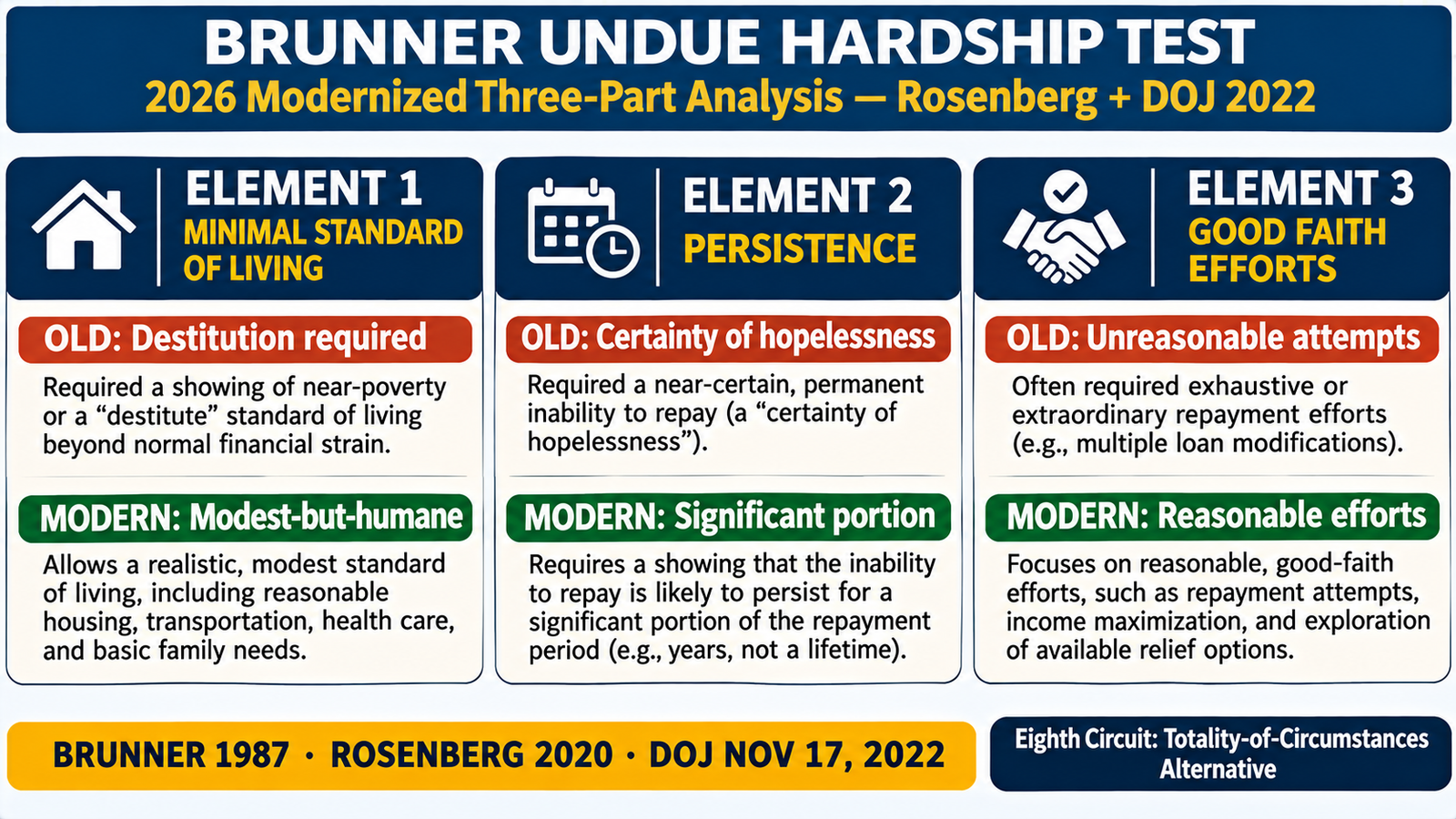
Brunner undue hardship test: Three-part test established by Brunner v. New York State Higher Education Services Corp. 831 F.2d 395 (2d Cir. 1987) governing discharge of student loans qualifying under 11 U.S.C. §523(a)(8). To prevail, borrower must demonstrate: (1) MINIMAL STANDARD OF LIVING — debtor cannot maintain, based on current income and expenses, a minimal standard of living for themselves and their dependents if forced to repay the loans; (2) PERSISTENCE — additional circumstances exist indicating that this state of affairs is likely to persist for a significant portion of the repayment period of the student loans; (3) GOOD FAITH EFFORTS — debtor has made good faith efforts to repay the loans. Historically applied with excessive strictness. MODERNIZED through In re Rosenberg 594 B.R. 22 (Bankr. S.D.N.Y. 2020) by Judge Cecelia Morris emphasizing test’s actual language — “minimal standard of living” doesn’t require destitution, “significant portion of repayment period” doesn’t require permanence, “good faith efforts” doesn’t require unreasonable attempts. DOJ November 17, 2022 undue hardship guidance established framework for government consent based on current ability to pay (income/expense analysis), likelihood of future ability to pay (long-term earning capacity, retirement, disability), good faith efforts (payment history, deferment usage, communication with lenders). Eighth Circuit (AR, IA, MN, MO, NE, ND, SD) applies ALTERNATIVE totality-of-circumstances test from Long v. Educational Credit Management Corp. 322 F.3d 549 (8th Cir. 2003) — more flexible standard. Partial discharge available under 11 U.S.C. §105(a) equitable authority when complete discharge not warranted. Modern Brunner success factors: documented medical hardship, significant family responsibilities, long-term earning capacity limitations, demonstrated payment efforts, income-driven repayment history. Expert witnesses (vocational, medical, financial) often essential for successful adversary proceedings. Requires §523(a)(8) adversary proceeding under Federal Rules of Bankruptcy Procedure 7001 with licensed bankruptcy attorney.
Read the complete Brunner framework below.
In this complete Brunner guide:
Original Brunner case and three-part test
1987 2d Cir. decision establishing framework
Element 1: Minimal standard of living
Current income vs essential expenses analysis
Element 2: Persistence of financial difficulty
Future circumstances analysis over repayment period
Element 3: Good faith efforts to repay
Payment history, deferments, communication
Rosenberg modernization framework
Judge Morris emphasizing actual statutory language
DOJ November 2022 undue hardship guidance
Government consent framework for qualifying cases
Eighth Circuit alternative and partial discharge
Totality-of-circumstances test, §105(a) partial discharge
Original Brunner case and three-part test
Understanding the original brunner v hesc case facts and three-part test formulation is essential to applying the modernized framework. The test’s language and structure determine analysis approach.
The original Brunner case facts
Brunner v. New York State Higher Education Services Corp. 831 F.2d 395 (2d Cir. 1987) facts: (1) Marie Brunner obtained graduate student loans guaranteed by New York State Higher Education Services Corp.; (2) she pursued graduate education; (3) upon completion, she sought discharge of student loans in Chapter 7 bankruptcy filed within one month after loans entered repayment status; (4) she had not made any payments on the loans; (5) she was 29 years old, in good health, had a master’s degree, no dependents, lived with her brother; (6) bankruptcy court granted discharge based on hardship; (7) district court reversed; (8) Second Circuit affirmed district court denial of discharge. The original Brunner case involved relatively weak hardship facts — the three-part test was announced as rationale for denying discharge in that specific case.
The three-part test formulation
Second Circuit’s three-part test formulation: To establish undue hardship under 11 U.S.C. §523(a)(8), the debtor must demonstrate: (1) “that she cannot maintain, based on current income and expenses, a ‘minimal’ standard of living for herself and her dependents if forced to repay the loans”; (2) “that additional circumstances exist indicating that this state of affairs is likely to persist for a significant portion of the repayment period of the student loans”; (3) “that she has made good faith efforts to repay the loans.” Each element must be proven by preponderance of the evidence. All three elements must be met for discharge — failure on any one element defeats discharge claim. The specific language of the test is central to modern analysis.
Historical strict application
Historical strict Brunner application developed through decades of restrictive case law: (1) “minimal standard of living” interpreted as near-destitution requiring sacrifice of basic necessities; (2) “significant portion of repayment period” interpreted as requiring near-permanent financial incapacity with “certainty of hopelessness”; (3) “good faith efforts” interpreted as requiring extensive payment attempts even when financially impossible; (4) accumulated interpretive restrictions made Brunner nearly impossible to meet; (5) discharge rates for undue hardship adversary proceedings dropped to extremely low levels; (6) perception emerged that student loans were effectively non-dischargeable in bankruptcy; (7) historical approach added requirements beyond statutory text through doctrine of accumulated precedent. Historical strict application was the primary target of Rosenberg modernization.
The “certainty of hopelessness” gloss
The problematic “certainty of hopelessness” gloss developed over time: (1) some courts began requiring borrowers to demonstrate “certainty of hopelessness” for second Brunner element; (2) language appeared in various Circuit and district court decisions; (3) “certainty of hopelessness” imposed requirement far beyond statutory text’s “significant portion of repayment period”; (4) effectively required borrowers to prove permanent incapacity for life; (5) nearly impossible standard that defeated meritorious discharge claims; (6) In re Rosenberg specifically rejected “certainty of hopelessness” as improper gloss on statutory text; (7) Judge Morris emphasized returning to test’s actual language. Elimination of “certainty of hopelessness” is central to Rosenberg modernization.
Element 1: Minimal standard of living
The first element of the brunner three part test requires borrower to demonstrate inability to maintain minimal standard of living while repaying loans. Understanding what “minimal” actually means is central to successful analysis.
Modern interpretation of “minimal standard of living”
Modern interpretation of “minimal standard of living” under Rosenberg framework: (1) does NOT require destitution, poverty-level existence, or complete sacrifice of basic human dignity; (2) does NOT require borrower to live in squalor, deprive family of essential needs, or make life untenable; (3) DOES mean modest but humane living standard including basic food, clothing, shelter, medical care, transportation, modest recreation; (4) considers reasonable expenses for borrower’s actual household circumstances (family size, location, health needs); (5) includes allowance for occasional dining out, cable/internet, basic entertainment, modest clothing purchases; (6) income must be insufficient to pay student loan amounts while maintaining such modest-but-humane standard; (7) Rosenberg framework explicitly rejected requiring deprivation or destitution. Modern “minimal” is reasonable not punitive.
Income analysis
Income analysis for first Brunner element: (1) current income from all sources including wages, self-employment, rental, investment, Social Security, disability, unemployment; (2) household income if married filing jointly; (3) consistent income rather than isolated windfalls; (4) income trajectory analysis — stagnant, growing, or declining; (5) earning capacity relative to education and experience; (6) unemployment or underemployment context; (7) business income seasonality or irregularity; (8) imputed income if voluntarily underemployed (court may analyze actual earning capacity). Comprehensive income documentation essential — tax returns, pay stubs, business records, bank statements.
Reasonable expenses analysis
Reasonable expenses analysis for first Brunner element: (1) housing (rent/mortgage, utilities, maintenance within reasonable amounts); (2) food (reasonable for household size); (3) transportation (vehicle payments, insurance, gas, maintenance, or public transit); (4) medical expenses (ongoing health conditions, prescriptions, insurance premiums); (5) child care if required for employment; (6) child support/alimony obligations; (7) basic clothing and personal care; (8) modest recreation and entertainment; (9) savings for emergencies (modest amount acceptable under modern analysis); (10) tax withholding and self-employment taxes; (11) insurance (auto, health, basic life); (12) retirement contributions (modest amounts). Expenses should be reasonable for borrower’s actual household circumstances, not stripped to absolute minimum.
Loan payment calculation
Loan payment calculation methodology: (1) typical required monthly payment under standard repayment plan; (2) if income-driven repayment available (federal loans), calculation often uses lower IDR amount — though borrower may argue standard amount is appropriate for Brunner purposes; (3) for private student loans without IDR, standard required payment; (4) multiple loans aggregated for total required payment; (5) private loans typically higher interest with less flexibility than federal; (6) calculation of loan payment vs income-expense surplus demonstrates whether borrower can maintain minimal standard while repaying; (7) significant monthly shortfall supports Brunner first element. Mathematical analysis combined with reasonableness evaluation.
Element 2: Persistence of financial difficulty
The second element requires demonstrating financial difficulty will persist for significant portion of repayment period. Modern analysis rejects “certainty of hopelessness” gloss in favor of actual statutory language.
Modern “significant portion of repayment period”
Modern interpretation under Rosenberg framework: (1) statutory text says “significant portion of repayment period” — NOT “entire repayment period,” NOT “permanent,” NOT “certainty of hopelessness”; (2) “significant portion” does NOT require lifetime incapacity; (3) does NOT require proving future circumstances with absolute certainty; (4) DOES require reasonable likelihood financial difficulty will continue meaningfully; (5) standard repayment period for private student loans typically 10-25 years; (6) “significant portion” of 10-25 year period could be 5-15 years or more; (7) analysis requires reasonable prediction based on current circumstances and foreseeable trajectory. Modern standard is reasonable not impossible.
Additional circumstances supporting persistence
Additional circumstances supporting persistence element: (1) Serious medical conditions — chronic illness, ongoing disability, degenerative disease; (2) Age factors — older borrowers approaching retirement with limited earning years; (3) Dependent care responsibilities — children with special needs, elderly parent care; (4) Long-term earning capacity limitations — permanent disability, specialized skills not applicable to higher-earning fields; (5) Geographic constraints — family responsibilities preventing relocation to higher-paying areas; (6) Industry decline — permanent loss of position in declining industry; (7) Educational field limitations — degree in field with limited earning potential and no realistic pivot options. Multiple factors cumulative — not required to have single overwhelming factor.
Future earning capacity analysis
Future earning capacity analysis: (1) current income trajectory — declining, stagnant, or growing; (2) realistic career advancement possibilities given age, health, family circumstances; (3) industry/field compensation benchmarks; (4) age-related earning capacity (peak earnings typically mid-career, declining pre-retirement); (5) health-related earning capacity limitations (particularly important for medical conditions); (6) disability or impairment limitations; (7) family responsibilities affecting work availability (full-time vs part-time); (8) educational qualifications and their market value; (9) expert vocational testimony often used. Vocational expert analysis particularly valuable for establishing future earning capacity limitations.
Rejection of “certainty of hopelessness”
Rejection of “certainty of hopelessness” gloss: (1) In re Rosenberg 594 B.R. 22 (Bankr. S.D.N.Y. 2020) explicitly rejected “certainty of hopelessness” as improper gloss; (2) statutory text contains no “certainty” requirement; (3) “hopelessness” is extreme standard not supported by statutory language; (4) imposing “certainty of hopelessness” is judicial amendment of statute beyond legislative intent; (5) modern analysis returns to actual statutory language “significant portion of repayment period”; (6) reasonable prediction of continuing financial difficulty satisfies element; (7) multiple courts have adopted Rosenberg framework rejecting restrictive interpretations; (8) DOJ 2022 guidance consistent with Rosenberg framework. Elimination of “certainty of hopelessness” opened pathway for successful Brunner analysis.
Element 3: Good faith efforts to repay
The third element requires demonstrating good faith efforts to repay. Modern analysis rejects unreasonable interpretation requiring payment attempts when financially impossible.
Modern “good faith efforts” interpretation
Modern “good faith efforts” interpretation under Rosenberg framework: (1) does NOT require unreasonable attempts to pay when financially impossible; (2) does NOT require borrower to sacrifice essential needs attempting payment; (3) does NOT require borrower to make large voluntary payments beyond ability; (4) DOES require reasonable efforts given circumstances; (5) considers borrower’s actual financial situation throughout loan history; (6) considers cooperation with lender regarding payment options; (7) considers use of deferment, forbearance, income-driven repayment when available; (8) considers employment efforts to generate income for payment capacity; (9) considers avoidance of improvident spending that prevents payment. Reasonable efforts sufficient — not unreasonable sacrifices required.
Positive factors supporting good faith
Positive factors supporting good faith element: (1) Payment history — any actual loan payments made, even partial or inconsistent; (2) Deferment/forbearance usage — using available relief mechanisms demonstrates attempts to maintain loan status rather than defaulting; (3) Income-driven repayment enrollment (federal loans) — participation in available IDR programs; (4) Communication with lenders — contacting lenders about payment difficulties, seeking modifications; (5) Employment efforts — maintaining employment, seeking higher-paying positions when possible; (6) Career advancement attempts — pursuing promotions, additional education, skill development; (7) Financial responsibility — avoiding luxury spending, maintaining reasonable budget; (8) No bankruptcy abuse — not filing bankruptcy primarily to discharge loans without underlying financial hardship. Evidence of effort over time supports good faith finding.
Negative factors to address
Negative factors that may be raised against good faith element: (1) zero payments ever made on loans; (2) voluntary underemployment or unemployment; (3) failure to seek deferment or forbearance when available; (4) failure to communicate with lenders about difficulties; (5) luxury spending or disposable income choices preferring other spending over loan payments; (6) bankruptcy filing shortly after loan repayment begins; (7) rejection of available payment options; (8) deceptive loan application information. Each negative factor requires explanation or context — not every factor is dispositive. Attorney preparation essential to address negative factors proactively with reasonable explanations.
Private student loan good faith considerations
Private student loan-specific good faith considerations: (1) limited payment options compared to federal loans (no PSLF, limited IDR, limited forbearance); (2) private lender settlement attempts demonstrate good faith even when unsuccessful; (3) communication with lender about hardship despite limited options; (4) attempts to refinance when possible (even if denied); (5) consistent partial payments when standard payments impossible; (6) use of forbearance mechanisms private lenders do offer; (7) attempts to resolve through consumer financial counseling. Private loan context affects what reasonable “good faith efforts” means — lack of options doesn’t equate to lack of effort.
Rosenberg modernization framework
In re Rosenberg 594 B.R. 22 (Bankr. S.D.N.Y. 2020) fundamentally transformed rosenberg brunner analysis by returning to the test’s actual statutory language. Understanding Rosenberg is essential to modern application.
The Rosenberg case facts
In re Rosenberg case facts: (1) Kevin J. Rosenberg filed Chapter 7 bankruptcy; (2) Rosenberg had approximately $221.000 in federal student loan debt from undergraduate and law school; (3) his income was approximately $37.000 per year; (4) Rosenberg had made minimal payments on loans despite extended period since graduation; (5) he filed §523(a)(8) adversary proceeding seeking undue hardship discharge; (6) case assigned to Judge Cecelia G. Morris of United States Bankruptcy Court for Southern District of New York; (7) Judge Morris granted discharge in significant January 7, 2020 decision; (8) decision became foundation for modern Brunner analysis despite relatively ordinary facts. Significance was reasoning not case facts.
Judge Morris’s core reasoning
Judge Morris’s core reasoning: (1) decades of restrictive Brunner interpretations had moved far from test’s actual language; (2) accumulated judicial glosses created requirements beyond statutory text; (3) “certainty of hopelessness” gloss was improper addition to statutory language; (4) requirement of near-destitution improperly added to “minimal standard of living”; (5) requirement of permanent lifetime incapacity improperly added to “significant portion of repayment period”; (6) requirement of unreasonable payment attempts improperly added to “good faith efforts”; (7) court should return to actual statutory language and apply as written; (8) Brunner as written was reasonable; accumulated interpretations made it nearly impossible. Return to statutory language was central to reasoning.
Specific Rosenberg holdings
Specific Rosenberg holdings: (1) “minimal standard of living” means modest-but-humane, not destitution; (2) “significant portion of repayment period” means meaningful portion, not entire period or permanence; (3) “good faith efforts” means reasonable efforts given circumstances, not unreasonable sacrifice; (4) “certainty of hopelessness” is improper judicial gloss to be rejected; (5) focus should be on actual statutory elements rather than accumulated precedent restrictions; (6) analysis should reflect reality of borrower’s situation not artificial legal standards; (7) partial discharge available where appropriate under §105(a) equitable authority; (8) hardship analysis should not require debtor to prove impossibilities. Each holding addressed specific accumulated restriction.
Rosenberg adoption across jurisdictions
Rosenberg adoption across jurisdictions: (1) while binding only in Southern District of New York, Rosenberg has been widely cited; (2) numerous bankruptcy courts across country have explicitly adopted Rosenberg framework; (3) Judge Morris’s reasoning has proven persuasive to many judges reconsidering accumulated restrictive interpretations; (4) adoption varies by jurisdiction and specific judge; (5) some judges continue applying historically strict Brunner; (6) trend toward Rosenberg framework adoption continues; (7) DOJ 2022 guidance consistent with Rosenberg framework reinforcing trend; (8) new Brunner adversary proceedings increasingly succeed with Rosenberg framework arguments. Nationwide trend toward modernized application though not universal.
DOJ November 2022 undue hardship guidance
U.S. Department of Justice issued comprehensive undue hardship guidance on November 17, 2022, establishing framework for government consent to undue hardship student loans discharge in qualifying cases. The guidance has substantially affected federal loan adversary proceedings and influenced private loan analysis.
Background of DOJ guidance
Background of DOJ guidance: (1) U.S. Trustee program represents United States in federal loan adversary proceedings; (2) historically DOJ consistently opposed undue hardship discharge even in meritorious cases; (3) advocates had long argued DOJ position contributed to perception of non-dischargeability; (4) DOJ undertook comprehensive review in 2021-2022; (5) November 17, 2022 guidance issued establishing new framework; (6) guidance directly applicable to federal student loan adversary proceedings; (7) influence on private loan analysis significant though technically not binding on private loan cases; (8) guidance represents government recognition that modernized undue hardship application appropriate. Policy shift reflects broader reconsideration of discharge framework.
Three-factor DOJ framework
DOJ three-factor framework for government consent to undue hardship discharge: (1) CURRENT ABILITY TO PAY — analysis of borrower’s income and expenses to determine whether borrower can afford loan payments while maintaining basic needs; uses IRS collection financial standards for allowed expenses; considers actual household circumstances; (2) LIKELIHOOD OF FUTURE ABILITY TO PAY — long-term earning capacity analysis including age, health, disability, family circumstances, career trajectory; considers whether financial situation likely to improve enough to support loan payment; (3) GOOD FAITH EFFORTS — payment history analysis, use of available programs (deferment, forbearance, income-driven repayment), communication with lenders, employment efforts. When all three factors favor borrower, DOJ typically consents to undue hardship discharge.
Attestation form process
Attestation form process under DOJ guidance: (1) borrower completes comprehensive attestation form providing financial information; (2) form covers income, expenses, assets, liabilities, employment history, family circumstances, health status; (3) borrower attests under penalty of perjury to accuracy; (4) DOJ reviews form and supporting documentation; (5) if three-factor analysis favors borrower, DOJ may consent to discharge without contested litigation; (6) consent streamlines process, saving borrower attorney fees for contested adversary proceeding; (7) process not perfect — DOJ still contests cases where factors don’t support consent; (8) attestation framework particularly valuable for federal loan borrowers. Process reduces procedural friction for qualifying cases.
Impact on private student loan analysis
DOJ guidance impact on private student loan analysis: (1) DOJ guidance technically only governs federal loan adversary proceedings; (2) however, three-factor framework has influenced bankruptcy court analysis of private loan Brunner cases; (3) bankruptcy judges often reference DOJ framework as reasonable application of statutory language; (4) consistent with Rosenberg framework rejection of restrictive interpretations; (5) private lenders sometimes consent to discharge in cases that would qualify under DOJ framework; (6) borrowers can cite DOJ framework as persuasive authority in private loan adversary proceedings; (7) three-factor analysis provides useful framework for private loan discharge analysis; (8) overall trend toward reasonable application supports private loan borrowers. DOJ framework influence extends beyond federal loan cases.
Eighth Circuit alternative test and partial discharge
The Eighth Circuit applies a completely different test for undue hardship, and all Circuits recognize partial discharge framework. Understanding these alternatives expands brunner discharge framework application.
Eighth Circuit totality-of-circumstances test
Eighth Circuit alternative test: (1) Long v. Educational Credit Management Corp. 322 F.3d 549 (8th Cir. 2003) rejected rigid Brunner three-part test; (2) adopted “totality-of-circumstances” test instead; (3) analysis considers all relevant factors including past, present, and future financial resources, reasonable living expenses, special circumstances; (4) binding in Eighth Circuit (Arkansas, Iowa, Minnesota, Missouri, Nebraska, North Dakota, South Dakota); (5) more flexible standard than historical strict Brunner; (6) Eighth Circuit has consistently applied this test since 2003; (7) borrowers in Eighth Circuit face different procedural framework than other Circuits; (8) totality analysis may produce different outcomes than Brunner three-part test for same facts. Eighth Circuit alternative provides different analytical pathway.
Totality-of-circumstances factors
Totality-of-circumstances factors analyzed: (1) debtor’s past, present, and reasonably reliable future financial resources; (2) debtor’s reasonable and necessary living expenses considering personal and family circumstances; (3) any other relevant facts and circumstances surrounding each particular bankruptcy case; (4) income trajectory and earning capacity; (5) family circumstances including dependents, special needs; (6) health conditions affecting income or expenses; (7) educational background and its practical earning value; (8) age and remaining work-years; (9) good faith conduct generally; (10) specific hardship circumstances. More flexible than rigid three-part test allows holistic evaluation.
Partial discharge under §105(a)
Partial discharge framework under 11 U.S.C. §105(a): (1) bankruptcy court has equitable authority to grant partial discharge when complete discharge not warranted but some relief appropriate; (2) §105(a) general equitable authority provides statutory basis; (3) In re Educational Credit Management Corp. v. Mosley 494 F.3d 1320 (11th Cir. 2007) and similar precedent establish partial discharge framework; (4) Rosenberg framework explicitly recognizes court can address undue hardship through partial rather than complete discharge; (5) common structures: discharge of accumulated interest with ongoing principal payment, discharge of portion of principal with modified repayment of remainder, discharge above specific debt threshold; (6) partial discharge decision considers specific case circumstances; (7) often negotiated with creditor consent during adversary proceeding. Partial discharge expands available remedies beyond binary all-or-nothing.
When partial discharge is appropriate
When partial discharge is appropriate: (1) borrower has some payment capacity but not full balance capacity; (2) specific hardship affects portion of debt but not all; (3) debt amount is substantial but borrower can sustain reduced amount; (4) borrower’s circumstances may improve long-term but not sufficient for full repayment; (5) court finds equity supports partial relief; (6) complete discharge not warranted but complete denial creates inequitable outcome; (7) creditor consents to partial resolution avoiding contested litigation; (8) middle-ground outcome serves both borrower and creditor interests. Partial discharge is important middle-ground option between complete discharge and complete denial.
Related resources — complete bankruptcy cluster
The 7-path master framework covering all private student loan bankruptcy mechanisms including Brunner undue hardship adversary.
Homaidan v Sallie Mae 2026: Complete Analysis
Second Circuit framework for private student loan discharge without undue hardship showing — alternative to Brunner for qualifying loans.
Chapter 7 Private Student Loans 2026 Guide
Complete Chapter 7 framework for Brunner adversary proceeding coordination.
Modern Brunner success factors and expert witnesses
Factors supporting successful modern Brunner analysis
Factors supporting successful modern brunner test analysis: (1) Documented medical hardship — serious ongoing conditions affecting earning capacity, treatment costs, disability; (2) Significant family responsibilities — dependents with special needs, elderly parent care, large family with constrained income; (3) Long-term earning capacity limitations — permanent disability, degree in low-earning field with no realistic pivot, specialized skills obsolete in market; (4) Age-related factors — borrower approaching retirement with limited earning years remaining; (5) Demonstrated payment efforts — history of partial payments, deferment usage, income-driven repayment enrollment; (6) Communication with lenders — documented attempts to work with lenders on payment difficulties; (7) Reasonable lifestyle — not luxury spending, basic expenses only; (8) Overall sympathy of circumstances — judge’s reasonable assessment that discharge justified.
Vocational expert testimony
Vocational expert testimony for Brunner adversary proceedings: (1) establishes borrower’s current earning capacity in actual job market; (2) analyzes borrower’s realistic career advancement possibilities; (3) identifies physical or mental limitations affecting employment; (4) assesses value of borrower’s education and experience in current job market; (5) evaluates job market conditions in borrower’s geographic area; (6) considers accommodations required for disability or medical conditions; (7) projects future earning capacity trajectory; (8) typically retained for cases with specific earning capacity issues. Vocational expert fees typically $2.000-$5.000 but essential for strong future earning capacity analysis supporting Brunner second element.
Medical expert testimony
Medical expert testimony for Brunner adversary proceedings: (1) establishes medical conditions affecting earning capacity; (2) documents functional limitations and treatment requirements; (3) provides prognosis for future condition trajectory; (4) explains impact of conditions on work capacity; (5) addresses costs of ongoing medical treatment; (6) treating physicians often sufficient — specialized expert sometimes needed for complex conditions; (7) particularly important for cases involving chronic illness, disability, mental health conditions; (8) coordinates with vocational expert for complete limitation analysis. Medical expert testimony can be decisive for first and second Brunner elements when health conditions central to hardship.
Financial expert and CPA coordination
Financial expert and CPA coordination: (1) comprehensive income and expense analysis; (2) documentation of actual household financial circumstances; (3) IRS collection financial standards application; (4) tax implications of discharge under IRC §108(a)(1)(A); (5) Form 982 preparation if discharge achieved; (6) business income analysis for self-employed borrowers; (7) reasonable expense documentation; (8) cash flow projection for Brunner element 1 analysis. CPA fees typically $500-$2.500 for Brunner case coordination — essential investment for strong financial documentation.
Common Brunner undue hardship test myths
Myth 1
“Brunner is impossible to prove”
Reality: While historically applied strictly making discharge difficult, Brunner has been fundamentally transformed through In re Rosenberg 594 B.R. 22 (Bankr. S.D.N.Y. 2020) and DOJ November 17, 2022 undue hardship guidance. The Rosenberg decision emphasized Brunner’s actual statutory language rather than accumulated restrictive interpretations — “minimal standard of living” doesn’t require destitution; “significant portion of repayment period” doesn’t require permanence (rejecting “certainty of hopelessness” gloss); “good faith efforts” doesn’t require unreasonable attempts. DOJ 2022 guidance established three-factor framework for government consent based on current ability to pay, likelihood of future ability to pay, and good faith efforts. Combined framework has dramatically improved success rates for qualifying cases. Documented medical hardship, significant family responsibilities, long-term earning capacity limitations, and demonstrated payment efforts support successful modern Brunner analysis. The “impossible to prove” perception reflects historical strict application — modern framework is reasonable.
Myth 2
“You have to be destitute to pass Brunner”
Reality: Modern Brunner interpretation under Rosenberg framework rejects destitution requirement. “Minimal standard of living” means modest-but-humane living standard — basic food, clothing, shelter, medical care, transportation, modest recreation. It does NOT mean living in poverty, depriving family of essential needs, or sacrificing basic human dignity. Modern analysis considers reasonable expenses for borrower’s actual household circumstances including family size, location, health needs, and other relevant factors. Allowance for occasional dining out, cable/internet, basic entertainment, modest clothing purchases, and emergency savings is appropriate under modern analysis. Borrowers maintaining reasonable but constrained lifestyle can satisfy first Brunner element if income insufficient to pay student loans while maintaining that modest-but-humane standard. “Minimal” in Brunner means reasonable not destitute.
Myth 3
“You must prove permanent inability to pay”
Reality: The statutory text of Brunner’s second element says “significant portion of repayment period” — NOT “permanent” and NOT “certainty of hopelessness.” Rosenberg explicitly rejected “certainty of hopelessness” as improper judicial gloss on statutory language. Modern analysis requires reasonable prediction of continuing financial difficulty for meaningful portion of repayment period. For 10-25 year repayment periods typical of private student loans, “significant portion” could be 5-15 years or more — not lifetime. Borrowers with ongoing medical conditions, long-term earning capacity limitations, significant family responsibilities, age-related factors approaching retirement, or industry decline can establish persistence element without proving absolute permanence. Reasonable prediction based on current circumstances and foreseeable trajectory satisfies element. The “permanence” requirement was accumulated judicial gloss properly rejected by modern framework.
Myth 4
“Only federal student loans can be discharged under Brunner”
Reality: Brunner v. New York State Higher Education Services Corp. 831 F.2d 395 (2d Cir. 1987) three-part undue hardship test applies to ALL loans qualifying under 11 U.S.C. §523(a)(8), including private student loans. The §523(a)(8) framework has three categories: §523(a)(8)(A)(i) governmental loans, §523(a)(8)(A)(ii) educational benefit per Homaidan narrow interpretation, §523(a)(8)(B) qualified education loans under IRC §221(d)(1). Private student loans qualifying under any category require Brunner analysis for discharge. Private loans NOT qualifying under any §523(a)(8) category are dischargeable without Brunner (Homaidan-qualifying direct-to-consumer loans, non-qualified loans failing IRC §221(d)(1)). DOJ November 2022 guidance technically applies to federal loans but three-factor framework has influenced private loan analysis. Private loan borrowers frequently succeed under modern Brunner analysis with proper documentation of hardship elements. Brunner framework applies across both federal and qualifying private student loans.
Frequently asked questions
1. What is the Brunner undue hardship test?
Brunner undue hardship test is three-part test established by Brunner v. New York State Higher Education Services Corp. 831 F.2d 395 (2d Cir. 1987) governing discharge of student loans qualifying under 11 U.S.C. §523(a)(8). Three elements required: (1) MINIMAL STANDARD OF LIVING — debtor cannot maintain, based on current income and expenses, a minimal standard of living for themselves and dependents if forced to repay the loans; (2) PERSISTENCE — additional circumstances exist indicating this state of affairs likely to persist for significant portion of repayment period; (3) GOOD FAITH EFFORTS — debtor has made good faith efforts to repay the loans. Historically applied strictly making discharge difficult, significantly moderated through In re Rosenberg 594 B.R. 22 (Bankr. S.D.N.Y. 2020) emphasizing test’s actual language rather than restrictive interpretations, and DOJ November 17, 2022 undue hardship guidance establishing three-factor framework for government consent. Modern Brunner analysis increasingly successful for qualifying cases.
2. How do I prove Brunner undue hardship?
Proving Brunner undue hardship requires: (1) Element 1 (minimal standard) — comprehensive income and expense documentation demonstrating monthly shortfall between income and modest-but-humane living expenses plus loan payments; income analysis (wages, self-employment, other sources); reasonable expense analysis using IRS collection financial standards framework; (2) Element 2 (persistence) — documentation of circumstances supporting continued financial difficulty: medical conditions, disability, age factors, family responsibilities, long-term earning capacity limitations; often requires vocational expert testimony and medical expert testimony; (3) Element 3 (good faith) — documentation of payment efforts, deferment/forbearance usage, income-driven repayment enrollment (federal loans), communication with lenders, reasonable lifestyle without luxury spending. Documentation plus expert testimony plus legal argument citing Rosenberg modernization and DOJ 2022 guidance frameworks. Attorney representation essential given complexity of multi-element proof.
3. What changed with In re Rosenberg?
In re Rosenberg 594 B.R. 22 (Bankr. S.D.N.Y. 2020) decision by Judge Cecelia G. Morris fundamentally transformed Brunner analysis by returning to the test’s actual statutory language: (1) “minimal standard of living” means modest-but-humane living standard, NOT destitution; (2) “significant portion of repayment period” means meaningful portion, NOT lifetime permanence (explicitly rejecting “certainty of hopelessness” gloss); (3) “good faith efforts” means reasonable efforts given circumstances, NOT unreasonable sacrifices or impossible payment attempts; (4) accumulated restrictive interpretations over decades had moved far from statutory text; (5) court should apply test as written rather than through judicial glosses adding requirements beyond statutory language; (6) partial discharge available under §105(a) equitable authority. While binding only in Southern District of New York, Rosenberg has been widely cited and increasingly adopted by other courts nationwide. Modern Brunner analysis under Rosenberg framework dramatically improved success rates for meritorious cases.
4. What does DOJ November 2022 guidance mean for private student loans?
DOJ November 17, 2022 undue hardship guidance technically governs federal student loan adversary proceedings, but three-factor framework has significant influence on private loan analysis: (1) Current ability to pay — income and expense analysis using IRS collection financial standards for allowed expenses; (2) Likelihood of future ability to pay — long-term earning capacity analysis including age, health, disability, family circumstances, career trajectory; (3) Good faith efforts — payment history analysis, use of available programs, communication with lenders, employment efforts. Private loan impact: (1) bankruptcy judges often reference DOJ framework as reasonable application of statutory language; (2) consistent with Rosenberg framework; (3) private lenders sometimes consent to discharge in cases that would qualify under DOJ framework; (4) borrowers can cite DOJ framework as persuasive authority in private loan adversary proceedings; (5) three-factor analysis provides useful framework for private loan discharge analysis. Overall influence supports modernized application of Brunner across both federal and private loan cases.
5. Does Brunner apply in my Circuit?
Brunner applies in all Circuits EXCEPT Eighth Circuit which uses alternative test: Brunner three-part test applies in First, Second, Third, Fourth, Fifth, Sixth, Seventh, Ninth, Tenth, Eleventh, D.C., and Federal Circuits. Eighth Circuit alternative — Long v. Educational Credit Management Corp. 322 F.3d 549 (8th Cir. 2003) established “totality-of-circumstances” test binding in Arkansas, Iowa, Minnesota, Missouri, Nebraska, North Dakota, South Dakota. Totality test considers all relevant factors including past, present, and future financial resources, reasonable living expenses, and other relevant circumstances — more flexible analytical framework. Within Brunner Circuits, modern Rosenberg framework has varying adoption by specific judges. Some judges continue applying historically strict Brunner; others have adopted Rosenberg modernization. DOJ 2022 guidance influences analysis across all Circuits. Attorney analysis in specific jurisdiction essential for framework strategy. Binding precedent and local judicial trends determine specific application.
6. Can I get partial discharge if full discharge not available?
Yes, partial discharge framework available under 11 U.S.C. §105(a) equitable authority: (1) bankruptcy court has equitable authority to grant partial discharge when complete discharge not warranted but some relief appropriate; (2) In re Educational Credit Management Corp. v. Mosley 494 F.3d 1320 (11th Cir. 2007) and similar precedent establish framework; (3) Rosenberg explicitly recognizes partial discharge as appropriate remedy; (4) common structures: discharge of accumulated interest with ongoing principal payment, discharge of portion of principal with modified repayment of remainder, discharge above specific debt threshold; (5) appropriate when borrower has some payment capacity but not full balance capacity, specific hardship affects portion of debt, debt amount substantial but reduced amount sustainable; (6) often negotiated with creditor consent during adversary proceeding rather than litigated to completion; (7) preserves some debt but provides substantial relief. Partial discharge expands available remedies beyond binary all-or-nothing outcome — important middle-ground option for cases where circumstances support meaningful but not complete relief.
7. Do I need experts for Brunner adversary proceeding?
Expert witness coordination often essential for successful Brunner adversary proceeding, particularly for second element (persistence): (1) Vocational expert — establishes current earning capacity in actual job market, analyzes realistic career advancement possibilities, identifies physical/mental limitations affecting employment, projects future earning capacity trajectory; fees typically $2.000-$5.000; (2) Medical expert — establishes medical conditions affecting earning capacity, documents functional limitations, provides prognosis; treating physicians often sufficient, specialized expert sometimes needed; (3) Financial expert/CPA — comprehensive income/expense analysis, IRS collection financial standards application, Form 982 preparation; fees typically $500-$2.500; (4) Expert necessity depends on case facts — simpler cases with clear documentation may not require all experts; complex cases with disputed earning capacity, medical conditions, or financial issues benefit substantially from expert testimony. Attorney evaluation determines expert necessity for specific case. Expert costs add to adversary proceeding fees but often decisive for successful outcome.
Think You Can Pass Modern Brunner?
Free specialist review of Brunner undue hardship framework for your private student loans.
Complete Brunner analysis: three-part test application under Brunner v. New York State Higher Education Services Corp. 831 F.2d 395 (2d Cir. 1987) with In re Rosenberg 594 B.R. 22 (Bankr. S.D.N.Y. 2020) modernization by Judge Cecelia Morris emphasizing test’s actual statutory language rather than accumulated restrictive interpretations (“minimal standard of living” means modest-but-humane not destitution, “significant portion of repayment period” means meaningful portion not lifetime permanence rejecting “certainty of hopelessness” gloss, “good faith efforts” means reasonable efforts not unreasonable sacrifices), DOJ November 17, 2022 undue hardship guidance three-factor framework for government consent (current ability to pay income/expense analysis, likelihood of future ability to pay long-term earning capacity analysis including age/health/disability/family circumstances, good faith efforts payment history/deferment usage/communication with lenders), Eighth Circuit alternative totality-of-circumstances test from Long v. Educational Credit Management Corp. 322 F.3d 549 (8th Cir. 2003) for borrowers in Arkansas, Iowa, Minnesota, Missouri, Nebraska, North Dakota, South Dakota, partial discharge framework under 11 U.S.C. §105(a) equitable authority with In re Educational Credit Management Corp. v. Mosley 494 F.3d 1320 (11th Cir. 2007), expert witness coordination (vocational, medical, financial/CPA), adversary proceeding preparation under Federal Rules of Bankruptcy Procedure 7001, coordination with Chapter 7 or Chapter 13 bankruptcy framework. All major lenders analyzed (Sallie Mae Bank NYSE:SLM, Navient/Earnest Operations LLC, Discover/Firstmark Services, SoFi Bank NA NMLS #696891, Citizens Bank NA NYSE:CFG, Ascent, NCSLT trusts 2003-1 through 2007-4, third-party debt buyers). Free eligibility review with attorney-backed partner provider — no upfront fees. Bankruptcy filing coordinated through qualified bankruptcy attorney referral.
Get a free eligibility review →
5-minute review · No obligation · Zero upfront fees · Since 2015 · 48 states served
About the author
Henry Silva — Private Student Loan Debt Specialist
10+ years analyzing Brunner undue hardship test framework and modernized application across all federal Circuits. Deep expertise in: original Brunner v. New York State Higher Education Services Corp. 831 F.2d 395 (2d Cir. 1987) three-part test (Marie Brunner case facts involving graduate student loans from New York State Higher Education Services Corp., Second Circuit three-part test formulation requiring minimal standard of living, persistence of financial difficulty, good faith efforts); historical strict application development over decades (accumulated judicial glosses adding requirements beyond statutory text, “certainty of hopelessness” gloss development, perception of non-dischargeability); In re Rosenberg 594 B.R. 22 (Bankr. S.D.N.Y. 2020) modernization by Judge Cecelia G. Morris (case facts involving Kevin Rosenberg approximately $221.000 federal student loan debt from undergraduate and law school with approximately $37.000 income, Judge Morris reasoning emphasizing test’s actual statutory language rather than accumulated restrictive interpretations, explicit rejection of “certainty of hopelessness” gloss as improper judicial addition to statute, specific holdings on each element); DOJ November 17, 2022 undue hardship guidance (background of U.S. Trustee program review, three-factor framework for government consent based on current ability to pay with IRS collection financial standards application, likelihood of future ability to pay with long-term earning capacity analysis including age/health/disability/family circumstances, good faith efforts with payment history/deferment/communication analysis, attestation form process for streamlined DOJ consent, impact on private student loan analysis through persuasive authority influence); Eighth Circuit alternative test from Long v. Educational Credit Management Corp. 322 F.3d 549 (8th Cir. 2003) totality-of-circumstances approach binding in Arkansas/Iowa/Minnesota/Missouri/Nebraska/North Dakota/South Dakota considering past/present/future financial resources, reasonable living expenses, and other relevant circumstances; partial discharge framework under 11 U.S.C. §105(a) equitable authority with In re Educational Credit Management Corp. v. Mosley 494 F.3d 1320 (11th Cir. 2007) and related precedent (common structures including interest discharge with principal payment, partial principal discharge, discharge above threshold); Element 1 “minimal standard of living” modern interpretation rejecting destitution requirement in favor of modest-but-humane standard including basic food/clothing/shelter/medical/transportation/modest recreation with reasonable expenses for household circumstances; Element 2 “significant portion of repayment period” modern interpretation rejecting “certainty of hopelessness” in favor of reasonable prediction of continuing financial difficulty based on additional circumstances including serious medical conditions/age factors/dependent care responsibilities/long-term earning capacity limitations/geographic constraints/industry decline/educational field limitations; Element 3 “good faith efforts” modern interpretation rejecting unreasonable payment attempts in favor of reasonable efforts given circumstances including payment history/deferment-forbearance usage/income-driven repayment enrollment/communication with lenders/employment efforts/career advancement attempts/financial responsibility; expert witness coordination framework (vocational expert fees $2.000-$5.000 for current earning capacity analysis and future trajectory projection, medical expert testimony for functional limitations and prognosis, financial expert/CPA fees $500-$2.500 for comprehensive income-expense analysis and Form 982 preparation); adversary proceeding litigation framework under Federal Rules of Bankruptcy Procedure 7001; coordination with Chapter 7 or Chapter 13 bankruptcy filing with §1328 enhanced Brunner analysis at plan completion through demonstrated good faith plan payments. Henry works with Private Student Relief’s attorney-backed partner provider network for settlement path analysis and coordinates bankruptcy attorney referrals through partner network for Brunner adversary proceeding representation, ensuring borrowers have access to complete modern Brunner framework analysis with proper professional representation across element documentation, expert coordination, Circuit-specific strategy, and adversary proceeding litigation.
Legal Disclaimer and Sources
This article is provided for informational purposes only and does not constitute legal, tax, or financial advice. Private Student Relief is a consulting and matching organization operated by Joco (555 Anton Blvd, Suite 368, Costa Mesa, CA 92626) — not a law firm, bankruptcy filing service, debt settlement company, debt consolidation company, or loan provider. Debt validation services for settlement path are performed by an attorney-backed partner provider (Panamerican Consulting LLC, Las Vegas, NV) under independent business credentials. Ratings, BBB accreditation, and AADR (American Association for Debt Resolution) membership referenced on the PSR website belong to the partner provider. Brunner undue hardship adversary proceeding requires licensed bankruptcy attorney in borrower’s jurisdiction. Discharge outcomes depend on specific borrower circumstances, Circuit jurisdiction, specific judge assigned, expert witness quality, documentation strength, and other factors. Individual results vary. Since 2015. 48 states served. Not available in South Carolina or Mississippi.
Primary case: Brunner v. New York State Higher Education Services Corp. 831 F.2d 395 (2d Cir. 1987) — Second Circuit decision establishing three-part undue hardship test applicable under 11 U.S.C. §523(a)(8); adopted by all Circuits except Eighth Circuit. Modernization: In re Rosenberg 594 B.R. 22 (Bankr. S.D.N.Y. 2020) — Judge Cecelia G. Morris decision January 7, 2020 emphasizing test’s actual statutory language and rejecting “certainty of hopelessness” gloss; binding in Southern District of New York, widely cited and persuasive nationally. Eighth Circuit alternative: Long v. Educational Credit Management Corp. 322 F.3d 549 (8th Cir. 2003) — totality-of-circumstances test binding in Arkansas, Iowa, Minnesota, Missouri, Nebraska, North Dakota, South Dakota. Partial discharge precedent: In re Educational Credit Management Corp. v. Mosley 494 F.3d 1320 (11th Cir. 2007) and related precedent establishing partial discharge framework under 11 U.S.C. §105(a). DOJ guidance: U.S. Department of Justice November 17, 2022 guidance regarding undue hardship adversary proceedings establishing three-factor framework for government consent based on current ability to pay, likelihood of future ability to pay, and good faith efforts. Alternative discharge framework: Homaidan v. Sallie Mae Inc. 992 F.3d 100 (2d Cir. 2021) narrow interpretation of §523(a)(8)(A)(ii) providing discharge path for direct-to-consumer private student loans without undue hardship showing; Crocker v. Navient Solutions LLC 941 F.3d 206 (5th Cir. 2019) binding in Fifth Circuit; McDaniel v. Navient Solutions LLC 973 F.3d 1083 (10th Cir. 2020) binding in Tenth Circuit.
Bankruptcy Code references: 11 U.S.C. §105(a) (general equitable authority supporting partial discharge framework); 11 U.S.C. §362 (automatic stay); 11 U.S.C. §523(a)(8) (student loan discharge exceptions requiring undue hardship with §523(a)(8)(A)(i) governmental unit, §523(a)(8)(A)(ii) educational benefit per Homaidan, §523(a)(8)(B) qualified education loan per IRC §221(d)(1)); 11 U.S.C. §727(a) (Chapter 7 general discharge); 11 U.S.C. §1328 (Chapter 13 discharge framework with §1328(a) plan completion discharge enhanced Brunner analysis). Federal Rules of Bankruptcy Procedure: FRBP 7001 (adversary proceeding scope); FRBP 7004 (service of summons and complaint); FRBP 7026-7037 (discovery provisions). Internal Revenue Code: IRC §221(d)(1) (qualified education loan definition for §523(a)(8)(B) analysis); IRC §108(a)(1)(A) (bankruptcy tax exclusion — complete exclusion for Brunner-based discharge); IRC §108(b) (tax attribute reduction ordering); Form 982 (reduction of tax attributes due to discharge of indebtedness). Fair Credit Reporting Act 15 U.S.C. §1681 et seq. for credit reporting implications post-discharge.
Adversary proceeding cost framework: §523(a)(8) adversary proceeding attorney fees typical $2.000-$5.000 beyond Chapter 7 or Chapter 13 base attorney fees; vocational expert fees typical $2.000-$5.000; medical expert fees variable ($1.500-$5.000+); financial expert/CPA coordination fees typical $500-$2.500 for comprehensive case analysis; total adversary proceeding costs including experts typically $5.000-$15.000 depending on case complexity. Chapter 7 attorney fees base typical $1.500-$3.500. Chapter 13 attorney fees base typical $3.000-$6.000. Investment in proper case preparation including expert testimony often decisive for successful outcome — Brunner adversary proceedings without proper preparation and expert testimony significantly less successful.
Brunner undue hardship test application requires case-by-case analysis coordinating: three-part test documentation (element 1 minimal standard of living with modern modest-but-humane interpretation, element 2 persistence with modern reasonable prediction standard rejecting “certainty of hopelessness,” element 3 good faith efforts with modern reasonable effort standard); Rosenberg modernization framework application returning to test’s actual statutory language; DOJ November 2022 three-factor guidance framework application with current ability to pay/future ability to pay/good faith analysis; Eighth Circuit alternative totality test for borrowers in applicable states; partial discharge framework under §105(a) equitable authority for middle-ground outcomes; expert witness coordination (vocational for earning capacity, medical for functional limitations, financial for comprehensive documentation); adversary proceeding litigation strategy under Federal Rules of Bankruptcy Procedure 7001; coordination with Chapter 7 or Chapter 13 bankruptcy filing framework including §1328 enhanced Brunner analysis at plan completion; alternative discharge paths (Homaidan narrow interpretation §523(a)(8)(A)(ii), §523(a)(8)(B) non-qualified education loan analysis); IRC §108(a)(1)(A) complete bankruptcy tax exclusion with Form 982 preparation. This article provides general framework information; specific adversary proceeding requires consultation with licensed bankruptcy attorney in borrower’s jurisdiction familiar with complete modern Brunner framework. Attorney representation essential given complexity of multi-element proof, expert witness coordination, Circuit-specific application strategy, and adversary proceeding litigation requirements. Last reviewed: October 2026.