

Informational content only. Not legal, tax, or financial advice. Private Student Relief is a consulting organization, not a law firm. Sallie Mae Bank NYSE:SLM, Navient Corporation NYSE:NAVI, and Earnest Operations LLC are public corporations referenced for historical corporate structure analysis — not endorsed, affiliated, or sponsored. Bankruptcy filing requires licensed bankruptcy attorney in borrower’s jurisdiction. Last reviewed: October 2026.
Written by Henry Silva
Private Student Loan Debt Specialist · 10+ years analyzing Sallie Mae bankruptcy discharge framework under 11 U.S.C. §523(a)(8) with direct application of Homaidan v. Sallie Mae Inc. 992 F.3d 100 (2d Cir. 2021) — the controlling precedent naming Sallie Mae as the actual defendant. Deep expertise in Sallie Mae loan characteristics including Tuition Answer Loans (the exact loan type from Homaidan), direct-to-consumer origination analysis, Signature Student Loans, Smart Option Student Loan analysis, pre-2014 Sallie Mae Inc. corporate structure vs post-2014 Sallie Mae Bank NYSE:SLM / Navient Corporation NYSE:NAVI separation, Navient inherited portfolio analysis, NCSLT trust framework (2003-1 through 2007-4 with U.S. Bank NA indenture trustee), Firstmark Services operational involvement where applicable, adversary proceeding strategy under FRBP 7001 against Sallie Mae Bank defendants. Last reviewed: October 2026.
Sallie Mae bankruptcy discharge framework benefits from unique advantage: Sallie Mae was the actual named defendant in Homaidan v. Sallie Mae Inc. 992 F.3d 100 (2d Cir. 2021) — the Second Circuit decision establishing narrow interpretation of 11 U.S.C. §523(a)(8)(A)(ii) that has fundamentally transformed private student loan dischargeability analysis. The Homaidan facts involve Hilal Homaidan’s $12.567 Tuition Answer Loans originated by Sallie Mae between 2003-2007 while attending Emerson College — a direct-to-consumer loan product typical of Sallie Mae’s pre-2014 origination practices. Sallie Mae’s corporate structure underwent significant transformation in 2014 when the company split into Sallie Mae Bank (NYSE:SLM, Newark DE — retained bank operations and new origination) and Navient Corporation (NYSE:NAVI — inherited loan servicing portfolio including legacy Sallie Mae loans). Understanding this corporate history is essential for Sallie Mae bankruptcy analysis: legacy loans originated by Sallie Mae Inc. pre-2014 are typically serviced by Navient or transferred to NCSLT trusts; post-2014 origination by Sallie Mae Bank remains with Sallie Mae Bank directly. The Homaidan framework directly applies to Sallie Mae loan analysis because Sallie Mae was the defendant whose Tuition Answer Loan practices were specifically analyzed. This complete 2026 guide covers Sallie Mae bankruptcy discharge framework: Sallie Mae corporate structure analysis, Tuition Answer Loan and other product characteristics, §523(a)(8) framework application with Homaidan direct precedent, Brunner adversary proceeding strategy for qualifying loans, settlement vs bankruptcy coordination, and specific adversary proceeding tactics against Sallie Mae Bank defendants.
Quick Answer
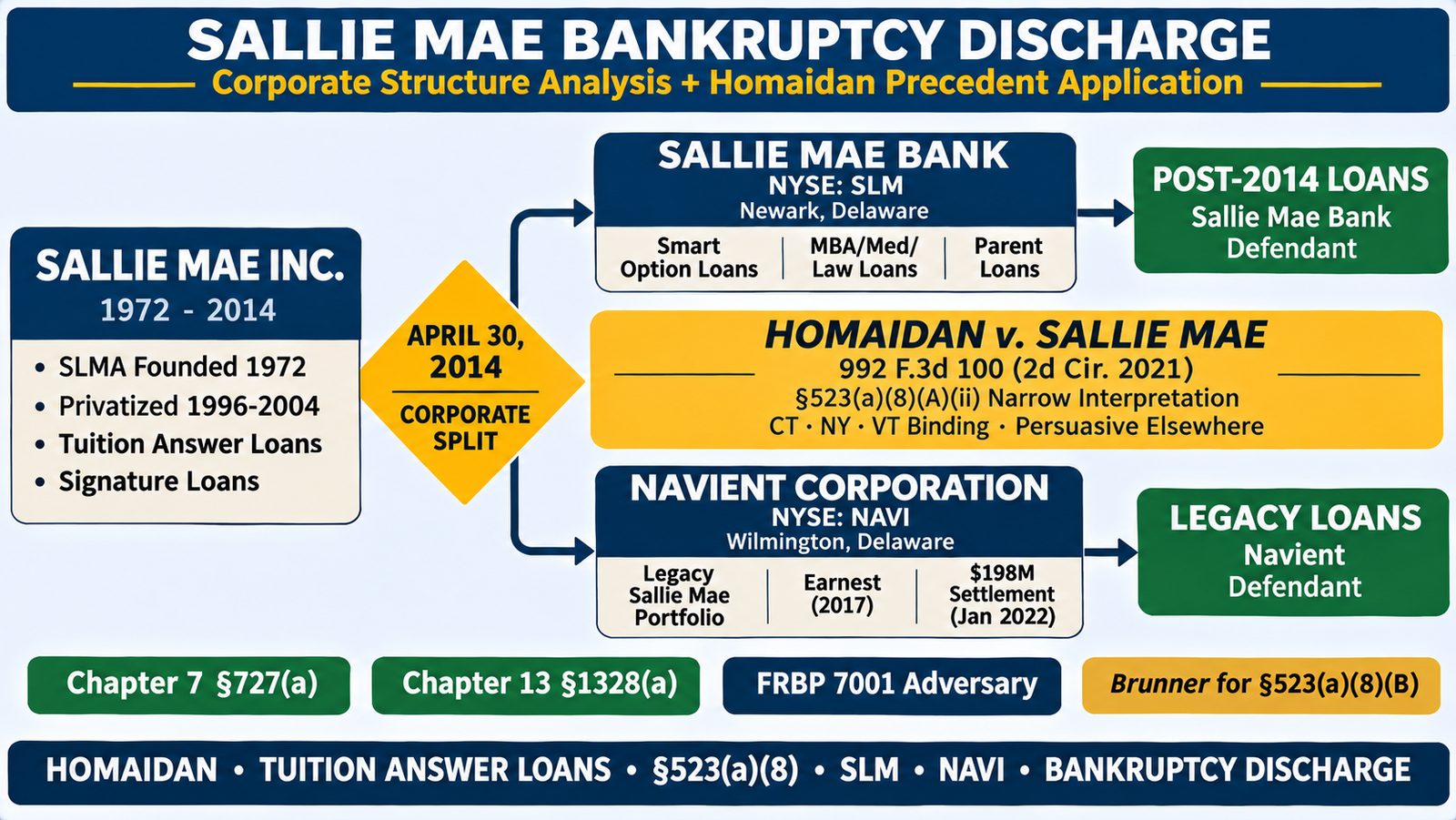
Sallie Mae bankruptcy discharge: Framework for discharging Sallie Mae-originated private student loans through 11 U.S.C. §523(a)(8) analysis with direct Homaidan v. Sallie Mae Inc. 992 F.3d 100 (2d Cir. 2021) precedent application. FRAMEWORK: (1) Sallie Mae corporate history — pre-2014 Sallie Mae Inc. originated loans including Tuition Answer Loans (the Homaidan loan type), Signature Student Loans, Smart Option Student Loans; 2014 corporate split created Sallie Mae Bank (NYSE:SLM, Newark DE, retained bank operations) and Navient Corporation (NYSE:NAVI, inherited servicing portfolio); (2) Loan identification — identify specific loan product (Tuition Answer, Signature, Smart Option), origination date, current servicer (Sallie Mae Bank, Navient, Firstmark Services, or NCSLT trust); (3) §523(a)(8) framework application — §523(a)(8)(A)(i) governmental unit analysis (Sallie Mae loans typically private, not governmental), §523(a)(8)(A)(ii) educational benefit analysis under Homaidan narrow interpretation (Tuition Answer Loans excluded from §523(a)(8)(A)(ii) scope per Homaidan direct precedent, dischargeable without undue hardship in Second Circuit binding and persuasive elsewhere), §523(a)(8)(B) qualified education loan analysis under IRC §221(d)(1) if attended qualifying educational institution; (4) Chapter 7 framework — means test under §707(b)(2), §362 automatic stay, 341 meeting, §523(a)(8) adversary proceeding required under FRBP 7001; (5) Brunner adversary for §523(a)(8) qualifying loans with In re Rosenberg modernization and DOJ 2022 guidance; (6) Settlement vs bankruptcy — Sallie Mae typically settles 25-50% range with bankruptcy preparation leverage; (7) Adversary proceeding strategy — Sallie Mae Bank/Navient defendant service under FRBP 7004, discovery focused on Tuition Answer Loan characteristics and §523(a)(8) analysis; (8) Chapter 7 vs Chapter 13 strategic choice with §1328(a) plan completion discharge for Chapter 13. Homaidan direct precedent provides strongest framework foundation for Sallie Mae legacy loans.
Read the complete Sallie Mae bankruptcy framework below.
In this complete Sallie Mae bankruptcy guide:
Sallie Mae corporate history and structure
Pre-2014 Sallie Mae Inc. vs post-2014 split (SLM/NAVI)
Sallie Mae loan product characteristics
Tuition Answer, Signature, Smart Option loan analysis
Homaidan direct precedent application
Named-defendant analysis under §523(a)(8)(A)(ii)
Chapter 7 vs Chapter 13 strategic choice
Framework selection for Sallie Mae loan discharge
Brunner adversary for qualifying loans
Undue hardship analysis for §523(a)(8) loans
Adversary proceeding strategy
Sallie Mae Bank defendant service and litigation
Settlement vs bankruptcy coordination
Hybrid strategy for optimal Sallie Mae outcomes
Sallie Mae corporate history and structure
Understanding Sallie Mae bankruptcy analysis requires knowledge of Sallie Mae’s corporate history and current structure. The company underwent significant transformation in 2014 that affects loan ownership and servicing today.
Pre-2014 Sallie Mae Inc.
Pre-2014 Sallie Mae Inc. history: (1) originally Student Loan Marketing Association (SLMA) chartered by Congress 1972 as government-sponsored enterprise for secondary market federal student loan purchases; (2) privatized through Student Loan Marketing Association Reorganization Act of 1996, becoming SLM Corporation (Sallie Mae); (3) completed privatization 2004 with full private company status; (4) originated federal and private student loans directly to consumers and through educational institutions; (5) private loan products included Tuition Answer Loans, Signature Student Loans, Smart Option Student Loans, direct-to-consumer loan products; (6) Hilal Homaidan’s $12.567 Tuition Answer Loans 2003-2007 originated during this era; (7) pre-2014 Sallie Mae Inc. was single corporate entity handling both bank operations and loan servicing; (8) significant private loan origination volume accumulated during this period. Pre-2014 origination is critical era for Homaidan framework application.
2014 corporate split
2014 corporate split (effective April 30, 2014): (1) SLM Corporation split into two separate public companies via tax-free spinoff; (2) Sallie Mae Bank (NYSE:SLM) — retained consumer banking operations, new loan origination, Newark Delaware headquarters; (3) Navient Corporation (NYSE:NAVI) — inherited education loan management, loan servicing including federal loans, legacy Sallie Mae loan portfolio, business processing solutions, Wilmington Delaware headquarters; (4) legacy Sallie Mae Inc. loans transferred to Navient for servicing; (5) new private student loan origination continued under Sallie Mae Bank; (6) corporate split created clear division between bank (Sallie Mae Bank/SLM) and servicer (Navient/NAVI) for subsequent analysis; (7) legacy loans retain original Sallie Mae Inc. origination terms but under Navient servicing; (8) new loans post-2014 remain Sallie Mae Bank obligations throughout. Understanding corporate split essential for identifying current loan responsibility.
Post-2014 Sallie Mae Bank operations
Post-2014 Sallie Mae Bank operations: (1) NYSE:SLM national bank charter; (2) Newark Delaware headquarters; (3) continues private student loan origination as primary business; (4) Smart Option Student Loan is primary current product; (5) Parent Loan option available; (6) MBA Loan, Medical School Loan, Dental School Loan, Law School Loan specialty products; (7) direct-to-consumer and institution-partner origination channels; (8) handles own servicing for new loans (does NOT transfer to Navient); (9) Sallie Mae Bank is defendant in bankruptcy adversary proceedings for post-2014 origination. Current Sallie Mae Bank obligations handled directly by SLM, not Navient.
Navient legacy portfolio
Navient legacy portfolio: (1) Navient Corporation NYSE:NAVI inherited legacy Sallie Mae Inc. loan servicing April 2014; (2) servicing includes both federal loans (through late 2021) and private loans; (3) December 2021 federal loan servicing transferred to Aidvantage (Navient subsidiary) and ultimately to Maximus Federal for federal servicing contract; (4) private loan portfolio continued under Navient direct servicing; (5) Earnest Operations LLC acquired by Navient 2017 for $155 million — separate loan origination and refinance brand; (6) January 13, 2022 $198M multi-state settlement with 39 state attorneys general ($1.85B total including $1.7B debt cancellation 66.000 borrowers plus $95M restitution) addressed Navient’s handling of federal loan services and some private loan practices; (7) Navient is defendant in bankruptcy adversary proceedings for legacy Sallie Mae Inc. loans serviced by Navient; (8) legacy loan analysis requires original loan documentation from Sallie Mae Inc. plus Navient servicing records. Navient inherits legacy Sallie Mae Inc. loan obligations through servicing relationship.
Sallie Mae loan product characteristics
Different Sallie Mae loan products have different §523(a)(8) analytical implications. Identifying specific Sallie Mae student loan bankruptcy product is essential for framework application.
Tuition Answer Loans (Homaidan loans)
Tuition Answer Loans — the Homaidan loan product: (1) Sallie Mae private student loan product originated pre-2014; (2) Hilal Homaidan received $12.567 in Tuition Answer Loans between 2003-2007 while attending Emerson College; (3) Second Circuit analysis in Homaidan v. Sallie Mae Inc. 992 F.3d 100 (2d Cir. 2021) specifically addressed Tuition Answer Loan characteristics; (4) Second Circuit held Tuition Answer Loans are NOT “obligation to repay funds received as educational benefit, scholarship, or stipend” under §523(a)(8)(A)(ii) because: (a) loans must be repaid regardless of education outcome (unlike conditional educational benefits); (b) direct cash loans not scholarships or stipends; (c) narrow interpretation required for discharge exceptions; (5) Tuition Answer Loans directly covered by Homaidan precedent in Second Circuit (binding CT/NY/VT); (6) persuasive authority elsewhere; (7) identifying Tuition Answer Loan in borrower’s documentation triggers Homaidan analysis; (8) borrowers with Tuition Answer Loans have strongest framework foundation. Tuition Answer Loan identification is foundational for strongest §523(a)(8) analysis.
Signature Student Loans
Signature Student Loans: (1) Sallie Mae private student loan product originated pre-2014; (2) similar direct-to-consumer loan structure as Tuition Answer Loans; (3) analyzed under same §523(a)(8)(A)(ii) framework as Tuition Answer Loans; (4) Homaidan reasoning applies — direct cash loans must be repaid regardless of education outcome; (5) not “obligation to repay funds received as educational benefit, scholarship, or stipend”; (6) typical loan amounts larger than Tuition Answer Loans; (7) may include non-cosigner and cosigner versions; (8) analysis requires original loan documentation from Sallie Mae Inc. Signature Student Loans benefit from Homaidan framework application.
Smart Option Student Loans
Smart Option Student Loans: (1) current primary Sallie Mae Bank private student loan product; (2) origination continues through Sallie Mae Bank post-2014; (3) available for undergraduate, graduate, and specialty school education; (4) features in-school payment options, fixed and variable rates; (5) typically requires school certification of enrollment and cost of attendance; (6) §523(a)(8) analysis differs from Tuition Answer Loans — Smart Option Student Loans may qualify as “qualified education loan” under IRC §221(d)(1) if school-certified amounts not exceeding cost of attendance at qualifying institution; (7) if qualified, falls within §523(a)(8)(B) scope requiring Brunner undue hardship analysis; (8) if not qualified (amounts exceed cost of attendance, non-qualifying institution, or other IRC §221(d)(1) failures), may be dischargeable without undue hardship under §523(a)(8)(B) analysis. Smart Option analysis requires careful IRC §221(d)(1) compliance review.
Career training and specialty loans
Career training and specialty loans: (1) Sallie Mae originated private loans for specific education categories including: career training, vocational schools, professional schools (MBA, Medical School, Dental School, Law School); (2) career training loans for non-degree programs analyzed for IRC §221(d)(1) qualifying institution status — programs not meeting qualifying institution requirements may fall outside §523(a)(8)(B) scope; (3) loans to non-Title IV institutions typically outside §523(a)(8)(B) scope (institution not “eligible” under IRC §221(d)(1)); (4) loans for courses not leading to degree or recognized credential may fail qualifying expenses under IRC §221(d)(1); (5) professional school loans typically qualifying institution but amount analysis required; (6) specialty analysis critical for non-degree or non-traditional program loans; (7) Homaidan framework applies to career training loans as direct cash loans; (8) §523(a)(8)(B) failure provides alternative discharge framework. Specialty loan analysis requires careful institution and program qualification review.
Homaidan direct precedent application
Homaidan v. Sallie Mae Inc. 992 F.3d 100 (2d Cir. 2021) is unique among §523(a)(8) precedents because Sallie Mae was the actual named defendant. This direct precedent provides strongest foundation for discharge sallie mae loans framework application.
Second Circuit binding authority
Second Circuit binding authority application: (1) Homaidan decided March 24, 2021 by Second Circuit panel including Judge Susan Carney (opinion author); (2) binding on all federal courts within Second Circuit including bankruptcy courts in Connecticut, New York, Vermont; (3) SCOTUS denied certiorari — decision stands as final authority on §523(a)(8)(A)(ii) interpretation in Second Circuit; (4) binding on all Sallie Mae loan analysis in Second Circuit — Sallie Mae cannot argue different interpretation applies; (5) specifically addresses Tuition Answer Loans — direct loan product precedent; (6) Second Circuit borrowers with Sallie Mae loans have strongest framework application available; (7) attorney familiar with Homaidan essential for Second Circuit cases; (8) adversary proceeding filing against Sallie Mae in Second Circuit begins with Homaidan controlling precedent. Second Circuit cases have decisive binding authority foundation.
Fifth and Tenth Circuit parallel authority
Fifth and Tenth Circuit parallel authority: (1) Crocker v. Navient Solutions LLC 941 F.3d 206 (5th Cir. October 21, 2019) — Fifth Circuit adopted similar narrow §523(a)(8)(A)(ii) interpretation; binding TX/LA/MS; (2) McDaniel v. Navient Solutions LLC 973 F.3d 1083 (10th Cir. August 31, 2020) — Tenth Circuit adopted similar framework; binding CO/KS/NM/OK/UT/WY; (3) both decisions involved Navient as defendant for legacy Sallie Mae Inc. loans; (4) parallel authority strengthens Homaidan framework application nationally; (5) Sallie Mae loans in Crocker/McDaniel Circuits analyzed under Fifth/Tenth Circuit precedent; (6) consistent Circuit agreement across three Circuits (Second, Fifth, Tenth) provides persuasive authority elsewhere; (7) borrowers in Second/Fifth/Tenth Circuits have strongest framework foundation; (8) other Circuits have persuasive but not binding authority. Multi-Circuit agreement strengthens framework application.
Persuasive authority in other Circuits
Persuasive authority in other Circuits: (1) Homaidan/Crocker/McDaniel provide persuasive but not binding authority in other Circuits; (2) multiple lower court decisions in other Circuits have adopted similar reasoning; (3) In re Page 592 B.R. 334 (Bankr. N.D. Ill. 2018) — early narrow interpretation; (4) various bankruptcy court decisions nationwide following Homaidan framework; (5) persuasive authority increases as more Circuits adopt framework; (6) Sallie Mae cases in other Circuits still benefit from persuasive authority but face greater uncertainty; (7) attorney familiar with framework history essential for persuasive authority cases; (8) local bankruptcy court judge’s prior rulings on §523(a)(8) analysis particularly important. Persuasive authority provides framework foundation but with less certainty than binding precedent.
Sallie Mae’s strategic response
Sallie Mae’s strategic response to Homaidan: (1) Sallie Mae/Navient have adjusted post-Homaidan litigation posture; (2) typically more open to pre-adversary settlement negotiations than pre-Homaidan; (3) settlement range typically 25-45% of balance for Homaidan-qualifying loans; (4) recognition of Homaidan precedent affects case assessment; (5) Sallie Mae/Navient still contest §523(a)(8) adversary proceedings but with recognition of Homaidan framework; (6) bankruptcy preparation leverage significant — credible threat of Homaidan adversary strengthens settlement position; (7) hybrid settlement-bankruptcy approach often optimal; (8) attorney with Sallie Mae-specific experience valuable. Sallie Mae’s post-Homaidan response creates opportunity for strategic positioning.
Chapter 7 vs Chapter 13 strategic choice
For sallie mae bank bankruptcy analysis, Chapter 7 vs Chapter 13 strategic choice depends on borrower circumstances and discharge framework.
Chapter 7 framework for Sallie Mae loans
Chapter 7 framework for Sallie Mae loans: (1) Chapter 7 provides immediate discharge framework — typically 3-6 months from filing to §727(a) discharge order; (2) requires means test qualification under §707(b)(2); (3) §523(a)(8) adversary proceeding required to establish Sallie Mae loan dischargeability; (4) Homaidan framework application for qualifying Tuition Answer/Signature/direct-to-consumer loans — discharge without undue hardship; (5) Brunner undue hardship adversary for qualifying Smart Option or §523(a)(8)(B) loans; (6) adversary proceeding typically filed shortly after §362 automatic stay or within discharge deadline (60 days post-341 meeting); (7) favorable Chapter 7 outcome: complete discharge of Sallie Mae loan obligation; (8) Chapter 7 preferred when borrower qualifies via means test. Chapter 7 provides fastest resolution for qualifying borrowers.
Chapter 13 framework for Sallie Mae loans
Chapter 13 framework for Sallie Mae loans: (1) Chapter 13 provides 3-5 year plan framework with §1328(a) discharge at plan completion; (2) available when means test fails or Chapter 13 strategically preferred; (3) same §523(a)(8) framework applies — adversary proceeding required to establish Sallie Mae loan dischargeability; (4) adversary proceeding can be filed during plan period or at plan completion; (5) Homaidan framework application same as Chapter 7; (6) Chapter 13 provides additional features: mortgage cure under §1322(b)(5), auto cram-down under §1325(a)(5), asset protection, business ownership preservation; (7) longer timeline but same ultimate discharge if §523(a)(8) adversary succeeds; (8) debt eligibility limits apply: unsecured below $465.275, secured below $1.395.875 as of 2024. Chapter 13 provides alternative path with additional protections.
Strategic factors for Chapter choice
Strategic factors for Chapter choice: (1) Means test qualification — if Chapter 7 means test fails, Chapter 13 required; (2) Asset protection needs — assets above state exemptions may require Chapter 13; (3) Mortgage or auto arrears — Chapter 13 provides §1322(b)(5) cure and §1325(a)(5) cram-down unavailable in Chapter 7; (4) Business ownership — Chapter 13 preserves business operations; (5) Timeline preference — Chapter 7 faster (3-6 months) vs Chapter 13 (3-5 years); (6) Cost considerations — Chapter 7 base fees $1.500-$3.500 vs Chapter 13 $3.000-$6.000; (7) Credit impact — Chapter 7 on report 10 years, Chapter 13 7 years per FCRA; (8) Prior bankruptcy history — §727(a)(8) 8-year Chapter 7 restriction; §1328(f) Chapter 13 restrictions. Strategic analysis requires attorney evaluation of specific circumstances.
Chapter 20 hybrid strategy
Chapter 20 hybrid strategy consideration: (1) “Chapter 20” is informal term for sequential Chapter 7 then Chapter 13 filing; (2) first file Chapter 7 for immediate discharge of dischargeable unsecured debts (credit cards, Homaidan-qualifying Sallie Mae loans); (3) then file Chapter 13 shortly after for mortgage cure, auto cram-down, non-dischargeable debt management; (4) complex strategy requiring attorney coordination; (5) §1328(f) restrictions limit Chapter 13 discharge availability after Chapter 7; (6) however, Chapter 13 can still provide plan for non-dischargeable debts even without §1328(a) discharge; (7) particularly useful when Chapter 7 provides Sallie Mae loan discharge but borrower needs Chapter 13 features for other debts; (8) requires experienced attorney coordination. Chapter 20 provides advanced strategy for complex situations.
Brunner adversary for qualifying loans
For Sallie Mae loans falling within §523(a)(8) categories (not excluded by Homaidan), Brunner undue hardship analysis provides discharge framework. Modernized Brunner application enables realistic discharge path for qualifying Sallie Mae loans.
When Brunner applies to Sallie Mae loans
When Brunner applies to Sallie Mae loans: (1) loans not excluded by Homaidan analysis under §523(a)(8)(A)(ii); (2) Smart Option Student Loans meeting qualified education loan requirements under IRC §221(d)(1) — qualifying institution under IRC §221(d)(2), eligible student, qualified higher education expenses, amount not exceeding cost of attendance; (3) specialty loans for qualifying graduate/professional school (MBA, Medical, Dental, Law) typically within §523(a)(8)(B) scope; (4) other Sallie Mae loans meeting §523(a)(8)(B) criteria; (5) for these loans, Brunner three-part undue hardship test required; (6) In re Rosenberg 594 B.R. 22 (Bankr. S.D.N.Y. 2020) modernized framework through Judge Cecelia G. Morris; (7) DOJ November 17, 2022 undue hardship guidance three-factor framework; (8) attorney Brunner evaluation essential for §523(a)(8)(B) qualifying loans. Brunner provides discharge path for §523(a)(8)(B) qualifying Sallie Mae loans.
Modernized Brunner elements for Sallie Mae cases
Modernized Brunner elements for Sallie Mae cases: (1) Element 1 — Minimal standard of living — modernized to “modest-but-humane” standard, not destitution; debtor cannot maintain reasonable standard with Sallie Mae payment; (2) Element 2 — Persistence of inability — modernized to “significant portion of repayment period,” not permanent inability; rejected certainty of hopelessness gloss; (3) Element 3 — Good faith efforts — modernized to reasonable efforts, not unreasonable standards; good faith shown by payment attempts, communication with Sallie Mae/Navient, consideration of alternatives, financial responsibility; (4) all three elements required but modernized interpretation significantly more achievable; (5) complete or partial discharge available under §105(a); (6) expert witness coordination (vocational, medical, financial) strengthens case; (7) attorney with Brunner-specific experience essential; (8) DOJ 2022 guidance adopted by some courts even in private loan cases. Modernized Brunner provides realistic discharge path for qualifying Sallie Mae loans.
Expert witness coordination
Expert witness coordination for Brunner cases: (1) Vocational expert — labor market analysis, earning capacity projection, employment prospect analysis; typical fee $2.000-$5.000; (2) Medical expert — treating physicians for medical conditions affecting employment; retained experts for complex conditions; typical fee $1.500-$5.000+; (3) Financial expert/CPA — income/expense analysis, Form 982 preparation, financial projections; typical fee $500-$2.500; (4) expert reports support Brunner elements analysis; (5) expert testimony at adversary trial; (6) coordinated expert presentation strengthens case; (7) expert fees significant cost — typically $3.000-$10.000+ for comprehensive expert coordination; (8) attorney coordination essential for expert selection and preparation. Expert coordination essential for strong Brunner case presentation.
Partial discharge under §105(a)
Partial discharge under 11 U.S.C. §105(a) for Sallie Mae cases: (1) when complete Brunner discharge not achievable, partial discharge may be available under §105(a) general equitable authority; (2) In re Educational Credit Management Corp. v. Mosley 494 F.3d 1320 (11th Cir. 2007) established partial discharge framework; (3) reasonable discharge amount with remaining manageable balance; (4) partial discharge preserves essential loan repayment capability while discharging unmanageable portion; (5) court analysis balances borrower circumstances with creditor interests; (6) particularly useful when total Sallie Mae loan balance exceeds realistic repayment capacity but some payment possible; (7) partial discharge preserves creditor position on discharged portion; (8) attorney advocacy for partial discharge in close cases. Partial discharge provides flexibility when complete discharge uncertain.
Adversary proceeding strategy
For homaidan sallie mae adversary proceeding against Sallie Mae Bank or Navient as servicer, strategic preparation and execution affects case outcome.
Defendant identification and service
Defendant identification and service: (1) determine current loan owner — Sallie Mae Bank for post-2014 origination, Navient for legacy Sallie Mae Inc. loans typically, NCSLT trusts for sold loans, debt buyers for charged-off loans; (2) check current servicer identification on recent statements/payment demands; (3) PACER search for recent Sallie Mae/Navient bankruptcy involvement in jurisdiction; (4) service under FRBP 7004 — 7-day service period, mail service to corporate officer; (5) Sallie Mae Bank registered agent service for post-2014 loans; (6) Navient registered agent service for legacy Sallie Mae Inc. loans; (7) NCSLT trusts served through U.S. Bank NA as indenture trustee and designated subservicer; (8) proper defendant identification critical — wrong defendant means delays and potentially dismissal. Defendant identification research essential before adversary filing.
Complaint framework
Complaint framework for Sallie Mae adversary: (1) FRBP 7001(6) scope — adversary to determine dischargeability of debt; (2) factual allegations: borrower identity, loan origination details (date, amount, product type, education program), current loan holder, servicer; (3) legal allegations: §523(a)(8) analysis framework (§523(a)(8)(A)(i) governmental unit analysis, §523(a)(8)(A)(ii) educational benefit analysis under Homaidan narrow interpretation, §523(a)(8)(B) qualified education loan analysis under IRC §221(d)(1)); (4) specific loan characteristic allegations: Tuition Answer vs Signature vs Smart Option vs other product identification, direct-to-consumer origination, cost of attendance comparison, institution qualification status; (5) alternative pleading for Brunner undue hardship if §523(a)(8) categories apply; (6) prayer for relief — declaratory judgment of dischargeability, injunctive relief under §524(a)(2); (7) comply with Twombly/Iqbal plausibility standards; (8) comprehensive complaint provides case foundation. Well-drafted complaint sets case trajectory.
Discovery focus for Sallie Mae cases
Discovery focus for Sallie Mae cases: (1) FRBP 7026(a)(1) initial disclosures; (2) FRBP 7033 interrogatories (25 limit) focused on: loan origination details, product classification, cost of attendance information, institution qualification analysis, servicer ownership transfers, internal §523(a)(8) analysis; (3) FRBP 7034 document requests focused on: original loan agreement, promissory note, application, cost of attendance certification, institution certification, ownership assignment chain, servicing records; (4) FRBP 7030 depositions (7 hr, 10 per party) of Sallie Mae/Navient corporate representatives on loan origination practices, product distinctions, Homaidan compliance; (5) FRBP 7036 requests for admission on loan characteristics, origination details, product classifications; (6) focused discovery on specific framework application; (7) discovery often reveals helpful Sallie Mae/Navient internal documents and practices; (8) attorney coordination for strategic discovery. Discovery essential for case preparation.
Trial preparation and presentation
Trial preparation and presentation for Sallie Mae adversary: (1) legal arguments — Homaidan direct precedent, §523(a)(8) framework analysis, IRC §221(d)(1) qualified education loan analysis; (2) factual presentation — borrower loan documentation, product identification, financial circumstances; (3) expert witnesses — vocational, medical, financial experts for Brunner cases; (4) direct examination of borrower on financial circumstances, loan history, payment efforts; (5) cross-examination of Sallie Mae/Navient witnesses on loan origination, product classification, framework compliance; (6) legal brief with Homaidan framework application; (7) oral argument preparation; (8) trial typically 1-3 days for adversary proceeding. Thorough trial preparation enables effective case presentation. Full adversary process detailed in our Student Loan Adversary Proceeding guide.
Settlement vs bankruptcy coordination
For optimal sallie mae tuition answer loans and other Sallie Mae loan resolution, coordinated settlement and bankruptcy approach often provides best outcome.
Sallie Mae settlement framework
Sallie Mae settlement framework: (1) Sallie Mae/Navient typically open to settlement negotiations with proper leverage; (2) settlement range typically 25-50% of balance for private loans; (3) Homaidan-qualifying loans settle in lower range (25-35%) due to strong discharge position; (4) §523(a)(8)(B) loans settle in middle range (35-45%); (5) loans with strong Brunner facts settle in middle range; (6) weak discharge position loans settle higher (45-55%); (7) settlement typically requires lump-sum payment or short-term payment plan; (8) settlement forgiven amount creates COD income under IRC §61(a)(12) with potential insolvency exclusion under IRC §108(a)(1)(B). Settlement provides faster resolution than full adversary litigation.
Bankruptcy leverage for settlement
Bankruptcy leverage for settlement: (1) credible bankruptcy threat strengthens settlement negotiation position significantly; (2) Sallie Mae/Navient assessment considers probability of §523(a)(8) adversary proceeding success; (3) Homaidan precedent means Sallie Mae/Navient know Tuition Answer and direct-to-consumer loans likely dischargeable; (4) attorney preparation of adversary proceeding filing creates immediate leverage; (5) even without actual filing, documented preparation and framework analysis affects negotiation; (6) typical result: settlement offer substantially below balance with reasonable payment terms; (7) hybrid approach — settlement attempt first, bankruptcy filing if settlement inadequate; (8) PSR coordination manages hybrid strategy. Bankruptcy leverage decisively affects settlement outcomes.
Hybrid approach timing
Hybrid approach timing for Sallie Mae cases: (1) typical sequence — settlement negotiation attempt first, bankruptcy filing if settlement fails or inadequate; (2) settlement negotiation typically 30-90 days; (3) if settlement reached, no bankruptcy filing necessary — settlement completes resolution; (4) if settlement inadequate (too high amount, unreasonable terms), proceed with bankruptcy filing; (5) bankruptcy filing provides additional leverage — settlement often improves after filing but before adversary completion; (6) if settlement not reached, adversary proceeding to completion; (7) timing allows maximum flexibility; (8) attorney coordination essential across settlement attempts and bankruptcy preparation. Hybrid approach optimizes outcomes across both paths.
PSR coordination for Sallie Mae cases
Private Student Relief coordination for Sallie Mae cases: (1) PSR partner network handles both settlement path (through attorney-backed partner provider Panamerican Consulting LLC Las Vegas NV) and bankruptcy path (through qualified bankruptcy attorney referrals); (2) initial free eligibility review via /apply/ identifies optimal approach; (3) Sallie Mae-specific analysis — product identification, servicer analysis, Homaidan applicability, Brunner analysis for §523(a)(8)(B) loans, Chapter 7 vs Chapter 13 strategy, settlement vs bankruptcy strategic choice; (4) coordinated settlement attempt through Panamerican Consulting LLC; (5) bankruptcy attorney referral through qualified network if bankruptcy path indicated; (6) hybrid coordination when optimal; (7) no upfront fees for initial review; (8) 48 states served (not SC or MS). Comprehensive Sallie Mae coordination through PSR streamlines complex cases.
Related resources — complete bankruptcy cluster
Homaidan v Sallie Mae 2026: Complete Analysis
The Second Circuit precedent directly naming Sallie Mae as defendant.
Private Student Loan Bankruptcy 2026: Complete Guide (PILAR)
The 7-path master framework covering all private student loan bankruptcy mechanisms.
Sallie Mae Settlement 2026 Complete Guide
Settlement path alternative or complement to bankruptcy for Sallie Mae loans.
Common Sallie Mae bankruptcy myths
Myth 1
“Sallie Mae loans cannot be discharged in bankruptcy”
Reality: Sallie Mae loans CAN be discharged in bankruptcy under specific frameworks. Homaidan v. Sallie Mae Inc. 992 F.3d 100 (2d Cir. 2021) specifically addressed Sallie Mae Tuition Answer Loans and held they are NOT within §523(a)(8)(A)(ii) “educational benefit” scope — making them dischargeable without undue hardship requirement in Second Circuit (binding CT/NY/VT) with persuasive authority elsewhere. Similar analysis applies to Signature Student Loans, direct-to-consumer loans, and other Sallie Mae products that don’t meet all §523(a)(8) categories. For Smart Option Student Loans and other loans meeting §523(a)(8)(B) qualified education loan requirements under IRC §221(d)(1), Brunner undue hardship analysis under modernized framework (In re Rosenberg 594 B.R. 22, DOJ November 2022 guidance) provides discharge path. The “cannot be discharged” myth is outdated — current framework provides multiple discharge paths for Sallie Mae loans. Framework-specific attorney essential for proper analysis.
Myth 2
“The Navient settlement discharged my Sallie Mae private loans”
Reality: The Navient $198 million multi-state settlement announced January 13, 2022 with 39 state attorneys general ($1.85 billion total including $1.7 billion debt cancellation for 66.000 borrowers plus $95 million restitution) primarily addressed Navient’s handling of FEDERAL student loan services and some predatory private loan practices. The settlement did NOT provide general discharge of Sallie Mae private student loans. Most private Sallie Mae/Navient loans remain outstanding obligations unaffected by the settlement. Settlement eligibility was narrow — specific borrower categories (certain career training loans, specific loan types from specific time periods) received debt cancellation. Most Sallie Mae private loan borrowers must pursue individual discharge through: (1) bankruptcy adversary proceeding under §523(a)(8) framework; (2) individual settlement negotiation with Sallie Mae/Navient; (3) Brunner undue hardship analysis for §523(a)(8)(B) qualifying loans. Check specific settlement participation status at navientsettlement.com — but assume loans not covered unless specifically notified. Separate discharge strategy required for most Sallie Mae loans.
Myth 3
“My Sallie Mae loan became a Navient loan — I need to file against Navient only”
Reality: Defendant identification depends on current loan ownership and servicer relationship, not transferred corporate identity. After 2014 Sallie Mae corporate split (effective April 30, 2014): (1) legacy Sallie Mae Inc. loan servicing transferred to Navient Corporation — Navient is proper defendant as current servicer/owner for most legacy Sallie Mae Inc. loans; (2) Sallie Mae Bank (NYSE:SLM) retained new origination capability — Sallie Mae Bank is proper defendant for post-2014 origination; (3) NCSLT trusts (2003-1 through 2007-4) may own certain legacy Sallie Mae loans through securitization — U.S. Bank NA as indenture trustee is proper defendant for NCSLT-owned loans; (4) debt buyers may own charged-off accounts — debt buyer is proper defendant for accounts purchased from Sallie Mae/Navient; (5) Firstmark Services may service certain loans — service identification matters. Proper defendant identification essential for successful adversary proceeding under FRBP 7004 service requirements. Loan documentation review (recent statements, payment demands, collection letters) identifies current servicer. Attorney coordination typically necessary for proper defendant identification.
Myth 4
“I should settle before filing bankruptcy — bankruptcy is always the last resort”
Reality: Settlement vs bankruptcy choice for Sallie Mae loans depends on specific circumstances — bankruptcy is sometimes better first choice, sometimes last resort, sometimes coordinated hybrid approach is optimal. Settlement advantages: faster resolution (30-90 days typical), avoids bankruptcy credit impact (10 years Chapter 7, 7 years Chapter 13), preserves professional licenses and security clearances, avoids bankruptcy stigma. Settlement disadvantages: typically only partial debt resolution (25-50% range), requires lump sum or short payment plan, creates COD income under IRC §61(a)(12) with potential insolvency exclusion complexity, doesn’t address other debts. Bankruptcy advantages: complete discharge framework (Chapter 7 immediate under §727(a), Chapter 13 at plan completion under §1328(a)), addresses all unsecured debts not just Sallie Mae, IRC §108(a)(1)(A) complete tax exclusion without insolvency calculation, automatic stay under §362 stops all collection activity immediately. Bankruptcy disadvantages: credit impact 7-10 years per FCRA, attorney/filing fees ($5.000-$15.000+ contested adversary case), court process 3-18 months for adversary proceeding. For Homaidan-qualifying loans, bankruptcy often provides superior outcome (complete discharge vs partial settlement). For borrowers with multiple debts beyond Sallie Mae, bankruptcy coordinates all debt resolution. Attorney analysis of specific circumstances determines optimal approach.
Frequently asked questions
1. Can Sallie Mae loans be discharged in bankruptcy?
Yes, Sallie Mae bankruptcy discharge is possible through specific frameworks under 11 U.S.C. §523(a)(8). Homaidan v. Sallie Mae Inc. 992 F.3d 100 (2d Cir. 2021) provides direct precedent — Sallie Mae Tuition Answer Loans and similar direct-to-consumer loans are NOT within §523(a)(8)(A)(ii) “educational benefit” scope, making them dischargeable without undue hardship in Second Circuit (binding CT/NY/VT) with persuasive authority elsewhere through Crocker v. Navient 941 F.3d 206 (5th Cir. 2019) binding TX/LA/MS and McDaniel v. Navient 973 F.3d 1083 (10th Cir. 2020) binding CO/KS/NM/OK/UT/WY. For Smart Option Student Loans and other loans meeting qualified education loan requirements under IRC §221(d)(1), Brunner v. New York State HESC 831 F.2d 395 undue hardship framework applies with In re Rosenberg 594 B.R. 22 (Bankr. S.D.N.Y. 2020) modernization and DOJ November 2022 guidance. Adversary proceeding under FRBP 7001 required to establish dischargeability. Discharge through Chapter 7 (§727(a) immediate) or Chapter 13 (§1328(a) at plan completion). Attorney coordination essential for framework application.
2. What is Homaidan v. Sallie Mae and why does it matter?
Homaidan v. Sallie Mae Inc. 992 F.3d 100 (2d Cir. March 24, 2021) is the Second Circuit decision that fundamentally transformed private student loan dischargeability analysis. Case facts: Hilal Homaidan received $12.567 in Sallie Mae Tuition Answer Loans between 2003-2007 while attending Emerson College; filed Chapter 7 bankruptcy 2007 in Eastern District of New York; received §727(a) discharge 2009; post-discharge Sallie Mae/Navient continued collection activity. Homaidan filed adversary proceeding challenging continued collection as discharge injunction violation under §524(a)(2). Second Circuit held: (1) Tuition Answer Loans are NOT “obligation to repay funds received as educational benefit, scholarship, or stipend” under §523(a)(8)(A)(ii); (2) narrow interpretation of discharge exceptions required under Kawaauhau v. Geiger 523 U.S. 57; (3) direct cash loans must be repaid regardless of education outcome, unlike conditional educational benefits; (4) decision binding in Second Circuit, SCOTUS cert denied. Why it matters: direct precedent naming Sallie Mae as defendant; provides strongest framework foundation for Sallie Mae loan analysis; applies to all similar direct-to-consumer private loan products; parallel authority through Crocker (5th Cir) and McDaniel (10th Cir); creates significant settlement leverage. For detailed analysis see our Homaidan v Sallie Mae Complete Analysis.
3. What’s the difference between Sallie Mae Bank and Navient?
Sallie Mae Bank and Navient became separate public companies on April 30, 2014 via tax-free corporate spinoff: (1) Sallie Mae Bank (NYSE:SLM) — retained consumer banking operations and new private student loan origination; headquartered in Newark, Delaware; national bank charter; continues Smart Option Student Loan origination as primary product; handles own servicing for new loans post-2014; (2) Navient Corporation (NYSE:NAVI) — inherited education loan management and legacy servicing portfolio from Sallie Mae Inc.; headquartered in Wilmington, Delaware; serviced federal loans through late 2021 then transferred federal servicing to Aidvantage; continues private loan servicing for legacy Sallie Mae Inc. portfolio; acquired Earnest Operations LLC 2017 for $155 million as refinance subsidiary. For bankruptcy analysis: post-2014 origination loans remain Sallie Mae Bank obligations (Sallie Mae Bank is defendant); legacy Sallie Mae Inc. loans servicing transferred to Navient (Navient typically defendant); some legacy loans in NCSLT trusts (U.S. Bank NA indenture trustee as defendant); charged-off accounts may be with debt buyers. Loan documentation identifies current servicer. Proper defendant identification essential for adversary proceeding.
4. How do I identify my specific Sallie Mae loan type?
Loan identification essential for framework application: (1) Review original loan documentation — promissory note, loan agreement, approval letter name specific loan product (Tuition Answer Loans, Signature Student Loans, Smart Option Student Loans, Career Training Loans, specialty school loans); (2) Check origination date — pre-2014 origination typically Sallie Mae Inc. (now Navient-serviced); post-2014 origination Sallie Mae Bank; (3) Verify current servicer — recent statements, payment demands, collection letters identify current servicer (Sallie Mae Bank, Navient, Firstmark Services, debt buyer); (4) Check cost of attendance comparison — if loan amount approximates or exceeds school’s certified cost of attendance for enrollment period, may fall outside §523(a)(8)(B) qualified education loan definition under IRC §221(d)(1); (5) Verify institution qualification status — Title IV eligible higher education institution (confirms IRC §221(d)(2) qualifying institution); (6) Check school certification — school-certified loans within cost of attendance more likely to meet IRC §221(d)(1) requirements; (7) Credit bureau pull — Experian, Equifax, TransUnion show loan accounts with original lender and current servicer identification; (8) Attorney coordination — qualified attorney can access additional documentation through discovery if needed. Comprehensive loan identification enables proper framework analysis.
5. What should I do if Sallie Mae/Navient refuses to settle?
If Sallie Mae/Navient refuses settlement or offers inadequate terms, bankruptcy framework provides alternative resolution: (1) Confirm settlement rejection or inadequate offer — attempt multiple rounds of negotiation with proper attorney leverage; (2) Document Homaidan framework applicability — specific loan product identification, Circuit precedent analysis, adversary proceeding preparation; (3) File Chapter 7 or Chapter 13 bankruptcy — depending on means test qualification under §707(b)(2) and strategic factors; (4) File §523(a)(8) adversary proceeding under FRBP 7001 with Homaidan framework (for direct-to-consumer loans) or Brunner framework (for §523(a)(8)(B) qualifying loans); (5) Pursue adversary through discovery and trial — Sallie Mae/Navient often settle during litigation at better terms than pre-filing offers; (6) Obtain discharge — favorable adversary outcome produces complete discharge of Sallie Mae debt; (7) §524(a)(2) enforcement if post-discharge collection attempts — Taggart v. Lorenzen 587 U.S. 554 “no fair ground of doubt” standard for civil contempt sanctions; (8) PSR coordination provides attorney referral and strategy analysis for Sallie Mae/Navient resistant cases. Refused settlement often leads to better bankruptcy outcome.
6. How much does Sallie Mae bankruptcy discharge cost?
Sallie Mae bankruptcy discharge cost varies by Chapter, adversary proceeding complexity, and jurisdiction: (1) Chapter 7 base attorney fees — $1.500-$3.500 typical range covering means test, petition, 341 meeting, standard discharge; (2) Chapter 13 base attorney fees — $3.000-$6.000 covering plan preparation, confirmation, 3-5 year supervision, discharge; local “no-look” fees $3.500-$5.500 common; (3) §523(a)(8) adversary proceeding — additional $2.000-$5.000 beyond base fees; complex contested cases can exceed $10.000; (4) Expert witness fees (for Brunner cases) — vocational $2.000-$5.000, medical $1.500-$5.000+, financial $500-$2.500; (5) Filing fees — Chapter 7 $338, Chapter 13 $313, adversary proceeding $350; (6) Total contested adversary Chapter 7 — typical $5.000-$15.000+ including all costs; (7) Credit counseling courses — $25-$50 required pre-filing and pre-discharge; (8) Deposition and discovery costs — $500-$2.000+ depending on case complexity. Cost significant but typically justified by potential discharge value for substantial Sallie Mae loan debt. For $50.000+ Sallie Mae debt, successful discharge provides substantial economic benefit relative to litigation cost.
7. How does PSR help with Sallie Mae cases?
Private Student Relief coordinates comprehensive Sallie Mae case analysis and resolution through attorney-backed partner network: (1) Free initial eligibility review via /apply/ form — 5-minute no-obligation assessment of Sallie Mae case specifics; (2) Sallie Mae-specific analysis — specific loan product identification (Tuition Answer Loans, Signature Student Loans, Smart Option Student Loans, specialty loans), origination era (pre-2014 Sallie Mae Inc. vs post-2014 Sallie Mae Bank), current servicer (Sallie Mae Bank, Navient, Firstmark Services, debt buyer), Homaidan framework applicability analysis, §523(a)(8)(B) qualified education loan analysis under IRC §221(d)(1) for Smart Option loans, Brunner adversary analysis for qualifying loans, means test analysis for Chapter 7 qualification; (3) Settlement path coordination through attorney-backed partner provider (Panamerican Consulting LLC, Las Vegas NV) — typical Sallie Mae settlement range 25-50% with Homaidan leverage; (4) Bankruptcy attorney referral through qualified partner network — NACBA members, ABC-certified Consumer Bankruptcy specialists, state bar bankruptcy specialists with specific §523(a)(8) adversary proceeding experience and Homaidan framework familiarity; (5) Hybrid coordination when optimal — settlement attempt with bankruptcy preparation leverage; (6) No upfront fees for initial review; (7) 48 states served (not South Carolina, not Mississippi); (8) Attorney-client relationship established directly with chosen attorney — PSR provides qualified matching while preserving borrower choice. PSR streamlines complex Sallie Mae cases through established attorney network and comprehensive framework analysis.
Need Sallie Mae Discharge?
Free specialist review of Sallie Mae bankruptcy discharge framework with direct Homaidan precedent analysis.
Complete Sallie Mae case analysis coordinating: Sallie Mae corporate history analysis (pre-2014 Sallie Mae Inc. vs post-2014 corporate split effective April 30, 2014 creating Sallie Mae Bank NYSE:SLM Newark Delaware headquartered with retained bank operations and new private student loan origination, and Navient Corporation NYSE:NAVI Wilmington Delaware headquartered with inherited legacy servicing portfolio, Earnest Operations LLC acquired 2017 for $155 million, December 2021 federal loan servicing transfer to Aidvantage); specific loan product identification analysis (Tuition Answer Loans — the Homaidan loan product from Hilal Homaidan $12.567 Emerson College 2003-2007 case facts, Signature Student Loans direct-to-consumer loan product similar framework, Smart Option Student Loan current Sallie Mae Bank primary product, career training and specialty loans including MBA/Medical/Dental/Law School products); §523(a)(8) framework application with Homaidan v. Sallie Mae Inc. 992 F.3d 100 (2d Cir. March 24, 2021) direct precedent analysis (Judge Carney opinion establishing narrow interpretation of §523(a)(8)(A)(ii) “educational benefit” exception, binding in Second Circuit CT/NY/VT, SCOTUS cert denied); parallel Circuit authority through Crocker v. Navient Solutions LLC 941 F.3d 206 (5th Cir. October 21, 2019) binding Texas/Louisiana/Mississippi and McDaniel v. Navient Solutions LLC 973 F.3d 1083 (10th Cir. August 31, 2020) binding Colorado/Kansas/New Mexico/Oklahoma/Utah/Wyoming; §523(a)(8)(B) qualified education loan analysis under IRC §221(d)(1) for Smart Option and other school-certified loans including qualifying educational institution verification under IRC §221(d)(2), eligible student status, cost of attendance comparison, qualified higher education expense analysis; Brunner v. New York State Higher Education Services Corp. 831 F.2d 395 (2d Cir. 1987) undue hardship three-part test with In re Rosenberg 594 B.R. 22 (Bankr. S.D.N.Y. 2020) Judge Cecelia G. Morris modernization including modest-but-humane standard rejection of destitution requirement, significant portion vs permanence requirement rejection of certainty of hopelessness gloss, reasonable efforts vs unreasonable standards; DOJ November 17, 2022 undue hardship guidance three-factor framework (current ability to pay, likelihood of future ability to pay, good faith efforts); partial discharge framework under 11 U.S.C. §105(a) and In re Educational Credit Management Corp. v. Mosley 494 F.3d 1320 (11th Cir. 2007); means test under §707(b)(2) with Chapter 7 vs Chapter 13 strategic choice analysis; adversary proceeding strategy under FRBP 7001 including defendant identification (Sallie Mae Bank for post-2014 loans, Navient Corporation for legacy Sallie Mae Inc. loans, NCSLT trusts through U.S. Bank NA indenture trustee for securitized loans, debt buyers for charged-off accounts), FRBP 7004 service requirements, complaint drafting under Twombly/Iqbal plausibility standards, FRBP 7026/7030/7033/7034/7036 discovery coordination, trial preparation under Federal Rules of Evidence; settlement vs bankruptcy coordination with typical Sallie Mae settlement range 25-50% leveraging Homaidan precedent; hybrid settlement-bankruptcy approach optimization; coordination with Chapter 20 sequential filing strategy; IRC §108(a)(1)(A) complete bankruptcy tax exclusion vs IRC §108(a)(1)(B) insolvency exclusion for settlements; §524(a)(2) post-discharge enforcement under Taggart v. Lorenzen 587 U.S. 554 (2019) “no fair ground of doubt” standard; FCRA 15 USC §1681c credit reporting (Chapter 7 10 years, Chapter 13 7 years). Free eligibility review with no upfront fees. 48 states served. Attorney-backed partner provider for settlement path (Panamerican Consulting LLC Las Vegas NV). Bankruptcy filing coordinated through qualified bankruptcy attorney referral.
Get a free eligibility review →
5-minute review · No obligation · Zero upfront fees · Since 2015 · 48 states served
About the author
Henry Silva — Private Student Loan Debt Specialist
10+ years analyzing Sallie Mae bankruptcy discharge framework under 11 U.S.C. §523(a)(8) with direct application of Homaidan v. Sallie Mae Inc. 992 F.3d 100 (2d Cir. 2021) — the controlling Second Circuit precedent decided March 24, 2021 by panel including Judge Susan Carney (opinion author) that specifically named Sallie Mae as defendant and addressed Sallie Mae Tuition Answer Loan characteristics. Deep expertise in: Sallie Mae corporate history including pre-2014 Sallie Mae Inc. era (originally Student Loan Marketing Association chartered 1972 as government-sponsored enterprise, privatized through 1996 Student Loan Marketing Association Reorganization Act becoming SLM Corporation, completed privatization 2004, originated federal and private student loans directly to consumers and through educational institutions, Hilal Homaidan’s $12.567 Tuition Answer Loans 2003-2007 originated during this era), 2014 corporate split effective April 30, 2014 via tax-free spinoff creating Sallie Mae Bank NYSE:SLM Newark Delaware headquartered with retained consumer banking operations and new private student loan origination and Navient Corporation NYSE:NAVI Wilmington Delaware headquartered with inherited education loan management and legacy servicing portfolio including federal loans through late 2021 and private loan portfolio with Earnest Operations LLC acquired 2017 for $155 million as refinance subsidiary and December 2021 federal loan servicing transfer to Aidvantage subsidiary and ultimately Maximus Federal; specific Sallie Mae loan product analysis including Tuition Answer Loans (the Homaidan loan product analyzed by Second Circuit as NOT within §523(a)(8)(A)(ii) “educational benefit” scope because direct cash loans must be repaid regardless of education outcome unlike conditional educational benefits), Signature Student Loans (similar direct-to-consumer structure analyzed under same Homaidan framework), Smart Option Student Loans (current Sallie Mae Bank primary product with potential §523(a)(8)(B) qualified education loan analysis under IRC §221(d)(1) if school-certified amounts not exceeding cost of attendance at qualifying institution under IRC §221(d)(2)), career training and specialty loans (MBA Loan, Medical School Loan, Dental School Loan, Law School Loan, vocational school loans with institution qualification analysis); §523(a)(8) framework application with Homaidan direct precedent in Second Circuit (binding Connecticut/New York/Vermont) and Crocker v. Navient Solutions LLC 941 F.3d 206 (5th Cir. October 21, 2019) binding Texas/Louisiana/Mississippi and McDaniel v. Navient Solutions LLC 973 F.3d 1083 (10th Cir. August 31, 2020) binding Colorado/Kansas/New Mexico/Oklahoma/Utah/Wyoming with persuasive authority elsewhere; §523(a)(8)(B) qualified education loan analysis under IRC §221(d)(1) qualifying institution verification under IRC §221(d)(2), eligible student status verification, cost of attendance comparison, qualified higher education expense analysis; Brunner v. New York State Higher Education Services Corp. 831 F.2d 395 (2d Cir. 1987) three-part undue hardship test with In re Rosenberg 594 B.R. 22 (Bankr. S.D.N.Y. 2020) Judge Cecelia G. Morris modernization through Kevin Rosenberg case (~$221.000 federal debt/~$37.000 income) and DOJ November 17, 2022 undue hardship guidance three-factor framework; partial discharge under 11 U.S.C. §105(a) and In re Educational Credit Management Corp. v. Mosley 494 F.3d 1320 (11th Cir. 2007); Chapter 7 means test under §707(b)(2) vs Chapter 13 plan under §1322 with §1328(a) plan completion discharge strategic analysis; Chapter 20 sequential filing strategy (Chapter 7 followed by Chapter 13) for complex cases; adversary proceeding strategy under FRBP 7001-9019 including defendant identification (Sallie Mae Bank registered agent for post-2014 origination, Navient Corporation registered agent for legacy Sallie Mae Inc. loans servicing, NCSLT trusts 2003-1 through 2007-4 through U.S. Bank NA indenture trustee and TSI designated subservicer for securitized loans, debt buyers for charged-off accounts), FRBP 7004 service requirements (7-day period, mail service to corporate officer), complaint drafting under Bell Atlantic Corp. v. Twombly 550 U.S. 544 (2007) and Ashcroft v. Iqbal 556 U.S. 662 (2009) plausibility standards, FRBP 7026/7030/7033/7034/7036 discovery coordination including 25 interrogatory limit and 10 deposition per party limit with 7-hour duration, trial preparation under Federal Rules of Evidence (FRE 702 expert witness Daubert standards, FRE 801-807 hearsay with FRE 803(6) business records exception, FRE 901 authentication); expert witness coordination (vocational $2.000-$5.000, medical $1.500-$5.000+, financial/CPA $500-$2.500); settlement vs bankruptcy coordination with typical Sallie Mae/Navient settlement range 25-50% of balance for private loans with Homaidan-qualifying loans settling in 25-35% range due to strong discharge position; Navient $198 million multi-state settlement January 13, 2022 with 39 state attorneys general ($1.85 billion total including $1.7 billion debt cancellation for 66.000 borrowers plus $95 million restitution) scope analysis primarily addressing federal loan services with some private loan practices; IRC §108(a)(1)(A) complete bankruptcy tax exclusion vs IRC §108(a)(1)(B) insolvency exclusion for settlements; §524(a)(2) post-discharge enforcement under Taggart v. Lorenzen 587 U.S. 554 (2019) “no fair ground of doubt” standard for civil contempt sanctions; FCRA 15 USC §1681c credit reporting (Chapter 7 10 years, Chapter 13 7 years). Henry coordinates Sallie Mae case analysis through PSR partner network with settlement path through attorney-backed partner provider Panamerican Consulting LLC Las Vegas NV and bankruptcy path through qualified bankruptcy attorney referrals matching borrower geography (48 states served, not South Carolina or Mississippi) and case complexity including specific §523(a)(8) adversary proceeding experience, Homaidan framework familiarity as direct precedent, Brunner case track record for §523(a)(8)(B) qualifying loans, trial capability for adversary proceedings.
Legal Disclaimer and Sources
This article is provided for informational purposes only and does not constitute legal, tax, or financial advice. Private Student Relief is a consulting and matching organization operated by Joco (555 Anton Blvd, Suite 368, Costa Mesa, CA 92626) — not a law firm, bankruptcy filing service, debt settlement company, debt consolidation company, or loan provider. Sallie Mae Bank NYSE:SLM (national bank charter, Newark Delaware headquartered), Navient Corporation NYSE:NAVI (Wilmington Delaware headquartered), and Earnest Operations LLC (Navient subsidiary since 2017 $155 million acquisition) are public corporations referenced for historical corporate structure and operational analysis only — not endorsed, affiliated, or sponsored by Private Student Relief. Debt validation services for settlement path are performed by an attorney-backed partner provider (Panamerican Consulting LLC, Las Vegas, NV) under independent business credentials. Ratings, BBB accreditation, and AADR (American Association for Debt Resolution) membership referenced on the PSR website belong to the partner provider. Bankruptcy filing and §523(a)(8) adversary proceeding require licensed bankruptcy attorney in borrower’s jurisdiction. Individual results vary. Since 2015. 48 states served. Not available in South Carolina or Mississippi.
Sallie Mae corporate history: Student Loan Marketing Association (SLMA) chartered by Congress 1972 as government-sponsored enterprise for secondary market federal student loan purchases; privatized through Student Loan Marketing Association Reorganization Act of 1996 becoming SLM Corporation (Sallie Mae); completed privatization 2004 with full private company status; 2014 corporate split effective April 30, 2014 via tax-free spinoff into Sallie Mae Bank NYSE:SLM (retained consumer banking operations and new private student loan origination, Newark Delaware headquartered, national bank charter) and Navient Corporation NYSE:NAVI (inherited education loan management, loan servicing including federal loans through late 2021 and legacy Sallie Mae Inc. private loan portfolio, business processing solutions, Wilmington Delaware headquartered). Navient subsequent corporate actions: Earnest Operations LLC acquired 2017 for $155 million as separate loan origination and refinance brand; December 2021 federal loan servicing transferred to Aidvantage (Navient subsidiary) with ultimate federal servicing contract to Maximus Federal; January 13, 2022 $198 million multi-state settlement with 39 state attorneys general ($1.85 billion total including $1.7 billion debt cancellation for 66.000 borrowers plus $95 million restitution) primarily addressed federal loan services with some private loan practices. Current Sallie Mae Bank product lineup: Smart Option Student Loan (primary current product), Parent Loan, MBA Loan, Medical School Loan, Dental School Loan, Law School Loan specialty products. Pre-2014 Sallie Mae Inc. product lineup included Tuition Answer Loans (the Homaidan loan type), Signature Student Loans, various specialty and direct-to-consumer loan products.
Bankruptcy Code references: 11 U.S.C. §105(a) (general equitable authority and partial discharge); 11 U.S.C. §362 (automatic stay); 11 U.S.C. §362(k) (stay violation sanctions); 11 U.S.C. §523(a)(8) (student loan discharge exceptions including §523(a)(8)(A)(i) governmental unit, §523(a)(8)(A)(ii) educational benefit per Homaidan narrow interpretation, §523(a)(8)(B) qualified education loan per IRC §221(d)(1)); 11 U.S.C. §524(a)(2) (discharge injunction); 11 U.S.C. §541 (bankruptcy estate); 11 U.S.C. §706(a) (conversion between Chapters); 11 U.S.C. §707(b)(2) (means test); 11 U.S.C. §727(a) (Chapter 7 general discharge); 11 U.S.C. §727(a)(8) (8-year Chapter 7 discharge restriction); 11 U.S.C. §1301 et seq. (Chapter 13 framework); 11 U.S.C. §1322 (Chapter 13 plan requirements); 11 U.S.C. §1322(b)(5) (mortgage cure); 11 U.S.C. §1325(a)(5) (secured claims and auto cram-down with 910-day rule); 11 U.S.C. §1328 (Chapter 13 discharge framework); 11 U.S.C. §1328(a) (plan completion discharge); 11 U.S.C. §1328(f) (prior bankruptcy restrictions). Federal Rules of Bankruptcy Procedure: FRBP 7001 (adversary proceeding scope including 7001(6) dischargeability); FRBP 7003 (commencement); FRBP 7004 (service with 7-day period and mail service to corporate officer); FRBP 7012 (answer 30-day deadline); FRBP 7026 (discovery scope); FRBP 7030 (depositions with 7-hour duration and 10 per party limit); FRBP 7033 (interrogatories with 25 limit); FRBP 7034 (document requests); FRBP 7036 (requests for admission); FRBP 7056 (summary judgment); FRBP 9017 (Federal Rules of Evidence); FRBP 9019 (settlement approval).
Key appellate precedent: Homaidan v. Sallie Mae Inc. 992 F.3d 100 (2d Cir. March 24, 2021) — Judge Susan Carney opinion establishing narrow interpretation of §523(a)(8)(A)(ii) “educational benefit” exception, binding in Second Circuit CT/NY/VT, SCOTUS cert denied; Crocker v. Navient Solutions LLC 941 F.3d 206 (5th Cir. October 21, 2019) binding TX/LA/MS; McDaniel v. Navient Solutions LLC 973 F.3d 1083 (10th Cir. August 31, 2020) binding CO/KS/NM/OK/UT/WY; Brunner v. New York State Higher Education Services Corp. 831 F.2d 395 (2d Cir. 1987) undue hardship three-part test; In re Rosenberg 594 B.R. 22 (Bankr. S.D.N.Y. 2020) modernized Brunner application through Judge Cecelia G. Morris; In re Educational Credit Management Corp. v. Mosley 494 F.3d 1320 (11th Cir. 2007) partial discharge framework under §105(a); In re Page 592 B.R. 334 (Bankr. N.D. Ill. 2018) early narrow §523(a)(8)(A)(ii) interpretation; Bell Atlantic Corp. v. Twombly 550 U.S. 544 (2007) and Ashcroft v. Iqbal 556 U.S. 662 (2009) pleading plausibility; Taggart v. Lorenzen 587 U.S. 554 (2019) §524(a)(2) “no fair ground of doubt” civil contempt standard; Grogan v. Garner 498 U.S. 279 (1991) preponderance standard for dischargeability; Kawaauhau v. Geiger 523 U.S. 57 (1998) discharge exceptions narrow construction. Internal Revenue Code: IRC §61(a)(12) COD baseline; IRC §108(a)(1)(A) complete bankruptcy tax exclusion; IRC §108(a)(1)(B) insolvency exclusion for settlements; IRC §221(d)(1) qualified education loan definition including §221(d)(2) qualifying institution under 20 USC §1088.
Attorney fee structures referenced current as of 2026: Chapter 7 base attorney fees typical $1.500-$3.500 range varying by jurisdiction and case complexity; Chapter 13 base attorney fees typical $3.000-$6.000 range with local court “no-look” fees establishing presumptive reasonable attorney fees paid through plan ($3.500-$5.500 common); §523(a)(8) adversary proceeding fees typical additional $2.000-$5.000 with complex contested cases exceeding $10.000; expert witness fees — vocational expert $2.000-$5.000, medical expert $1.500-$5.000+, financial/CPA expert $500-$2.500; filing fees — Chapter 7 $338, Chapter 13 $313, adversary proceeding $350; typical contested Sallie Mae adversary case total cost $5.000-$15.000+; typical Sallie Mae/Navient settlement range 25-50% of balance for private loans with Homaidan-qualifying loans in lower range (25-35%) and §523(a)(8)(B) loans in middle range (35-45%). All fee amounts subject to periodic adjustments and jurisdictional variation. Sallie Mae bankruptcy discharge application requires case-by-case analysis coordinating specific loan product identification, Sallie Mae corporate structure analysis, servicer identification for defendant naming, §523(a)(8) framework application with Homaidan direct precedent evaluation, §523(a)(8)(B) qualified education loan analysis under IRC §221(d)(1), Brunner undue hardship analysis for qualifying loans with In re Rosenberg modernization and DOJ 2022 guidance, Chapter 7 vs Chapter 13 strategic choice under §707(b)(2) means test, adversary proceeding strategy under FRBP 7001 with proper defendant identification and FRBP 7004 service, settlement vs bankruptcy strategic coordination with typical 25-50% settlement range, IRC §108 tax exclusion coordination, §524(a)(2) post-discharge enforcement protection. This article provides general framework information; specific Sallie Mae case analysis and bankruptcy filing requires consultation with licensed bankruptcy attorney in borrower’s jurisdiction. Last reviewed: October 2026.