

Informational content only. Not legal, tax, or financial advice. Private Student Relief is a consulting and matching organization, not a law firm. Bankruptcy filing requires licensed bankruptcy attorney in borrower’s jurisdiction. Attorney recommendations and PSR partner network referrals coordinate borrower access to qualified bankruptcy counsel. Last reviewed: October 2026.
Written by Henry Silva
Private Student Loan Debt Specialist · 10+ years coordinating private student loan bankruptcy lawyer referrals through attorney-backed partner network across all U.S. jurisdictions. Deep expertise in attorney qualification evaluation including National Association of Consumer Bankruptcy Attorneys (NACBA) membership significance, American Bankruptcy Institute (ABI) professional affiliations, American Board of Certification (ABC) bankruptcy specialization, state bar board-certified bankruptcy specialists, 11 U.S.C. §523(a)(8) adversary proceeding experience evaluation with Homaidan v. Sallie Mae 992 F.3d 100 (2d Cir. 2021) framework familiarity, Brunner v. New York State HESC 831 F.2d 395 (2d Cir. 1987) three-part test litigation experience, attorney fee structure analysis (Chapter 7 base $1.500-$3.500, Chapter 13 base $3.000-$6.000, adversary proceeding additional $2.000-$5.000), local bankruptcy court rules familiarity, trial experience evaluation, client communication expectations. Last reviewed: October 2026.
Private student loan bankruptcy lawyer selection is critical decision affecting discharge outcome. Not all bankruptcy attorneys have equivalent experience with 11 U.S.C. §523(a)(8) adversary proceedings, Homaidan v. Sallie Mae 992 F.3d 100 (2d Cir. 2021) framework application, or Brunner v. New York State HESC 831 F.2d 395 (2d Cir. 1987) undue hardship litigation. Many bankruptcy attorneys handle Chapter 7 and Chapter 13 filings routinely but have limited student loan adversary proceeding experience — a significant gap when private student loan discharge is central to case strategy. Qualified student loan bankruptcy attorney brings specific expertise: §523(a)(8) framework knowledge (Homaidan narrow interpretation, §523(a)(8)(B) qualified education loan analysis under IRC §221(d)(1), Brunner undue hardship test with Rosenberg modernization and DOJ 2022 guidance), adversary proceeding litigation experience under Federal Rules of Bankruptcy Procedure 7001, means test analysis under §707(b)(2), state exemption analysis, Chapter 7 vs Chapter 13 strategic choice, expert witness coordination (vocational, medical, financial). Professional affiliations (NACBA, ABI, ABC certification) and state bar specializations help identify qualified counsel. This complete 2026 guide covers how to find qualified private student loan bankruptcy lawyer: professional qualifications analysis, consultation question framework, fee structure evaluation, red flags identification, coordination with PSR attorney-backed partner network, and strategic attorney selection process for optimal case outcome.
Quick Answer
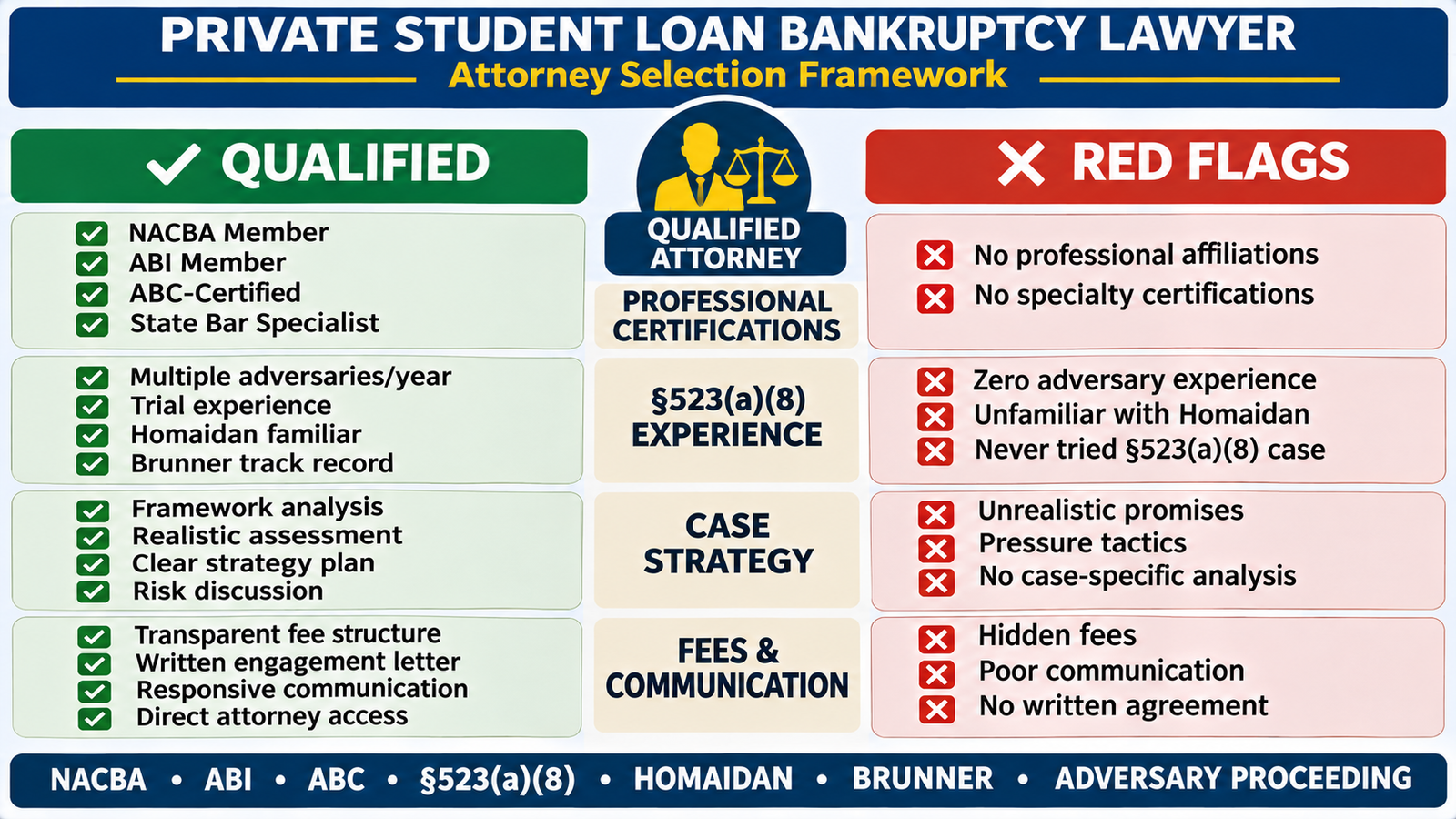
Private student loan bankruptcy lawyer: Specialized bankruptcy attorney with specific experience in 11 U.S.C. §523(a)(8) adversary proceedings for discharging private student loans through Homaidan v. Sallie Mae 992 F.3d 100 (2d Cir. 2021) framework or Brunner v. New York State HESC 831 F.2d 395 (2d Cir. 1987) undue hardship test. SELECTION FRAMEWORK: (1) Professional qualifications — National Association of Consumer Bankruptcy Attorneys (NACBA) membership, American Bankruptcy Institute (ABI) membership, American Board of Certification (ABC) consumer bankruptcy certification, state bar board-certified bankruptcy specialist designation; (2) Specific experience — §523(a)(8) adversary proceeding track record, Homaidan framework application cases, Brunner undue hardship litigation history, successful discharge outcomes for private student loans, trial experience in bankruptcy adversary proceedings; (3) Consultation questions — How many §523(a)(8) adversary proceedings have you filed? What percentage of your practice involves student loan dischargeability? Are you familiar with Homaidan v. Sallie Mae and its Circuit application? Have you litigated Brunner adversary proceedings? What’s your success rate for private student loan discharge? Are you familiar with In re Rosenberg modernization and DOJ 2022 guidance? What experts do you typically engage? (4) Fee structure — Chapter 7 base attorney fees $1.500-$3.500, Chapter 13 base $3.000-$6.000, §523(a)(8) adversary proceeding additional $2.000-$5.000, expert witness fees $2.000-$7.500+, total adversary cost $5.000-$15.000+; (5) Red flags — attorney unfamiliar with Homaidan framework, no §523(a)(8) adversary proceeding experience, pressure to file without proper framework analysis, unrealistic promises about outcomes, fee structure not clearly explained, poor communication, insufficient attention to specific case details; (6) PSR coordination — attorney-backed partner network provides access to qualified bankruptcy attorney referrals matching borrower geography and case complexity. Attorney selection decisively affects discharge outcome — invest time in proper selection process rather than selecting first available attorney.
Read the complete attorney selection framework below.
In this complete attorney selection guide:
Professional qualifications and certifications
NACBA, ABI, ABC, state bar specializations
Specific student loan experience evaluation
§523(a)(8) adversary track record, Homaidan/Brunner cases
Consultation questions framework
What to ask about experience, approach, and strategy
Fee structure analysis
Chapter 7, Chapter 13, adversary proceeding, expert fees
Red flags in attorney selection
Warning signs to avoid unqualified representation
Local rules familiarity and trial experience
Jurisdiction-specific factors for case success
PSR partner network coordination
Attorney-backed referral process and matching framework
Professional qualifications and certifications
When evaluating a student loan bankruptcy lawyer, professional qualifications and certifications provide objective evidence of expertise. Several key credentials indicate specialized bankruptcy practice.
National Association of Consumer Bankruptcy Attorneys (NACBA)
NACBA membership significance: (1) National Association of Consumer Bankruptcy Attorneys — professional organization for attorneys representing consumer debtors in bankruptcy; (2) membership requires active consumer bankruptcy practice; (3) provides continuing legal education specifically on consumer bankruptcy topics; (4) annual conferences cover latest developments including Homaidan framework, Brunner modernization, DOJ guidance; (5) member attorney directory at nacba.org helps borrowers identify specialized consumer bankruptcy attorneys; (6) NACBA actively advocates for consumer bankruptcy rights including student loan dischargeability; (7) members typically more current on evolving framework than general practitioners; (8) membership alone doesn’t guarantee student loan specialization but indicates consumer bankruptcy focus. NACBA membership is positive indicator but not sufficient alone — further specific student loan experience evaluation required.
American Bankruptcy Institute (ABI)
American Bankruptcy Institute membership: (1) multidisciplinary bankruptcy professional organization including attorneys, judges, academics, financial advisors; (2) over 10.000 members nationally; (3) provides extensive continuing education including Advanced Bankruptcy Workshops, Consumer Bankruptcy Committee programs; (4) publishes authoritative bankruptcy resources including ABI Journal and treatises; (5) ABI Consumer Bankruptcy Committee focuses on consumer practice issues; (6) member attorney directory at abi.org; (7) ABI membership indicates bankruptcy professional engagement but not consumer practice specialization specifically; (8) commonly held alongside NACBA membership for consumer bankruptcy attorneys. ABI membership is complementary indicator of professional engagement.
American Board of Certification (ABC)
American Board of Certification bankruptcy specialization: (1) non-profit organization certifying bankruptcy specialists; (2) Consumer Bankruptcy Law certification requires specific experience, examination, continuing education; (3) requirements include substantial bankruptcy practice experience, specific case volume, peer references, written examination, ongoing continuing education; (4) ABC-certified Consumer Bankruptcy specialists have demonstrated expertise; (5) certification requires 3-year renewal cycles with continuing education; (6) ABC-certified attorney directory at abcworld.org; (7) ABC-certified specialists typically among most qualified consumer bankruptcy attorneys; (8) relatively small number of certified specialists nationally — not widely available in all jurisdictions. ABC certification is strong positive indicator but not available in all areas.
State bar bankruptcy specialization
State bar bankruptcy specialization: (1) many state bars offer specialty certifications in bankruptcy law; (2) requirements vary by state but typically include substantial bankruptcy practice, examination, continuing education, peer evaluation; (3) states with bankruptcy specialization include California (State Bar Legal Specialization in Bankruptcy Law), Texas (Texas Board of Legal Specialization — Consumer Bankruptcy Law), Florida (The Florida Bar Business Litigation certification includes bankruptcy), North Carolina, Ohio, and others; (4) check specific state bar for available certifications; (5) state bar certification indicates recognized expertise within jurisdiction; (6) certified specialists must maintain ongoing continuing education and practice; (7) certification process typically rigorous. State bar certification is strong positive indicator in jurisdictions where available.
Specific student loan experience evaluation
Professional certifications establish general bankruptcy expertise, but bankruptcy attorney student loans selection requires evaluation of specific student loan dischargeability experience. Many qualified bankruptcy attorneys have limited §523(a)(8) adversary proceeding experience.
§523(a)(8) adversary proceeding track record
§523(a)(8) adversary proceeding track record evaluation: (1) ask how many §523(a)(8) adversary proceedings attorney has filed in recent years; (2) general bankruptcy attorney may file 0-5 §523(a)(8) adversaries throughout career; (3) specialized student loan attorney typically files 10-50+ §523(a)(8) adversaries per year; (4) ask for specific case outcomes (favorable discharge, partial discharge, denial, settlement); (5) ask about adversary proceeding stages experience (complaint drafting, discovery, motion practice, trial, appeal); (6) ask whether attorney has tried §523(a)(8) adversary to full completion including bench trial; (7) ask about outcomes in recent 12-24 months; (8) attorney without recent §523(a)(8) adversary experience less likely to have current framework expertise. Specific recent track record more important than general bankruptcy experience.
Homaidan framework familiarity
Homaidan framework familiarity evaluation: (1) ask attorney about Homaidan v. Sallie Mae Inc. 992 F.3d 100 (2d Cir. 2021) and its significance; (2) qualified attorney should immediately recognize case and explain §523(a)(8)(A)(ii) narrow interpretation; (3) ask about Circuit-specific application (Second Circuit binding, Fifth Circuit through Crocker, Tenth Circuit through McDaniel, persuasive elsewhere); (4) ask about direct-to-consumer loan characteristics identification for Homaidan qualification; (5) ask about §523(a)(8)(B) qualified education loan analysis under IRC §221(d)(1); (6) ask whether attorney has filed Homaidan-based adversary proceedings; (7) attorney unfamiliar with Homaidan is significant warning sign — framework is fundamental to private student loan dischargeability; (8) Homaidan expertise particularly important for Circuits with binding precedent. Homaidan familiarity is baseline requirement for current private student loan dischargeability expertise.
Brunner adversary proceeding experience
Brunner adversary proceeding experience evaluation: (1) ask about Brunner undue hardship adversary proceeding track record; (2) qualified attorney should know In re Rosenberg 594 B.R. 22 (Bankr. S.D.N.Y. 2020) modernization framework; (3) ask about DOJ November 17, 2022 undue hardship guidance familiarity; (4) ask about Eighth Circuit alternative totality-of-circumstances test if borrower in those states; (5) ask about expert witness coordination for Brunner cases (vocational, medical, financial experts); (6) ask about specific Brunner outcomes achieved including complete discharge and partial discharge under §105(a); (7) ask whether attorney has tried Brunner adversary to completion; (8) ask about experience with specific Brunner elements (minimal standard of living, persistence, good faith efforts). Brunner experience essential for loans falling within §523(a)(8) categories requiring undue hardship analysis.
Trial and appellate experience
Trial and appellate experience evaluation: (1) ask about actual trial experience in bankruptcy court; (2) many bankruptcy attorneys handle filings but rarely try cases; (3) credible trial threat affects creditor settlement posture; (4) ask about appellate experience to District Court, Bankruptcy Appellate Panel (BAP where available), Circuit Court of Appeals; (5) ask about specific trial victories; (6) ask about witness examination experience; (7) ask about expert witness direct examination and cross-examination experience; (8) trial-capable attorney provides stronger negotiating position even when case settles. Trial capability essential — attorneys unwilling or unable to try cases face systemic disadvantage in negotiations.
Consultation questions framework
Initial consultation is critical opportunity to evaluate how to find student loan bankruptcy lawyer qualifications. Prepared questions enable systematic evaluation of attorney expertise and fit.
Experience questions
Experience questions for consultation: (1) “How many years have you practiced consumer bankruptcy law?”; (2) “What percentage of your practice involves consumer bankruptcy?”; (3) “How many Chapter 7 cases have you handled in the last year? Chapter 13?”; (4) “How many §523(a)(8) student loan adversary proceedings have you filed in the last year?”; (5) “Are you a member of NACBA? ABI? Any other bankruptcy professional organizations?”; (6) “Do you hold ABC consumer bankruptcy certification? State bar bankruptcy specialization?”; (7) “How many §523(a)(8) adversaries have you tried to full bench trial?”; (8) “What’s your success rate for private student loan discharge in recent cases?”. Comprehensive experience questions reveal attorney’s actual practice focus.
Framework knowledge questions
Framework knowledge questions: (1) “Are you familiar with Homaidan v. Sallie Mae and its Circuit application?”; (2) “What’s your approach to analyzing §523(a)(8)(A)(ii) narrow interpretation under Homaidan?”; (3) “How do you analyze IRC §221(d)(1) qualified education loan requirements under §523(a)(8)(B)?”; (4) “Are you familiar with In re Rosenberg Brunner modernization framework?”; (5) “How do you apply DOJ November 2022 undue hardship guidance to private loan cases?”; (6) “What’s your experience with partial discharge under §105(a)?”; (7) “How do you coordinate Chapter 7 vs Chapter 13 strategy for private student loan cases?”; (8) “What experts do you typically engage for Brunner adversary proceedings?”. Framework knowledge questions test actual current expertise.
Strategy questions
Strategy questions for specific case: (1) “After reviewing my loan documentation, what framework do you think applies?”; (2) “What’s your recommended Chapter — 7 or 13 — and why?”; (3) “Should we file §523(a)(8) adversary proceeding, and if so, when?”; (4) “What settlement attempts should we make before adversary filing?”; (5) “What experts would you recommend for my case?”; (6) “What’s your estimated timeline from engagement to discharge?”; (7) “What are the specific risks in my case?”; (8) “What’s your realistic assessment of discharge probability?”. Strategy questions reveal attorney’s case-specific analysis capability and honesty.
Fee and communication questions
Fee and communication questions: (1) “What’s your fee structure for Chapter 7? Chapter 13? Adversary proceeding?”; (2) “What’s included in the base fee and what’s additional?”; (3) “How are expert witness fees handled?”; (4) “Can the fees be paid through Chapter 13 plan?”; (5) “Do you offer payment plans for retainer?”; (6) “Who will be the primary attorney on my case — you or an associate?”; (7) “How do you communicate with clients — phone, email, portal?”; (8) “What’s your typical response time for client questions?”. Fee and communication questions set expectations for engagement relationship.
Fee structure analysis
Understanding bankruptcy attorney fee structure is essential for hiring bankruptcy attorney student loans analysis. Fee structure varies significantly by Chapter, adversary proceeding requirements, and jurisdiction.
Chapter 7 base attorney fees
Chapter 7 base attorney fees: (1) typical range $1.500-$3.500 depending on jurisdiction and case complexity; (2) higher-cost markets (major metropolitan areas) typically $2.500-$4.500; (3) lower-cost markets (rural, smaller cities) typically $1.000-$2.500; (4) base fee covers: initial consultation, means test analysis, petition preparation, schedules, 341 meeting attendance, discharge coordination; (5) base fee does NOT typically cover: §523(a)(8) adversary proceeding, complex asset issues, appeal from objection to discharge, unusual complications; (6) flat fee most common for Chapter 7; (7) retainer typically required upfront ($500-$1.500 initial, remainder before filing); (8) filing fee $338 separate from attorney fees. Chapter 7 base fee is foundation of Chapter 7 bankruptcy cost.
Chapter 13 base attorney fees
Chapter 13 base attorney fees: (1) typical range $3.000-$6.000 depending on jurisdiction and case complexity; (2) higher than Chapter 7 due to 3-5 year plan supervision; (3) covers: initial consultation, means test, plan preparation and confirmation, 341 meeting, ongoing plan modifications, discharge coordination; (4) may not cover: §523(a)(8) adversary proceeding, complex plan modifications, defaults requiring extensive negotiation; (5) typically structured as retainer + portion through plan; (6) local bankruptcy court “no-look” fees establish presumptive reasonable attorney fees paid through plan ($3.500-$5.500 common); (7) extraordinary services require court approval under FRBP 2016; (8) filing fee $313 separate. Chapter 13 fee structure reflects extended representation period.
§523(a)(8) adversary proceeding fees
§523(a)(8) adversary proceeding fees: (1) typical additional $2.000-$5.000 beyond base Chapter 7 or Chapter 13 fees; (2) complex cases with substantial discovery and trial can exceed $10.000; (3) fee structure varies: flat fee, hourly, or hybrid; (4) adversary filing fee $350 separate; (5) covers: adversary complaint drafting, discovery coordination, motion practice, pretrial conferences, trial preparation, trial, decision; (6) may not cover: expert witness fees, appeals, extraordinary unforeseen complications; (7) hourly rates typically $250-$500 for specialized student loan attorneys ($150-$300 for less specialized); (8) Chapter 13 adversary fees may be paid through plan with court approval. Adversary fees are significant additional cost beyond base bankruptcy fees.
Expert witness and additional costs
Expert witness and additional costs: (1) Vocational expert — $2.000-$5.000 for retained vocational expert including report preparation and trial testimony; (2) Medical expert — $1.500-$5.000+ depending on complexity; treating physicians often sufficient with limited additional cost; (3) Financial expert/CPA — $500-$2.500 for comprehensive income/expense analysis and Form 982 preparation; (4) Deposition costs — court reporter fees $500-$2.000 per deposition; (5) Document copying and production — $200-$1.000; (6) Court filing fees — Chapter 7 $338, Chapter 13 $313, adversary $350; (7) Credit counseling courses — $25-$50 each; (8) Mailing and service costs — $100-$500. Total costs significantly exceed base attorney fees for contested cases.
Red flags in attorney selection
Recognizing warning signs helps avoid unqualified representation that could compromise discharge outcome. Several red flags should disqualify attorney from consideration for §523(a)(8) attorney role.
Framework unfamiliarity
Framework unfamiliarity red flags: (1) attorney not immediately familiar with Homaidan v. Sallie Mae; (2) attorney unable to explain §523(a)(8)(A)(ii) narrow interpretation significance; (3) attorney unaware of Circuit-specific application of Homaidan/Crocker/McDaniel; (4) attorney unaware of IRC §221(d)(1) qualified education loan definition; (5) attorney unfamiliar with In re Rosenberg Brunner modernization; (6) attorney unaware of DOJ November 2022 undue hardship guidance; (7) attorney relying on outdated “student loans not dischargeable” generalizations; (8) attorney unable to discuss specific recent §523(a)(8) case law developments. Framework unfamiliarity is disqualifying — private student loan discharge expertise essential for case success.
No §523(a)(8) adversary experience
No §523(a)(8) adversary experience red flags: (1) attorney has filed zero or very few §523(a)(8) adversary proceedings; (2) attorney has never tried §523(a)(8) adversary to full trial; (3) attorney suggests general Chapter 7 discharge will “automatically” cover student loans without adversary proceeding; (4) attorney uncertain about adversary proceeding mechanics under FRBP 7001; (5) attorney unfamiliar with expert witness coordination for Brunner cases; (6) attorney uncomfortable discussing adversary proceeding litigation strategy; (7) attorney suggests “wait and see” rather than proactive adversary filing. Inexperience with adversary proceedings significantly affects case outcome — proactive adversary filing typically essential for private student loan discharge.
Unrealistic promises or pressure tactics
Unrealistic promises or pressure tactics red flags: (1) attorney guarantees specific outcome (“your loans will be discharged”); (2) attorney promises specific discharge percentage; (3) attorney pressures quick filing without proper case preparation; (4) attorney downplays case complexity or risks; (5) attorney suggests undischargeable loans will be discharged without framework analysis; (6) attorney provides timeline shorter than realistic case duration; (7) attorney makes claims about judge preferences or guaranteed rulings; (8) attorney pressures immediate retainer payment without thorough consultation. Unrealistic promises indicate either incompetence or dishonesty — qualified attorneys provide realistic assessment including risks and uncertainties.
Fee and communication red flags
Fee and communication red flags: (1) fee structure not clearly explained in writing; (2) excessive fees significantly above market rates without justification; (3) demands for large cash payment without engagement letter; (4) refuses to provide written engagement agreement; (5) hidden fees or “additional charges” not disclosed upfront; (6) poor communication during consultation (not responding to questions, not listening to borrower circumstances); (7) delegating substantive work to unlicensed staff without disclosure; (8) attorney never available — always assistant or paralegal; (9) attorney with disciplinary history (check state bar for public records). Fee transparency and communication quality during consultation predict engagement experience.
Local rules familiarity and trial experience
Jurisdiction-specific factors significantly affect NACBA attorney selection analysis. Local bankruptcy court rules, judge preferences, and trial experience all affect case success.
Local bankruptcy court rules
Local bankruptcy court rules considerations: (1) each bankruptcy court has specific local rules supplementing Federal Rules of Bankruptcy Procedure; (2) local rules cover: filing procedures, form requirements, hearing scheduling, “no-look” fee structures, document formatting, electronic filing requirements; (3) attorney practicing regularly in specific court understands local rules and judge preferences; (4) attorney unfamiliar with local court may make procedural errors affecting case; (5) check whether attorney regularly files in specific bankruptcy court for borrower’s district; (6) local rules available on each court’s website; (7) PACER (Public Access to Court Electronic Records) allows checking attorney’s filing history in specific court; (8) local attorney bar associations often indicate local court familiarity. Local rules familiarity particularly important for Chapter 13 due to 3-5 year ongoing supervision.
Judge preferences and decisional tendencies
Judge preferences and decisional tendencies: (1) bankruptcy judges have specific preferences on procedure, documentation, hearing format; (2) decisional tendencies on §523(a)(8) cases vary — some judges more favorable to borrower discharge, others more restrictive; (3) local attorney familiar with judge rulings can advise on realistic case prospects; (4) Rosenberg modernization framework adoption varies by judge; (5) some judges embrace modern Brunner framework; others continue historically strict application; (6) attorney understanding of specific judge’s approach valuable for case strategy; (7) specific judge assignment often determines case strategy adjustments; (8) local bar relationships and court observations provide this intelligence. Judge-specific intelligence valuable but requires attorney with regular local court practice.
Trial experience evaluation
Trial experience evaluation: (1) ask about actual bankruptcy court trial experience; (2) many bankruptcy attorneys file cases but rarely try adversary proceedings to completion; (3) trial-capable attorney provides stronger negotiating position; (4) ask about specific trial victories and losses; (5) ask about expert witness examination experience; (6) ask about cross-examination of opposing experts; (7) ask about trial brief preparation; (8) ask whether attorney will personally handle trial or refer out. Trial capability significant — creditors assess attorney’s willingness to try case when evaluating settlement posture.
Appellate experience
Appellate experience considerations: (1) adversary proceeding decisions appealable to District Court under 28 U.S.C. §158(a)(1) or Bankruptcy Appellate Panel where available; (2) ask about appellate experience to District Court, BAP, Circuit Court of Appeals; (3) appeal may be necessary for unfavorable rulings; (4) appeal may be necessary to protect favorable rulings against creditor appeal; (5) ask about specific appellate decisions attorney has handled; (6) ask about Supreme Court certiorari petition experience for significant cases; (7) appellate experience less critical for most cases but important for complex matters; (8) appellate referral to specialist attorney sometimes appropriate. Appellate capability valuable but not always necessary for initial engagement decision.
PSR partner network coordination
Private Student Relief coordinates attorney referrals through established partner network connecting borrowers with qualified bankruptcy attorneys. Understanding PSR coordination framework streamlines attorney selection process.
PSR attorney-backed partner network
PSR attorney-backed partner network framework: (1) PSR operates as consulting and matching organization under Joco (555 Anton Blvd, Suite 368, Costa Mesa, CA 92626); (2) partner network includes qualified bankruptcy attorneys across 48 states (not SC, MS); (3) settlement path handled by attorney-backed partner provider (Panamerican Consulting LLC, Las Vegas NV) under independent business credentials; (4) bankruptcy path coordinated through qualified bankruptcy attorney referrals; (5) matching process considers borrower geography, case complexity, framework applicable; (6) partner network attorneys evaluated for §523(a)(8) adversary proceeding experience, Homaidan framework familiarity, Brunner case track record; (7) free initial eligibility review with no upfront fees; (8) borrower retains full choice of attorney — PSR provides qualified options, borrower makes final selection. PSR network provides starting point for qualified attorney identification.
Matching process
PSR matching process: (1) initial free eligibility review via /apply/ form; (2) PSR specialist reviews borrower circumstances including: loan types (federal vs private), lenders involved (Sallie Mae, Navient, Discover, SoFi, Citizens, Ascent, NCSLT trusts, debt buyers), loan amounts, financial situation, geographic location, Chapter 7 vs Chapter 13 analysis, Homaidan vs Brunner framework applicability; (3) analysis identifies optimal path (settlement, bankruptcy, hybrid approach); (4) if bankruptcy path indicated, referral to partner network attorney with matching qualifications; (5) if settlement path indicated, referral to attorney-backed partner provider; (6) if hybrid approach, coordinated referrals to both; (7) initial consultation with referred attorney typically no-cost; (8) borrower proceeds with engagement if comfortable with attorney selection. Matching process streamlines attorney identification for borrowers.
What PSR does and doesn’t do
PSR scope clarification: (1) PSR DOES: provide educational content about private student loan discharge frameworks, coordinate initial eligibility reviews, refer borrowers to qualified attorneys in partner network, coordinate settlement path through attorney-backed partner provider, maintain relationships with qualified bankruptcy attorneys across 48 states; (2) PSR DOES NOT: provide legal advice, file bankruptcy petitions, represent borrowers in court, provide debt settlement directly (handled by separate partner provider), act as law firm; (3) PSR is consulting organization — not law firm; (4) actual legal representation always through separate licensed attorney; (5) borrower attorney-client relationship is with chosen attorney, not PSR; (6) PSR coordination doesn’t limit borrower choice — borrowers can also engage attorneys outside PSR network; (7) PSR referrals provided to streamline qualified attorney identification. Understanding PSR scope clarifies coordination framework.
Coordination with settlement path
Coordination with settlement path: (1) many borrowers benefit from hybrid approach combining settlement and bankruptcy evaluation; (2) PSR coordinates settlement analysis through attorney-backed partner provider (Panamerican Consulting LLC); (3) credible bankruptcy threat strengthens settlement negotiation leverage; (4) typical settlement range 25-45% with bankruptcy preparation leverage; (5) settlement vs bankruptcy decision made with full framework understanding; (6) coordinated approach optimizes outcomes across both paths; (7) attorney coordination essential across settlement and bankruptcy professionals; (8) complete framework analysis supports optimal path decision. For complete framework see our Settlement vs Bankruptcy guide.
Related resources — complete bankruptcy cluster
Private Student Loan Bankruptcy 2026: Complete Guide (PILAR)
The 7-path master framework covering all private student loan bankruptcy mechanisms.
Student Loan Adversary Proceeding 2026 Guide
Complete operational mechanics under FRBP 7001 that qualified attorney handles.
Homaidan v Sallie Mae 2026: Complete Analysis
Second Circuit framework qualified attorney should know thoroughly.
Common attorney selection myths
Myth 1
“Any bankruptcy attorney can handle my private student loan case”
Reality: Not all bankruptcy attorneys have equivalent §523(a)(8) adversary proceeding expertise. Many qualified Chapter 7 and Chapter 13 attorneys have limited student loan dischargeability experience. Private student loan discharge requires specific knowledge of: Homaidan v. Sallie Mae 992 F.3d 100 (2d Cir. 2021) narrow interpretation of §523(a)(8)(A)(ii) with Circuit-specific application (Second Circuit binding CT/NY/VT, Fifth Circuit binding TX/LA/MS through Crocker, Tenth Circuit binding CO/KS/NM/OK/UT/WY through McDaniel); §523(a)(8)(B) qualified education loan analysis under IRC §221(d)(1); Brunner v. New York State HESC 831 F.2d 395 (2d Cir. 1987) three-part undue hardship test with In re Rosenberg 594 B.R. 22 (Bankr. S.D.N.Y. 2020) modernization and DOJ November 17, 2022 undue hardship guidance; adversary proceeding litigation under FRBP 7001 including complaint drafting, discovery coordination, expert witness retention, motion practice, trial, appeal; coordination with means test under §707(b)(2) for Chapter 7 qualification, Chapter 13 plan structure under §1322 with §1328 discharge analysis. Attorney without this specific expertise cannot provide optimal representation. Evaluate specific §523(a)(8) adversary proceeding experience, not just general bankruptcy credentials.
Myth 2
“The cheapest attorney is the best choice”
Reality: Attorney cost is only one factor in selection decision — specific student loan expertise, adversary proceeding experience, and trial capability affect case outcome far more than fee differences. Consider total case economics: (1) Chapter 7 base attorney fees typical range $1.500-$3.500; (2) Chapter 13 base $3.000-$6.000; (3) §523(a)(8) adversary proceeding additional $2.000-$5.000; (4) expert witness fees $2.000-$7.500+; (5) total cost for contested adversary proceeding typically $5.000-$15.000+. However, qualified attorney with proper framework expertise may achieve $50.000, $100.000, $200.000+ discharge of private student loan debt. A $1.000 fee difference becomes economically trivial when measured against potential discharge outcome difference. Avoid lowest-cost attorneys lacking specific expertise — the apparent savings are false economy when case outcome is compromised. Invest in qualified attorney with demonstrated §523(a)(8) adversary proceeding track record for optimal case value.
Myth 3
“My loans will be automatically discharged with Chapter 7 — I don’t need an attorney for adversary proceeding”
Reality: Private student loans are NOT automatically discharged through Chapter 7 or Chapter 13 standard discharge order under 11 U.S.C. §727(a) or §1328(a). Student loan dischargeability requires separate adversary proceeding under Federal Rule of Bankruptcy Procedure 7001 and specific findings on §523(a)(8) analysis. Without adversary proceeding: (1) creditor can continue collection activities after Chapter 7 discharge; (2) debt survives bankruptcy case closure; (3) wage garnishment can resume; (4) credit reporting continues; (5) collection lawsuits can proceed. Adversary proceeding is affirmative legal action required to establish dischargeability. Either: (1) Homaidan analysis establishes loan outside §523(a)(8)(A)(ii) scope — court finds loan not excepted from discharge; (2) §523(a)(8)(B) analysis establishes loan not qualified education loan under IRC §221(d)(1); (3) Brunner analysis establishes undue hardship. Each framework requires adversary proceeding to adjudicate. Attorney essential for adversary proceeding — pro se filing extremely difficult given procedural complexity and evidentiary requirements. Do NOT rely on automatic discharge for private student loans.
Myth 4
“Online reviews are reliable for attorney selection”
Reality: Online reviews provide limited information about attorney’s specific §523(a)(8) adversary proceeding expertise and should be only one factor in selection decision. Online reviews often reflect: (1) subjective client satisfaction unrelated to legal expertise; (2) non-attorney staff interactions rather than attorney competence; (3) reviews about Chapter 7 or Chapter 13 filing (routine services) rather than adversary proceeding (specialized expertise); (4) reviews by clients without expertise to evaluate legal quality; (5) manipulated reviews through solicitation or suppression; (6) reviews biased by case outcome regardless of attorney quality. More reliable evaluation factors: (1) Professional certifications (NACBA, ABI, ABC, state bar specialization); (2) Specific §523(a)(8) adversary proceeding track record; (3) Framework knowledge demonstrated during consultation; (4) Trial experience and published decisions; (5) State bar standing and any disciplinary history; (6) PACER filing history in local bankruptcy court; (7) Peer references from other attorneys and judges; (8) Educational background and continuing education commitment. Use online reviews as one data point but prioritize objective expertise indicators. Avoid attorneys with pattern of serious complaints or disciplinary history regardless of positive reviews elsewhere.
Frequently asked questions
1. How do I find a qualified private student loan bankruptcy lawyer?
Finding qualified private student loan bankruptcy lawyer requires systematic evaluation: (1) Professional organizations — search National Association of Consumer Bankruptcy Attorneys (NACBA) member directory at nacba.org, American Bankruptcy Institute (ABI) directory at abi.org; (2) Specialty certifications — American Board of Certification (ABC) Consumer Bankruptcy certification directory at abcworld.org, state bar bankruptcy specialization directories; (3) Specific experience evaluation — ask about §523(a)(8) adversary proceeding track record (how many filed, what percentage of practice, trial experience), Homaidan framework familiarity, Brunner case experience; (4) Local court familiarity — check PACER for filing history in borrower’s bankruptcy court district; (5) Multiple consultations — meet with 2-3 attorneys for comparison; (6) PSR partner network referrals — free matching through attorney-backed partner network for qualified bankruptcy attorneys matched to borrower geography and case complexity; (7) Peer references — ask other attorneys, judges, or legal professionals for recommendations; (8) State bar verification — confirm good standing and no disciplinary history. Qualified attorney selection decisively affects discharge outcome — invest time in proper selection process.
2. What questions should I ask in attorney consultation?
Essential consultation questions: (1) Experience — “How many §523(a)(8) adversary proceedings have you filed in the last year? How many have you tried to full trial? What’s your success rate for private student loan discharge?”; (2) Framework knowledge — “Are you familiar with Homaidan v. Sallie Mae and its Circuit application? How do you analyze §523(a)(8)(A)(ii) narrow interpretation? Are you familiar with In re Rosenberg Brunner modernization and DOJ 2022 guidance?”; (3) Strategy — “After reviewing my case, what framework applies? What’s your recommended Chapter — 7 or 13 — and why? Should we file adversary proceeding, and when?”; (4) Fees — “What’s your fee structure for Chapter 7? Chapter 13? Adversary proceeding? What’s included and what’s additional? How are expert fees handled?”; (5) Communication — “Who will be primary attorney on my case? How do you communicate with clients? What’s response time for questions?”; (6) Professional affiliations — “Are you NACBA member? ABI? ABC-certified? State bar bankruptcy specialist?”; (7) Local court — “Do you regularly practice in my bankruptcy court? Are you familiar with the assigned judges?”; (8) Case specifics — “What’s your realistic assessment of my discharge probability? What are specific risks?”. Comprehensive consultation questions enable systematic attorney evaluation.
3. How much does a private student loan bankruptcy lawyer cost?
Attorney cost varies significantly by jurisdiction, case complexity, and specific services: (1) Chapter 7 base attorney fees — $1.500-$3.500 typical range covering initial consultation, means test analysis, petition preparation, schedules, 341 meeting attendance, standard discharge coordination; (2) Chapter 13 base attorney fees — $3.000-$6.000 typical range covering plan preparation, confirmation, ongoing 3-5 year supervision, discharge coordination; local “no-look” fees establish presumptive reasonable attorney fees paid through plan; (3) §523(a)(8) adversary proceeding fees — additional $2.000-$5.000 beyond base Chapter 7/13 fees; complex cases can exceed $10.000; (4) Expert witness fees — vocational expert $2.000-$5.000, medical expert $1.500-$5.000+, financial expert $500-$2.500; (5) Filing fees — Chapter 7 $338, Chapter 13 $313, adversary proceeding $350 separate from attorney fees; (6) Total contested adversary case — $5.000-$15.000+ typical range; (7) Fee structures — flat fee most common for Chapter 7, retainer + payment plan for Chapter 13 (partially through plan), flat or hybrid for adversary; (8) Payment considerations — most attorneys require upfront retainer; payment plans sometimes available. Total cost significant but typically justified by potential discharge value for substantial student loan debt.
4. What’s the difference between consumer bankruptcy and general bankruptcy attorneys?
Consumer bankruptcy vs general bankruptcy attorney distinctions: (1) Consumer bankruptcy attorneys focus on individual Chapter 7, Chapter 13, and consumer bankruptcy matters; (2) General bankruptcy attorneys may handle consumer cases but also Chapter 11 business reorganization, large commercial bankruptcies, bankruptcy litigation for creditors; (3) Consumer bankruptcy attorneys more likely to have specific §523(a)(8) adversary proceeding experience due to consumer practice focus; (4) NACBA membership signals consumer bankruptcy focus specifically; (5) ABC Consumer Bankruptcy certification demonstrates consumer specialization; (6) consumer bankruptcy attorneys more familiar with means test analysis, state exemption optimization, consumer-specific procedures; (7) general bankruptcy attorneys may have broader bankruptcy litigation experience but less consumer practice focus; (8) for private student loan bankruptcy specifically, consumer bankruptcy specialist typically more appropriate. Choose consumer bankruptcy specialist with specific §523(a)(8) adversary proceeding experience for optimal private student loan discharge representation.
5. Can I file bankruptcy without an attorney (pro se)?
Pro se bankruptcy filing technically possible but strongly discouraged for complex cases: (1) Chapter 7 pro se filing possible for simple cases with no assets, simple income, few creditors; (2) Chapter 13 pro se filing extremely difficult due to plan complexity; (3) §523(a)(8) adversary proceeding pro se filing exceptionally difficult due to: procedural complexity under FRBP 7001-9019, evidence requirements under Federal Rules of Evidence (FRE 702 expert testimony, FRE 801-807 hearsay, FRE 901 authentication), discovery mechanics under FRBP 7030/7033/7034, motion practice standards under Twombly/Iqbal, trial procedures, witness examination, cross-examination; (4) adversary proceeding success rate dramatically higher with experienced counsel; (5) pro se §523(a)(8) adversary proceedings frequently dismissed on procedural grounds or lose on merits due to evidentiary deficiencies; (6) creditors represented by experienced attorneys — pro se borrower at significant disadvantage; (7) complex framework analysis (Homaidan, §523(a)(8)(B), Brunner) requires legal expertise; (8) attorney fees typically well-invested given stakes and complexity. Attorney representation strongly recommended for any §523(a)(8) adversary proceeding. If budget is limiting factor, seek free legal clinic, law school clinic, pro bono representation, or sliding-scale attorney rather than attempting pro se adversary proceeding.
6. Are free consultations typical for bankruptcy attorneys?
Free initial consultations are common but not universal for bankruptcy attorneys: (1) many consumer bankruptcy attorneys offer free initial consultations (30-60 minutes) to assess case fit; (2) some attorneys charge consultation fees ($100-$500) applied toward retainer if engagement follows; (3) specialized attorneys with limited availability sometimes charge consultation fees to screen prospects; (4) consultation fee doesn’t necessarily indicate quality — free consultation attorneys and paid consultation attorneys both include qualified specialists; (5) during consultation, ask: whether consultation fee applies toward retainer, what documentation to bring, how long consultation typically lasts, who will conduct consultation (attorney or staff); (6) use free consultations to interview multiple attorneys (2-3 recommended) for comparison; (7) prepared questions make free consultation time more productive; (8) PSR coordination typically includes free initial eligibility review. Free consultation is useful opportunity but not sole quality indicator — focus on attorney’s specific expertise and fit rather than consultation fee structure.
7. How does PSR help with attorney selection?
Private Student Relief attorney referral framework: (1) PSR operates as consulting and matching organization under Joco (Costa Mesa, CA 92626); (2) Initial free eligibility review via /apply/ form covers borrower circumstances including loan types, lenders, amounts, financial situation, geographic location; (3) Framework analysis identifies optimal path (settlement through attorney-backed partner Panamerican Consulting LLC, bankruptcy through qualified attorney referral, or hybrid approach); (4) Attorney matching considers borrower geography (48 states served, not SC or MS), case complexity, framework applicable (Homaidan vs §523(a)(8)(B) vs Brunner), lender involved (Sallie Mae Bank NYSE:SLM, Navient/Earnest Operations LLC, Discover/Firstmark Services, SoFi Bank NA, Citizens Bank NA, Ascent, NCSLT trusts, debt buyers); (5) Partner network attorneys evaluated for §523(a)(8) adversary proceeding experience, Homaidan framework familiarity, Brunner case track record; (6) Initial consultation with referred attorney typically no-cost; (7) Borrower retains full choice — PSR provides qualified options, borrower makes final attorney selection; (8) Coordinated settlement/bankruptcy approach if hybrid strategy indicated. PSR streamlines qualified attorney identification while preserving borrower choice and control. Attorney-client relationship is with chosen attorney, not PSR. Starting eligibility review takes 5 minutes with no obligation.
Need Qualified Attorney?
Free specialist review and qualified private student loan bankruptcy lawyer referral through attorney-backed partner network.
Complete attorney matching through PSR partner network: professional qualifications evaluation including National Association of Consumer Bankruptcy Attorneys (NACBA) membership significance and member directory at nacba.org, American Bankruptcy Institute (ABI) membership and professional engagement indicators, American Board of Certification (ABC) Consumer Bankruptcy Law specialization with 3-year renewal cycles, state bar board-certified bankruptcy specialist designations where available (California State Bar Legal Specialization, Texas Board of Legal Specialization Consumer Bankruptcy Law, Florida Bar Business Litigation with bankruptcy, and other state certifications); specific student loan experience evaluation including 11 U.S.C. §523(a)(8) adversary proceeding track record (volume, outcomes, trial experience), Homaidan v. Sallie Mae Inc. 992 F.3d 100 (2d Cir. 2021) narrow interpretation framework familiarity with Circuit-specific application analysis (Second Circuit binding CT/NY/VT through Homaidan, Fifth Circuit binding TX/LA/MS through Crocker v. Navient 941 F.3d 206, Tenth Circuit binding CO/KS/NM/OK/UT/WY through McDaniel v. Navient 973 F.3d 1083), §523(a)(8)(B) qualified education loan analysis under IRC §221(d)(1), Brunner v. New York State HESC 831 F.2d 395 (2d Cir. 1987) three-part undue hardship test litigation experience with In re Rosenberg 594 B.R. 22 (Bankr. S.D.N.Y. 2020) modernization and DOJ November 17, 2022 undue hardship guidance familiarity; adversary proceeding litigation experience under Federal Rules of Bankruptcy Procedure 7001-9019 including complaint drafting, discovery coordination under FRBP 7026/7030/7033/7034/7036, motion practice under Twombly 550 U.S. 544 and Iqbal 556 U.S. 662 pleading standards, Rule 7056 summary judgment, trial preparation under Federal Rules of Evidence (FRE 702 expert testimony, FRE 801-807 hearsay, FRE 901 authentication), appellate experience to District Court under 28 U.S.C. §158(a)(1) or Bankruptcy Appellate Panel where available (First/Sixth/Eighth/Ninth/Tenth Circuits); consultation question framework covering experience/framework knowledge/strategy/fees/communication; fee structure analysis including Chapter 7 base $1.500-$3.500 and Chapter 13 base $3.000-$6.000 with local “no-look” fee structures and §523(a)(8) adversary additional $2.000-$5.000 plus expert witness fees ($2.000-$7.500+ for vocational/medical/financial experts); red flag identification (framework unfamiliarity, no adversary experience, unrealistic promises, fee transparency issues, poor communication); local bankruptcy court rules familiarity and judge preferences intelligence; trial and appellate experience evaluation; coordination with attorney-backed partner provider (Panamerican Consulting LLC) for settlement path analysis; hybrid approach coordination when strategic. Free eligibility review with no upfront fees. 48 states served (not South Carolina, not Mississippi). Attorney-client relationship established directly with chosen attorney — PSR provides qualified matching while preserving borrower choice.
Get a free eligibility review →
5-minute review · No obligation · Zero upfront fees · Since 2015 · 48 states served
About the author
Henry Silva — Private Student Loan Debt Specialist
10+ years coordinating private student loan bankruptcy lawyer referrals through Private Student Relief attorney-backed partner network across all 48 states served (not South Carolina or Mississippi). Deep expertise in attorney qualification evaluation including: professional organization memberships (National Association of Consumer Bankruptcy Attorneys at nacba.org with 15.000+ consumer bankruptcy attorney members, American Bankruptcy Institute at abi.org with 10.000+ multidisciplinary bankruptcy professionals, Consumer Bankruptcy Committee programs); specialty certifications (American Board of Certification Consumer Bankruptcy Law certification at abcworld.org with experience/examination/continuing education requirements and 3-year renewal cycles, state bar board-certified bankruptcy specialist designations in California/Texas/Florida/North Carolina/Ohio/other states with jurisdiction-specific requirements); specific §523(a)(8) adversary proceeding experience evaluation including track record quantification (volume, outcomes, trial experience), Homaidan v. Sallie Mae Inc. 992 F.3d 100 (2d Cir. 2021) framework familiarity with narrow interpretation of §523(a)(8)(A)(ii), Circuit application analysis (Second Circuit binding Connecticut/New York/Vermont through Homaidan March 24, 2021, Fifth Circuit binding Texas/Louisiana/Mississippi through Crocker v. Navient Solutions LLC 941 F.3d 206 October 21, 2019, Tenth Circuit binding Colorado/Kansas/New Mexico/Oklahoma/Utah/Wyoming through McDaniel v. Navient Solutions LLC 973 F.3d 1083 August 31, 2020, persuasive authority elsewhere), §523(a)(8)(B) qualified education loan analysis under IRC §221(d)(1) including qualifying educational institution verification under IRC §221(d)(2), eligible student status verification, cost of attendance determination, qualified higher education expense analysis; Brunner v. New York State Higher Education Services Corp. 831 F.2d 395 (2d Cir. 1987) three-part undue hardship test litigation experience including minimal standard of living element modernized to modest-but-humane rather than destitution, persistence of inability element modernized to significant portion rather than permanence rejecting “certainty of hopelessness” gloss, good faith efforts element modernized to reasonable efforts rather than unreasonable standards; In re Rosenberg 594 B.R. 22 (Bankr. S.D.N.Y. 2020) modernization through Judge Cecelia G. Morris opinion; DOJ November 17, 2022 undue hardship guidance three-factor framework (current ability to pay, likelihood of future ability to pay, good faith efforts) with attestation form for streamlined consent process; Eighth Circuit alternative totality-of-circumstances test Long v. Educational Credit Management Corp. 322 F.3d 549 (8th Cir. 2003) binding Arkansas/Iowa/Minnesota/Missouri/Nebraska/North Dakota/South Dakota; partial discharge framework under 11 U.S.C. §105(a) and In re Educational Credit Management Corp. v. Mosley 494 F.3d 1320 (11th Cir. 2007); adversary proceeding litigation experience under Federal Rules of Bankruptcy Procedure 7001-9019 (complaint under FRBP 7003, service under FRBP 7004, answer deadlines under FRBP 7012, discovery coordination under FRBP 7026/7030/7033/7034/7036 with 25 interrogatory limit and 10 deposition per party limit and 7-hour deposition duration, motion practice under Twombly 550 U.S. 544 and Iqbal 556 U.S. 662 plausibility standards, summary judgment under FRBP 7056, pretrial under FRBP 7016, settlement approval under FRBP 9019); trial experience including Federal Rules of Evidence application (FRE 702 expert witness Daubert standards, FRE 801-807 hearsay with FRE 803(6) business records exception, FRE 901 authentication, FRE 401 relevance), witness examination (direct and cross-examination), expert witness coordination (vocational $2.000-$5.000, medical $1.500-$5.000+, financial/CPA $500-$2.500); appellate experience to District Court under 28 U.S.C. §158(a)(1), Bankruptcy Appellate Panel under §158(b) where available in First/Sixth/Eighth/Ninth/Tenth Circuits, Circuit Court of Appeals under FRBP 8002(a) 14-day notice of appeal deadline with FRBP 8013 standards of review (legal de novo, factual clearly erroneous, discretionary abuse of discretion); fee structure analysis including Chapter 7 base attorney fees typical $1.500-$3.500 range by jurisdiction, Chapter 13 base attorney fees typical $3.000-$6.000 range with local “no-look” fee structures establishing presumptive reasonable fees paid through plan ($3.500-$5.500 common), §523(a)(8) adversary proceeding additional fees typical $2.000-$5.000 with complex cases exceeding $10.000, expert witness fees aggregating $2.000-$7.500+, total contested adversary case typical $5.000-$15.000+, filing fees ($338 Chapter 7, $313 Chapter 13, $350 adversary proceeding). Henry coordinates attorney referrals through PSR partner network matching borrower geography and case complexity with qualified bankruptcy attorney specialization, ensuring borrowers have access to attorneys with specific §523(a)(8) adversary proceeding experience, Homaidan framework expertise, Brunner litigation track record, and trial capability for optimal private student loan discharge outcomes while preserving borrower choice and control over attorney-client relationship establishment.
Legal Disclaimer and Sources
This article is provided for informational purposes only and does not constitute legal, tax, or financial advice. Private Student Relief is a consulting and matching organization operated by Joco (555 Anton Blvd, Suite 368, Costa Mesa, CA 92626) — not a law firm, bankruptcy filing service, debt settlement company, debt consolidation company, or loan provider. Attorney referrals through PSR partner network provide borrowers access to qualified bankruptcy counsel but PSR does not provide legal advice, file bankruptcy petitions, or represent borrowers in court. Attorney-client relationship is established directly between borrower and chosen attorney. Debt validation services for settlement path are performed by an attorney-backed partner provider (Panamerican Consulting LLC, Las Vegas, NV) under independent business credentials. Ratings, BBB accreditation, and AADR (American Association for Debt Resolution) membership referenced on the PSR website belong to the partner provider. Bankruptcy filing and §523(a)(8) adversary proceeding require licensed bankruptcy attorney in borrower’s jurisdiction. Individual results vary. Since 2015. 48 states served. Not available in South Carolina or Mississippi.
Professional organizations: National Association of Consumer Bankruptcy Attorneys (NACBA) at nacba.org — approximately 15.000 consumer bankruptcy attorney members; American Bankruptcy Institute (ABI) at abi.org — multidisciplinary bankruptcy organization with 10.000+ members including attorneys, judges, academics, financial advisors; American Board of Certification (ABC) at abcworld.org — non-profit organization certifying bankruptcy specialists with Consumer Bankruptcy Law certification requiring substantial practice experience, examination, continuing education, and 3-year renewal cycles; state bar bankruptcy specialization programs available in multiple states (California State Bar Legal Specialization in Bankruptcy Law, Texas Board of Legal Specialization — Consumer Bankruptcy Law, Florida Bar Business Litigation with bankruptcy coverage, North Carolina State Bar Board Certified Bankruptcy Specialist, Ohio State Bar Association Consumer Bankruptcy Specialist, and others). Bankruptcy Code references: 11 U.S.C. §105(a) (general equitable authority); 11 U.S.C. §362 (automatic stay); 11 U.S.C. §523(a)(8) (student loan discharge exceptions with §523(a)(8)(A)(i) governmental unit, §523(a)(8)(A)(ii) educational benefit per Homaidan, §523(a)(8)(B) qualified education loan per IRC §221(d)(1)); 11 U.S.C. §524(a)(2) (discharge injunction); 11 U.S.C. §707(b)(2) (means test); 11 U.S.C. §727(a) (Chapter 7 discharge); 11 U.S.C. §1322 (Chapter 13 plan); 11 U.S.C. §1328 (Chapter 13 discharge); 28 U.S.C. §158(a)(1) (appellate jurisdiction District Court); 28 U.S.C. §158(b) (Bankruptcy Appellate Panel).
Federal Rules of Bankruptcy Procedure: FRBP 7001 (adversary proceeding scope); FRBP 7003 (commencement); FRBP 7004 (service); FRBP 7012 (answer and motions); FRBP 7016 (pretrial conferences); FRBP 7026 (discovery scope); FRBP 7030 (depositions); FRBP 7033 (interrogatories); FRBP 7034 (document requests); FRBP 7036 (requests for admission); FRBP 7056 (summary judgment); FRBP 8001-8028 (appeals); FRBP 8002(a) (14-day notice of appeal); FRBP 8013 (standards of review); FRBP 9017 (Federal Rules of Evidence); FRBP 9019 (settlement approval). Key appellate precedent: Homaidan v. Sallie Mae Inc. 992 F.3d 100 (2d Cir. March 24, 2021) narrow interpretation of §523(a)(8)(A)(ii); Crocker v. Navient Solutions LLC 941 F.3d 206 (5th Cir. October 21, 2019); McDaniel v. Navient Solutions LLC 973 F.3d 1083 (10th Cir. August 31, 2020); Brunner v. New York State Higher Education Services Corp. 831 F.2d 395 (2d Cir. 1987) undue hardship three-part test; In re Rosenberg 594 B.R. 22 (Bankr. S.D.N.Y. 2020) modernized Brunner application through Judge Cecelia G. Morris; Long v. Educational Credit Management Corp. 322 F.3d 549 (8th Cir. 2003) totality-of-circumstances test; In re Educational Credit Management Corp. v. Mosley 494 F.3d 1320 (11th Cir. 2007) partial discharge framework under §105(a); Bell Atlantic Corp. v. Twombly 550 U.S. 544 (2007) and Ashcroft v. Iqbal 556 U.S. 662 (2009) pleading plausibility; Taggart v. Lorenzen 587 U.S. 554 (2019) §524(a)(2) “no fair ground of doubt” standard; Grogan v. Garner 498 U.S. 279 (1991) preponderance standard for dischargeability. Federal Rules of Evidence: FRE 401 relevance; FRE 702 expert testimony Daubert standards; FRE 801-807 hearsay framework; FRE 803(6) business records exception; FRE 901 authentication.
Attorney fee structures referenced current as of 2026: Chapter 7 base attorney fees typical $1.500-$3.500 range varying by jurisdiction and case complexity; Chapter 13 base attorney fees typical $3.000-$6.000 range with local court “no-look” fees establishing presumptive reasonable attorney fees paid through plan ($3.500-$5.500 common); §523(a)(8) adversary proceeding fees typical additional $2.000-$5.000 with complex contested cases exceeding $10.000; expert witness fees — vocational expert $2.000-$5.000 including report preparation and trial testimony, medical expert $1.500-$5.000+ depending on complexity with treating physicians often sufficient with limited additional cost, financial/CPA expert $500-$2.500 for income/expense analysis; filing fees — Chapter 7 $338, Chapter 13 $313, adversary proceeding $350; deposition costs — court reporter fees $500-$2.000 per deposition. All fee amounts subject to periodic adjustments and jurisdictional variation. Payment arrangements through PSR partner network attorneys include flat fee, retainer plus payment plan, portion through Chapter 13 plan, and other structures varying by attorney practice and case circumstances.
Attorney selection for private student loan bankruptcy lawyer representation requires case-by-case analysis coordinating: professional qualifications verification (NACBA, ABI, ABC, state bar specialization); specific §523(a)(8) adversary proceeding experience evaluation with Homaidan framework familiarity and Brunner case track record; consultation question framework covering experience, framework knowledge, strategy, fees, communication; fee structure analysis across Chapter 7 base ($1.500-$3.500), Chapter 13 base ($3.000-$6.000), adversary proceeding additional ($2.000-$5.000), expert witness fees ($2.000-$7.500+), filing fees ($338 Chapter 7, $313 Chapter 13, $350 adversary); red flag identification; local bankruptcy court rules familiarity and judge preferences; trial and appellate experience evaluation; PSR partner network coordination through attorney-backed referral process; coordination with settlement path analysis through Panamerican Consulting LLC when hybrid approach indicated. PSR free eligibility review and attorney matching streamlines qualified attorney identification while preserving borrower choice over attorney-client relationship establishment. This article provides general framework information; specific attorney selection and bankruptcy filing requires consultation with qualified bankruptcy attorney in borrower’s jurisdiction. Last reviewed: October 2026.