

Informational content only. Not legal, tax, or financial advice. Private Student Relief is a consulting organization, not a law firm. Debt validation services are executed by an attorney-backed partner provider. Expatriate borrower analysis requires coordination between U.S. federal law, applicable state law from the borrower’s last U.S. domicile, and international jurisdictional considerations. Last reviewed: September 2026.
Written by Henry Silva
Private Student Loan Debt Specialist · 10+ years experience analyzing private student loan relief frameworks for U.S. citizens and permanent residents living abroad: Foreign Earned Income Exclusion (FEIE) IRC §911 income analysis and its interaction with lender documentation requirements, foreign employment income documentation strategies, Foreign Bank Account Reporting (FBAR — FinCEN Form 114) obligations, FATCA (Foreign Account Tax Compliance Act) implications for expatriate account holders, wage garnishment structural analysis for foreign employers, cross-border judgment enforcement including Hague Convention frameworks and comity doctrine, refinance qualification limitations for non-U.S. resident borrowers, and coordination with return-to-U.S. planning or long-term expatriate financial strategy. Last reviewed: September 2026.
Americans living abroad with private student loan debt face a distinct intersection of challenges: U.S. tax obligations continue regardless of foreign residence, foreign employment income complicates lender documentation, cross-border judgment enforcement raises complex jurisdictional questions, foreign bank accounts trigger FBAR and FATCA reporting, and most refinance lenders exclude non-U.S. resident borrowers entirely. The relief framework for expatriate borrowers requires coordination between U.S. federal law, state law from the borrower’s last U.S. domicile, and international jurisdictional considerations. Standard advice designed for U.S.-resident borrowers frequently does not fit the expatriate operational reality. This guide walks through the complete expatriate borrower private student loan relief framework.
Quick Answer
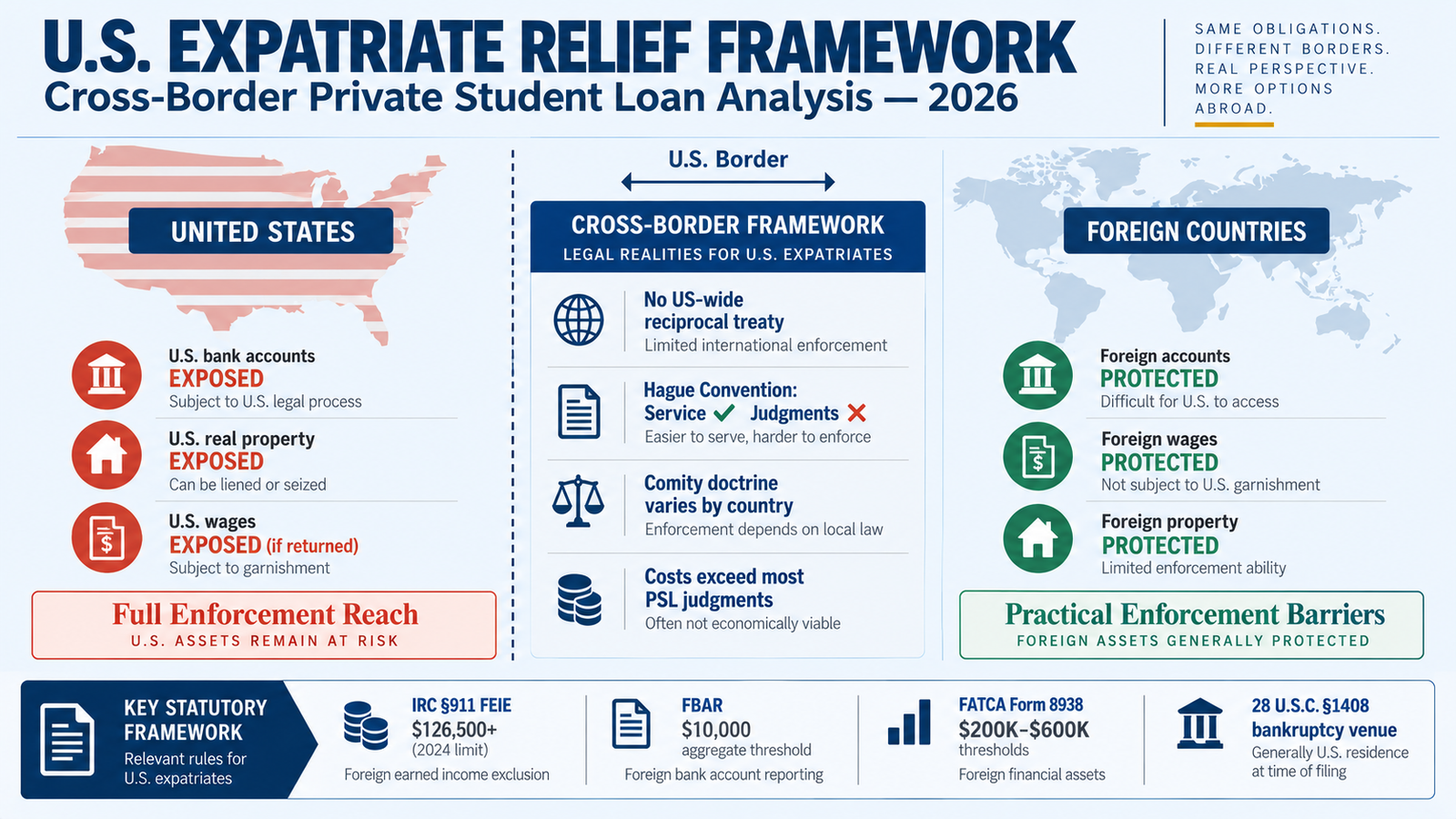
Private student loan relief for U.S. expatriates requires coordinated analysis across five dimensions: (1) foreign income analysis — IRC §911 Foreign Earned Income Exclusion allows exclusion of foreign earned income up to $126,500 (2024 limit, adjusted annually) plus housing exclusion; excluded income does NOT appear on Form 1040 Line 1 but is reported on Form 2555, complicating lender income documentation; (2) foreign employment documentation — foreign employer pay stubs, employment contracts with translation as needed, foreign tax filings, and bank statements support income analysis for hardship programs; refinance qualification is typically closed to non-U.S. residents; (3) wage garnishment structural analysis — U.S. courts have no jurisdiction to issue writs of garnishment against foreign employers; U.S. wage garnishment framework under CCPA 15 U.S.C. §1673 has no practical application; (4) cross-border judgment enforcement — U.S. money judgments are NOT automatically enforceable in foreign countries; enforcement requires foreign court proceedings under the destination country’s law (many countries do not recognize U.S. money judgments); the Hague Convention frameworks address service and evidence but not judgment enforcement generally; (5) U.S.-based assets remain fully subject to enforcement — U.S. bank accounts, U.S. real property, U.S.-source retirement accounts, and U.S. wages if the expat returns can all be reached.
Read the complete framework below.
In this article:
The expatriate borrower profile
U.S. citizens and permanent residents living abroad with private student loan debt
Foreign Earned Income Exclusion (FEIE) and lender documentation
IRC §911 mechanics and how excluded income affects program qualification
Foreign employment income documentation
Pay stubs, contracts, foreign tax filings, and bank statement analysis
FBAR and FATCA reporting obligations
Foreign bank account reporting requirements affecting expat financial visibility
Wage garnishment structural analysis for foreign employers
Why U.S. courts cannot garnish foreign wages and what this means practically
Cross-border judgment enforcement
Hague Convention frameworks, comity doctrine, and country-specific enforcement
Refinance qualification limitations for expatriates
Why most refinance lenders exclude non-U.S. residents and what alternatives exist
Return-to-U.S. planning and long-term strategy
Post-return exposure, bankruptcy venue considerations, and settlement timing
Common expatriate borrower myths and frequently asked questions
Widespread misconceptions and practical defensive questions from U.S. expats
The expatriate borrower profile
Americans living abroad — U.S. citizens working for foreign employers, U.S. citizens operating businesses in foreign countries, U.S. permanent residents who have relocated internationally, and U.S. citizens who have retired abroad — face a distinct set of private student loan relief considerations that differ materially from U.S.-resident borrowers. The relief framework requires coordination between U.S. federal law that continues to apply to citizens regardless of residence, state law from the borrower’s last U.S. domicile (which may still control specific defensive questions), and the practical realities of international jurisdictional and enforcement limitations.
Common expatriate patterns
Common expatriate borrower patterns include: U.S. professionals working abroad — tech workers in Ireland/UK/Germany, financial services professionals in Hong Kong/Singapore/London, healthcare workers in Australia/UK/Canada, consultants and executives on international assignments; Digital nomads and remote workers — U.S. citizens performing services for U.S. or foreign clients from foreign locations, often in lower-cost jurisdictions (Portugal, Mexico, Thailand, Colombia, Costa Rica); Retirees abroad — U.S. citizens who have relocated to retirement destinations (Mexico, Costa Rica, Panama, Portugal, Thailand); Cross-border families — U.S. citizens who married foreign nationals and relocated; Educational or academic expatriates — U.S. citizens pursuing graduate degrees or academic positions abroad; Missionary and NGO workers — U.S. citizens on foreign service assignments. Each pattern has specific analytical considerations, but the core framework applies across all.
Continuing U.S. legal obligations for expatriates
U.S. citizens and permanent residents remain subject to U.S. federal tax obligations regardless of foreign residence — the United States is one of few countries taxing based on citizenship rather than residence alone. Continuing U.S. obligations include: annual federal tax return filing (Form 1040) reporting worldwide income; state tax obligations from the last U.S. domicile (some states like California, Virginia have aggressive residency retention rules); FBAR filing for foreign accounts exceeding $10,000 aggregate; FATCA reporting on Form 8938 for larger foreign asset positions; potential state tax residency retention despite physical absence; and continuing federal court personal jurisdiction based on U.S. citizenship.
Practical realities of expatriate defense
While U.S. legal obligations continue for expatriates, the practical enforcement of those obligations against expatriate assets is substantially more complex than domestic enforcement. Foreign wages are structurally difficult to garnish, foreign bank accounts are not readily accessible to U.S. writ enforcement, foreign real property is beyond U.S. court reach, and cross-border judgment enforcement requires foreign court proceedings under destination-country law. This creates a “jurisdictional friction” that provides expatriate borrowers with meaningful defensive positioning against U.S.-based collection while also creating specific vulnerabilities for U.S.-based assets that remain fully exposed.
Why standard advice needs adaptation
Standard private student loan advice designed for U.S.-resident borrowers frequently does not fit expatriate circumstances. Refinance recommendations assume access to U.S. resident-required lenders. Wage garnishment defensive framework assumes U.S. employer relationships. Hardship program applications assume monthly income figures readily documented through W-2 or Schedule C. Bankruptcy analysis assumes U.S. residence and readily available venue. Effective expatriate strategy adapts each of these standard frameworks to the international reality of foreign residence, foreign employment, and cross-border jurisdictional complications.
Foreign Earned Income Exclusion (FEIE) and lender documentation
The Foreign Earned Income Exclusion under IRC §911 is the primary U.S. tax mechanism for reducing the tax burden of expatriate income — but its interaction with private student loan lender documentation creates specific complications. Understanding FEIE mechanics is essential for expatriate borrowers navigating relief programs.
FEIE mechanics under IRC §911
The Foreign Earned Income Exclusion allows U.S. citizens and permanent residents who satisfy either the Bona Fide Residence Test or the Physical Presence Test to exclude foreign earned income from U.S. federal taxation up to specified annual limits. The 2024 exclusion limit is $126,500, adjusted annually for inflation ($130,000+ for 2026 projected based on historical inflation adjustments). Additionally, a foreign housing exclusion or deduction is available for housing costs above a base amount. The exclusion is reported on Form 2555 filed with the annual Form 1040. Excluded income does NOT appear on Form 1040 Line 1 as wages — it appears on Form 2555 with the excluded amount offsetting the wage line, creating a Line 1 that shows only non-excluded income.
The tax return documentation problem
When lenders request “2 years of tax returns” for income documentation, expatriate borrowers using FEIE face a documentation problem: the Form 1040 shows minimal or zero wage income because the foreign earnings are excluded. A lender reviewing only the 1040 may conclude the borrower has minimal income, potentially disqualifying refinance applications or supporting aggressive hardship program approvals (though hardship approval based on truly excluded income may be problematic if actual foreign income substantially exceeds the U.S.-reported figures). Effective expat documentation requires providing Form 2555 alongside Form 1040 to show the full foreign earned income picture, not just the U.S.-taxable portion.
Bona fide residence and physical presence tests
FEIE qualification requires meeting one of two tests: Bona Fide Residence Test — the taxpayer is a bona fide resident of a foreign country for an uninterrupted period that includes an entire tax year; residence is a facts-and-circumstances test considering the nature, purpose, and duration of the foreign presence. Physical Presence Test — the taxpayer is physically present in a foreign country or countries for at least 330 full days during any 12-consecutive-month period. Documentation of these tests (foreign residence permits, foreign employment contracts, travel records showing physical presence pattern) supports the FEIE claim and, indirectly, supports lender documentation of the expatriate status.
Foreign Tax Credit as alternative
Instead of FEIE, expatriates in higher-tax countries (UK, Germany, France, Canada, Australia) often claim Foreign Tax Credit under IRC §901 for taxes paid to the foreign government. This approach reports the foreign income on Form 1040 (showing higher gross income figures) but credits the foreign tax against U.S. tax liability. From a lender documentation perspective, the Foreign Tax Credit approach may present a more favorable income picture than FEIE because the 1040 shows full foreign income. Tax strategy decisions between FEIE and Foreign Tax Credit should consider both current-year tax efficiency and future lender documentation needs.
Combining FEIE with hardship program applications
Hardship program applications from expatriate borrowers should acknowledge both the U.S.-reported income (which may be minimal after FEIE) and the actual foreign earned income (which represents the borrower’s true financial capacity). Failing to disclose actual foreign income while claiming hardship based on the U.S.-reduced figures could raise fraud concerns if discovered later. Better approach: transparent documentation of foreign income coupled with legitimate hardship analysis showing why even the full foreign income is insufficient (foreign cost of living, foreign tax obligations, family circumstances, currency exchange considerations, etc.).
Foreign employment income documentation
Documenting foreign employment income for lender programs requires assembling documentation that translates to U.S. lender standards while accommodating foreign employment norms.
Foreign employer pay stubs and payment records
Foreign employer pay stubs vary substantially by country. UK pay slips show gross pay, tax deductions (PAYE — Pay As You Earn), National Insurance contributions, and net pay in a format similar to U.S. pay stubs. German Gehaltsabrechnung shows gross pay, income tax (Lohnsteuer), social contributions (Sozialversicherung), and net pay. Australian pay slips show gross pay, tax withholding, superannuation contributions, and net pay. Documentation should be provided in original format with English translation where the pay stub is not in English. Digital pay stub records or employer letters certifying employment and income can supplement or substitute for physical pay stubs.
Foreign employment contracts
Foreign employment contracts document employment stability, position, and compensation structure. Contracts in foreign languages should be provided with English translation for lender review. Key contract elements supporting income documentation include: employer identification and business standing; position title and responsibilities; annual or monthly compensation figures; contract term (fixed-term vs. indefinite); benefits and additional compensation elements. A stable, indefinite-term employment contract with a substantial foreign employer supports income stability arguments similar to a U.S. W-2 relationship.
Foreign tax return documentation
Foreign tax returns (UK Self Assessment, German Einkommensteuererklärung, Australian tax return, Canadian T1, Mexican Declaración Anual) document the borrower’s income as reported to the foreign government. These returns provide independent verification of income figures separate from employer documentation. Foreign tax returns should be provided with English translation where necessary. Foreign tax return figures should generally reconcile with U.S. Form 1040 + Form 2555 (with adjustments for tax treatment differences between the two tax systems) — reconciliation notes may be needed for lender clarity.
Foreign bank statement analysis
Foreign bank statements showing consistent salary deposits from the foreign employer support income analysis for hardship programs. Bank statements in foreign currency should include exchange rate documentation or U.S. dollar equivalent conversions. Statement period should ideally cover 12 months to demonstrate income stability. Statements should identify the depositor (foreign employer name) matching the employment documentation. FBAR filing requirements (discussed further below) apply to foreign accounts exceeding $10,000 aggregate — expatriate borrowers should ensure FBAR compliance is current before extensive foreign bank statement disclosure to lenders (though lender document disclosure does not directly trigger FBAR obligations).
Currency conversion methodology
Foreign income must be converted to U.S. dollars for lender analysis. Conversion methodology can materially affect the picture: Spot rate on income date — most accurate for individual payment analysis; Annual average rate — smooths currency volatility across the year; Rate on lender review date — reflects current purchasing power. IRS publications provide official annual average exchange rates for tax reporting purposes; these are typically appropriate for lender documentation. Currency volatility during application processing (particularly during periods of dollar strength or weakness) may affect qualification analysis — timing applications during favorable exchange conditions can support qualification.
FBAR and FATCA reporting obligations
U.S. persons with foreign financial accounts face specific reporting obligations under the Bank Secrecy Act (FBAR) and Foreign Account Tax Compliance Act (FATCA). These obligations affect expatriate borrowers’ financial visibility and interact with private student loan defensive analysis.
FBAR filing requirements
The Foreign Bank Account Report (FBAR — FinCEN Form 114) must be filed annually by U.S. persons with financial interest in or signature authority over foreign financial accounts if the aggregate value of those accounts exceeded $10,000 at any time during the calendar year. Filing deadline is April 15 (extended automatically to October 15) filed electronically through FinCEN’s BSA E-Filing System. Non-willful failure to file penalties are $10,000 per violation (adjusted for inflation); willful failure penalties can reach the greater of $100,000 or 50% of the account balance. Expatriate borrowers typically have foreign accounts triggering FBAR requirements — ensuring FBAR compliance is essential financial hygiene.
FATCA reporting on Form 8938
The Foreign Account Tax Compliance Act (FATCA) requires reporting on Form 8938 (Statement of Specified Foreign Financial Assets) filed with the annual Form 1040 for U.S. persons whose specified foreign financial assets exceed threshold values that vary by filing status and residence (higher thresholds for foreign residents). For expatriates: single filer thresholds are $200,000 on last day of year or $300,000 at any time during year; married filing jointly thresholds are $400,000 and $600,000 respectively. Form 8938 reports both accounts and other specified foreign financial assets (foreign securities, foreign partnership interests, foreign hedge funds).
FATCA at the foreign bank level
FATCA also imposes obligations on foreign financial institutions to identify U.S. account holders and report account information to the IRS (either directly or through their home country tax authority under intergovernmental agreements). This has made banking relationships more complex for U.S. expatriates — some foreign banks have declined to serve U.S. clients rather than assume FATCA compliance burdens. Expatriates who maintain U.S. bank accounts alongside foreign accounts should coordinate account structures with awareness of FATCA reporting flows.
Interaction with private student loan defense
FBAR and FATCA reporting create financial visibility that affects private student loan defensive analysis in specific ways: (1) creditors conducting asset investigations may access FBAR/FATCA information through subpoena to IRS in appropriate cases; (2) bankruptcy filings require full asset disclosure including foreign accounts — coordination with FBAR/FATCA reporting for consistency is important; (3) hardship applications requiring full financial disclosure interact with the reporting obligations; (4) settlement negotiations involving significant sums require awareness of FBAR/FATCA on any related account movements. Ensuring current FBAR/FATCA compliance before extensive financial disclosure supports overall defensive positioning.
Wage garnishment structural analysis for foreign employers
U.S. courts have no jurisdiction over foreign employers absent specific minimum contacts with the U.S. jurisdiction — writs of garnishment directed to foreign employers face fundamental jurisdictional barriers that render standard wage garnishment framework practically inapplicable to expatriate borrowers working for foreign employers.
Jurisdictional foundation for wage garnishment
U.S. wage garnishment writs are court orders directing the debtor’s employer (the “garnishee”) to withhold a portion of wages and remit them to the creditor. The writ requires the issuing court to have jurisdiction over both the debtor and the garnishee employer. Personal jurisdiction over foreign employers requires either general jurisdiction (foreign employer is “at home” in the U.S. forum — extremely limited under Goodyear Dunlop Tires v. Brown 564 U.S. 915 (2011) and Daimler AG v. Bauman 571 U.S. 117 (2014)) or specific jurisdiction (the specific claim arises from foreign employer’s forum contacts). Employment of the debtor abroad does not create jurisdiction over the foreign employer.
Practical enforcement barriers
Even if a creditor obtained a writ against a foreign employer, practical enforcement barriers include: (1) foreign employer has no obligation to honor U.S. writs absent jurisdictional foundation; (2) service of the writ on a foreign employer requires compliance with Hague Convention on Service Abroad (or comity procedures if country is not a Hague Convention signatory); (3) foreign courts would not enforce a U.S. wage garnishment against a domestic employer — the wage garnishment is a U.S. procedural remedy without direct foreign law equivalent; (4) the foreign employer’s compliance with a U.S. writ might violate the employer’s own home-country labor law protecting employee wages. Given these barriers, creditors rarely attempt foreign wage garnishment.
Wages deposited to U.S. accounts
The wage garnishment barrier applies to wage payment by foreign employers. If the expatriate’s wages are deposited to a U.S. bank account (rather than remaining in a foreign account), those U.S. deposits are subject to standard bank account levy analysis discussed in Day 23. Expatriates seeking maximum protection from wage-based collection should consider having foreign employer payments deposited to foreign accounts rather than transferred to U.S. accounts. FBAR reporting obligations continue to apply to foreign account balances above thresholds regardless of collection considerations.
Return-to-U.S. wage exposure
Structural wage garnishment protection lasts only as long as the expatriate remains employed abroad. Upon return to U.S. employment, standard wage garnishment framework under CCPA 15 U.S.C. §1673 immediately applies — federal 25% cap or lower state cap (see Day 22 state-by-state framework). Expatriate borrowers considering U.S. return should plan for this transition — resolving pending private student loan matters before returning to U.S. employment (through settlement, discharge, or other resolution) may be strategically preferable to returning with unresolved judgment exposure.
Related resources
Private Student Loan Wage Garnishment Defense 2026
State-by-state framework for wage garnishment — particularly relevant for expatriates planning U.S. return and considering state destination.
Private Student Loan Bank Account Levy Defense 2026
Bank account levy framework — U.S. accounts remain fully exposed regardless of expatriate status.
Private Student Loan Judgment Enforcement Defense 2026
Judgment revival deadlines and cross-border enforcement — critical framework for expatriates facing existing judgments or potential future collection.
Cross-border judgment enforcement
One of the most powerful defensive frameworks available to expatriate borrowers is the practical limitation on cross-border judgment enforcement. U.S. money judgments are NOT automatically enforceable in foreign countries — enforcement requires separate proceedings in the destination country under that country’s own recognition and enforcement law.
No U.S.-wide reciprocal enforcement treaty
The United States is NOT a party to a multilateral treaty providing reciprocal enforcement of money judgments across borders. The Hague Convention on the Recognition and Enforcement of Foreign Judgments in Civil and Commercial Matters (the 2019 Hague Judgments Convention) has been signed by some countries but the U.S. is not a party. Absent a treaty framework, U.S. money judgments must be recognized and enforced under each destination country’s domestic law — which varies substantially across countries.
Comity doctrine and country variation
Foreign courts may recognize U.S. judgments under the doctrine of “comity” — a form of judicial respect for foreign court decisions. Comity recognition varies substantially: Common law countries (UK, Australia, Canada, New Zealand) generally recognize U.S. money judgments under formal recognition and enforcement procedures with specific requirements (proper jurisdiction of issuing court, adequate notice to defendant, fair procedures, no fraud). Civil law countries (France, Germany, Spain, Italy, Netherlands) vary — some have specific procedures for recognizing foreign judgments, others require re-litigation of the merits. Latin American countries (Mexico, Colombia, Brazil, Argentina) have specific recognition procedures (exequatur) with varying requirements. Some countries essentially require full re-litigation of the underlying claim under local law, making U.S. judgment enforcement impractical.
Cost-benefit analysis for creditors
Cross-border judgment enforcement requires: (1) hiring foreign counsel in the enforcement country; (2) commencing recognition proceedings under that country’s law; (3) potentially re-litigating aspects of the underlying claim; (4) defending against foreign law defenses (statute of limitations, procedural challenges); (5) executing on foreign assets under foreign procedures. Total costs for foreign enforcement can easily exceed the amount of most private student loan judgments, making foreign enforcement economically impractical for typical debts. Creditors rarely pursue foreign enforcement absent very large judgment amounts and known substantial foreign assets. This creates strong practical protection for expatriate borrowers.
U.S.-based assets remain fully exposed
The foreign enforcement barriers apply only to enforcement against foreign assets. U.S.-based assets held by expatriates remain fully subject to U.S. enforcement: U.S. bank accounts (see Day 23 bank levy framework); U.S. real property (subject to judgment liens under state law); U.S.-source retirement accounts (subject to §522(n) and ERISA protections but visible to U.S. creditors); U.S. investment accounts; U.S. business interests. Expatriate borrowers seeking maximum protection often coordinate asset structure to minimize U.S.-based holdings (with awareness of FBAR/FATCA reporting continuing to apply).
Refinance qualification limitations for expatriates
The U.S. residence requirement
Most major private student loan refinance lenders — including SoFi Bank NA (NMLS #696891), Earnest Operations LLC, Education Loan Finance (ELFI), Splash Financial partners, and Citizens Bank NA — require U.S. residence for borrower and cosigner. This effectively closes standard refinance qualification for expatriate borrowers regardless of their income and credit qualifications. The residence requirement stems from state-specific lending law compliance, servicing considerations, and enforcement practicality for the lender.
Alternative approaches
Expatriate borrowers seeking refinance-like benefits may consider: (1) U.S.-resident cosigner refinance — using a U.S.-resident cosigner to enable refinance (with careful Day 19 cosigner risk analysis); (2) foreign lender products — some international lenders serve expatriates in specific countries with credit products, though these typically do not refinance U.S. student loan debt; (3) home equity loan against U.S. real property if the expat retains U.S. real estate; (4) 401(k) loan from U.S.-based retirement plan; (5) family financing with proper documentation; (6) delaying refinance until return to U.S. residence. None of these are direct substitutes for standard refinance, but each may serve specific expatriate circumstances.
Hardship programs for expatriates
Hardship programs from major servicers (Sallie Mae, Citizens, SoFi, Earnest, Ascent, Discover/Firstmark) generally do NOT require U.S. residence — they focus on ability-to-pay analysis regardless of where the borrower resides. Expatriate borrowers can typically apply for hardship programs with proper foreign employment documentation. Hardship programs may be more accessible than refinance for expatriates because the analysis focuses on payment reduction rather than credit extension. Documentation should include FEIE-adjusted income analysis, foreign employment documentation, and cost-of-living context for the foreign residence.
Return-to-U.S. planning and long-term strategy
Timing analysis for return
Expatriate borrowers considering return to U.S. residence face specific timing questions relative to private student loan matters. Returning to U.S. residence triggers: (1) full U.S. wage garnishment exposure upon U.S. employment; (2) full U.S. bank account levy exposure on new U.S. accounts; (3) full personal jurisdiction over the borrower for post-judgment discovery and enforcement; (4) end of the practical cross-border enforcement barriers. Strategic return planning may include: resolving pending matters before return (settlement, discharge, or other resolution); building U.S.-based defensive infrastructure before return (state selection for wage garnishment protection, retirement plan positioning, real estate structure); coordinating with counsel to sequence resolution and return appropriately.
State selection for return
Expatriates with U.S. return flexibility can consider state selection for private student loan defensive positioning: prohibition states for wage garnishment (Texas, Pennsylvania, North Carolina, South Carolina — see Day 22); Florida for head-of-household exemption if qualifying; strong homestead states (Texas, Florida for unlimited value); Delaware/Nevada/Wyoming/Alaska for LLC asset protection frameworks. These considerations should not be decisive on their own — employment, family, and lifestyle factors dominate return-state decisions — but they can be part of the analysis for expatriates with genuine location flexibility.
Bankruptcy from abroad considerations
Bankruptcy filing from abroad presents specific challenges: (1) U.S. bankruptcy venue under 28 U.S.C. §1408 requires connection to the U.S. district court (domicile, residence, or principal place of business in the district for 180 days); (2) expatriates without recent U.S. residence may face venue challenges; (3) attendance at 341 meeting of creditors typically requires U.S. presence; (4) full disclosure of foreign assets, income, and accounts is required; (5) foreign courts may not recognize U.S. bankruptcy discharge for purposes of shielding foreign assets from U.S. creditors. Expatriate borrowers considering bankruptcy typically need to establish U.S. venue and physical presence — often coordinated with return-to-U.S. planning.
Long-term expatriate strategy without return
For expatriate borrowers with no return-to-U.S. intent, long-term strategy may include: maintaining current U.S. tax compliance (Form 1040, FBAR, FATCA); minimizing U.S.-based assets subject to enforcement; pursuing settlement negotiation leveraging cross-border enforcement barriers; monitoring statute of limitations and judgment revival deadlines on any existing U.S. judgments; and periodically reassessing the framework as personal circumstances or U.S. law evolves. Formal expatriation (renunciation of U.S. citizenship) is a rare and extreme option with substantial tax and personal implications (including IRC §877A expatriation tax for high-net-worth individuals) that should not be considered primarily for debt-avoidance reasons.
Common expatriate borrower myths and misconceptions
Myth 1
“Moving abroad eliminates my U.S. private student loan obligation”
Reality: Foreign residence does NOT eliminate the underlying private student loan debt or U.S. federal court jurisdiction over the borrower as a U.S. citizen. What foreign residence provides is practical enforcement complication: foreign wages cannot be garnished, foreign bank accounts are not readily accessible, and cross-border judgment enforcement requires expensive foreign court proceedings. U.S.-based assets remain fully exposed, and the debt continues accruing interest and remains available for enforcement upon return to U.S. residence. Statute of limitations and judgment revival deadlines continue running throughout expatriate residence.
Myth 2
“I can refinance my U.S. private student loans through a foreign lender”
Reality: Foreign lenders generally do not refinance U.S. private student loan debt — regulatory complexity, currency risk, and enforcement uncertainty make U.S. student loan refinance a specialized U.S. lender product. Expatriate borrowers seeking refinance-like benefits should consider: U.S.-resident cosigner refinance (with Day 19 cosigner risk analysis); home equity loan against U.S. real property; delaying refinance until return to U.S. residence. Standard U.S. refinance lenders (SoFi, Earnest, ELFI, Splash, Citizens) require U.S. residence and are not accessible to expatriates.
Myth 3
“Since I use FEIE and show minimal U.S. income, I qualify for maximum hardship reduction”
Reality: Hardship programs require honest disclosure of actual financial capacity — not just U.S.-reportable income after FEIE exclusion. Applying based on U.S.-reported minimal income while actually earning substantial foreign wages could constitute fraud if discovered. Proper hardship applications include full foreign income disclosure with contextual analysis (foreign cost of living, foreign tax obligations, family circumstances, currency considerations). Legitimate hardship may exist even at full foreign income levels — the analysis must be honest and complete.
Myth 4
“Renouncing U.S. citizenship will eliminate my private student loan debt”
Reality: Renunciation of U.S. citizenship does NOT eliminate underlying debt obligations — the debt continues under contract law regardless of citizenship status. Renunciation also triggers IRC §877A “expatriation tax” for high-net-worth individuals (net worth over $2 million or specified income tax liability thresholds) that treats all worldwide assets as sold at fair market value on the day before renunciation. Renunciation has profound personal and legal consequences (loss of U.S. passport, visa requirements for U.S. visits, loss of Social Security potential, complex banking implications) that dramatically exceed any debt-relief consideration. Renunciation is not a reasonable private student loan strategy.
Frequently asked questions about expatriate private student loan relief
1. Can private student loan creditors garnish my foreign salary?
Practically no. U.S. courts lack personal jurisdiction over foreign employers absent minimum contacts with the U.S. forum. Writs of garnishment directed to foreign employers are practically unenforceable — foreign employers have no obligation to honor U.S. writs, service under Hague Convention is complex, and foreign courts would not enforce U.S. wage garnishment against domestic employers. This structural protection lasts only while foreign employment continues. Upon return to U.S. employment, standard wage garnishment framework immediately applies under CCPA 15 U.S.C. §1673. Wages deposited to U.S. bank accounts remain fully subject to bank account levy.
2. Is my U.S. private student loan judgment enforceable in the country where I now live?
Not automatically. The United States is not party to a treaty providing reciprocal enforcement of money judgments — enforcement requires separate proceedings in the destination country under that country’s recognition and enforcement law. Common law countries (UK, Australia, Canada) generally recognize U.S. judgments under formal procedures with specific requirements. Civil law countries vary substantially. Practical enforcement costs (foreign counsel, recognition proceedings, potentially re-litigation) typically exceed the amount of most private student loan judgments, making foreign enforcement economically impractical for typical debts. U.S.-based assets remain fully exposed regardless.
3. Can I refinance my private student loans as a U.S. expat?
Standard refinance is generally not available. Major refinance lenders — SoFi Bank NA (NMLS #696891), Earnest Operations LLC, Education Loan Finance (ELFI), Splash Financial partners, Citizens Bank NA — require U.S. residence for borrower and cosigner. Alternatives include: U.S.-resident cosigner refinance (with Day 19 cosigner risk analysis); home equity loan against U.S. real property if retained; family financing with proper documentation; delaying refinance until return to U.S. residence. Hardship programs from major servicers generally do NOT require U.S. residence and remain accessible to expatriates.
4. How do I document my foreign income to a U.S. private student loan servicer?
Documentation should include: foreign employer pay stubs (with English translation as needed); foreign employment contracts (with translation); foreign tax return copies (with translation); foreign bank statements showing salary deposits; Form 2555 alongside Form 1040 if using FEIE (to show full foreign income picture, not just U.S.-taxable portion); currency conversion methodology with U.S. dollar equivalents. Transparent documentation with contextual explanation supports credibility and produces better program outcomes than reliance on U.S.-reported figures alone.
5. What are my FBAR and FATCA obligations as an expat with foreign accounts?
FBAR (FinCEN Form 114) must be filed annually if aggregate foreign account balances exceeded $10,000 at any time during the year — filed electronically by April 15 (auto-extended to October 15). FATCA reporting on Form 8938 required if specified foreign financial assets exceed threshold values (higher thresholds for foreign residents — $200,000/$300,000 single, $400,000/$600,000 married filing jointly). Non-willful FBAR failure penalty is $10,000 per violation; willful failure can reach greater of $100,000 or 50% of account balance. Compliance is essential financial hygiene regardless of private student loan considerations. Consult a tax professional familiar with expatriate compliance for individualized guidance.
6. Can I file U.S. bankruptcy while living abroad?
Bankruptcy filing from abroad presents specific challenges. U.S. bankruptcy venue under 28 U.S.C. §1408 requires connection to the U.S. district court (domicile, residence, or principal place of business in the district for 180 days). Expatriates without recent U.S. residence may face venue challenges. Attendance at 341 meeting of creditors typically requires U.S. presence. Full disclosure of foreign assets is required. Foreign courts may not recognize U.S. bankruptcy discharge for shielding foreign assets from other creditors. Bankruptcy is typically coordinated with return-to-U.S. planning to establish venue and physical presence. Consult bankruptcy counsel experienced with expatriate cases.
7. Should I plan to return to the U.S. eventually, and what should I do first?
Return-to-U.S. planning benefits from advance private student loan resolution. Return triggers: full U.S. wage garnishment exposure; full bank account levy exposure on new U.S. accounts; end of practical cross-border enforcement barriers. Strategic pre-return actions may include: settlement negotiation leveraging cross-border enforcement barriers; bankruptcy analysis and potential filing coordinated with return timing; state selection for return residence (considering wage garnishment prohibition states, homestead protection); coordination with counsel to sequence resolution and return appropriately. Resolving matters before return typically produces better outcomes than returning with unresolved judgment exposure.
U.S. Expatriate with Private Student Loan Debt?
Free specialist review adapted to expatriate circumstances.
FEIE income analysis, foreign employment documentation strategy, cross-border enforcement analysis, hardship program qualification for expatriates, and coordinated return-to-U.S. planning if applicable. Get a free eligibility review with a partner provider familiar with expatriate financial matters.
Get a free eligibility review →
5-minute review · No obligation · Zero upfront fees
About the author
Henry Silva — Private Student Loan Debt Specialist
10+ years experience analyzing private student loan relief frameworks for U.S. expatriate borrowers: FEIE IRC §911 income analysis, Foreign Tax Credit IRC §901 alternative, FBAR FinCEN Form 114 and FATCA Form 8938 reporting compliance, foreign employment income documentation strategies, wage garnishment structural analysis under CCPA 15 U.S.C. §1673 for foreign employers, cross-border judgment enforcement analysis (Hague Convention frameworks, comity doctrine, country-specific recognition), refinance qualification limitations for non-U.S. residents, bankruptcy venue analysis under 28 U.S.C. §1408 for expatriate filings, and coordinated return-to-U.S. planning. Henry works with Private Student Relief’s partner provider network to review expatriate scenarios coordinating U.S. federal law, state law from last U.S. domicile, and international jurisdictional realities.
Legal Disclaimer and Sources
This article is provided for informational purposes only and does not constitute legal, tax, or financial advice. Private Student Relief is a consulting and matching organization operated by Joco (555 Anton Blvd, Suite 368, Costa Mesa, CA 92626) — not a law firm, debt settlement company, debt consolidation company, or loan provider. Debt validation services are performed by an attorney-backed partner provider (Panamerican Consulting LLC, Las Vegas, NV) under independent business credentials. Ratings, BBB accreditation, and AADR membership referenced on the PSR website belong to the partner provider. Individual results vary based on expatriate location, foreign employment status, tax positioning, asset structure, U.S. state of last domicile, and specific loan characteristics. Not available in South Carolina or Mississippi.
Statutory and regulatory references: Internal Revenue Code — IRC §911 (Foreign Earned Income Exclusion, 2024 limit $126,500 adjusted annually), IRC §901 (Foreign Tax Credit), IRC §877A (expatriation tax for renunciation), IRC §108 (income exclusions for cancellation of debt). Bank Secrecy Act — FinCEN Form 114 FBAR reporting for foreign accounts exceeding $10,000 aggregate. Foreign Account Tax Compliance Act (FATCA) — Form 8938 reporting thresholds for specified foreign financial assets. Consumer Credit Protection Act 15 U.S.C. §§1671-1677 (federal wage garnishment framework — practical inapplicability to foreign employers). Bankruptcy Code — 28 U.S.C. §1408 (bankruptcy venue requirements), 11 U.S.C. §362 (automatic stay), 11 U.S.C. §523(a)(8) (student loan discharge exceptions). Personal jurisdiction precedent: Goodyear Dunlop Tires Operations SA v. Brown 564 U.S. 915 (2011); Daimler AG v. Bauman 571 U.S. 117 (2014). Hague Conventions on Service Abroad (1965) and Taking of Evidence Abroad (1970). 2019 Hague Judgments Convention (U.S. is NOT a party).
Refinance lender information current as of September 2026 per publicly available product disclosures: SoFi Bank NA NMLS #696891 requires U.S. residence; Earnest Operations LLC (Navient subsidiary since 2017) requires U.S. residence; Education Loan Finance division of SouthEast Bank requires U.S. residence; Splash Financial marketplace partners typically require U.S. residence; Citizens Bank NA NYSE:CFG requires U.S. residence. Servicer hardship program requirements per publicly available servicer documentation; specific program availability, requirements, and terms subject to change and should be verified directly with the servicer. Country-specific judgment recognition and enforcement law varies substantially and requires case-specific analysis by counsel licensed in the applicable foreign jurisdiction.
Expatriate private student loan defensive strategies require coordination between U.S. federal law (which continues to apply to U.S. citizens regardless of residence), state law from the borrower’s last U.S. domicile (which may continue to apply for specific defensive questions), and destination country law (which controls foreign enforcement questions). This article provides general framework information; specific defensive filings, refinance qualification, hardship program applications, bankruptcy venue analysis, and settlement negotiations must be evaluated for each expatriate borrower’s individual situation, foreign residence, employment structure, and specific circumstances. Consultation with counsel licensed in the applicable U.S. state and, where necessary, in the foreign jurisdiction of residence is recommended. Last reviewed: September 2026.