

Informational content only. Not legal, tax, or financial advice. Private Student Relief is a consulting organization, not a law firm. Debt validation services are executed by an attorney-backed partner provider. Small business owner relief strategies require case-by-case analysis coordinating personal debt matters with business structure implications. Last reviewed: September 2026.
Written by Henry Silva
Private Student Loan Debt Specialist · 10+ years experience analyzing private student loan relief frameworks for small business owners operating as sole proprietors (Schedule C), Limited Liability Companies (LLC), S-Corporations (Form 1120-S), and C-Corporations (Form 1120). Focus areas include personal guarantee interaction with private student loan liability, business entity asset protection frameworks, business income versus personal income documentation for lender programs, piercing the corporate veil considerations, retirement account protection under ERISA §206(d)(1) and 11 U.S.C. §522(b)(3)(C), business asset preservation in Chapter 7 versus Chapter 13 bankruptcy analysis, and coordination with settlement negotiation strategies specific to entrepreneurs. Last reviewed: September 2026.
Small business owners with private student loan debt face a distinct set of challenges that intersect with their business operations: personal guarantees on business obligations create parallel liability structures, business entity choice (LLC, S-Corp, C-Corp, sole prop) affects asset protection and income documentation, retirement account protections through ERISA-qualified plans provide meaningful shelter, and bankruptcy analysis requires coordination between personal and business obligations. The relief framework requires simultaneous analysis of personal debt matters and business structure implications — the standard advice designed for W-2 employees or straight consumer borrowers often misses critical business owner considerations. This guide walks through the complete small business owner private student loan relief framework.
Quick Answer
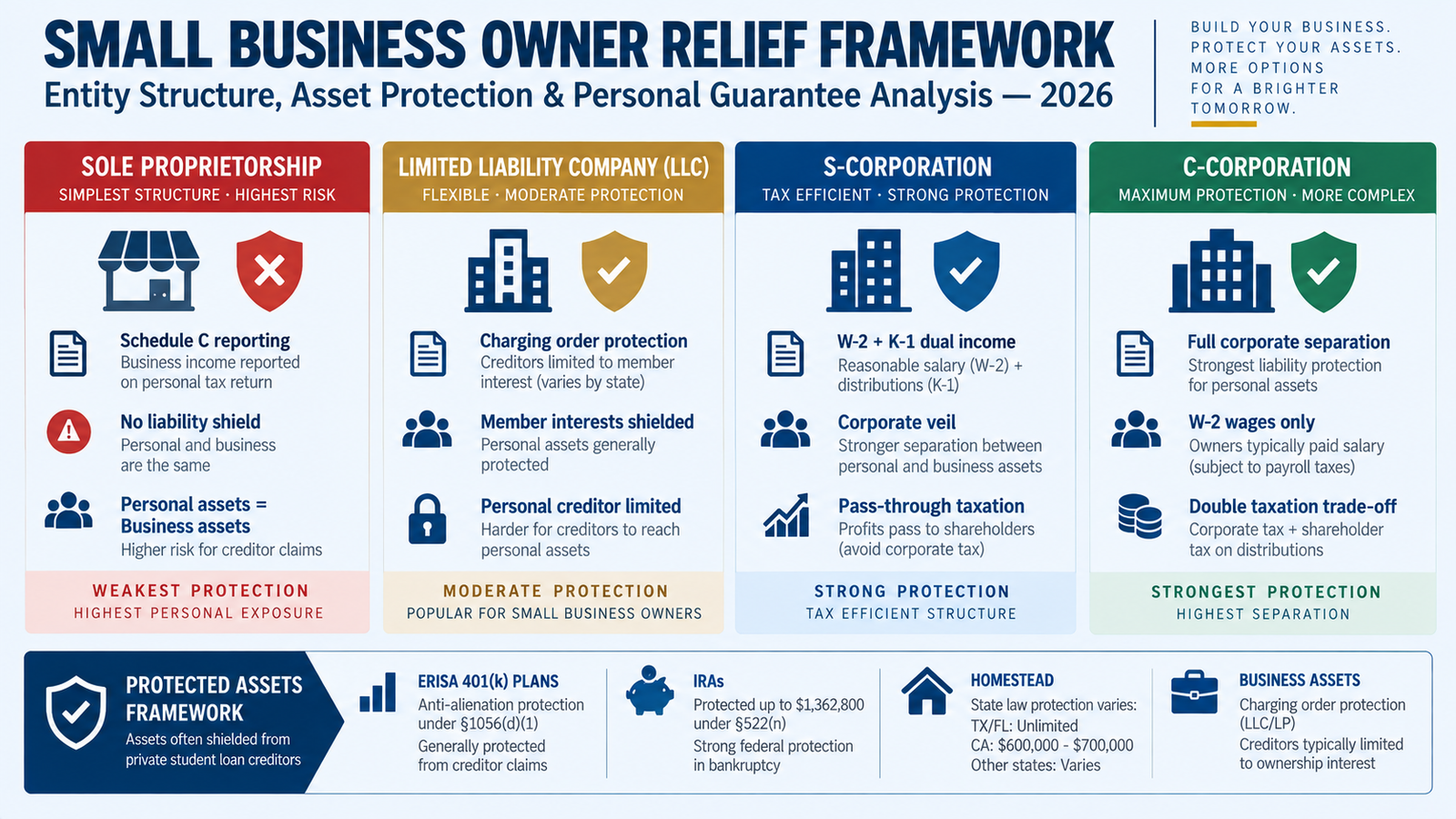
Private student loan relief for small business owners requires coordinated analysis across four dimensions: (1) business entity structure — sole proprietor (Schedule C exposure identical to personal), LLC (separate legal entity with member-managed liability shield), S-Corp (separate entity with pass-through taxation on Form 1120-S), C-Corp (separate entity with corporate-level taxation on Form 1120) — each has different implications for personal creditor reach; (2) personal guarantee analysis — most small business bank loans, SBA loans, commercial leases, and business credit cards require personal guarantees that create parallel personal liability; understanding which business obligations include personal guarantee helps predict business creditor claims that may compete with private student loan collection; (3) asset protection framework — ERISA-qualified retirement plans (401(k), pension) are typically protected from all creditors under 29 U.S.C. §1056(d)(1); IRA protection varies by state but has federal bankruptcy protection up to $1,362,800 per debtor under 11 U.S.C. §522(n) as of 2022 adjustment; state homestead exemptions protect real property; (4) bankruptcy analysis — Chapter 7 personal filing may liquidate non-exempt personal assets; Chapter 13 payment plan preserves assets over 3-5 years; business Chapter 11 restructuring separate from personal bankruptcy; §523(a)(8) discharge analysis applies to private student loans regardless of business ownership status.
Read the complete framework below.
In this article:
The small business owner borrower profile
Entity types and how business structure affects private student loan analysis
Personal guarantee interaction with private student loan liability
SBA loans, commercial leases, credit lines — parallel liability analysis
Business income versus personal income documentation
Schedule C, K-1, W-2 from own S-Corp, and how lenders evaluate each
Piercing the corporate veil considerations
When creditors can reach through business entity to personal debt collection
Asset protection framework for business owners
ERISA retirement plans, IRAs, homestead, and business asset preservation
Refinance qualification with business income
Lender treatment of Schedule C, K-1, and small business owner cash flow
Bankruptcy analysis for small business owners
Personal Ch 7/13 versus business Ch 11 versus coordinated filings
Settlement negotiation from business owner perspective
Cash flow analysis, lump sum funding sources, business continuity considerations
Common small business owner myths and frequently asked questions
Widespread misconceptions and practical defensive questions for entrepreneurs
The small business owner borrower profile
Small business owners with private student loan debt occupy a distinct position in the relief landscape — their private student loan matters interact with business structure decisions, personal guarantees on business obligations, retirement plan protections, and complex income documentation. Understanding the specific business owner profile is essential to identifying appropriate defensive strategies and relief pathways.
Business entity types and their implications
The four primary business entity structures have materially different implications for private student loan analysis: Sole Proprietor — no legal separation between business and personal; business assets are personal assets and vice versa; income reported on Schedule C; personal creditors including private student loan judgment creditors can reach business assets directly. Limited Liability Company (LLC) — separate legal entity providing liability shield between business and personal; single-member LLCs are typically disregarded entities for federal tax purposes (income on Schedule C) but may provide state-law liability protection; multi-member LLCs file Form 1065; personal creditors face charging order limitations against LLC interests in most states. S-Corporation — separate legal entity with pass-through taxation on Form 1120-S; shareholders receive K-1 and often W-2 wages if they perform services; provides liability shield subject to piercing analysis; retirement plan options include Solo 401(k) with significant protection. C-Corporation — separate legal entity with corporate-level taxation on Form 1120; owner-employees receive W-2 wages; strongest liability separation but double-taxation on distributed profits.
Why entity structure matters for private student loan defense
The entity structure affects private student loan analysis in specific ways: (1) Asset reach — private student loan judgment creditors seeking to enforce against the borrower’s assets face different obstacles depending on whether assets are held personally, through LLC membership interests, or through corporate shares; (2) Income documentation — lenders evaluating refinance qualification see very different pictures depending on whether business income flows through Schedule C, K-1 distributions, or W-2 wages from the owner’s own S-Corp; (3) Bankruptcy coordination — personal bankruptcy filing affects personal assets and personal debts (including private student loans); business bankruptcy is a separate framework for the entity’s own debts; (4) Retirement plan protection — the entity type determines which retirement plan options are available and the applicable protection framework.
The typical small business owner profile
Small business owners with private student loan debt typically fit patterns like: professional service providers (consultants, attorneys, accountants, financial advisors, healthcare practitioners) operating as S-Corp or LLC with $80,000-$300,000 annual net income; product-based small businesses (retail, e-commerce, manufacturing) with $50,000-$500,000 revenue and variable net margins; service-based small businesses (contractors, freelancers scaling up, small agencies) transitioning from sole prop to LLC; multi-owner partnerships and small firms. Each profile has specific analytical considerations, but the core framework of coordinating personal student loan matters with business structure applies across all patterns.
Why standard advice needs adaptation
Standard private student loan advice — designed for W-2 employees or straight consumer borrowers — often misses critical small business owner considerations. Asset protection strategies for W-2 borrowers focus on homestead exemptions and retirement accounts; business owners have additional protection through business entity structure. Income documentation for W-2 borrowers is straightforward; business owners require careful presentation of Schedule C, K-1, or W-2-from-own-company income. Bankruptcy analysis for W-2 borrowers considers personal debts only; business owners must consider business obligations, business continuity, and personal guarantee interactions. Effective business owner strategy adapts each of these standard frameworks to the entrepreneurial reality.
Personal guarantee interaction with private student loan liability
Most small business owners have signed personal guarantees on various business obligations — SBA loans, commercial leases, business credit lines, equipment financing, vendor accounts, and business credit cards. Personal guarantees convert business obligations into personal obligations for the guarantor if the business defaults. This creates parallel personal liability that interacts with private student loan collection in specific ways.
Common business obligations with personal guarantee requirements
Personal guarantees are commonly required on: SBA loans — Small Business Administration loan programs typically require personal guarantee from any owner with 20% or more equity in the business per SBA SOP 50 10 6 and related program requirements; Commercial real estate leases — landlords typically require personal guarantee from small business tenants, particularly for new businesses or businesses with limited operating history; Business credit lines and term loans — banks and non-bank commercial lenders almost universally require personal guarantee for small business borrowers; Equipment financing — equipment lenders typically require personal guarantee; Vendor credit accounts — larger vendor accounts often require personal guarantee, particularly for startup businesses; Business credit cards — most business credit cards from major issuers require personal guarantee even when the account is in the business name.
Parallel liability implications
A small business owner with multiple personal guarantees plus private student loan debt faces multiple potential personal creditors. If the business experiences distress and cannot service its obligations, the personal guarantees convert business debts into personal debts collectible against the owner personally. This creates competition for the owner’s personal assets — private student loan creditors, SBA loan personal guarantee, credit line personal guarantees, and other personal creditors all pursuing the same limited pool of personal assets. Understanding the total personal exposure across all obligations (student loans + personal guarantees + other personal debts) is essential to strategic planning.
Guarantee release considerations
Personal guarantees can sometimes be released through: (1) business success — mature businesses with strong operating history may negotiate guarantee removal from renewed credit facilities; (2) refinance with non-personally-guaranteed alternative — commercial lenders serving established businesses may offer credit without personal guarantee; (3) business sale — sale to a buyer who assumes obligations and substitutes their own guarantee; (4) guarantee expiration in specific contract terms; (5) creditor negotiation as part of broader restructuring. Reducing total personal guarantee exposure reduces the total personal creditor competition and improves the private student loan defensive position.
Timing coordination with business distress
If a business owner faces both business distress and private student loan issues simultaneously, coordinated timing becomes essential. Filing personal bankruptcy typically triggers automatic stay under 11 U.S.C. §362 that halts all personal creditor activity (including private student loan collection AND personal guarantee enforcement). Filing business bankruptcy (Chapter 11 for the entity) provides business creditor stay but does NOT automatically stay personal creditor claims against the owner. Coordinating these filings with counsel experienced in both personal and business bankruptcy is essential to optimize outcomes across the full liability spectrum.
Business income versus personal income documentation
Business owner income documentation for private student loan lender programs is more complex than W-2 employee documentation. The specific structure of income flow depends on the business entity type and requires targeted documentation strategies.
Sole proprietor income documentation
Sole proprietors report business income on Schedule C — the same framework discussed in Day 25 for gig workers. Documentation includes: 2 years of tax returns showing Schedule C net income (gross receipts minus business expenses); year-to-date profit and loss statement (unaudited or accountant-prepared); business bank statements showing revenue and expense patterns; 1099-NEC forms received from clients that paid $600+ per year. Schedule C net income is the primary figure lenders use for income analysis — self-employment tax under IRC §1401 (15.3%) reduces effective take-home but is not typically netted from Schedule C figures for lender purposes.
LLC income documentation
LLC income documentation depends on the tax election: Single-member LLC (disregarded entity) — treated as sole proprietor for federal tax purposes; income flows through to owner’s Schedule C; documentation identical to sole proprietor. Multi-member LLC (partnership taxation) — files Form 1065; members receive Schedule K-1 showing distributive share; documentation includes K-1 plus partnership return and member’s personal tax return. LLC electing S-Corp taxation — files Form 1120-S; shareholders receive K-1 and often W-2 wages if performing services; documentation includes both K-1 and W-2. The entity’s operating agreement and tax election letter to the IRS establish the applicable framework.
S-Corporation income documentation
S-Corporation shareholders who work in the business typically receive both W-2 wages (for services rendered — the “reasonable compensation” requirement under IRS guidance) AND K-1 distributions (for the shareholder’s share of remaining profits). The dual-source income creates specific analytical questions: lenders may treat the W-2 wages as more traditionally underwritable income while treating K-1 distributions with more caution. Some lenders count both fully; others discount K-1 distributions or require additional documentation of distribution history. Documentation includes: W-2 from the S-Corp; K-1 showing distributive share; corporate tax return (Form 1120-S); personal tax return (Form 1040 with Schedule E showing K-1 income).
C-Corporation income documentation
C-Corporation owner-employees receive W-2 wages like any other employee. Additional income from dividends or bonuses is reported on Form 1099-DIV or W-2 bonus lines. The W-2 documentation is essentially identical to non-owner W-2 documentation, though lenders may consider the ownership status and business profitability in overall underwriting. The corporation’s Form 1120 corporate tax return may be requested to verify business stability supporting the owner’s ongoing employment income.
Cash flow documentation for hardship applications
Business owner hardship program applications benefit from cash flow documentation beyond tax returns. Recent business bank statements showing revenue trends, expense patterns, and owner distributions provide granular financial picture. For business owners whose income has declined, documenting the specific business challenges (customer loss, market conditions, seasonal patterns, industry disruption) supports the hardship narrative. Business tax planning that reduced current-year Schedule C or K-1 income for legitimate business reasons should be explained to prevent lender misinterpretation of the reduced figures as capacity to pay.
Piercing the corporate veil considerations
The liability shield provided by LLCs, S-Corps, and C-Corps is not absolute — under specific circumstances, creditors can “pierce the corporate veil” and reach the owner’s business entity assets to satisfy personal debts. Similarly, reverse veil piercing can allow personal creditors of the owner to reach business assets. Understanding when veil piercing risk exists is essential for business owners with private student loan debt.
Traditional veil piercing factors
Courts generally consider factors including: (1) Undercapitalization — the business entity was formed without adequate capital to support its operations; (2) Commingling of personal and business assets — the owner treats business assets as personal or vice versa; (3) Failure to observe corporate formalities — no separate business bank accounts, no board meetings, no separate business identity in transactions; (4) Use of business entity to commit fraud — the entity was formed or used to defraud creditors; (5) Alter ego — the business entity is merely a facade for the owner’s personal activities. These factors are considered cumulatively, and no single factor typically justifies piercing. State-specific standards vary — some states have narrower piercing doctrines than others.
Reverse veil piercing by personal creditors
Traditional veil piercing allows business creditors to reach personal assets of the owner. “Reverse” veil piercing allows personal creditors of the owner to reach business assets — a distinct doctrine with more restricted application. Reverse piercing typically requires: (1) the personal creditor demonstrates the business entity is a mere alter ego of the debtor; (2) other creditors of the business entity would not be unfairly prejudiced by reaching business assets for the owner’s personal debts; (3) traditional legal remedies against the owner’s personal assets are inadequate. Many states restrict or reject reverse piercing entirely. Private student loan creditors seeking to reach business assets through reverse piercing face substantial legal barriers.
Best practices to maintain the shield
Small business owners can strengthen their liability shield through consistent practices: separate business bank accounts with no personal transactions; formal business documentation (LLC operating agreement, corporate bylaws, minutes of meetings for corporations); adequate capitalization for business operations; separate business tax filings; use of business identity in all transactions (business name on contracts, invoices, correspondence); avoiding personal use of business assets or personal payment of business debts (and vice versa). These practices strengthen the argument that the business is genuinely separate from personal affairs, reducing veil piercing risk.
Charging orders on LLC interests
Most states provide that personal creditors of an LLC member cannot directly access LLC assets or force distributions — they can only obtain a “charging order” that entitles them to receive distributions if and when the LLC makes distributions. This creates significant creditor protection because LLC managers (potentially the debtor member) control distribution timing. Some states (Delaware, Nevada, Wyoming, Alaska) provide especially strong charging order protections and are frequently used for asset protection LLC structures. Multi-member LLCs typically have stronger charging order protection than single-member LLCs, which some courts have treated with less protection due to the absence of other members whose interests would be affected by direct creditor access.
Asset protection framework for business owners
Small business owners have access to multiple asset protection frameworks that shield specific assets from private student loan creditor reach. Understanding the applicable protections is essential to strategic financial planning.
ERISA-qualified retirement plans
ERISA-qualified retirement plans — including employer-sponsored 401(k) plans, 403(b) plans, and traditional pension plans — receive substantial creditor protection under 29 U.S.C. §1056(d)(1), which provides that “each pension plan shall provide that benefits provided under the plan may not be assigned or alienated.” This anti-alienation provision has been interpreted by courts to protect ERISA-qualified plan assets from most creditors including private student loan judgment creditors. Small business owners with Solo 401(k) plans (available to sole proprietors and single-owner businesses with no non-owner employees other than spouses) receive similar protection. Small business retirement contributions can be significant — Solo 401(k) contribution limits allow the higher of 25% of compensation or approximately $69,000 (2024 limit, with 2025 and 2026 adjustments) plus catch-up contributions for age 50+.
IRA protection framework
Individual Retirement Accounts (IRAs) — Traditional IRA, Roth IRA, SEP-IRA, SIMPLE IRA — receive different protection frameworks: In bankruptcy, IRAs receive federal protection up to $1,362,800 per debtor under 11 U.S.C. §522(n) (as adjusted 2022, subject to periodic adjustment); SEP-IRA and SIMPLE IRA (funded through employer contributions) receive unlimited bankruptcy protection under the same section; rollover IRAs (funded from ERISA-qualified plan rollovers) receive unlimited bankruptcy protection. Outside bankruptcy, IRA protection depends on state law — some states provide unlimited protection, others provide limited protection or protection only for reasonable retirement needs. Small business owners with substantial IRA balances should evaluate state-specific protection framework and the potential value of ERISA-qualified plan rollovers.
Homestead exemption for business owners
Homestead exemptions protecting primary residences apply to business owners same as any other borrower — but the interaction with business use of the home requires attention. Home offices, home-based businesses, or portions of the home used exclusively for business may fall outside the homestead protection or trigger different analysis. State homestead exemption values vary substantially: Texas provides unlimited value protection on qualifying homestead (Tex. Const. Art. XVI §51); Florida provides unlimited value protection on qualifying homestead (Fla. Const. Art. X §4); California provides $600,000-$700,000 depending on county (recent CCP §704.730 update); most other states provide more modest exemption amounts. Business owners in stronger homestead states have additional asset protection layer beyond retirement accounts.
Business asset preservation
Business assets held through properly-structured LLC or corporation receive charging order protection (LLCs) or corporate liability shield (corporations) that shields them from most personal creditor claims. Preserving business operations during personal financial distress is often critical to the owner’s overall recovery — the business is often the primary income source that supports settlement negotiation, bankruptcy plan payments, or ongoing debt service. Business asset preservation strategies include: maintaining corporate/LLC formalities; adequate business capitalization; separation of business and personal transactions; and proactive coordination with counsel when personal financial stress emerges.
Insurance-based protection
Life insurance policies (cash value) and annuities receive varying levels of creditor protection by state — some states provide unlimited protection for life insurance cash value, others provide limited protection. These vehicles can be part of comprehensive asset protection planning for business owners, though the analysis is state-specific and requires careful structuring. 529 education savings plans and HSAs (Health Savings Accounts) also have specific protection frameworks that vary by state and by federal bankruptcy treatment.
Related resources
Complete refinance risk framework including business income treatment by major lenders and defensive framework consideration before refinance decision.
Private Student Loan Bank Account Levy Defense 2026
Treasury 31 CFR §212 look-back and state exemptions — particularly relevant for business owners with mixed personal/business bank accounts.
Private Student Loan Bankruptcy Discharge Guide 2026
§523(a)(8) discharge framework — coordinated analysis for business owners considering personal bankruptcy including means test and business continuity considerations.
Refinance qualification with business income
Private student loan refinance for small business owners requires specialized analysis because refinance lenders treat business income differently than W-2 wages. As discussed in Day 20 (Refinance Risk Analysis), refinance is not always the right answer — but for business owners who have determined refinance makes sense, understanding lender-specific business income treatment is essential.
Lender treatment of Schedule C income
Sole proprietor Schedule C income receives similar treatment to gig worker income discussed in Day 25 — 2 years of tax return documentation typically required, Schedule C net income (not gross receipts) used as underwriting figure, monthly averaging methodology varies by lender. SoFi Bank NA (NMLS #696891) and Earnest Operations LLC (Navient subsidiary since 2017) typically accept Schedule C self-employed borrowers with proper documentation. Splash Financial marketplace connects to multiple partner lenders with varying self-employed treatment. Education Loan Finance (ELFI) applies more traditional employment underwriting.
Lender treatment of K-1 income
K-1 distributions from LLC or S-Corp create additional complexity. Most refinance lenders require: 2 years of K-1 forms; 2 years of the entity’s tax returns (Form 1065 for partnership/LLC, Form 1120-S for S-Corp); documentation of distribution history (K-1 shows distributive share, which may not equal actual cash distributions received); and personal tax returns showing K-1 income on Schedule E. Some lenders discount K-1 income relative to W-2 wages on the theory that K-1 distributions can be adjusted by management (which the owner controls). This can create conservative income figures for underwriting.
Dual W-2 and K-1 income (S-Corp owners)
S-Corp owner-employees who receive both W-2 wages and K-1 distributions have the most complex income presentation. Some lenders count both fully; others count W-2 fully and discount K-1; a few may focus primarily on W-2. The “reasonable compensation” allocated to W-2 (a matter of tax planning under IRS reasonable compensation guidelines) affects the picture — owners who allocate minimal W-2 and maximum K-1 for tax efficiency may find themselves underqualifying for lender programs that discount K-1. Strategic W-2/K-1 allocation may need to consider both tax efficiency and lender underwriting implications.
Debt-to-income analysis for business owners
DTI calculation for business owners must include: personal debts (proposed refinance loan payment, existing student loans, credit cards, personal auto loans, mortgage); business debts personally guaranteed (SBA loan, business credit lines with personal guarantee, business credit cards with personal guarantee, commercial lease with personal guarantee). Some lenders include only personal debts in DTI; others include personally-guaranteed business debts because those are effectively personal obligations. The DTI figure that emerges from including personally-guaranteed business debts is typically substantially higher than pure personal DTI, potentially disqualifying refinance applications that would otherwise succeed.
Bankruptcy analysis for small business owners
Personal bankruptcy for the owner
Small business owners considering bankruptcy face specific analysis: Chapter 7 personal — discharges most personal unsecured debts including qualifying private student loans under §523(a)(8) analysis; requires means test qualification; exemptions protect essential personal assets and (through business entity structure) may protect business ownership interests; may or may not affect business operations depending on entity structure and asset situation. Chapter 13 personal — 3-5 year payment plan restructuring debts; may be required for higher-income owners who fail Chapter 7 means test; useful for retaining assets that exceed exemption limits by paying non-exempt value through plan; business operations typically continue; private student loan treatment through plan varies based on §523(a)(8) analysis.
Business bankruptcy separate from personal
Chapter 11 for business entity — reorganization for the business entity’s own debts; separate case from any personal bankruptcy; may allow the business to continue operating while restructuring; does NOT automatically discharge the owner’s personal guarantee liability for business debts. Chapter 7 for business entity — liquidation of business assets; typically ends business operations; separate from personal bankruptcy. Subchapter V (small business Chapter 11) — added by the Small Business Reorganization Act 2019; simplified Chapter 11 procedure for businesses with debts under approximately $7.5 million (temporarily expanded from $2.7 million); faster and less expensive than traditional Chapter 11.
Coordinated personal and business filings
Business owners with both personal debt distress and business distress may benefit from coordinated filings: personal Chapter 7 or 13 for personal debts (including private student loans) plus business Chapter 11 for business restructuring or Chapter 7 for business liquidation. The specific coordination requires experienced bankruptcy counsel familiar with both consumer and business bankruptcy. The 11 U.S.C. §362 automatic stay applies to whichever entity files — filing personal only does not stay business creditor activity; filing business only does not stay personal creditor activity. Coordinated filings may be necessary for complete stay coverage across all obligations.
Business continuity through personal bankruptcy
A key question for business owner-borrowers considering personal bankruptcy: will the business continue operating? Generally yes, particularly when: (1) the business is held through LLC or corporation providing liability shield; (2) the owner’s role in the business is functionally continuing (personal bankruptcy doesn’t prevent the owner from continuing to work); (3) business assets are adequately capitalized and separate from personal assets; (4) business creditor obligations are not simultaneously in distress. Business owners for whom the business is the primary income source typically benefit from personal bankruptcy analysis that preserves business continuity to support post-bankruptcy financial recovery.
Settlement negotiation from business owner perspective
Cash flow analysis for lump sum funding
Small business owners have unique lump sum funding options for settlement: (1) business cash reserves — if the business has accumulated cash and the owner can distribute it (subject to entity type rules and tax implications); (2) business line of credit draw — using business credit to fund personal settlement (with careful analysis of the effective interest cost); (3) SBA loan or other business financing — new debt against business collateral to raise lump sum; (4) partner or investor buyout — bringing in additional capital that provides distributions; (5) sale of business assets — non-essential business assets converted to cash; (6) coordinated timing with business seasonality — settling during peak revenue periods when cash flow is strongest. Each option has tax and business continuity implications requiring careful analysis.
Business continuity considerations in settlement
Settlement negotiation should preserve business continuity — the business is typically the owner’s primary income source that supports overall financial recovery. Considerations include: avoiding settlement structures that impair business operations (excessive distributions that undercapitalize business); maintaining sufficient business working capital post-settlement; preserving business credit relationships; and coordinating settlement timing with business needs. Debt settlement that solves the private student loan problem but damages business operations may be net negative — the analysis should be comprehensive.
Negotiation leverage from business owner profile
Business owner profiles can create specific settlement leverage: (1) business entity asset protection makes creditor collection more expensive than pursuing consumer borrowers; (2) charging order limitations on LLC interests limit creditor recovery even after judgment; (3) ERISA and IRA retirement protection insulates significant assets from creditor reach; (4) potential bankruptcy analysis under §523(a)(8) for private student loans; (5) chain of assignment defensive framework preserved regardless of business ownership status. The combination often produces meaningful settlement discounts when properly leveraged.
Tax implications of settlement forgiveness
As discussed in Day 21 (Rebuild Credit After Settlement), forgiven debt is typically reported on Form 1099-C and treated as taxable income. For business owners, additional planning considerations apply: (1) the insolvency exclusion under IRC §108(a)(1)(B) requires calculating insolvency including business assets and liabilities (not just personal); (2) business entity structure may affect whether the debt cancellation is treated as personal or business income; (3) coordinated tax planning across personal and business tax returns is important; (4) potential §108(d)(6) exclusion for certain business-related debts. Consult a CPA experienced with small business owners and debt matters for comprehensive tax planning around settlement.
Common small business owner myths and misconceptions
Myth 1
“My LLC completely protects me from private student loan creditors”
Reality: An LLC protects business assets from personal creditors through the charging order framework, but it does NOT protect personal assets from personal creditors. Private student loan judgments are personal debts — the LLC does not shield the owner’s personal bank accounts, personal residence, personal vehicles, or personal wages from collection. The LLC’s protection is meaningful for business assets specifically. Reverse veil piercing to reach business assets is rare and requires specific circumstances. Comprehensive asset protection requires both business entity structure AND personal exemption planning (retirement accounts, homestead, other exempt assets).
Myth 2
“Filing personal bankruptcy will destroy my business”
Reality: Personal bankruptcy for a business owner generally does NOT automatically destroy the business, particularly when the business is held through LLC or corporation with adequate separation from personal affairs. Business operations typically continue during and after personal bankruptcy. The owner’s ability to continue working in the business is not affected by personal bankruptcy. Business assets held through the entity are typically preserved through charging order protection (LLC) or corporate structure. Coordination with experienced counsel is essential to plan the specific case appropriately.
Myth 3
“My retirement accounts are at risk from private student loan creditors”
Reality: ERISA-qualified retirement plans (401(k), 403(b), pension) receive strong federal protection from most creditors under 29 U.S.C. §1056(d)(1) anti-alienation provision. IRAs receive federal bankruptcy protection up to $1,362,800 per debtor under 11 U.S.C. §522(n), with unlimited protection for SEP/SIMPLE and rollover IRAs. State law provides varying additional protection outside bankruptcy. Small business owners with Solo 401(k) plans receive strong ERISA-equivalent protection. Retirement accounts are generally among the most creditor-protected assets available to business owners.
Myth 4
“Refinance is easier for business owners because we have higher income”
Reality: Business owner income is often more complex to document and may be discounted by lenders relative to W-2 wages. Schedule C net income (after expenses) is typically the underwriting figure — not gross business revenue. K-1 distributions may be discounted by some lenders. Debt-to-income analysis should include personally-guaranteed business debts, which can substantially increase the DTI ratio and disqualify applications. The perceived advantage of “higher income” may not translate to easier refinance qualification without careful documentation strategy.
Frequently asked questions about small business owner private student loan relief
1. Can private student loan creditors reach my LLC assets to satisfy my personal debt?
Generally no — private student loan judgment creditors seeking to collect from LLC assets face “reverse veil piercing” barriers that most states limit or reject entirely. Instead, creditors typically obtain a “charging order” against the debtor’s LLC membership interest, which entitles them to receive distributions if and when the LLC makes distributions. LLC managers (potentially the debtor member) control distribution timing. Multi-member LLCs typically provide stronger protection than single-member LLCs. States like Delaware, Nevada, Wyoming, and Alaska provide especially strong charging order frameworks for asset protection LLCs.
2. How do private student loan lenders evaluate my income if I’m an S-Corp owner with both W-2 and K-1 income?
Lender treatment varies. Some lenders count both W-2 wages and K-1 distributions fully; others discount K-1 income on the theory that distribution timing is controlled by management (which the owner controls); a few may focus primarily on W-2 income. Documentation typically requires: 2 years of W-2s; 2 years of K-1s; 2 years of S-Corp tax returns (Form 1120-S); personal tax returns with Schedule E showing K-1 income. Strategic W-2/K-1 allocation for tax efficiency should consider lender underwriting implications — allocating minimal W-2 for tax efficiency may reduce refinance qualification.
3. Will filing personal bankruptcy affect my SBA loan personal guarantee?
Personal bankruptcy filing triggers 11 U.S.C. §362 automatic stay that halts SBA loan personal guarantee enforcement during the bankruptcy case. Discharge under Chapter 7 or completion of a Chapter 13 plan generally discharges the personal guarantee liability (subject to specific analysis of the guarantee terms and non-dischargeability provisions). The business entity’s SBA loan obligation is separate — the entity remains liable, and personal bankruptcy does not automatically discharge the entity’s obligation. Coordinated analysis between personal bankruptcy and business SBA loan management requires experienced counsel.
4. Can I use business assets to fund a private student loan settlement?
Yes, with proper structuring. Options include: distributions from LLC or S-Corp (subject to entity rules and tax implications); business line of credit draws (subject to personal guarantee if any); sale of non-essential business assets; SBA or bank financing against business collateral. Each option has tax implications (distributions may trigger K-1 income; business borrowing creates business debt) and business continuity considerations. The comprehensive analysis should ensure the business remains adequately capitalized post-settlement to continue operations and support ongoing owner income.
5. Are my retirement accounts safe from private student loan judgment creditors?
ERISA-qualified plans (401(k), 403(b), employer pension, Solo 401(k) for owner-only businesses) receive strong federal protection under 29 U.S.C. §1056(d)(1) anti-alienation provision that shields plan assets from most creditors including private student loan judgment creditors. IRAs receive federal bankruptcy protection up to $1,362,800 per debtor under 11 U.S.C. §522(n) as of 2022 adjustment, with unlimited protection for SEP-IRA, SIMPLE IRA, and rollover IRAs. State law provides varying additional protection outside bankruptcy. Small business owners with substantial retirement account contributions benefit significantly from this protection framework.
6. Does the type of business entity affect my private student loan refinance qualification?
Yes, entity type affects income documentation complexity and how lenders evaluate business income. Sole proprietors (Schedule C) are treated similarly to gig workers with 2-year tax return documentation. LLC members receive K-1 that may require entity tax returns. S-Corp owners with dual W-2 + K-1 income face the most complex documentation. C-Corp owners receiving primarily W-2 wages have the simplest documentation. Some lenders are more accommodating of business owner income than others — SoFi Bank NA and Earnest Operations LLC are generally accessible; Education Loan Finance (ELFI) applies more traditional employment underwriting.
7. Should I dissolve my business to protect from private student loan creditors?
Generally no — dissolving a legitimate operating business to avoid creditor collection typically produces net-negative outcomes: (1) loses the business income stream that supports overall financial recovery; (2) triggers business asset distributions that may be subject to creditor claims anyway; (3) may be characterized as fraudulent transfer under UFTA/UVTA if done in response to specific creditor collection activity; (4) loses the LLC/corporate protection framework that shields business assets. Preserving business operations while pursuing appropriate defensive framework (settlement, hardship programs, bankruptcy analysis) typically produces better outcomes than dissolution.
Small Business Owner Facing Private Student Loan Debt?
Free specialist review coordinating personal debt with business structure.
Personal guarantee analysis across your business obligations, entity structure asset protection review, business income documentation strategy for lender programs, and coordinated defensive framework for the small business owner profile. Get a free eligibility review with a partner provider familiar with entrepreneur financial matters.
Get a free eligibility review →
5-minute review · No obligation · Zero upfront fees
About the author
Henry Silva — Private Student Loan Debt Specialist
10+ years experience analyzing private student loan relief frameworks for small business owners across entity types (sole prop, LLC, S-Corp, C-Corp), personal guarantee interaction with private student loan liability, business entity asset protection through charging order framework, ERISA-qualified retirement plan protection under 29 U.S.C. §1056(d)(1), IRA protection under 11 U.S.C. §522(n), homestead exemption coordination, refinance qualification with Schedule C/K-1/dual W-2+K-1 income, personal and business bankruptcy coordination including Subchapter V small business Chapter 11, and settlement negotiation preserving business continuity. Henry works with Private Student Relief’s partner provider network to review small business owner scenarios coordinating personal debt matters with business operations.
Legal Disclaimer and Sources
This article is provided for informational purposes only and does not constitute legal, tax, or financial advice. Private Student Relief is a consulting and matching organization operated by Joco (555 Anton Blvd, Suite 368, Costa Mesa, CA 92626) — not a law firm, debt settlement company, debt consolidation company, or loan provider. Debt validation services are performed by an attorney-backed partner provider (Panamerican Consulting LLC, Las Vegas, NV) under independent business credentials. Ratings, BBB accreditation, and AADR membership referenced on the PSR website belong to the partner provider. Individual results vary based on business entity type, income patterns, personal guarantee exposure, asset structure, jurisdiction, and specific loan characteristics. Not available in South Carolina or Mississippi.
Statutory and regulatory references: Internal Revenue Code — IRC §162 (business expense deductions), IRC §401 (qualified retirement plans), IRC §408 (individual retirement accounts), IRC §1361-1379 (S-Corp taxation), IRC §108(a)(1)(B) (insolvency exclusion for cancellation of debt income), IRC §108(d)(6). ERISA — 29 U.S.C. §1056(d)(1) (anti-alienation provision for qualified retirement plans). Bankruptcy Code — 11 U.S.C. §362 (automatic stay), 11 U.S.C. §522(b)(3)(C) (state exemptions), 11 U.S.C. §522(d)(5) (federal wildcard exemption), 11 U.S.C. §522(n) (IRA protection $1,362,800 as of 2022 adjustment), 11 U.S.C. §523(a)(8) (student loan discharge exceptions), 11 U.S.C. §707(b)(2) (means test), 11 U.S.C. Chapter 11 including Subchapter V (Small Business Reorganization Act 2019 with temporary $7.5 million threshold expansion from $2.7 million). Small Business Administration — SBA SOP 50 10 6 (personal guarantee requirements for SBA loan programs). State-specific homestead exemptions: Texas Constitution Article XVI §51 (unlimited value); Florida Constitution Article X §4 (unlimited value); California CCP §704.730 ($600,000-$700,000 depending on county per recent update). State charging order LLC frameworks: Delaware, Nevada, Wyoming, Alaska (enhanced protection statutes).
Refinance lender information current as of September 2026 per publicly available product disclosures: SoFi Bank NA NMLS #696891; Earnest Operations LLC (Navient subsidiary since 2017); Education Loan Finance (ELFI) division of SouthEast Bank; Splash Financial marketplace with partner lender network. Business owner refinance qualification treatment varies by lender and should be verified directly with each institution during application. Business entity choice, personal guarantee structure, retirement plan selection, and asset protection strategies require case-by-case legal, tax, and financial planning analysis by professionals licensed in the applicable state and familiar with the borrower’s specific business and personal circumstances.
Piercing the corporate veil analysis, charging order enforcement, and business bankruptcy coordination with personal debt matters are complex areas of law requiring specialized counsel. This article provides general framework information; specific defensive filings, entity structure decisions, bankruptcy chapter selection, and settlement negotiations must be evaluated for each borrower’s individual situation, state of residence, business type, and specific circumstances. Last reviewed: September 2026.