

Informational content only. Not legal, tax, or financial advice. Private Student Relief is a consulting organization, not a law firm. Debt validation services are executed by an attorney-backed partner provider. Private student loan forgiveness options depend on loan characteristics, lender terms, borrower circumstances, and jurisdiction. Last reviewed: October 2026.
Written by Henry Silva
Private Student Loan Debt Specialist · 10+ years tracking federal legislation history on private student loans and delivering real forgiveness outcomes through non-federal mechanisms: settlement negotiation with major private lenders (Sallie Mae Bank NYSE:SLM, Navient/Earnest Operations LLC, Discover/Firstmark Services, SoFi Bank NA, Citizens Bank NA, Ascent), bankruptcy discharge under 11 U.S.C. §523(a)(8) with Homaidan v. Sallie Mae Second Circuit precedent, statute of limitations across all 50 states, chain of assignment challenges under Article III standing (Lujan/Spokeo/TransUnion). Last reviewed: October 2026.
If you’re asking will private student loans ever be forgiven, you deserve an honest answer rather than wishful speculation. This complete 2026 analysis addresses the question directly: federal legislation is unlikely to extend forgiveness programs (PSLF, IDR forgiveness) to private student loans in any realistic timeframe — the legal and political obstacles are substantial. However, private student loans ARE being forgiven right now through 6 real legal mechanisms that do not depend on federal legislation: settlement, bankruptcy discharge under 11 U.S.C. §523(a)(8) with Homaidan v. Sallie Mae precedent, statute of limitations expiration, chain of assignment defense, lender hardship programs, and death/disability discharge. This guide covers the honest answer about future federal action, why waiting is costly, and the actual paths that forgive private student loan debt today.
Quick Answer
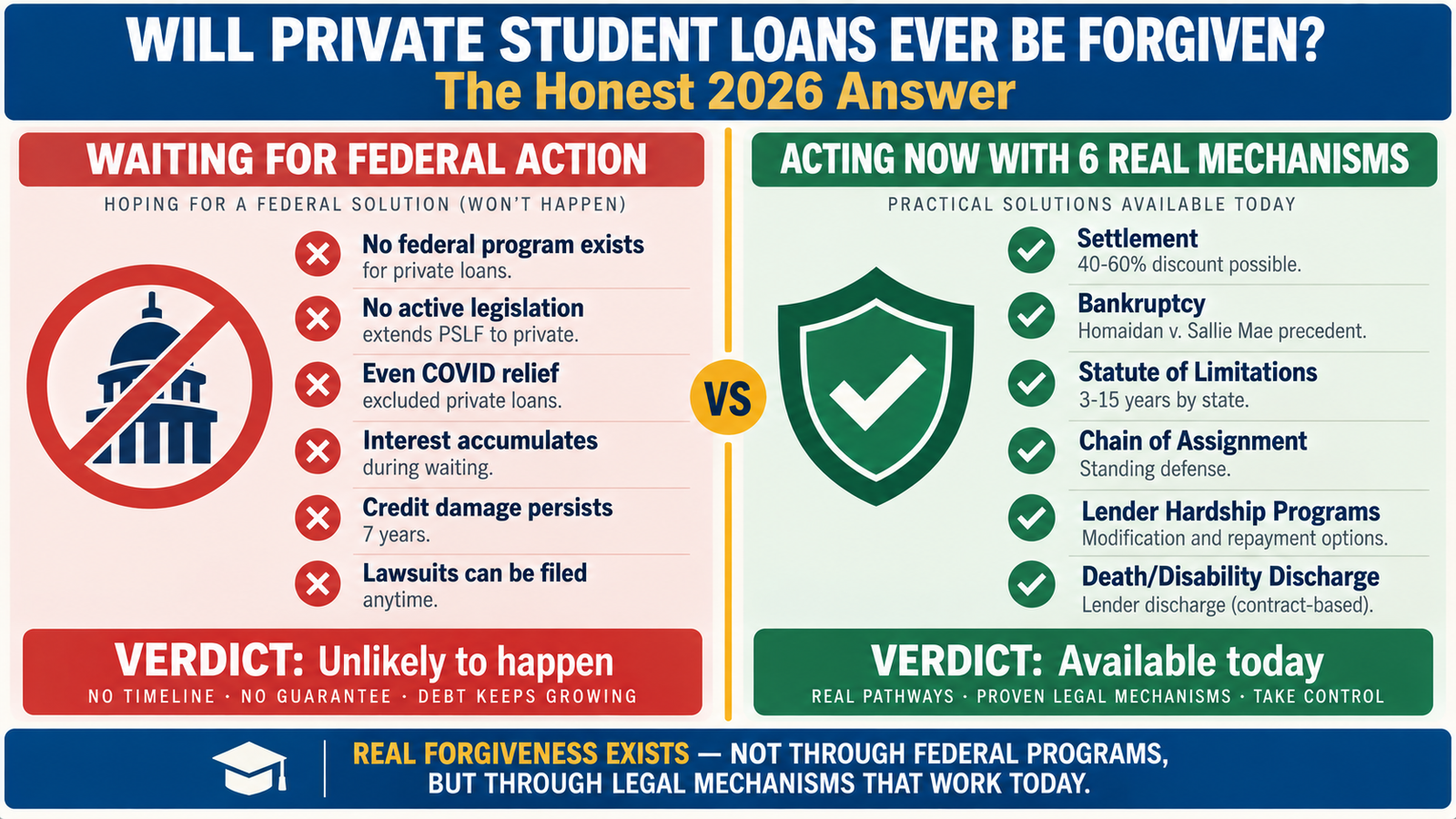
Will private student loans ever be forgiven through federal government programs? Realistically, no — the federal legal framework for forgiveness (PSLF under 20 U.S.C. §1087e(m), IDR forgiveness, Teacher Loan Forgiveness) applies ONLY to federal loans issued or guaranteed under the Higher Education Act (20 U.S.C. §1001 et seq.). Extending federal forgiveness to private loans would require federal purchase of or payment to private lenders at scale, which has no legislative support in any current proposal. BUT private student loans ARE being forgiven right now through 6 non-federal legal mechanisms: (1) settlement — paying reduced lump sum to current holder (typically 40-60% of balance for charged-off accounts); (2) bankruptcy discharge under 11 U.S.C. §523(a)(8) with Homaidan v. Sallie Mae 992 F.3d 100 (2d Cir. 2021) precedent making non-qualified private loans dischargeable without undue hardship; (3) statute of limitations expiration under state SOL (3-15 years by state) making debt uncollectible; (4) chain of assignment defense on Article III standing grounds (Lujan/Spokeo/TransUnion) particularly effective against NCSLT and debt-buyer-held debt; (5) lender hardship programs reducing debt burden; (6) death and disability discharge from most private lenders. Borrowers waiting for hypothetical future federal action on private loans forgo real forgiveness available through these mechanisms today.
Read the complete 2026 analysis below.
In this complete analysis:
The honest answer about federal forgiveness for private loans
Legal, political, and practical obstacles that make this unlikely
History: no federal program has ever forgiven private loans
What past precedent reveals about future prospects
The real cost of waiting for federal forgiveness
What happens to your debt while waiting for action that won’t come
The 6 real forgiveness mechanisms that work today
Non-federal paths that are forgiving private loans right now
State-level private loan protections (where they exist)
Limited state actions and borrower protections
Taking action: your private student loan forgiveness strategy
Decision framework and professional resources
The honest answer about federal forgiveness for private loans
Will private student loans ever be forgiven through federal government programs? The honest, direct answer is: realistically, no — at least not in any timeframe that should factor into current financial decisions. The legal, political, and practical obstacles are substantial and persistent. Borrowers deserve this honest answer rather than wishful speculation that encourages passive waiting while debt accumulates and legal rights erode.
The legal obstacle: federal statutory framework
Current federal forgiveness programs are tied specifically to federal loan statutes. Public Service Loan Forgiveness operates under 20 U.S.C. §1087e(m), which applies to Direct Loans. Income-Driven Repayment forgiveness operates under federal regulations tied to federal loan programs. Teacher Loan Forgiveness has similar federal statutory basis. None of these frameworks can be extended to private loans without new federal legislation specifically addressing private loan forgiveness — and no serious legislative proposal to do so has advanced.
The political obstacle: constituencies and cost
Extending federal forgiveness to private loans would require federal purchase of or payment to private lenders (Sallie Mae Bank NYSE:SLM, Navient Corporation NYSE:NAVI, Discover-related entities, SoFi Bank NA, Citizens Bank NA, Ascent, and numerous others) at substantial cost. The political constituencies that have supported federal loan forgiveness have focused on federal loans specifically — the argument that the federal government should forgive its own loans does not extend naturally to arguments that the federal government should buy out private lenders. Neither major political party has made private loan forgiveness a legislative priority.
The practical obstacle: scale and complexity
Even if political will existed, the practical implementation of federal private student loan forgiveness faces substantial challenges: identifying which loans qualify (many “private” loans involve complex origination histories including school programs and refinance combinations); valuation methodology for federal purchase; coordination with existing litigation and bankruptcy proceedings; precedent concerns for other private debt categories. Program design alone would require years of regulatory development before any disbursement.
What this means for borrowers
For borrowers asking are private student loans ever forgiven, the honest answer separates the question into two parts: (1) through future federal programs, realistically no; (2) through existing non-federal mechanisms, yes — right now, every day, across the country. The practical response is to engage with the real mechanisms available today rather than waiting for hypothetical federal action. Each year spent waiting is a year of interest accumulation, potential statute of limitations issues, and continued credit impact.
History: no federal program has ever forgiven private loans
To answer will private student loans ever be forgiven by the federal government, it helps to examine the complete historical record of federal action on student loan forgiveness. The pattern is remarkably consistent: every federal forgiveness program ever enacted has applied exclusively to federal loans, never to private loans — even during the broadest federal relief periods.
Federal forgiveness programs: federal-only track record
Public Service Loan Forgiveness (PSLF) enacted 2007 under the College Cost Reduction and Access Act — federal loans only; income-driven repayment forgiveness programs (ICR, IBR, PAYE, SAVE and successors) — federal loans only; Teacher Loan Forgiveness — federal loans only; Perkins Loan cancellation programs — federal loans only; Total and Permanent Disability discharge statutory version — federal loans only. The complete track record of federal forgiveness programs shows uniform application to federal loans with no extension to private loans in any program ever enacted.
COVID-era federal action: still federal-only
Even during the broadest federal student loan intervention in history during the COVID-19 pandemic — including payment pauses, interest suspension, and various forgiveness proposals — federal action applied exclusively to federal loans. Private loan borrowers received no equivalent federal relief despite similar economic pressures. The CARES Act of March 2020, subsequent executive actions, and related federal interventions did not extend to private student loans. This recent precedent during a national emergency is particularly instructive about future federal action on private loans.
Private loan reform proposals: structural, not forgiveness
Federal legislative proposals affecting private student loans have focused on structural reforms (bankruptcy treatment, cosigner protections, servicer regulations) rather than forgiveness programs. The Private Student Loan Bankruptcy Fairness Act and similar proposals have addressed §523(a)(8) bankruptcy treatment but not direct forgiveness. Even the most borrower-protective proposals contemplate changing how private loans are treated, not having the federal government forgive them. This pattern reinforces the historical conclusion that are private student loans forgiven federally is answered “no” and will likely continue to be answered “no” for the foreseeable future.
State-level action: limited private loan protections
Some states have enacted private student loan borrower protections: Washington, California, New York, and others have Student Loan Bills of Rights or servicer licensing requirements. However, these are consumer protection measures (improving servicing standards, prohibiting deceptive practices, requiring disclosures), not forgiveness programs. State-level programs that directly forgive private student loans remain rare and typically narrow in scope (specific occupations, specific geographic areas). The pattern of state action parallels federal action: structural improvements rather than mass forgiveness.
The real cost of waiting for federal forgiveness
For borrowers asking will private student loans ever be forgiven, the question is often really asking “should I wait for federal action before pursuing other options?” The practical cost of waiting is substantial and growing. Understanding what happens during the waiting period helps borrowers make informed decisions about whether to engage with available non-federal mechanisms now.
Interest and fee accumulation
Private student loan interest typically ranges 5-14% annually depending on origination terms. For borrowers in default, late fees and collection costs compound rapidly. A $50,000 private student loan debt accumulating 10% annual interest grows by $5,000 per year during passive waiting — meaning five years of waiting adds $25,000+ to the balance before any compounding or fees. This growth happens whether or not any future federal action ever materializes.
Credit damage persistence
Private student loan delinquency and default appear on credit reports for 7 years from original delinquency date under the Fair Credit Reporting Act. Waiting with delinquent accounts means extended credit damage affecting housing applications, employment background checks, auto loans, and other financial access. Addressing the debt through settlement or other mechanisms starts the credit recovery clock that eventually restores credit access.
Litigation and judgment risk
Private lenders and debt buyers file lawsuits on delinquent accounts, typically within 1-4 years of charge-off. Default judgments entered when borrowers fail to appear create wage garnishment, bank account levies, and property liens. These judgments remain enforceable for extended periods (often 20 years, renewable). Waiting for federal action while lawsuits are filed and judgments entered creates substantial additional damage that is difficult to reverse later.
Statute of limitations expiration opportunity cost
Paradoxically, SOL expiration can be a benefit for borrowers — but only if the borrower actively avoids actions that restart the SOL clock. Borrowers passively waiting for federal action often make small payments or written acknowledgments that restart SOL, forfeiting potential SOL-based private loan forgiveness. Coordinated strategy with awareness of SOL timing produces better outcomes than passive waiting.
Lost settlement leverage
Settlement leverage changes over time. Immediately after charge-off, lenders are often willing to accept lower settlements to avoid collection costs. As accounts age and move through multiple collection agencies and debt buyers, settlement dynamics change — sometimes favorably, sometimes unfavorably. Chain of assignment documentation often becomes stronger (worse for borrowers) over time as collection records accumulate, or weaker (better for borrowers) if portfolio sales create documentation gaps. Timing matters.
The 6 real forgiveness mechanisms that work today
While the answer to will private student loans ever be forgiven federally is realistically “no,” private student loans ARE being forgiven right now through 6 non-federal legal mechanisms. These are not hypothetical future programs — they are legal frameworks producing forgiveness outcomes for borrowers every day across the country.
Mechanism 1: Settlement
Settlement negotiation with current holder (Sallie Mae Bank, Navient/Earnest Operations LLC, Discover/Firstmark Services, SoFi Bank NA, Citizens Bank NA, Ascent, debt buyers) typically achieves 40-60% discount from balance for charged-off accounts. The forgiven portion (balance above settlement payment) is reported on IRS Form 1099-C and may qualify for IRC §108(a)(1)(B) insolvency exclusion from taxable income. Settlement produces immediate, measurable private student loan forgiveness for the balance above the settlement amount.
Mechanism 2: Bankruptcy discharge
Bankruptcy discharge under 11 U.S.C. §523(a)(8) with Homaidan v. Sallie Mae 992 F.3d 100 (2d Cir. 2021) precedent produces complete forgiveness of qualifying private student loans. The Second Circuit held that direct-to-consumer private education loans are dischargeable WITHOUT undue hardship showing. Similar precedents followed in Fifth Circuit (Crocker v. Navient 941 F.3d 206, 5th Cir. 2019) and Tenth Circuit (McDaniel v. Navient 973 F.3d 1083, 10th Cir. 2020). Non-qualified private loans and loans failing IRC §221(d)(1) requirements can discharge entirely.
Mechanism 3: Statute of limitations expiration
State SOL for written contract debt makes private student loan debt uncollectible through litigation after expiration period. SOL by state: Texas 4 years (Tex. Civ. Prac. & Rem. Code §16.004(a)(3)); New York 3 years (CPLR §214(2) per CCFA April 7, 2022); Pennsylvania 4 years (42 Pa.C.S. §5525); Ohio 6 years (R.C. §2305.06); Illinois 10 years (735 ILCS 5/13-206); Georgia 6 years (O.C.G.A. §9-3-24); California 4 years (CCP §337); Florida 5 years (Fla. Stat. §95.11(2)(b)); Delaware 3 years (10 Del. C. §8106). After SOL expiration, debt effectively forgiven in practical terms (uncollectible through courts).
Mechanism 4: Chain of assignment defense
Chain of assignment challenges under Article III standing (Lujan v. Defenders of Wildlife 504 U.S. 555; Spokeo, Inc. v. Robins 578 U.S. 330; TransUnion LLC v. Ramirez 594 U.S. 413) can eliminate debt through case dismissal when current plaintiff cannot prove ownership. Particularly effective against NCSLT (National Collegiate Student Loan Trusts) with Third Circuit’s March 19, 2024 “covered persons” decision and SCOTUS cert denial December 2024, and against debt-buyer-held debt with documentation gaps. Produces complete private loan forgiveness through dismissal.
Mechanism 5: Lender hardship programs
Private lender hardship programs provide contract-based relief: Sallie Mae Loan Modification Program with reduced interest rate 4-6%; Citizens Bank hardship forbearance; SoFi Unemployment Protection Program; Earnest skip-a-payment and hardship forbearance; Ascent hardship forbearance up to 24 months; Firstmark Services (for former Discover loans post-July 2024 Carlyle+KKR sale) hardship programs. While not technically “forgiveness,” these programs reduce debt burden and prevent charge-off, supporting longer-term forgiveness strategy.
Mechanism 6: Death and disability discharge
Most major private lenders provide contract-based death discharge: Sallie Mae discharges borrower’s balance on death with cosigner discharge for 2015-and-later loans; Discover/Firstmark, SoFi, Earnest, Citizens Bank, and Ascent all provide death discharge. Disability discharge available from Sallie Mae (Total and Permanent Disability program) and Ascent, with varying availability from other lenders. Complete forgiveness through these mechanisms for qualifying situations.
State-level private loan protections (where they exist)
While federal action on private student loan forgiveness remains unlikely, some states have enacted private student loan borrower protections that affect how private loans operate. Understanding state-level actions helps borrowers identify what protections apply in their jurisdiction, though these protections are structural rather than forgiveness-based.
Student Loan Bills of Rights
Several states have enacted Student Loan Bills of Rights or similar legislation addressing private student loan servicing: Washington (first in 2018); California (2020); New York (2019); Virginia; Illinois; Connecticut; Maryland; Colorado; New Jersey; and others. These laws typically require: student loan servicer licensing; disclosure requirements; prohibited deceptive practices; consumer complaint mechanisms. Enforcement varies by state. These protections improve how private loans are serviced but do not forgive them.
State consumer protection enforcement
State attorneys general have brought enforcement actions against private student loan companies for deceptive practices and consumer protection violations. Notable actions include multi-state settlements with Navient (January 2022 for $1.85 billion with participating state attorneys general for alleged origination and servicing issues). These enforcement actions sometimes produce debt reduction for affected borrowers as part of settlement terms, but are not forgiveness programs in the general sense.
Narrow state forgiveness programs
A limited number of states offer narrow private student loan assistance programs typically tied to specific professions (healthcare workers in underserved areas, teachers in critical shortage subjects) or geographic areas (rural service commitments). These programs typically repay a portion of loans rather than forgiving directly, and typically require ongoing service commitments. Program availability changes periodically; current state program listings should be verified directly with each state’s higher education authority.
Statute of limitations variations
The most significant state-level private loan protection is statute of limitations variation. New York’s Consumer Credit Fairness Act (CCFA) effective April 7, 2022 shortened SOL to 3 years and strengthened protections against time-barred debt collection. Several other states have shortened or clarified SOL periods. State SOL variation creates significant differences in private student loan debt relief opportunities by jurisdiction — a borrower in a 3-year SOL state faces different timing dynamics than one in a 10-year SOL state.
Taking action: your private student loan forgiveness strategy
Rather than waiting for federal action that is unlikely to come, borrowers asking will private student loans ever be forgiven can take concrete action today through the 6 non-federal mechanisms. A strategic approach involves assessing current situation, identifying which mechanisms apply, and executing on the most favorable options.
Step 1: Honest situation assessment
Begin with honest assessment of current situation: total private student loan debt by lender; current loan status (current, delinquent 1-179 days, charged-off, in collections, in litigation, judgment entered); income and asset position; state of residence (affects SOL and state-level protections); years since original default (affects SOL opportunity); whether cosigner is involved. This assessment identifies which of the 6 mechanisms likely apply.
Step 2: Mechanism selection by circumstance
Select mechanisms by circumstance: Currently paying but struggling — lender hardship programs, cosigner release if eligible, potential refinance; Recently delinquent — early settlement discussion, hardship forbearance; Charged-off accounts — settlement with chain of assignment analysis for leverage, SOL analysis; NCSLT or debt-buyer debt — chain of assignment challenges; Old debt near SOL — careful SOL analysis, avoid revival; Serious distress — bankruptcy analysis under Homaidan §523(a)(8); Death/disability — lender-specific discharge applications. Multiple mechanisms often apply simultaneously for coordinated strategy.
Step 3: Professional resource engagement
Given complexity of the 6 mechanisms and their interactions, professional resources typically produce better outcomes than DIY approaches. Resources: bankruptcy counsel familiar with Homaidan §523(a)(8) adversary proceedings; state-licensed consumer attorneys for chain of assignment and SOL defense; consulting organizations coordinating multi-mechanism strategy with attorney-backed partners; CPAs for IRC §108 tax planning. Private Student Relief coordinates these resources through attorney-backed partner provider network.
Step 4: Execution and documentation
Execute selected strategy with proper documentation: settlement agreements with full satisfaction release language and credit tradeline update instructions; bankruptcy filings with §523(a)(8) adversary proceeding complaints citing Homaidan; chain of assignment challenges with proper standing arguments; FDCPA counterclaims where applicable under 15 U.S.C. §1692g and §1692e; proper notarization and recording where required. Documentation protects against future revival or dispute.
Related resources — complete forgiveness ecosystem
The 7-path master framework covering all private student loan forgiveness mechanisms available in 2026.
Debt Forgiveness for Private Student Loans: What Works 2026
6-mechanism framework for real debt forgiveness including tax planning under IRC §108.
Private Student Loan Debt Help: Your Options 2026
6 real options for borrowers facing private student loan burdens with lender-specific details.
Common misconceptions about private student loan forgiveness
Misconception 1
“The government will eventually extend federal forgiveness to private loans”
Reality: No federal legislation extending PSLF, IDR forgiveness, or other federal programs to private loans has gained meaningful legislative traction. The federal statutory framework is specifically tied to federal loan statutes, and extension to private loans would require either: (a) federal purchase of private loans at substantial cost, or (b) direct federal payments to private lenders. Neither has political support in current legislative proposals. Borrowers planning around hypothetical future federal extension of forgiveness to private loans are planning around a scenario with no realistic probability.
Misconception 2
“If federal forgiveness happens, waiting will have been worth it”
Reality: Even in the hypothetical scenario of future federal action, the costs of waiting are substantial and often not recoverable. Interest accumulation during waiting typically exceeds the forgiveness amount of any realistic program. Credit damage during waiting affects housing, employment, and other access. Judgments entered during waiting create long-lasting obligations. SOL opportunity costs if revival occurs during waiting are permanent. Even if some future program existed, borrowers who addressed debt through existing mechanisms during the waiting period typically achieve better overall financial outcomes than those who passively waited.
Misconception 3
“Private student loans can never actually be forgiven”
Reality: Private student loans ARE being forgiven right now, every day, through the 6 non-federal mechanisms. Settlement produces partial forgiveness; bankruptcy discharge under Homaidan precedent produces complete forgiveness; SOL expiration makes debt uncollectible; chain of assignment challenges can eliminate debt through dismissal; lender programs reduce debt burden; death/disability discharge forgives qualifying debt. The confusion between “no federal forgiveness program” and “no forgiveness ever” causes many borrowers to miss real forgiveness opportunities. Are private student loans forgiven? Yes — just not through federal programs.
Misconception 4
“Operators claiming ‘government-approved private student loan forgiveness’ can help”
Reality: No federal government-approved program for private student loan forgiveness exists. Operators claiming otherwise are misrepresenting the law and often charging substantial upfront fees for services that don’t deliver promised outcomes. Real private student relief works through the 6 non-federal mechanisms with transparent fee structures and documented results. Red flags: large upfront fees before any work performed; claims of “government approval”; guarantees of complete debt elimination without case-specific analysis; discouragement of consulting independent counsel. Legitimate help uses non-federal mechanisms and transparent engagement terms.
Frequently asked questions
1. Will private student loans ever be forgiven by the federal government?
Realistically, no — not in any timeframe that should factor into current financial decisions. Federal forgiveness programs (PSLF under 20 U.S.C. §1087e(m), IDR forgiveness, Teacher Loan Forgiveness) apply only to federal loans issued or guaranteed under the Higher Education Act. Extending federal forgiveness to private loans would require federal purchase of or payment to private lenders (Sallie Mae Bank, Navient Corporation, Discover-related entities, SoFi Bank, Citizens Bank, Ascent, and others) at substantial cost, with no political support in current legislative proposals. However, private student loans ARE being forgiven right now through 6 non-federal mechanisms: settlement, bankruptcy discharge, SOL expiration, chain of assignment defense, lender hardship programs, and death/disability discharge. These existing mechanisms are the realistic path forward.
2. Are private student loans ever forgiven in bankruptcy?
Yes, private student loans can be forgiven in bankruptcy through 11 U.S.C. §523(a)(8) discharge. Following Homaidan v. Sallie Mae 992 F.3d 100 (2d Cir. 2021), direct-to-consumer private education loans are dischargeable WITHOUT undue hardship showing. Similar precedents in Fifth Circuit (Crocker v. Navient 941 F.3d 206) and Tenth Circuit (McDaniel v. Navient 973 F.3d 1083) support broad discharge availability. Loans failing IRC §221(d)(1) qualified education loan requirements are dischargeable. Qualified loans may discharge under Brunner undue hardship test with moderated application following In re Rosenberg 594 B.R. 22 (Bankr. S.D.N.Y. 2020) and DOJ November 2022 guidance.
3. Why doesn’t PSLF apply to private student loans?
Public Service Loan Forgiveness operates under 20 U.S.C. §1087e(m), which specifically governs Direct Loan program forgiveness after qualifying payments and employment. Private loans are not Direct Loans and fall outside this statutory framework entirely. Extending PSLF to private loans would require Congress to amend the statute to include private loans or create a parallel private loan forgiveness program — neither has advanced in current legislative proposals. Borrowers with private loans in public service positions cannot access PSLF regardless of employment type, length, or payment history.
4. How are private student loans forgiven today without federal programs?
Six non-federal mechanisms forgive private student loan debt in 2026: (1) settlement — negotiating with current holder (Sallie Mae, Navient/Earnest, Discover/Firstmark, SoFi, Citizens, Ascent) to pay reduced lump sum, typically 40-60% of balance for charged-off accounts; (2) bankruptcy discharge under §523(a)(8) with Homaidan precedent; (3) statute of limitations expiration under state SOL (3-15 years); (4) chain of assignment defense on Article III standing grounds; (5) lender hardship programs; (6) death and disability discharge. Each produces real forgiveness outcomes for qualifying situations without any federal action required.
5. Should I wait for federal action before pursuing private loan debt help?
No — waiting carries substantial costs that typically exceed any realistic benefit from hypothetical future federal action. Costs of waiting include: interest and fee accumulation (often thousands of dollars per year); credit damage persistence (7 years from original delinquency under FCRA); litigation and judgment risk during the waiting period; SOL opportunity cost if actions during waiting restart the clock; lost settlement leverage as circumstances change. Even if some future federal action eventually occurred, borrowers who addressed debt through existing mechanisms during the waiting period typically achieve better overall outcomes than passive waiters. Taking action today through the 6 real mechanisms is almost always better than waiting.
6. Did COVID-era federal action include private student loans?
No — even during the broadest federal student loan intervention in history during the COVID-19 pandemic, federal action applied exclusively to federal loans. The CARES Act of March 2020 payment pause, interest suspension, and subsequent related federal interventions did not extend to private loans. Private loan borrowers received no equivalent federal relief despite similar economic pressures. This recent precedent during a national emergency is particularly instructive about future federal action on private loans — even emergency conditions did not prompt federal action on private loans.
7. What’s the best approach for private student loan forgiveness in 2026?
The best approach combines honest situation assessment with strategic use of the 6 real mechanisms: (1) assess current debt, loan status, state of residence, and personal circumstances; (2) identify which mechanisms apply — often multiple simultaneously; (3) engage professional resources (bankruptcy counsel for Homaidan §523(a)(8), consumer attorneys for chain of assignment and SOL defense, consulting organizations for multi-mechanism coordination, CPAs for IRC §108 tax planning); (4) execute selected strategy with proper documentation; (5) coordinate across multiple mechanisms when applicable. Avoid waiting for hypothetical federal action and avoid operators claiming “government-approved private student loan forgiveness” — neither exists in reality.
Stop Waiting — Start Forgiving Today
Free specialist review of all 6 real mechanisms that forgive private student loans today.
Settlement negotiation analysis, bankruptcy discharge evaluation under §523(a)(8) with Homaidan precedent, statute of limitations analysis by state, chain of assignment defensive framework for NCSLT-held and debt-buyer debt, lender hardship program qualification, and coordinated multi-mechanism approach for maximum private student loan forgiveness outcomes available today. Free eligibility review with attorney-backed partner provider — no upfront fees, no waiting for federal action that won’t come.
Get a free eligibility review →
5-minute review · No obligation · Zero upfront fees · Since 2015 · 48 states served
About the author
Henry Silva — Private Student Loan Debt Specialist
10+ years experience tracking federal legislation history on private student loans and delivering real forgiveness outcomes through non-federal mechanisms: settlement negotiation with major private lenders (Sallie Mae Bank NYSE:SLM, Navient/Earnest Operations LLC, Discover/Firstmark Services after July 2024 Carlyle+KKR sale, SoFi Bank NA NMLS #696891, Citizens Bank NA NYSE:CFG, Ascent Student Loans), bankruptcy discharge analysis under 11 U.S.C. §523(a)(8) with Homaidan v. Sallie Mae 992 F.3d 100 (2d Cir. 2021) precedent, Crocker v. Navient 941 F.3d 206 (5th Cir. 2019), McDaniel v. Navient 973 F.3d 1083 (10th Cir. 2020), Brunner v. New York State Higher Education Services Corp. 831 F.2d 395 (2d Cir. 1987) framework for qualified loans, In re Rosenberg 594 B.R. 22 (Bankr. S.D.N.Y. 2020) updated application, statute of limitations analysis across all 50 states, hardship program qualification, cosigner release strategy, chain of assignment challenges under Article III standing doctrine (Lujan/Spokeo/TransUnion), NCSLT Third Circuit precedent application, IRC §108(a)(1)(A) bankruptcy and IRC §108(a)(1)(B) insolvency tax exclusion analysis, and coordinated multi-mechanism strategy for maximum debt elimination outcomes. Henry works with Private Student Relief’s attorney-backed partner provider network to review individual scenarios across all 6 real forgiveness mechanisms that produce results today — without waiting for hypothetical future federal action.
Legal Disclaimer and Sources
This article is provided for informational purposes only and does not constitute legal, tax, or financial advice. Private Student Relief is a consulting and matching organization operated by Joco (555 Anton Blvd, Suite 368, Costa Mesa, CA 92626) — not a law firm, debt settlement company, debt consolidation company, or loan provider. Debt validation services are performed by an attorney-backed partner provider (Panamerican Consulting LLC, Las Vegas, NV) under independent business credentials. Ratings, BBB accreditation, and AADR membership referenced on the PSR website belong to the partner provider. Private student loan forgiveness pathway availability depends on loan characteristics, lender terms, borrower circumstances, and jurisdiction. Individual results vary. Since 2015. 48 states served. Not available in South Carolina or Mississippi.
Analysis of federal legislation prospects is informational and reflects publicly available legislative tracking as of October 2026. Future legislative or regulatory action cannot be predicted with certainty, and nothing in this article should be construed as legal or financial advice regarding future legislation. Borrowers should make financial decisions based on available current mechanisms rather than speculative future federal action.
Federal student loan program citations (for comparison, these do NOT apply to private student loans): Higher Education Act (20 U.S.C. §1001 et seq.); Public Service Loan Forgiveness (20 U.S.C. §1087e(m)); Income-Driven Repayment forgiveness (federal loan regulatory framework); Direct Loan death discharge (20 U.S.C. §1087); Perkins Loan death discharge (20 U.S.C. §1087dd). These federal programs apply ONLY to federal loans. COVID-era federal action (CARES Act March 2020 and subsequent related interventions) also applied only to federal loans.
Bankruptcy Code references: 11 U.S.C. §523(a)(8) (student loan discharge exceptions with §523(a)(8)(A)(i) governmental unit, §523(a)(8)(A)(ii) educational benefit, §523(a)(8)(B) qualified education loan categories); 11 U.S.C. §362 (automatic stay); 11 U.S.C. §707(b)(2) (means test); 11 U.S.C. §1328 (Chapter 13 discharge). Key bankruptcy precedent: Homaidan v. Sallie Mae 992 F.3d 100 (2d Cir. 2021); Brunner v. New York State Higher Education Services Corp. 831 F.2d 395 (2d Cir. 1987); Crocker v. Navient Solutions LLC 941 F.3d 206 (5th Cir. 2019); McDaniel v. Navient Solutions LLC 973 F.3d 1083 (10th Cir. 2020); In re Rosenberg 594 B.R. 22 (Bankr. S.D.N.Y. 2020). Article III standing precedent: Lujan v. Defenders of Wildlife 504 U.S. 555 (1992); Spokeo, Inc. v. Robins 578 U.S. 330 (2016); TransUnion LLC v. Ramirez 594 U.S. 413 (2021). Federal Rules of Civil Procedure: FRCP 60(b)(4) (void judgment). Internal Revenue Code: IRC §221(d)(1); IRC §108(a)(1)(A); IRC §108(a)(1)(B). FDCPA: 15 U.S.C. §1692g (debt validation); 15 U.S.C. §1692e (deceptive practices).
Statute of limitations for written contract debt (private student loans) by state: Texas 4 years under Tex. Civ. Prac. & Rem. Code §16.004(a)(3); New York 3 years under CPLR §214(2) per Consumer Credit Fairness Act (CCFA) effective April 7, 2022; Pennsylvania 4 years under 42 Pa.C.S. §5525; Ohio 6 years under Ohio R.C. §2305.06 (reduced 2021); Illinois 10 years under 735 ILCS 5/13-206; Georgia 6 years under O.C.G.A. §9-3-24; California 4 years under CCP §337; Florida 5 years under Fla. Stat. §95.11(2)(b); Delaware 3 years under 10 Del. C. §8106. Complete state SOL analysis should be verified against current statutes for each specific borrower situation.
Lender information current as of October 2026 per publicly available documentation: Sallie Mae Bank NYSE:SLM; Navient Corporation NYSE:NAVI (2014 Sallie Mae split; 2017 Earnest acquisition $155M; December 2021 Aidvantage transfer federal exit; January 2022 state attorneys general settlement $1.85B); Earnest Operations LLC (Navient subsidiary since 2017); Discover student loans acquired by Carlyle Group and KKR July 2024 with servicing transitioned to Firstmark Services (Nelnet NYSE:NNI subsidiary); SoFi Bank NA NMLS #696891 (chartered as national bank 2022); Citizens Bank NA NYSE:CFG; Ascent Student Loans with June 5, 2023 originated loans having contractual §523(a)(8) discharge waiver. Specific lender program details subject to change and should be verified directly with current lender documentation.
Private student loan forgiveness through the 6 non-federal mechanisms requires case-by-case analysis coordinating loan characteristics, lender identification, chain of assignment history, borrower jurisdiction, defensive framework opportunities, and specific circumstances. This article provides general framework information; specific settlement negotiations, bankruptcy filings under Homaidan precedent, chain of assignment challenges, hardship program applications, cosigner release strategies, and coordinated multi-mechanism approaches must be evaluated for each borrower’s individual situation by counsel or consulting resources familiar with the complete private student loan debt relief framework. Future federal action on private student loans cannot be predicted and should not factor into current financial planning. Last reviewed: October 2026.