

Informational content only. Not legal, tax, or financial advice. Private Student Relief is a consulting organization, not a law firm. Debt validation services are executed by an attorney-backed partner provider. Bankruptcy filing requires representation by licensed bankruptcy counsel. Discharge outcomes depend on loan characteristics, lender terms, borrower circumstances, and jurisdiction. Last reviewed: October 2026.
Written by Henry Silva
Private Student Loan Debt Specialist · 10+ years experience in private student loan bankruptcy discharge analysis under 11 U.S.C. §523(a)(8): Homaidan v. Sallie Mae 992 F.3d 100 (2d Cir. 2021), Crocker v. Navient 941 F.3d 206 (5th Cir. 2019), McDaniel v. Navient 973 F.3d 1083 (10th Cir. 2020), Brunner v. New York State HESC 831 F.2d 395 (2d Cir. 1987), In re Rosenberg 594 B.R. 22 (Bankr. S.D.N.Y. 2020), DOJ November 2022 attorney guidance, and IRC §221(d)(1) qualified education loan analysis. Coordination with bankruptcy counsel for Chapter 7 and Chapter 13 adversary proceedings against Sallie Mae Bank NYSE:SLM, Navient/Earnest Operations LLC, Discover/Firstmark Services, SoFi Bank NA, Citizens Bank NA, Ascent Student Loans, NCSLT trusts, and debt buyers. Last reviewed: October 2026.
The widespread belief that “student loans can never be discharged in bankruptcy” is outdated and incorrect for private student loans. Since the Second Circuit’s landmark Homaidan v. Sallie Mae decision in 2021, private student loan borrowers across the country have been obtaining private student loan bankruptcy discharge without proving undue hardship for a substantial category of loans. This complete 2026 technical deep-dive explains how §523(a)(8) actually works, the three categorical exceptions and which private loans fall outside them, the controlling Circuit Court precedents (Homaidan, Crocker, McDaniel), the Brunner undue hardship test with its moderated application (In re Rosenberg) and DOJ November 2022 guidance, Chapter 7 vs Chapter 13 selection, adversary proceeding mechanics, costs and timelines, and the IRC §221(d)(1) qualified education loan analysis that determines dischargeability. For borrowers with overwhelming private student loan debt, bankruptcy discharge may produce complete debt elimination that no other path can match.
Quick Answer
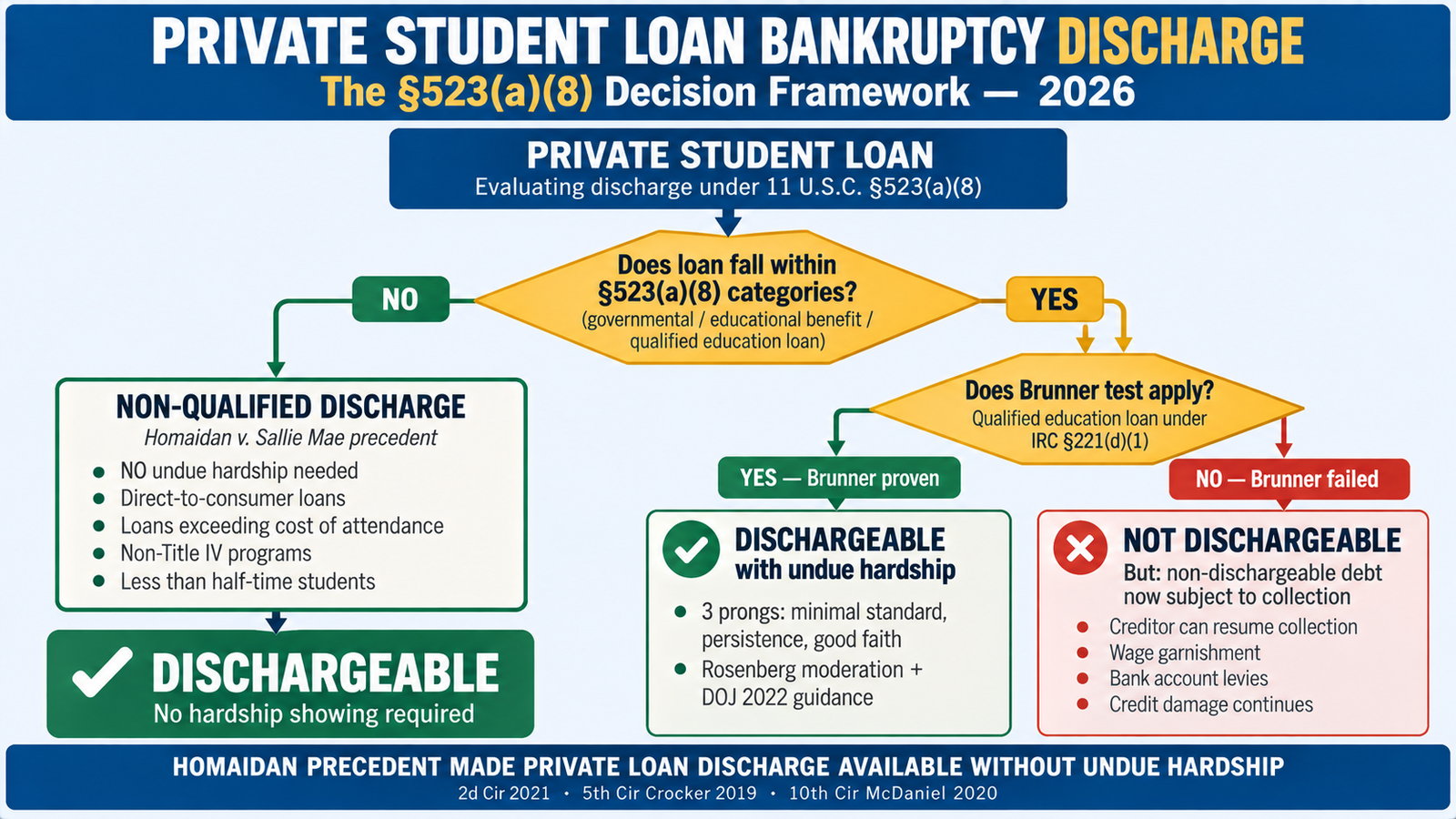
Private student loan bankruptcy discharge is available under 11 U.S.C. §523(a)(8) through two pathways: (1) NON-QUALIFIED discharge WITHOUT undue hardship showing — for private loans that do NOT fall into §523(a)(8)’s three categorical exceptions (not from a governmental unit, not an “educational benefit” under §523(a)(8)(A)(ii), not a “qualified education loan” under IRC §221(d)(1)). Following Homaidan v. Sallie Mae Inc. 992 F.3d 100 (2d Cir. 2021), direct-to-consumer private loans dischargeable without any undue hardship analysis. Similar precedents in Fifth Circuit (Crocker v. Navient Solutions LLC 941 F.3d 206) and Tenth Circuit (McDaniel v. Navient Solutions LLC 973 F.3d 1083) support broad discharge availability. (2) QUALIFIED discharge WITH undue hardship showing under Brunner v. New York State HESC 831 F.2d 395 (2d Cir. 1987) three-prong test, moderated by In re Rosenberg 594 B.R. 22 (Bankr. S.D.N.Y. 2020) and DOJ November 2022 guidance making discharge more accessible than historical practice suggested. Loans potentially dischargeable without undue hardship: direct-to-consumer loans without school certification; loans exceeding cost of attendance limit; loans for non-title IV eligible programs (vocational, bar prep, non-degree); loans to less-than-half-time students; loans failing other IRC §221(d)(1) requirements. Chapter 7 typically produces discharge in 3-4 months plus 60-90 days for §523(a)(8) adversary proceeding. Chapter 13 involves 3-5 year plan with discharge under 11 U.S.C. §1328 at completion. Discharge produces complete debt elimination for Sallie Mae Bank, Navient/Earnest Operations LLC, Discover/Firstmark Services, SoFi Bank NA, Citizens Bank NA, Ascent, NCSLT, and debt buyer debts qualifying under the framework.
Read the complete 2026 bankruptcy discharge framework below.
In this complete bankruptcy discharge guide:
The outdated myth and the modern reality
Why “can’t discharge student loans” is wrong for private loans in 2026
The §523(a)(8) framework in detail
Three categorical exceptions and what each means
Homaidan v. Sallie Mae deep-dive
The 2021 Second Circuit decision that changed everything
Crocker and McDaniel: Fifth and Tenth Circuit precedents
How parallel precedents expanded Homaidan nationally
IRC §221(d)(1) qualified education loan analysis
The 5 requirements and how loans fail to meet them
Brunner undue hardship test (for qualified loans)
Three-prong test with Rosenberg and DOJ 2022 moderation
Chapter 7 vs Chapter 13 selection
Means test, asset considerations, discharge timing
The §523(a)(8) adversary proceeding mechanics
How discharge is actually obtained in practice
Costs, timeline, and attorney selection
What to expect financially and procedurally
The outdated myth and the modern reality
For decades, the conventional wisdom held that “student loans cannot be discharged in bankruptcy.” This was always an oversimplification, but it has become substantially incorrect for private student loans since 2021. Understanding how the legal landscape actually works today — not what it looked like 10 or 20 years ago — is essential for borrowers evaluating bankruptcy discharge private student loans options.
The historical “no discharge” myth
The myth that student loans cannot be discharged in bankruptcy originated from §523(a)(8) of the Bankruptcy Code, which was progressively amended between 1976 and 2005 to make educational loans harder to discharge. By 2005, the statute reached its current form making certain educational loans non-dischargeable unless “undue hardship” is shown. Historically, courts interpreted “undue hardship” very narrowly, making discharge nearly impossible in practice. This history produced the widespread (but now outdated) belief that discharge was simply unavailable.
The 2021 Second Circuit transformation
Everything changed with Homaidan v. Sallie Mae Inc. 992 F.3d 100 (2d Cir. 2021). The Second Circuit held that §523(a)(8) does NOT make all private student loans non-dischargeable — only specific categories defined in the statute. Private loans falling outside those categories are dischargeable in bankruptcy WITHOUT any undue hardship showing. Similar decisions in Fifth Circuit (Crocker v. Navient Solutions LLC 941 F.3d 206, 5th Cir. 2019) and Tenth Circuit (McDaniel v. Navient Solutions LLC 973 F.3d 1083, 10th Cir. 2020) created a broad legal framework supporting private student loan discharge.
The current 2026 landscape
In 2026, the landscape for private student loan bankruptcy discharge includes: (1) controlling Circuit Court precedent in multiple jurisdictions supporting discharge without undue hardship for non-qualified loans; (2) more flexible Brunner analysis for qualified loans following In re Rosenberg 594 B.R. 22 (Bankr. S.D.N.Y. 2020) and DOJ November 2022 guidance; (3) growing bankruptcy practice specifically focused on private student loan discharge; (4) better-educated bankruptcy judges applying Homaidan-type analysis. Borrowers evaluating discharge today operate in a substantially more favorable environment than those evaluating it a decade ago.
Why misinformation persists
Despite the legal reality, misinformation persists because: (1) older bankruptcy attorneys sometimes still apply pre-Homaidan analysis; (2) consumer-facing content often repeats outdated conventional wisdom; (3) lenders sometimes make misleading statements about discharge availability; (4) the technical nature of §523(a)(8) analysis is not well-understood by general consumer audiences. Borrowers should seek bankruptcy counsel specifically familiar with Homaidan-type adversary proceedings rather than relying on general assumptions about student loan dischargeability.
The §523(a)(8) framework in detail
11 U.S.C. §523(a)(8) is the specific statute governing private student loan bankruptcy discharge. The statute does NOT prohibit discharge of all student loans — it makes specific categories of educational loans non-dischargeable unless undue hardship is shown. Understanding what the statute actually says, and what falls OUTSIDE its three categorical exceptions, is foundational to every discharge analysis.
The statutory text
11 U.S.C. §523(a)(8) excepts from discharge debts for “an educational benefit overpayment or loan made, insured, or guaranteed by a governmental unit, or made under any program funded in whole or in part by a governmental unit or nonprofit institution; or an obligation to repay funds received as an educational benefit, scholarship, or stipend; or any other educational loan that is a qualified education loan, as defined in section 221(d)(1) of the Internal Revenue Code of 1986, incurred by a debtor who is an individual” unless excepting such debt would impose undue hardship on the debtor and dependents.
Category 1: §523(a)(8)(A)(i) — governmental unit loans
The first category covers loans “made, insured, or guaranteed by a governmental unit.” This primarily captures federal student loans (Direct Loans, FFEL Loans, Perkins Loans) which are made or guaranteed by the U.S. Department of Education. Private loans are typically NOT in this category because they come from private lenders without governmental involvement. For private loans, Category 1 is generally not the obstacle to discharge.
Category 2: §523(a)(8)(A)(ii) — educational benefit, scholarship, or stipend
The second category covers obligations to repay “funds received as an educational benefit, scholarship, or stipend.” The critical question is what constitutes an “educational benefit.” Lenders historically argued this category captured essentially all private student loans. Homaidan v. Sallie Mae and parallel decisions rejected this broad interpretation, holding that “educational benefit” is narrow — covering specific scholarship/stipend-type obligations rather than general private loans used for education.
Category 3: §523(a)(8)(B) — qualified education loan
The third category covers “any other educational loan that is a qualified education loan, as defined in section 221(d)(1) of the Internal Revenue Code of 1986, incurred by a debtor who is an individual.” This category incorporates the IRC §221(d)(1) definition of “qualified education loan.” Many private loans fail to meet all requirements of §221(d)(1) — rendering them NOT “qualified education loans” and therefore outside Category 3. Loans falling outside all three categories are fully dischargeable without undue hardship showing.
The “undue hardship” exception
Even loans falling WITHIN one of the three categories can be discharged if the borrower proves “undue hardship.” Undue hardship is not defined in the statute itself — courts have developed tests, most commonly the Brunner three-prong test from Brunner v. New York State HESC 831 F.2d 395 (2d Cir. 1987). The Brunner test has been applied strictly historically but has been moderated by recent decisions and DOJ November 2022 guidance. For qualified loans, undue hardship remains the discharge pathway; for non-qualified loans, it is not required.
The two pathways summary
Two distinct pathways exist for private student loan bankruptcy discharge: (1) Non-qualified discharge WITHOUT undue hardship — for loans falling outside all three §523(a)(8) categories, following Homaidan analysis; (2) Qualified discharge WITH undue hardship — for loans within the categories, through Brunner (or alternative test) showing. The first pathway is substantially easier when applicable, which is why detailed §523(a)(8) analysis determining which category applies is the first step in every private loan discharge evaluation.
Homaidan v. Sallie Mae deep-dive
The 2021 Second Circuit decision in Homaidan v. Sallie Mae Inc. 992 F.3d 100 (2d Cir. 2021) is the single most important legal development for bankruptcy discharge private student loans in the modern era. Understanding what the court actually decided — and why it matters — is essential for every borrower considering bankruptcy discharge.
The factual background
Hilal Homaidan obtained private student loans from Sallie Mae while attending Emerson College. The loans were “direct-to-consumer” private loans — meaning they went directly to Homaidan without any requirement that the loan amount be certified by Emerson as covering educational expenses within cost of attendance. After graduation, Homaidan filed Chapter 7 bankruptcy and received a general discharge. Sallie Mae continued to collect on the loans, asserting they were non-dischargeable under §523(a)(8). Homaidan sued to establish discharge.
The legal question
The core legal question: do direct-to-consumer private loans fall within §523(a)(8)(A)(ii) — “obligation to repay funds received as an educational benefit, scholarship, or stipend”? Sallie Mae argued yes, interpreting “educational benefit” broadly to capture any private loan used for education. Homaidan argued no, interpreting “educational benefit” narrowly to capture scholarship/stipend-type obligations rather than general consumer loans used for education.
The Second Circuit’s holding
The Second Circuit sided with Homaidan. The court held that “educational benefit” under §523(a)(8)(A)(ii) is narrow — it covers specific scholarship, stipend, or conditional educational benefit obligations rather than private loans generally. Applying statutory canon of construction (ejusdem generis), the court reasoned that “educational benefit” must be interpreted in light of the surrounding terms “scholarship” and “stipend” — all three refer to conditional educational funding, not general-purpose consumer loans used for education. Direct-to-consumer private loans like Homaidan’s are therefore NOT within §523(a)(8)(A)(ii).
What loans Homaidan covers
Homaidan directly covered direct-to-consumer private loans without school certification. By analogy and subsequent application, the decision supports non-qualified discharge for: (1) direct-to-consumer loans without school certification of cost of attendance; (2) loans exceeding school-certified cost of attendance; (3) loans for non-title IV eligible programs; (4) loans to students not enrolled at least half-time; (5) loans failing other IRC §221(d)(1) requirements that would make them “qualified education loans” under §523(a)(8)(B). Any private loan failing both §523(a)(8)(A)(ii) (“educational benefit”) analysis AND §523(a)(8)(B) (“qualified education loan”) analysis is dischargeable without undue hardship.
The practical significance
Homaidan’s practical significance is enormous. A substantial portion of private student loans — particularly those from Sallie Mae, Navient/Earnest, Discover (now Firstmark), SoFi, Citizens, Ascent, and other major lenders — fall within one or more of the categories supporting non-qualified discharge. For affected borrowers, bankruptcy discharge becomes available without the historically difficult Brunner undue hardship showing. This has transformed private student loan bankruptcy practice.
Crocker and McDaniel: Fifth and Tenth Circuit precedents
Homaidan’s reasoning has been embraced in parallel Fifth and Tenth Circuit decisions, creating broad precedential support for private student loan discharge across multiple federal circuits. Together with Homaidan, these decisions form the legal framework for non-qualified discharge nationally.
Crocker v. Navient Solutions LLC (Fifth Circuit)
In Crocker v. Navient Solutions LLC 941 F.3d 206 (5th Cir. 2019), the Fifth Circuit considered whether Navient-serviced private “bar study” loans (used to fund bar exam preparation) were dischargeable. The court held that these loans were NOT “educational loans” under §523(a)(8)(A)(ii) and were NOT “qualified education loans” under §523(a)(8)(B) (because bar preparation is not covered by IRC §221(d)(1)). The Fifth Circuit’s analysis closely tracked the Homaidan reasoning on narrow interpretation of “educational benefit.”
McDaniel v. Navient Solutions LLC (Tenth Circuit)
In McDaniel v. Navient Solutions LLC 973 F.3d 1083 (10th Cir. 2020), the Tenth Circuit considered private student loans issued through programs with Educational Credit Management Corporation (ECMC). The court held that these loans were NOT within §523(a)(8)(A)(ii)’s educational benefit category — reaching similar conclusions to Homaidan on narrow interpretation. McDaniel reinforced the growing circuit court consensus that broad “educational benefit” interpretation is incorrect.
The emerging circuit consensus
The three major Circuit decisions (Homaidan 2d Cir 2021, Crocker 5th Cir 2019, McDaniel 10th Cir 2020) create a strong consensus that §523(a)(8)(A)(ii) is narrow and does NOT capture general private loans. Other circuits have not yet directly ruled but typically find persuasive authority in these decisions when considering similar questions. The emerging consensus substantially supports non-qualified discharge availability across federal bankruptcy practice.
Geographic implications
Borrowers in Second Circuit (NY, VT, CT), Fifth Circuit (TX, LA, MS), and Tenth Circuit (CO, UT, OK, NM, WY, KS) jurisdictions have direct binding precedent supporting discharge. Borrowers in other circuits can cite these decisions as persuasive authority. Local bankruptcy practice varies — some bankruptcy judges in other circuits readily apply Homaidan reasoning; others require more detailed argumentation. Bankruptcy counsel familiar with local practice is essential for understanding geographic implications in specific cases.
IRC §221(d)(1) qualified education loan analysis
The §523(a)(8)(B) category — “qualified education loan” — incorporates the IRC §221(d)(1) definition. A loan is a “qualified education loan” ONLY if it meets ALL five requirements of §221(d)(1). Loans failing ANY requirement are not qualified education loans and fall outside §523(a)(8)(B), making them potentially dischargeable without undue hardship (assuming they also fall outside the other two §523(a)(8) categories).
Requirement 1: Qualified higher education expenses
The loan must be used for “qualified higher education expenses” — tuition, fees, room and board, and related education expenses at an eligible educational institution. Loans used for other purposes (vocational training not qualifying, bar exam preparation, test preparation outside educational institution context) fail this requirement. The Crocker Fifth Circuit decision addressed bar study loans failing this requirement.
Requirement 2: Eligible educational institution
The educational institution must be “eligible” — meaning it participates in Title IV federal student aid programs. Loans for programs at non-Title IV eligible institutions (some vocational schools, trade schools, certificate programs, non-accredited institutions) fail this requirement. Loans for study-abroad programs at non-eligible foreign institutions also typically fail. Verification of institution’s Title IV status is a critical analysis step.
Requirement 3: Student enrollment at least half-time
The student must be enrolled at least half-time (as defined by the institution and §221 regulations). Loans to students enrolled less than half-time, or for programs that do not qualify as at least half-time study, fail this requirement. Part-time students taking fewer credits than half-time definition typically produce non-qualified loans. Documentation of enrollment status at time of loan is essential.
Requirement 4: Cost of attendance limit
The loan amount must not exceed the school-certified “cost of attendance” for the enrollment period, reduced by other financial aid received. Loans exceeding cost of attendance fail this requirement for the excess amount. Direct-to-consumer private loans issued without school certification of cost of attendance often fail this requirement because there is no documented cost of attendance limit for comparison. This was central to the Homaidan analysis.
Requirement 5: Reasonable repayment period
The loan must be used for expenses incurred within a reasonable period before or after the educational period, typically 90 days. Loans issued long before or after the educational period, or used for non-educational purposes during the educational period, fail this requirement. Timing documentation of loan proceeds and educational expenses is relevant.
The analysis in practice
For each private student loan evaluated for discharge, bankruptcy counsel analyzes all 5 §221(d)(1) requirements based on documentation: original loan agreement; school certification documentation (or absence thereof); enrollment records; cost of attendance calculations; timing of loan proceeds vs educational expenses. Loans failing any one requirement are not “qualified education loans” and support non-qualified discharge analysis. Many private loans fail at least one requirement upon detailed examination.
Brunner undue hardship test (for qualified loans)
For private loans that DO qualify under §523(a)(8) (meeting all three categorical exception requirements), discharge requires undue hardship showing. Most federal circuits apply the Brunner test from Brunner v. New York State Higher Education Services Corp. 831 F.2d 395 (2d Cir. 1987). Recent decisions have moderated how Brunner is applied.
The three Brunner prongs
The Brunner test requires debtor to show: Prong 1 — debtor cannot maintain, based on current income and expenses, a minimal standard of living for self and dependents if forced to repay the loans. Prong 2 — additional circumstances exist indicating that this state of affairs is likely to persist for a significant portion of the repayment period. Prong 3 — debtor has made good faith efforts to repay the loans. All three prongs must be met.
Prong 1: Minimal standard of living analysis
The first prong requires detailed budget analysis showing that current income cannot support both minimal standard of living and loan repayment. “Minimal standard of living” is not luxury — it is basic shelter, food, utilities, transportation, healthcare, and basic clothing. Courts consider household size and local cost of living. Showing a current inability to repay while maintaining minimal standard is typically the easier prong for distressed borrowers.
Prong 2: Persistence of hardship
The second prong — “certainty of hopelessness” historically — has been the most difficult. Courts required evidence that current hardship would persist. Factors considered: medical disability; advanced age; educational attainment versus earning capacity; obligations limiting employment flexibility; chronic conditions affecting work capacity; demonstrated difficulty obtaining employment despite good faith efforts. Historical interpretations were strict; moderated interpretations are more flexible.
Prong 3: Good faith efforts
The third prong requires showing good faith efforts to repay — such as making payments when able, participating in income-driven repayment plans (for federal loans), seeking appropriate employment, communicating with lenders about hardship, seeking modifications. Good faith does not require actual successful repayment — it requires reasonable effort given circumstances. Deliberately avoiding repayment or failing to engage with options typically undermines this prong.
In re Rosenberg moderation
In re Rosenberg 594 B.R. 22 (Bankr. S.D.N.Y. 2020) represented a notable moderation of Brunner application. The court granted discharge for a student loan borrower in his 40s with reasonable income and employment but overwhelming debt burden. The court emphasized that Brunner should be applied as a flexible test rather than requiring near-impossible “certainty of hopelessness.” Rosenberg has influenced subsequent cases toward more realistic application of the three prongs.
DOJ November 2022 guidance
In November 2022, the Department of Justice (coordinating with Department of Education) issued attorney guidance on handling undue hardship cases involving federal loans. While the guidance addresses federal loans specifically, its approach to Brunner analysis has influenced private loan practice. The guidance encourages: realistic application of each Brunner prong; focus on reasonable repayment ability rather than theoretical possibilities; consideration of modified payment plans vs. full obligation; willingness to stipulate to discharge in appropriate cases. These approaches have made discharge more accessible for borrowers who meet the moderated standards.
Alternative tests in some circuits
A minority of circuits apply the “totality of circumstances” test rather than Brunner — Eighth Circuit (Long v. Educational Credit Management Corp.) and some bankruptcy courts in First Circuit. This test considers all relevant factors without rigid prong structure. Both tests ask fundamentally similar questions but with different formal structures. Local practice knowledge determines which test applies in specific jurisdictions.
Chapter 7 vs Chapter 13 selection
For private student loan bankruptcy discharge, borrowers must choose between Chapter 7 (liquidation) and Chapter 13 (payment plan). Each has different mechanics, timing, and implications for student loan discharge.
Chapter 7 overview
Chapter 7 provides discharge of qualifying debts in approximately 3-4 months. Process: filing petition; automatic stay invoked under §362; §341 meeting of creditors (typically 30-45 days post-filing); §523(a)(8) adversary proceeding filed if seeking student loan discharge (requires separate filing); trustee review of assets (typically no non-exempt assets for most consumer debtors); discharge order approximately 60-90 days after §341 meeting. §523(a)(8) adversary proceeding adds 60-90 days to timeline.
Chapter 7 means test
Chapter 7 requires passing the means test under 11 U.S.C. §707(b)(2). The means test compares household income to state median for household size — those below median automatically qualify; those above median must show inability to pay through complex calculation. Many consumer debtors with private student loan debt qualify for Chapter 7 based on means test. Those failing means test typically file Chapter 13 instead.
Chapter 13 overview
Chapter 13 involves 3-5 year repayment plan with discharge under 11 U.S.C. §1328 at completion. Process: filing petition; plan proposal typically within 14 days; §341 meeting; plan confirmation (typically 60-90 days); 3-5 years of plan payments; discharge upon plan completion. §523(a)(8) adversary proceeding can be filed during plan to address student loan dischargeability. Chapter 13 appropriate for borrowers with regular income above means test, significant non-exempt assets, or specific plan goals.
Asset considerations
Chapter 7 may result in liquidation of non-exempt assets. Each state has exemption schedule covering homestead, vehicle, personal property, retirement accounts, and other categories. Most consumer debtors with modest assets lose nothing in Chapter 7 because all assets fall within exemptions. Those with significant non-exempt assets may prefer Chapter 13 to preserve assets through plan payments rather than liquidation.
Choosing between chapters for student loans
For borrowers primarily seeking private student loan discharge: Chapter 7 is often preferred when §523(a)(8) analysis supports non-qualified discharge under Homaidan — faster process produces discharge in approximately 6 months total. Chapter 13 may be preferred when means test fails Chapter 7 qualification, significant non-exempt assets exist, Brunner undue hardship analysis is required and plan payments support good faith prong, or coordination with other debts favors structured plan. Analysis with bankruptcy counsel determines optimal chapter.
Related resources — complete discharge ecosystem
The 7-path master framework covering all private student loan forgiveness mechanisms available in 2026.
How to Get Your Student Loans Dismissed 2026
6 proven legal defenses for case dismissal when facing private student loan lawsuits.
Private Student Loan Settlement 2026: Complete Guide
Settlement negotiation framework with 40-60% discount outcomes for charged-off accounts.
The §523(a)(8) adversary proceeding mechanics
Student loan discharge is not automatic in bankruptcy — it requires a separate “adversary proceeding” filed within the main bankruptcy case. Understanding adversary proceeding mechanics is essential for borrowers evaluating private student loan bankruptcy discharge.
What is an adversary proceeding
An adversary proceeding is essentially a lawsuit within the bankruptcy case. It is initiated by filing an adversary complaint, is governed by Federal Rules of Bankruptcy Procedure, and follows standard litigation structure (complaint, answer, discovery, motions, trial if necessary). For student loan discharge, the debtor files complaint against the lender/holder seeking court determination that the specific loans are dischargeable under §523(a)(8).
Filing the adversary complaint
The adversary complaint for §523(a)(8) discharge typically alleges: (1) existence of specific private student loans and current holder; (2) factual basis for non-qualified discharge under Homaidan analysis (loans not within §523(a)(8)(A)(ii) educational benefit, not within §523(a)(8)(B) qualified education loan); OR (3) factual basis for undue hardship under Brunner (for qualified loans); (4) request for court determination of discharge; (5) request for injunction against future collection on discharged debt.
Discovery in §523(a)(8) proceedings
Discovery for non-qualified discharge typically focuses on: original loan agreement; school certification documentation (or absence); enrollment records at time of loan; cost of attendance calculations; loan proceeds disbursement records; underwriting documentation. For undue hardship cases, discovery expands to: borrower’s financial situation; employment history and prospects; medical/disability documentation; family circumstances; prior repayment efforts. Discovery can be extensive but typically completes within 60-90 days.
Summary judgment and trial
Many §523(a)(8) adversary proceedings are decided on summary judgment without trial — when controlling precedent clearly supports non-qualified discharge based on documented facts. Trial is required when disputed factual issues exist (undue hardship cases often require trial on borrower circumstances). Trial typically lasts 1-2 days with testimony from debtor and relevant witnesses, documentary evidence, and legal argument.
Stipulated discharge resolutions
Increasingly, lenders stipulate to discharge in appropriate cases to avoid litigation costs and risk. Stipulated resolutions typically include: lender’s agreement to discharge of specified loans; court order of discharge; dismissal of adversary proceeding; no further collection. Stipulated discharges are faster and less expensive than contested trial. Experienced bankruptcy counsel can often negotiate stipulated resolution.
Post-discharge enforcement
Once discharge is entered, the debt is permanently extinguished and §524 injunction prohibits further collection. Any attempt by lender or debt buyer to collect post-discharge violates the injunction and supports contempt motion, sanctions, and damages. Discharge orders should be preserved and provided to credit reporting agencies to ensure proper credit tradeline updates reflecting discharged status.
Costs, timeline, and attorney selection
Chapter 7 costs
Chapter 7 bankruptcy typical costs: attorney fees $1,500-$3,500 for main case (consumer bankruptcy); court filing fee $338 (as of 2026); credit counseling fee $25-$50; debtor education course $25-$50. Total main case cost typically $2,000-$4,000. §523(a)(8) adversary proceeding adds attorney fees typically $2,500-$5,000 depending on complexity (non-qualified discharge analysis is less complex than contested undue hardship cases).
Chapter 13 costs
Chapter 13 bankruptcy typical costs: attorney fees $3,500-$6,000 (often paid through plan); court filing fee $313 (as of 2026); credit counseling and debtor education fees. Attorney fees for Chapter 13 are often structured to be paid through the plan rather than upfront. §523(a)(8) adversary proceeding fees similar to Chapter 7.
Timeline summary
Chapter 7 timeline: approximately 3-4 months from filing to main discharge, plus 60-90 days for §523(a)(8) adversary proceeding = total approximately 6 months. Chapter 13 timeline: approximately 3-5 years to plan completion with discharge, with adversary proceeding addressable during plan. Pre-filing preparation (document gathering, means test analysis, adversary proceeding analysis) typically adds 30-60 days before filing.
Attorney selection criteria
Bankruptcy counsel selection for private student loan bankruptcy discharge should consider: (1) specific experience with §523(a)(8) adversary proceedings — not all bankruptcy attorneys handle these; (2) familiarity with Homaidan and parallel precedents; (3) willingness to pursue non-qualified discharge analysis (some attorneys default to settlement without exploring discharge); (4) local practice knowledge; (5) transparent fee structure; (6) client references and track record. Interviews with multiple attorneys often reveal significant practice variation.
Finding qualified bankruptcy counsel
Sources for qualified §523(a)(8) bankruptcy counsel: state bar association lawyer referral services; National Association of Consumer Bankruptcy Attorneys (NACBA) directory; consulting organizations with attorney partner networks (such as Private Student Relief’s network); local bankruptcy court referrals; recommendations from bankruptcy clinic programs. Initial consultations are often free — use consultations to assess attorney’s §523(a)(8) experience specifically.
Lender-specific discharge considerations
Sallie Mae discharge analysis
Sallie Mae Bank NYSE:SLM originated many direct-to-consumer private loans historically — the Homaidan case itself involved Sallie Mae loans. Many Sallie Mae loans fall outside §523(a)(8)(A)(ii) educational benefit under Homaidan analysis. Older Sallie Mae loans (pre-2014) may now be held by NCSLT trusts, requiring NCSLT-specific analysis. Sallie Mae typically contests discharge actively but increasingly stipulates to discharge in clear Homaidan cases.
Navient / Earnest discharge analysis
Navient Corporation NYSE:NAVI loans are directly addressed by Crocker (5th Cir) and McDaniel (10th Cir) precedents. Earnest Operations LLC (Navient subsidiary since 2017) loans follow similar analysis. Both have strong precedential support for non-qualified discharge in appropriate cases. January 2022 $1.85B multi-state attorneys general settlement affected some loan modification but not discharge availability.
Discover / Firstmark discharge analysis
Discover student loan portfolio acquired by Carlyle Group and KKR July 2024 with servicing transitioned to Firstmark Services (Nelnet NYSE:NNI subsidiary). The 2024 portfolio transfer may create additional chain of assignment considerations for discharge analysis. Discover-originated loans with direct-to-consumer characteristics support Homaidan analysis.
SoFi discharge analysis
SoFi Bank NA (NMLS #696891, chartered as national bank 2022) loans analyze similarly to other direct-to-consumer private loans under Homaidan framework. SoFi’s lack of cosigner release makes bankruptcy discharge particularly relevant for cosigner protection. Discharge of borrower’s obligation does NOT automatically discharge cosigner obligation unless cosigner also files bankruptcy.
Citizens Bank discharge analysis
Citizens Bank NA NYSE:CFG private loans typically have school certification requirements (less direct-to-consumer than some other lenders), which may complicate Homaidan analysis. However, loans exceeding cost of attendance, loans for non-eligible programs, or loans failing other §221(d)(1) requirements may still support non-qualified discharge. Case-by-case analysis required.
Ascent discharge analysis
Ascent Student Loans has an important distinguishing feature: college loans originated June 5, 2023 or later contain a contractual §523(a)(8) discharge waiver — meaning the loan contract itself waives §523(a)(8) protection, making discharge available without §523(a)(8) analysis. This contract-based discharge availability is unique in the industry and makes post-June 2023 Ascent loans the easiest private loans to discharge. Pre-June 2023 Ascent loans follow standard §523(a)(8) analysis.
NCSLT and debt buyer discharge analysis
NCSLT trusts and debt buyers face additional challenges in opposing discharge: (1) must prove chain of ownership to establish standing in adversary proceeding; (2) often lack detailed origination documentation needed to oppose Homaidan analysis; (3) commercial calculation often favors stipulated discharge over expensive adversary proceeding. Discharge against NCSLT and debt buyers often produces favorable outcomes through stipulation or default when parties cannot adequately defend.
Common myths about private student loan bankruptcy discharge
Myth 1
“Student loans can never be discharged in bankruptcy”
Reality: This outdated myth is substantially incorrect for private student loans. Following Homaidan v. Sallie Mae 992 F.3d 100 (2d Cir. 2021), non-qualified private loans are dischargeable WITHOUT undue hardship showing. Parallel precedents in Fifth Circuit (Crocker v. Navient 941 F.3d 206) and Tenth Circuit (McDaniel v. Navient 973 F.3d 1083) support broad discharge availability. Even qualified loans can discharge through Brunner undue hardship test with moderated application. Bankruptcy counsel with §523(a)(8) adversary proceeding experience should evaluate every borrower’s specific situation.
Myth 2
“Only disabled or hopelessly poor people can discharge student loans”
Reality: This describes the historical application of Brunner undue hardship test for qualified loans — which has been moderated by In re Rosenberg 594 B.R. 22 (Bankr. S.D.N.Y. 2020) and DOJ November 2022 guidance. More importantly, non-qualified discharge under Homaidan does NOT require any hardship showing at all — it depends on whether the loan falls within §523(a)(8) categorical exceptions. Working borrowers with reasonable income can discharge private loans that fall outside the statutory categories.
Myth 3
“Bankruptcy will ruin my credit forever”
Reality: Chapter 7 bankruptcy appears on credit reports for 10 years from filing date (Chapter 13 for 7 years). However, credit scores typically begin recovering within 12-18 months of discharge, and many borrowers obtain mortgages 2-4 years post-bankruptcy. The alternative to bankruptcy — ongoing default, lawsuits, judgments, garnishments — often damages credit more severely over longer periods. For borrowers with overwhelming private student loan debt, bankruptcy may produce better long-term credit outcomes than continued struggle.
Myth 4
“My bankruptcy attorney said discharge isn’t possible — so it isn’t”
Reality: Not all bankruptcy attorneys are familiar with Homaidan analysis — many default to older “student loans can’t discharge” conventional wisdom. If your attorney has not specifically addressed §523(a)(8) adversary proceeding analysis under current precedent, consider seeking second opinion from attorney with specific experience in private student loan discharge. The National Association of Consumer Bankruptcy Attorneys (NACBA) and specialized consulting networks (such as Private Student Relief’s attorney-backed partner network) can refer attorneys with specific §523(a)(8) experience.
Frequently asked questions
1. Can you discharge private student loans in bankruptcy?
Yes, private student loans can be discharged in bankruptcy under 11 U.S.C. §523(a)(8). Two pathways: (1) non-qualified discharge WITHOUT undue hardship showing for loans falling outside §523(a)(8)’s three categorical exceptions, following Homaidan v. Sallie Mae 992 F.3d 100 (2d Cir. 2021) and parallel precedents in Fifth Circuit (Crocker v. Navient 941 F.3d 206) and Tenth Circuit (McDaniel v. Navient 973 F.3d 1083); (2) qualified discharge WITH undue hardship showing under Brunner v. New York State HESC 831 F.2d 395 (2d Cir. 1987) test, moderated by In re Rosenberg 594 B.R. 22 (Bankr. S.D.N.Y. 2020) and DOJ November 2022 guidance. The outdated myth that “student loans can never be discharged” is substantially incorrect for modern private loan practice.
2. How does Homaidan v. Sallie Mae affect my private student loans?
Homaidan v. Sallie Mae 992 F.3d 100 (2d Cir. 2021) held that direct-to-consumer private loans do NOT qualify as “educational benefit” under §523(a)(8)(A)(ii) and are dischargeable WITHOUT undue hardship showing. By analogy, the decision supports discharge for: (1) direct-to-consumer loans without school certification; (2) loans exceeding cost of attendance; (3) loans for non-Title IV eligible programs (vocational, bar prep, non-degree); (4) loans to less-than-half-time students; (5) loans failing other IRC §221(d)(1) requirements. Many Sallie Mae, Navient/Earnest, Discover, SoFi, Citizens, and Ascent loans meet at least one criterion supporting non-qualified discharge upon detailed analysis.
3. What is 523(a)(8) discharge?
11 U.S.C. §523(a)(8) is the Bankruptcy Code section governing student loan discharge. The statute makes three categories of educational loans non-dischargeable unless undue hardship is shown: §523(a)(8)(A)(i) governmental unit loans (federal); §523(a)(8)(A)(ii) obligations to repay funds received as educational benefit, scholarship, or stipend; §523(a)(8)(B) qualified education loans under IRC §221(d)(1). Private loans falling OUTSIDE all three categories are dischargeable WITHOUT undue hardship (non-qualified discharge). Private loans within any category require undue hardship showing under Brunner test (qualified discharge).
4. How long does private student loan bankruptcy discharge take?
Chapter 7 timeline: approximately 3-4 months from filing to main discharge, plus 60-90 days for §523(a)(8) adversary proceeding = total approximately 6 months. Chapter 13 timeline: approximately 3-5 years to plan completion with discharge under 11 U.S.C. §1328, with adversary proceeding addressable during plan. Pre-filing preparation (document gathering, means test analysis, adversary proceeding analysis) typically adds 30-60 days before filing. Settlement-based stipulated discharge resolutions can shorten timelines. Overall from first consultation to final discharge: Chapter 7 typically 8-10 months; Chapter 13 typically 3.5-6 years.
5. How much does private student loan bankruptcy cost?
Chapter 7 total costs typically $4,500-$9,000: main case attorney fees $1,500-$3,500; filing fee $338; credit counseling and debtor education $50-$100; §523(a)(8) adversary proceeding attorney fees $2,500-$5,000. Chapter 13 total costs typically $6,500-$11,000 with attorney fees often paid through the plan rather than upfront. These costs produce complete elimination of qualifying debt that may be worth $30,000 to $200,000+ — making bankruptcy cost-effective for borrowers with substantial private student loan debt. Some bankruptcy courts have fee waiver provisions for borrowers below poverty threshold.
6. Will bankruptcy discharge my cosigned private student loans?
Your bankruptcy discharge eliminates YOUR obligation on cosigned loans but does NOT automatically discharge the cosigner’s obligation. Cosigner remains fully liable unless cosigner also files bankruptcy. This cosigner impact must factor into bankruptcy decision — borrowers often attempt settlement or cosigner release before bankruptcy to protect cosigners. Chapter 13 has a “codebtor stay” under 11 U.S.C. §1301 providing some temporary cosigner protection during plan, but final discharge still only affects borrower’s obligation. Discussion with cosigner before bankruptcy filing is strongly recommended.
7. Should I file bankruptcy or try to settle private student loans?
The choice depends on specific circumstances: Bankruptcy works best when total debt (student plus other) is overwhelming, limited lump sum capacity for settlement, debt likely qualifies for non-qualified discharge under Homaidan, or complete fresh start is preferred. Settlement works best when lump sum available for 40-60% discount, want to avoid bankruptcy filing on credit report, specific accounts dominate overall debt picture, or cosigner protection is priority. Both can produce good outcomes. Analysis comparing settlement feasibility vs discharge probability (through Homaidan analysis) with professional resources informs the best choice. Sometimes combining both — settling some accounts while discharging others — produces optimal result.
Explore Bankruptcy Discharge Options
Free specialist review of §523(a)(8) discharge potential for your private loans.
Homaidan non-qualified discharge analysis across Sallie Mae, Navient/Earnest, Discover/Firstmark, SoFi, Citizens, Ascent, NCSLT, and debt-buyer-held debt. IRC §221(d)(1) qualified education loan analysis across all 5 requirements. Brunner undue hardship evaluation with Rosenberg and DOJ 2022 moderated application. Chapter 7 vs Chapter 13 selection analysis including means test under §707(b)(2). Coordination with bankruptcy counsel for §523(a)(8) adversary proceeding filing. Free eligibility review with attorney-backed partner provider — no upfront fees.
Get a free eligibility review →
5-minute review · No obligation · Zero upfront fees · Since 2015 · 48 states served
About the author
Henry Silva — Private Student Loan Debt Specialist
10+ years experience coordinating private student loan bankruptcy discharge analysis with bankruptcy counsel. Expertise in 11 U.S.C. §523(a)(8) analysis across all three categorical exceptions (§523(a)(8)(A)(i) governmental unit, §523(a)(8)(A)(ii) educational benefit, §523(a)(8)(B) qualified education loan), controlling Circuit Court precedents including Homaidan v. Sallie Mae 992 F.3d 100 (2d Cir. 2021), Crocker v. Navient Solutions LLC 941 F.3d 206 (5th Cir. 2019), McDaniel v. Navient Solutions LLC 973 F.3d 1083 (10th Cir. 2020), Brunner v. New York State Higher Education Services Corp. 831 F.2d 395 (2d Cir. 1987) undue hardship test with moderated application following In re Rosenberg 594 B.R. 22 (Bankr. S.D.N.Y. 2020) and DOJ November 2022 attorney guidance, IRC §221(d)(1) qualified education loan analysis across all 5 requirements (qualified higher education expenses, eligible educational institution, half-time enrollment, cost of attendance limit, reasonable period), Chapter 7 selection under 11 U.S.C. §707(b)(2) means test, Chapter 13 selection with discharge under 11 U.S.C. §1328, §523(a)(8) adversary proceeding filing and discovery practice, automatic stay under 11 U.S.C. §362, discharge enforcement under 11 U.S.C. §524, codebtor stay under 11 U.S.C. §1301 for Chapter 13 cosigner protection, and coordinated discharge strategy across Sallie Mae Bank NYSE:SLM, Navient/Earnest Operations LLC, Discover/Firstmark Services after July 2024 Carlyle+KKR sale, SoFi Bank NA NMLS #696891, Citizens Bank NA NYSE:CFG, Ascent Student Loans (including June 5, 2023+ contractual §523(a)(8) discharge waiver loans), NCSLT trusts, and debt-buyer-held debt. Henry works with Private Student Relief’s attorney-backed partner provider network to coordinate bankruptcy counsel referral for §523(a)(8) adversary proceedings.
Legal Disclaimer and Sources
This article is provided for informational purposes only and does not constitute legal, tax, or financial advice. Private Student Relief is a consulting and matching organization operated by Joco (555 Anton Blvd, Suite 368, Costa Mesa, CA 92626) — not a law firm, debt settlement company, debt consolidation company, or loan provider. Debt validation services are performed by an attorney-backed partner provider (Panamerican Consulting LLC, Las Vegas, NV) under independent business credentials. Ratings, BBB accreditation, and AADR membership referenced on the PSR website belong to the partner provider. Bankruptcy filing requires representation by state-licensed bankruptcy counsel; this article does not substitute for legal advice. Discharge outcomes depend on loan characteristics, lender terms, borrower circumstances, documentation evidence, and jurisdiction. Individual results vary. Since 2015. 48 states served. Not available in South Carolina or Mississippi.
Bankruptcy Code references: 11 U.S.C. §523(a)(8) (student loan discharge exceptions with §523(a)(8)(A)(i) governmental unit, §523(a)(8)(A)(ii) educational benefit, §523(a)(8)(B) qualified education loan categories); 11 U.S.C. §362 (automatic stay); 11 U.S.C. §524 (discharge injunction); 11 U.S.C. §707(b)(2) (means test); 11 U.S.C. §1301 (codebtor stay in Chapter 13); 11 U.S.C. §1328 (Chapter 13 discharge). Key bankruptcy precedent: Homaidan v. Sallie Mae Inc. 992 F.3d 100 (2d Cir. 2021) — direct-to-consumer private education loans dischargeable without undue hardship; Brunner v. New York State Higher Education Services Corp. 831 F.2d 395 (2d Cir. 1987) — three-prong undue hardship test; Crocker v. Navient Solutions LLC 941 F.3d 206 (5th Cir. 2019) — bar study loans not qualified education loans; McDaniel v. Navient Solutions LLC 973 F.3d 1083 (10th Cir. 2020) — ECMC-related loans not educational benefit; In re Rosenberg 594 B.R. 22 (Bankr. S.D.N.Y. 2020) — moderated Brunner application. Department of Justice November 2022 attorney guidance on undue hardship cases (addressing federal loans with influence on private loan practice). Internal Revenue Code: IRC §221(d)(1) (qualified education loan definition with 5 requirements); IRC §108(a)(1)(A) (bankruptcy exclusion for cancelled debt from taxable income).
Lender information current as of October 2026 per publicly available documentation: Sallie Mae Bank NYSE:SLM; Navient Corporation NYSE:NAVI (2014 Sallie Mae split; 2017 Earnest acquisition $155M; December 2021 Aidvantage transfer federal exit; January 2022 state attorneys general settlement $1.85B); Earnest Operations LLC (Navient subsidiary since 2017); Discover student loans acquired by Carlyle Group and KKR July 2024 with servicing transitioned to Firstmark Services (Nelnet NYSE:NNI subsidiary); SoFi Bank NA NMLS #696891 (chartered as national bank 2022, no cosigner release); Citizens Bank NA NYSE:CFG; Ascent Student Loans with June 5, 2023 originated loans having contractual §523(a)(8) discharge waiver. NCSLT (National Collegiate Student Loan Trusts) holds pre-2014 Sallie Mae-originated loans particularly 2001-2007 origination period; Third Circuit March 19, 2024 “covered persons” decision under Consumer Financial Protection Act; SCOTUS cert denial December 2024.
Private student loan bankruptcy discharge requires case-by-case analysis by state-licensed bankruptcy counsel coordinating loan characteristics (direct-to-consumer, cost of attendance, enrollment status, program eligibility), §523(a)(8) categorical analysis (§523(a)(8)(A)(i), §523(a)(8)(A)(ii), §523(a)(8)(B)), IRC §221(d)(1) qualified education loan analysis across all 5 requirements, Homaidan non-qualified discharge pathway OR Brunner undue hardship analysis for qualified loans, Chapter 7 vs Chapter 13 selection with means test analysis, §523(a)(8) adversary proceeding filing, chain of assignment considerations for NCSLT and debt-buyer-held debt, cosigner impact analysis under §1301 codebtor stay, and discharge enforcement under §524. This article does not create attorney-client relationship and does not substitute for legal representation. Bankruptcy involves significant long-term consequences — professional consultation is essential before filing. Last reviewed: October 2026.