

Informational content only. Not legal, tax, or financial advice. Private Student Relief is a consulting organization, not a law firm. Debt validation services are executed by an attorney-backed partner provider. Case dismissal availability depends on loan characteristics, lender terms, borrower circumstances, documentation evidence, and jurisdiction. Last reviewed: October 2026.
Written by Henry Silva
Private Student Loan Debt Specialist · 10+ years experience in private student loan litigation defense: chain of assignment challenges under Article III standing (Lujan/Spokeo/TransUnion), NCSLT dismissal cases, statute of limitations defense across all 50 states, FDCPA debt validation challenges under 15 U.S.C. §1692g, motion to dismiss practice, motion to vacate default judgments under FRCP 60(b)(4), and bankruptcy discharge under 11 U.S.C. §523(a)(8) with Homaidan v. Sallie Mae Second Circuit precedent for borrowers facing lawsuits from Sallie Mae Bank NYSE:SLM, Navient/Earnest Operations LLC, Discover/Firstmark Services, SoFi Bank NA, Citizens Bank NA, Ascent, and debt buyers. Last reviewed: October 2026.
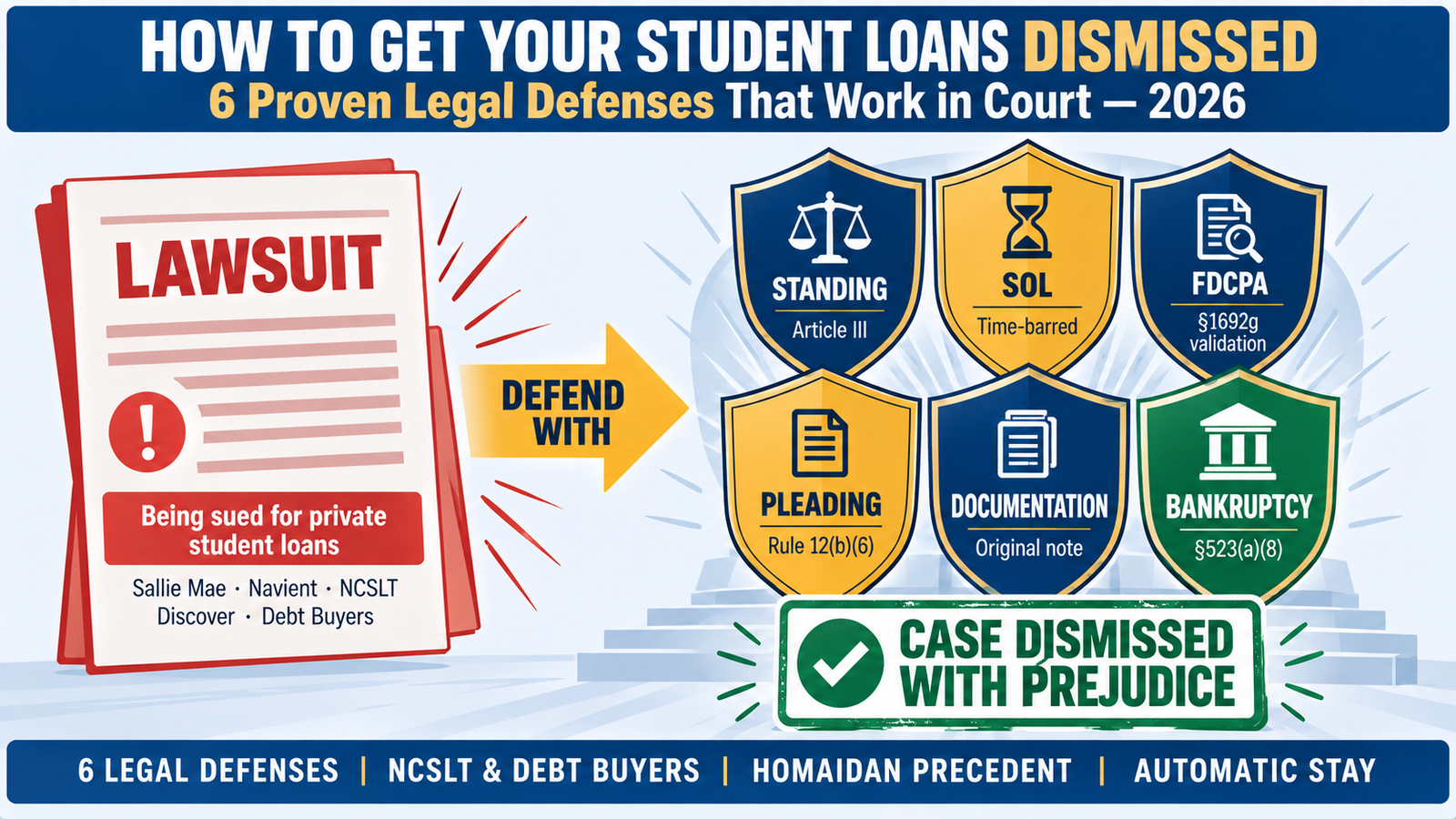
If you’ve been sued for private student loan debt or want to know how to get your student loans dismissed, this complete 2026 guide covers the 6 proven legal defenses that produce real case dismissal outcomes in court. Case dismissal is specifically a procedural/legal outcome — different from “forgiveness” or “settlement” — where the court dismisses the plaintiff’s case against you, meaning they lose the ability to collect through that lawsuit. The 6 dismissal defenses: chain of assignment challenges on Article III standing grounds, statute of limitations expiration, FDCPA debt validation challenges, defective pleading, failure to produce original documentation, and bankruptcy discharge under 11 U.S.C. §523(a)(8). Many borrowers facing private student loan lawsuits can get their cases dismissed when these defenses are properly raised, particularly for debt held by NCSLT (National Collegiate Student Loan Trusts) and third-party debt buyers.
Quick Answer
How to get your student loans dismissed in court involves 6 proven legal defenses: (1) chain of assignment challenges on Article III standing grounds — if the plaintiff cannot prove ownership of your debt through complete chain from original lender, the case must be dismissed (particularly effective against NCSLT and debt-buyer-held debt); (2) statute of limitations expiration — state SOL for written contract debt ranges 3-15 years (New York 3 years per CCFA April 7, 2022; Texas 4 years; Pennsylvania 4 years; California 4 years; Illinois 10 years), after which the lawsuit should be dismissed as time-barred; (3) FDCPA debt validation challenges under 15 U.S.C. §1692g — if third-party collector cannot produce proper validation, dismissal and counterclaim available; (4) defective pleading — if plaintiff’s complaint fails to state proper cause of action or lacks required elements, dismissal under Rule 12(b)(6); (5) failure to produce original documentation — courts require original promissory note or proper documentation of assignment chain, and failure to produce supports dismissal; (6) bankruptcy discharge under 11 U.S.C. §523(a)(8) with Homaidan v. Sallie Mae 992 F.3d 100 (2d Cir. 2021) precedent — filing bankruptcy automatically stays the lawsuit under 11 U.S.C. §362 and discharge eliminates the debt entirely. Even default judgments already entered can be vacated through motion under FRCP 60(b)(4) when standing was never established. These dismissal defenses are available for debt from Sallie Mae Bank, Navient/Earnest, Discover/Firstmark, SoFi, Citizens, Ascent, NCSLT, and debt buyers.
Read the complete 2026 dismissal framework below.
In this complete dismissal guide:
What case dismissal means (and doesn’t mean)
Procedural dismissal vs forgiveness vs settlement — the critical distinction
Defense 1: Chain of assignment / Article III standing
The most powerful dismissal defense for NCSLT and debt-buyer debt
Defense 2: Statute of limitations
State-by-state SOL for time-barred debt dismissal
Defense 3: FDCPA debt validation challenge
15 U.S.C. §1692g validation and counterclaim framework
Defense 4: Defective pleading (Rule 12(b)(6))
Failure to state a claim and missing elements
Defense 5: Failure to produce documentation
Original promissory note, allonge chain, assignment records
Defense 6: Bankruptcy discharge
11 U.S.C. §523(a)(8) with Homaidan precedent, automatic stay
Vacating default judgments already entered
FRCP 60(b)(4) motion to vacate for old judgments
What case dismissal means (and doesn’t mean)
Understanding how to get your student loans dismissed starts with understanding what case dismissal actually means in a legal context — it is distinct from forgiveness, settlement, discharge, or other debt elimination mechanisms. Case dismissal is a procedural outcome where the court throws out the plaintiff’s lawsuit against you, meaning they lose the ability to collect through that specific legal action.
Dismissal with prejudice vs without prejudice
Case dismissal comes in two forms with substantially different consequences: Dismissal with prejudice permanently bars the plaintiff from refiling the same claim against you on the same facts — this is effectively complete private student loan dismissal for that specific debt and plaintiff. Dismissal without prejudice allows the plaintiff to refile if they can correct the defect that caused dismissal — useful for the borrower temporarily but may not provide permanent relief. Strategic defense practice aims for dismissal with prejudice whenever possible, particularly when SOL will expire before refiling, or when the plaintiff fundamentally lacks standing.
How dismissal differs from forgiveness and settlement
Three terms are often confused but mean different things: Forgiveness is formal elimination of debt through contract, statute, or other mechanism (lender writes off remaining balance). Settlement is voluntary agreement to pay reduced amount in satisfaction of full debt (borrower pays something, lender accepts less). Dismissal is court order throwing out the plaintiff’s lawsuit (lawsuit ends, plaintiff cannot continue in that action). Dismissal doesn’t technically forgive the debt — it just means the plaintiff can’t collect through that lawsuit. However, dismissal with prejudice combined with SOL expiration produces effective debt elimination in practical terms.
The automatic stay from bankruptcy filing
A powerful dismissal-related mechanism is the automatic stay under 11 U.S.C. §362, triggered immediately by bankruptcy filing. The automatic stay immediately halts all collection activities including pending lawsuits, wage garnishments, bank levies, and foreclosure proceedings. For borrowers asking how to get your student loans dismissed while facing an active lawsuit, bankruptcy filing immediately stops the lawsuit and the subsequent discharge analysis under §523(a)(8) can produce complete debt elimination. The automatic stay is one of the most immediate dismissal-equivalent remedies available.
Defense 1: Chain of assignment / Article III standing
Chain of assignment defense on Article III standing grounds is the most powerful mechanism for understanding how to get your student loans dismissed. Under Article III of the U.S. Constitution, plaintiffs must have standing to bring a lawsuit — requiring proof of injury, causation, and redressability. For debt collection lawsuits, the plaintiff must prove they own the debt at issue through complete chain of assignment from the original lender. When they cannot prove ownership, the case must be dismissed for lack of standing.
Article III standing framework
Article III standing requires three elements: (1) concrete and particularized injury to the plaintiff; (2) causal connection between the injury and defendant’s conduct; (3) redressability through court decision. The modern framework was established in Lujan v. Defenders of Wildlife 504 U.S. 555 (1992), refined in Spokeo, Inc. v. Robins 578 U.S. 330 (2016), and further developed in TransUnion LLC v. Ramirez 594 U.S. 413 (2021). TransUnion specifically emphasized that courts must verify that plaintiffs have Article III standing at every stage of litigation, including when standing is challenged after judgment.
Standing is jurisdictional and can be raised at any time
Standing is a jurisdictional requirement — meaning the court must have standing to proceed, and lack of standing can be raised at any stage of litigation, including before answer, during discovery, at summary judgment, at trial, and even after judgment through motion to vacate under FRCP 60(b)(4). This jurisdictional nature means standing challenges are preserved even when other defenses may be waived. For borrowers seeking student loan lawsuit dismissed outcomes, standing is often the most reliable defense.
NCSLT-specific application
National Collegiate Student Loan Trusts (NCSLT) hold substantial portfolios of pre-2014 Sallie Mae-originated private loans, now subject to enforcement actions by NCSLT. The Third Circuit’s March 19, 2024 decision established “covered persons” analysis under the Consumer Financial Protection Act; SCOTUS cert denial in December 2024 left Third Circuit precedent in place; various stipulated resolutions have followed through 2026. Borrowers facing NCSLT lawsuits have documented pathways to case dismissal through motion to dismiss on standing grounds, with chain of assignment often spanning: Original lender → Securitization vehicle → NCSLT trust → Current servicer. Any gap in this chain supports dismissal.
Debt buyer standing challenges
Private student loan debt sold to third-party debt buyers after charge-off often has documentation gaps between original lender ownership and current debt buyer’s asserted ownership. Common defects supporting dismissal: missing intermediate assignment documentation between original lender and current plaintiff; assignments executed without adequate documentation of specific debts included in bulk portfolio sales; blank endorsements without proper allonge chain demonstrating specific transfers; discrepancies between servicing records and asserted debt buyer ownership; absence of original promissory note required for secondary market transfers. These defects support motion to dismiss on standing grounds and often produce case dismissal outcomes.
Discovery to expose chain defects
Chain of assignment defense often requires discovery to expose documentation gaps. Strategic discovery requests include: production of original promissory note; production of complete assignment documentation chain from original lender; identification of all intermediate holders; production of all pooling and servicing agreements if debt was securitized; identification of servicers at each stage; verification of specific debt inclusion in each portfolio transfer. Plaintiffs often cannot produce complete documentation, which supports motion to dismiss on standing grounds.
Defense 2: Statute of limitations
Statute of limitations expiration provides reliable dismissal defense for older private student loan lawsuits. When state SOL has expired, the plaintiff cannot maintain the lawsuit regardless of the merits of the underlying debt — the court must dismiss the time-barred action. This is one of the most straightforward dismissal defenses available.
State SOL periods for private student loan debt
SOL periods for written contract debt (private student loans) vary significantly by state: Texas 4 years under Tex. Civ. Prac. & Rem. Code §16.004(a)(3); New York 3 years under CPLR §214(2) per Consumer Credit Fairness Act (CCFA) effective April 7, 2022; Pennsylvania 4 years under 42 Pa.C.S. §5525; Ohio 6 years under Ohio R.C. §2305.06 (reduced 2021); Illinois 10 years under 735 ILCS 5/13-206; Georgia 6 years under O.C.G.A. §9-3-24; California 4 years under CCP §337; Florida 5 years under Fla. Stat. §95.11(2)(b); Delaware 3 years under 10 Del. C. §8106. Accrual typically starts on date of first default or last payment, depending on state law. The applicable SOL is determined by: (a) state law of the court where the lawsuit is filed; (b) governing law clause in loan contract (may select different state law); (c) borrower domicile for personal jurisdiction purposes.
Raising SOL as affirmative defense
SOL must typically be raised as an affirmative defense in the answer to the complaint — failure to raise it timely can waive the defense. Steps for proper SOL dismissal: (1) answer the lawsuit within required time (typically 20-30 days); (2) raise SOL as affirmative defense in answer; (3) file motion to dismiss or motion for summary judgment based on SOL; (4) prove accrual date (first default or last payment) and SOL expiration; (5) argue plaintiff’s lawsuit is time-barred. Many borrowers lose SOL defense by failing to appear or failing to raise SOL in initial answer.
Revival concerns during pending litigation
During pending litigation, borrowers must avoid actions that could restart SOL even while the lawsuit is active: making any payment during litigation may restart SOL; written acknowledgment of debt in settlement discussions may create problems; promise to pay in any form may support revival argument. If SOL has already expired by the time the lawsuit was filed, the lawsuit should be dismissed as time-barred — but revival during the lawsuit could potentially undermine this defense.
FDCPA counterclaim for time-barred collection
If the plaintiff is a third-party debt collector (not the original creditor), filing lawsuit on time-barred debt may constitute FDCPA violation under 15 U.S.C. §1692e (deceptive practices) — supporting counterclaim for statutory damages, actual damages, attorney fees. Combined motion to dismiss plus FDCPA counterclaim produces both dismissal and potential compensation. This dual approach significantly strengthens the defensive position in SOL cases involving debt buyers.
Defense 3: FDCPA debt validation challenge
The Fair Debt Collection Practices Act (FDCPA) 15 U.S.C. §1692 et seq. provides borrowers with powerful validation rights that can support student loan case dismissal, particularly when the plaintiff is a third-party debt collector or debt buyer rather than the original creditor.
Debt validation request under 15 U.S.C. §1692g
Under 15 U.S.C. §1692g, consumers can request validation of debt from third-party collectors within 30 days of initial communication. The validation request requires the collector to: (a) verify the amount of debt; (b) identify the current creditor; (c) provide verification of the debt including original creditor identification; (d) stop collection activity until validation is provided. Failure to properly validate supports dismissal of collection lawsuit and FDCPA counterclaim. Validation requests should be in writing, sent certified mail with return receipt, and preserved as documentation.
Validation failure as dismissal grounds
When debt collector files lawsuit without proper validation despite timely consumer validation request, several defenses become available: (a) motion to dismiss for failure to validate; (b) FDCPA counterclaim under 15 U.S.C. §1692g; (c) FDCPA counterclaim under 15 U.S.C. §1692e for false or misleading representations; (d) sanctions motion if the plaintiff knew validation was insufficient. These combined defenses often result in motion-to-dismiss leverage sufficient to produce voluntary dismissal by plaintiff.
FDCPA counterclaim statutory damages
Successful FDCPA counterclaims support: actual damages (any provable harm from violation); statutory damages up to $1,000 per violation; attorney fees and costs; potential class action remedies for widespread practices. Even modest-value FDCPA counterclaims create settlement leverage because debt buyers typically prefer to dismiss and avoid FDCPA judgment risk. Combined motion to dismiss plus FDCPA counterclaim is often the most effective dismissal strategy against debt-buyer-held debt.
Defense 4: Defective pleading (Rule 12(b)(6))
Motion to dismiss for failure to state a claim under Federal Rule of Civil Procedure 12(b)(6) and equivalent state rules provides a critical dismissal pathway when the plaintiff’s complaint fails to allege all required elements of their cause of action. Many private student loan lawsuits — particularly those filed by debt buyers using form complaints — contain pleading defects that support dismissal.
Required elements of breach of contract claim
A breach of contract claim for private student loan collection typically requires plaintiff to allege: (1) existence of valid contract with specific terms; (2) plaintiff’s own performance (or excuse for non-performance); (3) defendant’s breach of specific contract terms; (4) damages caused by breach; (5) plaintiff’s standing to enforce the contract (ownership of debt). Form complaints often fail to allege specific terms, specific breach details, or chain of ownership supporting standing. Each missing element supports Rule 12(b)(6) motion to dismiss.
Account stated claim deficiencies
Debt buyers often plead account stated as alternative claim, requiring allegations of: (1) prior transactions between parties creating balance; (2) express or implied agreement that balance is owed; (3) express or implied promise to pay. For private student loans transferred between parties, debt buyers typically lack any direct transaction history with the borrower — undermining account stated claims. Motion to dismiss these alternative claims narrows the issues and often eliminates the plaintiff’s fallback position.
Unjust enrichment pleading issues
Unjust enrichment claims (sometimes pled as fallback) require: (1) benefit conferred on defendant by plaintiff; (2) defendant’s knowledge of benefit; (3) acceptance of benefit; (4) inequity of allowing defendant to retain benefit without payment. For debt buyers who never provided any benefit to the borrower (they merely purchased the debt), unjust enrichment claims fail at the pleading stage because no benefit was conferred BY the plaintiff. These defective fallback claims should be dismissed.
Specific pleading requirements by jurisdiction
Some jurisdictions have heightened pleading requirements for consumer collection cases: New York under CCFA April 7, 2022 requires specific documentation at pleading stage; California requires attachment of writing on which claim is based (CCP §454); various other states have debt collection specific pleading rules. Failure to meet jurisdiction-specific requirements supports dismissal. Local practice knowledge is essential for identifying all available pleading-based dismissal grounds.
Defense 5: Failure to produce documentation
Private student loan lawsuits require specific documentation to proceed. When plaintiffs cannot produce required documentation, dismissal becomes available. This is particularly important for understanding how to get your student loans dismissed for debt that has been through multiple assignments or securitizations where documentation often has gaps.
Original promissory note production
Many jurisdictions require production of original promissory note or legally sufficient copy with proper chain of transfer documentation. Lost note affidavits may be allowed in some circumstances but typically require strict proof. For private student loans transferred multiple times through securitization and portfolio sales, original note production often creates problems. Motion to compel production or motion to dismiss for failure to produce original note can effectively end lawsuits where documentation is deficient.
Allonge and endorsement chain
Private student loan notes transferred between parties typically require endorsement (either on the note itself or on an allonge — an attachment to the note). Proper endorsement chain traces ownership from original lender through all intermediate holders to current plaintiff. Blank endorsements (not naming specific transferee) create problems; missing endorsements for intermediate transfers create standing problems; forged or improperly executed endorsements are grounds for dismissal.
Assignment agreement documentation
Beyond note endorsements, each transfer typically requires written assignment agreement identifying specific debts transferred. For portfolio sales involving thousands of loans, individual loan identification in assignment agreements is often inadequate. Challenges to assignment documentation include: assignments lacking specific loan identification; bulk assignments without loan-by-loan schedules; assignment agreements executed by parties lacking authority; assignments inconsistent with servicing records. Each weakness supports dismissal motions.
Business records authentication
Private student loan plaintiffs typically rely on business records to prove the debt. Business records exception to hearsay requires proper authentication: (1) records made at or near time of events; (2) by someone with knowledge; (3) kept in course of regularly conducted activity; (4) regular practice of that activity to make the records. For debt buyers who did not create original records, authentication through records of original lender creates evidentiary challenges. Motion in limine or objections at trial can exclude business records that cannot be properly authenticated — potentially leaving plaintiff without evidence to prove the debt and supporting dismissal.
Defense 6: Bankruptcy discharge
Bankruptcy discharge under 11 U.S.C. §523(a)(8) is the most powerful dismissal mechanism — it can eliminate the entire debt through court order and immediately halt any pending lawsuit through automatic stay. For borrowers facing active private student loan lawsuits, bankruptcy filing can provide immediate relief and ultimate case dismissal.
Automatic stay stops lawsuits immediately
Immediately upon bankruptcy filing, the automatic stay under 11 U.S.C. §362 halts all collection activities including pending lawsuits, wage garnishments, bank levies, and other collection efforts. The pending private student loan lawsuit is automatically stayed — plaintiffs cannot proceed, obtain default judgments, or take any collection action. The automatic stay provides immediate dismissal-equivalent relief while the bankruptcy case proceeds.
§523(a)(8) discharge framework
11 U.S.C. §523(a)(8) makes certain educational loans non-dischargeable unless “undue hardship” is shown. Categories: §523(a)(8)(A)(i) governmental unit loans; §523(a)(8)(A)(ii) obligation to repay funds received as educational benefit; §523(a)(8)(B) qualified education loan under IRC §221(d)(1). Private loans NOT falling into these categories are dischargeable in bankruptcy WITHOUT undue hardship showing.
Homaidan Second Circuit precedent
Homaidan v. Sallie Mae Inc. 992 F.3d 100 (2d Cir. 2021) established that “educational benefit” under §523(a)(8)(A)(ii) is narrow. The Second Circuit held that Sallie Mae’s direct-to-consumer loans do NOT qualify as “educational benefit” and are dischargeable WITHOUT undue hardship. Similar precedents in Fifth Circuit (Crocker v. Navient Solutions LLC 941 F.3d 206, 5th Cir. 2019) and Tenth Circuit (McDaniel v. Navient Solutions LLC 973 F.3d 1083, 10th Cir. 2020). These precedents support broad private loan discharge in bankruptcy, with discharge automatically ending any pending lawsuit on the discharged debt.
Brunner test for qualified loans
Private loans qualifying under §523(a)(8) require undue hardship showing for discharge. Most circuits apply Brunner test from Brunner v. New York State Higher Education Services Corp. 831 F.2d 395 (2d Cir. 1987): (1) debtor cannot maintain minimal standard of living while repaying; (2) additional circumstances indicate this will persist; (3) debtor has made good faith efforts to repay. Recent case law (In re Rosenberg 594 B.R. 22, Bankr. S.D.N.Y. 2020) and DOJ November 2022 guidance have moderated application, making discharge more accessible than historical practice suggested.
Chapter selection for dismissal strategy
Chapter 7 provides discharge of qualifying debts in 3-4 months with §523(a)(8) adversary proceeding adding 60-90 days. Chapter 13 involves 3-5 year payment plan with discharge under 11 U.S.C. §1328 at completion. Chapter selection depends on means test under 11 U.S.C. §707(b)(2), asset preservation needs, and overall financial strategy. For borrowers primarily seeking student loan lawsuit dismissed outcomes, Chapter 7 with §523(a)(8) adversary proceeding is often the direct path to permanent lawsuit elimination.
Vacating default judgments already entered
If a default judgment has already been entered against you for a private student loan — perhaps because you did not appear or did not know about the lawsuit — the dismissal story is not necessarily over. Motion to vacate under Federal Rule of Civil Procedure 60(b)(4) and equivalent state rules provides the mechanism for setting aside judgments entered without proper standing.
FRCP 60(b)(4) void judgment standard
FRCP 60(b)(4) provides for motion to vacate judgment that is “void.” Judgments entered when the court lacked jurisdiction (including when the plaintiff lacked standing) are void and can be vacated at any time — there is no time limit on 60(b)(4) motions. This creates powerful opportunity for borrowers facing old default judgments on private student loan debt: standing challenges preserved years or even decades later can produce vacation of the judgment.
Standing-based judgment vacation
Default judgment entered when plaintiff lacked Article III standing is void and subject to vacation under 60(b)(4). This is particularly powerful for older NCSLT and debt-buyer judgments where chain of assignment was never adequately proven. Steps: (1) analyze judgment and underlying documentation; (2) identify standing defects in original lawsuit; (3) file motion to vacate under 60(b)(4) citing standing defect; (4) if judgment vacated, lawsuit returns to pre-judgment status where SOL and other defenses often apply.
Impact on wage garnishment and bank levies
Vacation of judgment removes the legal basis for wage garnishment, bank levies, and other post-judgment collection activities. Successful vacation motion typically includes: (1) order setting aside judgment; (2) order quashing any outstanding garnishments; (3) order releasing any bank account freezes; (4) potential order for return of amounts already collected. This comprehensive relief restores borrower’s financial position substantially.
Related resources — complete dismissal ecosystem
The 7-path master framework covering all private student loan forgiveness mechanisms available in 2026.
How to Get Rid of Private Student Loans 2026
5-path framework for getting rid of private student loans with decision framework by loan status.
Private Student Loan Debt Help: Your Options 2026
6 real options for borrowers facing private student loan burdens with lender-specific details.
Dismissal strategy by case stage
Pre-lawsuit — collection letters only
When only receiving collection letters, no lawsuit has been filed yet. Dismissal doesn’t apply, but defensive positioning does: send FDCPA validation request under 15 U.S.C. §1692g; do not acknowledge the debt or make payments; preserve chain of assignment arguments for future lawsuit; monitor SOL timing; consider proactive bankruptcy filing if comprehensive relief is desired. Preparation at this stage significantly improves dismissal prospects if lawsuit is eventually filed.
Lawsuit just filed — before answer deadline
Lawsuit filed, answer deadline approaching (typically 20-30 days from service). This is the critical window for proper dismissal strategy: (1) do NOT ignore — default judgment is worst outcome; (2) retain counsel immediately or at minimum file timely answer with affirmative defenses; (3) raise all available defenses (SOL, standing, improper documentation, failure to validate); (4) begin discovery to expose chain of assignment weaknesses; (5) consider bankruptcy if comprehensive relief preferable. Many winnable cases are lost at this stage due to failure to timely answer.
Active litigation — post-answer
After answer filed, strategy shifts to building dismissal case through discovery and motion practice: (1) discovery requests exposing chain of assignment weaknesses; (2) motion to dismiss based on standing grounds; (3) motion for summary judgment on SOL expiration; (4) FDCPA counterclaim if applicable; (5) motion to exclude unauthenticated business records; (6) negotiate settlement from defensive leverage position. Multi-pronged approach typically produces dismissal or favorable settlement.
Post-judgment — default or adverse judgment entered
If judgment has been entered (particularly default judgment entered because you didn’t appear), the dismissal story continues through: (1) motion to vacate under FRCP 60(b)(4) if standing was never established; (2) motion to vacate under FRCP 60(b)(1) for excusable neglect if you didn’t receive proper service; (3) appeal if judgment was entered erroneously; (4) bankruptcy filing to invoke automatic stay and address through discharge; (5) negotiated settlement to avoid continued collection even without vacation. Post-judgment relief is more difficult but often still available.
Collection enforcement — garnishment or levy active
Active garnishment or levy requires immediate action: (1) emergency bankruptcy filing invokes automatic stay stopping enforcement immediately; (2) motion to vacate underlying judgment if applicable (vacation removes basis for enforcement); (3) claim of exemption if assets or income is exempt under state law; (4) negotiation with judgment creditor for reduced satisfaction. Timing is critical — delayed action means continued collection and asset depletion.
Working with professional resources for dismissal
Why DIY dismissal usually fails
While some pro se borrowers successfully defend private student loan lawsuits, DIY dismissal attempts typically fail for several reasons: (1) unfamiliarity with court rules and procedures leading to procedural defaults; (2) failure to properly raise affirmative defenses in timely answer; (3) inability to conduct effective discovery; (4) insufficient legal argument on complex standing issues; (5) difficulty recognizing all available defenses. Professional representation significantly improves dismissal outcomes.
Types of professional resources
Professional resources for student loan case dismissal: state-licensed consumer attorneys for chain of assignment challenges and FDCPA practice (often contingency-based); bankruptcy counsel for §523(a)(8) adversary proceeding filings; legal aid organizations for income-qualifying borrowers; law school clinics in some areas; attorney-backed consulting organizations coordinating multi-mechanism strategy. Resource selection depends on case specifics, jurisdiction, and borrower resources.
Private Student Relief attorney-backed partner network
Private Student Relief coordinates attorney-backed partner provider network for comprehensive private student loan dismissal analysis. Services include: initial case assessment across all 6 dismissal defenses; coordination with state-licensed counsel for litigation defense; bankruptcy counsel referral when §523(a)(8) analysis favors discharge; chain of assignment research through established debt buyer and NCSLT documentation knowledge; multi-mechanism strategy coordination. Free eligibility review without upfront fees.
Common misconceptions about student loan dismissal
Misconception 1
“Student loan lawsuits cannot be dismissed”
Reality: Private student loan lawsuits are regularly dismissed through the 6 defenses in this guide. Chain of assignment challenges have produced NCSLT and debt-buyer dismissals in jurisdictions across the country; SOL expiration defeats time-barred collection; FDCPA validation failures support dismissal and counterclaim; defective pleading supports Rule 12(b)(6) dismissal; failure to produce documentation ends many cases; bankruptcy discharge eliminates debt entirely. The myth that “student loans can’t be dismissed” prevents many borrowers from pursuing winnable defenses.
Misconception 2
“If I just ignore the lawsuit, it will go away”
Reality: Ignoring a private student loan lawsuit is the worst possible response — it typically results in default judgment with wage garnishment, bank levies, and property liens. Default judgments remain enforceable for extended periods (often 20 years, renewable). Vacating a default judgment after the fact is possible under FRCP 60(b)(4) when standing was never established, but is substantially more difficult than defending the original lawsuit properly. ALWAYS respond to lawsuits with timely answer raising all available defenses.
Misconception 3
“I can’t afford a lawyer, so I have no options”
Reality: Multiple affordable options exist for professional help with how to get student loans dismissed: (1) consumer attorneys often work on contingency for FDCPA cases (no upfront fee, attorney paid from recovery); (2) legal aid organizations serve income-qualifying borrowers at no cost; (3) law school clinics provide pro bono representation in many areas; (4) attorney-backed consulting organizations work with transparent fee structures and often no upfront fees; (5) bankruptcy counsel typically $2,500-$5,000 producing complete debt elimination worth tens of thousands. Cost should not be the barrier to pursuing dismissal defenses.
Misconception 4
“Default judgments are permanent and cannot be challenged”
Reality: Default judgments can be challenged through motion to vacate, particularly under FRCP 60(b)(4) for void judgments entered without proper standing. This jurisdictional challenge has no time limit — a default judgment entered 10 or 15 years ago without proper chain of assignment can still be vacated today. Even where 60(b)(4) doesn’t apply, 60(b)(1) excusable neglect, 60(b)(2) newly discovered evidence, and 60(b)(6) extraordinary circumstances provide additional pathways. If you have an old default judgment on private student loan debt, standing analysis may reveal grounds for vacation.
Frequently asked questions
1. How to get your student loans dismissed in court?
How to get your student loans dismissed in court involves 6 proven legal defenses: (1) chain of assignment challenges on Article III standing grounds (Lujan v. Defenders of Wildlife 504 U.S. 555; Spokeo, Inc. v. Robins 578 U.S. 330; TransUnion LLC v. Ramirez 594 U.S. 413); (2) statute of limitations expiration under state law (3-15 years by state); (3) FDCPA debt validation challenges under 15 U.S.C. §1692g; (4) defective pleading under Rule 12(b)(6) and equivalent state rules; (5) failure to produce original promissory note or complete assignment documentation; (6) bankruptcy discharge under 11 U.S.C. §523(a)(8) with Homaidan v. Sallie Mae 992 F.3d 100 (2d Cir. 2021) precedent. The right defense depends on specific case circumstances; multi-pronged defense typically produces best outcomes.
2. Can a private student loan lawsuit be dismissed?
Yes, private student loan lawsuits are regularly dismissed through the 6 defenses in this guide. Chain of assignment challenges have produced dismissals of NCSLT (National Collegiate Student Loan Trusts) and debt-buyer-held debt lawsuits across the country. Statute of limitations expiration defeats time-barred collection. FDCPA validation failures support dismissal and counterclaim. Defective pleading supports Rule 12(b)(6) dismissal. Failure to produce documentation ends many cases where portfolio sales created documentation gaps. Bankruptcy discharge under §523(a)(8) with Homaidan precedent produces complete debt elimination. Private student loan lawsuits CAN be dismissed when defenses are properly raised.
3. What is a motion to dismiss for a student loan case?
A motion to dismiss student loan case is a formal court filing asking the judge to throw out the plaintiff’s lawsuit for specific legal defects. Common bases: lack of subject matter jurisdiction (court cannot hear the case); lack of personal jurisdiction over defendant; improper venue; insufficient service of process; failure to state a claim upon which relief can be granted (Rule 12(b)(6)); failure to join necessary party; lack of standing (Article III analysis). Motion to dismiss must be filed before answer in most jurisdictions, though lack of jurisdiction and standing can be raised at any time. If granted, the case is dismissed — either with prejudice (permanent) or without prejudice (plaintiff may refile if defect correctable).
4. How long does it take to get a student loan case dismissed?
Timeline varies by defense and jurisdiction: motion to dismiss filed early can produce dismissal in 2-4 months; motion for summary judgment on SOL after some discovery typically 4-8 months; chain of assignment dismissal often 6-18 months after discovery exposes documentation gaps; bankruptcy automatic stay stops lawsuit immediately with §523(a)(8) adversary proceeding adding 60-90 days to Chapter 7 timeline; motion to vacate default judgment typically 3-6 months. Overall dismissal strategy from lawsuit filing to final resolution often ranges 6-18 months depending on jurisdiction and complexity. Immediate action upon receiving lawsuit is essential.
5. Can an old default judgment on student loans be vacated?
Yes, old default judgments on private student loans can often be vacated through motion to vacate under FRCP 60(b)(4) when the underlying judgment was entered without proper standing. Standing is jurisdictional and has no time limit for challenge — a default judgment entered 10, 15, or even 20 years ago without proper chain of assignment can still be vacated today. This is particularly powerful for NCSLT and debt-buyer judgments where chain of assignment was never adequately proven. Successful vacation removes the basis for ongoing wage garnishment, bank levies, and other collection activities. Analysis of judgment and underlying documentation reveals whether vacation is available.
6. Does bankruptcy dismiss student loan lawsuits?
Yes, bankruptcy filing immediately halts pending private student loan lawsuits through the automatic stay under 11 U.S.C. §362. The automatic stay stops lawsuit progression, prevents default judgments, blocks wage garnishments, and halts bank levies — all immediately upon filing. If the bankruptcy produces discharge of the underlying debt under 11 U.S.C. §523(a)(8) with Homaidan precedent for non-qualified private loans, the lawsuit is permanently resolved. Bankruptcy is often the most comprehensive student loan lawsuit dismissed mechanism available, particularly when §523(a)(8) analysis favors discharge.
7. What should I do first if I’ve been served with a student loan lawsuit?
Immediate steps when served with private student loan lawsuit: (1) note the answer deadline (typically 20-30 days from service — DO NOT MISS); (2) do NOT ignore the lawsuit (default judgment is worst outcome); (3) retain counsel or consulting resource immediately; (4) gather all documentation (original loan documents, payment history, correspondence); (5) identify the plaintiff and determine if debt was sold (debt buyer, NCSLT); (6) analyze SOL based on last payment or first default date; (7) file timely answer raising all available affirmative defenses (SOL, standing, failure to validate, defective documentation); (8) begin discovery to expose chain of assignment weaknesses; (9) consider bankruptcy analysis if comprehensive relief preferable. Early action significantly improves how to get student loans dismissed prospects.
Facing a Student Loan Lawsuit?
Free specialist review of all 6 dismissal defenses for your case.
Chain of assignment analysis on Article III standing grounds for NCSLT and debt-buyer debt, statute of limitations analysis by state, FDCPA debt validation challenges under 15 U.S.C. §1692g, Rule 12(b)(6) pleading defect analysis, documentation production challenges, bankruptcy discharge evaluation under §523(a)(8) with Homaidan precedent, motion to vacate FRCP 60(b)(4) for old default judgments, and coordinated defensive strategy for maximum private student loan dismissal outcomes. Free eligibility review with attorney-backed partner provider — no upfront fees.
Get a free eligibility review →
5-minute review · No obligation · Zero upfront fees · Since 2015 · 48 states served
About the author
Henry Silva — Private Student Loan Debt Specialist
10+ years experience in private student loan litigation defense producing real student loan case dismissal outcomes: chain of assignment challenges under Article III standing doctrine (Lujan v. Defenders of Wildlife 504 U.S. 555, Spokeo, Inc. v. Robins 578 U.S. 330, TransUnion LLC v. Ramirez 594 U.S. 413), NCSLT dismissal cases through Third Circuit March 19, 2024 precedent and SCOTUS cert denial December 2024, statute of limitations defense across all 50 states, FDCPA debt validation challenges under 15 U.S.C. §1692g and deceptive practices claims under 15 U.S.C. §1692e, motion to dismiss practice under Rule 12(b)(6) and equivalent state rules, documentation production challenges including original promissory note and allonge chain, motion to vacate default judgments under FRCP 60(b)(4) for void judgments entered without proper standing, bankruptcy discharge under 11 U.S.C. §523(a)(8) with Homaidan v. Sallie Mae 992 F.3d 100 (2d Cir. 2021) precedent, Crocker v. Navient 941 F.3d 206 (5th Cir. 2019), McDaniel v. Navient 973 F.3d 1083 (10th Cir. 2020), Brunner v. New York State Higher Education Services Corp. 831 F.2d 395 (2d Cir. 1987) framework for qualified loans, In re Rosenberg 594 B.R. 22 (Bankr. S.D.N.Y. 2020) updated application, automatic stay under 11 U.S.C. §362 for immediate lawsuit relief, and coordinated multi-defense strategy for borrowers facing lawsuits from Sallie Mae Bank NYSE:SLM, Navient/Earnest Operations LLC, Discover/Firstmark Services after July 2024 Carlyle+KKR sale, SoFi Bank NA NMLS #696891, Citizens Bank NA NYSE:CFG, Ascent Student Loans, NCSLT, and third-party debt buyers. Henry works with Private Student Relief’s attorney-backed partner provider network to coordinate litigation defense across all 6 dismissal mechanisms.
Legal Disclaimer and Sources
This article is provided for informational purposes only and does not constitute legal, tax, or financial advice. Private Student Relief is a consulting and matching organization operated by Joco (555 Anton Blvd, Suite 368, Costa Mesa, CA 92626) — not a law firm, debt settlement company, debt consolidation company, or loan provider. Debt validation services are performed by an attorney-backed partner provider (Panamerican Consulting LLC, Las Vegas, NV) under independent business credentials. Ratings, BBB accreditation, and AADR membership referenced on the PSR website belong to the partner provider. Case dismissal availability depends on loan characteristics, lender terms, borrower circumstances, documentation evidence, and jurisdiction. Individual results vary. Since 2015. 48 states served. Not available in South Carolina or Mississippi. Litigation defense requires legal representation from state-licensed counsel; this article does not substitute for legal advice.
Federal student loan program citations (for comparison, these do NOT apply to private student loans): Higher Education Act (20 U.S.C. §1001 et seq.); Public Service Loan Forgiveness (20 U.S.C. §1087e(m)); Income-Driven Repayment forgiveness (federal loan regulatory framework); Direct Loan death discharge (20 U.S.C. §1087); Perkins Loan death discharge (20 U.S.C. §1087dd). These federal programs apply ONLY to federal loans.
Bankruptcy Code references: 11 U.S.C. §523(a)(8) (student loan discharge exceptions with §523(a)(8)(A)(i) governmental unit, §523(a)(8)(A)(ii) educational benefit, §523(a)(8)(B) qualified education loan categories); 11 U.S.C. §362 (automatic stay); 11 U.S.C. §707(b)(2) (means test); 11 U.S.C. §1328 (Chapter 13 discharge). Key bankruptcy precedent: Homaidan v. Sallie Mae 992 F.3d 100 (2d Cir. 2021) — direct-to-consumer private education loans dischargeable without undue hardship; Brunner v. New York State Higher Education Services Corp. 831 F.2d 395 (2d Cir. 1987) — undue hardship test; Crocker v. Navient Solutions LLC 941 F.3d 206 (5th Cir. 2019); McDaniel v. Navient Solutions LLC 973 F.3d 1083 (10th Cir. 2020); In re Rosenberg 594 B.R. 22 (Bankr. S.D.N.Y. 2020). Article III standing precedent: Lujan v. Defenders of Wildlife 504 U.S. 555 (1992); Spokeo, Inc. v. Robins 578 U.S. 330 (2016); TransUnion LLC v. Ramirez 594 U.S. 413 (2021). Federal Rules of Civil Procedure: FRCP 12(b)(6) (failure to state claim); FRCP 60(b)(4) (void judgment vacation); FRCP 60(b)(1) (excusable neglect); FRCP 60(b)(2) (newly discovered evidence); FRCP 60(b)(6) (extraordinary circumstances). Internal Revenue Code: IRC §221(d)(1) (qualified education loan definition); IRC §108(a)(1)(A) (bankruptcy exclusion); IRC §108(a)(1)(B) (insolvency exclusion). FDCPA: 15 U.S.C. §1692g (debt validation); 15 U.S.C. §1692e (deceptive practices).
NCSLT (National Collegiate Student Loan Trusts) precedent: Third Circuit March 19, 2024 “covered persons” decision under Consumer Financial Protection Act; SCOTUS cert denial December 2024 leaving Third Circuit precedent in place; various stipulated resolutions through 2026. NCSLT holds substantial portfolios of pre-2014 Sallie Mae-originated private loans, particularly 2001-2007 origination period.
Statute of limitations for written contract debt (private student loans) by state: Texas 4 years under Tex. Civ. Prac. & Rem. Code §16.004(a)(3); New York 3 years under CPLR §214(2) per Consumer Credit Fairness Act (CCFA) effective April 7, 2022; Pennsylvania 4 years under 42 Pa.C.S. §5525; Ohio 6 years under Ohio R.C. §2305.06 (reduced 2021); Illinois 10 years under 735 ILCS 5/13-206; Georgia 6 years under O.C.G.A. §9-3-24; California 4 years under CCP §337; Florida 5 years under Fla. Stat. §95.11(2)(b); Delaware 3 years under 10 Del. C. §8106. Complete state SOL analysis should be verified against current statutes for each specific borrower situation; applicable SOL may vary based on governing law clause in loan contract.
Lender information current as of October 2026 per publicly available documentation: Sallie Mae Bank NYSE:SLM; Navient Corporation NYSE:NAVI (2014 Sallie Mae split; 2017 Earnest acquisition $155M; December 2021 Aidvantage transfer federal exit; January 2022 state attorneys general settlement $1.85B); Earnest Operations LLC (Navient subsidiary since 2017); Discover student loans acquired by Carlyle Group and KKR July 2024 with servicing transitioned to Firstmark Services (Nelnet NYSE:NNI subsidiary); SoFi Bank NA NMLS #696891 (chartered as national bank 2022); Citizens Bank NA NYSE:CFG; Ascent Student Loans with June 5, 2023 originated loans having contractual §523(a)(8) discharge waiver. Specific lender program details subject to change and should be verified directly with current lender documentation.
Student loan case dismissal requires case-by-case analysis coordinating loan characteristics, lender identification, chain of assignment history, borrower jurisdiction, documentation evidence, defensive framework opportunities, and specific circumstances. This article provides general framework information; specific motions to dismiss, chain of assignment challenges, SOL affirmative defenses, FDCPA validation requests and counterclaims, Rule 12(b)(6) pleading challenges, documentation production motions, bankruptcy filings under Homaidan precedent, and motions to vacate default judgments must be filed by state-licensed counsel familiar with litigation practice in the applicable jurisdiction. This article does not create attorney-client relationship and does not substitute for legal representation. If you are facing a private student loan lawsuit, retain qualified counsel immediately — missed deadlines result in default judgment with substantial long-term consequences. Last reviewed: October 2026.