

Informational content only. Not legal, tax, or financial advice. Private Student Relief is a consulting organization, not a law firm or debt settlement company. Debt validation services are executed by an attorney-backed partner provider. Settlement outcomes depend on loan characteristics, lender terms, borrower circumstances, documentation evidence, and jurisdiction. Last reviewed: October 2026.
Written by Henry Silva
Private Student Loan Debt Specialist · 10+ years experience negotiating private student loan settlement with Sallie Mae Bank NYSE:SLM, Navient/Earnest Operations LLC, Discover/Firstmark Services, SoFi Bank NA, Citizens Bank NA, Ascent, NCSLT, and major debt buyers. Expertise includes defensive framework leverage through chain of assignment challenges under Article III standing (Lujan/Spokeo/TransUnion), statute of limitations analysis across all 50 states, FDCPA debt validation under 15 U.S.C. §1692g, IRC §108(a)(1)(B) insolvency and IRC §108(a)(1)(A) bankruptcy tax exclusion coordination, and bankruptcy discharge alternative analysis under 11 U.S.C. §523(a)(8) with Homaidan v. Sallie Mae Second Circuit precedent. Last reviewed: October 2026.
If you’re drowning in private student loan debt and ready to resolve it, private student loan settlement is often the most accessible path to substantial debt reduction. This complete 2026 guide covers how settlement actually works: typical discount ranges by lender and loan status (40-60% off balance for charged-off accounts), the negotiation process from initial contact through final payment, how defensive framework leverage (chain of assignment, SOL, bankruptcy alternative) produces materially better settlement outcomes, IRC §108 tax planning for the forgiven portion reported on 1099-C, lump sum funding sources, credit impact and recovery timeline, and critical mistakes to avoid. Settlement produces real, immediate debt elimination — the forgiven balance above your settlement payment is permanently extinguished through written agreement. Learn how borrowers successfully settle private loans with Sallie Mae, Navient/Earnest, Discover/Firstmark, SoFi, Citizens, Ascent, NCSLT, and debt buyers.
Quick Answer
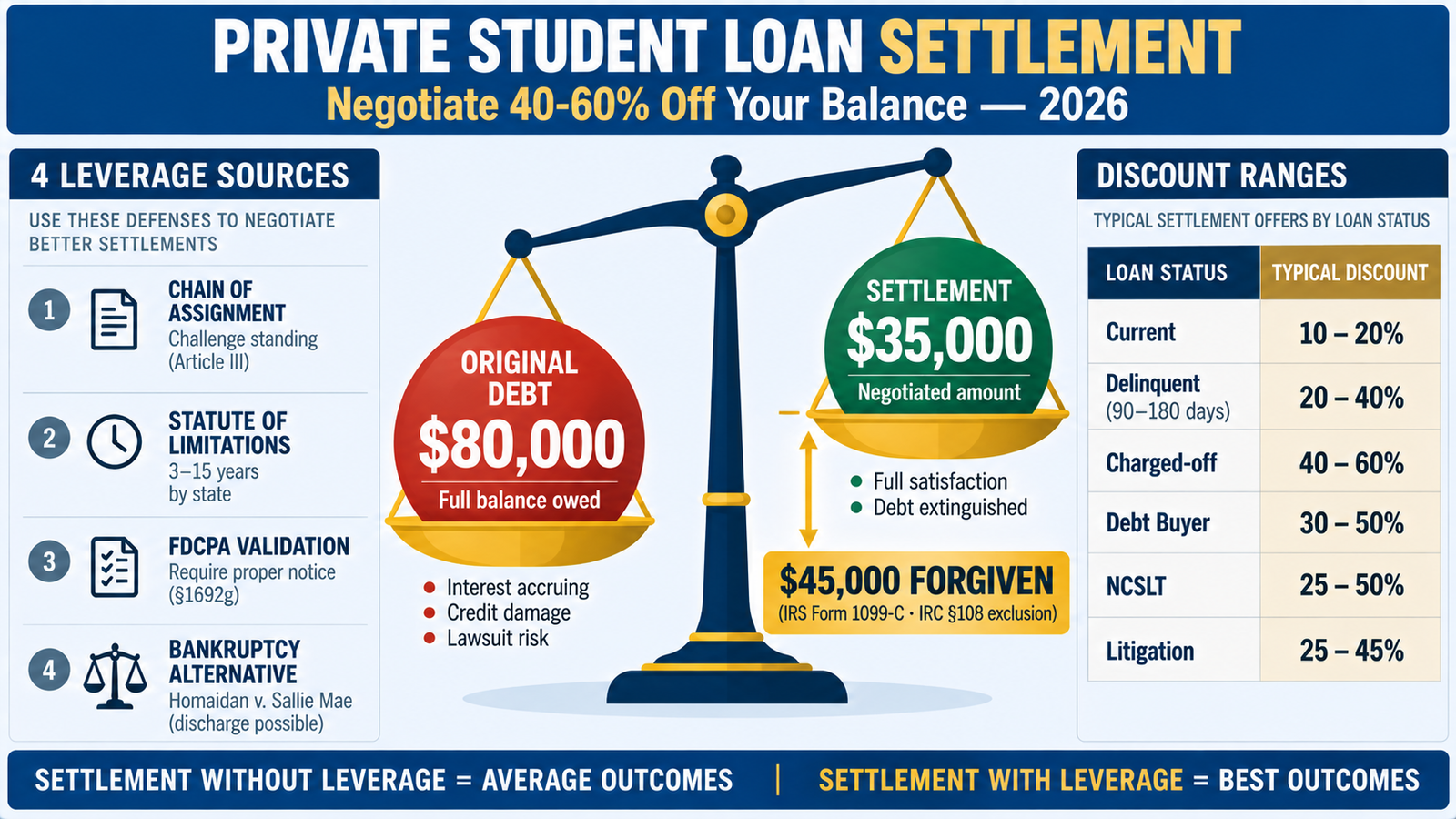
Private student loan settlement is the negotiation process where a borrower pays reduced lump sum to the current loan holder in full satisfaction of the entire debt — producing immediate forgiveness of the balance above the settlement payment. Typical settlement outcomes vary by loan status and holder: current/early delinquent (0-90 days) — lenders typically prefer hardship modification; 90-180 days delinquent — settlement becomes possible as charge-off approaches; charged-off accounts (180+ days) — 40-60% discount from balance is common; debt-buyer accounts — 30-50% of balance given lower acquisition cost; NCSLT-held debt — additional discount when chain of assignment weaknesses documented. The settlement process involves 7 stages: (1) situation assessment and defensive framework analysis; (2) initial contact with current holder identification; (3) hardship documentation preparation; (4) initial settlement offer typically 25-35% of balance; (5) negotiation with counter-offers over 30-90 days; (6) written settlement agreement with full satisfaction release language, credit tradeline update instructions, and 1099-C handling; (7) lump sum payment and confirmation of debt extinguishment. Defensive leverage from chain of assignment challenges under Article III standing (Lujan v. Defenders of Wildlife 504 U.S. 555), statute of limitations analysis (state SOL 3-15 years), FDCPA validation challenges under 15 U.S.C. §1692g, and bankruptcy alternative under 11 U.S.C. §523(a)(8) with Homaidan v. Sallie Mae 992 F.3d 100 (2d Cir. 2021) precedent produces materially better settlement outcomes. The forgiven portion is reported on IRS Form 1099-C and may qualify for IRC §108(a)(1)(B) insolvency exclusion from taxable income. Settlement is available for debt from Sallie Mae Bank, Navient/Earnest, Discover/Firstmark, SoFi, Citizens, Ascent, NCSLT, and third-party debt buyers.
Read the complete 2026 settlement framework below.
In this complete settlement guide:
What private student loan settlement actually is
Definition, legal effect, difference from refinance and consolidation
Settlement discount ranges by loan status
Realistic outcomes for current, delinquent, charged-off, and litigation debt
The 7-stage settlement process
Step-by-step from assessment through final payment
Defensive framework leverage for better settlement
Chain of assignment, SOL, FDCPA, bankruptcy alternative
Lender-specific settlement expectations
Sallie Mae, Navient/Earnest, Discover/Firstmark, SoFi, Citizens, Ascent, NCSLT
IRC §108 tax planning for settlement forgiveness
1099-C handling, insolvency exclusion, bankruptcy exclusion
Lump sum funding sources
How borrowers fund settlement payments
Credit impact and recovery timeline
What happens to credit scores and how quickly they recover
What private student loan settlement actually is
Private student loan settlement is a negotiation process where the borrower and the current holder of the debt reach written agreement that payment of a specified reduced amount satisfies the entire debt. The borrower pays the agreed lump sum; the current holder accepts this payment in full satisfaction; the balance above the settlement payment is permanently extinguished and reported to the IRS on Form 1099-C.
Legal effect of settlement
Settlement produces a legally binding resolution to the debt: once the written settlement agreement is executed and payment is made, the current holder cannot sue for the forgiven balance, cannot report the account as delinquent going forward, and cannot sell the settled debt to another collector. The debt is permanently resolved for the amount above settlement. This immediate, enforceable resolution distinguishes settlement from informal payment arrangements, hardship forbearance, or other temporary accommodations that don’t legally eliminate the debt.
Settlement vs refinance vs consolidation
Three terms are often confused: Settlement pays reduced amount in full satisfaction of existing debt — reduces total obligation. Refinance replaces existing debt with new loan at different terms (often lower interest rate) — doesn’t reduce principal, just restructures. Consolidation combines multiple loans into one (private consolidation refinance) — simplifies payment but doesn’t reduce debt. Only settlement actually reduces the total amount owed. Borrowers seeking debt reduction (not just restructuring) need settlement rather than refinance or consolidation.
Settlement vs forgiveness vs discharge
Related terms with distinct meanings: Settlement is voluntary agreement to pay reduced amount (borrower pays something, lender accepts less). Forgiveness is formal elimination of debt through contract, statute, or other mechanism — technically the “forgiven portion” of settlement is forgiveness of balance above payment. Discharge is court order eliminating debt in bankruptcy — produces complete elimination. Settlement is often the most accessible path for borrowers who cannot pursue bankruptcy and don’t qualify for other forgiveness mechanisms. Settlement produces real private student relief for the forgiven portion.
Who holds the debt matters
Settlement outcomes depend significantly on who currently holds the debt: Original lender (Sallie Mae, Navient/Earnest, Discover/Firstmark, SoFi, Citizens, Ascent) — typically more institutional, slower negotiations, more documentation requirements but larger settlements possible; In-house collection department — specific authority limits and settlement guidelines; Third-party collection agency — contingent agents working on commission, often willing to negotiate; Debt buyer (purchased charged-off debt at steep discount) — most negotiating flexibility given low acquisition cost; NCSLT trusts — specific negotiation dynamics given Third Circuit precedent and chain of assignment considerations. Identifying the current holder is the first step in effective settlement strategy.
Settlement discount ranges by loan status
Realistic private student loan settlement outcomes vary significantly by current loan status. Understanding typical discount ranges helps borrowers set realistic expectations and identify optimal timing for settlement negotiations.
Current or early delinquent (0-90 days past due)
Settlement is generally difficult to achieve for current or recently delinquent accounts because the lender has not yet taken loss on the debt. Lenders prefer hardship modification programs (reduced interest, extended terms, forbearance) over settlement during this period. If settlement is possible, discounts are modest — perhaps 10-20% off balance in exceptional circumstances. Most borrowers in this status benefit more from exploring hardship programs first and considering settlement only if circumstances worsen.
90-180 days delinquent (approaching charge-off)
As accounts approach charge-off (typically 120-180 days delinquent), settlement opportunities increase. Lenders begin recognizing that recovery is uncertain and may accept pre-charge-off settlements to avoid losses from charge-off, debt sale, or litigation costs. Typical pre-charge-off settlements: 20-40% discount from balance when combined with lump sum availability and compelling hardship documentation. Pre-charge-off settlement preserves some credit standing (account resolved before formal charge-off reporting).
Charged-off accounts (180+ days delinquent)
Charged-off accounts represent the sweet spot for private student loan debt settlement. Lenders have taken the formal loss, accounting is written off, and management of the account typically moves to in-house recovery or third-party collection. Typical outcomes: 40-60% discount from balance is common; sometimes 30-50% depending on account characteristics and negotiation leverage; occasionally 20-40% for strong defensive leverage positions. Charged-off status is often the most favorable time for settlement when borrower has lump sum available.
Debt-buyer-held accounts
After charge-off, debt may be sold to third-party debt buyers (companies specializing in purchasing distressed debt at steep discounts, often pennies on the dollar). Debt buyers typically have substantial negotiation flexibility given their low acquisition cost. Typical outcomes: 30-50% discount from balance when approached with proper negotiation strategy; sometimes 20-40% depending on buyer and leverage; occasionally 15-30% when combined with chain of assignment challenges demonstrating documentation weaknesses. Debt-buyer settlements require careful chain of assignment analysis to avoid paying parties lacking standing to enforce.
NCSLT-held accounts
National Collegiate Student Loan Trusts (NCSLT) hold substantial portfolios of pre-2014 Sallie Mae-originated private loans. NCSLT settlements require specific analysis given the Third Circuit’s March 19, 2024 “covered persons” decision and SCOTUS cert denial December 2024. Typical outcomes: 25-50% discount from balance; additional discount when chain of assignment analysis exposes documentation gaps between original Sallie Mae origination and current NCSLT ownership. NCSLT settlements often benefit substantially from defensive framework leverage.
Accounts in litigation
Settlement during active litigation can produce excellent outcomes when borrower has defensive leverage. Current plaintiff recognizes costs of continued litigation, risk of dismissal on standing or SOL grounds, and potential FDCPA counterclaim exposure. Typical outcomes: 25-45% discount from balance when borrower has substantive defenses raised; sometimes 15-35% for strong standing or SOL cases where dismissal is likely. Settlement in litigation requires motion-to-dismiss leverage — simply offering to settle without defensive position typically produces worse outcomes than aggressive defense followed by settlement.
Accounts with judgment entered
Post-judgment settlement is possible but typically less favorable than pre-judgment outcomes. Judgment creditor has established right to collect through garnishment and levies. Typical outcomes: 50-70% of judgment amount; sometimes less when combined with motion to vacate under FRCP 60(b)(4) demonstrating lack of standing. Post-judgment settlement often negotiated to avoid continued collection efforts and may include payment plan rather than pure lump sum.
The 7-stage settlement process
Effective private student loan settlement follows a structured process from initial assessment through final payment and debt extinguishment. Understanding each stage helps borrowers execute successful settlement outcomes.
Stage 1: Situation assessment and defensive framework analysis
Begin with comprehensive assessment: total debt by lender and account; current status of each account (current, delinquent 90-179, charged-off 180+, in litigation, judgment entered); identification of current holder and any assignment history; state of residence (affects SOL); last payment date (affects SOL accrual); overall financial position (income, assets, insolvency status for IRC §108). Simultaneously analyze defensive framework leverage: chain of assignment opportunities, SOL status, FDCPA validation potential, bankruptcy alternative under Homaidan §523(a)(8). This dual assessment determines settlement strategy.
Stage 2: Current holder identification
Confirm who currently holds and has authority to settle each debt: review most recent correspondence to identify current servicer; pull credit reports from Experian, Equifax, TransUnion to identify current reporting entity; contact original lender if debt may have been sold; demand validation under FDCPA 15 U.S.C. §1692g if third-party collector involved. Negotiating with the wrong party wastes time and may compromise defensive positions. Current holder identification is foundational to effective settlement.
Stage 3: Hardship documentation preparation
Prepare documentation supporting settlement rationale: current income from all sources; monthly expenses with supporting bills; assets and account balances; medical issues or other hardship factors; employment history and prospects; any documented IRC §108 insolvency position (liabilities exceeded assets at relevant time). Lenders typically require some hardship documentation to approve settlements. Well-prepared documentation accelerates negotiation and supports larger discounts.
Stage 4: Initial settlement offer
Make initial settlement offer in writing: typically 25-35% of balance to leave negotiation room; cite hardship factors; reference any defensive framework leverage (chain of assignment issues, SOL concerns, bankruptcy alternative); specify lump sum availability and timing. Written offers establish paper trail and typically produce better outcomes than verbal negotiations. Initial offers below the ultimate target leave room for negotiation while anchoring the discussion.
Stage 5: Negotiation with counter-offers
Expect multiple rounds of counter-offers over 30-90 days: lender responds with higher counter (often 60-70% initially); borrower counters with slight increase; continue narrowing until agreement; use defensive framework leverage to support position; be prepared to walk away if lender won’t move to acceptable range. Negotiations may stall and resume multiple times. Patience and consistency typically produce best outcomes. Lender personnel may change during extended negotiations.
Stage 6: Written settlement agreement
Finalize settlement in written agreement containing: specific settlement amount; payment timing (lump sum due date); explicit full satisfaction release language; credit tradeline update instructions (e.g., “paid for less than full balance” or “settled in full”); cosigner release if cosigned loans; representation that debt will not be resold or further collected; acknowledgment that signed agreement supersedes prior terms; 1099-C handling specification. NEVER make settlement payment without executed written agreement — verbal promises are unenforceable and create risk of continued collection after payment.
Stage 7: Lump sum payment and confirmation
Execute payment per agreement terms: use traceable payment method (certified check, wire, verified ACH); retain complete payment records including confirmation of receipt; obtain written confirmation of debt extinguishment within 30 days of payment; monitor credit reports for 60-90 days to verify tradeline updates per agreement; file 1099-C with tax return if received (typical IRS reporting threshold is $600 forgiven); consult CPA for IRC §108 insolvency or bankruptcy exclusion analysis. Complete documentation protects against future revival or dispute.
Defensive framework leverage for better settlement
The single most important factor distinguishing average private student loan settlement outcomes from exceptional ones is defensive framework leverage. Settlement without defensive position produces mediocre discounts; settlement with proper leverage produces materially better outcomes. Understanding how to build and use defensive leverage transforms settlement economics.
Chain of assignment leverage
For debt that has been assigned (sold or transferred) from original lender, chain of assignment analysis exposes documentation gaps that undermine the current holder’s ability to enforce. Under Article III standing precedent (Lujan v. Defenders of Wildlife 504 U.S. 555; Spokeo, Inc. v. Robins 578 U.S. 330; TransUnion LLC v. Ramirez 594 U.S. 413), the plaintiff must prove complete chain of ownership. Settlement leverage: documenting chain of assignment weaknesses in correspondence demonstrates likelihood of dismissal if lawsuit filed, motivating current holder to accept lower settlement rather than risk complete loss through litigation. Particularly powerful against NCSLT and debt-buyer-held debt.
Statute of limitations leverage
For older debt approaching or past state SOL expiration, SOL analysis creates settlement urgency and leverage. State SOL for written contract debt varies: Texas 4 years (Tex. Civ. Prac. & Rem. Code §16.004(a)(3)); New York 3 years (CPLR §214(2) per CCFA April 7, 2022); Pennsylvania 4 years (42 Pa.C.S. §5525); Ohio 6 years (R.C. §2305.06); Illinois 10 years (735 ILCS 5/13-206); Georgia 6 years (O.C.G.A. §9-3-24); California 4 years (CCP §337); Florida 5 years (Fla. Stat. §95.11(2)(b)); Delaware 3 years (10 Del. C. §8106). Approaching SOL creates urgency for current holder to settle before losing right to sue. CRITICAL: SOL leverage requires careful avoidance of actions that could restart SOL (payment, written acknowledgment) during negotiation.
FDCPA validation leverage
For debt held by third-party collectors, FDCPA debt validation challenges under 15 U.S.C. §1692g create leverage through risk of statutory damages and attorney fees. Validation request within 30 days of initial collector communication requires collector to verify debt. Collectors unable to properly validate face FDCPA counterclaim exposure in any lawsuit. Settlement leverage: documented validation failures demonstrate FDCPA liability, motivating collector to accept lower settlement rather than face FDCPA counterclaim in subsequent litigation. Combined with chain of assignment analysis, FDCPA leverage is often decisive.
Bankruptcy alternative leverage
Credible bankruptcy alternative under 11 U.S.C. §523(a)(8) with Homaidan v. Sallie Mae 992 F.3d 100 (2d Cir. 2021) precedent creates powerful settlement leverage. If borrower qualifies for Chapter 7 and the debt is likely dischargeable under Homaidan analysis (non-qualified private loan dischargeable without undue hardship) or Brunner undue hardship for qualified loans, the alternative to settlement is complete elimination through discharge. Settlement leverage: documented bankruptcy analysis showing likely discharge motivates current holder to accept settlement rather than risk receiving zero through discharge. Even modest settlement is better than complete loss.
Combining multiple leverage sources
The most favorable settlement outcomes typically combine multiple leverage sources: chain of assignment analysis + SOL approach + FDCPA validation + bankruptcy alternative. Each leverage source alone reduces the current holder’s expected recovery; combined, they often make settlement at substantial discount the clearly rational outcome from the holder’s perspective. Multi-leverage approach requires professional coordination to execute properly without compromising positions or inadvertently restarting SOL.
Lender-specific settlement expectations
Sallie Mae settlement expectations
Sallie Mae Bank NYSE:SLM settlements vary by account age and status. In-house Sallie Mae settlements on charged-off accounts typically 40-55% of balance. Older Sallie Mae-originated debt may now be held by NCSLT (sold pre-2014), requiring NCSLT-specific analysis. Sallie Mae prefers written settlement proposals through formal channels; verbal negotiations less effective. Settlement available after 90-180 days delinquency with proper hardship documentation. Cosigner release complications must be addressed in settlement terms if cosigned loans involved.
Navient / Earnest settlement expectations
Navient Corporation NYSE:NAVI exited federal servicing December 2021 (Aidvantage transfer) and $1.85B state attorneys general settlement January 2022 affected servicing practices. Earnest Operations LLC (Navient subsidiary since 2017 $155M acquisition) handles current private loan servicing. Typical settlement outcomes: 40-55% of balance for charged-off accounts. Fifth Circuit (Crocker v. Navient Solutions LLC 941 F.3d 206, 5th Cir. 2019) and Tenth Circuit (McDaniel v. Navient Solutions LLC 973 F.3d 1083, 10th Cir. 2020) bankruptcy precedents create strong Homaidan-based leverage for Navient debt. Specific Earnest hardship programs supplement settlement options.
Discover / Firstmark Services settlement
Discover’s student loan portfolio acquired by Carlyle Group and KKR July 2024 with servicing transitioned to Firstmark Services (Nelnet NYSE:NNI subsidiary). This ownership change created some settlement opportunities as portfolio managers prioritize monetization. Typical outcomes: 40-55% of balance for charged-off accounts. Chain of assignment analysis particularly relevant given 2024 transfer may have documentation gaps. Firstmark handling creates specific procedural requirements for settlement negotiation.
SoFi settlement expectations
SoFi Bank NA (NMLS #696891, chartered 2022) handles its own private loan servicing without common portfolio sales. Settlement outcomes typically 40-55% of balance for charged-off accounts. Important: SoFi does not offer cosigner release, so settlement is often the only path to resolve cosigner exposure. SoFi hardship programs (Unemployment Protection Program, Discretionary Forbearance) may precede settlement discussions for current borrowers facing hardship.
Citizens Bank settlement expectations
Citizens Bank NA (NYSE:CFG) handles its own private loan servicing through Loan Servicing Center. Settlement outcomes typically 40-55% of balance for charged-off accounts. Citizens cosigner release available after 36 consecutive on-time payments; borrowers close to meeting this threshold may negotiate differently than those far from eligibility. Citizens Education Refinance Loan program for current borrowers who could qualify for lower-rate refinance (alternative to settlement in some situations).
Ascent settlement expectations
Ascent Student Loans settlement outcomes typically 40-55% of balance for charged-off accounts. Important: Ascent college loans originated June 5, 2023 or later contain contractual §523(a)(8) discharge waiver — meaning bankruptcy discharge is easier for these loans, creating stronger bankruptcy alternative leverage in settlement discussions. Pre-June 2023 Ascent loans follow standard §523(a)(8) analysis. Ascent hardship programs (up to 24 months forbearance) may precede or supplement settlement.
NCSLT settlement expectations
NCSLT (National Collegiate Student Loan Trusts) settlements require specific analysis given Third Circuit March 19, 2024 “covered persons” precedent, SCOTUS cert denial December 2024, and various stipulated resolutions through 2026. Typical outcomes: 25-50% of balance with additional discount when chain of assignment analysis exposes documentation gaps between original Sallie Mae origination and current NCSLT ownership. NCSLT settlements particularly benefit from defensive framework leverage. Many NCSLT cases produce dismissal rather than settlement when standing cannot be established.
Debt buyer settlement expectations
Third-party debt buyers who purchased charged-off private student loan debt typically have maximum negotiation flexibility given low acquisition cost (often pennies on dollar). Typical outcomes: 20-40% of balance with proper negotiation; occasionally 15-30% with strong chain of assignment challenges. Debt buyer settlements require careful validation to avoid paying parties lacking standing. FDCPA leverage particularly powerful against debt buyers given their third-party collector status.
Related resources — complete settlement ecosystem
The 7-path master framework covering all private student loan forgiveness mechanisms available in 2026.
Debt Forgiveness for Private Student Loans: What Works 2026
6-mechanism framework for real debt forgiveness including tax planning under IRC §108.
How to Get Your Student Loans Dismissed 2026
6 proven legal defenses for case dismissal when facing private student loan lawsuits.
IRC §108 tax planning for settlement forgiveness
The forgiven portion of private student loan settlement (balance above settlement payment) is reported on IRS Form 1099-C and generally taxable as ordinary income. Proper IRC §108 tax planning can eliminate or substantially reduce this tax liability. Many borrowers can structure settlements to minimize tax impact through §108 exclusions.
Form 1099-C mechanics
Lenders typically file Form 1099-C “Cancellation of Debt” for forgiven amounts of $600 or more. The 1099-C reports: amount of debt forgiven; identity of borrower; date of forgiveness event. The forgiven amount is reported on borrower’s tax return (Form 1040, Schedule 1) and generally taxed as ordinary income. Without §108 exclusion planning, settlement forgiveness creates tax liability that reduces the effective benefit of the settlement.
IRC §108(a)(1)(B) insolvency exclusion
The most commonly applicable exclusion is IRC §108(a)(1)(B) insolvency exclusion: cancelled debt is excluded from income to the extent the borrower was insolvent immediately before cancellation. Insolvency is defined as liabilities exceeding assets. Many borrowers facing settlement are insolvent (significant private student loan debt plus other obligations exceeding modest assets). Insolvency calculation must be prepared contemporaneously with settlement and documented for tax purposes. CPA preparation is strongly recommended.
IRC §108(a)(1)(A) bankruptcy exclusion
Alternative exclusion is IRC §108(a)(1)(A): debt cancelled in Chapter 7 or Chapter 13 bankruptcy is excluded from income entirely. For borrowers filing bankruptcy, no 1099-C tax liability applies to discharged debt. This is one factor making bankruptcy more attractive than settlement for some borrowers — complete elimination with no tax consequence. However, bankruptcy has other implications beyond tax that must factor into overall analysis.
Timing and documentation considerations
Proper IRC §108 planning requires: insolvency calculation prepared at time of settlement (not retroactively); documentation of all liabilities and assets at relevant date; Form 982 “Reduction of Tax Attributes Due to Discharge of Indebtedness” filed with tax return claiming exclusion; proper allocation if multiple debts cancelled in same year; CPA consultation to ensure proper exclusion claim. Settlement amounts and timing can be structured to optimize §108 benefits across tax years when appropriate.
Lump sum funding sources
Settlement typically requires lump sum payment, which creates practical obstacle for many borrowers. Understanding viable funding sources helps borrowers execute settlements they could not otherwise fund.
Personal savings and asset sales
Direct funding sources include personal savings; checking and non-retirement investment accounts; sale of non-essential assets (secondary vehicles, collectibles, valuable items); tax refund proceeds timed with settlement execution; employment bonus timing. Settlement timing can often be structured around predictable income events to maximize lump sum availability.
Family financial assistance
Family gifts or loans can fund settlement payments. Important considerations: document family assistance clearly (gifts vs. loans); understand gift tax implications ($18,000 per donor per recipient annual exclusion in 2026); any family loan terms separate from the student loan settlement; impact on family relationships of financial assistance. Family assistance combined with aggressive settlement negotiation often produces outcomes substantially better than paying debt over time.
401(k) loan considerations
401(k) loans allow borrowing against retirement balance (typically up to 50% of vested balance or $50,000, whichever is less) with repayment over 5 years at modest interest. Pros: no credit check, interest paid to self, access to retirement funds. Cons: creates repayment obligation; defaults on 401(k) loan may result in taxable distribution plus 10% penalty if under 59½; employment termination may accelerate repayment. 401(k) loan should be considered when overall analysis shows net benefit vs. continued private student loan burden.
Personal lines of credit
Home equity lines of credit (HELOC) or personal lines of credit can fund settlement when credit allows. Important: HELOC converts unsecured student loan debt to debt secured by home — understanding this risk is critical. Personal lines of credit at lower interest than private student loan debt (typically 7-15% vs 10-14% private student loan) can produce net benefit. Credit availability depends on credit score and underwriting; borrowers with current credit damage may find this unavailable.
Negotiated payment plans within settlement
When lump sum unavailable, some settlements accept 3-6 month payment plans. Not all lenders accept payment plans; those that do may require larger overall settlement amount (reduced discount) in exchange for payment flexibility. Payment plan settlements require: written agreement specifying all payment dates; what happens if any payment missed; confirmation of debt extinguishment only after final payment. Payment plan settlements are generally second-best to lump sum but better than no settlement.
Credit impact and recovery timeline
Credit impact of settlement
Settlement credit impact depends heavily on current status. For accounts already charged-off (where most settlements occur), the credit damage has already been incurred — settlement typically improves the account status from “charged-off” to “settled” or “paid for less than full balance.” For current accounts (rarely settled), settlement would create new credit damage. Pre-charge-off settlements can preserve some credit standing by resolving before formal charge-off reporting.
FCRA 7-year reporting limit
Under the Fair Credit Reporting Act (FCRA), negative credit reporting is limited to 7 years from original delinquency date — regardless of whether or when settlement occurs. This means: an account that first went delinquent in January 2020 will drop from credit reports in January 2027, regardless of settlement timing. Settlement during this period does not extend the reporting period. Many borrowers mistakenly believe settlement “starts a new 7-year clock” — this is incorrect. Settlement after charge-off doesn’t extend the credit reporting damage.
Credit score recovery timeline
Credit score recovery after settlement typically follows this pattern: Months 0-3 — slight improvement as account status changes from charged-off/delinquent to settled; Months 3-12 — gradual improvement as account ages and other positive credit activity builds; Months 12-24 — substantial recovery as settled account becomes less recent; Years 2-7 — continued improvement with eventual drop-off at 7-year FCRA mark. Most borrowers see substantial credit score recovery within 12-24 months of settlement completion when combined with positive credit management.
Rebuilding credit after settlement
Active credit rebuilding accelerates post-settlement recovery: secured credit card to establish positive payment history; credit builder loans; authorized user status on established accounts; keeping existing credit utilization below 30% (ideally below 10%); monitoring credit reports regularly to ensure settlement tradeline updates per agreement; disputing any inaccuracies promptly. Combined with time, active rebuilding typically restores credit access for mortgages, auto loans, and other major financial transactions within 2-3 years post-settlement.
Critical mistakes to avoid in settlement
Mistake 1
Making payment without written settlement agreement
Problem: Verbal promises from collectors are unenforceable. Payment made without written agreement may be applied to balance (reducing it modestly) without extinguishing the remaining debt. Collectors may continue collection on remaining balance despite verbal “settlement” discussions. NEVER make settlement payment without executed written agreement specifying full satisfaction release language and credit tradeline update instructions.
Mistake 2
Settling with party lacking standing to enforce
Problem: Paying settlement to third-party collector without verifying their ownership of debt can result in: (1) settlement doesn’t bind actual debt owner; (2) subsequent collection by actual owner on the same debt; (3) payment to party lacking authority to settle. Validate every settlement party’s standing before paying. Chain of assignment verification is essential, particularly for debt-buyer-held debt.
Mistake 3
Restarting SOL during settlement negotiations
Problem: For debt approaching or past state SOL expiration, making payments, offering written promises to pay, or acknowledging the debt during negotiations may restart the SOL clock — forfeiting the SOL defense. Older debt requires extreme care in settlement discussions. Consulting counsel before any communication with creditors on old debt prevents inadvertent revival that eliminates one of the most powerful defensive positions.
Mistake 4
Ignoring tax consequences
Problem: Settlement forgiveness is generally taxable without IRC §108 exclusion planning. Borrowers who settle without CPA analysis may face unexpected tax liability on forgiven amounts, substantially reducing the net benefit of the settlement. For a $50,000 settlement forgiveness, uncovered tax liability could exceed $10,000 depending on tax bracket — material impact on settlement economics. Always coordinate with CPA before finalizing settlement to document insolvency position and claim appropriate exclusion.
Mistake 5
Working with scam operators demanding upfront fees
Problem: Debt settlement scam operators historically have charged thousands of dollars upfront for services never properly delivered. Red flags: large upfront fees before any work performed; guarantees of specific settlement amounts; claims of “government approval”; discouragement of consulting independent counsel; pressure tactics for immediate decision. Legitimate private student relief services work on transparent terms, typically without upfront fees, with clear documentation of scope and process.
Frequently asked questions
1. What is private student loan settlement?
Private student loan settlement is a negotiation process where the borrower and current loan holder agree in writing that payment of a specified reduced lump sum satisfies the entire debt. The borrower pays the agreed amount; the current holder accepts this as full satisfaction; the balance above the settlement payment is permanently extinguished and reported on IRS Form 1099-C. Settlement produces real, immediate debt reduction with legally binding resolution. Settlement is available for debt from Sallie Mae Bank, Navient/Earnest, Discover/Firstmark, SoFi, Citizens, Ascent, NCSLT, and debt buyers through structured negotiation process typically producing 40-60% discount for charged-off accounts.
2. How much can I settle private student loan debt for?
Settlement discounts vary by loan status: current/early delinquent (0-90 days) — difficult to settle, 10-20% discount if possible; 90-180 days delinquent — 20-40% discount as charge-off approaches; charged-off accounts (180+ days) — 40-60% discount is common; debt-buyer accounts — 30-50% of balance given lower acquisition cost; NCSLT-held debt — 25-50% discount with additional reduction when chain of assignment weaknesses documented; litigation accounts — 25-45% with defensive leverage; judgment accounts — 50-70% of judgment amount. Defensive framework leverage (chain of assignment, SOL, FDCPA, bankruptcy alternative) typically produces materially better outcomes than settlement without leverage.
3. How long does private student loan settlement take?
Settlement typically takes 2-6 months from initial contact to completion: Stage 1-2 (situation assessment and holder identification) — 2-4 weeks; Stage 3-4 (hardship documentation and initial offer) — 2-4 weeks; Stage 5 (negotiation with counter-offers) — 30-90 days with multiple rounds; Stage 6-7 (written agreement and payment) — 2-4 weeks after agreement reached. Some settlements complete faster with strong defensive leverage; others take longer when lender personnel changes or negotiations stall. Patience through extended negotiations typically produces better outcomes than rushing to settlement.
4. Will settlement hurt my credit?
Credit impact depends on current status. For accounts already charged-off (where most settlements occur), credit damage has already been incurred — settlement typically improves account status from “charged-off” to “settled in full” or “paid for less than full balance.” For current accounts (rarely settled), settlement would create new credit damage. FCRA limits negative reporting to 7 years from original delinquency date regardless of settlement timing — settlement does NOT extend the 7-year clock. Most borrowers see substantial credit score recovery within 12-24 months of settlement completion when combined with positive credit rebuilding activity.
5. Do I have to pay taxes on settled student loan debt?
The forgiven portion (balance above settlement payment) is reported on IRS Form 1099-C and generally taxable as ordinary income. However, IRC §108 exclusions can eliminate or substantially reduce this tax liability. The most commonly applicable is IRC §108(a)(1)(B) insolvency exclusion: cancelled debt is excluded from income to the extent borrower was insolvent (liabilities exceeded assets) immediately before cancellation. Many borrowers facing settlement are insolvent and qualify for this exclusion. IRC §108(a)(1)(A) bankruptcy exclusion applies to debt cancelled in Chapter 7 or 13 bankruptcy. CPA preparation using Form 982 to claim appropriate exclusion is essential — don’t settle significant debt without tax planning.
6. Can I settle private student loans without a lump sum?
Settlement typically requires lump sum payment, but some lenders accept 3-6 month payment plans within settlement agreements. Payment plan settlements usually involve larger overall amounts (reduced discount) in exchange for payment flexibility. If lump sum unavailable, consider: personal savings mobilization; family financial assistance with proper documentation; 401(k) loan with careful analysis; home equity line of credit (converts unsecured to secured debt — significant risk consideration); tax refund timing; sale of non-essential assets. Lump sum availability through combination of sources often enables settlements that would otherwise be impossible.
7. Should I settle or file bankruptcy for private student loan debt?
The choice between settlement and bankruptcy depends on specific circumstances: Settlement works best when borrower has lump sum available, debt amount is manageable through settlement, borrower wants to avoid bankruptcy filing, or specific accounts dominate overall debt picture. Bankruptcy works best when total debt (student plus other) is overwhelming, borrower has limited lump sum capacity, debt likely qualifies for discharge under Homaidan §523(a)(8) analysis for non-qualified private loans, or complete fresh start is preferred. Both can produce good outcomes depending on situation. Analysis with professional resources comparing settlement feasibility vs. bankruptcy discharge probability informs the best choice. Sometimes combining both — settling some accounts while discharging others — produces optimal result.
Ready to Settle Your Private Student Loans?
Free specialist review of settlement options with defensive framework leverage.
Settlement feasibility analysis across Sallie Mae Bank, Navient/Earnest, Discover/Firstmark, SoFi, Citizens, Ascent, NCSLT, and debt buyers. Chain of assignment leverage on Article III standing grounds, statute of limitations positioning, FDCPA validation leverage under 15 U.S.C. §1692g, bankruptcy alternative analysis under §523(a)(8) with Homaidan precedent, IRC §108 tax exclusion planning, and coordinated multi-leverage approach for maximum private student loan settlement outcomes. Free eligibility review with attorney-backed partner provider — no upfront fees.
Get a free eligibility review →
5-minute review · No obligation · Zero upfront fees · Since 2015 · 48 states served
About the author
Henry Silva — Private Student Loan Debt Specialist
10+ years experience negotiating private student loan settlement outcomes with major private lenders (Sallie Mae Bank NYSE:SLM, Navient/Earnest Operations LLC, Discover/Firstmark Services after July 2024 Carlyle+KKR sale, SoFi Bank NA NMLS #696891, Citizens Bank NA NYSE:CFG, Ascent Student Loans with June 5, 2023+ contractual §523(a)(8) discharge waiver), NCSLT trusts following Third Circuit March 19, 2024 precedent and SCOTUS cert denial December 2024, and third-party debt buyers. Expertise includes defensive framework leverage through chain of assignment challenges under Article III standing doctrine (Lujan v. Defenders of Wildlife 504 U.S. 555, Spokeo, Inc. v. Robins 578 U.S. 330, TransUnion LLC v. Ramirez 594 U.S. 413), statute of limitations analysis across all 50 states, FDCPA debt validation challenges under 15 U.S.C. §1692g, bankruptcy discharge alternative analysis under 11 U.S.C. §523(a)(8) with Homaidan v. Sallie Mae 992 F.3d 100 (2d Cir. 2021) precedent (Crocker v. Navient 941 F.3d 206, 5th Cir. 2019; McDaniel v. Navient 973 F.3d 1083, 10th Cir. 2020), Brunner v. New York State HESC 831 F.2d 395 (2d Cir. 1987) framework for qualified loans, In re Rosenberg 594 B.R. 22 (Bankr. S.D.N.Y. 2020) updated application, IRC §108(a)(1)(B) insolvency and IRC §108(a)(1)(A) bankruptcy tax exclusion coordination with Form 982 preparation, Fair Credit Reporting Act 7-year reporting analysis, and coordinated multi-leverage strategy producing settlement outcomes typically 40-60% discount from balance for charged-off accounts. Henry works with Private Student Relief’s attorney-backed partner provider network for comprehensive settlement analysis and execution.
Legal Disclaimer and Sources
This article is provided for informational purposes only and does not constitute legal, tax, or financial advice. Private Student Relief is a consulting and matching organization operated by Joco (555 Anton Blvd, Suite 368, Costa Mesa, CA 92626) — not a law firm, debt settlement company, debt consolidation company, or loan provider. Debt validation services are performed by an attorney-backed partner provider (Panamerican Consulting LLC, Las Vegas, NV) under independent business credentials. Ratings, BBB accreditation, and AADR membership referenced on the PSR website belong to the partner provider. Private student loan settlement outcomes depend on loan characteristics, lender terms, borrower circumstances, documentation evidence, and jurisdiction. Individual results vary. Since 2015. 48 states served. Not available in South Carolina or Mississippi. Settlement negotiation typically requires professional representation for optimal outcomes.
Bankruptcy Code references: 11 U.S.C. §523(a)(8) (student loan discharge exceptions with §523(a)(8)(A)(i) governmental unit, §523(a)(8)(A)(ii) educational benefit, §523(a)(8)(B) qualified education loan categories); 11 U.S.C. §362 (automatic stay); 11 U.S.C. §707(b)(2) (means test); 11 U.S.C. §1328 (Chapter 13 discharge). Key bankruptcy precedent: Homaidan v. Sallie Mae 992 F.3d 100 (2d Cir. 2021); Brunner v. New York State Higher Education Services Corp. 831 F.2d 395 (2d Cir. 1987); Crocker v. Navient Solutions LLC 941 F.3d 206 (5th Cir. 2019); McDaniel v. Navient Solutions LLC 973 F.3d 1083 (10th Cir. 2020); In re Rosenberg 594 B.R. 22 (Bankr. S.D.N.Y. 2020). Article III standing precedent: Lujan v. Defenders of Wildlife 504 U.S. 555 (1992); Spokeo, Inc. v. Robins 578 U.S. 330 (2016); TransUnion LLC v. Ramirez 594 U.S. 413 (2021). Federal Rules of Civil Procedure: FRCP 60(b)(4) (void judgment vacation). Internal Revenue Code: IRC §221(d)(1) (qualified education loan definition); IRC §108(a)(1)(A) (bankruptcy exclusion); IRC §108(a)(1)(B) (insolvency exclusion); Form 982 (reduction of tax attributes due to discharge of indebtedness); Form 1099-C (cancellation of debt). FDCPA: 15 U.S.C. §1692g (debt validation); 15 U.S.C. §1692e (deceptive practices). FCRA: 15 U.S.C. §1681c (reporting time limits, 7 years from original delinquency).
NCSLT (National Collegiate Student Loan Trusts) precedent: Third Circuit March 19, 2024 “covered persons” decision under Consumer Financial Protection Act; SCOTUS cert denial December 2024 leaving Third Circuit precedent in place; various stipulated resolutions through 2026. NCSLT holds substantial portfolios of pre-2014 Sallie Mae-originated private loans, particularly 2001-2007 origination period.
Statute of limitations for written contract debt (private student loans) by state: Texas 4 years under Tex. Civ. Prac. & Rem. Code §16.004(a)(3); New York 3 years under CPLR §214(2) per Consumer Credit Fairness Act (CCFA) effective April 7, 2022; Pennsylvania 4 years under 42 Pa.C.S. §5525; Ohio 6 years under Ohio R.C. §2305.06 (reduced 2021); Illinois 10 years under 735 ILCS 5/13-206; Georgia 6 years under O.C.G.A. §9-3-24; California 4 years under CCP §337; Florida 5 years under Fla. Stat. §95.11(2)(b); Delaware 3 years under 10 Del. C. §8106. Complete state SOL analysis should be verified against current statutes for each specific borrower situation.
Lender information current as of October 2026 per publicly available documentation: Sallie Mae Bank NYSE:SLM; Navient Corporation NYSE:NAVI (2014 Sallie Mae split; 2017 Earnest acquisition $155M; December 2021 Aidvantage transfer federal exit; January 2022 state attorneys general settlement $1.85B); Earnest Operations LLC (Navient subsidiary since 2017); Discover student loans acquired by Carlyle Group and KKR July 2024 with servicing transitioned to Firstmark Services (Nelnet NYSE:NNI subsidiary); SoFi Bank NA NMLS #696891 (chartered as national bank 2022); Citizens Bank NA NYSE:CFG; Ascent Student Loans with June 5, 2023 originated loans having contractual §523(a)(8) discharge waiver. Specific lender settlement practices subject to change and should be verified during negotiation.
Private student loan settlement requires case-by-case analysis coordinating loan characteristics, current holder identification, chain of assignment history, borrower jurisdiction, defensive framework opportunities, lump sum availability, and tax planning considerations. This article provides general framework information; specific settlement negotiations with major lenders (Sallie Mae, Navient/Earnest, Discover/Firstmark, SoFi, Citizens, Ascent, NCSLT, debt buyers), chain of assignment challenges, SOL positioning, FDCPA validation leverage, bankruptcy alternative analysis under Homaidan precedent, IRC §108 insolvency and bankruptcy exclusion claims through Form 982, and coordinated multi-leverage approaches must be evaluated for each borrower’s individual situation by counsel or consulting resources familiar with the complete private student loan debt settlement framework. Settlement without proper written agreement containing full satisfaction release language, credit tradeline update instructions, and 1099-C handling specification creates risk of continued collection despite payment. Last reviewed: October 2026.