

Informational content only. Not legal, tax, or financial advice. Private Student Relief is a consulting organization, not a law firm. Debt validation services are executed by an attorney-backed partner provider. Discover student loan forgiveness options depend on loan characteristics, servicer terms, borrower circumstances, and jurisdiction. Last reviewed: October 2026.
Written by Henry Silva
Private Student Loan Debt Specialist · 10+ years experience with discover student loan forgiveness analysis including the July 2024 Carlyle Group and KKR acquisition of Discover’s student loan portfolio and servicing transition to Firstmark Services (Nelnet NYSE:NNI subsidiary). Expertise in Discover Undergraduate Loan, Discover MBA Loan, Discover Law Loan, Discover Health Professions Loan analysis, bankruptcy discharge under 11 U.S.C. §523(a)(8) with Homaidan v. Sallie Mae Second Circuit precedent for direct-to-consumer private loans, chain of assignment challenges following 2024 portfolio transfer, statute of limitations analysis across all 50 states, settlement negotiation with Firstmark Services, and coordinated multi-path strategy for maximum debt reduction. Last reviewed: October 2026.
If you have private student loans that originated with Discover and are now serviced by Firstmark Services following the July 2024 Carlyle Group and KKR acquisition, real discover student loan forgiveness options exist. Discover student loans are private loans — they are NOT eligible for federal forgiveness programs like PSLF, IDR forgiveness, or Teacher Loan Forgiveness. However, 6 real non-federal paths produce actual forgiveness outcomes: settlement negotiation with Firstmark Services, bankruptcy discharge under 11 U.S.C. §523(a)(8) with Homaidan precedent, statute of limitations analysis, chain of assignment challenges (particularly relevant given the 2024 portfolio transfer), hardship program utilization, and death/disability discharge. This complete 2026 guide covers Discover’s specific loan products, the 2024 ownership transition and its implications, how each forgiveness path applies to Discover loans, and the coordinated strategy that produces best outcomes for borrowers.
Quick Answer
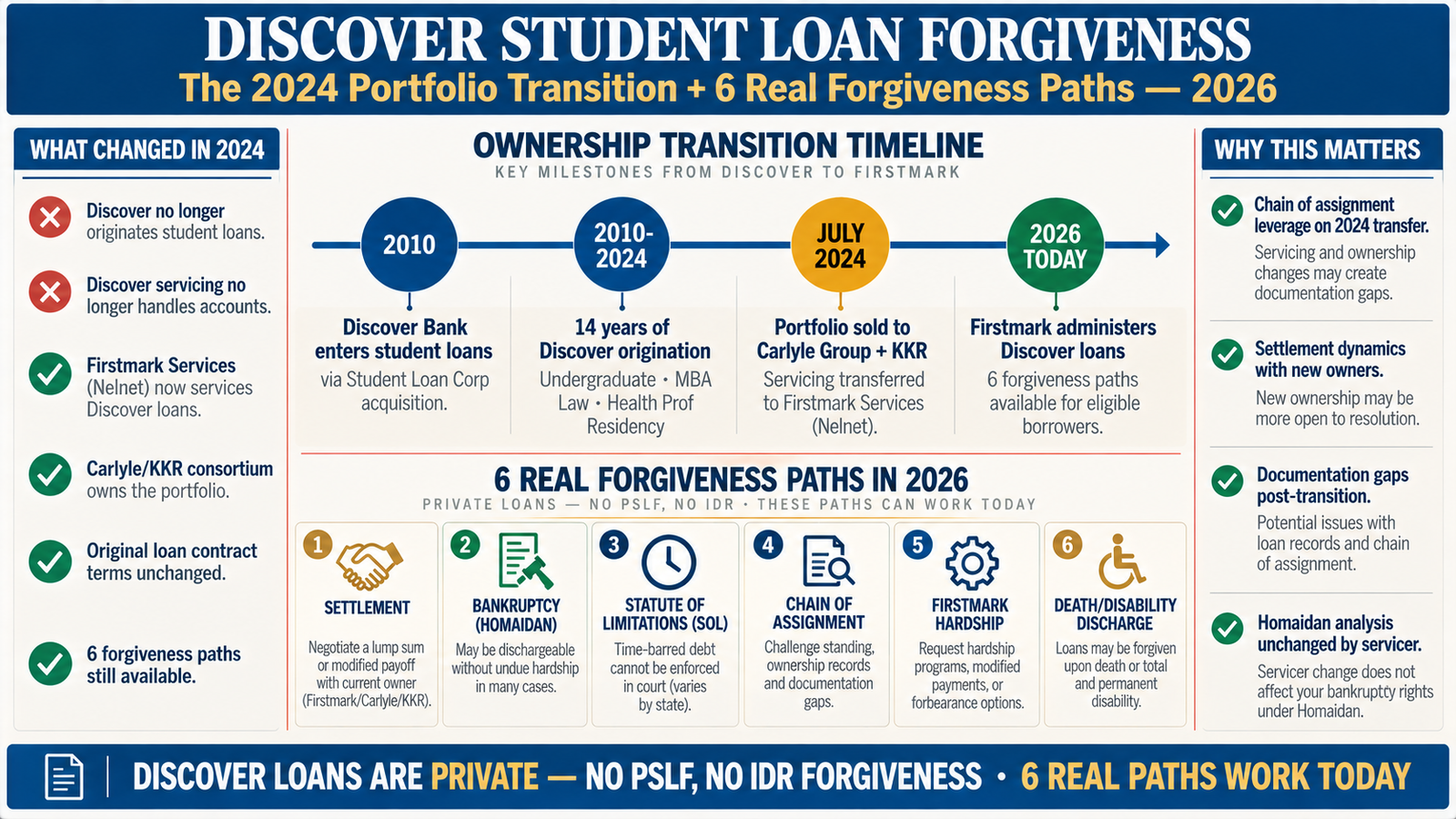
Discover student loan forgiveness is available through 6 non-federal legal mechanisms — federal forgiveness programs (PSLF, IDR forgiveness) do NOT apply to Discover loans because they are private, not federal. The paths: (1) settlement — negotiating with Firstmark Services (current servicer following July 2024 Carlyle Group and KKR acquisition of Discover’s student loan portfolio, with servicing transitioned from Discover Bank’s own servicing operation to Firstmark Services, a Nelnet NYSE:NNI subsidiary) typically 40-60% discount from balance for charged-off accounts; (2) bankruptcy discharge under 11 U.S.C. §523(a)(8) with Homaidan v. Sallie Mae 992 F.3d 100 (2d Cir. 2021) precedent — many Discover loans qualify for non-qualified discharge WITHOUT undue hardship showing (direct-to-consumer loans, loans exceeding cost of attendance, loans for non-Title IV programs); (3) statute of limitations expiration under state SOL (3-15 years by state); (4) chain of assignment defense — particularly relevant given the 2024 portfolio transfer creating documentation considerations between Discover original ownership and current Carlyle/KKR ownership through Firstmark servicing; (5) Firstmark Services hardship programs continuing Discover framework; (6) death and disability discharge available per Discover-era contract terms. Discover’s portfolio includes Undergraduate Loan, Discover MBA Loan, Discover Law Loan, Discover Health Professions Loan, and Discover Residency Loan products. Important: Discover Bank fully exited the private student loan origination business — no new Discover student loans are being originated. All existing Discover loans are being administered through Firstmark Services with Carlyle/KKR as the new portfolio owners.
Read the complete 2026 Discover forgiveness framework below.
In this complete Discover forgiveness guide:
Discover’s exit from student loans — the 2024 Carlyle/KKR acquisition
What happened and what it means for borrowers
Discover’s loan products and their characteristics
Undergraduate, MBA, Law, Health Professions, Residency
Why Discover loans don’t get federal forgiveness
Private vs federal — critical distinction and implications
Path 1: Settlement with Firstmark Services
Post-2024 negotiation dynamics and realistic outcomes
Path 2: Bankruptcy discharge via Homaidan
Which Discover loans qualify for non-qualified discharge
Path 3: Statute of limitations
State SOL analysis for time-barred Discover debt
Path 4: Chain of assignment (post-2024 opportunity)
Discover → Carlyle/KKR → Firstmark documentation analysis
Path 5: Firstmark hardship programs
What Firstmark offers continuing Discover framework
Path 6: Death and disability discharge
Contract-based discharge continuing from Discover era
Discover’s exit from student loans — the 2024 Carlyle/KKR acquisition
Understanding the 2024 Carlyle Group and KKR acquisition of Discover’s student loan portfolio is essential to understanding current discover student loan forgiveness options. The transaction fundamentally changed how Discover loans are owned, serviced, and administered, with important implications for borrowers.
The pre-2024 Discover student loan business
Discover Bank entered the private student loan business in 2010 through acquisition of The Student Loan Corporation from Citigroup. From 2010 through early 2024, Discover was a major private student loan originator and servicer, offering Undergraduate Loans, MBA Loans, Law Loans, Health Professions Loans, Residency Loans, and refinance products. Discover marketed heavily to borrowers through direct advertising, school financial aid offices, and partnership programs. The business grew substantially over the 14-year period Discover operated it.
The July 2024 sale to Carlyle Group and KKR
In July 2024, Discover Financial Services (parent of Discover Bank) completed sale of its entire private student loan portfolio to a consortium led by Carlyle Group (private equity firm) and KKR (private equity firm). The transaction was part of Discover’s strategic decision to exit the student loan business and focus on core credit card and banking operations. Simultaneously, servicing of the loans was transitioned from Discover’s internal operation to Firstmark Services, a subsidiary of Nelnet NYSE:NNI — one of the largest student loan servicers nationally.
What this means for borrowers
For Discover student loan borrowers, the 2024 transition means: (1) Current loan ownership — loans are now owned by Carlyle/KKR consortium, not Discover Bank; (2) Current servicing — Firstmark Services handles all day-to-day servicing (payments, customer service, hardship programs); (3) Loan terms unchanged — original loan contract terms remain in effect, but administration goes through Firstmark; (4) Payment addresses changed — new payment instructions provided by Firstmark; (5) Credit reporting — tradeline reporting typically now reflects Firstmark Services or the Carlyle/KKR entity rather than Discover.
Implications for forgiveness options
The ownership and servicing transition creates specific implications for forgiveness analysis: Chain of assignment considerations — the Discover → Carlyle/KKR → Firstmark administration chain creates documentation that must be properly preserved for enforcement, and gaps may support standing challenges; Settlement dynamics — new portfolio owners often prioritize monetization of acquired debt, potentially creating settlement opportunities; Firstmark hardship programs — may differ from historical Discover programs, requiring verification of current offerings; Bankruptcy discharge — Homaidan analysis of original Discover loan characteristics unchanged by servicer transition. The analysis of underlying loan characteristics for discharge purposes applies to the loans as originally issued by Discover.
Discover’s loan products and their characteristics
Understanding specific Discover loan product characteristics is important for discover student loan forgiveness analysis because different products have different characteristics affecting dischargeability under §523(a)(8) and other forgiveness mechanisms.
Discover Undergraduate Loan
The flagship product covering undergraduate students at eligible colleges and universities. Variable or fixed rate options; typical terms 10-20 years; could be used for cost of attendance expenses at Title IV eligible institutions. Required school certification of cost of attendance in most cases — potentially supporting IRC §221(d)(1) “qualified education loan” status, which would require undue hardship for discharge. However, specific loan characteristics should be analyzed case-by-case.
Discover MBA Loan
Designed for graduate business students. Could cover full cost of attendance at eligible MBA programs. Larger loan amounts than undergraduate product (reflecting MBA tuition costs). Variable or fixed rate options. Discharge analysis follows similar framework to Undergraduate Loan but with graduate program considerations. Some Discover MBA Loans may have been used for executive MBA or part-time programs where enrollment status analysis matters for §221(d)(1) “at least half-time” requirement.
Discover Law Loan
Specialized product for law school students. Available for JD and LLM programs at eligible law schools. Could cover full cost of attendance including bar study expenses (though separate Bar Loan products existed). Cost of attendance limits and school certification requirements typically applied. Analysis under §523(a)(8) follows standard framework for private law school loans.
Discover Health Professions Loan
Specialized product for medical, dental, veterinary, pharmacy, and other health professions students. Available for programs at eligible institutions. Larger loan amounts reflecting health professions tuition costs. Could include additional expenses relevant to health professions education. Discharge analysis follows standard private student loan framework.
Discover Residency Loan
Specialized product for medical residents to cover residency-related expenses (relocation, licensing exams, board examination fees). The residency context creates specific §221(d)(1) analysis considerations: whether residency expenses qualify as “qualified higher education expenses”; whether residents are “students enrolled at least half-time”; whether residency programs are “eligible educational institutions” for §221(d)(1) purposes. Residency Loans may be more likely to fall outside §221(d)(1) qualified education loan definition — supporting non-qualified discharge analysis.
Discover refinance loans
Discover offered refinance products that could combine federal and private loans into new private refinance loans. These refinance loans follow private loan analysis — federal protections do NOT transfer to refinance loans (meaning borrowers who refinanced federal loans with Discover lost PSLF, IDR, and other federal benefits). Discharge analysis for refinance loans follows private loan framework. Many borrowers who refinanced federal loans with Discover now face full private loan exposure without federal protections.
Why Discover loans don’t get federal forgiveness
A common source of confusion for Discover borrowers is why federal forgiveness programs don’t apply to their loans. Understanding this distinction is foundational to pursuing real discover student loan forgiveness options.
Private vs federal loan distinction
Federal student loans are issued or guaranteed by the U.S. Department of Education under the Higher Education Act (20 U.S.C. §1001 et seq.). Federal programs include Direct Loans, Perkins Loans, and historical FFEL Loans. Private student loans — including all Discover loans — are issued by private lenders (banks, credit unions, specialized lenders) without federal involvement. The distinction matters because federal forgiveness programs are tied specifically to federal loan statutes and do not apply to private loans.
Federal programs that don’t apply to Discover loans
The following federal programs do NOT apply to Discover student loans: Public Service Loan Forgiveness (PSLF) under 20 U.S.C. §1087e(m) — applies only to Direct Loans; Income-Driven Repayment forgiveness — federal regulatory programs for federal loans only; Teacher Loan Forgiveness — federal loans only; Perkins Loan cancellation — federal Perkins Loans only. Any Discover borrower who was told they qualified for one of these programs received incorrect information. Discover loans are private, not federal.
Federal protections that DO apply via FDCPA/FCRA
While federal forgiveness doesn’t apply, certain federal CONSUMER PROTECTION laws do apply to Discover loans: FDCPA 15 U.S.C. §1692 et seq. applies to third-party debt collection on Discover loans (post-charge-off); FCRA 15 U.S.C. §1681 et seq. applies to credit reporting of Discover loans; Bankruptcy Code 11 U.S.C. §523(a)(8) governs bankruptcy discharge of Discover loans (with Homaidan precedent supporting non-qualified discharge for many loans). These federal protections support discover private student loan defensive framework even though federal forgiveness programs do not apply.
What this means practically
For Discover borrowers, the practical implication: don’t wait for federal action, pursue non-federal mechanisms. The 6 real forgiveness paths — settlement, bankruptcy discharge, SOL, chain of assignment, Firstmark hardship programs, death/disability discharge — produce real outcomes TODAY. Hypothetical future federal extension of forgiveness programs to private loans is unlikely and shouldn’t factor into current financial decisions.
Path 1: Settlement with Firstmark Services
Settlement negotiation with Firstmark Services (current servicer following July 2024 Carlyle/KKR acquisition) is often the most accessible discover student loan settlement path for borrowers with charged-off or delinquent accounts. The post-2024 ownership transition has created some new settlement dynamics.
Post-2024 settlement dynamics
The 2024 Carlyle/KKR acquisition created specific dynamics affecting settlement outcomes: (1) new portfolio owners (private equity) typically prioritize monetization of acquired debt over long-term portfolio holding; (2) Firstmark Services operates under contract terms with the new owners, with authority limits for settlements; (3) early period after major portfolio transitions often sees more flexible settlement terms as new owners want to clean up charged-off accounts; (4) chain of assignment documentation may create additional settlement leverage during transition period; (5) ongoing portfolio management decisions may create windows of opportunity for favorable settlements.
Typical settlement outcomes
Settlement outcomes for Discover loans through Firstmark typically range: Pre-charge-off (90-180 days delinquent) — 20-40% discount; Charged-off accounts (180+ days) — 40-55% discount from balance; Older charged-off accounts — sometimes 50-60% discount depending on circumstances; Accounts with strong defensive leverage (chain of assignment issues, SOL approach, Homaidan analysis) — 30-45% of balance in some cases. Approaching settlement with proper defensive framework analysis produces materially better outcomes.
Settlement negotiation process
Firstmark settlement negotiation typically follows standard process: (1) initial contact and current account status verification; (2) hardship documentation preparation; (3) written initial settlement offer (typically 25-35% of balance to leave negotiation room); (4) multiple rounds of counter-offers over 30-90 days; (5) written settlement agreement with full satisfaction release language, credit tradeline update instructions, and 1099-C handling specification; (6) lump sum payment via traceable method; (7) confirmation of debt extinguishment and tradeline update verification. NEVER make payment without executed written agreement.
IRC §108 tax planning for settlement
The forgiven portion of Discover settlement is reported on IRS Form 1099-C and generally taxable. IRC §108(a)(1)(B) insolvency exclusion can eliminate or reduce this tax liability for borrowers whose liabilities exceeded assets immediately before cancellation. For borrowers facing settlement, insolvency is common and this exclusion often applies. CPA preparation using Form 982 to claim appropriate exclusion is essential — don’t settle significant Discover debt without tax planning.
Path 2: Bankruptcy discharge via Homaidan
Many Discover student loans qualify for bankruptcy discharge WITHOUT undue hardship showing under Homaidan v. Sallie Mae Second Circuit precedent. This is often the most powerful discover student loan discharge mechanism for borrowers with overwhelming debt.
Which Discover loans qualify for non-qualified discharge
Discover loans potentially dischargeable without undue hardship showing: (1) direct-to-consumer loans without proper school certification of cost of attendance; (2) loans exceeding school-certified cost of attendance; (3) Discover Residency Loans (specific residency context may fail §221(d)(1) requirements); (4) loans for programs that are not Title IV eligible; (5) loans to students enrolled less than half-time; (6) refinance loans that failed to maintain original loan characteristics; (7) loans failing other IRC §221(d)(1) requirements. Each loan requires case-by-case analysis of specific documentation.
Homaidan analysis for Discover loans
Applying Homaidan v. Sallie Mae 992 F.3d 100 (2d Cir. 2021) framework to Discover loans: the “educational benefit” category of §523(a)(8)(A)(ii) is narrow and does not capture general private loans; the “qualified education loan” category of §523(a)(8)(B) requires meeting ALL 5 IRC §221(d)(1) requirements (qualified higher education expenses, eligible educational institution, half-time enrollment, cost of attendance limit, reasonable period). Many Discover loans fail at least one of these requirements, supporting non-qualified discharge analysis. The current servicer (Firstmark) and current owner (Carlyle/KKR) often lack original documentation to prove qualified education loan status.
Documentation gaps post-2024 transfer
The 2024 portfolio transfer created potential documentation challenges for the new owners. Original origination documentation (school certifications, cost of attendance calculations, enrollment verification) was maintained by Discover for years, but transfer to new owners may have resulted in incomplete documentation reaching Carlyle/KKR and Firstmark. In §523(a)(8) adversary proceedings, the current holder bears burden of proving qualified education loan status — documentation gaps support non-qualified discharge analysis.
Chapter 7 vs Chapter 13 for Discover discharge
Chapter 7 is often preferred when Homaidan analysis supports non-qualified discharge — faster process (3-4 months main case plus 60-90 days §523(a)(8) adversary proceeding = total approximately 6 months) produces complete discharge. Chapter 13 may be preferred when: means test under 11 U.S.C. §707(b)(2) fails Chapter 7 qualification; significant non-exempt assets exist; Brunner undue hardship analysis is required (for qualified loans) and plan payments support good faith prong; coordination with other debts favors structured plan.
Path 3: Statute of limitations
For older Discover loan debt, state statute of limitations analysis may provide one of the strongest defensive positions. When SOL expires, the current holder loses the legal ability to file a lawsuit — making the debt effectively uncollectible through litigation.
State SOL periods relevant to Discover loans
State SOL periods for written contract debt (which includes Discover loans) vary significantly: Texas 4 years under Tex. Civ. Prac. & Rem. Code §16.004(a)(3); New York 3 years under CPLR §214(2) per CCFA April 7, 2022; Pennsylvania 4 years under 42 Pa.C.S. §5525; Ohio 6 years under Ohio R.C. §2305.06; Illinois 10 years under 735 ILCS 5/13-206; California 4 years under CCP §337; Florida 5 years under Fla. Stat. §95.11(2)(b); Delaware 3 years under 10 Del. C. §8106 (particularly relevant given Discover’s Delaware incorporation).
Governing law clause considerations
Discover student loan contracts typically contain governing law clauses that may specify Delaware law (given Discover Bank’s Delaware charter). Delaware’s 3-year SOL for written contracts is relatively short, potentially supporting earlier SOL expiration for Discover debt. However, state borrowing statutes may apply shorter SOL between forum state and governing law state. Original loan contract review for governing law clause is essential first step in Discover-specific SOL analysis.
Revival avoidance critical
For older Discover debt approaching or past SOL, revival avoidance is essential: NEVER make any payment (even small payment restarts SOL in most states); NEVER provide written acknowledgment of debt validity; NEVER promise to pay in any form; avoid responding to collection communications without consulting counsel first. Firstmark Services (as current servicer) may attempt collection activities designed to trigger revival on time-barred debt. The transition from Discover to Firstmark servicing created a period when some borrowers were contacted anew — any response during this period required careful SOL consideration.
FDCPA leverage for time-barred Discover debt
When Firstmark or third-party collectors pursue collection on time-barred Discover debt, FDCPA leverage becomes available: 15 U.S.C. §1692e prohibits deceptive practices (lawsuit on time-barred debt may violate); 15 U.S.C. §1692g debt validation requirement; successful FDCPA counterclaims support statutory damages, actual damages, attorney fees. Combined SOL defense plus FDCPA counterclaim produces strongest defensive position against time-barred Discover debt collection.
Path 4: Chain of assignment (post-2024 opportunity)
The 2024 Carlyle/KKR acquisition of Discover’s student loan portfolio created specific chain of assignment considerations that may support powerful defensive positions. Under Article III standing precedent, current holders must prove complete chain of ownership from original Discover origination through the current Carlyle/KKR ownership structure.
The Discover → Carlyle/KKR → Firstmark chain
Current chain of ownership for Discover loans involves: (1) original Discover Bank origination documentation; (2) July 2024 purchase agreement transferring portfolio to Carlyle/KKR consortium; (3) servicing transfer to Firstmark Services under new servicing agreement. Each step must be properly documented for enforcement purposes. Gaps in any step may support standing challenges, particularly in debt collection litigation.
Article III standing framework
Article III standing requires: (1) concrete and particularized injury to plaintiff; (2) causal connection to defendant conduct; (3) redressable by court decision. Framework established in Lujan v. Defenders of Wildlife 504 U.S. 555 (1992), refined in Spokeo, Inc. v. Robins 578 U.S. 330 (2016), and TransUnion LLC v. Ramirez 594 U.S. 413 (2021). For current holder to sue on Discover-originated debt, must prove ownership through complete chain. Any gap supports motion to dismiss on standing grounds.
Common post-transfer documentation issues
Post-portfolio-transfer documentation issues that may support chain of assignment defense: assignment documentation lacking specific loan identification in bulk transfers; missing allonge chain or blank endorsements; purchase agreement provisions inconsistent with specific loan assignment; Firstmark servicing records inconsistent with Discover original records; delays in document transfer creating ownership gaps. Discovery in litigation often exposes these issues.
Post-judgment vacation opportunity
For borrowers who had default judgments entered on Discover loans before the 2024 transfer, motion to vacate under FRCP 60(b)(4) may be available if the original judgment was entered without proper standing. Standing challenges are jurisdictional and preserved even post-judgment. For older Discover default judgments where the original plaintiff could not establish complete standing documentation, vacation may be available even years later.
Path 5: Firstmark hardship programs
Firstmark Services continues administering hardship programs for Discover-originated loans under the new Carlyle/KKR ownership. These programs provide contract-based relief that can reduce debt burden and support longer-term forgiveness strategy, though they are not technically “forgiveness.”
Hardship forbearance
Firstmark offers hardship forbearance for Discover loan borrowers facing documented financial difficulty. Forbearance typically: suspends required payments for 3-12 months (cumulative limits may apply); interest continues to accrue during forbearance; may be available in 3-month increments; requires hardship documentation (job loss, medical issues, other qualifying circumstances); may be renewable upon continued hardship. Hardship forbearance prevents charge-off and preserves credit standing but doesn’t reduce total debt burden.
Modified payment plans
Firstmark may offer modified payment plans reducing monthly payments through: interest rate reduction (potentially 3-6 months); extended repayment term; interest-only payment periods; graduated payment schedules. Modification programs require documentation and typically have review periods. Modified payments can make debt manageable while longer-term forgiveness strategy develops.
Cosigner release
Discover historically offered cosigner release after specific requirements: typically 12-36 consecutive on-time principal and interest payments; borrower creditworthiness criteria; income verification. Firstmark continues administering cosigner release under original Discover terms. Specific requirements vary by loan product and origination date. Borrowers close to cosigner release eligibility often prioritize meeting requirements before considering settlement or bankruptcy options that would affect cosigner.
Important: hardship programs don’t forgive debt
While hardship programs provide valuable relief, they don’t produce “forgiveness” — the debt remains fully owed. For borrowers seeking actual debt reduction (not just payment relief), the other 5 forgiveness paths (settlement, bankruptcy discharge, SOL, chain of assignment, death/disability discharge) are necessary. Hardship programs can be useful as bridge strategy while planning more comprehensive debt resolution.
Path 6: Death and disability discharge
Discover student loan contracts typically include death and disability discharge provisions that continue to apply through Firstmark Services administration under new Carlyle/KKR ownership. These contract-based mechanisms produce actual discover student loan forgiveness for qualifying situations.
Death discharge
Discover student loans typically discharge upon death of the borrower per contract terms. Estate administration process involves: notification to Firstmark Services with proper documentation (certified death certificate); documentation of loan ownership (borrower vs cosigner); application for discharge per loan contract terms; confirmation of debt extinguishment; credit reporting update. Cosigner discharge upon borrower death may vary by loan age and specific terms.
Disability discharge
Discover student loans may discharge for Total and Permanent Disability per original contract terms, now administered through Firstmark Services. Documentation typically requires: physician certification of permanent disability; evidence meeting lender-specific criteria for permanence; application through Firstmark processes. Specific disability discharge availability varies by loan product and origination date — Residency Loans and Health Professions Loans may have specific provisions reflecting the borrower’s profession.
Estate planning considerations
For Discover borrowers with significant private student loan debt, estate planning should address: documentation of loan terms for estate administrators; life insurance planning to cover cosigner exposure (which may not discharge on borrower death); documentation of disability discharge availability; family communication about debt resolution options. Private student loan debt should be addressed in overall estate planning strategy.
Related resources — complete Discover ecosystem
Private Student Loan Forgiveness 2026: Complete Guide (PILAR)
The 7-path master framework covering all private student loan forgiveness mechanisms available in 2026.
Private Student Loan Settlement 2026: Complete Guide
Settlement negotiation framework with 40-60% discount outcomes for charged-off accounts.
Private Student Loan Bankruptcy Discharge 2026
Homaidan deep-dive with Chapter 7 vs 13 selection for complete debt elimination.
Common Discover student loan myths
Myth 1
“Discover loans qualify for PSLF because Discover is a major bank”
Reality: Discover student loans do NOT qualify for Public Service Loan Forgiveness, Income-Driven Repayment forgiveness, Teacher Loan Forgiveness, or any other federal forgiveness program. These programs apply exclusively to federal loans issued or guaranteed under the Higher Education Act. Discover loans are private loans — the bank’s size or reputation is irrelevant to federal program eligibility. Real discover student loan forgiveness works through non-federal mechanisms only.
Myth 2
“The 2024 sale to Carlyle/KKR eliminates my obligation”
Reality: The July 2024 Carlyle/KKR acquisition transferred loan ownership but did NOT eliminate borrower obligations. Original loan contract terms remain enforceable; new owners can collect on the debt through Firstmark Services administration. However, the transfer did create documentation and chain of assignment considerations that may support defensive positions in some circumstances. The transfer created opportunities for negotiation and defensive framework analysis but did not eliminate underlying debt.
Myth 3
“My Discover loan is a federal loan because I used it for college”
Reality: The purpose of the loan (for college) does not determine federal vs private status. Federal status requires the loan to be issued or guaranteed by U.S. Department of Education under Higher Education Act programs. All Discover student loans are private loans regardless of educational purpose. To verify loan type, check studentaid.gov NSLDS — federal loans appear there; Discover loans do NOT appear there. If your loan is listed as being from “Discover” or “Firstmark Services,” it is private.
Myth 4
“Discover student loans can never be discharged in bankruptcy”
Reality: This outdated myth is substantially incorrect. Following Homaidan v. Sallie Mae 992 F.3d 100 (2d Cir. 2021), many private student loans — including Discover loans with specific characteristics — are dischargeable in bankruptcy WITHOUT undue hardship showing. Discover loans that are direct-to-consumer, exceed cost of attendance, fail IRC §221(d)(1) requirements, or are Residency Loans may qualify for non-qualified discharge. Bankruptcy counsel with §523(a)(8) adversary proceeding experience should evaluate each Discover loan situation.
Frequently asked questions
1. Can I get Discover student loan forgiveness?
Yes, discover student loan forgiveness is available through 6 non-federal mechanisms — federal forgiveness programs (PSLF, IDR forgiveness) do NOT apply to Discover loans. The 6 paths: (1) settlement with Firstmark Services (current servicer following July 2024 Carlyle Group and KKR acquisition) typically 40-60% discount for charged-off accounts; (2) bankruptcy discharge under 11 U.S.C. §523(a)(8) with Homaidan v. Sallie Mae precedent for non-qualified private loans; (3) statute of limitations expiration (3-15 years by state); (4) chain of assignment defense (particularly relevant given 2024 portfolio transfer); (5) Firstmark hardship programs; (6) death and disability discharge. The right path depends on specific circumstances; multi-mechanism coordination typically produces best outcomes.
2. Who services my Discover student loans now?
Following the July 2024 Carlyle Group and KKR acquisition of Discover’s student loan portfolio, servicing of all Discover-originated student loans transferred from Discover Bank’s internal servicing operation to Firstmark Services, a subsidiary of Nelnet NYSE:NNI. Firstmark handles all day-to-day servicing including payments, customer service, hardship programs, and account administration. Your original loan contract terms remain in effect, but all interactions should go through Firstmark Services rather than Discover. Payment addresses, customer service numbers, and online account access changed with the transition.
3. Can Discover student loans be discharged in bankruptcy?
Yes, Discover student loans can be discharged in bankruptcy under 11 U.S.C. §523(a)(8). Many Discover loans qualify for non-qualified discharge WITHOUT undue hardship showing under Homaidan v. Sallie Mae 992 F.3d 100 (2d Cir. 2021) precedent — particularly direct-to-consumer loans, loans exceeding cost of attendance, Residency Loans, loans for non-Title IV programs, and loans failing other IRC §221(d)(1) requirements. Qualified loans may discharge through Brunner undue hardship test with moderated application. Chapter 7 adversary proceeding typically produces discharge in 6-9 months total from filing. Bankruptcy counsel with specific §523(a)(8) experience should evaluate each case.
4. Does Discover offer a settlement program for defaulted loans?
Settlement for defaulted Discover loans is now handled through Firstmark Services following the July 2024 ownership transition. Firstmark negotiates settlements on behalf of the Carlyle/KKR consortium that acquired the portfolio. Typical settlement outcomes: 40-55% discount from balance for charged-off accounts, with better outcomes possible when combined with defensive framework leverage (chain of assignment analysis, SOL positioning, Homaidan bankruptcy alternative). Settlement requires lump sum payment typically, with written settlement agreement containing full satisfaction release language. The forgiven portion is reported on IRS Form 1099-C — IRC §108 tax planning essential.
5. What happened to Discover’s student loan business?
Discover Financial Services (parent of Discover Bank) completed sale of its entire private student loan portfolio to a consortium led by Carlyle Group and KKR in July 2024. The transaction was part of Discover’s strategic decision to exit the student loan business and focus on core credit card and banking operations. Simultaneously, servicing transferred from Discover’s internal operation to Firstmark Services (Nelnet NYSE:NNI subsidiary). Discover is no longer originating new student loans — all existing Discover loans are being administered through Firstmark under the new Carlyle/KKR ownership. Borrower loan contract terms remain in effect, but administrative handling has changed completely.
6. Can I refinance my Discover student loans?
Refinancing Discover student loans into new private student loans with other lenders (SoFi, Citizens Bank, Earnest, other private lenders) is possible if creditworthiness supports approval at favorable rates. However, refinancing considerations: (1) credit requirements vary by lender; (2) new loan terms replace Discover terms; (3) refinancing federal loans with Discover previously lost federal benefits (irreversible); (4) refinancing private loans may not reduce total debt significantly; (5) alternative to refinancing may be settlement for substantially less than refinance would preserve. For borrowers facing significant private student loan debt, settlement or bankruptcy discharge analysis often produces better outcomes than refinancing.
7. What should I do if I can’t afford my Discover student loan payments?
Steps when struggling with Discover payments: (1) contact Firstmark Services about hardship forbearance (short-term relief); (2) explore modified payment plans through Firstmark; (3) if cosigner release available, pursue requirements to protect cosigner; (4) analyze Homaidan bankruptcy discharge potential for comprehensive relief; (5) consider SOL approach for older debt; (6) evaluate settlement if lump sum will become available; (7) consult consumer attorney or consulting resources familiar with full defensive framework. Hardship programs provide temporary relief while longer-term strategy develops. The combination of mechanisms often produces best overall outcomes. Private Student Relief partner network coordinates these resources.
Need Discover Student Loan Forgiveness?
Free specialist review of all 6 paths for Discover and Firstmark Services debt.
Settlement negotiation with Firstmark Services following July 2024 Carlyle Group and KKR portfolio acquisition, bankruptcy discharge evaluation under §523(a)(8) with Homaidan precedent for Discover Undergraduate/MBA/Law/Health Professions/Residency loans, statute of limitations analysis by state including Delaware governing law considerations, chain of assignment defensive framework for post-2024 transfer documentation, Firstmark hardship program qualification, and coordinated multi-path approach for maximum discover student loan forgiveness outcomes. Free eligibility review with attorney-backed partner provider — no upfront fees.
Get a free eligibility review →
5-minute review · No obligation · Zero upfront fees · Since 2015 · 48 states served
About the author
Henry Silva — Private Student Loan Debt Specialist
10+ years experience in discover student loan forgiveness analysis across Discover Undergraduate Loan, Discover MBA Loan, Discover Law Loan, Discover Health Professions Loan, and Discover Residency Loan products. Expertise includes July 2024 Carlyle Group and KKR acquisition dynamics, Firstmark Services (Nelnet NYSE:NNI subsidiary) servicing transition analysis, settlement negotiation with Firstmark on behalf of new portfolio owners, bankruptcy discharge analysis under 11 U.S.C. §523(a)(8) with Homaidan v. Sallie Mae 992 F.3d 100 (2d Cir. 2021) precedent, Crocker v. Navient Solutions LLC 941 F.3d 206 (5th Cir. 2019), McDaniel v. Navient Solutions LLC 973 F.3d 1083 (10th Cir. 2020), Brunner v. New York State Higher Education Services Corp. 831 F.2d 395 (2d Cir. 1987) framework for qualified loans, In re Rosenberg 594 B.R. 22 (Bankr. S.D.N.Y. 2020) moderated application, IRC §221(d)(1) qualified education loan analysis across all 5 requirements, statute of limitations analysis across all 50 states with specific attention to Delaware governing law clause (Discover Bank Delaware charter), chain of assignment challenges following the 2024 portfolio transfer under Article III standing doctrine (Lujan v. Defenders of Wildlife 504 U.S. 555, Spokeo, Inc. v. Robins 578 U.S. 330, TransUnion LLC v. Ramirez 594 U.S. 413), FDCPA leverage under 15 U.S.C. §1692g for debt validation and §1692e for deceptive practices in collection, Firstmark hardship program coordination continuing Discover framework, cosigner release strategy, IRC §108(a)(1)(B) insolvency and IRC §108(a)(1)(A) bankruptcy tax exclusion analysis with Form 982 preparation, and coordinated multi-mechanism strategy for maximum debt reduction outcomes. Henry works with Private Student Relief’s attorney-backed partner provider network to coordinate Discover-specific analysis across all 6 forgiveness paths.
Legal Disclaimer and Sources
This article is provided for informational purposes only and does not constitute legal, tax, or financial advice. Private Student Relief is a consulting and matching organization operated by Joco (555 Anton Blvd, Suite 368, Costa Mesa, CA 92626) — not a law firm, debt settlement company, debt consolidation company, or loan provider. Debt validation services are performed by an attorney-backed partner provider (Panamerican Consulting LLC, Las Vegas, NV) under independent business credentials. Ratings, BBB accreditation, and AADR membership referenced on the PSR website belong to the partner provider. Discover student loan forgiveness pathway availability depends on loan characteristics, servicer terms, borrower circumstances, and jurisdiction. Individual results vary. Since 2015. 48 states served. Not available in South Carolina or Mississippi.
Federal student loan program citations (for comparison, these do NOT apply to Discover private student loans): Higher Education Act (20 U.S.C. §1001 et seq.); Public Service Loan Forgiveness (20 U.S.C. §1087e(m)); Income-Driven Repayment forgiveness (federal loan regulatory framework); Direct Loan death discharge (20 U.S.C. §1087); Perkins Loan death discharge (20 U.S.C. §1087dd). These federal programs apply ONLY to federal loans.
Bankruptcy Code references: 11 U.S.C. §523(a)(8) (student loan discharge exceptions with §523(a)(8)(A)(i) governmental unit, §523(a)(8)(A)(ii) educational benefit, §523(a)(8)(B) qualified education loan categories); 11 U.S.C. §362 (automatic stay); 11 U.S.C. §524 (discharge injunction); 11 U.S.C. §707(b)(2) (means test); 11 U.S.C. §1328 (Chapter 13 discharge). Key bankruptcy precedent: Homaidan v. Sallie Mae Inc. 992 F.3d 100 (2d Cir. 2021); Brunner v. New York State Higher Education Services Corp. 831 F.2d 395 (2d Cir. 1987); Crocker v. Navient Solutions LLC 941 F.3d 206 (5th Cir. 2019); McDaniel v. Navient Solutions LLC 973 F.3d 1083 (10th Cir. 2020); In re Rosenberg 594 B.R. 22 (Bankr. S.D.N.Y. 2020). Article III standing precedent: Lujan v. Defenders of Wildlife 504 U.S. 555 (1992); Spokeo, Inc. v. Robins 578 U.S. 330 (2016); TransUnion LLC v. Ramirez 594 U.S. 413 (2021). Federal Rules of Civil Procedure: FRCP 60(b)(4) (void judgment vacation). Internal Revenue Code: IRC §221(d)(1) (qualified education loan definition with 5 requirements); IRC §108(a)(1)(A) (bankruptcy exclusion); IRC §108(a)(1)(B) (insolvency exclusion); Form 982; Form 1099-C. FDCPA: 15 U.S.C. §1692g (debt validation); 15 U.S.C. §1692e (deceptive practices). FCRA: 15 U.S.C. §1681c (7-year credit reporting limit).
Statute of limitations for written contract debt (private student loans) by state: Texas 4 years under Tex. Civ. Prac. & Rem. Code §16.004(a)(3); New York 3 years under CPLR §214(2) per Consumer Credit Fairness Act (CCFA) effective April 7, 2022; Pennsylvania 4 years under 42 Pa.C.S. §5525; Ohio 6 years under Ohio R.C. §2305.06 (reduced 2021); Illinois 10 years under 735 ILCS 5/13-206; Georgia 6 years under O.C.G.A. §9-3-24; California 4 years under CCP §337; Florida 5 years under Fla. Stat. §95.11(2)(b); Delaware 3 years under 10 Del. C. §8106 (particularly relevant given Discover Bank Delaware charter). Governing law clause in Discover loan contracts may specify Delaware law. Specific contract review essential for SOL analysis.
Discover student loan portfolio and servicing information current as of October 2026 per publicly available documentation: Discover Financial Services (parent of Discover Bank) completed sale of entire private student loan portfolio to consortium led by Carlyle Group and KKR in July 2024, exiting the private student loan business. Servicing transitioned from Discover Bank internal operation to Firstmark Services (Nelnet NYSE:NNI subsidiary) coincident with ownership transfer. All existing Discover-originated student loans are now owned by Carlyle/KKR consortium and serviced by Firstmark Services. Loan products included: Discover Undergraduate Loan, Discover MBA Loan, Discover Law Loan, Discover Health Professions Loan, Discover Residency Loan, and Discover refinance products. Original Discover loan contract terms remain in effect for all transferred loans. Discover acquired entry into student loan business through 2010 acquisition of The Student Loan Corporation from Citigroup.
Discover student loan forgiveness requires case-by-case analysis coordinating loan product characteristics (Undergraduate, MBA, Law, Health Professions, Residency, refinance), origination documentation (school certification, cost of attendance verification, enrollment status), post-2024 ownership transition considerations, Homaidan non-qualified discharge analysis vs qualified loan Brunner analysis, SOL positioning with governing law clause consideration, chain of assignment analysis through Discover→Carlyle/KKR→Firstmark administration chain, Firstmark hardship program availability, cosigner impact analysis, and coordinated multi-mechanism approach. This article provides general framework information; specific settlement negotiations with Firstmark Services, bankruptcy filings under Homaidan precedent, chain of assignment challenges, SOL defense in time-barred lawsuits, FDCPA counterclaims, IRC §108 tax exclusion claims via Form 982, and coordinated strategy must be evaluated for each borrower’s individual situation by counsel or consulting resources familiar with the complete discover student loan framework. Last reviewed: October 2026.