

Informational content only. Not legal, tax, or financial advice. Private Student Relief is a consulting organization, not a law firm. Bankruptcy filing requires licensed bankruptcy attorney in borrower’s jurisdiction. Debt validation services for settlement path are performed by an attorney-backed partner provider. Bankruptcy discharge outcomes depend on loan characteristics, borrower circumstances, Circuit jurisdiction, and other factors. Last reviewed: October 2026.
Written by Henry Silva
Private Student Loan Debt Specialist · 10+ years analyzing private student loan bankruptcy discharge frameworks across all Circuits. Deep expertise in 11 U.S.C. §523(a)(8) framework with Homaidan v. Sallie Mae 992 F.3d 100 (2d Cir. 2021), Crocker v. Navient 941 F.3d 206 (5th Cir. 2019), McDaniel v. Navient 973 F.3d 1083 (10th Cir. 2020), Brunner v. New York State HESC 831 F.2d 395 (2d Cir. 1987) undue hardship test, In re Rosenberg 594 B.R. 22 (Bankr. S.D.N.Y. 2020) modernized Brunner application, DOJ November 2022 undue hardship guidance, means test analysis under 11 U.S.C. §707(b)(2), Chapter 13 plan integration under §1322 and §1328, adversary proceeding framework, and coordinated settlement + bankruptcy strategies. Last reviewed: October 2026.
Private student loan bankruptcy has been fundamentally transformed over the past five years by watershed appellate precedents establishing that many private student loans ARE dischargeable in bankruptcy — contrary to decades of common misconception. The Second Circuit’s Homaidan v. Sallie Mae Inc. 992 F.3d 100 (2d Cir. 2021) decision, combined with Crocker v. Navient Solutions LLC 941 F.3d 206 (5th Cir. 2019), McDaniel v. Navient Solutions LLC 973 F.3d 1083 (10th Cir. 2020), In re Rosenberg 594 B.R. 22 (Bankr. S.D.N.Y. 2020), and DOJ November 2022 undue hardship guidance, has established substantial national framework for private student loan discharge. Direct-to-consumer private student loans without school certification of cost of attendance can be discharged in Chapter 7 WITHOUT undue hardship showing. Even private loans qualifying under §523(a)(8) framework can be discharged through modernized Brunner undue hardship analysis. This complete 2026 guide — the master pilar of our bankruptcy cluster — covers how private student loan bankruptcy actually works in 2026: the 7 proven paths to discharge, Chapter 7 vs Chapter 13 analysis, means test qualification, Homaidan framework application, Brunner undue hardship analysis, adversary proceeding mechanics, coordination with settlement strategies, and the complete framework for determining whether bankruptcy produces optimal outcome for your private student loan situation.
Quick Answer
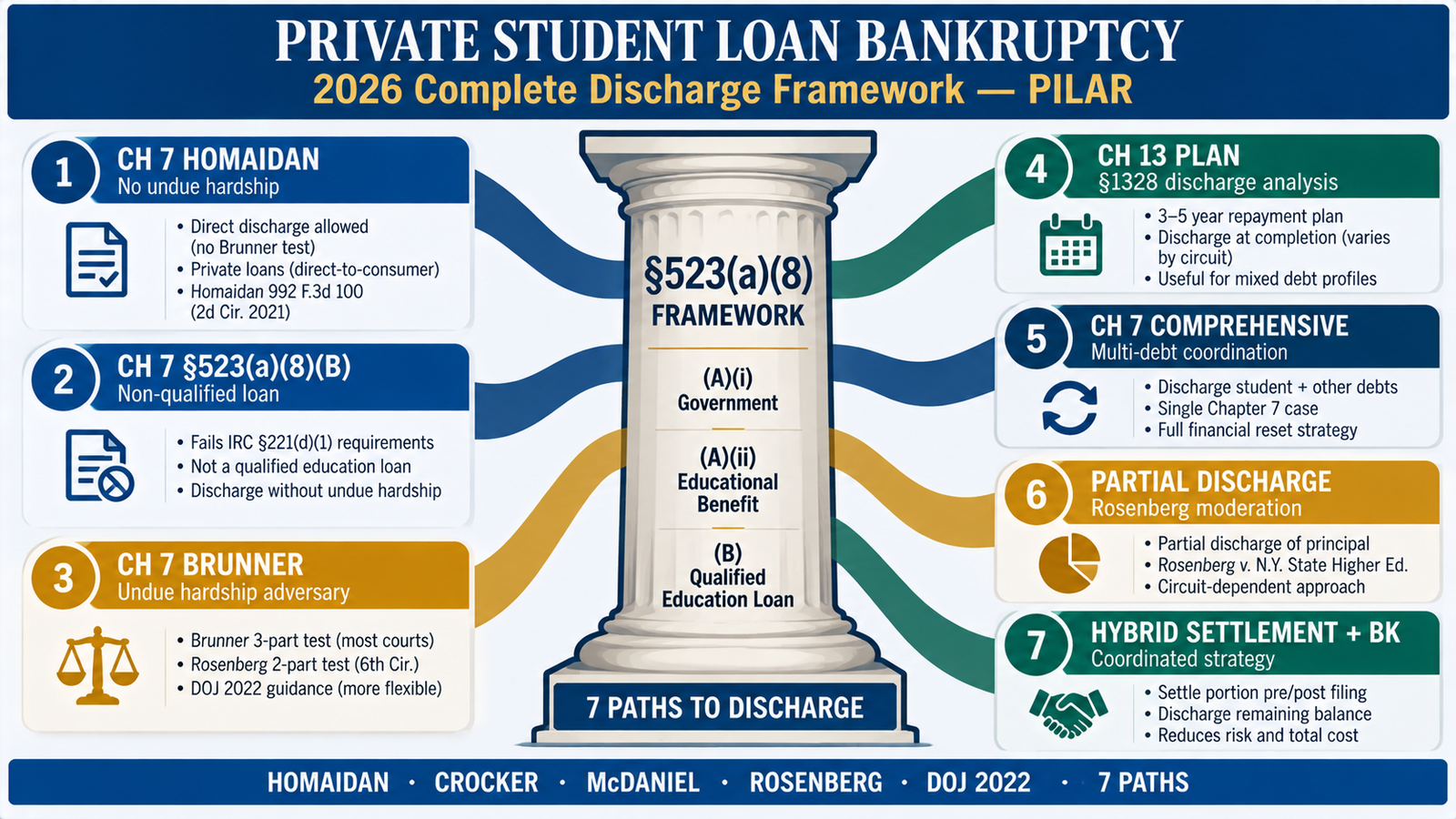
Private student loan bankruptcy in 2026: Private student loans CAN be discharged in bankruptcy — contrary to common misconception. Framework operates under 11 U.S.C. §523(a)(8) which excepts specific student loan categories from discharge: §523(a)(8)(A)(i) governmental loans; §523(a)(8)(A)(ii) “obligation to repay funds received as an educational benefit, scholarship, or stipend”; §523(a)(8)(B) qualified education loans under IRC §221(d)(1). Private loans NOT meeting any of these three categories are dischargeable WITHOUT undue hardship showing. Homaidan v. Sallie Mae 992 F.3d 100 (2d Cir. 2021) established narrow interpretation of §523(a)(8)(A)(ii) — direct-to-consumer private loans without school certification don’t qualify as “educational benefit” and are dischargeable without hardship. SEVEN PROVEN PATHS: (1) Chapter 7 §523(a)(8)(A)(ii) Homaidan discharge for direct-to-consumer loans — no hardship required; (2) Chapter 7 §523(a)(8)(B) non-qualified education loan discharge for loans failing IRC §221(d)(1) requirements — no hardship required; (3) Chapter 7 Brunner undue hardship adversary proceeding for qualified loans with Rosenberg modernization and DOJ 2022 guidance; (4) Chapter 13 plan with §1328 discharge analysis at completion; (5) Chapter 7 for comprehensive debt coordination; (6) Partial discharge framework under Rosenberg moderation; (7) Hybrid settlement + bankruptcy coordinated strategy. Requires licensed bankruptcy attorney for filing. Many borrowers eligible for discharge who previously believed otherwise.
Read the complete 7-path bankruptcy framework below.
In this complete bankruptcy pilar guide:
Path 1: Chapter 7 Homaidan §523(a)(8)(A)(ii) discharge
Direct-to-consumer loans — no undue hardship required
Path 2: Chapter 7 §523(a)(8)(B) non-qualified loan discharge
Loans failing IRC §221(d)(1) qualified education loan test
Path 3: Chapter 7 Brunner undue hardship adversary
Qualified loans with Rosenberg + DOJ 2022 moderated analysis
Path 4: Chapter 13 plan with §1328 discharge analysis
For borrowers failing means test or needing asset protection
Path 5: Chapter 7 for comprehensive debt coordination
Multi-debt situations with full fresh start
Path 6: Partial discharge under Rosenberg framework
Middle-ground discharge for mixed hardship cases
Path 7: Hybrid settlement + bankruptcy coordination
Strategic combination optimizing both frameworks
The §523(a)(8) framework foundation
Before examining the 7 paths, understanding the bankruptcy for private student loans statutory foundation is essential. 11 U.S.C. §523(a)(8) governs when student loans are excepted from the general bankruptcy discharge — and the specific statutory categories determine which path applies.
The three §523(a)(8) categories
Section 523(a)(8) excepts from discharge “unless excepting such debt from discharge under this paragraph would impose an undue hardship on the debtor and the debtor’s dependents”: §523(a)(8)(A)(i) — “an educational benefit overpayment or loan made, insured, or guaranteed by a governmental unit, or made under any program funded in whole or in part by a governmental unit or nonprofit institution”; §523(a)(8)(A)(ii) — “an obligation to repay funds received as an educational benefit, scholarship, or stipend”; §523(a)(8)(B) — “any other educational loan that is a qualified education loan, as defined in section 221(d)(1) of the Internal Revenue Code of 1986, incurred by a debtor who is an individual.” Loans not fitting any category are dischargeable in Chapter 7 WITHOUT undue hardship showing.
Why categorization matters
The categorization determines discharge path: loans NOT falling within any §523(a)(8) category are dischargeable in Chapter 7 like other unsecured debt — no undue hardship showing required (Paths 1 and 2 below); loans falling within a §523(a)(8) category require Brunner undue hardship adversary proceeding for discharge (Path 3); Chapter 13 provides additional framework through plan payments and §1328 discharge analysis (Path 4). Accurate loan characterization is the foundation of discharge analysis — many private student loans historically presumed non-dischargeable actually fall outside §523(a)(8) categories.
Path 1: Chapter 7 Homaidan §523(a)(8)(A)(ii) discharge
The Homaidan v. Sallie Mae Inc. 992 F.3d 100 (2d Cir. 2021) precedent provides the most powerful chapter 7 private student loans discharge framework. For qualifying loans, Chapter 7 discharge requires NO undue hardship showing — complete discharge of the private student loan debt.
The Homaidan holding
In Homaidan v. Sallie Mae Inc., the Second Circuit held that §523(a)(8)(A)(ii)’s “educational benefit, scholarship, or stipend” language is narrow — it refers to specific types of educational financial assistance (conditional grants that may be forgivable), NOT private student loans generally. The court reasoned that if Congress intended “educational benefit” to encompass all educational loans, the subsequent §523(a)(8)(B) qualified education loan category would be unnecessary. Statutory interpretation canons require giving effect to all provisions — therefore §523(a)(8)(A)(ii) must mean something distinct from §523(a)(8)(B). The precedent is binding in Second Circuit (Connecticut, New York, Vermont) and persuasive in all other Circuits.
Which private loans qualify under Homaidan
Private loans potentially qualifying for Homaidan Chapter 7 discharge: (1) direct-to-consumer private student loans made without school certification of cost of attendance; (2) loans exceeding “cost of attendance” limit for enrollment period; (3) loans for non-title IV eligible programs (vocational schools, bar exam prep, non-degree programs); (4) loans to students not enrolled at least half-time; (5) loans failing other IRC §221(d)(1) qualified education loan requirements. Analysis requires loan-by-loan documentation review — many Sallie Mae-originated loans (including NCSLT trust-held loans), Navient-originated loans, Discover-originated loans, and loans from other major lenders may qualify depending on specific characteristics.
Chapter 7 Homaidan adversary proceeding mechanics
Chapter 7 Homaidan discharge mechanics: (1) file Chapter 7 bankruptcy petition under 11 U.S.C. §301; (2) means test qualification under §707(b)(2); (3) typical case proceeds through discharge order within 4-6 months; (4) private student loan creditor may file objection to discharge or claim debt non-dischargeable; (5) debtor or creditor may file adversary proceeding under Federal Rules of Bankruptcy Procedure 7001 to determine dischargeability; (6) adversary proceeding presents Homaidan analysis — demonstrating specific loan doesn’t fit §523(a)(8) categories; (7) court order determines dischargeability. In some cases, lenders don’t contest dischargeability once Homaidan analysis is presented — avoiding litigation.
Circuit-specific application
Circuit application of Homaidan framework: Second Circuit (CT, NY, VT) — Homaidan directly binding; Fifth Circuit (TX, LA, MS) — Crocker v. Navient Solutions LLC 941 F.3d 206 (5th Cir. 2019) similar framework binding; Tenth Circuit (CO, KS, NM, OK, UT, WY) — McDaniel v. Navient Solutions LLC 973 F.3d 1083 (10th Cir. 2020) similar framework binding; Other Circuits — Homaidan, Crocker, McDaniel persuasive authority routinely cited and increasingly adopted by bankruptcy courts. Framework application has substantial national reach — Chapter 7 Homaidan discharge is viable path across jurisdictions.
Path 2: Chapter 7 §523(a)(8)(B) non-qualified loan discharge
The second path to discharge private student loans bankruptcy operates through §523(a)(8)(B) — loans failing to qualify as “qualified education loan” under IRC §221(d)(1) definition. Like Path 1, this discharge requires NO undue hardship showing for qualifying loans.
IRC §221(d)(1) qualified education loan definition
IRC §221(d)(1) defines “qualified education loan” as indebtedness incurred by the taxpayer solely to pay qualified higher education expenses which are: (A) incurred on behalf of the taxpayer, spouse, or dependent; (B) paid or incurred within a reasonable period of time before or after the indebtedness is incurred; and (C) attributable to education furnished during a period during which the recipient was an eligible student. “Qualified higher education expenses” means cost of attendance (as defined in section 472 of the Higher Education Act of 1965) at an eligible educational institution reduced by scholarships, grants, and specific other amounts.
Common §221(d)(1) qualification failures
Common ways private loans fail §221(d)(1) qualified education loan test: (1) loan proceeds not actually used solely for qualified higher education expenses (used for living expenses beyond cost of attendance, personal expenses, etc.); (2) loan amount exceeds cost of attendance limit; (3) borrower was not enrolled at least half-time during relevant period; (4) educational institution not Title IV-eligible (vocational training schools, bar exam preparation programs, non-degree programs); (5) borrower was not “eligible student” under §25A(b)(3) during relevant period; (6) loan made to pay prior obligations rather than current education expenses; (7) consolidation or refinance loans that include non-qualifying balances. Each failure removes the loan from §523(a)(8)(B) protection — making loan dischargeable without undue hardship.
Documentation analysis
Documentation analysis for §523(a)(8)(B) non-qualified loan discharge requires: (1) original loan application documentation showing loan purpose and amount; (2) school certification documentation (or absence thereof); (3) cost of attendance documentation for enrollment period; (4) enrollment status documentation during relevant period; (5) educational institution Title IV eligibility documentation; (6) actual loan proceeds disbursement records; (7) tax returns and other documentation supporting borrower’s “eligible student” status. Attorney review of loan documentation typically identifies specific qualification failures supporting discharge.
Path 3: Chapter 7 Brunner undue hardship adversary
For private student loans qualifying under §523(a)(8) framework, private student loan discharge requires Brunner undue hardship adversary proceeding. The framework has moderated significantly through Rosenberg and DOJ 2022 guidance, making discharge more achievable than historical application suggested.
The Brunner three-part test
Brunner v. New York State Higher Education Services Corp. 831 F.2d 395 (2d Cir. 1987) established three-part undue hardship test: (1) the debtor cannot maintain, based on current income and expenses, a “minimal” standard of living for themselves and their dependents if forced to repay the loans; (2) additional circumstances exist indicating that this state of affairs is likely to persist for a significant portion of the repayment period of the student loans; (3) the debtor has made good faith efforts to repay the loans. Historically strict application made discharge difficult. Recent moderation has improved outcomes substantially.
In re Rosenberg modernization
In re Rosenberg 594 B.R. 22 (Bankr. S.D.N.Y. 2020) significantly modernized Brunner application. Judge Morris emphasized the test’s actual language rather than accumulated restrictive interpretations: “minimal standard of living” doesn’t require destitution; “significant portion of repayment period” doesn’t require permanence; “good faith efforts” doesn’t require unreasonable attempts. The decision rejected many interpretive restrictions that had made Brunner nearly impossible to meet. While not binding beyond the Southern District of New York, Rosenberg has been widely cited and increasingly adopted by other courts seeking more reasonable Brunner application.
DOJ November 2022 guidance
The U.S. Department of Justice issued significant guidance on November 17, 2022 regarding government position on undue hardship adversary proceedings under §523(a)(8). The guidance established framework for government consent to undue hardship in qualifying cases based on specific factors: (1) current ability to pay (income and expense analysis); (2) likelihood of future ability to pay (long-term earning capacity, retirement status, disability); (3) good faith efforts to repay (payment history, deferment usage, communication with lenders). The DOJ guidance has shifted practical landscape — government positions in adversary proceedings now more frequently support discharge for qualifying cases. While DOJ guidance directly applies to federal loan cases, it has influenced bankruptcy court analysis of private loan Brunner cases as well.
Brunner adversary proceeding mechanics
Brunner adversary proceeding mechanics: (1) file Chapter 7 or Chapter 13 bankruptcy; (2) file adversary proceeding complaint under FRBP 7001 seeking determination of undue hardship; (3) extensive discovery including financial documentation; (4) expert testimony often used (vocational experts, medical experts for disability); (5) trial on undue hardship elements; (6) court decision on discharge, partial discharge, or non-discharge; (7) typical adversary proceeding timeline 6-12 months in addition to main bankruptcy case. Modernized Brunner framework and DOJ guidance have improved success rates significantly since 2020.
Path 4: Chapter 13 plan with §1328 discharge analysis
For borrowers who don’t qualify for Chapter 7 or who have specific asset protection needs, Chapter 13 bankruptcy provides alternative private student loan bankruptcy discharge framework through court-supervised repayment plan with discharge analysis at completion.
Chapter 13 framework overview
Chapter 13 operates through court-supervised repayment plan: (1) file Chapter 13 petition under 11 U.S.C. §301; (2) automatic stay under §362 stops all creditor collection; (3) propose plan under §1322 (3-5 year duration); (4) trustee supervises plan payments; (5) private student loans typically treated as unsecured debt receiving proportional distribution during plan period; (6) discharge at successful plan completion under §1328; (7) §523(a)(8) framework still applies at discharge — qualifying loans discharged under Homaidan/non-qualified analysis, loans within §523(a)(8) categories require Brunner analysis. Chapter 13 preserves assets above Chapter 7 exemption limits while providing comprehensive debt framework.
When Chapter 13 is optimal path
Chapter 13 optimal when: (1) borrower fails Chapter 7 means test under §707(b)(2) (above state median income with insufficient allowed deductions); (2) significant non-exempt assets above Chapter 7 exemption limits requiring protection; (3) mortgage or auto arrears requiring cure through plan; (4) regular income sufficient to support 3-5 year plan commitment; (5) multiple debt types benefiting from comprehensive plan treatment; (6) borrower circumstances may improve during plan period (supporting Brunner undue hardship analysis at plan completion); (7) extended court supervision preferred during financial recovery; (8) business ownership requiring protection from Chapter 7 liquidation.
§1328 discharge analysis at plan completion
At Chapter 13 plan completion, §1328 discharge analysis applies the same §523(a)(8) framework as Chapter 7. Private student loans qualifying under Homaidan analysis or §523(a)(8)(B) non-qualified analysis can be discharged without undue hardship showing. Private student loans within §523(a)(8) categories require Brunner undue hardship analysis — but with important advantage: time during Chapter 13 plan may support stronger undue hardship showing by demonstrating sustained financial difficulty despite good faith plan completion. Many Chapter 13 borrowers find discharge analysis more successful at plan completion than at Chapter 7 filing because plan completion itself demonstrates good faith efforts to repay.
Path 5: Chapter 7 for comprehensive debt coordination
For borrowers facing multiple debt problems beyond private student loans, Chapter 7 provides comprehensive debt relief framework addressing all qualifying debts simultaneously. This differs from settlement approach which targets specific private student loan debt only.
Comprehensive discharge scope
Chapter 7 addresses: (1) private student loans under §523(a)(8) framework analysis; (2) credit card debt (dischargeable); (3) medical debt (dischargeable); (4) personal loans (dischargeable); (5) deficiency balances from repossessions (dischargeable); (6) utility arrears (dischargeable); (7) old back taxes meeting specific requirements (potentially dischargeable); (8) business debts if personally liable (dischargeable in individual Chapter 7). Chapter 7 does NOT discharge: recent back taxes within 3-year lookback; alimony and child support; damages from DUI, intentional torts, fraud; some specific statutory exceptions. For borrowers with multiple debt types, comprehensive discharge provides complete fresh start.
Means test qualification
Chapter 7 requires passing means test under 11 U.S.C. §707(b)(2): (1) if household income below state median for similar household size, qualifies automatically; (2) if above state median, detailed calculation of disposable income against allowed expenses determines qualification; (3) failing means test may require Chapter 13 instead. Means test calculation includes current monthly income (CMI) from last 6 months and specific allowed deductions under IRS collection financial standards. State median income tables published periodically by U.S. Trustee program. Bankruptcy attorney essential for accurate means test analysis.
Asset considerations
Chapter 7 non-exempt asset considerations: (1) state exemption laws vary significantly (homestead, vehicle, personal property, retirement account, wildcard exemptions); (2) non-exempt assets subject to trustee liquidation; (3) most Chapter 7 cases are “no asset” cases where all assets are exempt; (4) some borrowers may need to convert to Chapter 13 to protect specific non-exempt assets; (5) retirement accounts (401(k), IRA) typically fully protected under federal and most state law; (6) tools of trade may have specific exemption. Asset analysis essential before Chapter 7 filing to prevent unexpected asset loss.
Path 6: Partial discharge under Rosenberg framework
For private student loans qualifying under §523(a)(8) with mixed hardship circumstances, partial discharge framework provides middle-ground option — discharging portion of debt while maintaining partial repayment obligation.
Partial discharge basis
Partial discharge basis: (1) bankruptcy court has equitable authority to grant partial discharge when complete discharge not warranted but some debt relief appropriate; (2) 11 U.S.C. §105(a) general equitable authority supports partial discharge; (3) Rosenberg framework explicitly recognizes court can address undue hardship through partial rather than complete discharge; (4) In re Educational Credit Management Corp. v. Mosley 494 F.3d 1320 (11th Cir. 2007) and other cases establish partial discharge framework; (5) partial discharge decision considers specific case circumstances rather than binary all-or-nothing analysis.
When partial discharge is appropriate
Partial discharge appropriate when: (1) borrower has some payment capacity but not full balance capacity; (2) specific hardship affects portion of debt but not all; (3) debt amount is substantial but borrower can sustain reduced amount; (4) borrower’s circumstances may improve long-term but not sufficient for full repayment; (5) court finds equity supports partial relief; (6) negotiated partial discharge during adversary proceeding more efficient than contested litigation. Partial discharge often negotiated with creditor consent rather than litigated to completion.
Partial discharge structures
Common partial discharge structures: (1) discharge of accumulated interest with ongoing principal payment; (2) discharge of portion of principal with modified repayment of remainder; (3) discharge of interest and fees with original principal payment plan; (4) reduction of monthly payment amount with extended term; (5) discharge above specific debt threshold (first $X owed, remainder discharged). Specific structure depends on case circumstances, creditor positions, and court approval. Partial discharge preserves some debt but provides substantial relief for borrowers unable to achieve complete discharge.
Path 7: Hybrid settlement + bankruptcy coordination
Many borrowers benefit from coordinated approach combining settlement and bankruptcy strategies rather than pursuing one path exclusively. Hybrid coordination can optimize outcomes across both frameworks.
Settlement with bankruptcy threat leverage
Most common coordination: credible bankruptcy threat strengthens settlement negotiation. Preparation: (1) bankruptcy counsel consultation documenting §523(a)(8) analysis with Homaidan application; (2) means test qualification analysis under §707(b)(2); (3) hardship documentation supporting bankruptcy viability; (4) specific legal strategy articulated. Communication to lender: credible bankruptcy alternative with documented preparation framework. Outcome: settlement at 25-45% range (versus 40-60% without leverage), avoiding bankruptcy filing while achieving substantial debt reduction. For details see our complete Private Student Loan Settlement guide.
Partial settlement with bankruptcy backstop
Alternative coordination: settle some accounts, bankruptcy for others. Framework: (1) attempt settlement on accounts with weakest Homaidan analysis or strongest holder negotiation posture; (2) reserve bankruptcy for accounts with strongest Homaidan characteristics; (3) coordinate timing to maximize both outcomes; (4) ensure settlement agreements don’t impair later bankruptcy filing. This approach can work when borrower has multiple accounts with varying characteristics. Legal counsel essential to coordinate without creating problems for either path.
Avoiding coordination missteps
Common coordination missteps: (1) settlement payments within 90 days before bankruptcy filing may be subject to preference claw-back under 11 U.S.C. §547(b); (2) failing to disclose pre-filing settlement payments in bankruptcy filing (can create significant legal problems); (3) acknowledging debt in settlement discussions in ways affecting bankruptcy preparation; (4) failing to coordinate professional representation across settlement and bankruptcy teams; (5) timing settlement payments poorly relative to bankruptcy filing. Legal representation essential for coordinated approach to avoid these missteps.
Related resources — complete private student loan debt relief ecosystem
The super pilar covering all private student loan debt relief mechanisms including bankruptcy, settlement, and other paths.
Private Student Loan Settlement 2026: Complete Guide
Settlement cluster pilar — primary alternative to bankruptcy with 7-path framework.
Settlement vs Bankruptcy Student Loans 2026
Detailed comparative framework for choosing between the two primary debt relief paths.
IRC §108 tax implications of bankruptcy discharge
Private student loan debt discharged in bankruptcy benefits from complete tax exclusion under IRC §108(a)(1)(A) — fundamentally different and more favorable than cancelled debt from settlement which requires insolvency analysis.
IRC §108(a)(1)(A) bankruptcy exclusion
IRC §108(a)(1)(A) excludes from gross income any debt discharged in Title 11 bankruptcy case (Chapter 7, Chapter 11, Chapter 13). Key advantages over settlement §108(a)(1)(B) insolvency exclusion: (1) no insolvency calculation required; (2) full amount of cancelled debt excluded regardless of post-cancellation financial position; (3) applies to all debt discharged through bankruptcy court order; (4) more straightforward documentation requirement; (5) particularly valuable for borrowers who would struggle to document insolvency for settlement §108(a)(1)(B) exclusion. Form 982 Part I, Line 1a (Title 11 bankruptcy box) required to claim exclusion.
Tax attribute reduction
While §108(a)(1)(A) provides complete income exclusion, IRC §108(b) requires tax attribute reduction when exclusion claimed. Attribute reduction ordering under §108(b)(2): (1) net operating losses; (2) general business credit carryforwards; (3) minimum tax credit; (4) capital loss carryovers; (5) basis of property; (6) passive activity loss and credit carryovers; (7) foreign tax credit carryovers. For many Chapter 7 borrowers, attribute reduction has minimal practical impact because borrower may not have substantial tax attributes to reduce. CPA coordination essential for proper tax planning. For complete tax analysis see our Student Loan Settlement Tax Consequences guide.
Decision framework for private student loan bankruptcy
By loan characteristics
Loan characteristics drive which private student loan bankruptcy path applies: Direct-to-consumer loans without school certification — Path 1 Chapter 7 Homaidan discharge (no undue hardship required); Loans failing IRC §221(d)(1) qualified education loan test — Path 2 Chapter 7 §523(a)(8)(B) discharge (no undue hardship required); Loans qualifying under §523(a)(8) categories — Path 3 Chapter 7 Brunner adversary proceeding; Mixed portfolio with varying characteristics — multi-path approach addressing each loan type individually; Loans with uncertain characteristics — comprehensive documentation review by attorney to determine applicable path.
By borrower financial situation
Financial situation determines Chapter choice: Below state median income + minimal non-exempt assets — Chapter 7 (Paths 1, 2, 3, 5) typically optimal; Above state median income + specific allowed deductions — detailed means test analysis determines Chapter 7 eligibility; Above median income failing means test — Chapter 13 (Path 4) with 3-5 year plan; Significant non-exempt assets — Chapter 13 (Path 4) to preserve assets; Mortgage or auto arrears to cure — Chapter 13 (Path 4) with cure provisions; Business ownership — Chapter 13 (Path 4) or Chapter 11 preserves business operations; Multiple debt problems requiring comprehensive relief — Chapter 7 (Path 5) for maximum fresh start.
By Circuit jurisdiction
Circuit jurisdiction affects path strength: Second Circuit (CT, NY, VT) — Homaidan directly binding, strongest Path 1 framework; Fifth Circuit (TX, LA, MS) — Crocker similar framework binding; Tenth Circuit (CO, KS, NM, OK, UT, WY) — McDaniel similar framework binding; Other Circuits — Homaidan, Crocker, McDaniel persuasive authority, increasingly adopted. Southern District of New York offers particularly favorable Rosenberg framework for Brunner analysis. State-specific exemption laws affect Chapter 7 asset considerations. Local bankruptcy attorney essential for jurisdiction-specific strategy optimization.
Multi-path coordination
Effective bankruptcy strategy typically combines multiple paths: Path 1 or 2 (automatic discharge for qualifying loans) + Path 3 (Brunner for qualifying loans) + settlement coordination (Path 7) for comprehensive outcome. Within single case, loans may be addressed through different paths depending on specific characteristics. Attorney analysis essential to identify optimal multi-path coordination for specific borrower situation.
Common private student loan bankruptcy myths
Myth 1
“Private student loans can never be discharged in bankruptcy”
Reality: This outdated understanding significantly misstates current law. Homaidan v. Sallie Mae Inc. 992 F.3d 100 (2d Cir. 2021) established that direct-to-consumer private student loans without school certification of cost of attendance do NOT qualify as “educational benefit” under §523(a)(8)(A)(ii) and are therefore dischargeable in Chapter 7 WITHOUT undue hardship showing. Combined with Crocker v. Navient 941 F.3d 206 (5th Cir. 2019), McDaniel v. Navient 973 F.3d 1083 (10th Cir. 2020), and other precedents, substantial national framework for private student loan dischargeability exists. Many private student loans — including Sallie Mae-originated loans in NCSLT trusts, Navient loans, Discover loans, SoFi loans with specific characteristics — may qualify for discharge. Analysis requires examination of specific loan characteristics. The old “impossible to discharge” understanding is simply wrong in 2026.
Myth 2
“Brunner undue hardship is impossible to prove”
Reality: While Brunner was historically applied very strictly, the framework has moderated significantly through In re Rosenberg 594 B.R. 22 (Bankr. S.D.N.Y. 2020) and DOJ November 2022 undue hardship guidance. The Rosenberg decision emphasized Brunner’s actual language rather than accumulated restrictive interpretations — “minimal standard of living” doesn’t require destitution; “significant portion of repayment period” doesn’t require permanence; “good faith efforts” doesn’t require unreasonable attempts. The DOJ 2022 guidance established framework for government consent to undue hardship in qualifying cases based on specific factors. Combined effect: Brunner adversary proceedings now more successful than historical application suggested. Modern Brunner analysis particularly supportive for: documented medical hardship, significant family responsibilities, long-term earning capacity limitations, and borrowers who have made good faith efforts to repay.
Myth 3
“Bankruptcy will cost more than it saves on private student loans”
Reality: Chapter 7 bankruptcy for private student loan discharge typically produces greater total debt reduction at lower cost than settlement. Example on $50.000 private student loan: Settlement at 40% with professional representation ≈ $27.500 total cost (debt reduction $22.500); Chapter 7 with Homaidan-qualifying loan ≈ $6.838 total cost (debt reduction $43.162 — nearly double the settlement reduction). Chapter 7 attorney fees typically $1.500-$3.500, filing fee $338, potential §523(a)(8) adversary proceeding $2.000-$5.000. For qualifying loans, Chapter 7 almost always produces better total outcome than settlement. The question isn’t whether bankruptcy is cost-effective — it’s whether loans qualify for discharge and whether borrower qualifies under means test. Settlement advantages lie elsewhere (no court record, targeted resolution, timeline) not cost comparison.
Myth 4
“My income is too high for bankruptcy”
Reality: Chapter 7 means test under 11 U.S.C. §707(b)(2) is more nuanced than simple income threshold. Even above state median income, detailed calculation of disposable income against allowed expenses (IRS collection financial standards for food, housing, transportation, plus specific actual expenses) may support Chapter 7 qualification. Many borrowers above state median income actually pass means test when properly calculated. For borrowers who do fail means test, Chapter 13 (Path 4) provides alternative framework — 3-5 year plan with discharge under §1328. High income does NOT preclude bankruptcy — it may affect which Chapter applies. Bankruptcy attorney essential for proper means test analysis given its complexity. Don’t assume ineligibility without actual analysis.
Frequently asked questions
1. Can private student loans be discharged in bankruptcy?
Can private student loans be discharged in bankruptcy: YES. Private student loans can be discharged in Chapter 7 or Chapter 13 bankruptcy under 11 U.S.C. §523(a)(8) framework. Direct-to-consumer loans without school certification of cost of attendance are dischargeable WITHOUT undue hardship showing under Homaidan v. Sallie Mae Inc. 992 F.3d 100 (2d Cir. 2021) binding in Second Circuit (CT, NY, VT), persuasive elsewhere, with similar framework in Crocker v. Navient 941 F.3d 206 (5th Cir. 2019) binding in Fifth Circuit (TX, LA, MS) and McDaniel v. Navient 973 F.3d 1083 (10th Cir. 2020) binding in Tenth Circuit (CO, KS, NM, OK, UT, WY). Loans qualifying under §523(a)(8) require Brunner undue hardship adversary proceeding — moderated significantly through In re Rosenberg 594 B.R. 22 (Bankr. S.D.N.Y. 2020) and DOJ November 2022 guidance. Many borrowers eligible for discharge who previously believed otherwise.
2. What is Homaidan and how does it affect my private student loans?
Homaidan v. Sallie Mae Inc. 992 F.3d 100 (2d Cir. 2021) is landmark Second Circuit decision establishing narrow interpretation of §523(a)(8)(A)(ii) “educational benefit” category. The court held this language refers to specific educational financial assistance (conditional grants that may be forgivable) — NOT private student loans generally. Direct-to-consumer private student loans without school certification of cost of attendance don’t qualify as “educational benefit” and are therefore dischargeable in Chapter 7 WITHOUT undue hardship showing. Precedent binding in Second Circuit (CT, NY, VT), persuasive elsewhere. For borrowers nationally, Homaidan creates substantial opportunity for private student loan discharge through Chapter 7 without needing to prove Brunner undue hardship. Loan characteristics analysis determines whether specific loan qualifies — includes direct-to-consumer origination, lack of cost of attendance certification, loans exceeding cost of attendance, non-title IV eligible programs.
3. How much does private student loan bankruptcy cost?
Private student loan bankruptcy cost structure: Chapter 7 attorney fees typically $1.500-$3.500 (varies by jurisdiction and complexity); Chapter 7 filing fee $338; credit counseling and debtor education course fees $25-$50 each; §523(a)(8) adversary proceeding attorney fees typically additional $2.000-$5.000 if required (Brunner cases); Chapter 13 attorney fees typically $3.000-$6.000 (higher due to 3-5 year plan supervision); Chapter 13 filing fee $313; plan payments over 3-5 years. For Homaidan-qualifying loans not requiring adversary proceeding, total Chapter 7 cost can be approximately $2.000. Even with adversary proceeding, total cost typically well under settlement cost for substantial private student loan balances. CPA fees for Form 982 preparation and tax planning typically $300-$1.500 additional.
4. How long does bankruptcy take for private student loan discharge?
Bankruptcy timeline for private student loan discharge: Chapter 7 typical case 4-6 months from filing to discharge order; §523(a)(8) adversary proceeding typically adds 6-12 months for cases requiring Brunner analysis or dischargeability determination; Chapter 13 initial filing to plan confirmation 60-90 days plus 3-5 year plan period plus §1328 discharge analysis at completion. For Homaidan-qualifying loans not requiring adversary proceeding, Chapter 7 discharge within 4-6 months typically. For Brunner cases, 10-18 months total common. Chapter 13 provides extended court protection but longer total timeline. Compared to settlement (60-120 days typical), bankruptcy generally takes longer but can produce complete discharge rather than partial resolution.
5. Should I file Chapter 7 or Chapter 13 for private student loans?
Chapter choice depends on specific factors: Chapter 7 typically optimal when: borrower passes means test under §707(b)(2); non-exempt assets within state exemption limits; comprehensive debt relief preferred; loans have Homaidan characteristics for discharge without undue hardship; faster timeline needed. Chapter 13 typically optimal when: borrower fails Chapter 7 means test; significant non-exempt assets requiring protection; mortgage/auto arrears to cure; regular income supports 3-5 year plan; borrower circumstances may improve during plan supporting stronger Brunner analysis at discharge; business ownership requiring protection. Both Chapters allow §523(a)(8) framework application for private student loan discharge. Bankruptcy attorney analysis essential for Chapter choice given specific circumstances.
6. What is the Brunner undue hardship test?
Brunner v. New York State Higher Education Services Corp. 831 F.2d 395 (2d Cir. 1987) three-part undue hardship test: (1) debtor cannot maintain minimal standard of living for themselves and dependents if forced to repay loans based on current income and expenses; (2) additional circumstances exist indicating this state of affairs likely to persist for significant portion of repayment period; (3) debtor has made good faith efforts to repay loans. Required for discharge of private student loans falling within §523(a)(8) categories. Historically applied strictly making discharge difficult. Significantly moderated through In re Rosenberg 594 B.R. 22 (Bankr. S.D.N.Y. 2020) emphasizing test’s actual language rather than restrictive interpretations, and DOJ November 2022 guidance establishing framework for government consent in qualifying cases. Modern Brunner analysis more successful than historical application — particularly for documented medical hardship, family responsibilities, long-term earning capacity limitations, and demonstrated good faith efforts.
7. How is bankruptcy different from settlement for private student loans?
Bankruptcy and settlement differ fundamentally: Bankruptcy — court-supervised process; can produce complete discharge of qualifying debts; addresses all debts simultaneously (Chapter 7) or through comprehensive plan (Chapter 13); significant credit impact (bankruptcy on credit report 7-10 years); IRC §108(a)(1)(A) complete tax exclusion; 4-6 months Chapter 7 timeline or 3-5 years Chapter 13; typical cost $1.500-$6.000 depending on Chapter and complexity; requires bankruptcy attorney. Settlement — negotiated resolution outside court; typically 25-60% balance reduction; targets specific debts individually; less severe credit impact; IRC §108(a)(1)(B) insolvency exclusion typically required; 60-120 day timeline; cost typically 15-30% of settlement savings; attorney or non-attorney services available. For comprehensive comparison see our Settlement vs Bankruptcy guide. Many borrowers benefit from coordinated approach combining both frameworks.
Facing Private Student Loan Debt?
Free specialist review of all 7 bankruptcy paths for your private student loans.
Chapter 7 Homaidan §523(a)(8)(A)(ii) discharge for direct-to-consumer loans without undue hardship, Chapter 7 §523(a)(8)(B) discharge for loans failing IRC §221(d)(1) qualified education loan test, Chapter 7 Brunner undue hardship adversary proceeding with In re Rosenberg 594 B.R. 22 (Bankr. S.D.N.Y. 2020) and DOJ November 2022 guidance moderated analysis, Chapter 13 plan with §1328 discharge analysis at completion, Chapter 7 for comprehensive debt coordination, partial discharge framework under Rosenberg moderation, hybrid settlement + bankruptcy coordination for optimal outcomes. All major private lenders analyzed (Sallie Mae Bank NYSE:SLM, Navient/Earnest Operations LLC, Discover/Firstmark Services, SoFi Bank NA NMLS #696891, Citizens Bank NA NYSE:CFG, Ascent, NCSLT trusts 2003-1 through 2007-4, third-party debt buyers). Free eligibility review with attorney-backed partner provider — no upfront fees. Bankruptcy filing coordinated through qualified bankruptcy attorney referral.
Get a free eligibility review →
5-minute review · No obligation · Zero upfront fees · Since 2015 · 48 states served
About the author
Henry Silva — Private Student Loan Debt Specialist
10+ years analyzing private student loan bankruptcy discharge frameworks across all federal Circuits. Deep expertise in 11 U.S.C. §523(a)(8) statutory framework including §523(a)(8)(A)(i) governmental loan exception, §523(a)(8)(A)(ii) educational benefit exception, §523(a)(8)(B) qualified education loan exception under IRC §221(d)(1) definition. Appellate precedent application: Homaidan v. Sallie Mae Inc. 992 F.3d 100 (2d Cir. 2021) binding in Second Circuit (Connecticut, New York, Vermont) establishing narrow §523(a)(8)(A)(ii) educational benefit interpretation making direct-to-consumer private student loans dischargeable without undue hardship; Crocker v. Navient Solutions LLC 941 F.3d 206 (5th Cir. 2019) binding in Fifth Circuit (Texas, Louisiana, Mississippi); McDaniel v. Navient Solutions LLC 973 F.3d 1083 (10th Cir. 2020) binding in Tenth Circuit (Colorado, Kansas, New Mexico, Oklahoma, Utah, Wyoming); Lamar, Archer & Cofrin, LLP v. Appling 584 U.S. 709 (2018) §523(a)(2)(B) framework. Brunner undue hardship test from Brunner v. New York State Higher Education Services Corp. 831 F.2d 395 (2d Cir. 1987) three-part analysis with modernized application through In re Rosenberg 594 B.R. 22 (Bankr. S.D.N.Y. 2020) emphasizing test’s actual language rather than restrictive interpretations, and U.S. Department of Justice November 17, 2022 undue hardship guidance establishing framework for government consent in qualifying cases based on current ability to pay, likelihood of future ability to pay, and good faith efforts. Chapter 7 framework under 11 U.S.C. §701 et seq. including automatic stay under §362, means test qualification under §707(b)(2) with state median income analysis using U.S. Trustee program tables and IRS collection financial standards for allowed expense deductions, discharge under §727(a), §523(a)(8) adversary proceeding mechanics under Federal Rules of Bankruptcy Procedure 7001. Chapter 13 framework under 11 U.S.C. §1301 et seq. including eligibility and debt limits ($465.275 unsecured / $1.395.875 secured as of 2024 with periodic adjustments), §1322 plan requirements and content, §1328 plan completion discharge analysis, 3-5 year plan duration based on income level, trustee percentage under 28 U.S.C. §586, mortgage/auto cure provisions, business ownership preservation. Partial discharge framework under 11 U.S.C. §105(a) equitable authority with In re Educational Credit Management Corp. v. Mosley 494 F.3d 1320 (11th Cir. 2007) and related precedent. Preference analysis under 11 U.S.C. §547(b) for pre-filing settlement payment coordination. Employment protection under 11 U.S.C. §525. IRC §108(a)(1)(A) complete bankruptcy tax exclusion with Form 982 preparation and §108(b) tax attribute reduction ordering. State exemption analysis for Chapter 7 asset considerations across all 50 states. Coordinated settlement + bankruptcy strategy including credible bankruptcy threat for settlement leverage, partial settlement with bankruptcy backstop, Chapter 13 with mid-plan settlement opportunities, timing coordination to avoid preference issues. Henry works with Private Student Relief’s attorney-backed partner provider network for settlement path and coordinates bankruptcy attorney referrals through partner network for bankruptcy path, ensuring borrowers have access to all 7 paths with proper professional representation across the complete decision framework.
Legal Disclaimer and Sources
This article is provided for informational purposes only and does not constitute legal, tax, or financial advice. Private Student Relief is a consulting and matching organization operated by Joco (555 Anton Blvd, Suite 368, Costa Mesa, CA 92626) — not a law firm, bankruptcy filing service, debt settlement company, debt consolidation company, or loan provider. Debt validation services for settlement path are performed by an attorney-backed partner provider (Panamerican Consulting LLC, Las Vegas, NV) under independent business credentials. Ratings, BBB accreditation, and AADR (American Association for Debt Resolution) membership referenced on the PSR website belong to the partner provider. Bankruptcy filing requires licensed bankruptcy attorney in borrower’s jurisdiction — PSR coordinates referrals through partner network but does not itself provide bankruptcy filing services. Discharge outcomes depend on loan characteristics, borrower circumstances, Circuit jurisdiction, specific judge assigned, and other factors. Individual results vary. Since 2015. 48 states served. Not available in South Carolina or Mississippi.
Bankruptcy Code references: 11 U.S.C. §105(a) (general equitable authority supporting partial discharge); 11 U.S.C. §301 (voluntary case commencement); 11 U.S.C. §362 (automatic stay); 11 U.S.C. §523(a)(8) (student loan discharge exceptions with §523(a)(8)(A)(i) governmental unit, §523(a)(8)(A)(ii) educational benefit, §523(a)(8)(B) qualified education loan categories); 11 U.S.C. §525 (employment protection); 11 U.S.C. §547(b) (preference analysis for pre-filing payments); 11 U.S.C. §707(b)(2) (Chapter 7 means test); 11 U.S.C. §727(a) (Chapter 7 discharge); 11 U.S.C. §1322 (Chapter 13 plan contents); 11 U.S.C. §1328 (Chapter 13 discharge analysis). 28 U.S.C. §586 (U.S. Trustee program authority). Federal Rules of Bankruptcy Procedure: FRBP 7001 (adversary proceeding scope); FRBP 7004 (service of summons and complaint). Key appellate precedent: Homaidan v. Sallie Mae Inc. 992 F.3d 100 (2d Cir. 2021) — binding in Second Circuit (CT, NY, VT), persuasive elsewhere, establishing narrow interpretation of §523(a)(8)(A)(ii) “educational benefit”; Crocker v. Navient Solutions LLC 941 F.3d 206 (5th Cir. 2019) — binding in Fifth Circuit (TX, LA, MS); McDaniel v. Navient Solutions LLC 973 F.3d 1083 (10th Cir. 2020) — binding in Tenth Circuit (CO, KS, NM, OK, UT, WY); Lamar, Archer & Cofrin, LLP v. Appling 584 U.S. 709 (2018) §523(a)(2)(B) framework; Brunner v. New York State Higher Education Services Corp. 831 F.2d 395 (2d Cir. 1987) undue hardship three-part test; In re Rosenberg 594 B.R. 22 (Bankr. S.D.N.Y. 2020) modernized Brunner application; In re Educational Credit Management Corp. v. Mosley 494 F.3d 1320 (11th Cir. 2007) partial discharge framework. Federal Rules of Civil Procedure: FRCP 60(b)(4) (void judgment); FRCP 12(b)(6) (failure to state claim). Pleading standards: Bell Atlantic Corp. v. Twombly 550 U.S. 544 (2007); Ashcroft v. Iqbal 556 U.S. 662 (2009). Article III standing precedent: Lujan v. Defenders of Wildlife 504 U.S. 555 (1992); Spokeo, Inc. v. Robins 578 U.S. 330 (2016); TransUnion LLC v. Ramirez 594 U.S. 413 (2021). Internal Revenue Code: IRC §221(d)(1) (qualified education loan definition — critical to §523(a)(8)(B) analysis); IRC §61(a)(12) (cancellation of debt income baseline); IRC §108(a)(1)(A) (bankruptcy tax exclusion); IRC §108(a)(1)(B) (insolvency tax exclusion for settlement comparison); IRC §108(b) (tax attribute reduction); Form 982 (reduction of tax attributes due to discharge of indebtedness). DOJ guidance: U.S. Department of Justice November 17, 2022 guidance regarding undue hardship adversary proceedings establishing framework for government consent in qualifying cases.
Chapter 7 means test specifics: Current monthly income (CMI) calculated from last 6 months of income; compared to state median income table published periodically by U.S. Trustee program; if CMI below median, Chapter 7 generally available; if above median, detailed calculation of disposable income against allowed expenses determines qualification. Allowed expenses use IRS collection financial standards for food, housing, transportation plus specific actual expenses. Chapter 13 debt limits (periodic adjustments): currently $465.275 unsecured and $1.395.875 secured as of 2024. Chapter 7 attorney fees typical range $1.500-$3.500. Chapter 13 attorney fees typical range $3.000-$6.000. §523(a)(8) adversary proceeding fees typical additional $2.000-$5.000. Chapter 7 filing fee $338. Chapter 13 filing fee $313. Fee amounts subject to periodic adjustments.
Credit reporting: Chapter 7 bankruptcy shows on credit report 10 years from filing date; Chapter 13 bankruptcy shows 7 years from filing date; other adverse information shows 7 years from original delinquency (Fair Credit Reporting Act 15 U.S.C. §1681c).
Private student loan bankruptcy strategy requires case-by-case analysis coordinating loan characteristics (Homaidan analysis under §523(a)(8)(A)(ii), §523(a)(8)(B) qualified education loan analysis under IRC §221(d)(1), Brunner undue hardship analysis for qualifying loans with Rosenberg and DOJ 2022 moderated application), Chapter choice (Chapter 7 means test qualification under §707(b)(2), Chapter 13 eligibility and plan structure under §1322/§1328), Circuit jurisdiction (Second Circuit Homaidan binding, Fifth Circuit Crocker binding, Tenth Circuit McDaniel binding, other Circuits persuasive application), asset analysis under state exemption laws, adversary proceeding preparation and litigation, IRC §108(a)(1)(A) complete tax exclusion coordination with Form 982 and §108(b) attribute reduction, coordinated settlement strategy evaluation for hybrid approaches, and preference analysis under §547(b) for timing coordination. This article provides general framework information; specific bankruptcy filing requires consultation with licensed bankruptcy attorney in borrower’s jurisdiction familiar with the complete private student loan bankruptcy framework. Legal representation essential given complexity of §523(a)(8) framework, means test calculation, adversary proceeding mechanics, state exemption analysis, and coordinated strategy requirements. Last reviewed: October 2026.