

Informational content only. Not legal, tax, or financial advice. Private Student Relief is a consulting organization, not a law firm. Chapter 7 bankruptcy filing requires licensed bankruptcy attorney in borrower’s jurisdiction. Chapter 7 discharge outcomes depend on loan characteristics, means test qualification, state exemption analysis, Circuit jurisdiction, and other factors. Last reviewed: October 2026.
Written by Henry Silva
Private Student Loan Debt Specialist · 10+ years analyzing chapter 7 private student loans discharge mechanics across all federal Circuits. Deep expertise in 11 U.S.C. §707(b)(2) means test calculation methodology including CMI (current monthly income) analysis and IRS collection financial standards for allowed expense deductions, state median income tables from U.S. Trustee program, state exemption laws across all 50 states, 11 U.S.C. §523(a)(8) discharge framework with Homaidan v. Sallie Mae 992 F.3d 100 (2d Cir. 2021), Crocker v. Navient 941 F.3d 206 (5th Cir. 2019), McDaniel v. Navient 973 F.3d 1083 (10th Cir. 2020), adversary proceeding mechanics under Federal Rules of Bankruptcy Procedure 7001, automatic stay under §362, discharge order under §727(a), 341 meeting of creditors, trustee interaction, IRC §108(a)(1)(A) complete tax exclusion with Form 982. Last reviewed: October 2026.
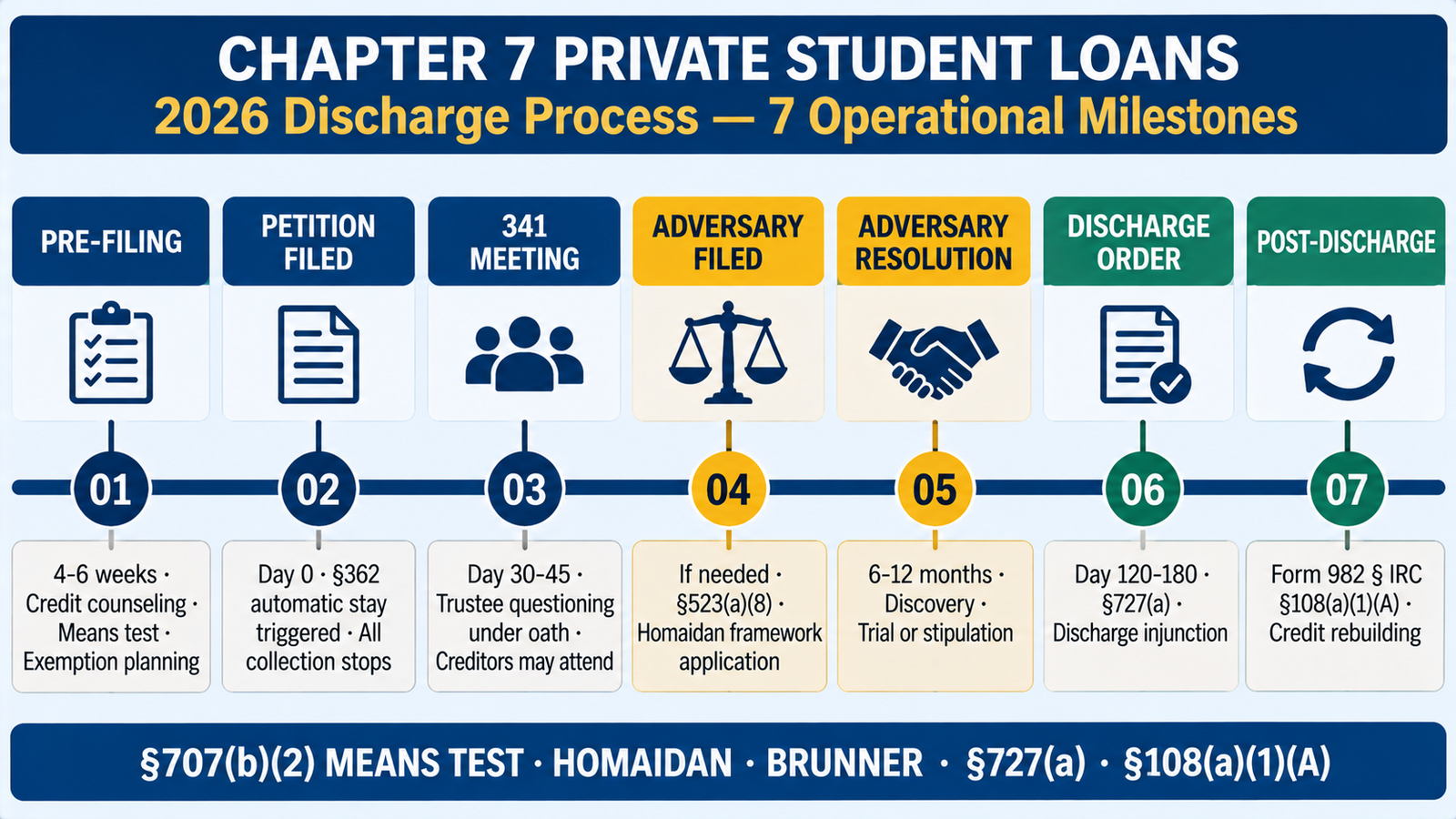
Chapter 7 private student loans discharge is the most powerful bankruptcy framework for resolving private student loan debt — producing complete discharge of qualifying loans typically within 4-6 months of filing. The combination of Homaidan v. Sallie Mae 992 F.3d 100 (2d Cir. 2021), Crocker v. Navient 941 F.3d 206 (5th Cir. 2019), McDaniel v. Navient 973 F.3d 1083 (10th Cir. 2020), and modernized Brunner undue hardship analysis through In re Rosenberg 594 B.R. 22 (Bankr. S.D.N.Y. 2020) and DOJ November 2022 guidance has transformed Chapter 7 into viable discharge path for many private student loan borrowers. However, Chapter 7 requires qualifying under 11 U.S.C. §707(b)(2) means test and involves specific operational mechanics (automatic stay, 341 meeting of creditors, state exemption analysis, adversary proceeding preparation for §523(a)(8) determination). This complete 2026 guide covers how chapter 7 private student loans discharge actually works: means test qualification methodology, state exemption analysis, Homaidan adversary preparation framework, operational timeline from filing through discharge, 341 meeting navigation, trustee interaction, discharge order mechanics, and IRC §108(a)(1)(A) tax coordination for complete framework execution.
Quick Answer
Chapter 7 private student loans discharge: Chapter 7 bankruptcy under 11 U.S.C. §701 et seq. can discharge qualifying private student loans completely within 4-6 months of filing. Required steps: (1) means test qualification under 11 U.S.C. §707(b)(2) — if household income below state median automatically qualifies; if above median, detailed calculation of disposable income against IRS collection financial standards determines eligibility; (2) state exemption analysis to identify non-exempt assets that may be subject to trustee liquidation; (3) file Chapter 7 petition triggering automatic stay under §362 stopping all creditor collection; (4) attend 341 meeting of creditors (typically 30-45 days post-filing) answering trustee questions under oath; (5) complete pre-filing credit counseling and pre-discharge debtor education courses; (6) if private student loan creditor doesn’t acknowledge dischargeability, file adversary proceeding under FRBP 7001 for §523(a)(8) determination applying Homaidan v. Sallie Mae 992 F.3d 100 (2d Cir. 2021) framework for direct-to-consumer loans without school certification or Brunner undue hardship analysis for qualifying loans; (7) discharge order typically entered 4-6 months after filing (longer with adversary proceeding); (8) file Form 982 claiming IRC §108(a)(1)(A) complete bankruptcy tax exclusion. Typical total cost: $1.500-$3.500 attorney fees + $338 filing fee + $2.000-$5.000 adversary proceeding fees if required. Attorney essential — Chapter 7 cannot be properly executed pro se for complex private student loan discharge.
Read the complete Chapter 7 framework below.
In this complete Chapter 7 guide:
Means test qualification under §707(b)(2)
CMI calculation, state median income, allowed expenses
State exemption analysis
Non-exempt assets at risk; state-by-state framework
Filing process and automatic stay
Petition filing, §362 stay, creditor notification
341 meeting of creditors and trustee interaction
Meeting mechanics, questions, preparation
§523(a)(8) adversary proceeding preparation
Homaidan framework application for private loans
Discharge order and post-discharge
§727(a) order, credit impact, rebuilding
IRC §108(a)(1)(A) tax coordination
Complete bankruptcy tax exclusion with Form 982
Means test qualification under §707(b)(2)
The first qualification hurdle for chapter 7 bankruptcy private student loans discharge is passing the means test under 11 U.S.C. §707(b)(2). This test determines whether debtor has sufficient income to repay creditors through Chapter 13 — if yes, Chapter 7 is unavailable; if no, Chapter 7 is available.
Current monthly income (CMI) calculation
The means test starts with current monthly income (CMI) calculation: (1) average of all income received during 6 full calendar months preceding filing (not including filing month); (2) includes wages, salary, bonuses, self-employment income, rental income, pension income, Social Security (though Social Security has special treatment), unemployment benefits, workers compensation; (3) excludes payments received as victim of war crimes or crimes against humanity; (4) excludes certain Social Security Act benefits; (5) includes contributions to household expenses from non-filing spouse (marital adjustment); (6) multiply monthly average by 12 for annualized CMI. CMI calculation is precise and requires careful 6-month income documentation.
State median income comparison
CMI is compared to state median income for household size: (1) if CMI × 12 is below state median for household size, borrower automatically passes means test — Chapter 7 available without further analysis; (2) if CMI × 12 is above state median, detailed calculation of disposable income against allowed expenses required (Form B122A-2 calculation); (3) state median income tables published periodically by U.S. Trustee program at justice.gov/ust; (4) tables adjusted periodically (typically quarterly or semi-annually); (5) household size includes all members for whom debtor provides more than 50% financial support. State median thresholds vary significantly by state and household size — critical to use current table.
Allowed expense deductions (above median)
For above-median income debtors, allowed expense deductions determine net disposable income: (1) IRS collection financial standards for food, clothing, household supplies, personal care, housekeeping supplies (specific amounts by household size); (2) IRS standards for housing/utilities expenses based on county of residence (specific caps); (3) IRS standards for transportation operation expenses (specific amounts by region); (4) actual transportation ownership expenses up to IRS cap (car payments, insurance); (5) actual secured debt payments on home and vehicles; (6) actual other secured debt payments spread over 60 months; (7) actual medical expenses; (8) actual tax expenses; (9) actual insurance expenses; (10) actual child support, alimony, child care; (11) actual charitable contributions up to 15% of CMI; (12) actual continuing contributions to religious or charitable organizations. Allowed expense calculation is detailed and nuanced.
Disposable income determination
Final disposable income determination: (1) CMI minus allowed expenses equals monthly disposable income; (2) multiplied by 60 months for 5-year calculation; (3) if 60-month disposable income is less than $9.075 (as of 2024, with periodic adjustments), presumption of abuse does not arise — Chapter 7 available; (4) if 60-month disposable income is $15.150 or more, presumption of abuse arises — Chapter 7 typically unavailable, Chapter 13 required; (5) between $9.075 and $15.150, additional analysis determines whether 25% of unsecured debt exceeds 60-month disposable income (if yes, Chapter 7 available). These dollar thresholds adjust periodically. Means test calculation is complex — bankruptcy attorney essential.
State exemption analysis
Chapter 7 asset consideration is critical for file chapter 7 for private student loans analysis. Non-exempt assets may be subject to trustee liquidation to pay creditors. State exemption laws vary dramatically — same assets may be fully exempt in one state and non-exempt in another.
Federal vs state exemptions
Exemption framework: (1) Bankruptcy Code 11 U.S.C. §522(d) provides federal exemptions; (2) 11 U.S.C. §522(b)(2) allows states to opt out of federal exemptions requiring debtors to use state exemptions only; (3) approximately 32 states have opted out requiring state exemptions only; (4) other states allow debtor choice between federal and state exemptions (choose whichever is more favorable); (5) exemption choice is made at filing — strategic analysis before filing essential. State-specific analysis determines which assets protected vs at risk.
Key exemption categories
Common exemption categories: (1) Homestead exemption — protects equity in primary residence (varies dramatically: Texas unlimited, Florida unlimited, California up to $678.391 as of 2024, Pennsylvania $0 under state law though federal $27.900 may apply); (2) Motor vehicle exemption — protects equity in vehicle (varies: Texas unlimited for one vehicle per adult, California up to $7.500 per vehicle); (3) Personal property/household goods — protects household items (varies); (4) Retirement accounts — 401(k), IRA, pension typically fully protected under federal law and most state law; (5) Wages — some portion of wages typically exempt from garnishment; (6) Tools of trade — tools and equipment for trade/business; (7) Public benefits — Social Security, disability, unemployment typically exempt; (8) Wildcard exemption — flexible amount to protect specific assets of debtor’s choice (varies).
State-by-state significant variations
Significant state exemption variations: Texas, Florida, Kansas, Oklahoma, South Dakota — unlimited homestead exemption (particularly favorable for homeowners); California — two exemption systems available with different trade-offs ($678.391 homestead with specific household structure, or alternative system with no homestead but higher wildcard); New York — allows choice between federal and state exemptions, state homestead varies by region; Pennsylvania — no state homestead exemption but federal exemption available ($27.900); New Jersey, Delaware, Rhode Island — allow federal exemptions; Oregon — opt-out state with specific state exemption framework. State-specific exemption analysis is essential — no two states exactly alike.
Pre-filing exemption planning
Pre-filing exemption planning considerations: (1) convert non-exempt assets to exempt assets within legal limits (pay down mortgage with cash in state with unlimited homestead, max out retirement contributions); (2) timing of filing to maximize exemption value; (3) residency considerations for state exemption qualification (730-day residency requirement under §522(b)(3)(A)); (4) avoid fraudulent transfer concerns (transfers within 2 years before filing scrutinized); (5) avoid pre-filing payments to insiders (within 1 year scrutinized); (6) coordinate with CPA for tax implications of asset movements. Legal counsel essential — aggressive exemption planning can be successful or can create fraudulent transfer problems.
Filing process and automatic stay
Chapter 7 filing initiates the chapter 7 discharge private student loans process and immediately provides automatic stay protection stopping creditor collection activity.
Pre-filing requirements
Required pre-filing steps: (1) credit counseling from approved credit counseling agency within 180 days before filing (course typically 60-90 minutes online or by phone, cost $25-$50); (2) comprehensive financial documentation gathering (last 2 years tax returns, last 6 months pay stubs, bank statements, debt documentation, asset documentation); (3) means test calculation preparation with attorney; (4) exemption analysis and strategic planning; (5) Chapter 7 vs Chapter 13 analysis for optimal path. Pre-filing preparation typically takes 4-6 weeks with attorney coordination.
Petition filing mechanics
Chapter 7 petition filing: (1) voluntary petition filed under 11 U.S.C. §301 in bankruptcy court for district of residence; (2) petition includes schedules of assets, liabilities, income, expenses, statement of financial affairs; (3) means test calculation (Form B122A) filed; (4) $338 filing fee paid (fee waiver possible for very low income); (5) credit counseling certificate filed; (6) list of creditors filed; (7) filing creates bankruptcy estate under §541 including all legal and equitable interests in property; (8) case number assigned; (9) trustee appointed within days of filing.
Automatic stay under §362
11 U.S.C. §362 automatic stay takes effect immediately upon filing: (1) stops all creditor collection activity including phone calls, letters, collection agency activity, lawsuits, garnishments, foreclosures, repossessions; (2) applies to all creditors including private student loan lenders and NCSLT trusts; (3) violations by creditors can result in sanctions and damages under §362(k); (4) exceptions exist (criminal cases, domestic support actions, certain tax actions); (5) stay typically lasts throughout bankruptcy case until discharge or dismissal; (6) creditors seeking relief from stay must file motion with court. Automatic stay provides immediate protection — collection activity should cease within days of filing notice to creditors.
Notice to creditors
Creditor notification process: (1) bankruptcy court sends notice of filing to all listed creditors; (2) notice typically received by creditors within 7-14 days of filing; (3) notice includes 341 meeting information, deadlines for proof of claim filing, discharge deadlines; (4) creditors cannot continue collection after receiving notice; (5) if creditor continues collection, document specific violation for potential §362(k) sanctions motion. For private student loan creditors, notice typically goes to lender address of record — accurate creditor list essential for stay effectiveness.
341 meeting of creditors and trustee interaction
The 341 meeting of creditors is a required milestone in private student loans chapter 7 process — typically occurring 30-45 days after filing, providing opportunity for trustee and creditors to question debtor under oath.
Meeting mechanics
341 meeting mechanics under 11 U.S.C. §341: (1) scheduled within 20-40 days after filing in most districts; (2) typically held at U.S. Trustee office or courthouse (some districts now use video conference); (3) chaired by Chapter 7 trustee (not judge); (4) debtor testifies under oath; (5) trustee asks standard questions about petition accuracy, financial condition, asset disclosure; (6) creditors may attend and ask questions (though many don’t attend); (7) typical meeting duration 5-15 minutes for straightforward cases; (8) longer meetings for complex cases or when creditors attend. Debtor must attend in person (or by permitted video); failure to attend can result in case dismissal.
Standard trustee questions
Standard 341 meeting trustee questions: (1) Did you sign the petition and schedules? (2) Did you review them before signing? (3) Are all debts listed? (4) Are all assets listed? (5) Are the values accurate? (6) Have you listed all income sources? (7) Have you made any payments to creditors in last 90 days exceeding $600? (8) Have you made any transfers of property in last 2 years? (9) Have you made any payments to family/friends/business associates in last year? (10) Do you have interest in any lawsuits or claims? (11) Have you filed previous bankruptcy cases? (12) Do you expect any inheritances, tax refunds, insurance payouts? Standard questions allow trustee verification of petition accuracy.
Private student loan creditor attendance
Private student loan creditor attendance considerations: (1) most private student loan creditors do not attend 341 meetings for individual Chapter 7 cases; (2) when creditors attend, questions typically focus on loan characteristics (for §523(a)(8) dischargeability analysis), payment history, and debtor financial situation; (3) attorney representation at 341 meeting essential when creditor attendance expected; (4) debtor should be prepared to answer questions about loan origination (direct-to-consumer vs school certification), loan purpose, enrollment status, program type for potential Homaidan analysis; (5) 341 meeting testimony is under oath — accuracy critical. Attorney coaching before meeting helps debtor navigate successfully.
Post-meeting process
Post-341 meeting process: (1) trustee issues report after meeting (typically “no asset” report meaning no assets to administer for creditor payment); (2) trustee may request additional documentation if questions raised; (3) 60-day deadline for creditors to object to discharge or file §523 non-dischargeability complaint; (4) deadline for trustee to object to exemptions; (5) if no objections filed and trustee completes case, discharge order typically entered 60-90 days after 341 meeting; (6) complex cases (adversary proceedings, trustee asset administration) may take longer. For straightforward Chapter 7 with no challenges, discharge typically within 4-6 months of filing.
§523(a)(8) adversary proceeding preparation
For Chapter 7 cases involving private student loans, the critical analysis is 11 U.S.C. §523(a)(8) adversary proceeding to determine dischargeability. For loans qualifying under Homaidan framework, this is often the most important step in how to file chapter 7 for student loans successfully.
Adversary proceeding mechanics
Adversary proceeding operates as separate lawsuit within the bankruptcy case: (1) initiated by filing adversary complaint under Federal Rules of Bankruptcy Procedure 7001; (2) debtor files complaint seeking determination of dischargeability (or creditor files complaint objecting to discharge); (3) summons issued and served on defendant creditor under FRBP 7004; (4) defendant files answer typically within 30 days; (5) discovery process under FRBP 7026-7037 (document requests, interrogatories, depositions); (6) motion practice (summary judgment, dismissal); (7) trial if case doesn’t resolve; (8) court decision on dischargeability. Timeline typically 6-12 months for adversary proceeding separate from main Chapter 7 case.
Homaidan framework in adversary proceeding
For Chapter 7 adversary proceeding applying Homaidan v. Sallie Mae Inc. 992 F.3d 100 (2d Cir. 2021): (1) complaint alleges specific loan doesn’t qualify under §523(a)(8)(A)(ii) “educational benefit” category per Homaidan narrow interpretation; (2) complaint identifies specific loan characteristics supporting qualification (direct-to-consumer, no school certification, exceeded cost of attendance, non-title IV program, etc.); (3) complaint seeks declaratory judgment that loan is dischargeable; (4) creditor’s answer typically denies allegations; (5) discovery produces loan origination documentation; (6) summary judgment motion often appropriate if clear Homaidan qualification; (7) if denied summary judgment, trial on specific loan characteristics. Precedent application has strengthened substantially since 2021 with increased Circuit court adoption.
Brunner adversary proceeding for qualified loans
For loans qualifying under §523(a)(8), Brunner undue hardship adversary proceeding: (1) complaint alleges all three Brunner elements — minimal standard of living, persistence, good faith efforts; (2) extensive financial documentation produced during discovery; (3) often involves expert testimony (vocational experts, medical experts for disability); (4) In re Rosenberg 594 B.R. 22 (Bankr. S.D.N.Y. 2020) modernized framework cited supporting reasonable Brunner application; (5) DOJ November 2022 guidance cited where applicable (particularly federal loan cases but influential elsewhere); (6) trial typically required for contested Brunner cases; (7) partial discharge sometimes achievable when complete discharge not supported. Brunner adversary proceedings have improved outcomes significantly since 2020.
Alternative resolution: creditor non-contest
In some cases, creditors don’t contest Homaidan-based dischargeability once properly presented: (1) economic analysis shows cost of defense exceeds potential recovery; (2) similar cases in jurisdiction have ruled against creditor; (3) debtor financial situation makes judgment uncollectable even if obtained; (4) specific loan characteristics clearly fail §523(a)(8) qualification; (5) creditor consent to dischargeability avoids litigation. When creditor doesn’t contest, dischargeability can be achieved through stipulation or default judgment — avoiding full adversary proceeding. Attorney negotiation with creditor’s counsel often productive before formal litigation.
Discharge order and post-discharge
Chapter 7 discharge order under 11 U.S.C. §727(a) represents the culmination of the discharge process. Understanding discharge mechanics and post-discharge considerations completes the chapter 7 private student loans framework.
§727(a) discharge order
11 U.S.C. §727(a) general discharge order: (1) discharges all qualifying debts in bankruptcy case; (2) typically entered 60-90 days after 341 meeting if no objections or adversary proceedings; (3) with §523(a)(8) adversary proceeding, discharge may be entered first with separate order on dischargeability of specific debts; (4) discharge order includes injunction prohibiting creditor collection on discharged debts; (5) creditor violations of discharge injunction can result in contempt sanctions; (6) discharge order sent to all creditors and recorded. Discharge order is the court’s final determination that debtor is entitled to fresh start.
Private student loan discharge specifics
Private student loan discharge requires specific attention: (1) general discharge order discharges all debts EXCEPT those specifically non-dischargeable including §523(a)(8) qualifying student loans; (2) for Homaidan-qualifying loans, adversary proceeding order specifically determines dischargeability; (3) adversary proceeding order and general discharge order together provide complete private student loan discharge; (4) retain both orders permanently as proof of discharge; (5) if creditor attempts collection post-discharge, provide copies of orders — most creditors cease collection immediately upon notification; (6) violations of discharge injunction can result in contempt action and damages recovery.
Credit impact and reporting
Chapter 7 credit impact: (1) bankruptcy shows on credit report 10 years from filing date under Fair Credit Reporting Act 15 U.S.C. §1681c; (2) individual discharged debts show as “included in bankruptcy” status (not “charged-off” or “in collection”); (3) typical immediate credit score impact 100-200 point reduction; (4) credit score typically bottoms within 6-12 months of filing; (5) credit score recovery typically begins 12-18 months post-discharge with proactive rebuilding; (6) secured credit cards and credit builder loans typically accessible immediately post-discharge; (7) significant score recovery (returning to pre-bankruptcy range) typically 3-5 years; (8) prime credit access typically returns 4-7 years post-discharge with consistent rebuilding.
Post-discharge rebuilding
Post-discharge rebuilding strategies: (1) secured credit cards (depositing $500-$2.000 with issuer) available immediately post-discharge; (2) credit builder loans from credit unions and specialty lenders report to credit bureaus; (3) consistent on-time payments on all remaining debt (mortgage, auto, utilities); (4) low credit utilization on new accounts; (5) authorized user status on family member’s established accounts (if available); (6) annual credit report monitoring from Experian, Equifax, TransUnion; (7) dispute any inaccurate reporting under FCRA framework; (8) 12-24 months of consistent rebuilding typically supports access to unsecured credit cards and auto loans. Patience and consistency drive recovery.
Related resources — complete bankruptcy cluster
The 7-path master framework covering all private student loan bankruptcy mechanisms including Chapter 7 and Chapter 13.
Settlement vs Bankruptcy Student Loans 2026
Comparative framework for choosing between Chapter 7 bankruptcy and settlement paths.
Private Student Loan Settlement 2026: Complete Guide
Settlement cluster pilar — primary alternative to Chapter 7 bankruptcy.
IRC §108(a)(1)(A) tax coordination
Chapter 7 discharge of private student loans receives complete tax exclusion under IRC §108(a)(1)(A) — significantly more favorable than settlement tax treatment requiring insolvency analysis under §108(a)(1)(B).
Complete bankruptcy exclusion
IRC §108(a)(1)(A) provides complete exclusion from gross income for debt discharged in Title 11 bankruptcy case: (1) applies to all debts discharged through Chapter 7 bankruptcy court order; (2) no insolvency calculation required (unlike §108(a)(1)(B) for settlement); (3) full amount of discharged debt excluded regardless of post-discharge financial position; (4) more straightforward documentation requirement than insolvency analysis; (5) particularly valuable for borrowers who would struggle to document insolvency for settlement §108(a)(1)(B); (6) applies to private student loan debt discharged under Homaidan or Brunner framework. Complete bankruptcy exclusion is one of the most favorable aspects of Chapter 7 for private student loan discharge.
Form 982 for bankruptcy exclusion
Form 982 (Reduction of Tax Attributes Due to Discharge of Indebtedness) for Chapter 7 bankruptcy: (1) Part I, Line 1a — check box for Title 11 bankruptcy exclusion; (2) Part I, Line 2 — total amount of discharged indebtedness excluded; (3) Part II — reduction of tax attributes under §108(b) ordering rules; (4) supporting documentation: Chapter 7 discharge order plus any §523(a)(8) adversary proceeding order; (5) filed with tax return for year discharge order entered; (6) 1099-C from creditor if issued (though creditors sometimes don’t issue 1099-C for bankruptcy-discharged debt). Form 982 bankruptcy exclusion is more straightforward than insolvency exclusion.
Tax attribute reduction under §108(b)
IRC §108(b) requires tax attribute reduction when bankruptcy exclusion claimed. Attribute reduction ordering under §108(b)(2): (1) net operating losses; (2) general business credit carryforwards; (3) minimum tax credit; (4) capital loss carryovers; (5) basis of property; (6) passive activity loss and credit carryovers; (7) foreign tax credit carryovers. For many Chapter 7 debtors, attribute reduction has minimal practical impact because debtor may not have substantial tax attributes to reduce. However, borrowers with significant NOLs, business credits, or appreciated property should coordinate attribute reduction carefully with CPA to minimize impact.
CPA coordination for Chapter 7 cases
CPA coordination for Chapter 7 tax implications: (1) consultation before filing to analyze tax attribute reduction impact; (2) coordination with bankruptcy attorney on filing timing and tax year considerations; (3) Form 982 preparation for year of discharge; (4) state tax implications specific to borrower’s state (most states conform to federal §108 exclusions); (5) coordination with any pre-bankruptcy settlement for borrowers using hybrid approach; (6) retention of all tax documentation for 7-year IRS examination period. CPA fees typically $300-$1.500 for Chapter 7 tax coordination — small investment relative to tax impact being managed. For complete tax framework see our Student Loan Settlement Tax Consequences guide.
When Chapter 7 is right for private student loans
Optimal Chapter 7 candidate profile
Chapter 7 is typically optimal when borrower exhibits specific characteristics: (1) passes means test under §707(b)(2) — below state median income OR passing above-median analysis; (2) private student loans with Homaidan characteristics — direct-to-consumer loans without school certification, non-qualified loans failing IRC §221(d)(1), loans exceeding cost of attendance; (3) non-exempt assets within state exemption limits — most assets protected under state homestead, vehicle, retirement, personal property exemptions; (4) multiple debt problems benefiting from comprehensive discharge; (5) stable income sufficient for essential expenses without needing Chapter 13 reorganization; (6) no significant tax attributes to lose through §108(b) attribute reduction; (7) willingness to accept credit impact 10 years on credit report; (8) no prior bankruptcy within 8 years (Chapter 7 to Chapter 7 restriction under §727(a)(8)).
When Chapter 7 is NOT optimal
Chapter 7 not optimal when: (1) fails means test — above median income with insufficient allowed deductions (Chapter 13 required instead); (2) significant non-exempt assets that would be liquidated by trustee (Chapter 13 preserves assets); (3) mortgage or auto arrears that need to be cured over time (Chapter 13 cure provisions better); (4) business ownership requiring continued operation (Chapter 13 or Chapter 11 preserves business); (5) loans don’t meet Homaidan or Brunner framework — if private student loan is clearly §523(a)(8) qualifying and borrower has strong future earning capacity, Brunner may not succeed; (6) recent prior bankruptcy — Chapter 7 unavailable within 8 years of prior Chapter 7 discharge; (7) minor debt relative to assets — settlement may provide better value preserving credit; (8) significant tax attributes to lose through §108(b) reduction.
Chapter 7 vs settlement comparison
Chapter 7 vs settlement comparison for private student loans: Debt reduction — Chapter 7 potential complete discharge vs settlement 25-60% reduction; Cost — Chapter 7 approximately $2.000-$8.500 vs settlement typically 15-30% of savings; Timeline — Chapter 7 4-6 months vs settlement 60-120 days; Credit impact — Chapter 7 severe (10 years on credit report) vs settlement less severe; Tax treatment — Chapter 7 complete §108(a)(1)(A) exclusion vs settlement requires §108(a)(1)(B) insolvency documentation; Scope — Chapter 7 addresses all debts vs settlement targets specific debts; Court involvement — Chapter 7 formal court process vs settlement private negotiation. For borrowers meeting Chapter 7 qualification and with Homaidan-qualifying loans, Chapter 7 almost always produces superior total outcome. For complete comparison see our Settlement vs Bankruptcy guide.
Common Chapter 7 private student loans myths
Myth 1
“Private student loans can’t be discharged in Chapter 7”
Reality: This outdated understanding significantly misstates current law. Homaidan v. Sallie Mae Inc. 992 F.3d 100 (2d Cir. 2021) established that direct-to-consumer private student loans without school certification of cost of attendance do NOT qualify as “educational benefit” under §523(a)(8)(A)(ii) and are therefore dischargeable in Chapter 7 WITHOUT undue hardship showing. Combined with Crocker v. Navient 941 F.3d 206 (5th Cir. 2019), McDaniel v. Navient 973 F.3d 1083 (10th Cir. 2020), and §523(a)(8)(B) non-qualified education loan framework based on IRC §221(d)(1), substantial national framework for Chapter 7 private student loan discharge exists. Many Sallie Mae-originated loans in NCSLT trusts, Navient-originated loans, Discover-originated loans, and others may qualify. The old “impossible to discharge” understanding is simply wrong in 2026.
Myth 2
“I’ll lose all my assets in Chapter 7”
Reality: Most Chapter 7 cases are “no asset” cases where state exemption laws protect all debtor assets. Common protections: homestead exemption (Texas and Florida unlimited, California up to $678.391, state-specific amounts elsewhere), motor vehicle exemption ($5.000-$10.000+ typical, Texas unlimited for one vehicle per adult), 401(k)/IRA retirement accounts (fully protected under federal law and most state law), personal property/household goods, tools of trade, wildcard exemption for strategic protection. Pre-filing exemption planning can convert non-exempt assets to exempt assets within legal limits. For most borrowers, Chapter 7 preserves essential assets while discharging qualifying debts. Attorney analysis of specific state exemption framework determines exact asset protection — the “lose everything” fear is largely unfounded for most borrowers.
Myth 3
“My income is too high for Chapter 7”
Reality: Means test under 11 U.S.C. §707(b)(2) is more nuanced than simple income threshold. Even above state median income, detailed calculation of disposable income against IRS collection financial standards for allowed expenses (food, housing, transportation, plus actual secured debt, medical, tax, insurance, charitable expenses) frequently supports Chapter 7 qualification. Many borrowers above state median income actually pass means test when properly calculated. Allowed deductions include substantial expense categories that significantly reduce calculated disposable income. For borrowers who do fail means test, Chapter 13 provides alternative framework. Don’t assume ineligibility without actual means test analysis — many borrowers who assume they won’t qualify do qualify after proper calculation. Attorney means test analysis essential given complexity.
Myth 4
“Bankruptcy will ruin my credit forever”
Reality: While Chapter 7 bankruptcy appears on credit report for 10 years from filing date (Fair Credit Reporting Act 15 U.S.C. §1681c), practical credit impact is significantly less severe than commonly believed. Credit score typically bottoms within 6-12 months of filing (often with 100-200 point reduction). Rebuilding begins immediately post-discharge with secured credit cards (available immediately), credit builder loans, and consistent on-time payments. Many borrowers achieve credit scores above 700 within 2-3 years of discharge. Significant recovery (returning to pre-bankruptcy range) typically 3-5 years. Compare to private student loan default without bankruptcy — can show as “charged-off” or “in collection” for 7 years from original delinquency with potential ongoing collection activity. For borrowers with substantial debt already damaging credit, Chapter 7 may actually accelerate credit recovery by providing clear end-point rather than ongoing collection drag.
Frequently asked questions
1. How long does Chapter 7 take for private student loan discharge?
Chapter 7 private student loans timeline: typical straightforward Chapter 7 case 4-6 months from filing to discharge order; §523(a)(8) adversary proceeding (for private student loan dischargeability determination) typically adds 6-12 months in addition to main case; cases without adversary proceeding (where loans clearly qualify under Homaidan or where creditor doesn’t contest) may complete discharge within 4-6 months; cases with contested Brunner adversary proceeding may take 12-18 months total. Pre-filing preparation typically 4-6 weeks including credit counseling, documentation gathering, means test analysis, exemption planning. 341 meeting typically 30-45 days after filing. 60-day deadline for creditor objections after 341 meeting. Discharge order typically 60-90 days after 341 meeting if no objections. Timeline faster than Chapter 13 (3-5 year plan) but slower than settlement (60-120 days).
2. What are means test requirements for Chapter 7?
Means test under 11 U.S.C. §707(b)(2): (1) calculate current monthly income (CMI) from average of 6 months preceding filing; (2) multiply by 12 for annualized income; (3) compare to state median income for household size (U.S. Trustee program publishes current tables); (4) if below median, automatically pass; (5) if above median, calculate disposable income using IRS collection financial standards for food, housing, transportation, plus specific actual expenses (secured debt payments, medical, tax, insurance, child support, charitable contributions up to 15% CMI); (6) if 60-month disposable income less than approximately $9.075 (periodic adjustments), presumption of abuse doesn’t arise; (7) if $15.150 or more, presumption of abuse arises; (8) between amounts, 25% unsecured debt test applies. Many above-median borrowers actually pass means test with proper calculation. Attorney analysis essential given complexity.
3. How much does Chapter 7 cost for private student loan discharge?
Chapter 7 cost structure: (1) attorney fees typically $1.500-$3.500 depending on jurisdiction and case complexity (higher in major metropolitan areas); (2) filing fee $338 (fee waiver possible for very low income); (3) credit counseling course $25-$50; (4) debtor education course $25-$50; (5) §523(a)(8) adversary proceeding typically additional $2.000-$5.000 if required; (6) CPA fees for Form 982 preparation typically $300-$1.500. For Homaidan-qualifying loans not requiring adversary proceeding, total Chapter 7 cost approximately $2.000-$4.000. Even with adversary proceeding, total cost typically $4.000-$8.500 — substantially less than settlement cost for large private student loan balances. For $50.000+ private student loan debt, Chapter 7 typically produces significantly better total value than settlement.
4. Will I lose my house in Chapter 7?
House protection in Chapter 7 depends on state homestead exemption and home equity: (1) if home equity is less than state homestead exemption, home fully protected; (2) states with unlimited homestead exemption (Texas, Florida, Kansas, Oklahoma, South Dakota) protect all home equity regardless of amount; (3) California protects up to $678.391 depending on specific household structure (2024 amount, periodic adjustments); (4) Pennsylvania has no state homestead exemption but federal exemption ($27.900 as of 2024) may be available; (5) if home equity exceeds exemption, trustee may liquidate home to pay creditors (unusual in practice for primary residences); (6) mortgage must be current to preserve home — Chapter 7 doesn’t cure mortgage arrears (Chapter 13 required for cure); (7) ongoing mortgage payments must continue post-filing. Most Chapter 7 debtors retain their homes when mortgage is current and equity within exemption limits.
5. Can I keep my car in Chapter 7?
Car protection in Chapter 7 depends on state motor vehicle exemption and vehicle equity: (1) if vehicle equity is less than state motor vehicle exemption, vehicle fully protected; (2) Texas allows unlimited motor vehicle exemption for one vehicle per adult household member; (3) most states provide $5.000-$10.000+ motor vehicle exemption; (4) wildcard exemption can supplement motor vehicle exemption for additional protection; (5) if car has outstanding loan and payments are current, typically retain vehicle through “reaffirmation agreement” with lender; (6) if payments not current, lender may seek relief from automatic stay to repossess; (7) if vehicle equity exceeds exemption, trustee may liquidate (unusual for typical vehicles). Attorney analysis of specific state framework determines car protection. Most Chapter 7 debtors retain their vehicles.
6. How does Chapter 7 affect my credit score?
Chapter 7 credit impact: (1) bankruptcy shows on credit report 10 years from filing date under Fair Credit Reporting Act 15 U.S.C. §1681c; (2) typical immediate score reduction 100-200 points; (3) individual debts show as “included in bankruptcy” status rather than “charged-off” or “in collection”; (4) credit score typically bottoms within 6-12 months post-filing; (5) rebuilding begins immediately post-discharge with secured credit cards and credit builder loans; (6) credit score recovery to pre-bankruptcy range typically 3-5 years with consistent rebuilding; (7) prime credit access typically returns 4-7 years post-discharge; (8) for borrowers with already damaged credit from private student loan default, Chapter 7 may actually accelerate credit recovery by providing clear end-point. Post-discharge rebuilding strategy (secured cards, credit builder loans, authorized user status, consistent on-time payments) can produce substantial recovery within 2-3 years.
7. Do I need an attorney for Chapter 7 private student loan discharge?
Attorney representation essential for Chapter 7 private student loan discharge: (1) means test calculation under §707(b)(2) requires technical expertise given complexity of CMI calculation, IRS allowed expenses, and above-median analysis; (2) state exemption analysis requires expertise in specific state framework; (3) §523(a)(8) adversary proceeding for private student loan dischargeability requires understanding of Homaidan framework, Brunner analysis, and litigation strategy; (4) 341 meeting preparation and representation; (5) coordination with CPA for IRC §108(a)(1)(A) tax exclusion; (6) pre-filing planning to maximize exemption value and avoid preference issues; (7) post-discharge issues (credit reporting disputes, discharge injunction violations). Pro se Chapter 7 for complex private student loan cases almost always fails. Attorney fees typical range $1.500-$3.500 plus $2.000-$5.000 for adversary proceeding — essential investment for successful outcome.
Considering Chapter 7 for Private Student Loans?
Free specialist review of Chapter 7 qualification and discharge path for your private student loans.
Complete Chapter 7 analysis: means test qualification under 11 U.S.C. §707(b)(2) with CMI calculation and IRS collection financial standards for allowed expense deductions, state exemption analysis across all 50 states for asset protection (unlimited homestead TX/FL/KS/OK/SD, specific exemption amounts other states), §523(a)(8) adversary proceeding preparation applying Homaidan v. Sallie Mae 992 F.3d 100 (2d Cir. 2021) framework for direct-to-consumer loans without school certification, Brunner undue hardship analysis for qualified loans with In re Rosenberg 594 B.R. 22 (Bankr. S.D.N.Y. 2020) and DOJ November 2022 moderated application, operational timeline from filing through 341 meeting through discharge order (typical 4-6 months), IRC §108(a)(1)(A) complete bankruptcy tax exclusion with Form 982, credit impact and post-discharge rebuilding strategy, coordination with Chapter 13 alternative when means test failed. All major lenders analyzed (Sallie Mae Bank NYSE:SLM, Navient/Earnest Operations LLC, Discover/Firstmark Services, SoFi Bank NA NMLS #696891, Citizens Bank NA NYSE:CFG, Ascent, NCSLT trusts, debt buyers). Free eligibility review with attorney-backed partner provider — no upfront fees. Bankruptcy filing coordinated through qualified bankruptcy attorney referral.
Get a free eligibility review →
5-minute review · No obligation · Zero upfront fees · Since 2015 · 48 states served
About the author
Henry Silva — Private Student Loan Debt Specialist
10+ years analyzing chapter 7 private student loans discharge mechanics across all federal Circuits. Deep expertise in 11 U.S.C. §701 et seq. Chapter 7 framework including: automatic stay under §362 immediate collection cessation; means test qualification under §707(b)(2) with current monthly income (CMI) calculation from 6-month pre-filing average, state median income comparison using U.S. Trustee program tables published periodically, allowed expense deductions under IRS collection financial standards for food/clothing/household supplies/personal care, housing/utilities by county, transportation operation by region, actual secured debt payments, medical, tax, insurance, child support/alimony, charitable contributions up to 15% CMI; state exemption analysis across all 50 states including unlimited homestead jurisdictions (Texas, Florida, Kansas, Oklahoma, South Dakota) and specific amount jurisdictions (California up to $678.391 as of 2024 with periodic adjustments, Pennsylvania no state homestead with federal $27.900 alternative, New York variable by region); 341 meeting of creditors mechanics under §341 with trustee questioning under oath, standard trustee question framework, creditor attendance considerations; §523(a)(8) adversary proceeding mechanics under Federal Rules of Bankruptcy Procedure 7001 including Homaidan v. Sallie Mae Inc. 992 F.3d 100 (2d Cir. 2021) narrow interpretation of “educational benefit” category binding in Second Circuit (CT, NY, VT), Crocker v. Navient Solutions LLC 941 F.3d 206 (5th Cir. 2019) binding in Fifth Circuit (TX, LA, MS), McDaniel v. Navient Solutions LLC 973 F.3d 1083 (10th Cir. 2020) binding in Tenth Circuit (CO, KS, NM, OK, UT, WY), §523(a)(8)(B) qualified education loan analysis under IRC §221(d)(1) definition, Brunner v. New York State Higher Education Services Corp. 831 F.2d 395 (2d Cir. 1987) three-part undue hardship test with In re Rosenberg 594 B.R. 22 (Bankr. S.D.N.Y. 2020) modernized application and DOJ November 17, 2022 undue hardship guidance establishing framework for government consent in qualifying cases, partial discharge framework under §105(a) equitable authority; discharge order mechanics under §727(a) with discharge injunction and creditor cessation obligations; credit impact under Fair Credit Reporting Act 15 U.S.C. §1681c 10-year reporting period and post-discharge rebuilding strategy framework; IRC §108(a)(1)(A) complete bankruptcy tax exclusion with Form 982 preparation and §108(b) tax attribute reduction ordering; preference analysis under §547(b) for pre-filing payment coordination; fraudulent transfer analysis under §548 for pre-filing asset movement planning; employment protection under §525. Henry works with Private Student Relief’s attorney-backed partner provider network for settlement path analysis and coordinates bankruptcy attorney referrals through partner network for Chapter 7 filing, ensuring borrowers have access to complete Chapter 7 framework analysis with proper professional representation across means test, exemption planning, adversary proceeding, and tax coordination.
Legal Disclaimer and Sources
This article is provided for informational purposes only and does not constitute legal, tax, or financial advice. Private Student Relief is a consulting and matching organization operated by Joco (555 Anton Blvd, Suite 368, Costa Mesa, CA 92626) — not a law firm, bankruptcy filing service, debt settlement company, debt consolidation company, or loan provider. Debt validation services for settlement path are performed by an attorney-backed partner provider (Panamerican Consulting LLC, Las Vegas, NV) under independent business credentials. Ratings, BBB accreditation, and AADR (American Association for Debt Resolution) membership referenced on the PSR website belong to the partner provider. Chapter 7 bankruptcy filing requires licensed bankruptcy attorney in borrower’s jurisdiction — PSR coordinates referrals through partner network but does not itself provide bankruptcy filing services. Chapter 7 discharge outcomes depend on means test qualification, loan characteristics, Circuit jurisdiction, state exemption framework, specific judge assigned, and other factors. Individual results vary. Since 2015. 48 states served. Not available in South Carolina or Mississippi.
Bankruptcy Code references: 11 U.S.C. §105(a) (general equitable authority); 11 U.S.C. §301 (voluntary case commencement); 11 U.S.C. §341 (meeting of creditors); 11 U.S.C. §362 (automatic stay with §362(k) sanctions for violations); 11 U.S.C. §362(k) (actual damages, attorney fees, and punitive damages for willful stay violations); 11 U.S.C. §522 (exemptions with §522(b)(2) state opt-out provisions, §522(b)(3)(A) 730-day residency requirement, §522(d) federal exemptions); 11 U.S.C. §523(a)(8) (student loan discharge exceptions); 11 U.S.C. §525 (employment protection); 11 U.S.C. §541 (bankruptcy estate scope); 11 U.S.C. §547(b) (preference analysis for pre-filing payments); 11 U.S.C. §548 (fraudulent transfer analysis for pre-filing asset movements); 11 U.S.C. §701 et seq. (Chapter 7 framework); 11 U.S.C. §707(b)(2) (means test); 11 U.S.C. §727(a) (Chapter 7 discharge with §727(a)(8) 8-year prior Chapter 7 restriction). Federal Rules of Bankruptcy Procedure: FRBP 7001 (adversary proceeding scope); FRBP 7004 (service of summons and complaint); FRBP 7026-7037 (discovery provisions). Key appellate precedent: Homaidan v. Sallie Mae Inc. 992 F.3d 100 (2d Cir. 2021) — narrow interpretation of §523(a)(8)(A)(ii) “educational benefit” binding in Second Circuit (CT, NY, VT); Crocker v. Navient Solutions LLC 941 F.3d 206 (5th Cir. 2019) — binding in Fifth Circuit (TX, LA, MS); McDaniel v. Navient Solutions LLC 973 F.3d 1083 (10th Cir. 2020) — binding in Tenth Circuit (CO, KS, NM, OK, UT, WY); Brunner v. New York State Higher Education Services Corp. 831 F.2d 395 (2d Cir. 1987) undue hardship three-part test; In re Rosenberg 594 B.R. 22 (Bankr. S.D.N.Y. 2020) modernized Brunner application. DOJ guidance: U.S. Department of Justice November 17, 2022 guidance regarding undue hardship adversary proceedings establishing framework for government consent in qualifying cases based on current ability to pay, likelihood of future ability to pay, and good faith efforts. Internal Revenue Code: IRC §221(d)(1) (qualified education loan definition for §523(a)(8)(B) analysis); IRC §108(a)(1)(A) (bankruptcy tax exclusion — complete exclusion for Chapter 7 discharge); IRC §108(a)(1)(B) (insolvency exclusion for settlement comparison); IRC §108(b) (tax attribute reduction ordering under §108(b)(2)); Form 982 (reduction of tax attributes due to discharge of indebtedness).
Chapter 7 means test specifics: Current monthly income (CMI) calculated from last 6 months of income average. State median income tables published periodically by U.S. Trustee program at justice.gov/ust (quarterly or semi-annual updates). IRS collection financial standards for allowed expenses include National Standards (food, clothing, household supplies, personal care, housekeeping supplies, miscellaneous) with specific amounts by household size; Local Standards for housing/utilities by county; Local Standards for transportation operation by region. Chapter 7 presumption of abuse thresholds: approximately $9.075 and $15.150 as of 2024 (periodic adjustments). Chapter 7 attorney fees typical range $1.500-$3.500 depending on jurisdiction. §523(a)(8) adversary proceeding fees typical additional $2.000-$5.000. Chapter 7 filing fee $338. Fee amounts subject to periodic adjustments. Credit counseling course required within 180 days before filing from approved agency ($25-$50 typical). Debtor education course required before discharge ($25-$50 typical).
Credit reporting: Chapter 7 bankruptcy shows on credit report 10 years from filing date (Fair Credit Reporting Act 15 U.S.C. §1681c). Individual discharged debts show as “included in bankruptcy” status. Post-discharge rebuilding typically begins immediately with secured credit cards and credit builder loans. Credit score recovery to pre-bankruptcy range typically 3-5 years. State exemption examples (periodic adjustments): Texas unlimited homestead; Florida unlimited homestead (with specific acreage limits for rural properties); Kansas unlimited homestead; Oklahoma unlimited homestead; South Dakota unlimited homestead; California up to $678.391 homestead (as of 2024, varies by county median home price); Pennsylvania no state homestead ($27.900 federal alternative where allowed); New York variable by region. Motor vehicle exemptions range $0-$10.000+ with Texas unlimited for one vehicle per adult. Attorney analysis of specific state exemption framework essential.
Chapter 7 private student loans strategy requires case-by-case analysis coordinating means test qualification under §707(b)(2) with precise CMI calculation and IRS allowed expense application, state exemption framework analysis for asset protection, §523(a)(8) adversary proceeding preparation applying Homaidan narrow interpretation framework or Brunner modernized undue hardship analysis for qualifying loans, 341 meeting preparation and representation, discharge order coordination, IRC §108(a)(1)(A) complete bankruptcy tax exclusion with Form 982 preparation, post-discharge credit rebuilding strategy. This article provides general framework information; specific Chapter 7 filing requires consultation with licensed bankruptcy attorney in borrower’s jurisdiction familiar with complete Chapter 7 private student loan discharge framework. Attorney representation essential given complexity of means test, exemption analysis, adversary proceeding mechanics, and tax coordination requirements. Last reviewed: October 2026.