

Informational content only. Not legal, tax, or financial advice. Private Student Relief is a consulting organization, not a law firm. Means test analysis and Chapter 7 bankruptcy filing require licensed bankruptcy attorney in borrower’s jurisdiction. Means test calculation is complex — amounts and thresholds adjust periodically. Last reviewed: October 2026.
Written by Henry Silva
Private Student Loan Debt Specialist · 10+ years analyzing means test for student loan bankruptcy under 11 U.S.C. §707(b)(2) framework across all U.S. jurisdictions. Deep expertise in current monthly income (CMI) calculation from 6-month pre-filing average, state median income tables from U.S. Trustee program published periodically at justice.gov/ust, IRS collection financial standards application including National Standards for food/clothing/household supplies/personal care by household size, Local Standards for housing/utilities by county, Local Standards for transportation operation by region, presumption of abuse thresholds ($9.075 and $15.150 as of 2024 with periodic adjustments), §707(b)(2)(A)(iii) 25% unsecured debt test for intermediate zone, marital adjustment calculations, §707(b)(2)(D) military and disabled veteran exclusions, Form B122A-1 and B122A-2 preparation, Form B122C-1 and B122C-2 for Chapter 13 disposable income calculation, Chapter 7 to Chapter 13 conversion framework, 11 U.S.C. §523(a)(8) framework coordination with Homaidan v. Sallie Mae 992 F.3d 100 (2d Cir. 2021) and Brunner undue hardship test. Last reviewed: October 2026.
Means test for student loan bankruptcy under 11 U.S.C. §707(b)(2) is the first qualification hurdle for Chapter 7 bankruptcy — the primary bankruptcy chapter for private student loan discharge through Homaidan framework or Brunner undue hardship analysis. Enacted as part of 2005 Bankruptcy Abuse Prevention and Consumer Protection Act (BAPCPA), the means test determines whether borrower has sufficient disposable income to repay creditors through Chapter 13 plan rather than receiving immediate Chapter 7 discharge. The calculation involves specific methodology: current monthly income (CMI) from 6-month pre-filing average under §707(b)(7), state median income comparison using U.S. Trustee program tables, IRS collection financial standards for allowed expenses when above state median, and presumption of abuse thresholds triggering Chapter 7 unavailability. Many borrowers above state median income actually pass means test when properly calculated. For borrowers who fail means test, Chapter 13 provides alternative framework with same §523(a)(8) discharge analysis at §1328 plan completion. This complete 2026 guide covers how means test for student loan bankruptcy actually operates: CMI calculation methodology, state median income analysis, IRS collection financial standards application, presumption of abuse thresholds, §707(b)(2)(A)(iii) 25% unsecured debt test, marital adjustment and military exclusions, Form B122A preparation, and Chapter 7 vs Chapter 13 conversion framework when means test fails.
Quick Answer
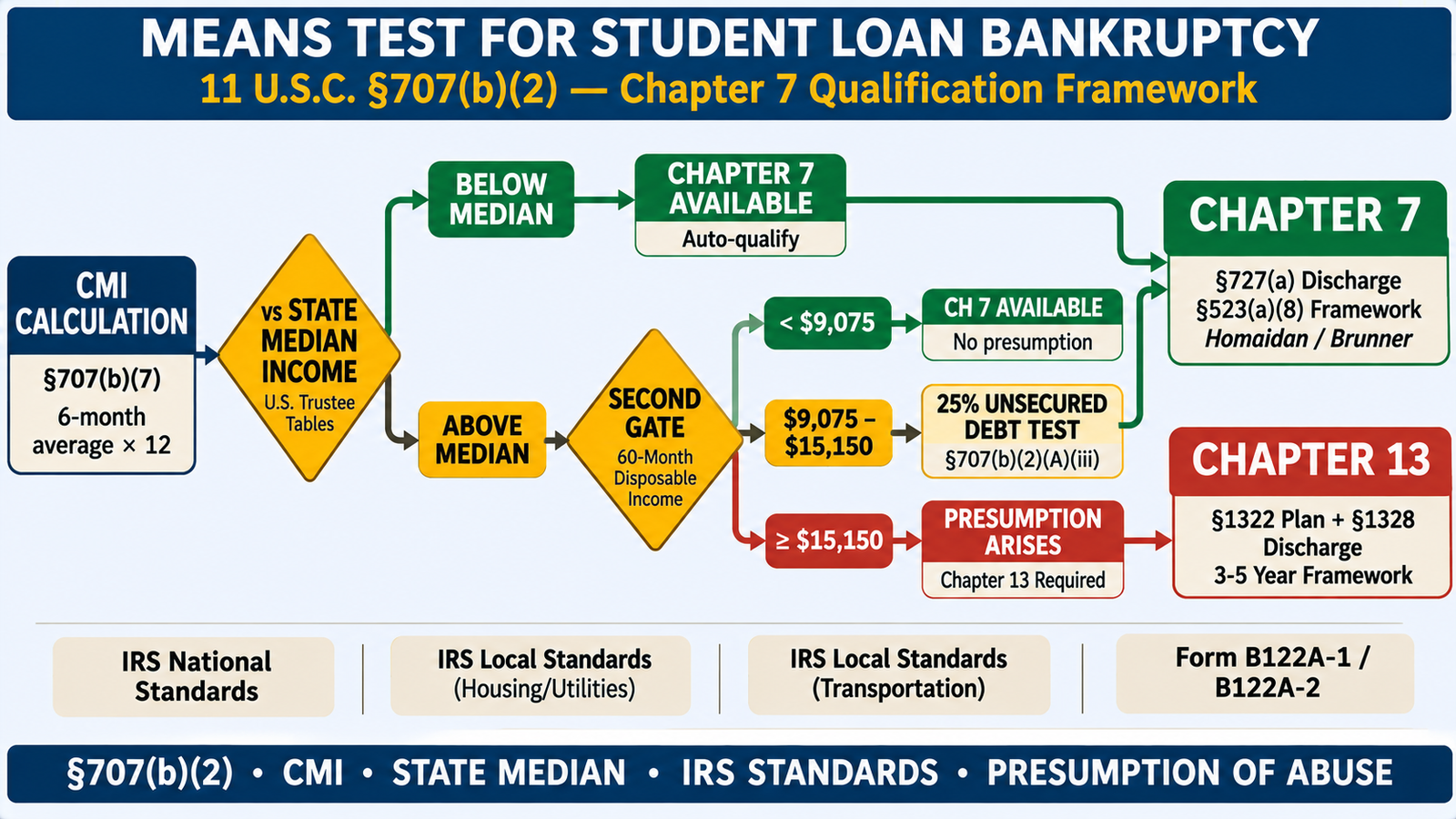
Means test for student loan bankruptcy: Chapter 7 qualification test under 11 U.S.C. §707(b)(2) determining whether debtor has sufficient disposable income to repay creditors through Chapter 13 rather than receiving Chapter 7 discharge. METHODOLOGY: (1) Calculate current monthly income (CMI) — average of all income received during 6 full calendar months preceding filing (not including filing month) under §707(b)(7), multiply by 12 for annualized income; includes wages, self-employment, rental, pension, Social Security (with special treatment), unemployment benefits, workers compensation; (2) Compare CMI × 12 to state median income for household size — U.S. Trustee program publishes current tables at justice.gov/ust (updated periodically typically semi-annually); if below median, automatically pass means test — Chapter 7 available without further analysis; if above median, detailed §707(b)(2)(A) calculation required; (3) Above-median calculation under §707(b)(2)(A)(ii) — apply IRS collection financial standards including National Standards for food/clothing/household supplies/personal care by household size, Local Standards for housing/utilities by county, Local Standards for transportation operation by region, plus actual secured debt payments on home/vehicles, actual priority tax payments, actual medical expenses, actual insurance, actual child support/alimony, actual child care, actual charitable contributions up to 15% CMI; (4) Presumption of abuse thresholds — if 60-month disposable income less than approximately $9.075 (as of 2024, periodic adjustments), presumption does not arise — Chapter 7 available; if $15.150 or more, presumption arises — Chapter 7 typically unavailable; between amounts, §707(b)(2)(A)(iii) 25% unsecured debt test applies; (5) Special provisions — marital adjustment for non-filing spouse income, §707(b)(2)(D) exclusions for disabled veterans and military members on active duty, non-consumer debt cases exempted; (6) Forms — Form B122A-1 Statement of Current Monthly Income, Form B122A-2 Chapter 7 Means Test Calculation. If means test failed, Chapter 13 available as alternative with Form B122C-1/B122C-2 calculation. Attorney essential — means test calculation is highly technical.
Read the complete means test framework below.
In this complete means test guide:
Current monthly income (CMI) calculation
6-month pre-filing average methodology under §707(b)(7)
State median income comparison
U.S. Trustee program tables, below-median auto qualification
IRS collection financial standards
National/Local Standards + specific additional expenses
Presumption of abuse thresholds
$9.075/$15.150 60-month disposable income analysis
25% unsecured debt test and special provisions
§707(b)(2)(A)(iii) intermediate zone analysis
Marital adjustment and military exclusions
Non-filing spouse income, §707(b)(2)(D) exclusions
Forms B122A/B122C and Chapter 13 conversion
Statement forms and failed means test alternatives
Current monthly income (CMI) calculation
The foundation of the §707(b)(2) means test is current monthly income (CMI) calculation. This precise methodology determines starting point for all subsequent means test analysis.
Six-month pre-filing average under §707(b)(7)
11 U.S.C. §707(b)(7) CMI methodology: (1) calculate average monthly income received during 6 full calendar months preceding filing month; (2) filing month itself NOT included in calculation; (3) example: filing January 15, 2026 → calculate average from July 1, 2025 through December 31, 2025 (6 full months); (4) all income from all sources averaged; (5) multiply resulting monthly figure by 12 for annualized income used in state median comparison; (6) income timing matters — filing month selection can affect calculation significantly for borrowers with recent income changes; (7) strategic filing timing can be advantageous after income reduction (bonus received 6+ months ago drops out of calculation after waiting 6 months). Precise 6-month documentation essential.
Income sources included in CMI
Income sources included in CMI calculation: (1) Wages and salary — gross amount before taxes/deductions; (2) Bonuses — all bonuses received during 6-month period averaged; (3) Self-employment income — net business income after ordinary business expenses; (4) Rental income — net after ordinary expenses; (5) Pension income — all pension receipts; (6) Retirement distributions — included for CMI purposes; (7) Unemployment benefits — included (though some courts have varying treatment); (8) Workers compensation — generally included; (9) Interest and dividend income — included; (10) Rental from boarders — included; (11) Alimony received — included; (12) Regular contributions from others — household contributions from non-filing household members may be included under marital adjustment analysis. Comprehensive income documentation required.
Income sources excluded from CMI
Income sources excluded from CMI calculation: (1) Social Security benefits — excluded under §101(10A) definition (Title 11 excludes SSA benefits from CMI definition); (2) Payments received as victim of war crimes, crimes against humanity — specifically excluded; (3) Payments for international terrorism — excluded; (4) Child support received — generally excluded (though treatment varies by jurisdiction); (5) Tax refunds received — not typically income under CMI definition; (6) One-time gifts or inheritances — not recurring income; (7) Workers compensation — some treatment variation; (8) Disability insurance — varies by specific policy/program. Social Security exclusion particularly significant — many borrowers receive Social Security as substantial income portion but excluded from CMI calculation allowing Chapter 7 qualification despite seemingly high income.
Household vs individual income
Household vs individual income considerations: (1) individual filing — only debtor’s income counted; (2) joint filing with spouse — both spouses’ income counted; (3) individual filing with non-filing spouse — complex marital adjustment analysis under §707(b)(7)(B); (4) household size includes all members for whom debtor provides more than half financial support; (5) household size affects applicable state median income table; (6) non-filing household member income (adult children, parents, roommates) may be considered depending on jurisdiction; (7) proper household composition documentation essential; (8) strategic filing considerations for married couples — joint vs individual analysis. Attorney analysis of specific household circumstances determines optimal filing approach.
State median income comparison
After CMI calculation, comparison to state median income determines whether borrower automatically qualifies for Chapter 7 or requires detailed §707(b)(2)(A) analysis. Understanding state median income bankruptcy framework is central to means test analysis.
U.S. Trustee program tables
U.S. Trustee program state median income tables: (1) Office of the United States Trustee (part of DOJ) publishes current median income tables at justice.gov/ust; (2) tables updated periodically — typically every 6 months (April 1 and November 1 effective dates common); (3) based on Census Bureau data by state and household size; (4) tables provide median income for household sizes 1, 2, 3, 4, and additional amounts for each additional member beyond 4; (5) use current table in effect at filing date; (6) check current table before filing — thresholds shift and timing matters; (7) tables archived — historical tables available for cases filed previously; (8) specific state and household size applicable determines threshold. Tables accessed at: www.justice.gov/ust/eo/bapcpa/20XX/meanstesting.htm.
Below state median = automatic qualification
Below state median income automatic qualification: (1) if CMI × 12 is below state median for household size, debtor automatically passes means test; (2) no further calculation required under §707(b)(2); (3) Chapter 7 available as of right; (4) significant simplification compared to above-median analysis; (5) many Chapter 7 cases resolve at this step with no further means test analysis; (6) below-median analysis particularly favorable for low-income borrowers; (7) median income varies significantly by state — below-median threshold higher in high-income states, lower in low-income states; (8) household size dramatically affects applicable threshold (larger households have higher thresholds). Below-median qualification is simplest means test outcome.
Household size calculation
Household size calculation methodology: (1) household size includes all members for whom debtor provides more than half financial support; (2) includes debtor, dependent spouse, dependent children, dependent elderly parents or other relatives; (3) does NOT typically include adult non-dependent roommates; (4) does NOT include children residing primarily with other parent (unless debtor provides more than half support); (5) foster children may be included depending on specific circumstances; (6) complex family structures require careful analysis; (7) IRS dependent status not dispositive but informative; (8) household size directly affects applicable state median threshold. Accurate household size determination affects threshold application.
Above state median = detailed analysis required
Above state median income analysis: (1) if CMI × 12 is above state median for household size, detailed §707(b)(2)(A) calculation required; (2) calculation determines disposable income using IRS collection financial standards; (3) results compared to presumption of abuse thresholds; (4) above-median status does NOT automatically disqualify Chapter 7 — many above-median borrowers still qualify after detailed analysis; (5) analysis more complex and typically requires attorney assistance; (6) Form B122A-2 used for detailed calculation; (7) IRS standards applied as specific permitted expenses; (8) actual necessary expenses also allowed in specific categories. Above-median status triggers but doesn’t determine Chapter 7 availability.
IRS collection financial standards
For above-median borrowers, IRS collection financial standards govern allowed expense deductions in bankruptcy means test calculation. Understanding IRS standards application is essential for means test analysis.
National Standards
IRS National Standards for allowed expenses: (1) Food — specific amount by household size; (2) Housekeeping supplies — specific amount by household size; (3) Apparel and services — specific amount by household size; (4) Personal care products and services — specific amount by household size; (5) Miscellaneous — specific amount by household size; (6) amounts published periodically by IRS; (7) applied as specific dollar amounts regardless of actual expenses in these categories; (8) borrower cannot exceed National Standards for these specific expense categories. Single amounts per household size — simplifies calculation but limits flexibility for high-cost households.
Local Standards — Housing and Utilities
IRS Local Standards for housing and utilities: (1) specific caps by county (or metro area) for housing expenses (rent/mortgage + utilities + maintenance); (2) separate caps for housing with mortgage and housing without mortgage (non-mortgage expenses); (3) county-specific amounts reflect local cost of housing; (4) actual secured mortgage payments can exceed Local Standard non-mortgage portion in some analyses; (5) utilities include electricity, gas, water, trash, telephone, internet; (6) borrower allowed lesser of actual or Local Standard for non-mortgage housing expenses; (7) specific county tables published by IRS; (8) significant variation by county — high-cost coastal areas have substantially higher caps than rural areas. Housing/utilities often largest means test deduction.
Local Standards — Transportation
IRS Local Standards for transportation operation: (1) specific amounts by MSA (Metropolitan Statistical Area) or region; (2) covers gas, insurance, licenses, registration, maintenance, parking, tolls, public transit; (3) one vehicle allowed per household; second vehicle for additional allowance in some analyses; (4) different amounts for metro areas vs non-metro; (5) separate from vehicle ownership expense (actual loan/lease payments, with specific cap); (6) borrower allowed Local Standard amount regardless of actual lower expenses; (7) borrower NOT allowed amount exceeding Local Standard even if actual expenses higher; (8) significant variation by region — major metros have higher transportation operation standards. Transportation Local Standards complement vehicle ownership expense analysis.
Additional allowed expenses
Additional allowed expenses beyond IRS National/Local Standards: (1) Actual secured debt payments — mortgage principal/interest on primary residence, auto loan payments up to specific caps; (2) Other secured debts spread over 60 months — arrears, past-due amounts; (3) Actual priority tax debt payments — IRS/state tax obligations; (4) Actual medical expenses — including insurance premiums beyond IRS allowance; (5) Actual health insurance premiums — separate from medical expenses; (6) Actual mandatory deductions — union dues, mandatory retirement contributions; (7) Court-ordered child support and alimony — actual amounts; (8) Child care expenses — reasonable amount for working parents; (9) Charitable contributions up to 15% CMI — actual amounts documented; (10) Continued education expenses — for dependent children under 18; (11) Life insurance — term insurance on debtor’s life; (12) Tax expenses — federal, state, local, FICA, self-employment taxes. Actual expenses often permitted beyond IRS standard amounts for specific categories.
Presumption of abuse thresholds
After calculating disposable income using CMI minus allowed expenses, comparison to presumption of abuse thresholds determines chapter 7 means test outcome.
60-month disposable income calculation
60-month disposable income calculation methodology: (1) start with CMI from 6-month pre-filing average; (2) subtract all allowed expenses (National Standards, Local Standards housing/utilities, Local Standards transportation operation, actual secured debt, actual priority tax, actual medical, actual insurance, actual child support/alimony, actual child care, actual charitable contributions up to 15%, other permitted expenses); (3) result is monthly disposable income; (4) multiply monthly disposable income by 60 for 60-month calculation; (5) 60-month disposable income used for presumption of abuse analysis; (6) negative or zero disposable income means no presumption arises — Chapter 7 available; (7) positive disposable income subject to threshold analysis. Precise calculation essential — small expense deduction changes can significantly affect outcome.
Lower threshold — no presumption of abuse
Lower threshold analysis under §707(b)(2)(A)(i): (1) if 60-month disposable income is less than $9.075 (as of 2024, periodic adjustments typically every 3 years), presumption of abuse does NOT arise; (2) Chapter 7 available — means test satisfied; (3) borrowers in this category qualify for Chapter 7 even if above state median income; (4) lower threshold updated periodically by Judicial Conference of United States; (5) adjustments typically effective April 1 of adjustment year; (6) current threshold check essential before filing analysis; (7) lower threshold provides safe harbor for above-median borrowers with high allowed expenses. No-presumption outcome is favorable above-median result.
Upper threshold — presumption of abuse arises
Upper threshold analysis under §707(b)(2)(A)(i): (1) if 60-month disposable income is $15.150 or more (as of 2024, periodic adjustments), presumption of abuse arises; (2) Chapter 7 typically unavailable — Chapter 13 required instead; (3) presumption can be rebutted under §707(b)(2)(B) only in special circumstances (serious medical conditions, military service, other extraordinary circumstances); (4) rebuttal rarely successful — most cases hitting upper threshold must proceed to Chapter 13; (5) upper threshold also updated periodically; (6) above upper threshold means significant projected disposable income to fund Chapter 13 plan; (7) dollar amount — approximately $25.000 per month disposable income over 60 months. Upper threshold typically means Chapter 13 is required alternative path.
Rebutting presumption of abuse
Rebutting presumption of abuse under §707(b)(2)(B): (1) when presumption arises (60-month disposable income $15.150+), debtor may attempt rebuttal; (2) rebuttal requires demonstration of special circumstances justifying additional expenses or adjustments to CMI; (3) examples: serious medical conditions requiring specific treatment costs; call to active military duty; other extraordinary situations; (4) rebuttal rarely successful — courts narrowly construe “special circumstances”; (5) attempting rebuttal adds cost and time without high success probability; (6) most practitioners recommend Chapter 13 instead of attempting rebuttal unless genuinely extraordinary circumstances; (7) attorney evaluation determines whether rebuttal realistic. Rebuttal provisions exist but rarely productive strategy.
25% unsecured debt test and special provisions
Between the lower and upper presumption thresholds, the means test student loans framework requires additional analysis under §707(b)(2)(A)(iii). Understanding intermediate zone and special provisions completes means test analysis.
Intermediate zone between thresholds
Intermediate zone between thresholds: (1) if 60-month disposable income is between $9.075 and $15.150 (as of 2024, periodic adjustments), additional analysis under §707(b)(2)(A)(iii) required; (2) intermediate zone represents borderline cases requiring specific additional test; (3) 25% unsecured debt test applied in intermediate zone; (4) outcome depends on comparison of disposable income to percentage of unsecured debt; (5) intermediate zone less common than clear lower or upper threshold outcomes; (6) if §707(b)(2)(A)(iii) test satisfied, Chapter 7 available; (7) if test not satisfied, presumption arises and Chapter 7 unavailable. Intermediate zone adds complexity but provides path for specific cases.
25% unsecured debt test calculation
25% unsecured debt test under §707(b)(2)(A)(iii) methodology: (1) determine total nonpriority unsecured debt; (2) multiply by 25%; (3) compare 25% amount to 60-month disposable income; (4) if 60-month disposable income is less than 25% of nonpriority unsecured debt, no presumption of abuse arises — Chapter 7 available; (5) if 60-month disposable income equals or exceeds 25% of nonpriority unsecured debt, presumption arises — Chapter 7 unavailable; (6) example: $200.000 nonpriority unsecured debt → 25% = $50.000 → if 60-month disposable income less than $50.000, Chapter 7 available; (7) test rewards borrowers with high unsecured debt relative to disposable income; (8) private student loans count as nonpriority unsecured for calculation. 25% test can be favorable for borrowers with substantial student loan debt.
Marital adjustment for non-filing spouse
Marital adjustment under §707(b)(7)(B) for non-filing spouse: (1) individual Chapter 7 filing by one spouse while other spouse doesn’t file; (2) CMI includes non-filing spouse income contributed to household expenses; (3) non-filing spouse personal expenses (not contributing to household) deducted from CMI through marital adjustment; (4) analysis requires detailed household financial documentation; (5) non-filing spouse may have substantial income but if income not contributed to household (separate finances), marital adjustment reduces calculated CMI; (6) common adjustments: non-filing spouse personal debt payments, personal expenses, personal retirement contributions, personal insurance; (7) strategic analysis for married couples considering individual vs joint filing; (8) attorney coordination essential. Marital adjustment can be decisive for married borrowers considering individual filing.
Military and disabled veteran exclusions
Military and disabled veteran exclusions under §707(b)(2)(D): (1) disabled veterans with primarily consumer debts from military service — means test does NOT apply; (2) military members on active duty or performing homeland defense activity — means test may not apply during service period and specific post-service period; (3) exclusions reflect Congressional recognition of unique service-related circumstances; (4) specific documentation of qualifying status required; (5) VA disability rating documentation for disabled veterans; (6) military orders documentation for active duty status; (7) exclusions provide important path for qualifying service members; (8) attorney with military-specific experience valuable for qualifying cases. Specific exclusions acknowledge service-related financial challenges.
Non-consumer debt cases
Non-consumer debt cases exempted from means test: (1) means test under §707(b)(2) applies only to cases with “primarily consumer debts”; (2) if majority of debt is non-consumer (business debt), means test doesn’t apply; (3) private student loans typically consumer debt; (4) business debts include: operating loans, equipment financing, SBA loans, business line of credit, business credit cards used for business expenses; (5) analysis of primary debt character — majority test; (6) small business owners with substantial business debt may qualify for Chapter 7 regardless of income; (7) sole proprietorship debts often business character; (8) attorney analysis of debt character essential. Non-consumer debt exemption provides alternative qualification path for some borrowers.
Forms B122A/B122C and Chapter 13 conversion
Means test is formally documented through specific bankruptcy forms. Understanding forms and Chapter 13 conversion framework completes the means test bankruptcy operational picture.
Form B122A-1 Statement of Current Monthly Income
Form B122A-1 Statement of Current Monthly Income for Chapter 7: (1) initial means test form documenting CMI calculation; (2) lists income sources and amounts for 6-month pre-filing period; (3) applied to state median income comparison; (4) if CMI × 12 below state median, means test satisfied and no further calculation required; (5) if above median, proceed to Form B122A-2; (6) requires accurate income documentation support; (7) signed under penalty of perjury; (8) comprehensive income listing essential — omission can be considered concealment; (9) filed with Chapter 7 petition or shortly after.
Form B122A-2 Chapter 7 Means Test Calculation
Form B122A-2 Chapter 7 Means Test Calculation for above-median borrowers: (1) detailed calculation form for above-state-median debtors; (2) applies IRS National Standards for food/clothing/household/personal care by household size; (3) applies IRS Local Standards for housing/utilities by county; (4) applies IRS Local Standards for transportation operation by region; (5) adds specific additional allowed expenses (actual secured debt, medical, insurance, child support, tax, etc.); (6) calculates 60-month disposable income; (7) compares to presumption thresholds; (8) determines Chapter 7 availability. Form completion requires detailed financial documentation and expertise in IRS standards application.
Form B122C-1 and B122C-2 for Chapter 13
Forms B122C-1 and B122C-2 for Chapter 13: (1) parallel forms for Chapter 13 cases; (2) B122C-1 Statement of Current Monthly Income used to determine plan duration — 3 years if below state median, 5 years if above; (3) B122C-2 calculates disposable income for Chapter 13 plan under §1325(b); (4) similar IRS Standards application as Chapter 7 B122A-2; (5) determines minimum disposable income commitment to plan; (6) below-median Chapter 13 debtors have simpler commitment calculation; (7) above-median Chapter 13 debtors use detailed IRS Standards calculation; (8) forms coordinate Chapter 13 plan funding with means test methodology. Chapter 13 forms maintain consistent methodology with Chapter 7 means test.
Converting Chapter 7 to Chapter 13 when means test fails
Chapter 7 to Chapter 13 conversion when means test fails: (1) if means test failed (presumption of abuse arose and not rebutted), Chapter 13 provides alternative framework; (2) conversion under 11 U.S.C. §706(a) available as of right; (3) Chapter 13 plan under §1322 proposed to address debts over 3-5 year period; (4) same §523(a)(8) framework applies at §1328(a) plan completion for private student loan discharge; (5) Chapter 13 has debt eligibility limits — unsecured debt below $465.275 and secured below $1.395.875 as of 2024; (6) Chapter 13 provides additional features unavailable in Chapter 7 (mortgage cure, auto cram-down, asset protection); (7) means test methodology also applies to Chapter 13 plan calculation; (8) attorney evaluation determines whether Chapter 13 provides viable path. Failed means test doesn’t mean no bankruptcy — Chapter 13 provides alternative.
Related resources — complete bankruptcy cluster
The 7-path master framework covering all private student loan bankruptcy mechanisms.
Chapter 7 Private Student Loans 2026 Guide
Complete Chapter 7 framework requiring means test qualification.
Chapter 13 Private Student Loans 2026 Guide
Chapter 13 alternative for borrowers who fail means test.
Strategic timing and pre-filing analysis
Timing of filing to optimize CMI
Strategic filing timing to optimize CMI: (1) CMI based on 6-month pre-filing average — timing of filing affects calculation; (2) borrowers with recent income reduction benefit from waiting 6 months after reduction; (3) borrowers with large bonuses or windfalls should wait 6 months after bonus to exclude from CMI; (4) seasonal income borrowers may benefit from filing during low-income season; (5) commission-based income volatility affects optimal timing; (6) overtime elimination or job loss affects timing strategy; (7) filing too soon after income reduction may still include higher pre-reduction income in average; (8) attorney coordination essential for timing optimization. Strategic filing timing can be decisive for Chapter 7 qualification.
Household composition optimization
Household composition optimization: (1) household size affects applicable state median threshold; (2) proper household member documentation essential; (3) include all dependents for whom debtor provides more than half support; (4) adult children returning home for education or employment may be dependents; (5) elderly parents receiving support may be dependents; (6) proper household composition can increase applicable median threshold significantly; (7) do not include household members not qualifying as dependents; (8) specific documentation supporting household composition (tax returns, Social Security records, financial records). Household optimization can shift from above-median to below-median qualification.
Expense documentation preparation
Expense documentation preparation for above-median analysis: (1) comprehensive documentation of actual expenses for allowed categories beyond IRS Standards; (2) mortgage statements, escrow analysis, property tax documentation; (3) auto loan statements, insurance documentation; (4) medical bills, insurance premiums, prescription costs; (5) child support/alimony orders and payment records; (6) child care receipts; (7) health insurance statements; (8) tax payment records (federal, state, local, property); (9) charitable contribution records; (10) retirement contribution statements. Comprehensive documentation supports maximum allowed expense deductions reducing calculated disposable income.
Attorney coordination for complex cases
Attorney coordination for complex means test cases: (1) means test calculation highly technical — pro se analysis frequently incorrect; (2) attorney expertise in IRS Standards application essential; (3) Form B122A-1 and B122A-2 proper completion requires specific expertise; (4) strategic analysis of filing timing, household composition, expense documentation; (5) coordination with §523(a)(8) framework analysis (Homaidan, Brunner); (6) Chapter 7 vs Chapter 13 strategic choice analysis; (7) means test failure doesn’t preclude bankruptcy — Chapter 13 alternative often viable; (8) attorney fees typical Chapter 7 $1.500-$3.500 well-invested given calculation complexity. Attorney essential for successful means test navigation and bankruptcy strategy.
Common means test myths
Myth 1
“My income is too high — I can’t file Chapter 7”
Reality: Means test under 11 U.S.C. §707(b)(2) is more nuanced than simple income threshold. Being above state median income does NOT automatically disqualify Chapter 7. Many above-median borrowers pass means test after detailed Form B122A-2 analysis applying IRS collection financial standards including National Standards for food/clothing/household supplies/personal care, Local Standards for housing/utilities by county, Local Standards for transportation operation by region, plus actual secured debt payments, actual medical expenses, actual insurance, actual child support/alimony, actual tax expenses, actual charitable contributions up to 15% CMI. Specific additional allowed expenses can substantially reduce calculated disposable income. Borrowers with high mortgage, auto payments, medical expenses, or family support obligations frequently qualify despite above-median income. Social Security benefits are excluded from CMI entirely. Don’t assume ineligibility without actual means test calculation by qualified bankruptcy attorney.
Myth 2
“The means test uses my current income”
Reality: Means test calculation uses 6-month pre-filing average under 11 U.S.C. §707(b)(7), NOT current income. CMI calculated as average of all income received during 6 full calendar months preceding filing month (filing month itself not included). This methodology matters significantly: (1) borrowers with recent income reduction may still show higher CMI due to prior higher income in 6-month average; (2) borrowers with recent bonuses or windfalls have higher CMI than current income suggests; (3) borrowers who lost job recently may still have high CMI from prior employment; (4) strategic timing of filing — waiting 6 months after income reduction allows reduced income to fully reflect in calculation; (5) seasonal income volatility affects calculation. Understanding 6-month averaging methodology essential for means test analysis. Current income may support Chapter 7 qualification even when CMI suggests otherwise, or vice versa.
Myth 3
“IRS Standards prevent me from deducting my actual expenses”
Reality: IRS collection financial standards govern specific expense categories but many expenses allowed at actual amounts beyond IRS Standards. IRS Standards apply to: food, clothing, household supplies, personal care (National Standards by household size); housing and utilities (Local Standards by county); transportation operation (Local Standards by region). However, ACTUAL amounts allowed for: secured debt payments (mortgage, auto); priority tax debt payments; medical expenses; health insurance premiums; mandatory deductions (union dues, mandatory retirement); court-ordered child support and alimony; child care; charitable contributions up to 15% CMI; continued education for dependent children; term life insurance on debtor; tax expenses (federal, state, local, FICA, self-employment). Many borrowers have substantial actual expenses in these categories that significantly reduce calculated disposable income beyond IRS Standard amounts. Comprehensive expense documentation essential for maximum means test benefit.
Myth 4
“If I fail means test, I can’t file bankruptcy at all”
Reality: Failing Chapter 7 means test does NOT mean bankruptcy unavailable. Chapter 13 provides alternative framework for borrowers who fail means test — court-supervised 3-5 year repayment plan under 11 U.S.C. §1322 culminating in discharge under 11 U.S.C. §1328 at plan completion. Chapter 13 debt eligibility limits apply: noncontingent liquidated unsecured debt below $465.275, noncontingent liquidated secured debt below $1.395.875 as of 2024 (periodic adjustments). The SAME §523(a)(8) framework applies for private student loan discharge at Chapter 13 §1328(a) plan completion — Homaidan-qualifying loans discharged without undue hardship, loans within §523(a)(8) categories require Brunner adversary proceeding. Chapter 13 provides additional features unavailable in Chapter 7: mortgage cure under §1322(b)(5), auto cram-down under §1325(a)(5), asset protection beyond state exemptions, business ownership preservation. For borrowers who fail means test, Chapter 13 is viable alternative providing comprehensive debt relief framework.
Frequently asked questions
1. What is the means test for student loan bankruptcy?
Means test for student loan bankruptcy is Chapter 7 qualification test under 11 U.S.C. §707(b)(2) determining whether debtor has sufficient disposable income to repay creditors through Chapter 13 rather than receiving Chapter 7 immediate discharge. Required for private student loan discharge through Chapter 7 under Homaidan or Brunner framework. Methodology: (1) calculate current monthly income (CMI) from 6-month pre-filing average under §707(b)(7); (2) compare CMI × 12 to state median income for household size using U.S. Trustee program tables; (3) if below median, automatic Chapter 7 qualification; (4) if above median, detailed Form B122A-2 calculation applying IRS collection financial standards; (5) compare 60-month disposable income to presumption of abuse thresholds ($9.075 lower, $15.150 upper as of 2024); (6) intermediate zone uses §707(b)(2)(A)(iii) 25% unsecured debt test. Many above-median borrowers qualify after proper calculation. For borrowers failing means test, Chapter 13 provides alternative with same §523(a)(8) framework at §1328(a) discharge.
2. How is current monthly income (CMI) calculated?
CMI calculated under 11 U.S.C. §707(b)(7): (1) average of all income received during 6 full calendar months preceding filing month; (2) filing month itself NOT included — example: filing January 15, 2026 uses July 1-December 31, 2025; (3) all income sources averaged: wages (gross before deductions), bonuses, self-employment net income, rental income, pension, retirement distributions, unemployment benefits, workers compensation, interest/dividends, alimony received, regular household contributions; (4) EXCLUDED: Social Security benefits under §101(10A), war crime/terrorism victim payments, one-time gifts/inheritances; (5) multiply resulting monthly figure by 12 for annualized income used in state median comparison. Precise 6-month documentation essential. Strategic timing of filing can affect calculation — borrowers with recent income reduction may benefit from waiting 6 months. Social Security exclusion significant for many borrowers.
3. Where do I find state median income tables?
State median income tables published by Office of the United States Trustee (part of DOJ): (1) current tables at justice.gov/ust website under “Means Testing Information”; (2) updated periodically — typically semi-annually with April 1 and November 1 effective dates common; (3) based on U.S. Census Bureau data by state and household size; (4) tables provide median income for household sizes 1, 2, 3, 4, and additional amounts for each additional member; (5) use current table in effect at filing date; (6) historical tables archived for cases filed previously; (7) specific state applicable determined by debtor’s state of residence; (8) household size determined by members for whom debtor provides more than half financial support. Check current table before filing — thresholds shift and timing matters. Attorney coordination ensures proper current table application. Specific URL: www.justice.gov/ust/eo/bapcpa/[year]/meanstesting.htm.
4. What are IRS collection financial standards?
IRS collection financial standards govern allowed expense deductions for above-median means test analysis under Form B122A-2: (1) National Standards — specific amounts by household size for food, clothing, household supplies, personal care, miscellaneous; (2) Local Standards for housing/utilities — specific caps by county for housing (rent/mortgage, utilities, maintenance); separate caps for housing with and without mortgage; (3) Local Standards for transportation operation — specific amounts by Metropolitan Statistical Area (MSA) or region for gas, insurance, maintenance, licenses, registration, parking, tolls, public transit; (4) Additional allowed expenses — actual amounts permitted for secured debt payments, priority tax, medical expenses, health insurance, mandatory deductions, child support/alimony, child care, charitable contributions up to 15% CMI, continued education for dependents, term life insurance, tax expenses. Standards published periodically by IRS at irs.gov. Attorney with IRS Standards expertise essential for maximum allowable deductions. Significant variation by location and household size.
5. What happens if I fail the means test?
Failing Chapter 7 means test does NOT prevent bankruptcy filing: (1) Chapter 13 provides alternative framework — court-supervised 3-5 year repayment plan under 11 U.S.C. §1322; (2) discharge under 11 U.S.C. §1328(a) at plan completion; (3) SAME §523(a)(8) framework applies for private student loan discharge — Homaidan-qualifying loans discharged without undue hardship, Brunner required for §523(a)(8) qualifying loans; (4) Chapter 13 debt eligibility limits: unsecured below $465.275, secured below $1.395.875 as of 2024; (5) Chapter 13 provides additional features: mortgage cure under §1322(b)(5), auto cram-down, asset protection beyond state exemptions, business ownership preservation; (6) plan duration — 3 years below state median, 5 years above; (7) conversion to Chapter 13 under §706(a) available as of right; (8) means test methodology also applies to Chapter 13 plan calculation. Chapter 13 provides viable path for private student loan discharge when means test fails for Chapter 7.
6. Does Social Security count in means test?
Social Security benefits are EXCLUDED from CMI calculation under 11 U.S.C. §101(10A) definition of “current monthly income” which specifically excludes benefits received under the Social Security Act. This exclusion is significant: (1) borrowers receiving substantial Social Security retirement, disability, or survivor benefits may qualify for Chapter 7 despite seemingly high total household income; (2) exclusion applies to retirement benefits, disability benefits (SSDI, SSI), survivor benefits; (3) non-Social Security income still counted in CMI; (4) exclusion particularly favorable for older borrowers receiving retirement benefits and disabled borrowers; (5) Social Security income can be used for ongoing living expenses during Chapter 7 proceedings; (6) specific documentation of Social Security benefits (Form SSA-1099) supports exclusion. For many older or disabled borrowers, Social Security exclusion is decisive for Chapter 7 qualification regardless of other income levels.
7. Do I need an attorney for means test analysis?
Attorney representation strongly recommended for means test analysis given complexity: (1) CMI calculation under §707(b)(7) requires precise 6-month income documentation and application; (2) state median income threshold application requires current U.S. Trustee program table identification; (3) above-median Form B122A-2 calculation requires IRS collection financial standards expertise (National Standards, Local Standards housing/utilities, Local Standards transportation, additional allowed expenses); (4) presumption of abuse threshold analysis requires 60-month disposable income calculation; (5) §707(b)(2)(A)(iii) 25% unsecured debt test for intermediate zone; (6) marital adjustment analysis for married borrowers with non-filing spouse; (7) §707(b)(2)(D) military/disabled veteran exclusions; (8) strategic filing timing considerations; (9) household composition optimization; (10) Chapter 7 vs Chapter 13 strategic choice. Attorney fees typical Chapter 7 $1.500-$3.500 well-invested given calculation complexity. Pro se means test analysis frequently incorrect leading to case dismissal or missed qualification. Attorney coordination essential for optimal outcome.
Need Means Test Analysis?
Free specialist review of Chapter 7 means test qualification for your private student loan bankruptcy.
Complete means test analysis under 11 U.S.C. §707(b)(2): CMI calculation methodology using 6-month pre-filing average under §707(b)(7) with proper inclusion of wages/self-employment/rental/pension/unemployment/workers compensation and exclusion of Social Security benefits under §101(10A), state median income comparison using current U.S. Trustee program tables published at justice.gov/ust (semi-annually updated with April 1 and November 1 effective dates typical), above-median Form B122A-2 detailed calculation applying IRS collection financial standards including National Standards for food/clothing/household supplies/personal care by household size, Local Standards for housing/utilities by county, Local Standards for transportation operation by Metropolitan Statistical Area, plus additional allowed expenses (actual secured debt payments, priority tax, medical, health insurance, mandatory deductions, child support/alimony, child care, charitable contributions up to 15% CMI, continued education for dependents, term life insurance, tax expenses), 60-month disposable income calculation, presumption of abuse threshold comparison ($9.075 lower and $15.150 upper as of 2024 with periodic Judicial Conference adjustments), §707(b)(2)(A)(iii) 25% unsecured debt test for intermediate zone, §707(b)(2)(B) presumption rebuttal for special circumstances, marital adjustment analysis under §707(b)(7)(B) for non-filing spouse income, §707(b)(2)(D) military and disabled veteran exclusions, non-consumer debt case exemption, Form B122A-1 and B122A-2 preparation coordination, Chapter 7 to Chapter 13 conversion analysis under §706(a) when means test fails, coordination with §523(a)(8) framework application (Homaidan v. Sallie Mae 992 F.3d 100 Second Circuit framework, Brunner v. New York State HESC 831 F.2d 395 three-part undue hardship test with Rosenberg modernization and DOJ 2022 guidance). All major lenders analyzed (Sallie Mae Bank NYSE:SLM, Navient/Earnest Operations LLC, Discover/Firstmark Services, SoFi Bank NA NMLS #696891, Citizens Bank NA NYSE:CFG, Ascent, NCSLT trusts 2003-1 through 2007-4, third-party debt buyers). Free eligibility review with attorney-backed partner provider — no upfront fees. Bankruptcy filing coordinated through qualified bankruptcy attorney referral.
Get a free eligibility review →
5-minute review · No obligation · Zero upfront fees · Since 2015 · 48 states served
About the author
Henry Silva — Private Student Loan Debt Specialist
10+ years analyzing means test for student loan bankruptcy under 11 U.S.C. §707(b)(2) framework across all U.S. jurisdictions. Deep expertise in: current monthly income (CMI) calculation methodology under §707(b)(7) using 6-month pre-filing average with filing month excluded, proper income source treatment including wages/salary (gross amount), bonuses (all received during period), self-employment net income after ordinary business expenses, rental income net of ordinary expenses, pension receipts, retirement distributions, unemployment benefits, workers compensation, interest/dividend income, alimony received, regular household contributions from non-filing household members under marital adjustment analysis; income source exclusions including Social Security benefits under §101(10A) Title 11 definition (retirement/SSDI/SSI/survivor benefits), war crimes/crimes against humanity/international terrorism payments, child support received (varies by jurisdiction); state median income tables from Office of the United States Trustee at justice.gov/ust published semi-annually typically with April 1 and November 1 effective dates based on U.S. Census Bureau data by state and household size for household sizes 1/2/3/4 plus additional member amounts; household size calculation including all members for whom debtor provides more than half financial support; below-median automatic Chapter 7 qualification without further calculation; above-median detailed Form B122A-2 analysis with IRS collection financial standards application including National Standards (food, clothing, household supplies, personal care, miscellaneous by household size), Local Standards for housing and utilities by county with separate caps for housing with and without mortgage, Local Standards for transportation operation by Metropolitan Statistical Area; additional allowed expenses beyond IRS Standards (actual secured debt payments including mortgage principal/interest and auto loan up to specific caps, other secured debts spread over 60 months for arrears, actual priority tax debt payments, actual medical expenses including insurance premiums beyond IRS allowance, actual health insurance premiums separate category, actual mandatory deductions like union dues and mandatory retirement, court-ordered child support and alimony actual amounts, reasonable child care expenses for working parents, actual charitable contributions up to 15% CMI with documentation, continued education for dependent children under 18, term life insurance on debtor’s life, tax expenses including federal/state/local/FICA/self-employment); 60-month disposable income calculation methodology; presumption of abuse threshold analysis under §707(b)(2)(A)(i) including lower threshold (approximately $9.075 as of 2024 with Judicial Conference periodic adjustments typically every 3 years, no presumption arises if 60-month disposable below), upper threshold ($15.150 as of 2024 with periodic adjustments, presumption arises if 60-month disposable equals or exceeds), §707(b)(2)(B) presumption rebuttal for special circumstances rarely successful; §707(b)(2)(A)(iii) 25% unsecured debt test for intermediate zone calculation; marital adjustment under §707(b)(7)(B) for non-filing spouse income contribution to household expenses vs separate finances; §707(b)(2)(D) exclusions for disabled veterans with primarily consumer debts from military service and military members on active duty or homeland defense activity; non-consumer debt case exemption under §707(b)(1) for primarily business debt cases; Form B122A-1 Statement of Current Monthly Income preparation; Form B122A-2 Chapter 7 Means Test Calculation preparation; Form B122C-1 and B122C-2 Chapter 13 parallel forms coordination; Chapter 7 to Chapter 13 conversion under §706(a) available as of right when means test fails; coordination with §523(a)(8) framework application for private student loan discharge through Homaidan narrow interpretation or Brunner modernized undue hardship test. Henry works with Private Student Relief’s attorney-backed partner provider network for settlement path analysis and coordinates bankruptcy attorney referrals through partner network for means test analysis and bankruptcy filing, ensuring borrowers have access to complete means test framework with proper professional representation across CMI calculation, IRS Standards application, presumption analysis, strategic timing, and Chapter 7 vs Chapter 13 strategic choice.
Legal Disclaimer and Sources
This article is provided for informational purposes only and does not constitute legal, tax, or financial advice. Private Student Relief is a consulting and matching organization operated by Joco (555 Anton Blvd, Suite 368, Costa Mesa, CA 92626) — not a law firm, bankruptcy filing service, debt settlement company, debt consolidation company, or loan provider. Debt validation services for settlement path are performed by an attorney-backed partner provider (Panamerican Consulting LLC, Las Vegas, NV) under independent business credentials. Ratings, BBB accreditation, and AADR (American Association for Debt Resolution) membership referenced on the PSR website belong to the partner provider. Means test analysis and Chapter 7 bankruptcy filing require licensed bankruptcy attorney in borrower’s jurisdiction. Means test calculation is highly complex — amounts, thresholds, and IRS Standards adjust periodically. Dollar amounts referenced current as of 2024 unless otherwise specified. Check current thresholds and standards before filing analysis. Individual results vary. Since 2015. 48 states served. Not available in South Carolina or Mississippi.
Bankruptcy Code references: 11 U.S.C. §101(10A) (current monthly income definition excluding Social Security benefits); 11 U.S.C. §105(a) (general equitable authority); 11 U.S.C. §523(a)(8) (student loan discharge exceptions with §523(a)(8)(A)(i) governmental unit, §523(a)(8)(A)(ii) educational benefit per Homaidan, §523(a)(8)(B) qualified education loan per IRC §221(d)(1)); 11 U.S.C. §706(a) (conversion between Chapters); 11 U.S.C. §707(b)(1) (dismissal of Chapter 7 for primarily consumer debts); 11 U.S.C. §707(b)(2) (means test framework with §707(b)(2)(A) calculation methodology including §707(b)(2)(A)(i) presumption thresholds, §707(b)(2)(A)(ii) allowed expenses using IRS collection financial standards, §707(b)(2)(A)(iii) 25% unsecured debt test for intermediate zone); 11 U.S.C. §707(b)(2)(B) (rebuttal of presumption for special circumstances); 11 U.S.C. §707(b)(2)(D) (exclusions for disabled veterans with military-service consumer debts and military members on active duty); 11 U.S.C. §707(b)(7) (CMI calculation 6-month pre-filing average with §707(b)(7)(B) marital adjustment for non-filing spouse); 11 U.S.C. §727(a) (Chapter 7 general discharge); 11 U.S.C. §1301 et seq. (Chapter 13 framework); 11 U.S.C. §1322 (Chapter 13 plan requirements); 11 U.S.C. §1328 (Chapter 13 discharge framework with §1328(a) plan completion); 28 U.S.C. §586 (U.S. Trustee program authority and compensation). Key appellate precedent: Homaidan v. Sallie Mae Inc. 992 F.3d 100 (2d Cir. 2021) narrow interpretation of §523(a)(8)(A)(ii); Crocker v. Navient Solutions LLC 941 F.3d 206 (5th Cir. 2019); McDaniel v. Navient Solutions LLC 973 F.3d 1083 (10th Cir. 2020); Brunner v. New York State Higher Education Services Corp. 831 F.2d 395 (2d Cir. 1987) undue hardship three-part test; In re Rosenberg 594 B.R. 22 (Bankr. S.D.N.Y. 2020) modernized Brunner application. Internal Revenue Code: IRC §221(d)(1) (qualified education loan definition for §523(a)(8)(B) analysis).
Means test resources: U.S. Trustee program state median income tables published semi-annually at www.justice.gov/ust/eo/bapcpa/[year]/meanstesting.htm with typical April 1 and November 1 effective dates; IRS collection financial standards at www.irs.gov covering National Standards (food, clothing, household supplies, personal care, miscellaneous) by household size, Local Standards for housing/utilities by county, Local Standards for transportation operation by Metropolitan Statistical Area; Form B122A-1 Statement of Current Monthly Income; Form B122A-2 Chapter 7 Means Test Calculation; Form B122C-1 Chapter 13 Statement of Current Monthly Income; Form B122C-2 Chapter 13 Calculation of Disposable Income. All forms available at Administrative Office of U.S. Courts at www.uscourts.gov/forms-rules/forms/bankruptcy-forms.
Presumption of abuse thresholds and periodic adjustments: lower threshold approximately $9.075 and upper threshold $15.150 as of 2024 — amounts periodically adjusted by Judicial Conference of United States typically every 3 years with effective dates typically April 1 of adjustment year. Chapter 13 debt eligibility limits also periodically adjusted — currently noncontingent liquidated unsecured $465.275 and noncontingent liquidated secured $1.395.875 as of 2024. Chapter 7 attorney fees typical $1.500-$3.500 depending on jurisdiction and case complexity; Chapter 13 attorney fees typical $3.000-$6.000; adversary proceeding fees typical additional $2.000-$5.000. Chapter 7 filing fee $338; Chapter 13 filing fee $313. All fee amounts subject to periodic adjustments.
Means test for student loan bankruptcy application requires case-by-case analysis coordinating: CMI calculation under §707(b)(7) with 6-month pre-filing average methodology and proper income source treatment; state median income threshold comparison using current U.S. Trustee program tables; above-median Form B122A-2 detailed calculation with IRS collection financial standards application (National Standards, Local Standards housing/utilities, Local Standards transportation, additional allowed expenses); 60-month disposable income analysis against presumption thresholds; §707(b)(2)(A)(iii) 25% unsecured debt test for intermediate zone; marital adjustment under §707(b)(7)(B) for non-filing spouse; §707(b)(2)(D) military/veteran exclusions; non-consumer debt case exemption; Form B122A-1 and B122A-2 preparation; strategic filing timing optimization; household composition analysis; comprehensive expense documentation; Chapter 7 vs Chapter 13 strategic choice with Chapter 13 §1322 plan framework alternative if means test fails; coordination with §523(a)(8) framework application for private student loan discharge through Homaidan narrow interpretation of §523(a)(8)(A)(ii) binding in Second/Fifth/Tenth Circuits with persuasive authority elsewhere, §523(a)(8)(B) non-qualified education loan analysis under IRC §221(d)(1), or Brunner v. New York State HESC 831 F.2d 395 (2d Cir. 1987) three-part undue hardship test with In re Rosenberg 594 B.R. 22 (Bankr. S.D.N.Y. 2020) modernization and DOJ November 2022 guidance for qualifying loans; IRC §108(a)(1)(A) complete bankruptcy tax exclusion coordination. This article provides general framework information; specific means test analysis and bankruptcy filing requires consultation with licensed bankruptcy attorney in borrower’s jurisdiction familiar with complete means test methodology and §523(a)(8) framework. Attorney representation essential given means test calculation complexity. Last reviewed: October 2026.