

Informational content only. Not legal, tax, or financial advice. Private Student Relief is a consulting organization, not a law firm. Debt validation services are executed by an attorney-backed partner provider. Private student loan settlement process steps depend on loan characteristics, current holder, borrower circumstances, and jurisdiction. Last reviewed: October 2026.
Written by Henry Silva
Private Student Loan Debt Specialist · 10+ years guiding borrowers through how to settle private student loans step-by-step with major private lenders (Sallie Mae Bank NYSE:SLM, Navient/Earnest Operations LLC, Discover/Firstmark Services, SoFi Bank NA, Citizens Bank NA, Ascent), plus NCSLT trusts and third-party debt buyers. Expertise in each phase of the settlement process: loan status analysis, holder identification, defensive leverage preparation (chain of assignment under Lujan/Spokeo/TransUnion, Homaidan §523(a)(8) bankruptcy alternative), hardship documentation preparation, lump sum funding strategy, negotiation framework, settlement agreement review, payment execution, and credit tradeline verification. Last reviewed: October 2026.
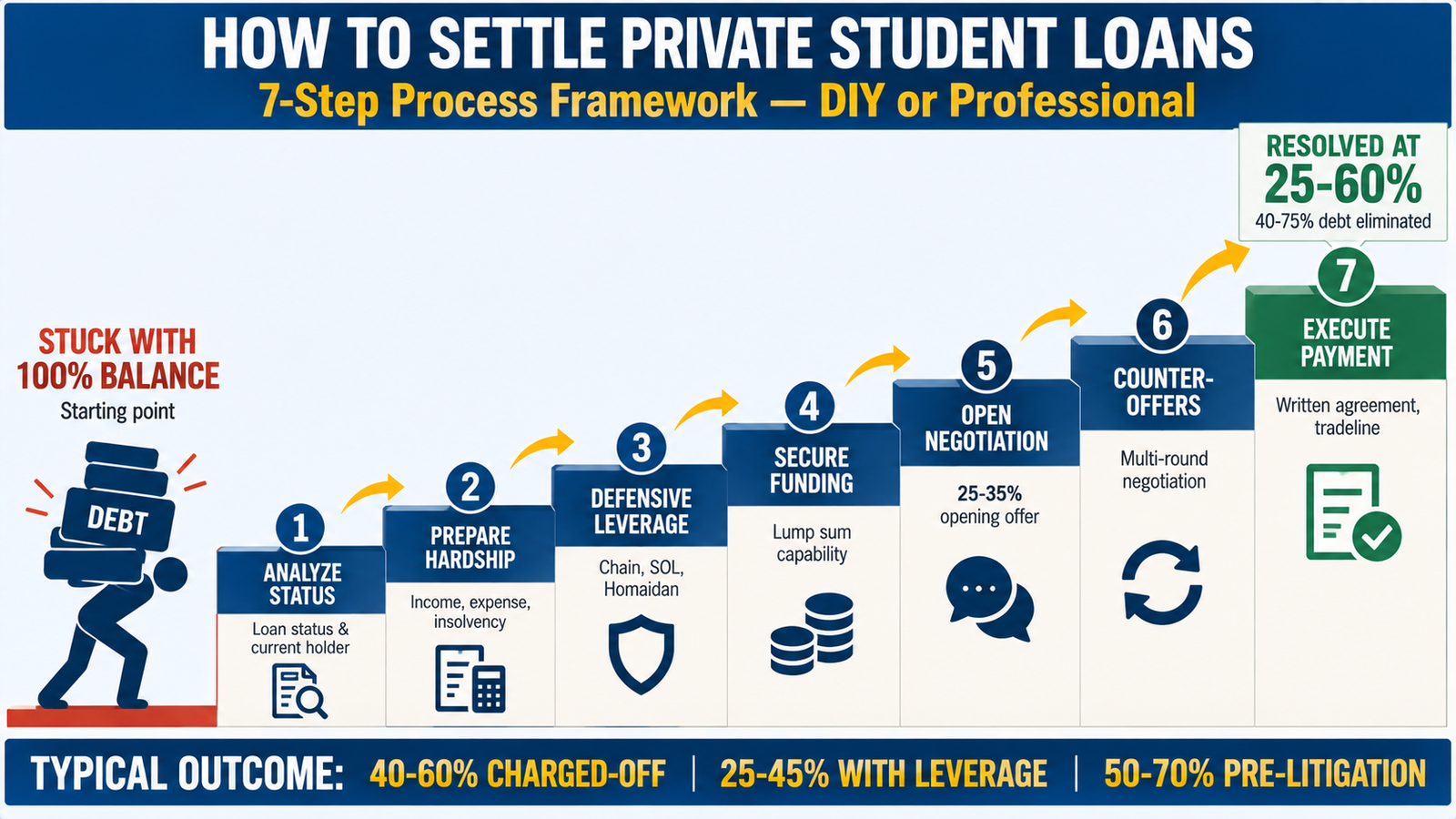
Learning how to settle private student loans can mean the difference between years of unmanageable debt and a resolved financial situation at 40-70% of the original balance. For borrowers struggling with private student loans from Sallie Mae Bank, Navient/Earnest, Discover/Firstmark, SoFi, Citizens, Ascent, or debt buyers and NCSLT trusts, settlement is often the fastest and most cost-effective path to debt resolution. This complete 2026 step-by-step guide walks through the 7 proven steps to successfully settle private student loans: analyze your current loan status and identify your holder, prepare documented hardship presentation, analyze defensive leverage opportunities (chain of assignment, SOL, Homaidan bankruptcy alternative), secure lump sum funding capability, open negotiation with proper opening offer, negotiate counter-offers to reach favorable terms, and execute payment with proper documentation and credit tradeline verification. Each step is actionable and produces measurable progress toward final debt resolution.
Quick Answer
How to settle private student loans in 7 proven steps: (1) Analyze loan status and identify current holder — determine whether loan is current, delinquent, charged-off, or in litigation; identify whether holder is original lender (Sallie Mae Bank, Navient/Earnest, Discover/Firstmark, SoFi, Citizens, Ascent), NCSLT trust, or third-party debt buyer. (2) Prepare documented hardship presentation — income statements, expense breakdown, medical/employment documentation, insolvency calculation. (3) Analyze defensive leverage — chain of assignment under Article III standing (Lujan/Spokeo/TransUnion), statute of limitations by state (3-15 years), Homaidan v. Sallie Mae 992 F.3d 100 (2d Cir. 2021) §523(a)(8) bankruptcy alternative framework. (4) Secure lump sum funding — savings, family assistance, asset sale, 401(k) loan analysis, tax refund timing. (5) Open negotiation with proper opening offer — typically 25-35% of balance (anchor low); contact appropriate department (hardship team pre-charge-off, recovery department post-charge-off). (6) Negotiate counter-offers — expect multiple rounds, cite defensive leverage, document hardship, reach favorable final terms (typical outcomes 40-60% charged-off, 25-45% with defensive leverage). (7) Execute payment with proper documentation — written settlement agreement including full satisfaction release language, cosigner release, tradeline update instructions, 1099-C disclosure; execute payment per agreement; verify tradeline updates to Experian/Equifax/TransUnion. Legal representation typically produces materially better outcomes than DIY approach.
Read the complete 7-step framework below.
In this complete step-by-step guide:
Step 1: Analyze loan status and identify current holder
Determine account status and who actually owns the debt now
Step 2: Prepare documented hardship presentation
Build the financial hardship case supporting settlement
Step 3: Analyze defensive leverage opportunities
Chain of assignment, SOL, Homaidan bankruptcy alternative
Step 4: Secure lump sum funding
Prepare the payment source for settlement execution
Step 5: Open negotiation with proper opening offer
Make the first move strategically to anchor the negotiation
Step 6: Negotiate counter-offers to reach favorable terms
Multiple rounds of negotiation using defensive leverage
Step 7: Execute payment with proper documentation
Settlement agreement, payment execution, tradeline verification
Step 1: Analyze loan status and identify current holder
The first step in how to settle private student loans is understanding what you actually have. Many borrowers approach settlement without proper status analysis and holder identification, resulting in wasted effort contacting wrong parties or missing leverage opportunities.
Determining current account status
Account status drives settlement strategy. The main status categories: Current (payments current, no delinquency) — settlement typically premature; pursue modification programs first. Early delinquent (1-90 days past due) — hardship team authority, modification preferred over settlement. Late delinquent (90-180 days past due) — pre-litigation settlement window, 50-70% range outcomes possible. Charged-off (180+ days past due) — recovery department authority, 40-60% range outcomes standard. In litigation (lawsuit filed) — defensive position settlement with motion-to-dismiss leverage, 25-50% range possible. Judgment entered — post-judgment vacation and bankruptcy analysis required.
Confirming loan is actually private (not federal)
Before pursuing settling private student loans, confirm the loan is actually private (not federal). Check studentaid.gov NSLDS — federal loans appear there; private loans do NOT. If any of your loans are federal, those loans need different approach (federal forgiveness programs like PSLF, IDR forgiveness) rather than private settlement framework. Private loans with no federal counterpart proceed to settlement analysis.
Identifying current holder
Current holder identification is critical because settlement authority rests with current owner, not original lender. Options: (1) Original lender still holds the loan (common for current and early delinquent accounts); (2) Original lender’s recovery department (post-charge-off); (3) NCSLT trust (common for pre-2014 Sallie Mae-originated loans); (4) Third-party debt buyer (common for older charged-off accounts); (5) Collection law firm acting on behalf of any of the above. Methods to identify: check credit reports from Experian/Equifax/TransUnion for current furnisher; request debt validation under FDCPA 15 U.S.C. §1692g; analyze any correspondence received; request chain of assignment documentation from any party claiming ownership.
Common Discover transition consideration
If your loan was originally Discover-originated, note the July 2024 ownership transition: Discover Financial Services (NYSE:DFS) sold its student loan portfolio to Carlyle Group + KKR private equity consortium; servicing transitioned to Firstmark Services (Nelnet NYSE:NNI subsidiary). For former Discover loans in 2026, Firstmark Services handles customer-facing settlement discussions. Contacting Discover directly will not reach the current owner.
Step 2: Prepare documented hardship presentation
Step 2 in the private student loan settlement process is building a documented hardship case supporting your settlement request. Settlement representatives have authority to accept lower settlement amounts when hardship is properly documented — undocumented hardship claims typically result in standard range settlement at best.
Income documentation
Income documentation establishes current earning capacity: (1) recent pay stubs (last 3 months) if employed; (2) 1099s from last 12 months if self-employed or gig worker; (3) last 2 years tax returns showing income history; (4) bank statements showing deposit patterns; (5) unemployment benefits documentation if applicable; (6) disability or retirement benefit documentation if applicable; (7) child support or alimony received documentation. Settlement representatives analyze income against expenses to assess hardship credibility — proper documentation strengthens the hardship case.
Expense breakdown
Expense breakdown demonstrates cash flow constraints: (1) housing costs (rent/mortgage, utilities, insurance, taxes); (2) transportation (car payment, insurance, fuel, maintenance); (3) food costs (groceries, essential household supplies); (4) medical expenses (insurance premiums, out-of-pocket costs, medications); (5) childcare and dependent care if applicable; (6) other debt payments (credit cards, auto loans, other student loans); (7) tax obligations (quarterly estimates for self-employed, back taxes if applicable). Expense documentation shows that current income cannot sustain full private student loan payment while meeting basic needs.
Hardship circumstance documentation
Specific hardship circumstances strengthen settlement case: (1) medical hardship — physician letters, treatment records, insurance EOBs showing uncovered costs; (2) employment hardship — termination letters, unemployment documentation, reduced hours documentation; (3) family hardship — divorce documents, death in family affecting income, custody changes affecting expenses; (4) business hardship — tax returns showing business losses, closure documentation if applicable; (5) disability hardship — disability determination letters, physician statements. Documented hardship circumstances move settlement discussions toward hardship accommodation framework rather than standard collection posture.
Insolvency calculation for IRC §108
Insolvency calculation serves dual purpose — supports settlement hardship and documents IRC §108(a)(1)(B) tax exclusion basis. Prepare: (1) complete asset list with fair market values (checking/savings, retirement accounts at discounted value for early withdrawal penalty, home equity if applicable, vehicles at wholesale value, personal property at liquidation value); (2) complete liability list (all debts including student loans, credit cards, medical bills, back taxes, judgments); (3) net worth calculation (assets minus liabilities). Negative net worth = insolvency, supporting both settlement case and tax exclusion. Keep calculation documentation for later Form 982 filing.
Step 3: Analyze defensive leverage opportunities
Step 3 is where how to negotiate private student loan settlement becomes significantly more effective — identifying and preparing defensive leverage that supports deeper settlement discounts. Settlement from defensive leverage position typically produces 25-45% range outcomes versus 40-60% range for standard settlement without leverage.
Chain of assignment analysis
Chain of assignment leverage applies particularly to debt-buyer-held and NCSLT-held loans. Analysis: (1) identify every entity that has owned the loan from origination to current holder; (2) request documentation for each transfer; (3) identify gaps or inconsistencies (missing intermediate assignments, blank endorsements, bulk sale documentation without account-specific listing, signatory authority questions); (4) assess strength of Article III standing position (Lujan v. Defenders of Wildlife 504 U.S. 555 (1992), Spokeo, Inc. v. Robins 578 U.S. 330 (2016), TransUnion LLC v. Ramirez 594 U.S. 413 (2021)); (5) document specific defects for settlement discussion. Strong chain challenges often reduce settlement outcomes by 15-25 percentage points.
Statute of limitations analysis
Statute of limitations by state for written contract debt (private student loans): Texas 4 years under Tex. Civ. Prac. & Rem. Code §16.004(a)(3); New York 3 years under CPLR §214(2) per CCFA April 7, 2022; Pennsylvania 4 years under 42 Pa.C.S. §5525; Ohio 6 years under R.C. §2305.06; Illinois 10 years under 735 ILCS 5/13-206; Georgia 6 years under O.C.G.A. §9-3-24; California 4 years under CCP §337; Florida 5 years under Fla. Stat. §95.11(2)(b); Delaware 3 years under 10 Del. C. §8106. Analysis: calculate accrual date (first default or last payment per state law); compare to current date and litigation posture; if SOL has expired, time-barred debt supports deepest settlement leverage (20-35% range) or alternative strategy (SOL defense if sued).
Homaidan v. Sallie Mae §523(a)(8) analysis
Homaidan v. Sallie Mae 992 F.3d 100 (2d Cir. 2021) framework analysis for bankruptcy alternative leverage: (1) determine loan characteristics (direct-to-consumer without school certification of cost of attendance, loans exceeding cost of attendance, non-title IV eligible programs, less-than-half-time enrollment); (2) analyze whether loan qualifies under §523(a)(8)(A)(ii) narrow “educational benefit” interpretation; (3) identify Circuit-specific additional support (Crocker 5th Cir. 2019, McDaniel 10th Cir. 2020); (4) document bankruptcy counsel consultation establishing credible alternative; (5) calculate means test qualification under 11 U.S.C. §707(b)(2). Credible Homaidan-based bankruptcy alternative typically reduces settlement to 25-45% range.
Multi-leverage coordination
Effective settlement typically combines multiple defensive leverage points: chain of assignment + Homaidan + hardship documentation produces materially better outcomes than any single leverage. Prepare each leverage point separately with supporting documentation, then present as coordinated framework in negotiation. Multi-leverage approach communicates sophistication and creates maximum settlement motivation for current holder.
Step 4: Secure lump sum funding
Step 4 in private student loan settlement steps is securing the lump sum funding that will execute the settlement. Settlement without funding capability is theoretical — actual settlement requires available funds for payment within 30-60 days of agreement.
Primary funding sources
Common lump sum funding sources: (1) personal savings — most straightforward if available; (2) family financial assistance — document terms with written agreement; (3) sale of non-essential assets (secondary vehicle, collectibles, investment accounts); (4) 401(k) loan — careful analysis of repayment obligation (typical 5-year repayment, lose if employment terminates); (5) 401(k) hardship withdrawal — note 10% penalty if under 59½ plus ordinary income tax; (6) tax refund proceeds — time settlement to coincide with refund receipt; (7) seasonal income — year-end bonuses, commission timing; (8) small business loan or line of credit if applicable; (9) home equity line of credit if homeowner. Each source has different cost structure and tax implications.
Funding adequacy calculation
Target funding amount depends on anticipated settlement range: (1) for strong defensive leverage case (25-45% range), target 30-35% of balance for lump sum capability; (2) for standard charged-off account (40-60% range), target 45-50% of balance; (3) for pre-litigation accounts (50-70% range), target 55-65% of balance; (4) include buffer for negotiation flexibility — if lump sum caps at 35% but opponent won’t go below 40%, deal falls through. Confirming adequate funding BEFORE opening negotiation prevents false starts.
Timing considerations
Funding timing coordinates with settlement execution: (1) settlement agreements typically require payment within 30-60 days of execution; (2) tax refund timing may align with specific negotiation windows; (3) seasonal income (year-end bonus, commission) may dictate best negotiation opening date; (4) if family assistance involved, confirm availability before negotiation to avoid overcommitting; (5) if 401(k) loan planned, verify current employer plan terms and application timeline. Coordinate funding availability with negotiation timeline from the start.
Backup options if lump sum insufficient
If full lump sum isn’t achievable, backup options: (1) structured settlement with 3-6 month payment plan (typically 10-20% higher total settlement); (2) initial down payment with later balance (lender dependent); (3) family assistance commitment with structured contribution; (4) delayed settlement allowing additional savings accumulation (SOL risk if debt is older). Structured settlement carries default risk — borrower must have high confidence in payment capacity throughout the plan term since missed payment typically reverses the settlement.
Step 5: Open negotiation with proper opening offer
Step 5 begins active negotiation with current holder. The opening offer is critical because it anchors the entire negotiation — anchoring too high leaves money on the table; anchoring too low may cause representative to dismiss the discussion. Proper opening offer typically falls in the 25-35% range for charged-off accounts.
Contacting the right department
Contact routing depends on account status: Current or early delinquent (0-90 days) — customer service / hardship team for modification first; Late delinquent (90-180 days) — hardship team for pre-charge-off settlement; Charged-off (180+ days) — recovery department for settlement authority; In litigation — attorney for current holder or law firm filing lawsuit (not recovery department); Transferred to debt buyer — current debt buyer’s collection operation. Contact wrong department wastes time and sometimes creates revival risk.
Written vs phone opening
Written opening offer is generally preferred over phone opening for several reasons: (1) written offer creates clear documentation of terms proposed; (2) written offer prevents representative from recording oral acknowledgments that could create revival risk; (3) written offer allows careful phrasing of defensive leverage and hardship points; (4) written offer forces structured response rather than extemporaneous reaction; (5) written offer creates professional posture signaling competent representation. Prepare opening offer as formal written letter sent via trackable method.
Opening offer structure
Effective opening offer structure: (1) brief statement of situation and account identification; (2) specific settlement offer amount (25-35% of balance for charged-off accounts); (3) hardship summary with documented support referenced; (4) defensive leverage summary (chain, SOL, Homaidan as applicable); (5) proposed timeline for payment execution (30-60 days from agreement); (6) proposed settlement agreement terms (full satisfaction release, tradeline update, cosigner release); (7) response deadline (typically 2-3 weeks for initial response); (8) professional sign-off with contact information. Keep it concise — settlement representatives see many offers; clear structure receives better attention.
What NOT to include in opening offer
Critical mistakes to avoid in opening offer: (1) acknowledging debt validity in ways that could restart SOL (phrase as “subject to validation”); (2) emotional appeals without substantive leverage; (3) promises of future payment that aren’t backed by funding; (4) threats or hostile language that trigger defensive response; (5) commitment to specific payment date that may not be achievable; (6) revealing exact lump sum capability (keep flexibility for negotiation); (7) agreeing to any terms beyond the specific offer. Keep opening focused on the specific offer and supporting rationale.
Step 6: Negotiate counter-offers to reach favorable terms
Step 6 is the active private student loan settlement process — multiple rounds of counter-offer exchange to reach favorable terms. Expect 2-4 rounds of negotiation before reaching final terms. Each round requires strategic response using defensive leverage and hardship documentation.
Expected counter-offer patterns
Typical counter-offer progression: Opening offer at 25-30% → Lender counter at 65-75% → Your counter at 32-38% → Lender counter at 55-60% → Your counter at 40-45% → Final agreement at 42-50% range. Patterns vary by lender and leverage, but this illustrates typical multi-round progression. Each round moves 5-15 percentage points toward middle ground. Avoid moving in equal increments that signal standard progression — strategic jumps based on new information support better outcomes.
Using defensive leverage in negotiation
Defensive leverage usage in negotiation: (1) introduce leverage incrementally rather than all at once — initial offer references leverage, subsequent rounds elaborate specific concerns; (2) cite specific precedents by name (Homaidan v. Sallie Mae 992 F.3d 100 (2d Cir. 2021), Crocker v. Navient 941 F.3d 206 (5th Cir. 2019)) demonstrating sophisticated preparation; (3) reference specific documentation defects or SOL timing as negotiation deadlocks; (4) escalate to bankruptcy alternative discussion if standard range not reachable; (5) demonstrate credible willingness to execute alternative (bankruptcy filing, litigation defense) rather than mere settlement acceptance.
Negotiation timing dynamics
Timing dynamics affect negotiation: (1) end-of-quarter periods (March, June, September, December) often see lender flexibility due to quarterly recovery targets; (2) end-of-year periods (November-December) often see additional flexibility to close year’s recovery numbers; (3) response time between rounds — faster responses show urgency, delayed responses signal consideration of alternatives; (4) negotiation sessions over 4-8 weeks allow processing time between rounds; (5) extended negotiations beyond 3 months sometimes signal need to escalate or shift approach.
Walking away vs accepting final terms
Decision framework for walking away vs accepting: (1) if final offer exceeds your target range with no additional movement — consider walking away and pursuing alternative (bankruptcy, waiting for SOL, standing challenge if litigated); (2) if final offer is slightly above target but represents real progress — accept and execute; (3) if alternative pathway (bankruptcy, SOL) has substantial probability of better outcome, walking away may be optimal; (4) if alternative pathway has significant uncertainty, accepting reasonable settlement often preferred; (5) weight payment finality (immediate resolution) against percentage improvement (potentially years waiting for alternative). Legal counsel assists this analysis.
Step 7: Execute payment with proper documentation
Step 7 completes the settlement process — executing payment with proper documentation protecting borrower interests after payment. This step is where DIY settlements often fail — payment made without proper written settlement agreement leaves borrower exposed to future collection claims and improper credit reporting.
Settlement agreement review before signing
Critical settlement agreement elements requiring review: (1) exact settlement amount and payment deadline; (2) specific account identification with loan numbers; (3) “full and final satisfaction” release language extinguishing all further obligations on this specific account; (4) explicit statement that no further payments will be due; (5) tradeline update instructions to Experian, Equifax, TransUnion marking account as “settled” or “paid as agreed”; (6) cosigner release language if cosigned loan — critical that cosigner is fully released, not just that collection stops; (7) 1099-C reporting disclosure; (8) release of any pending collection activities including lawsuits; (9) representation that signing party has authority to settle; (10) no reinstatement provisions (settlement cannot be reversed if payment made per agreement). Review carefully — this document controls future obligations.
Payment execution
Payment execution best practices: (1) use trackable payment method (certified check, wire transfer, cashier’s check — avoid personal checks which can bounce or get lost); (2) obtain delivery confirmation and payment confirmation; (3) retain copy of payment instrument and all transfer confirmations; (4) note date of payment and reference to settlement agreement; (5) if payment plan, set up automatic payment to avoid missed payments reversing settlement; (6) retain receipts and documentation permanently (never discard settlement documentation). Document everything.
Tradeline verification
Tradeline update verification protects credit outcomes: (1) wait 30-60 days post-payment for tradeline update processing; (2) check all three credit reports (Experian, Equifax, TransUnion) for proper update; (3) verify account status shows “settled” or “paid as agreed” (not “charged-off” or “in collection”); (4) verify balance shows $0 or appropriate settled status; (5) if tradeline not updated per agreement, send written dispute to each credit bureau citing settlement agreement; (6) send written complaint to lender if tradeline update doesn’t occur after dispute. Settlement agreement typically specifies tradeline language — enforce it.
1099-C and tax filing
1099-C and tax follow-up: (1) 1099-C typically issued in January for prior year settlements; (2) retain 1099-C with tax records; (3) file Form 982 claiming applicable IRC §108 exclusion (insolvency §108(a)(1)(B) or bankruptcy §108(a)(1)(A)); (4) attach insolvency calculation if claiming insolvency exclusion; (5) CPA assistance recommended for proper filing; (6) retain all documentation for IRS record retention period (typically 7 years). Proper tax follow-up prevents unexpected IRS liability on cancelled debt amount.
Related resources — complete settlement framework ecosystem
Private Student Loan Settlement 2026: Complete Guide (PILAR)
The 7-path master framework covering all private student loan settlement mechanisms across major lenders and debt buyers.
Sallie Mae Settlement 2026: How It Works
Lender-specific framework for Sallie Mae Bank NYSE:SLM private student loan settlement.
Navient Student Loan Settlement 2026 Guide
Lender-specific framework for Navient Corporation NYSE:NAVI and Earnest Operations LLC settlement with Crocker/McDaniel defensive leverage.
DIY vs professional representation decision
A critical decision in how to settle private student loans is whether to pursue DIY settlement or engage professional representation. The 7 steps above are executable by borrowers themselves — but professional representation typically produces materially better outcomes.
When DIY may be appropriate
DIY settlement may be appropriate for: (1) small balance accounts (under $10.000) where professional fees would exceed benefit; (2) straightforward pre-litigation hardship situations without complex defensive leverage; (3) borrowers with legal background familiar with debt negotiation; (4) borrowers with time and willingness to execute each step carefully; (5) accounts where simple settlement in standard ranges (not deep discount) is adequate. Even DIY settlement should include CPA consultation for IRC §108 tax planning.
When professional representation produces materially better outcomes
Professional representation produces materially better outcomes for: (1) larger balance accounts where percentage improvements have substantial dollar impact; (2) complex defensive leverage situations (chain of assignment, Homaidan analysis, multi-Circuit precedent application); (3) accounts in or approaching litigation; (4) NCSLT-held debt requiring Third Circuit precedent analysis; (5) multiple accounts requiring coordinated strategy; (6) borrowers whose lack of comparative knowledge limits negotiation effectiveness; (7) situations where cosigner protection is critical; (8) complex tax planning scenarios. Professional fees typically pay for themselves through better settlement outcomes.
Red flags in settlement services
Settlement service red flags to avoid: (1) large upfront fees ($3.000-$10.000+) before any results; (2) promises of specific settlement percentages before analysis; (3) claims of “government-approved” programs (none exist for private loans); (4) pressure tactics creating urgency; (5) instructions to stop paying without hardship justification; (6) unclear fee structure or results-based promises; (7) failure to provide specific attorney credentials. Legitimate services operate with clear scope, defined fees, and realistic expectations. Private Student Relief’s attorney-backed partner provider operates under these legitimate principles.
Common mistakes to avoid
Mistake 1
Deliberately stopping payments to “force” settlement
Why it fails: Deliberately stopping payments without documented hardship creates credit damage without corresponding settlement benefit. Lenders view intentional non-payment differently than hardship-driven default. Risks: credit score damage; cosigner credit damage; potential lawsuit before settlement opportunity materializes; loss of hardship accommodation options available to current borrowers. If settlement is appropriate, approach lender with documented hardship first — pre-charge-off settlement often produces better outcomes than deliberately-induced default.
Mistake 2
Making verbal commitments without written agreement
Why it fails: Verbal commitments or informal email confirmations don’t bind lenders to settlement terms. Payment made based on verbal agreement without written settlement agreement may still leave balance unresolved. Lenders can later claim payment was partial rather than full satisfaction. ALWAYS require written settlement agreement before any payment execution. The written agreement is the only enforceable document — verbal promises are not.
Mistake 3
Settling without cosigner release provisions
Why it fails: On cosigned loans, settlement with primary borrower doesn’t automatically release cosigner. Without explicit cosigner release language in settlement agreement, cosigner may remain exposed to continued collection — including balance above settled amount or related claims. This creates serious family relationship issues and leaves cosigner at legal risk. ALWAYS require explicit cosigner release language in settlement agreement for cosigned loans. Never execute settlement that leaves cosigner exposed.
Mistake 4
Ignoring 1099-C tax implications
Why it fails: Settlement cancels debt above payment amount, which is reported on IRS Form 1099-C. Borrowers who ignore 1099-C may face unexpected IRS liability years after settlement. However, IRC §108 exclusions (insolvency §108(a)(1)(B), bankruptcy §108(a)(1)(A)) typically eliminate most or all tax liability — but only if claimed properly through Form 982. CPA consultation BEFORE settlement establishes insolvency documentation and tax planning framework. Settlement without tax planning risks substantial unexpected tax liability on cancelled debt income.
Frequently asked questions
1. How do I settle private student loans?
How to settle private student loans in 7 proven steps: (1) Analyze loan status (current, delinquent, charged-off, in litigation) and identify current holder (original lender, NCSLT trust, or debt buyer); (2) Prepare documented hardship presentation with income/expense/circumstance documentation and insolvency calculation; (3) Analyze defensive leverage (chain of assignment under Article III standing, statute of limitations by state, Homaidan v. Sallie Mae §523(a)(8) bankruptcy alternative); (4) Secure lump sum funding (savings, family assistance, asset sale, 401(k) loan, tax refund); (5) Open negotiation with proper opening offer (25-35% of balance); (6) Negotiate counter-offers to reach favorable final terms; (7) Execute payment with proper written settlement agreement including full satisfaction release, cosigner release, tradeline update instructions. Legal representation typically produces materially better outcomes than DIY approach.
2. What is the private student loan settlement process?
The private student loan settlement process is a structured negotiation sequence: initial contact with current holder (lender recovery department for charged-off accounts, hardship team for pre-charge-off); exchange of counter-offers over 2-4 rounds typically spanning 2-4 months; final agreement at mutually acceptable settlement percentage (typically 40-60% for charged-off accounts, 25-45% with defensive leverage, 50-70% pre-litigation); written settlement agreement execution with full satisfaction release language; payment execution via trackable method within 30-60 days; tradeline update verification 30-60 days post-payment; 1099-C receipt in January following settlement year with Form 982 filing claiming applicable IRC §108 tax exclusion. Each step requires strategic approach — professional representation typically produces materially better outcomes.
3. How much should I offer when settling private student loans?
Opening offer typically falls in 25-35% of balance range for charged-off accounts — low enough to anchor negotiation favorably, high enough to be taken seriously. Opening offer should match target range by account status: (1) pre-litigation accounts (opening 35-45%, target 50-70% range); (2) charged-off accounts (opening 25-30%, target 40-60% range); (3) accounts with strong defensive leverage (opening 20-25%, target 25-45% range); (4) NCSLT-held accounts (opening 15-20%, target 20-35% range). Lump sum funding must align with target range plus buffer for negotiation flexibility. Opening offer substantially higher than target leaves money on table; opening offer substantially below target may cause representative to dismiss discussion.
4. How long does the settlement process take?
Typical private student loan settlement timeline: initial contact to opening offer 1-2 weeks; first counter-offer exchange 2-3 weeks; multiple negotiation rounds 2-6 weeks; final agreement 1-2 weeks; written agreement review and execution 1-2 weeks; payment processing 1-2 weeks; tradeline updates 30-60 days post-payment. Total timeline typically 2-4 months from initial engagement to full completion including tradeline verification. Faster timelines (6-8 weeks) occur with proper preparation: defensive leverage ready, funding confirmed, reasonable opening offer, professional representation coordinating. Complex situations (NCSLT trusts, Homaidan analysis, active litigation) may extend to 4-9 months.
5. Can I settle private student loans myself?
Yes, settle private student loans DIY is legally permitted. The 7 steps outlined work for both DIY and professional-represented settlement. DIY may be appropriate for: small balance accounts; straightforward pre-litigation hardship situations; borrowers with debt negotiation experience; situations where standard range settlement is adequate. However, professional representation typically produces materially better outcomes for: larger balance accounts; complex defensive leverage situations; accounts in or approaching litigation; NCSLT-held debt; multiple account coordination; situations requiring sophisticated tax planning; cosigner protection situations. Legal representation often pays for itself through better settlement outcomes — the question is whether specific situation benefits from representation.
6. What should I include in the settlement agreement?
Essential settlement agreement elements: (1) exact settlement amount and payment deadline; (2) specific account identification with loan numbers; (3) “full and final satisfaction” release language extinguishing all further obligations; (4) explicit statement no further payments due; (5) tradeline update instructions to Experian, Equifax, TransUnion marking account as “settled” or “paid as agreed”; (6) cosigner release language if cosigned (fully releases cosigner, not just stops collection); (7) 1099-C reporting disclosure; (8) release of pending collection activities including lawsuits; (9) representation of settlor’s authority; (10) no reinstatement provisions (settlement cannot be reversed if payment made per agreement). Review carefully before signing — this document controls future obligations and credit outcomes.
7. What happens after I complete the settlement?
Post-settlement completion sequence: (1) retain all documentation permanently (settlement agreement, payment confirmation, correspondence); (2) verify tradeline updates to Experian, Equifax, TransUnion 30-60 days post-payment; (3) dispute tradeline inaccuracies if updates don’t match agreement; (4) receive 1099-C in January following settlement year; (5) file Form 982 with tax return claiming IRC §108 exclusion (insolvency §108(a)(1)(B) or bankruptcy §108(a)(1)(A)); (6) coordinate with CPA for proper tax filing; (7) credit score typically begins recovering within 12-24 months post-settlement; (8) monitor credit reports annually to confirm continued proper reporting. The debt is legally resolved — remaining steps are documentation and tax follow-up.
Ready to Settle Your Private Student Loans?
Free specialist review of your complete 7-step settlement framework.
Loan status analysis and current holder identification across major lenders (Sallie Mae Bank NYSE:SLM, Navient/Earnest Operations LLC, Discover/Firstmark Services, SoFi Bank NA, Citizens Bank NA, Ascent) plus NCSLT trusts and debt buyers. Defensive leverage analysis including chain of assignment under Article III standing (Lujan/Spokeo/TransUnion), statute of limitations by state, Homaidan v. Sallie Mae 992 F.3d 100 (2d Cir. 2021) §523(a)(8) bankruptcy alternative framework. Hardship documentation preparation, lump sum funding strategy, negotiation framework, settlement agreement drafting, payment execution coordination, tradeline verification, IRC §108 tax planning. Free eligibility review with attorney-backed partner provider — no upfront fees.
Get a free eligibility review →
5-minute review · No obligation · Zero upfront fees · Since 2015 · 48 states served
About the author
Henry Silva — Private Student Loan Debt Specialist
10+ years guiding borrowers through how to settle private student loans step-by-step across major private lenders. Deep expertise in each phase of the private student loan settlement process: loan status analysis across all account conditions (current, early delinquent, late delinquent, charged-off, in litigation, judgment entered); holder identification across original lenders (Sallie Mae Bank NYSE:SLM, Navient Corporation NYSE:NAVI, Earnest Operations LLC as Navient subsidiary since 2017, Discover Financial Services NYSE:DFS historical with Carlyle+KKR current ownership and Firstmark Services NELNET NYSE:NNI subsidiary servicing, SoFi Bank NA NMLS #696891, Citizens Bank NA NYSE:CFG, Ascent Student Loans), NCSLT trusts (2003-1 through 2007-4), and third-party debt buyers. Hardship documentation preparation including income statements, expense breakdown, hardship circumstance documentation, and insolvency calculation under IRC §108(a)(1)(B). Defensive leverage preparation across all mechanisms: chain of assignment analysis under Article III standing doctrine (Lujan v. Defenders of Wildlife 504 U.S. 555 (1992), Spokeo, Inc. v. Robins 578 U.S. 330 (2016), TransUnion LLC v. Ramirez 594 U.S. 413 (2021)); statute of limitations analysis across all 50 states with specific focus on Texas 4 years, New York 3 years post-CCFA, Pennsylvania 4 years, Ohio 6 years, Illinois 10 years, Georgia 6 years, California 4 years, Florida 5 years, Delaware 3 years; Homaidan v. Sallie Mae Inc. 992 F.3d 100 (2d Cir. 2021) §523(a)(8)(A)(ii) bankruptcy alternative framework with Crocker v. Navient Solutions LLC 941 F.3d 206 (5th Cir. 2019) binding TX/LA/MS, McDaniel v. Navient Solutions LLC 973 F.3d 1083 (10th Cir. 2020) binding CO/KS/NM/OK/UT/WY, Brunner v. New York State Higher Education Services Corp. 831 F.2d 395 (2d Cir. 1987) undue hardship test, In re Rosenberg 594 B.R. 22 (Bankr. S.D.N.Y. 2020) moderated application, DOJ November 2022 undue hardship guidance; NCSLT Third Circuit March 19, 2024 “covered persons” decision with SCOTUS cert denial December 2024. Lump sum funding strategy across all source types; opening offer calibration by account status and leverage; multi-round counter-offer negotiation using progressive defensive leverage disclosure; settlement agreement drafting with full satisfaction release, cosigner release, tradeline update instructions, and 1099-C disclosure; payment execution via trackable methods; tradeline verification across Experian, Equifax, TransUnion; IRC §108 tax planning with Form 982 preparation and CPA coordination. FDCPA 15 U.S.C. §1692g validation and §1692e counterclaim coordination. Henry works with Private Student Relief’s attorney-backed partner provider network to execute coordinated settlement strategies across all 7 process steps for borrower scenarios ranging from DIY-appropriate small balances through complex multi-leverage high-balance situations.
Legal Disclaimer and Sources
This article is provided for informational purposes only and does not constitute legal, tax, or financial advice. Private Student Relief is a consulting and matching organization operated by Joco (555 Anton Blvd, Suite 368, Costa Mesa, CA 92626) — not a law firm, debt settlement company, debt consolidation company, or loan provider. Debt validation services are performed by an attorney-backed partner provider (Panamerican Consulting LLC, Las Vegas, NV) under independent business credentials. Ratings, BBB accreditation, and AADR (American Association for Debt Resolution) membership referenced on the PSR website belong to the partner provider. Private student loan settlement outcomes depend on loan characteristics, current holder, defensive leverage opportunities, lump sum funding capability, borrower jurisdiction, and other factors. Individual results vary. Since 2015. 48 states served. Not available in South Carolina or Mississippi.
Bankruptcy Code references: 11 U.S.C. §523(a)(8) (student loan discharge exceptions with §523(a)(8)(A)(i) governmental unit, §523(a)(8)(A)(ii) educational benefit, §523(a)(8)(B) qualified education loan categories); 11 U.S.C. §362 (automatic stay); 11 U.S.C. §707(b)(2) (means test); 11 U.S.C. §1328 (Chapter 13 discharge). Key bankruptcy precedent: Homaidan v. Sallie Mae Inc. 992 F.3d 100 (2d Cir. 2021) — binding in Second Circuit (CT, NY, VT), persuasive elsewhere, establishing that direct-to-consumer private education loans without school certification of cost of attendance do not meet §523(a)(8)(A)(ii) “educational benefit” criteria and are dischargeable without undue hardship; Crocker v. Navient Solutions LLC 941 F.3d 206 (5th Cir. 2019) — binding in Fifth Circuit (TX, LA, MS); McDaniel v. Navient Solutions LLC 973 F.3d 1083 (10th Cir. 2020) — binding in Tenth Circuit (CO, KS, NM, OK, UT, WY); Brunner v. New York State Higher Education Services Corp. 831 F.2d 395 (2d Cir. 1987) undue hardship test; In re Rosenberg 594 B.R. 22 (Bankr. S.D.N.Y. 2020). Article III standing precedent: Lujan v. Defenders of Wildlife 504 U.S. 555 (1992); Spokeo, Inc. v. Robins 578 U.S. 330 (2016); TransUnion LLC v. Ramirez 594 U.S. 413 (2021). Federal Rules of Civil Procedure: FRCP 60(b)(4) (void judgment); FRCP 12(b)(6) (failure to state claim). Pleading standards: Bell Atlantic Corp. v. Twombly 550 U.S. 544 (2007); Ashcroft v. Iqbal 556 U.S. 662 (2009). Internal Revenue Code: IRC §221(d)(1) (qualified education loan definition); IRC §108(a)(1)(A) (bankruptcy exclusion); IRC §108(a)(1)(B) (insolvency exclusion); Form 982 (reduction of tax attributes due to discharge of indebtedness). FDCPA: 15 U.S.C. §1692g (debt validation); 15 U.S.C. §1692e (deceptive practices); 15 U.S.C. §1692f (unfair practices). Federal tax reporting: IRS Form 1099-C (cancellation of debt). NCSLT precedent: Third Circuit March 19, 2024 “covered persons” decision; SCOTUS cert denial December 2024.
Statute of limitations for written contract debt (private student loans) by state: Texas 4 years under Tex. Civ. Prac. & Rem. Code §16.004(a)(3); New York 3 years under CPLR §214(2) per Consumer Credit Fairness Act (CCFA) effective April 7, 2022; Pennsylvania 4 years under 42 Pa.C.S. §5525; Ohio 6 years under Ohio R.C. §2305.06; Illinois 10 years under 735 ILCS 5/13-206; Georgia 6 years under O.C.G.A. §9-3-24; California 4 years under CCP §337; Florida 5 years under Fla. Stat. §95.11(2)(b); Delaware 3 years under 10 Del. C. §8106.
Lender and servicer information current as of October 2026: Sallie Mae Bank NYSE:SLM (Newark DE, largest private student loan originator); Navient Corporation NYSE:NAVI (2014 Sallie Mae split; 2017 Earnest acquisition; Dec 2021 Aidvantage transfer; Jan 2022 state AG settlement $1.85B); Earnest Operations LLC (Navient subsidiary since 2017); Discover Financial Services NYSE:DFS (exited student loan business July 2024); Carlyle Group + KKR private equity consortium (current former Discover portfolio owner); Firstmark Services (Nelnet NYSE:NNI subsidiary servicing former Discover portfolio); SoFi Bank NA NMLS #696891 (national bank charter 2022); Citizens Bank NA NYSE:CFG; Ascent Student Loans; NCSLT (National Collegiate Student Loan Trusts: 2003-1 through 2007-4 hold pre-2014 Sallie Mae-originated loans). Information subject to change; verify current status through direct account documentation.
How to settle private student loans process requires case-by-case analysis coordinating loan characteristics, current holder identification, current account status, defensive leverage opportunities, lump sum funding capability, Homaidan §523(a)(8) qualification analysis, chain of assignment history, statute of limitations analysis by jurisdiction, hardship documentation, IRC §108 tax exclusion qualification, cosigner coordination, and coordinated multi-step execution. This article provides general step-by-step framework; specific settlement negotiations, defensive leverage preparation, settlement agreement drafting, payment execution coordination, and tradeline verification must be evaluated for each borrower’s individual situation by counsel or consulting resources familiar with the complete private student loan settlement process framework. Last reviewed: October 2026.