

Informational content only. Not legal, tax, or financial advice. Private Student Relief is a consulting organization, not a law firm. Debt validation services are executed by an attorney-backed partner provider. Private student loan debt help options depend on loan characteristics, lender terms, borrower circumstances, and jurisdiction. Last reviewed: October 2026.
Written by Henry Silva
Private Student Loan Debt Specialist · 10+ years delivering real private student loan debt help: settlement negotiation with major private lenders (Sallie Mae Bank NYSE:SLM, Navient/Earnest Operations LLC, Discover/Firstmark Services, SoFi Bank NA, Citizens Bank NA, Ascent), bankruptcy discharge analysis under 11 U.S.C. §523(a)(8) with Homaidan v. Sallie Mae Second Circuit precedent, statute of limitations across all 50 states, chain of assignment challenges under Article III standing (Lujan/Spokeo/TransUnion), and coordinated multi-path strategy for maximum debt reduction outcomes. Last reviewed: October 2026.
If you’re searching private student loan debt help, you’re not alone — millions of borrowers face private student loan burdens with no federal forgiveness programs to turn to. The good news: real help exists, just not through PSLF or federal income-driven repayment plans (which only apply to federal loans). This complete 2026 guide covers the 6 real paths to private student loan debt help: settlement negotiation, bankruptcy discharge under 11 U.S.C. §523(a)(8), statute of limitations analysis, chain of assignment defensive framework, lender hardship programs, and death/disability discharge. Each path produces measurable debt reduction when applied correctly, and most borrowers qualify for at least one. Learn which path fits your situation, what results to expect realistically, and how to coordinate multiple paths for maximum impact on your private student loan debt.
Quick Answer
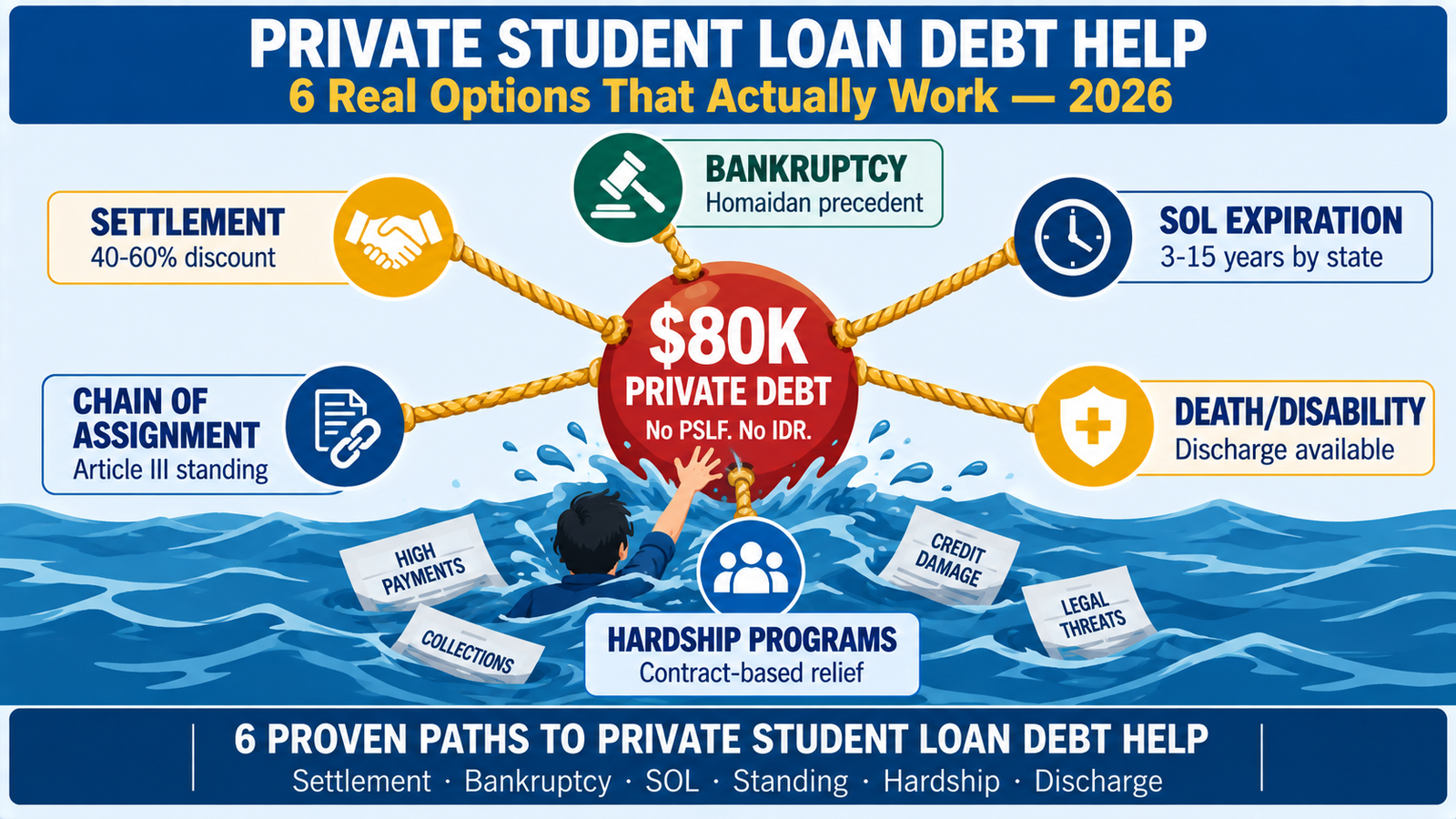
Private student loan debt help works through 6 real legal paths — not through federal forgiveness programs (which only apply to federal loans). The paths are: (1) settlement — negotiating with the current holder (Sallie Mae Bank NYSE:SLM, Navient/Earnest Operations LLC, Discover/Firstmark Services, SoFi Bank NA, Citizens Bank NA, Ascent) to pay reduced lump sum, typically 40-60% of balance for charged-off accounts; (2) bankruptcy discharge under 11 U.S.C. §523(a)(8) with Homaidan v. Sallie Mae 992 F.3d 100 (2d Cir. 2021) precedent making non-qualified private loans dischargeable without undue hardship, plus Brunner v. New York State HESC 831 F.2d 395 (2d Cir. 1987) framework for qualified loans; (3) statute of limitations expiration under state SOL (3-15 years by state); (4) chain of assignment defense on Article III standing grounds (Lujan/Spokeo/TransUnion) particularly effective against NCSLT and debt-buyer-held debt; (5) lender hardship programs reducing payment burden; (6) death and disability discharge from most private lenders. The right path depends on loan status (current, delinquent, charged-off, in litigation), current holder, borrower circumstances, and defensive framework opportunities. Multi-path coordination typically produces better outcomes than any single path alone.
Read the complete 2026 framework below.
In this complete private student loan debt help guide:
Why private student loans need different help than federal loans
The critical gap and why federal programs don’t apply
Option 1: Settlement — the most accessible help
Negotiation framework, realistic outcomes, lump sum funding
Option 2: Bankruptcy discharge — complete help
Homaidan precedent, non-qualified vs qualified loans
Option 3: Statute of limitations — time-based help
State SOL analysis, revival concerns, defensive application
Option 4: Chain of assignment — standing-based help
Article III analysis, NCSLT precedent, debt buyer defects
Option 5: Lender hardship programs
Lender-by-lender hardship assistance programs
Option 6: Death and disability discharge
Lender-specific death and disability provisions
Why private student loans need different help than federal loans
The fundamental reason borrowers struggle to find private student loan debt help is that federal forgiveness programs do NOT apply to private loans. Public Service Loan Forgiveness (PSLF) under 20 U.S.C. §1087e(m), Income-Driven Repayment forgiveness, and Teacher Loan Forgiveness are all federal programs that apply only to federal loans issued or guaranteed under the Higher Education Act (20 U.S.C. §1001 et seq.). Private loans from Sallie Mae Bank, Navient/Earnest, Discover/Firstmark, SoFi, Citizens, Ascent, and other private lenders fall outside this federal framework entirely.
What this means for borrowers seeking help
Borrowers calling private lender servicers asking for “forgiveness programs” or “income-driven payment plans” quickly discover these don’t exist for private loans. Private lenders may offer modified payment plans or hardship forbearance, but these are contract-based accommodations, not statutory forgiveness. Real private student loan debt help requires understanding that different legal mechanisms govern private debt — and that these mechanisms, properly applied, can produce substantial debt reduction and complete elimination outcomes.
The 6-option framework at a glance
Six real options exist for private student loan debt help in 2026: Settlement through negotiation with current holder; Bankruptcy discharge under §523(a)(8) with Homaidan Second Circuit precedent; Statute of limitations expiration under state law (3-15 years); Chain of assignment defense on Article III standing grounds; Lender hardship programs providing contract-based relief; Death and disability discharge from most private lenders. Which option(s) apply depends on your specific loan status, holder, circumstances, and jurisdiction.
Who provides private student loan help
Private student loan debt help comes from various sources with different capabilities: bankruptcy attorneys for §523(a)(8) analysis and Chapter 7/13 filings; consumer debt attorneys for chain of assignment and SOL defense; consulting organizations (like Private Student Relief) coordinating multi-path strategy with attorney-backed partners; CPAs for IRC §108 tax planning on settled debt; direct lender hardship programs for modification. Beware of operators claiming “government-approved private student loan forgiveness” — no such federal program exists.
Option 1: Settlement — the most accessible private student loan debt help
Settlement is often the most accessible private student loan debt help for borrowers with delinquent or charged-off private student loans. Rather than paying the full balance, the borrower negotiates with the current holder to pay a reduced lump sum in full satisfaction of the debt. For borrowers facing seemingly unmanageable private student loan balances, settlement produces immediate measurable debt reduction.
How settlement provides help
Settlement works through voluntary agreement between the borrower and current holder: the borrower pays a specified lump sum (less than the full balance); the current holder accepts this payment in full satisfaction of the entire debt; the remaining balance above the settlement payment is extinguished. For a borrower with $80,000 in charged-off private student loans who settles for $35,000 lump sum, this is immediate help with private student loans — the $45,000 above settlement is eliminated.
Realistic settlement outcomes by loan status
Settlement outcomes vary significantly by loan status: Current/early delinquent (0-90 days) — lenders typically prefer hardship modification over settlement; 90-180 days delinquent — settlement becomes possible as charge-off approaches; Charged-off accounts (180+ days) — often 40-60% discount from balance when approached with proper leverage; Debt-buyer accounts — sometimes 30-50% of balance given lower acquisition cost; NCSLT-held debt — additional discount when chain of assignment weaknesses documented. Approaching settlement from defensive leverage position (chain of assignment, SOL status, bankruptcy alternative) produces materially better outcomes than straightforward settlement attempts.
Finding lump sum funding
Settlement typically requires lump sum payment, which creates a practical obstacle for many borrowers seeking private student loan debt help. Common funding sources: personal savings; family financial assistance with proper documentation; sale of non-essential assets (vehicles, collectibles, investment accounts); 401(k) loan with careful analysis of repayment obligation; tax refund proceeds; small business loan or line of credit if applicable; coordinated timing with seasonal income patterns (year-end bonuses, commission). Payment plans over 3-6 months can sometimes be negotiated when full lump sum is not immediately available.
IRC §108 tax planning for settlement forgiveness
The forgiven portion of settlement is reported on IRS Form 1099-C by the lender and is generally taxable as ordinary income. IRC §108 provides important exclusions that reduce or eliminate this tax liability: Insolvency exclusion (IRC §108(a)(1)(B)) excludes cancelled debt to the extent the borrower was insolvent (liabilities exceeded assets) immediately before cancellation — many borrowers in default qualify; Bankruptcy exclusion (IRC §108(a)(1)(A)) excludes debt cancelled in Chapter 7 or Chapter 13 bankruptcy entirely. CPA analysis before finalizing settlement can eliminate or significantly reduce tax liability on settled private student loan debt.
Option 2: Bankruptcy discharge — complete private student loan debt help
Bankruptcy discharge is the most powerful private student loan debt help mechanism — it can eliminate the entire debt through court order. The prevailing myth that “student loans can never be discharged in bankruptcy” is outdated and incorrect, particularly for private student loans following key Second, Fifth, and Tenth Circuit Court precedents establishing that non-qualified private education loans are dischargeable without any undue hardship showing.
The §523(a)(8) framework
11 U.S.C. §523(a)(8) makes certain educational loans non-dischargeable in bankruptcy unless “undue hardship” is shown. The statute has three categories: §523(a)(8)(A)(i) — loans made, insured, or guaranteed by a governmental unit (federal loans); §523(a)(8)(A)(ii) — “obligation to repay funds received as educational benefit, scholarship, or stipend”; §523(a)(8)(B) — “qualified education loan” as defined in Internal Revenue Code §221(d)(1). Private loans that do NOT fall into any of these three categories are dischargeable in bankruptcy WITHOUT any undue hardship showing — just like ordinary credit card debt.
The Homaidan Second Circuit precedent
Homaidan v. Sallie Mae Inc. 992 F.3d 100 (2d Cir. 2021) established that “educational benefit” under §523(a)(8)(A)(ii) is narrow and limited. The Second Circuit held that Sallie Mae’s direct-to-consumer loans — loans made directly to students without school certification of cost of attendance — do NOT qualify as “educational benefit” under the statute and are therefore dischargeable WITHOUT undue hardship showing. Similar precedents followed in Fifth Circuit (Crocker v. Navient Solutions LLC 941 F.3d 206, 5th Cir. 2019) and Tenth Circuit (McDaniel v. Navient Solutions LLC 973 F.3d 1083, 10th Cir. 2020). These precedents provide the most important private student loan debt help framework available in bankruptcy.
Which private loans discharge under Homaidan
Private loans potentially dischargeable without undue hardship showing under Homaidan and related precedent: (1) direct-to-consumer loans without school certification of cost of attendance; (2) loans exceeding “cost of attendance” limit for the specific enrollment period; (3) loans for non-title IV eligible programs (vocational schools, bar exam preparation, non-degree programs); (4) loans to students not enrolled at least half-time; (5) loans failing other IRC §221(d)(1) requirements. Many Sallie Mae, Navient/Earnest, Discover, SoFi, Citizens, and Ascent loans meet at least one of these criteria upon detailed analysis.
Qualified loans and Brunner test
Private loans that DO qualify under §523(a)(8) require undue hardship showing for discharge. Most federal circuits apply the Brunner test from Brunner v. New York State Higher Education Services Corp. 831 F.2d 395 (2d Cir. 1987): (1) debtor cannot maintain minimal standard of living while repaying; (2) additional circumstances indicate this situation will persist for significant portion of repayment period; (3) debtor has made good faith efforts to repay. Recent case law (In re Rosenberg 594 B.R. 22, Bankr. S.D.N.Y. 2020) and DOJ guidance (November 2022) have moderated how Brunner is applied, making discharge more accessible than historical practice suggested.
Chapter 7 vs Chapter 13 for private student loan help
Chapter 7 bankruptcy provides discharge of qualifying debts in approximately 3-4 months. Chapter 13 involves 3-5 year repayment plan with discharge under 11 U.S.C. §1328 at completion. Chapter selection depends on: means test qualification (Chapter 7 requires income below state median or successful means test under 11 U.S.C. §707(b)(2)); asset preservation needs; whether structured payment plan benefits overall situation. For private student loan debt help, Chapter 7 is often preferred when §523(a)(8) adversary proceeding will produce discharge of non-qualified private loans. Bankruptcy counsel familiar with Homaidan-based adversary proceedings is essential.
Option 3: Statute of limitations — time-based private student loan help
Statute of limitations expiration creates time-based private student loan help for older private student loan debt. When state SOL expires, the current holder loses the legal ability to file a lawsuit to collect the debt. While the debt still legally exists, it becomes effectively uncollectible through litigation — producing substantial practical help for borrowers with aged defaults.
State SOL periods for private student loan debt
SOL periods for written contract debt (private student loans) vary by state: Texas 4 years under Tex. Civ. Prac. & Rem. Code §16.004(a)(3); New York 3 years under CPLR §214(2) per Consumer Credit Fairness Act (CCFA) effective April 7, 2022; Pennsylvania 4 years under 42 Pa.C.S. §5525; Ohio 6 years under Ohio R.C. §2305.06 (reduced 2021); Illinois 10 years under 735 ILCS 5/13-206; Georgia 6 years under O.C.G.A. §9-3-24; California 4 years under CCP §337; Florida 5 years under Fla. Stat. §95.11(2)(b); Delaware 3 years under 10 Del. C. §8106. Accrual typically starts on date of first default or last payment, depending on state law.
Revival concerns for older debt
Borrowers with older private student loan debt must carefully avoid actions that could restart the SOL clock: making any payment on the debt (even small “goodwill” payments) may restart SOL; written acknowledgment of the debt (hardship applications, settlement offers, promise to pay) may create restart; new agreement or settlement with payment plan resets timing. Collectors sometimes specifically solicit small payments or written communications designed to revive time-barred debt. Consulting counsel before communicating with creditors on old private student loan debt prevents inadvertent revival that could restart the SOL clock.
Defensive application when SOL expires
When SOL has expired: (1) debt legally exists but cannot be enforced through litigation; (2) collection calls and letters can be disputed under FDCPA 15 U.S.C. §1692g if third-party collector involved; (3) if lawsuit is filed on time-barred debt, motion to dismiss based on SOL expiration typically succeeds and may support FDCPA counterclaim under 15 U.S.C. §1692e for misrepresentation; (4) credit reporting continues under 7-year FCRA reporting period regardless of SOL; (5) settlement of time-barred debt should proceed carefully to avoid revival. SOL expiration provides effective private student loan assistance by making the debt practically uncollectible.
Option 4: Chain of assignment — standing-based private student loan debt help
Chain of assignment defense produces one of the most powerful forms of private student loan debt help — case dismissal on standing grounds that effectively eliminates the debt when the current plaintiff cannot demonstrate right to enforce. Under Article III of the U.S. Constitution, plaintiffs must have standing to bring a lawsuit, which requires proving ownership of the debt at issue through complete chain of assignment from original lender.
Article III standing framework
Article III standing requires: (1) concrete and particularized injury; (2) causally connected to defendant’s conduct; (3) redressable by court decision. The framework was established in Lujan v. Defenders of Wildlife 504 U.S. 555 (1992), refined in Spokeo, Inc. v. Robins 578 U.S. 330 (2016), and further developed in TransUnion LLC v. Ramirez 594 U.S. 413 (2021). For a plaintiff to sue on private student loan debt, they must establish complete chain of ownership from original lender to themselves. Standing is jurisdictional and can be raised at any stage of litigation, including post-judgment through motion to vacate under FRCP 60(b)(4).
NCSLT-specific application
National Collegiate Student Loan Trusts (NCSLT) hold substantial portfolios of pre-2014 Sallie Mae-originated private loans, now potentially subject to enforcement actions by NCSLT. The Third Circuit’s March 19, 2024 decision established “covered persons” analysis under the Consumer Financial Protection Act; SCOTUS cert denial in December 2024 left Third Circuit precedent in place; various stipulated resolutions have followed through 2026. Borrowers with private student loan debt held by NCSLT have documented pathways to complete debt elimination through motion to dismiss on standing grounds, providing substantial private student loan debt help.
Debt buyer chain defects
Private student loan debt sold to third-party debt buyers after charge-off often has documentation gaps between original lender ownership and current debt buyer’s asserted ownership. Common defects: missing intermediate assignment documentation; assignments executed without adequate documentation of specific debts included in bulk portfolio sales; blank endorsements without proper allonge chain; discrepancies between servicing records and asserted debt buyer ownership. These documentation defects support standing challenges that can achieve case dismissal and effective debt elimination.
Post-judgment vacation
Because standing is jurisdictional, chain of assignment challenges are preserved even after judgment has been entered. Motion to vacate under Federal Rule of Civil Procedure 60(b)(4) (void judgment) can be filed at any time if the underlying judgment was entered without proper plaintiff standing. Particularly relevant for older default judgments where the borrower did not appear at the time — the standing challenge remains available years or even decades later, offering private student loan debt help for borrowers facing wage garnishment or bank account levies on old judgments.
Related resources — complete private student loan debt help ecosystem
The 7-path master framework covering all private student loan forgiveness mechanisms available in 2026.
How to Get Rid of Private Student Loans 2026
5-path framework for getting rid of private student loans with decision framework by loan status.
Debt Forgiveness for Private Student Loans: What Works 2026
6-mechanism framework for real debt forgiveness including tax planning under IRC §108.
Option 5: Lender hardship programs
Major private student loan lenders offer contract-based hardship programs that provide meaningful private student loan assistance. While not “forgiveness” in the strictest sense, these programs can reduce overall debt cost, prevent charge-off, and support longer-term debt reduction strategy. Understanding lender-specific programs is essential for borrowers seeking help directly from their current lender.
Sallie Mae programs
Sallie Mae Bank (NYSE:SLM) offers Loan Modification Program with reduced interest rate (often 4-6%) and reduced payments; Rate Reduction Program for shorter-term relief; Interest-Only Payment Program for 3-12 months; Hardship Forbearance up to 12 months cumulative. Cosigner release after 12 consecutive on-time principal-and-interest payments plus creditworthiness criteria. Death discharge on all Sallie Mae loans; cosigner discharge on borrower death for 2015-and-later loans. Total and Permanent Disability discharge available for qualifying borrowers.
Citizens Bank programs
Citizens Bank NA (NYSE:CFG) offers hardship forbearance and modified payment plans through Loan Servicing Center. Citizens Education Refinance Loan program for refinance when creditworthiness supports lower rate. Cosigner release after 36 consecutive on-time principal-and-interest payments plus additional criteria. Death discharge available.
SoFi programs
SoFi Bank NA (NMLS #696891) offers Unemployment Protection Program providing up to 3 months of paused payments for qualifying job loss, plus short-term Discretionary Forbearance for other hardship situations. Important: SoFi does NOT offer cosigner release — cosigner status is permanent absent full refinance in borrower’s name alone without the cosigner. Death discharge available.
Earnest programs
Earnest Operations LLC (Navient subsidiary since 2017 acquisition for $155M) offers skip-a-payment feature (one skipped payment per 12-month period) and hardship forbearance. More accommodating of alternative income sources including gig work and self-employment income verification. Cosigner release available after qualifying payment period. Death discharge available.
Ascent programs
Ascent Student Loans offers up to 24 months cumulative hardship forbearance plus specific programs for job loss or medical hardship situations. Cosigner release after 24 or 36 consecutive on-time payments depending on loan terms. Important: Ascent college loans originated June 5, 2023 or later contain a contractual §523(a)(8) discharge waiver — meaning the loan contract itself waives the §523(a)(8) protection, making discharge easier. Death and disability discharge available.
Discover / Firstmark Services programs
Firstmark Services (Nelnet NYSE:NNI subsidiary) services former Discover student loans following July 2024 Carlyle Group and KKR acquisition of Discover’s student loan portfolio. Firstmark offers hardship deferment and modified payment programs continuing the Discover framework. Cosigner release policies continue through Firstmark servicing. Death discharge available.
Option 6: Death and disability discharge
Death and disability discharge are contract-based mechanisms for private student loan debt help offered by most major private lenders. These programs operate through the loan’s own terms rather than statutory forgiveness, discharging the debt entirely upon qualifying death or permanent disability.
Federal loan discharge for comparison
For comparison, federal loans have statutory discharge on death under 20 U.S.C. §1087 (Direct Loans) and 20 U.S.C. §1087dd (Perkins Loans). Federal Total and Permanent Disability discharge available for qualifying borrowers. These statutory federal protections do NOT apply to private loans — discharge depends entirely on each specific lender’s contract terms and application process.
Private lender death discharge policies
Death discharge policies vary by lender: Sallie Mae — discharges borrower’s balance upon death; cosigner discharge upon borrower death for 2015-and-later loans. Discover / Firstmark — discharges upon borrower death. SoFi — discharges upon borrower death. Earnest — discharges upon borrower death. Citizens Bank — discharges upon borrower death. Ascent — discharges upon borrower death. Specific terms should be verified against current lender documentation for each loan. Estate administrators should promptly notify each lender with proper documentation to activate discharge processing.
Private lender disability discharge policies
Disability discharge is less consistently offered than death discharge across private lenders. Sallie Mae — Total and Permanent Disability discharge for qualifying borrowers. Ascent — disability discharge available. Other lenders have varying policies that must be verified case-by-case against current lender terms. Documentation typically requires physician certification of permanent disability meeting lender-specific criteria.
Choosing your private student loan debt help strategy
Decision framework by loan status
The right private student loan debt help approach depends on specific circumstances: Current but struggling — lender hardship programs (Option 5), potential refinance, cosigner release if eligible; Recently delinquent — hardship forbearance to prevent charge-off, early settlement discussion if lump sum available; Charged-off accounts — settlement negotiation (Option 1) typically most cost-effective, chain of assignment analysis (Option 4) if NCSLT or debt-buyer-held, SOL analysis (Option 3) for older debt; Lawsuit filed — motion to dismiss on standing or SOL grounds, settlement from defensive position, bankruptcy analysis (Option 2); Judgment entered — motion to vacate on standing grounds preserved under FRCP 60(b)(4); Long-standing debt near SOL — careful SOL analysis, avoid revival; Serious financial distress — bankruptcy analysis including Homaidan §523(a)(8) framework; Death or permanent disability — lender-specific discharge application (Option 6).
Combining multiple options
Effective private student loan debt help outcomes often combine multiple options: chain of assignment analysis creating settlement leverage; SOL analysis creating urgency for current holder to accept lower settlement; bankruptcy analysis under Homaidan as credible alternative; hardship program buying time while developing longer-term strategy; cosigner release combined with refinance in borrower’s name alone. Coordinated multi-option strategy typically produces materially better outcomes than any single option alone.
Working with professional resources
Given the complexity of the 6 options and their interactions, working with professional resources typically produces better outcomes than DIY approaches. Options include: bankruptcy counsel familiar with Homaidan §523(a)(8) adversary proceeding practice; state-licensed consumer attorneys for chain of assignment challenges and SOL defense; consulting organizations familiar with complete defensive framework; CPAs for IRC §108 tax analysis. Private Student Relief‘s attorney-backed partner provider network coordinates these resources for comprehensive analysis.
Common private student loan debt help myths
Myth 1
“No real help exists for private student loans”
Reality: Real private student loan debt help absolutely exists through 6 proven mechanisms. The confusion arises because federal forgiveness programs (PSLF, IDR forgiveness) do NOT apply to private loans — but this doesn’t mean no help exists. Settlement, bankruptcy discharge under §523(a)(8) with Homaidan precedent, SOL expiration, chain of assignment defense, lender hardship programs, and death/disability discharge are all real options. Millions of borrowers receive measurable debt reduction through these mechanisms every year.
Myth 2
“Private student loans can never be discharged in bankruptcy”
Reality: This widespread myth is outdated and incorrect for private loans. Following Homaidan v. Sallie Mae 992 F.3d 100 (2d Cir. 2021), non-qualified private education loans are dischargeable WITHOUT any undue hardship showing. Similar precedents in Fifth Circuit (Crocker v. Navient 941 F.3d 206) and Tenth Circuit (McDaniel v. Navient 973 F.3d 1083) establish broad discharge availability. Even qualified loans can discharge under Brunner test with proper analysis. Bankruptcy counsel with §523(a)(8) adversary proceeding experience should evaluate every borrower’s specific situation.
Myth 3
“Settlement will ruin my credit for 10+ years”
Reality: Settlement credit impact depends heavily on current status. For accounts already charged-off (where most settlements occur), the credit damage has already been incurred — settlement typically improves the account status to “settled” rather than “charged-off.” Credit reporting under the Fair Credit Reporting Act (FCRA) is limited to 7 years from original delinquency date regardless of settlement timing. Most borrowers see credit score recovery within 12-24 months of settlement completion as the account ages. Credit score concerns should not prevent exploring private student loan debt help when the alternative is continued default and potential lawsuit.
Myth 4
“If I ignore private student loans long enough, they go away”
Reality: Ignoring private student loans does not make them go away and often makes the situation significantly worse. While statute of limitations expiration can make debt uncollectible through litigation (varying 3-15 years by state), many lenders file lawsuits well before SOL expiration — resulting in default judgments with wage garnishment or bank account levies if the borrower doesn’t appear. Interest and fees continue accruing during the ignore period. Credit reporting continues for 7 years from original delinquency. Proactive private student loan debt help through the 6 options in this guide produces materially better outcomes than passive waiting.
Frequently asked questions
1. What is private student loan debt help?
Private student loan debt help refers to the real legal and financial mechanisms that reduce or eliminate private student loan debt from lenders like Sallie Mae Bank NYSE:SLM, Navient/Earnest Operations LLC, Discover/Firstmark Services, SoFi Bank NA, Citizens Bank NA, and Ascent. Six real options exist: settlement negotiation, bankruptcy discharge under 11 U.S.C. §523(a)(8) with Homaidan v. Sallie Mae Second Circuit precedent, statute of limitations expiration, chain of assignment defense on Article III standing grounds, lender hardship programs, and death/disability discharge. Federal forgiveness programs (PSLF, IDR forgiveness) do NOT apply to private loans — the help comes through these alternative mechanisms.
2. Where can I get help with private student loans?
Help with private student loans is available from several professional sources depending on which option fits your situation: bankruptcy attorneys familiar with Homaidan §523(a)(8) analysis for discharge filings; state-licensed consumer attorneys for chain of assignment challenges and SOL defense; consulting organizations (like Private Student Relief) coordinating multi-path strategy with attorney-backed partner providers; CPAs for IRC §108 tax planning on settled debt; direct lender hardship programs for current borrowers. Beware of operators claiming “government-approved private student loan forgiveness” — no such federal program exists for private loans.
3. Can private student loan debt be forgiven?
Yes, private student loan debt can be forgiven through multiple mechanisms, though not through federal programs. Settlement produces partial forgiveness of the balance above the settlement payment (typically 40-60% discount for charged-off accounts). Bankruptcy discharge under §523(a)(8) with Homaidan precedent produces complete forgiveness for non-qualified private loans without undue hardship showing. Chain of assignment challenges can eliminate debt through case dismissal on standing grounds. SOL expiration makes debt uncollectible. Death and disability discharge forgives qualifying debt. Each mechanism produces real private student loan assistance when applicable.
4. How much does private student loan debt help cost?
Cost structure varies by help type: Bankruptcy attorney fees for Chapter 7 with §523(a)(8) adversary proceeding typically $2,500-$5,000 plus adversary proceeding costs; chain of assignment challenges by consumer attorney typically on contingency or flat fee ranging $1,500-$5,000; consulting organizations typically charge based on scope with varying structures; CPA tax analysis typically $300-$800. Avoid operators demanding large upfront fees without clear scope — scam operations in private student loan debt relief space have historically charged thousands upfront for services never delivered. Private Student Relief partner providers work on documented engagement terms with no upfront enrollment fees.
5. How long does private student loan debt help take?
Timelines vary significantly by help type: settlement typically 2-6 months from initial negotiation to completion; bankruptcy Chapter 7 typically 3-4 months from filing to discharge (plus 60-90 days for §523(a)(8) adversary proceeding if needed); Chapter 13 typically 3-5 years to plan completion; chain of assignment challenges typically 6-18 months for motion practice through dismissal; statute of limitations timing depends on state law (3-15 years from default); lender hardship program applications typically 30-90 days for approval. Realistic expectations are essential — unlike the 20-25 year federal IDR forgiveness timeline, private student loan debt help through these mechanisms can produce measurable results in months rather than decades.
6. Can I get help with private student loans if I’m already being sued?
Yes, borrowers facing active private student loan lawsuits often have the strongest leverage for favorable outcomes. Options when sued: (1) answer the lawsuit (never ignore — default judgment is the worst outcome); (2) raise defenses including statute of limitations, chain of assignment challenges on Article III standing grounds, lack of proper documentation; (3) file counterclaims under FDCPA 15 U.S.C. §1692g if third-party collector involved; (4) negotiate settlement from defensive position with motion-to-dismiss leverage; (5) file bankruptcy to invoke automatic stay under 11 U.S.C. §362 and address debt through discharge analysis. Legal representation is strongly recommended when facing litigation. Private student loan debt help in litigation context often produces better outcomes than pre-litigation negotiations.
7. What’s the difference between private student loan debt help and federal loan help?
The two frameworks are entirely different and should never be confused. Federal loan help uses federal statutory programs: PSLF under 20 U.S.C. §1087e(m), IDR forgiveness, Teacher Loan Forgiveness, death discharge under 20 U.S.C. §1087, Total and Permanent Disability discharge. These apply ONLY to federal loans issued or guaranteed under the Higher Education Act. Private student loan debt help uses the 6 mechanisms in this guide: settlement, bankruptcy discharge, SOL expiration, chain of assignment, lender programs, death/disability discharge. These apply to private loans from Sallie Mae, Navient/Earnest, Discover/Firstmark, SoFi, Citizens, Ascent, and other private lenders. Mixing the two frameworks is a common and costly mistake — ensure you know whether your loans are federal or private before pursuing any specific help.
Need Private Student Loan Debt Help?
Free specialist review of all 6 options for your private student loan situation.
Settlement negotiation analysis, bankruptcy discharge evaluation under §523(a)(8) with Homaidan precedent, statute of limitations analysis by state, chain of assignment defensive framework for NCSLT-held and debt-buyer debt, lender hardship program qualification across Sallie Mae/Navient/Earnest/Discover/Firstmark/SoFi/Citizens/Ascent, and coordinated multi-option approach for maximum private student loan debt help. Free eligibility review with attorney-backed partner provider — no upfront fees.
Get a free eligibility review →
5-minute review · No obligation · Zero upfront fees · Since 2015 · 48 states served
About the author
Henry Silva — Private Student Loan Debt Specialist
10+ years experience delivering real private student loan debt help outcomes: settlement negotiation with major private lenders (Sallie Mae Bank NYSE:SLM, Navient/Earnest Operations LLC, Discover/Firstmark Services after July 2024 Carlyle+KKR sale, SoFi Bank NA NMLS #696891, Citizens Bank NA NYSE:CFG, Ascent Student Loans), bankruptcy discharge analysis under 11 U.S.C. §523(a)(8) with Homaidan v. Sallie Mae 992 F.3d 100 (2d Cir. 2021) precedent, Crocker v. Navient 941 F.3d 206 (5th Cir. 2019), McDaniel v. Navient 973 F.3d 1083 (10th Cir. 2020), Brunner v. New York State Higher Education Services Corp. 831 F.2d 395 (2d Cir. 1987) framework for qualified loans, In re Rosenberg 594 B.R. 22 (Bankr. S.D.N.Y. 2020) updated application, statute of limitations analysis across all 50 states, hardship program qualification, cosigner release strategy, chain of assignment challenges under Article III standing doctrine (Lujan/Spokeo/TransUnion), NCSLT Third Circuit precedent application, IRC §108(a)(1)(A) bankruptcy and IRC §108(a)(1)(B) insolvency tax exclusion analysis, and coordinated multi-path strategy for maximum debt reduction outcomes. Henry works with Private Student Relief’s attorney-backed partner provider network to review individual scenarios across all 6 private student loan assistance mechanisms.
Legal Disclaimer and Sources
This article is provided for informational purposes only and does not constitute legal, tax, or financial advice. Private Student Relief is a consulting and matching organization operated by Joco (555 Anton Blvd, Suite 368, Costa Mesa, CA 92626) — not a law firm, debt settlement company, debt consolidation company, or loan provider. Debt validation services are performed by an attorney-backed partner provider (Panamerican Consulting LLC, Las Vegas, NV) under independent business credentials. Ratings, BBB accreditation, and AADR membership referenced on the PSR website belong to the partner provider. Private student loan debt help pathway availability depends on loan characteristics, lender terms, borrower circumstances, and jurisdiction. Individual results vary. Since 2015. 48 states served. Not available in South Carolina or Mississippi.
Federal student loan program citations (for comparison, these do NOT apply to private student loans): Higher Education Act (20 U.S.C. §1001 et seq.); Public Service Loan Forgiveness (20 U.S.C. §1087e(m)); Income-Driven Repayment forgiveness (federal loan regulatory framework); Direct Loan death discharge (20 U.S.C. §1087); Perkins Loan death discharge (20 U.S.C. §1087dd). These federal programs apply ONLY to federal loans.
Bankruptcy Code references: 11 U.S.C. §523(a)(8) (student loan discharge exceptions with §523(a)(8)(A)(i) governmental unit, §523(a)(8)(A)(ii) educational benefit, §523(a)(8)(B) qualified education loan categories); 11 U.S.C. §362 (automatic stay); 11 U.S.C. §707(b)(2) (means test); 11 U.S.C. §1328 (Chapter 13 discharge). Key bankruptcy precedent: Homaidan v. Sallie Mae 992 F.3d 100 (2d Cir. 2021) — direct-to-consumer private education loans dischargeable without undue hardship; Brunner v. New York State Higher Education Services Corp. 831 F.2d 395 (2d Cir. 1987) — undue hardship test; Crocker v. Navient Solutions LLC 941 F.3d 206 (5th Cir. 2019); McDaniel v. Navient Solutions LLC 973 F.3d 1083 (10th Cir. 2020); In re Rosenberg 594 B.R. 22 (Bankr. S.D.N.Y. 2020). Article III standing precedent: Lujan v. Defenders of Wildlife 504 U.S. 555 (1992); Spokeo, Inc. v. Robins 578 U.S. 330 (2016); TransUnion LLC v. Ramirez 594 U.S. 413 (2021). Federal Rules of Civil Procedure: FRCP 60(b)(4) (void judgment). Internal Revenue Code: IRC §221(d)(1) (qualified education loan definition); IRC §108(a)(1)(A) (bankruptcy exclusion); IRC §108(a)(1)(B) (insolvency exclusion). FDCPA: 15 U.S.C. §1692g (debt validation); 15 U.S.C. §1692e (deceptive practices).
Statute of limitations for written contract debt (private student loans) by state: Texas 4 years under Tex. Civ. Prac. & Rem. Code §16.004(a)(3); New York 3 years under CPLR §214(2) per Consumer Credit Fairness Act (CCFA) effective April 7, 2022; Pennsylvania 4 years under 42 Pa.C.S. §5525; Ohio 6 years under Ohio R.C. §2305.06 (reduced 2021); Illinois 10 years under 735 ILCS 5/13-206; Georgia 6 years under O.C.G.A. §9-3-24; California 4 years under CCP §337; Florida 5 years under Fla. Stat. §95.11(2)(b); Delaware 3 years under 10 Del. C. §8106. Complete state SOL analysis should be verified against current statutes for each specific borrower situation.
Lender information current as of October 2026 per publicly available documentation: Sallie Mae Bank NYSE:SLM; Navient Corporation NYSE:NAVI (2014 Sallie Mae split; 2017 Earnest acquisition $155M; December 2021 Aidvantage transfer federal exit; January 2022 state attorneys general settlement $1.85B); Earnest Operations LLC (Navient subsidiary since 2017); Discover student loans acquired by Carlyle Group and KKR July 2024 with servicing transitioned to Firstmark Services (Nelnet NYSE:NNI subsidiary); SoFi Bank NA NMLS #696891 (chartered as national bank 2022); Citizens Bank NA NYSE:CFG; Ascent Student Loans with June 5, 2023 originated loans having contractual §523(a)(8) discharge waiver. Specific lender program details subject to change and should be verified directly with current lender documentation.
Private student loan debt help strategy requires case-by-case analysis coordinating loan characteristics, lender identification, chain of assignment history, borrower jurisdiction, defensive framework opportunities, and specific circumstances. This article provides general framework information; specific settlement negotiations, bankruptcy filings under Homaidan precedent, chain of assignment challenges, hardship program applications, cosigner release strategies, and coordinated multi-option approaches must be evaluated for each borrower’s individual situation by counsel or consulting resources familiar with the complete private student loan debt help framework. Last reviewed: October 2026.