

Informational content only. Not legal, tax, or financial advice. Private Student Relief is a consulting organization, not a law firm. Debt validation services are executed by an attorney-backed partner provider. Statute of limitations analysis depends on loan characteristics, contract terms, borrower circumstances, and jurisdiction. State SOL periods may be modified by current statutes — verify with current state law. Last reviewed: October 2026.
Written by Henry Silva
Private Student Loan Debt Specialist · 10+ years experience in private student loan statute of limitations by state analysis across all 50 states for debt from Sallie Mae Bank NYSE:SLM, Navient/Earnest Operations LLC, Discover/Firstmark Services, SoFi Bank NA, Citizens Bank NA, Ascent Student Loans, NCSLT trusts, and third-party debt buyers. Expertise includes accrual date determination (first default vs last payment), governing law clause analysis, revival avoidance, FDCPA leverage under 15 U.S.C. §1692e and §1692g for time-barred debt collection, motion to dismiss practice for time-barred lawsuits, and coordinated SOL strategy with other defensive framework elements. Last reviewed: October 2026.
If you have older private student loan debt, understanding private student loan statute of limitations by state may provide the most powerful defensive position available. State SOL periods for written contract debt (which includes private student loans) range from 3 years to 15 years, varying by state. When SOL expires, the current holder loses the legal ability to file a lawsuit to collect — making the debt effectively uncollectible through litigation. This complete 2026 guide covers SOL for all 50 states and D.C., how accrual date is determined (first default vs last payment vs other triggers), governing law clause complications, critical revival concerns that can restart the SOL clock, FDCPA leverage under 15 U.S.C. §1692e for time-barred debt collection, and defensive application when SOL has expired. For borrowers with old private student loan debt from Sallie Mae, Navient/Earnest, Discover/Firstmark, SoFi, Citizens, Ascent, NCSLT, or debt buyers, SOL analysis is often the first and most important defensive step.
Quick Answer
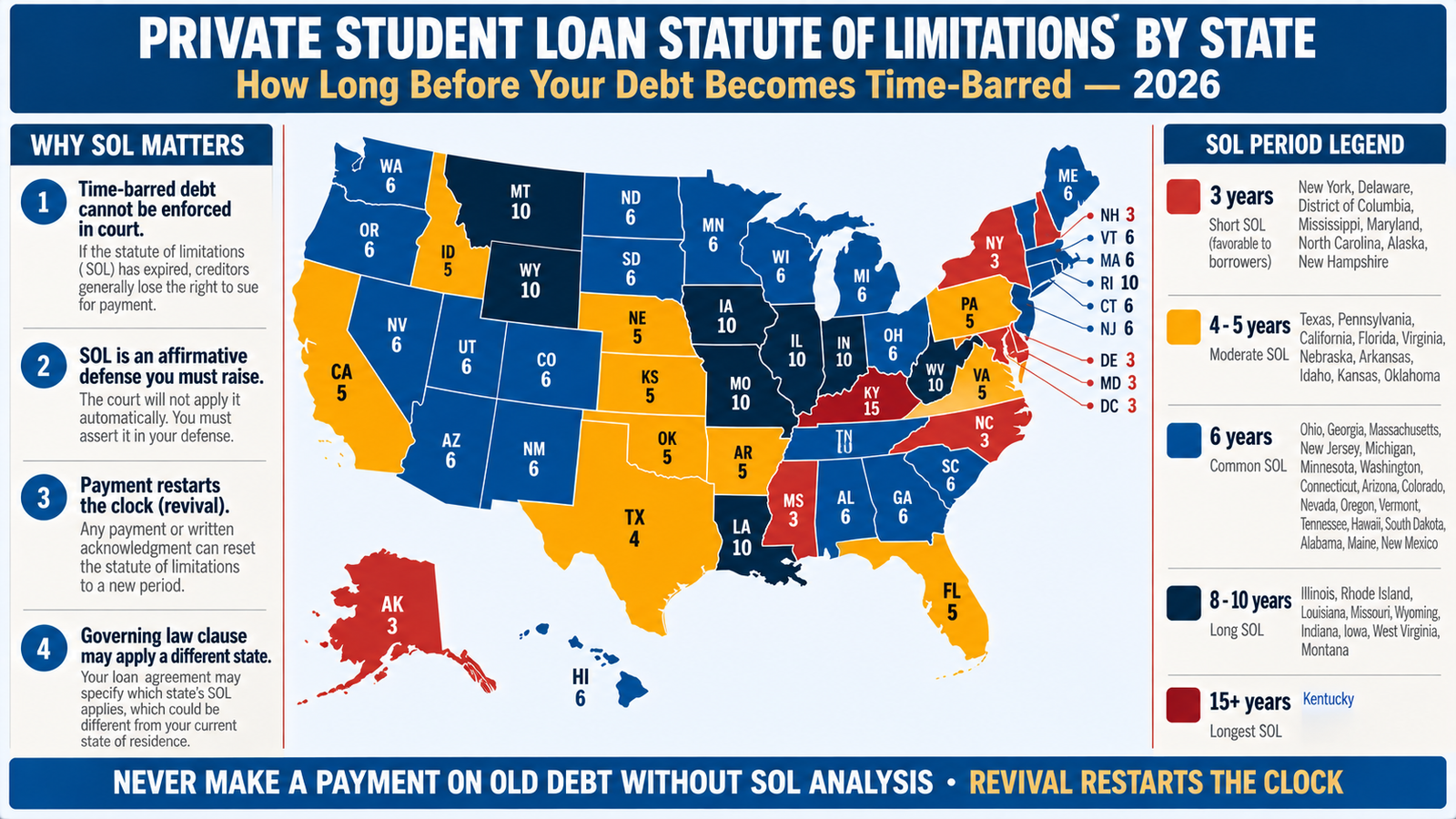
Private student loan statute of limitations by state varies from 3 years to 15 years for written contract debt. Short SOL states (3 years): Delaware, New York (per CCFA April 7, 2022), District of Columbia. Common 4-year SOL states: Texas, Pennsylvania, California. Common 5-year SOL states: Florida, Virginia, Nebraska. Common 6-year SOL states: Ohio, Georgia, Massachusetts, New Jersey. Common 10-year SOL states: Illinois, Rhode Island. Longest SOL states (15 years): Kentucky, Ohio in some circumstances. SOL accrual typically begins on date of first default or date of last payment — state law and specific contract language determine exact accrual trigger. Critical considerations: governing law clause in loan contract may select different state’s law from borrower’s residence (common for private loans — Delaware law often selected); payments or written acknowledgment during negotiations may restart SOL; FDCPA 15 U.S.C. §1692e supports counterclaim for time-barred debt collection by third-party collectors; motion to dismiss on SOL expiration grounds typically succeeds when properly raised as affirmative defense in answer to lawsuit. Older private student loan debt from Sallie Mae Bank, Navient/Earnest Operations LLC, Discover/Firstmark Services, SoFi Bank NA, Citizens Bank NA, Ascent, NCSLT trusts, and third-party debt buyers may be time-barred — careful SOL analysis is essential before any communication with creditors on old debt to avoid inadvertent revival.
Read the complete 50-state SOL guide below.
In this complete 50-state SOL guide:
What statute of limitations is and how it works
Legal effect, accrual, written vs oral contract distinctions
Which state’s SOL applies to your debt
Governing law clause vs residence vs forum state
Complete 50-state SOL table (plus DC)
State-by-state SOL for written contract debt with statutory citations
Revival concerns and avoidance
Actions that can restart SOL and how to prevent them
Defensive application when SOL has expired
Motion to dismiss practice and FDCPA counterclaim
SOL interaction with other defensive mechanisms
Settlement leverage, chain of assignment, bankruptcy coordination
What statute of limitations is and how it works
Statute of limitations (SOL) is a state law that sets the maximum time period after an event (such as debt default) within which a legal action can be filed. For debt collection, SOL means that after the expiration period, the creditor cannot file a lawsuit to collect — the debt is “time-barred.” Understanding how SOL actually works is foundational to using private student loan statute of limitations as a defensive framework.
The legal effect of SOL expiration
When state SOL expires on a debt: (1) the creditor loses the right to file a lawsuit for collection — any lawsuit filed after expiration should be dismissed as time-barred; (2) the debt still legally exists but cannot be enforced through courts; (3) credit reporting continues under separate FCRA 7-year rule from original delinquency (SOL and credit reporting have different time periods); (4) in some states, SOL affects post-expiration collection activity (prohibited practices under state consumer protection laws); (5) FDCPA may provide additional protections against collection on time-barred debt by third-party collectors.
SOL is affirmative defense — must be raised
Critical procedural point: SOL is an affirmative defense that must be raised by the defendant in a lawsuit. Courts will not raise SOL on their own — if the defendant doesn’t appear or doesn’t raise SOL in the answer, judgment can be entered on time-barred debt. Many borrowers lose the SOL defense by failing to appear at the lawsuit (default judgment) or by failing to raise SOL properly in their answer. This procedural requirement makes professional representation essential when SOL defense is available.
Written contract vs oral contract SOL
States typically have different SOL periods for written contracts versus oral contracts. Private student loans are virtually always written contracts (promissory notes with specific written terms), so the written contract SOL applies. Oral contract SOL (often shorter) does not apply unless the specific loan was somehow created without written documentation (extremely rare for private student loans). When reviewing state SOL tables, use the “written contract” column rather than oral contract or general civil action SOL.
Accrual: when SOL starts running
SOL accrual (when the clock starts) is critical and varies by state law and sometimes by contract terms. Common accrual triggers: Date of first default — when borrower first missed a required payment (common accrual trigger in many states); Date of last payment — when borrower last made any payment on the debt; Date of acceleration — when lender declared full balance due (some loan contracts specify acceleration triggers); Date of charge-off — when lender wrote off account (less common accrual trigger). State case law typically determines which trigger applies in the absence of specific contract language.
Partial payments and SOL
In most states, partial payments on a debt restart the SOL clock — meaning the accrual date resets to the date of the most recent payment. This has important implications: a borrower who makes a small payment in year 7 of a 10-year SOL state may restart the clock, extending the enforcement period by up to 10 more years. This revival concern is one of the most common ways borrowers inadvertently lose SOL defense. For old debt approaching SOL expiration, avoiding ALL payments (even small ones) is often essential to preserve the defense.
Which state’s SOL applies to your debt
A critical and often confusing question in private student loan statute of limitations by state analysis is determining which state’s SOL law actually applies to a specific debt. This can be surprisingly complex because multiple states may be involved: borrower’s current residence; borrower’s residence when loan originated; state where loan originated; state where lender is based; state selected in loan contract’s governing law clause; state where lawsuit is filed. The answer depends on specific legal analysis.
Governing law clause in loan contract
Most private student loan contracts contain a “governing law” or “choice of law” clause specifying which state’s substantive law governs the contract. Common choices: Delaware (very common for many private lenders due to favorable banking law); Pennsylvania; the lender’s home state; borrower’s residence at origination. The governing law clause often determines which state’s SOL applies for enforcement purposes, though some states have “borrowing statutes” that modify this. Reviewing the original loan contract for the governing law clause is essential first step.
State borrowing statutes
Many states have “borrowing statutes” that apply the shorter SOL between the forum state (where lawsuit filed) and the state governing the contract. For example, a lawsuit filed in Illinois (10-year SOL) on a contract governed by New York law (3-year SOL per CCFA) would apply the shorter 3-year New York SOL under Illinois’s borrowing statute. Borrowing statutes benefit borrowers in long-SOL states when the contract is governed by shorter-SOL state law. State-specific borrowing statute analysis is essential.
Forum selection and jurisdiction
The state where a lawsuit is filed (forum state) matters for SOL analysis — forum state’s procedural law applies to SOL affirmative defense, forum state’s borrowing statute (if any) may apply, and personal jurisdiction over the borrower generally requires borrower contact with the forum state. For private student loans, lawsuits are typically filed in borrower’s state of residence (where personal jurisdiction is established). This often creates alignment between forum state law and borrower residence law.
The practical analysis
Practical SOL analysis typically proceeds: (1) identify loan contract governing law clause; (2) identify borrower’s current state of residence; (3) identify state where any lawsuit has been or likely will be filed; (4) analyze each applicable state’s SOL and borrowing statute; (5) determine which SOL applies through choice of law analysis. For most private student loan debt, the ultimately applicable SOL is either: (a) the state where borrower currently resides and might be sued; (b) the shorter state SOL via borrowing statute; or (c) the state specified in governing law clause. Consulting counsel for specific analysis is strongly recommended for borrowers near SOL expiration.
Complete 50-state SOL table (plus DC)
The following table lists statute of limitations for written contract debt (which includes private student loans) across all 50 states and the District of Columbia. State SOL periods may be modified by current legislation — verify with current state statutes before relying on these for specific cases. These SOL periods reflect general written contract SOL; specific loan contracts may be subject to different analysis through governing law clauses.
Short SOL states (3 years)
Delaware — 3 years under 10 Del. C. §8106
New York — 3 years under CPLR §214(2) per Consumer Credit Fairness Act (CCFA) effective April 7, 2022 (previously 6 years under CPLR §213(2))
District of Columbia — 3 years under D.C. Code §12-301
Mississippi — 3 years under Miss. Code §15-1-29 (note: PSR does not serve Mississippi)
4-year SOL states
Texas — 4 years under Tex. Civ. Prac. & Rem. Code §16.004(a)(3)
Pennsylvania — 4 years under 42 Pa.C.S. §5525
California — 4 years under CCP §337
Alabama — 6 years under Ala. Code §6-2-34 for written contracts (3 years for oral)
Arizona — 6 years under A.R.S. §12-548 for written contracts (6 years for credit)
Oregon — 6 years under ORS §12.080
South Dakota — 6 years under SDCL §15-2-13
5-year SOL states
Florida — 5 years under Fla. Stat. §95.11(2)(b)
Virginia — 5 years under Va. Code §8.01-246(2)
Nebraska — 5 years under Neb. Rev. Stat. §25-205
Arkansas — 5 years under Ark. Code §16-56-111
Idaho — 5 years under Idaho Code §5-216
New Hampshire — 3 years under RSA §508:4 (shorter)
6-year SOL states (common)
Ohio — 6 years under Ohio R.C. §2305.06 (reduced from 8 years in 2021)
Georgia — 6 years under O.C.G.A. §9-3-24
Massachusetts — 6 years under M.G.L. c.260 §2
New Jersey — 6 years under N.J.S.A. §2A:14-1
Connecticut — 6 years under Conn. Gen. Stat. §52-576
Maryland — 3 years under Md. Code, Cts. & Jud. Proc. §5-101 (shorter — 3 years)
Michigan — 6 years under MCL §600.5807(8)
Minnesota — 6 years under Minn. Stat. §541.05
Washington — 6 years under RCW §4.16.040
Hawaii — 6 years under HRS §657-1
Vermont — 6 years under 12 V.S.A. §511
North Carolina — 3 years under N.C. Gen. Stat. §1-52 (shorter — 3 years)
South Carolina — 3 years under S.C. Code §15-3-530 (note: PSR does not serve South Carolina)
Tennessee — 6 years under Tenn. Code §28-3-109
West Virginia — 10 years under W. Va. Code §55-2-6 (longer)
Alaska — 3 years under AS §09.10.053 (shorter — 3 years)
8-year SOL states
Missouri — 10 years under RSMo. §516.110 for written contracts (longer)
Montana — 8 years under MCA §27-2-202
Wyoming — 10 years under W.S. §1-3-105 (longer)
Nevada — 6 years under NRS §11.190
10-year SOL states
Illinois — 10 years under 735 ILCS 5/13-206
Rhode Island — 10 years under R.I. Gen. Laws §9-1-13
Louisiana — 10 years under La. Civil Code art. 3499 (prescription)
Missouri — 10 years under RSMo. §516.110
Wyoming — 10 years under W.S. §1-3-105
Indiana — 10 years under IC §34-11-2-9 (previously 20 years; reduced)
Iowa — 10 years under Iowa Code §614.1
Kansas — 5 years under K.S.A. §60-511 (shorter — 5 years)
Maine — 6 years under 14 M.R.S.A. §752
North Dakota — 6 years under N.D.C.C. §28-01-16
Utah — 6 years under Utah Code §78B-2-309 (previously 4 years)
Oklahoma — 5 years under 12 O.S. §95
New Mexico — 6 years under N.M.S.A. §37-1-3
Longest SOL states (15+ years)
Kentucky — 15 years under KRS §413.090 for written contracts
West Virginia — 10 years under W. Va. Code §55-2-6
Colorado — 6 years under C.R.S. §13-80-103.5 (previously longer)
Wisconsin — 6 years under Wis. Stat. §893.43
Important verification note
State SOL periods are subject to legislative modification. New York’s CCFA (effective April 7, 2022) reduced SOL from 6 years to 3 years — a significant change benefiting NY borrowers. Ohio reduced SOL from 8 years to 6 years in 2021. Other states periodically modify SOL. Current statutory verification is essential before relying on SOL for specific cases. State legislative tracking services or legal research tools provide current statute versions. Case law in each state may also affect how SOL is interpreted (accrual triggers, revival rules, borrowing statute application).
Revival concerns and avoidance
Perhaps the most critical practical aspect of private student loan statute of limitations is avoiding actions that restart (revive) the SOL clock. Many borrowers inadvertently revive time-barred debt through actions that seem harmless but have significant legal consequences. Understanding revival mechanisms and avoiding them is essential for preserving SOL defense.
Actions that typically revive SOL
Actions that commonly restart SOL in most states: (1) Making any payment on the debt — even a small “goodwill” or “token” payment of $5-$20 may restart the entire SOL period; (2) Written acknowledgment of the debt — any writing (letter, email, text) acknowledging that the debt exists and is owed may restart SOL; (3) Promise to pay — any written or sometimes verbal promise to pay the debt in the future may restart SOL; (4) New agreement — settlement agreement, payment plan, or forbearance agreement typically creates new obligation that resets SOL on new terms. Each state has specific rules about what constitutes revival.
Collector tactics designed to trigger revival
Debt collectors sometimes employ specific tactics to trigger SOL revival on time-barred debt: (1) Small payment offers — “just pay $10 to show good faith” (specifically to restart SOL); (2) Settlement letters requesting borrower response (any written response acknowledging debt may trigger revival); (3) Hardship applications requiring borrower acknowledgment of debt; (4) Promise to pay forms or similar documents; (5) Phone calls seeking verbal acknowledgment of the debt. Borrowers with old debt approaching or past SOL should be extremely cautious in ALL communications with creditors — consulting counsel before responding to any communication is strongly recommended.
How to communicate without revival
When communication with collectors on old debt is necessary (such as to invoke FDCPA validation rights or raise SOL defense), communication should: (1) be in writing only (preserves documentation); (2) specifically identify the debt as time-barred and demand cessation of collection activity; (3) demand FDCPA validation under 15 U.S.C. §1692g; (4) explicitly state that no acknowledgment of debt validity is being made; (5) avoid any payment, promise to pay, or admission that the debt is owed. Template letters prepared by consumer attorneys can facilitate these communications without triggering revival.
State variation in revival rules
Revival rules vary by state. Some states have “statute of frauds” style requirements that revival requires written acknowledgment with specific language. Other states allow revival through less formal means. New York’s CCFA (April 7, 2022) specifically addressed revival concerns, limiting what constitutes revival for consumer debt and providing greater borrower protection. California and some other states also have specific revival limitations. State-specific analysis of revival rules is essential — what revives SOL in one state may not revive in another.
Even “safe” communications can backfire
Borrowers sometimes attempt informal “I don’t owe this” or “I never agreed to this” communications thinking they protect their position — but these can be interpreted as acknowledging the debt exists and challenging only specific terms, potentially supporting revival argument. The safest approach is: no verbal communication; written communication only through counsel; letters specifically disclaiming any acknowledgment of validity; invoking FDCPA rights without discussing underlying debt merits. When in doubt, no response is often safer than attempted response.
Defensive application when SOL has expired
When SOL has expired on private student loan debt, several defensive applications become available. Properly leveraging SOL expiration can produce case dismissal, FDCPA counterclaim recovery, and effective debt elimination through uncollectibility.
Motion to dismiss time-barred lawsuit
When a lawsuit is filed on time-barred debt, the proper defensive response: (1) answer the lawsuit timely raising SOL as affirmative defense; (2) file motion to dismiss or motion for summary judgment on SOL grounds; (3) prove accrual date through documentation (payment history, charge-off date, correspondence); (4) prove expiration of applicable state SOL; (5) argue dismissal with prejudice. Motion typically includes supporting declaration or affidavit with payment history and relevant documents. Successful SOL motion produces case dismissal with prejudice.
FDCPA counterclaim for time-barred debt collection
When third-party debt collector files lawsuit on time-barred debt, FDCPA counterclaim may be available: 15 U.S.C. §1692e prohibits deceptive practices — filing lawsuit on time-barred debt may constitute false representation of debt enforceability; 15 U.S.C. §1692f prohibits unfair practices; Successful FDCPA counterclaims support statutory damages up to $1,000 per violation, actual damages, and attorney fees. Combined motion to dismiss plus FDCPA counterclaim often produces favorable settlement to avoid both dismissal and FDCPA liability.
State UDAP claims
Many states have Unfair and Deceptive Acts and Practices (UDAP) laws that supplement FDCPA. Collecting on time-barred debt may violate state UDAP provisions. State UDAP claims sometimes provide: (1) treble damages (3x actual damages); (2) attorney fees; (3) specific state consumer protection remedies. State UDAP analysis supplements FDCPA counterclaim strategy in states with strong consumer protection laws (California, New York, Massachusetts, Washington, others).
Credit reporting disputes
While SOL and credit reporting have different time periods (SOL varies by state 3-15 years; FCRA 7 years from original delinquency regardless of SOL), SOL expiration can support credit reporting disputes in some circumstances. If collector reports time-barred debt in misleading way (e.g., recent collection activity dates on old debt), FCRA dispute may be appropriate. Credit reporting disputes separate from SOL defense but may be coordinated.
Settlement from SOL leverage position
Even time-barred debt can be settled — some borrowers choose settlement to resolve credit reporting or stop collection calls despite time-barred status. Settlement from SOL leverage position typically produces substantially better outcomes than regular settlement: current holder recognizes case dismissal is likely, FDCPA counterclaim exposure exists, and recovery through other means is unlikely. Settlement discounts on time-barred debt sometimes reach 10-20% of balance (90% discount from borrower perspective). Settlement must carefully avoid revival that could restart SOL on remaining balance.
Related resources — complete SOL ecosystem
The 7-path master framework covering all private student loan forgiveness mechanisms available in 2026.
How to Get Your Student Loans Dismissed 2026
6 proven legal defenses for case dismissal including SOL expiration as primary defense.
Private Student Loan Settlement 2026: Complete Guide
Settlement negotiation framework with SOL leverage producing substantial discounts.
SOL interaction with other defensive mechanisms
SOL + chain of assignment defense
For debt that has been assigned to debt buyers or trusts (like NCSLT), SOL analysis combines powerfully with chain of assignment challenges on Article III standing grounds. Current holder must prove both: (1) complete chain of ownership from original lender; AND (2) that lawsuit is filed within applicable SOL. Failure on either prong produces dismissal. Combined motion addressing both standing and SOL produces strongest possible defensive position.
SOL + bankruptcy coordination
For borrowers with multiple debts including some time-barred: SOL defense can resolve some debts without bankruptcy; remaining debts may require bankruptcy for comprehensive resolution. Coordination requires: filing bankruptcy before any revival events; raising SOL defense for time-barred debts within bankruptcy proceeding; strategic timing to preserve SOL defenses. The automatic stay under 11 U.S.C. §362 upon bankruptcy filing immediately halts any pending time-barred lawsuits, preserving SOL defense position.
SOL + FDCPA validation
FDCPA debt validation request under 15 U.S.C. §1692g combines effectively with SOL analysis: validation request documents the debt and starts procedural analysis; failure of collector to validate time-barred debt supports multiple FDCPA claims; validation documentation may reveal information supporting SOL defense (actual charge-off date, payment history for accrual analysis). Validation + SOL creates multi-pronged defensive position.
SOL + settlement leverage
When debt is approaching but not past SOL, approaching SOL creates settlement leverage: current holder recognizes they must settle before SOL expires or lose enforcement right entirely. This leverage often produces substantially better settlement outcomes than regular settlement negotiations. Timing is critical — settlement must complete before SOL expiration but with sufficient leverage based on approaching deadline. Careful avoidance of revival events during negotiation preserves leverage.
Multi-mechanism coordination
Comprehensive private student relief strategy often coordinates SOL analysis with multiple other mechanisms: SOL identification across all debts; chain of assignment analysis for assigned debts; FDCPA validation of all third-party collection; bankruptcy analysis under Homaidan §523(a)(8) for non-time-barred debts; settlement negotiation from defensive leverage positions; coordinated execution to preserve all defensive positions. This multi-mechanism approach typically produces materially better outcomes than any single mechanism alone.
Common SOL myths and misconceptions
Myth 1
“SOL expiration eliminates the debt”
Reality: SOL expiration makes debt uncollectible through lawsuit but does not legally eliminate the debt. The debt still exists; it just cannot be enforced through courts. Practical effect is similar to elimination (creditor cannot force payment through legal process), but technical debt status remains. Credit reporting continues under separate 7-year FCRA rule. Collectors may continue voluntary collection efforts (though some practices may violate FDCPA on time-barred debt).
Myth 2
“My state’s SOL is the one that applies”
Reality: Which state’s SOL applies depends on complex choice of law analysis. Loan contract governing law clause may select different state’s law. State borrowing statutes may apply shorter SOL between forum state and governing law state. Your current residence SOL is not automatically the applicable SOL. For old private student loan debt, analysis of actual applicable SOL requires reviewing: loan contract governing law clause; your current state of residence; state where lawsuit may be filed; applicable borrowing statutes. Professional analysis essential for specific cases.
Myth 3
“Making a small payment to show good faith is harmless”
Reality: Making ANY payment on time-barred debt typically restarts SOL in most states — potentially extending enforcement period by the full SOL duration. A $5 “goodwill” payment on debt that is 1 year past SOL in a 6-year SOL state restarts the entire 6-year clock. Collectors sometimes specifically request small payments to accomplish exactly this revival. NEVER make any payment on old debt without consulting counsel about SOL implications first.
Myth 4
“If SOL has expired, the collector will stop contacting me”
Reality: SOL expiration does not automatically stop collection contacts — many collectors continue attempting voluntary collection on time-barred debt. Some even file lawsuits on time-barred debt hoping borrowers won’t appear to raise SOL defense (producing default judgments on legally unenforceable debt). FDCPA 15 U.S.C. §1692g validation requests and written cease-and-desist letters may stop third-party collector contact. Original creditors (not third-party collectors) are not covered by FDCPA validation and may continue contact.
Frequently asked questions
1. What is the statute of limitations on private student loans in my state?
Private student loan statute of limitations by state varies 3-15 years for written contract debt. Common examples: Texas 4 years (Tex. Civ. Prac. & Rem. Code §16.004(a)(3)); New York 3 years (CPLR §214(2) per CCFA April 7, 2022); Pennsylvania 4 years (42 Pa.C.S. §5525); California 4 years (CCP §337); Florida 5 years (Fla. Stat. §95.11(2)(b)); Ohio 6 years (R.C. §2305.06); Illinois 10 years (735 ILCS 5/13-206); Delaware 3 years (10 Del. C. §8106); Kentucky 15 years (KRS §413.090). Governing law clause in loan contract may select different state’s SOL. Borrowing statutes may apply shorter SOL. Specific analysis for your situation requires reviewing loan contract and consulting counsel familiar with applicable state law.
2. When do private student loans expire or become uncollectible?
Private student loans become uncollectible through litigation (not technically “expired”) when state SOL expires. SOL timing depends on: applicable state (3-15 years); accrual date (typically first default or last payment); any revival events that restart the clock. For a Pennsylvania borrower whose loan went into default January 2020 with no subsequent payments or acknowledgments, 4-year SOL expires January 2024 — lawsuit filed after that date should be dismissed as time-barred. However, revival events during the period (even small payments) can extend enforcement period significantly. Each loan requires individual analysis.
3. Can collectors sue me on time-barred student loan debt?
Collectors can FILE lawsuits on time-barred debt, but you can raise SOL as affirmative defense in your answer and move to dismiss on SOL grounds. Properly raised SOL defense typically succeeds — court dismisses time-barred lawsuit. However, if you don’t appear or don’t raise SOL defense, judgment can be entered on time-barred debt (default judgment). This is why NEVER ignoring lawsuits and properly answering with all defenses is essential. Filing lawsuit on time-barred debt by third-party collector may also support FDCPA counterclaim under 15 U.S.C. §1692e for false representation of debt enforceability.
4. Will making a small payment on old debt restart the SOL clock?
In most states, YES — making any payment on debt typically restarts SOL. Even small “token” or “goodwill” payments of $5-$20 may restart the entire SOL period. Collectors sometimes specifically request small payments to accomplish exactly this revival. State revival rules vary — some states have more restrictive revival requirements (New York under CCFA, California, others). For old debt approaching or past SOL, NEVER make any payment without first consulting counsel about SOL implications. Written acknowledgment of debt and promises to pay can also revive SOL. When in doubt, no response/no payment is safer than attempted communication.
5. Does SOL affect credit reporting?
SOL and credit reporting are DIFFERENT and operate on different timelines. SOL varies by state 3-15 years for ability to sue. Fair Credit Reporting Act (FCRA) 15 U.S.C. §1681c limits negative credit reporting to 7 years from original delinquency date regardless of state SOL. A debt may be time-barred (SOL expired) but still appear on credit reports; conversely, a debt may have been removed from credit reports (FCRA period expired) but still be enforceable (SOL period longer than 7 years). These separate systems operate independently. Credit reporting disputes are governed by FCRA; lawsuit enforcement by state SOL.
6. How do I know what SOL applies to my private student loan?
SOL analysis requires: (1) locate original loan contract and check governing law clause (specifies state law applicable); (2) identify your current state of residence (where lawsuit might be filed); (3) check both states’ SOL for written contract debt; (4) check both states’ borrowing statutes (may apply shorter SOL); (5) identify accrual date (first default or last payment date); (6) check for any revival events (payments, written acknowledgments) during the period; (7) calculate expiration date based on applicable SOL from accrual. For specific cases, consulting attorney familiar with debt collection defense is strongly recommended — SOL analysis complexity often warrants professional review.
7. What should I do if I think my private student loan debt is past SOL?
Steps if you believe debt may be past SOL: (1) do NOT contact the creditor or collector without consulting counsel first (any communication risks revival); (2) do NOT make any payment (even small payment restarts SOL in most states); (3) gather documentation (original loan contract with governing law clause, payment history showing last payment, any charge-off notices, current state of residence information); (4) consult consumer attorney or consulting organization familiar with SOL analysis for your specific situation; (5) if lawsuit is filed, respond timely raising SOL as affirmative defense; (6) consider FDCPA counterclaim if third-party collector is involved; (7) coordinate SOL defense with other defensive mechanisms (chain of assignment, bankruptcy, settlement) for comprehensive strategy. Private student relief consulting can facilitate professional analysis across these elements.
Think Your Debt Might Be Time-Barred?
Free specialist review of SOL defense for your private student loan debt.
State SOL analysis for all 50 states including New York CCFA 3-year rule, Texas 4-year, California 4-year, Pennsylvania 4-year, Florida 5-year, Ohio 6-year, Illinois 10-year, Delaware 3-year, Kentucky 15-year. Governing law clause analysis for private loans. Borrowing statute application. Accrual date determination. Revival avoidance strategy. FDCPA leverage under 15 U.S.C. §1692e for time-barred debt collection by third-party collectors. Motion to dismiss practice for time-barred lawsuits. Coordinated private student loan statute of limitations by state defense with other mechanisms. Free eligibility review with attorney-backed partner provider — no upfront fees.
Get a free eligibility review →
5-minute review · No obligation · Zero upfront fees · Since 2015 · 48 states served
About the author
Henry Silva — Private Student Loan Debt Specialist
10+ years experience in private student loan statute of limitations by state analysis across all 50 states and the District of Columbia for debt from Sallie Mae Bank NYSE:SLM, Navient Corporation NYSE:NAVI, Earnest Operations LLC (Navient subsidiary since 2017), Discover student loan portfolio acquired by Carlyle Group and KKR July 2024 with servicing by Firstmark Services (Nelnet NYSE:NNI subsidiary), SoFi Bank NA NMLS #696891, Citizens Bank NA NYSE:CFG, Ascent Student Loans (including June 5, 2023+ contractual §523(a)(8) discharge waiver loans), NCSLT (National Collegiate Student Loan Trusts) following Third Circuit March 19, 2024 “covered persons” decision and SCOTUS cert denial December 2024, and third-party debt buyers. Expertise includes governing law clause analysis across common lender choices (Delaware, Pennsylvania, lender home states), state borrowing statute application, accrual date determination (first default vs last payment vs acceleration vs charge-off), revival event avoidance across state-specific revival rules (New York CCFA April 7, 2022; California CCP; others), FDCPA leverage under 15 U.S.C. §1692e for deceptive practices and §1692g for debt validation on time-barred debt collection by third-party collectors, state UDAP claim coordination (California, Massachusetts, Washington, New York, others), motion to dismiss practice for time-barred lawsuits as affirmative defense in answer, bankruptcy coordination for comprehensive debt resolution under 11 U.S.C. §523(a)(8) with Homaidan v. Sallie Mae 992 F.3d 100 (2d Cir. 2021) precedent, chain of assignment challenges under Article III standing (Lujan v. Defenders of Wildlife 504 U.S. 555), and coordinated multi-mechanism defensive strategy preserving all available positions. Henry works with Private Student Relief’s attorney-backed partner provider network to coordinate SOL analysis with other defensive framework elements for maximum borrower protection.
Legal Disclaimer and Sources
This article is provided for informational purposes only and does not constitute legal, tax, or financial advice. Private Student Relief is a consulting and matching organization operated by Joco (555 Anton Blvd, Suite 368, Costa Mesa, CA 92626) — not a law firm, debt settlement company, debt consolidation company, or loan provider. Debt validation services are performed by an attorney-backed partner provider (Panamerican Consulting LLC, Las Vegas, NV) under independent business credentials. Ratings, BBB accreditation, and AADR membership referenced on the PSR website belong to the partner provider. Statute of limitations analysis depends on loan characteristics, contract terms, borrower circumstances, and jurisdiction. State SOL periods may be modified by current legislation — verify with current state law before relying on any SOL analysis. Individual results vary. Since 2015. 48 states served. Not available in South Carolina or Mississippi. SOL defense in litigation requires representation by state-licensed counsel.
State statute of limitations citations (verify current statutes): Texas 4 years under Tex. Civ. Prac. & Rem. Code §16.004(a)(3); New York 3 years under CPLR §214(2) per Consumer Credit Fairness Act (CCFA) effective April 7, 2022 (previously 6 years under CPLR §213(2)); Pennsylvania 4 years under 42 Pa.C.S. §5525; Ohio 6 years under Ohio R.C. §2305.06 (reduced from 8 years in 2021); Illinois 10 years under 735 ILCS 5/13-206; Georgia 6 years under O.C.G.A. §9-3-24; California 4 years under CCP §337; Florida 5 years under Fla. Stat. §95.11(2)(b); Delaware 3 years under 10 Del. C. §8106; District of Columbia 3 years under D.C. Code §12-301; Massachusetts 6 years under M.G.L. c.260 §2; New Jersey 6 years under N.J.S.A. §2A:14-1; Virginia 5 years under Va. Code §8.01-246(2); Michigan 6 years under MCL §600.5807(8); Washington 6 years under RCW §4.16.040; Minnesota 6 years under Minn. Stat. §541.05; North Carolina 3 years under N.C. Gen. Stat. §1-52; Maryland 3 years under Md. Code Cts. & Jud. Proc. §5-101; Connecticut 6 years under Conn. Gen. Stat. §52-576; Colorado 6 years under C.R.S. §13-80-103.5; Arizona 6 years under A.R.S. §12-548; Nevada 6 years under NRS §11.190; Oregon 6 years under ORS §12.080; Utah 6 years under Utah Code §78B-2-309; Wisconsin 6 years under Wis. Stat. §893.43; Louisiana 10 years under La. Civil Code art. 3499; Missouri 10 years under RSMo. §516.110; Rhode Island 10 years under R.I. Gen. Laws §9-1-13; Indiana 10 years under IC §34-11-2-9; Iowa 10 years under Iowa Code §614.1; Wyoming 10 years under W.S. §1-3-105; West Virginia 10 years under W. Va. Code §55-2-6; Kentucky 15 years under KRS §413.090. Specific loan contract may be governed by different state law via governing law clause; borrowing statutes may apply shorter SOL between forum state and governing law state.
Federal statutes: FDCPA 15 U.S.C. §1692 et seq. (particularly §1692g debt validation, §1692e deceptive practices, §1692f unfair practices); FCRA 15 U.S.C. §1681c (7-year credit reporting limit from original delinquency); Bankruptcy Code 11 U.S.C. §523(a)(8) (student loan discharge exceptions); 11 U.S.C. §362 (automatic stay upon bankruptcy filing). Key precedent: Homaidan v. Sallie Mae Inc. 992 F.3d 100 (2d Cir. 2021); Article III standing cases Lujan v. Defenders of Wildlife 504 U.S. 555 (1992), Spokeo, Inc. v. Robins 578 U.S. 330 (2016), TransUnion LLC v. Ramirez 594 U.S. 413 (2021).
Lender information current as of October 2026 per publicly available documentation: Sallie Mae Bank NYSE:SLM; Navient Corporation NYSE:NAVI (2014 Sallie Mae split; 2017 Earnest acquisition $155M; December 2021 Aidvantage transfer federal exit; January 2022 state attorneys general settlement $1.85B); Earnest Operations LLC (Navient subsidiary since 2017); Discover student loans acquired by Carlyle Group and KKR July 2024 with servicing transitioned to Firstmark Services (Nelnet NYSE:NNI subsidiary); SoFi Bank NA NMLS #696891 (chartered as national bank 2022); Citizens Bank NA NYSE:CFG; Ascent Student Loans. NCSLT (National Collegiate Student Loan Trusts) holds pre-2014 Sallie Mae-originated loans particularly 2001-2007 origination period; Third Circuit March 19, 2024 “covered persons” decision under Consumer Financial Protection Act; SCOTUS cert denial December 2024.
Private student loan statute of limitations analysis requires case-by-case review by counsel familiar with applicable state law including: loan contract governing law clause review; current borrower state of residence identification; forum state analysis for lawsuit filing; borrowing statute application; accrual date determination through payment history and correspondence; revival event analysis across state-specific revival rules; coordinated defensive strategy with chain of assignment challenges, FDCPA validation, bankruptcy analysis under Homaidan §523(a)(8), and settlement negotiation leverage. This article does not create attorney-client relationship and does not substitute for legal representation. SOL defense is affirmative defense that must be properly raised in answer to any lawsuit — missed deadlines or improperly raised defense results in waiver. For borrowers facing active lawsuits or communications from creditors on old debt, immediate professional consultation is essential. Last reviewed: October 2026.