

Informational content only. Not legal, tax, or financial advice. Private Student Relief is a consulting organization, not a law firm. Debt validation services are executed by an attorney-backed partner provider. Decision between settlement and bankruptcy depends on loan characteristics, financial situation, borrower circumstances, and jurisdiction. Bankruptcy filing requires licensed bankruptcy attorney. Last reviewed: October 2026.
Written by Henry Silva
Private Student Loan Debt Specialist · 10+ years analyzing settlement vs bankruptcy student loans decision frameworks for borrowers with private student loan debt. Deep expertise in private loan settlement across all major lenders, Chapter 7 analysis under 11 U.S.C. §707(b)(2) means test, Chapter 13 analysis under §1322, §523(a)(8) discharge framework with Homaidan v. Sallie Mae 992 F.3d 100 (2d Cir. 2021), Crocker v. Navient 941 F.3d 206 (5th Cir. 2019), McDaniel v. Navient 973 F.3d 1083 (10th Cir. 2020), Brunner undue hardship analysis, In re Rosenberg 594 B.R. 22 (Bankr. S.D.N.Y. 2020), DOJ November 2022 guidance, comparative credit impact analysis, cost comparison frameworks, and coordinated multi-path approaches integrating settlement and bankruptcy strategies. Last reviewed: October 2026.
The settlement vs bankruptcy student loans decision is one of the most consequential choices for borrowers facing unmanageable private student loan debt. Both paths can produce substantial relief, but they operate through fundamentally different legal mechanisms with distinct cost structures, credit impacts, timelines, and outcomes. Settlement typically produces 25-60% balance reduction through negotiated resolution; Chapter 7 bankruptcy can produce complete discharge of qualifying private student loans under 11 U.S.C. §523(a)(8) framework with Homaidan v. Sallie Mae 992 F.3d 100 (2d Cir. 2021) precedent — but requires qualifying under 11 U.S.C. §707(b)(2) means test and often involves other asset considerations. This complete 2026 guide covers the full comparative framework: how settlement works vs how bankruptcy works for private student loans; cost comparison including attorney fees and tax implications; credit score impact comparison; timeline comparison; the §523(a)(8) analysis determining which private loans qualify for bankruptcy discharge; and the decision framework for determining which path — or combined strategy — produces the best outcome for your specific situation.
Quick Answer
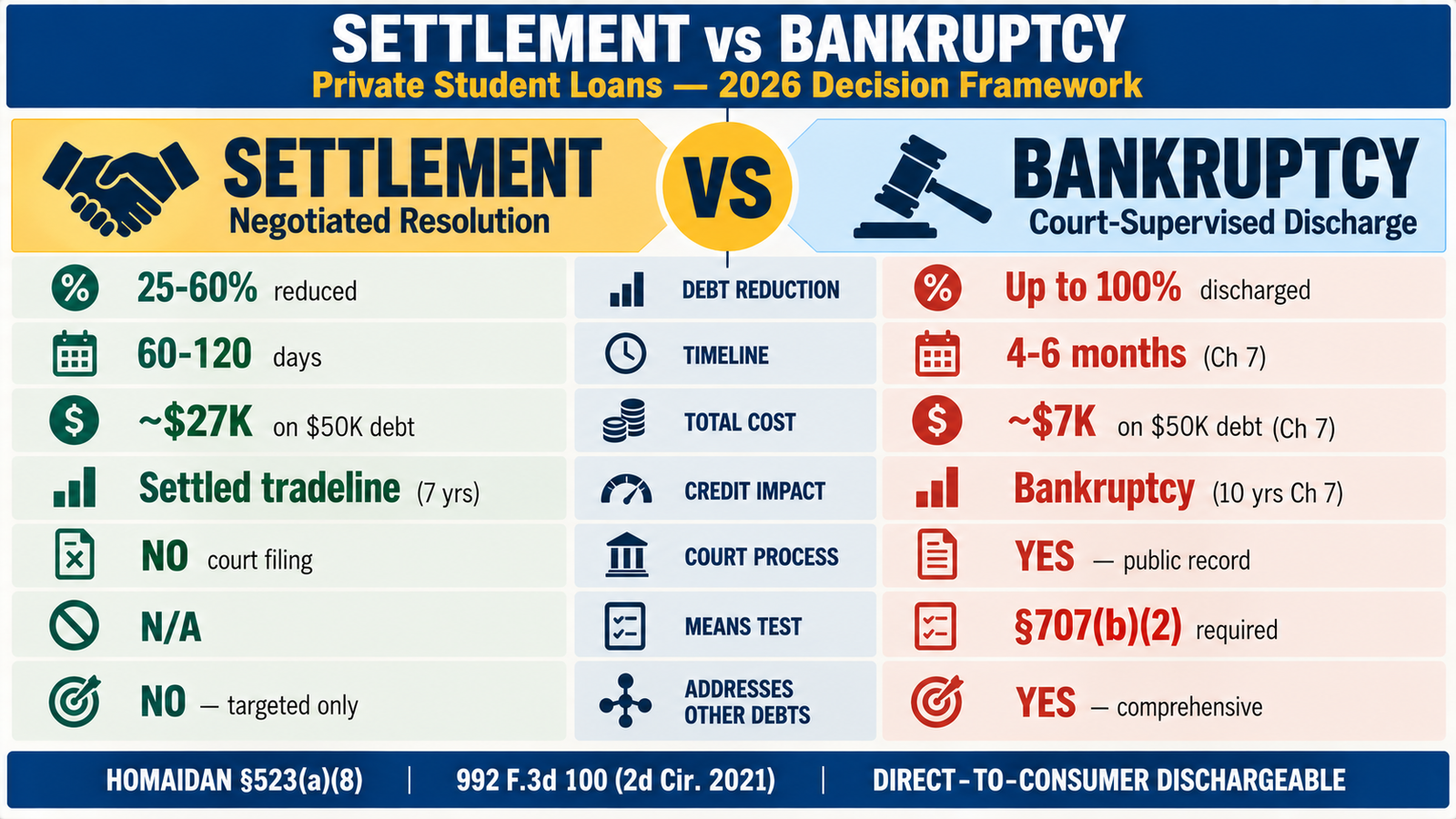
Settlement vs bankruptcy for private student loans: Both paths produce substantial relief but operate differently. SETTLEMENT: Negotiated agreement with lender/trust/debt buyer paying reduced lump sum (typically 25-60% of balance) in full satisfaction; no court filing; typical cost 15-30% of settlement savings for professional representation; 60-120 day timeline; initial credit damage from charged-off account, recovery begins 12-24 months post-settlement; tax implications on cancelled debt (1099-C) typically eliminated via IRC §108(a)(1)(B) insolvency exclusion. CHAPTER 7 BANKRUPTCY: Complete discharge of qualifying debts under court order; requires means test qualification under 11 U.S.C. §707(b)(2); typical attorney fees $1.500-$3.500 plus $338 filing fee; 4-6 month timeline; significant credit impact (bankruptcy on credit report 10 years from filing); private student loans discharged ONLY if qualifying under §523(a)(8) framework analyzed per Homaidan v. Sallie Mae 992 F.3d 100 (2d Cir. 2021) — direct-to-consumer loans without school certification often qualify; non-qualifying loans require Brunner undue hardship adversary proceeding. CHAPTER 13 BANKRUPTCY: 3-5 year repayment plan under court supervision; preserves assets above Chapter 7 exemption limits; discharge at completion under §1328; similar private student loan analysis. DECISION FACTORS: Loan characteristics (Homaidan analysis), means test qualification, asset protection needs, timeline urgency, credit impact tolerance, cost comparison. Many borrowers benefit from coordinated approach combining settlement attempts with bankruptcy consultation.
Read the complete comparative framework below.
In this complete comparison guide:
How settlement works for private student loans
Mechanism, outcomes, timeline, cost structure
How Chapter 7 bankruptcy works for private student loans
§707(b)(2) means test, §523(a)(8) with Homaidan
How Chapter 13 bankruptcy works for private student loans
3-5 year plan, asset protection, §1328 discharge
Cost comparison — fees, taxes, total cost
What each path actually costs borrowers
Credit impact and recovery comparison
How each affects credit scores short and long term
Decision framework for choosing between them
When settlement wins, when bankruptcy wins, when both
Coordinated strategy — settlement + bankruptcy
Combining both paths for optimal outcomes
How settlement works for private student loans
Understanding the bankruptcy vs settlement private student loans comparison requires understanding how each mechanism actually operates. Settlement is a negotiated resolution outside court; bankruptcy is court-supervised debt relief.
Settlement mechanism
Settlement operates through direct negotiation between borrower (or representative) and current holder of debt (original lender, NCSLT trust, or third-party debt buyer). Negotiation reaches written agreement where borrower pays reduced lump sum in full satisfaction of debt. Common settlement ranges: 40-60% for charged-off accounts with major lenders; 25-45% with defensive leverage (Homaidan analysis, chain of assignment, SOL); 20-40% for NCSLT and debt-buyer-held accounts; 50-70% for pre-litigation accounts. No court involvement required (though settlement can occur during pending litigation). Resolution typically completed within 60-120 days of serious engagement.
What settlement does and doesn’t accomplish
Settlement accomplishments: (1) specific private student loan debt resolved via written agreement; (2) credit tradeline updates to “settled” or “paid as agreed” status; (3) cosigner release where properly included in agreement; (4) stops specific lender collection activities; (5) no court record. Settlement does NOT: (1) address other debts (credit cards, medical, other student loans); (2) stop other creditor collection activities; (3) address IRS tax debt or child support obligations; (4) provide court protection against future collection by other creditors. Settlement is targeted resolution of specific debt rather than comprehensive financial restructuring.
Settlement advantages
Settlement advantages: (1) no court filing or public record of financial difficulty; (2) typically faster than bankruptcy (60-120 days vs 4-6 months Chapter 7, or 3-5 years Chapter 13); (3) targeted resolution without affecting other financial relationships; (4) credit tradeline typically shows “settled” rather than “discharged in bankruptcy” (different impact profile); (5) no bankruptcy on credit report for 7-10 years; (6) preserves relationships with other creditors not involved in settlement; (7) typically lower professional fees than bankruptcy for most situations; (8) does not affect employment background checks (bankruptcy appears on these); (9) does not affect security clearances in most cases.
Settlement disadvantages
Settlement disadvantages: (1) requires lump sum funding (typically 25-60% of balance) within 30-60 days of agreement; (2) does not address other debts in financial situation; (3) 1099-C reporting creates potential tax liability (though typically eliminated via IRC §108(a)(1)(B)); (4) credit impact already incurred if account is charged-off before settlement; (5) outcome dependent on negotiation success (not guaranteed outcome); (6) no court protection during negotiation (other creditors can still pursue collection); (7) requires sophisticated analysis for optimal defensive leverage integration; (8) may not resolve lingering disputes about specific amounts owed.
How Chapter 7 bankruptcy works for private student loans
Chapter 7 bankruptcy under 11 U.S.C. §701 et seq. provides complete discharge of qualifying debts through court-supervised liquidation process. For private student loan bankruptcy vs settlement analysis, Chapter 7 can discharge qualifying private student loans entirely under §523(a)(8) framework.
Chapter 7 mechanism
Chapter 7 operates through: (1) filing bankruptcy petition under 11 U.S.C. §301; (2) automatic stay under §362 stopping all creditor collection activity; (3) means test qualification under §707(b)(2); (4) trustee appointment to liquidate non-exempt assets; (5) discharge order typically within 4-6 months of filing under §727(a); (6) specific debts not automatically discharged require adversary proceeding for discharge (including student loans under §523(a)(8) framework). Chapter 7 provides comprehensive financial restart addressing all qualifying debts simultaneously, not just private student loans.
§707(b)(2) means test qualification
Chapter 7 eligibility requires passing the means test under 11 U.S.C. §707(b)(2): (1) if household income below state median for similar household size, qualifies automatically; (2) if household income above state median, detailed calculation of disposable income against allowed expenses determines qualification; (3) failing means test may require Chapter 13 instead (though some adjustments possible); (4) means test calculation includes last 6 months income (CMI — current monthly income) and specific allowed deductions. State median income tables published periodically by U.S. Trustee program. Bankruptcy attorney essential for proper means test analysis given its complexity.
§523(a)(8) framework for private student loans
Private student loan discharge in Chapter 7 operates through 11 U.S.C. §523(a)(8). The statute excepts from discharge: (A)(i) governmental unit loans or those made under program partially funded by governmental unit; (A)(ii) “obligation to repay funds received as an educational benefit, scholarship, or stipend”; (B) “any other educational loan that is a qualified education loan” as defined in IRC §221(d)(1). Private student loans NOT meeting any of these three categories can be discharged in Chapter 7 WITHOUT undue hardship showing. Private student loans meeting any of these categories require Brunner undue hardship adversary proceeding for discharge.
Homaidan v. Sallie Mae precedent
Homaidan v. Sallie Mae Inc. 992 F.3d 100 (2d Cir. 2021) established narrow interpretation of §523(a)(8)(A)(ii) “educational benefit” category. The Second Circuit held that “educational benefit” refers to specific types of educational payments (scholarships, stipends, conditional grants) — NOT private student loans generally. Direct-to-consumer private student loans without school certification of cost of attendance do NOT qualify as “educational benefit” and are therefore dischargeable in Chapter 7 WITHOUT undue hardship showing. Precedent binding in Second Circuit (CT, NY, VT); persuasive elsewhere and widely applied. Combined with Crocker v. Navient Solutions LLC 941 F.3d 206 (5th Cir. 2019) binding in Fifth Circuit (TX, LA, MS) and McDaniel v. Navient Solutions LLC 973 F.3d 1083 (10th Cir. 2020) binding in Tenth Circuit (CO, KS, NM, OK, UT, WY), substantial national framework for private student loan dischargeability.
Brunner undue hardship for qualified loans
Private student loans qualifying under §523(a)(8) require Brunner undue hardship showing for discharge. Brunner v. New York State Higher Education Services Corp. 831 F.2d 395 (2d Cir. 1987) established three-part test: (1) debtor cannot maintain minimal standard of living if forced to repay loans; (2) circumstances exist indicating this will persist for significant portion of repayment period; (3) debtor has made good faith effort to repay. Historically strict application; recent moderation: In re Rosenberg 594 B.R. 22 (Bankr. S.D.N.Y. 2020) modernized Brunner analysis; DOJ November 2022 guidance provided framework for government-position consent to undue hardship in qualifying cases. Undue hardship adversary proceedings have become more successful since 2022 DOJ guidance.
Chapter 7 advantages and disadvantages
Chapter 7 advantages: comprehensive debt relief addressing all qualifying debts; court-protected process with automatic stay; typical 4-6 month timeline to discharge; no payment required for discharged debts; complete fresh start. Chapter 7 disadvantages: means test qualification required (many borrowers above median income don’t qualify); non-exempt assets subject to liquidation (exemptions vary by state); significant credit impact (bankruptcy on credit report for 10 years); public record of filing; some professional and employment implications; private student loans require §523(a)(8) analysis — not automatic discharge; attorney fees typically $1.500-$3.500 plus $338 filing fee.
How Chapter 13 bankruptcy works for private student loans
Chapter 13 bankruptcy under 11 U.S.C. §1301 et seq. provides court-supervised repayment plan rather than liquidation. For borrowers who don’t qualify for Chapter 7 or who have specific asset protection needs, Chapter 13 provides alternative framework for addressing private student loans.
Chapter 13 mechanism
Chapter 13 operates through: (1) filing bankruptcy petition under §301; (2) automatic stay under §362 stopping all creditor collection; (3) proposed repayment plan under §1322 (3-5 year duration); (4) trustee supervision of plan payments to creditors; (5) discharge at successful plan completion under §1328; (6) private student loans typically treated as unsecured debt in plan; (7) §523(a)(8) framework still applies at discharge — qualifying loans discharged, non-qualifying require Brunner analysis. Chapter 13 preserves assets above Chapter 7 exemption limits while providing comprehensive debt relief.
Chapter 13 eligibility and plan
Chapter 13 eligibility: (1) regular income required to fund plan payments; (2) debt limits apply (currently $465,275 unsecured, $1,395,875 secured as of 2024 — periodic adjustments); (3) plan duration 3-5 years (3 years if below median income, up to 5 years above); (4) plan must pay priority debts in full, cover minimum unsecured dividends. Private student loans typically included as unsecured debt — receive proportional distribution during plan period, with remaining balance eligible for §1328 discharge analysis at completion.
§523(a)(8) at Chapter 13 discharge
At Chapter 13 plan completion, §1328 discharge analysis applies — same §523(a)(8) framework as Chapter 7. Private student loans qualifying under Homaidan analysis (direct-to-consumer without cost of attendance certification) can be discharged. Non-qualifying private student loans require Brunner undue hardship analysis. Chapter 13 provides time for borrower circumstances to develop (potentially supporting undue hardship showing) while plan addresses other debt. Some borrowers can achieve substantial private student loan reduction through combination of Chapter 13 plan payments plus discharge analysis at completion.
Chapter 13 advantages and disadvantages
Chapter 13 advantages: available when Chapter 7 means test not passed; preserves assets above Chapter 7 exemption limits; allows curing of secured debts (mortgage, auto arrears); provides time for circumstances development; discharge available at completion under §1328; private student loans treated as unsecured debt with proportional distribution. Chapter 13 disadvantages: 3-5 year commitment to plan payments; most of borrower’s disposable income directed to plan; plan completion required for discharge (dismissal if plan not completed); significant credit impact for extended period; higher attorney fees than Chapter 7 (typically $3.000-$6.000); regular income required throughout plan; private student loans still subject to §523(a)(8) analysis at discharge.
Cost comparison — fees, taxes, total cost
Comparing settle or bankruptcy student loans requires accurate cost accounting across professional fees, government fees, tax implications, and total resolution cost. Each path has distinct cost structure.
Settlement cost structure
Settlement total cost components: (1) settlement payment itself (typically 25-60% of balance depending on leverage); (2) professional representation fees — attorney-backed services typically 15-30% of settlement savings or specific fee structures; non-attorney services under FTC Rule 310 performance-based fees charged after settlement reached; (3) tax implications on cancelled debt via 1099-C (typically eliminated via IRC §108(a)(1)(B) insolvency exclusion with Form 982 filing); (4) incidental costs (CPA fees for tax filing coordination, documentation preparation). Example calculation: $50.000 debt settled at 40% = $20.000 settlement payment; professional fees at 25% of $30.000 savings = $7.500; total settlement cost approximately $27.500 (saving $22.500 vs full balance).
Chapter 7 cost structure
Chapter 7 total cost components: (1) attorney fees typically $1.500-$3.500 (varies by jurisdiction and case complexity); (2) filing fee $338 (as of 2024, periodic adjustments); (3) credit counseling and debtor education course fees (typically $25-$50 each); (4) adversary proceeding attorney fees if §523(a)(8) adversary required (typically additional $2.000-$5.000); (5) potential loss of non-exempt assets (varies by state exemptions); (6) typically no tax implications on discharged debt (IRC §108(a)(1)(A) bankruptcy exclusion); (7) possible professional fees for post-bankruptcy credit rebuilding. Example calculation: $50.000 private student loan discharged in Chapter 7; attorney fees $3.000; filing fee $338; adversary proceeding $3.500 (if required); total cost approximately $6.838 (saving $43.162 vs full balance) plus potential non-exempt asset loss.
Chapter 13 cost structure
Chapter 13 total cost components: (1) attorney fees typically $3.000-$6.000 (higher than Chapter 7 due to 3-5 year plan supervision); (2) filing fee $313 (as of 2024); (3) credit counseling and debtor education course fees; (4) plan payments over 3-5 years including some payment to unsecured creditors; (5) trustee percentage of plan payments (10% maximum under 28 U.S.C. §586); (6) potential §523(a)(8) adversary proceeding fees for private student loan analysis at discharge; (7) opportunity cost of 3-5 years at reduced disposable income. Example calculation: $50.000 private student loan with Chapter 13 unsecured dividend of 20% = $10.000 plan distribution; attorney fees $5.000; filing fee $313; discharge of remaining $40.000 at plan completion (if qualifying under §523(a)(8)); total cost approximately $15.313 (saving $34.687 vs full balance) plus 3-5 year plan commitment.
Comparative total cost analysis
On $50.000 private student loan with standard situation: Settlement at 40% with professional representation ≈ $27.500 total cost (debt reduction $22.500); Chapter 7 with Homaidan-qualifying loan ≈ $6.838 total cost (debt reduction $43.162 plus potential asset considerations); Chapter 13 with 20% unsecured dividend ≈ $15.313 total cost (debt reduction $34.687 plus 3-5 year commitment). Chapter 7 produces greatest debt reduction but requires means test qualification and may involve non-exempt asset loss. Settlement produces moderate debt reduction without court involvement. Chapter 13 provides intermediate outcome with payment plan structure. Analysis should include non-financial factors (credit impact, timeline, asset protection) alongside pure cost comparison.
Credit impact and recovery comparison
Credit impact is a significant factor in settlement or bankruptcy private loans decisions. Both paths affect credit but with distinct profiles and recovery timelines.
Settlement credit impact
Settlement credit impact: (1) if settlement occurs after charge-off, the charge-off itself has already impacted credit significantly (typically 100-150 point score reduction); (2) settlement tradeline typically shows “settled” or “paid as agreed for less than full balance” — negative but less severe than ongoing charge-off; (3) tradeline persistence 7 years from original delinquency per Fair Credit Reporting Act; (4) credit score typically begins recovering within 6-12 months post-settlement; (5) full credit score recovery typically 2-4 years post-settlement with proper credit rebuilding behaviors; (6) pre-charge-off settlement (if achieved) can avoid worst credit damage. Settlement credit impact is already present when borrower reaches charge-off settlement — settlement itself may actually improve the trajectory from charge-off continuing.
Chapter 7 bankruptcy credit impact
Chapter 7 bankruptcy credit impact: (1) bankruptcy filing shows on credit report 10 years from filing date per Fair Credit Reporting Act; (2) typical immediate credit score impact 100-200 point reduction (varies based on pre-bankruptcy score); (3) all discharged debts show as “included in bankruptcy” status; (4) credit score typically bottoms within 6-12 months of filing; (5) credit score recovery typically begins 12-18 months post-discharge with proper rebuilding; (6) significant score recovery (returning to pre-bankruptcy range) typically 3-5 years; (7) secured credit cards and credit builder loans typically accessible immediately post-discharge for rebuilding; (8) prime credit access typically returns 4-7 years post-discharge with consistent rebuilding. Chapter 7 produces more severe immediate credit impact but shorter total duration than Chapter 13 (10 years vs 7 years for Chapter 13).
Chapter 13 bankruptcy credit impact
Chapter 13 bankruptcy credit impact: (1) bankruptcy filing shows on credit report 7 years from filing date (shorter than Chapter 7); (2) typical immediate credit score impact 75-175 point reduction; (3) debts in plan show as “included in Chapter 13 bankruptcy” status; (4) plan payments typically do not improve credit score during plan period (payments to trustee, not to individual creditors with credit reporting); (5) credit score recovery typically limited during plan period; (6) significant score recovery possible 1-2 years post-discharge; (7) similar rebuilding tools accessible post-discharge as Chapter 7. Chapter 13 credit impact is extended through plan period but overall duration shorter than Chapter 7.
Credit comparison summary
Credit impact comparison summary: Settlement generally produces less severe credit impact than bankruptcy (particularly Chapter 7); however, if account already charged-off, the worst damage is already incurred regardless of resolution path. Chapter 7 produces most severe immediate impact but potentially faster long-term recovery. Chapter 13 produces more moderate impact extended over longer period. Credit considerations should be weighed alongside financial resolution outcome — maximum debt reduction with modest additional credit impact may be preferred over minimal credit impact with insufficient debt resolution.
Related resources — complete decision framework
Private Student Loan Settlement 2026: Complete Guide (PILAR)
The 7-path master framework for private student loan settlement across all lender scenarios.
How to Settle Private Student Loans 2026
Complete 7-step process framework for settlement execution.
NCSLT Settlement 2026: Trust Debt Guide
NCSLT trust-specific settlement with Homaidan integration — relevant for Chapter 7 §523(a)(8) analysis.
Decision framework for choosing between settlement and bankruptcy
The should i settle or file bankruptcy student loans decision depends on multiple factors. Clear decision framework helps identify which path produces optimal outcome for specific situation.
Factors favoring settlement
Settlement typically produces better outcome when: (1) only private student loans need resolution (no other significant debt problems); (2) above Chapter 7 means test threshold without ability to adjust; (3) significant non-exempt assets to protect; (4) employment or security clearance considerations making bankruptcy problematic; (5) smaller balance accounts where total settlement cost reasonable; (6) borrower has sufficient income/resources for lump sum funding; (7) loans don’t clearly qualify under Homaidan framework (standard §523(a)(8) qualified loans requiring Brunner analysis); (8) timeline urgency requiring faster resolution than bankruptcy; (9) desire to avoid public bankruptcy record; (10) strong defensive leverage producing deep settlement discounts (NCSLT, chain of assignment, SOL cases).
Factors favoring Chapter 7 bankruptcy
Chapter 7 typically produces better outcome when: (1) multiple debt problems beyond private student loans (credit cards, medical, personal loans); (2) qualifying under §707(b)(2) means test (below state median income or passing calculation); (3) non-exempt assets within state exemption limits; (4) private student loans have strong Homaidan characteristics (direct-to-consumer, lack of cost of attendance certification); (5) comprehensive financial restart preferred over targeted resolution; (6) employment allows bankruptcy without professional consequences; (7) credit impact already significant from existing financial problems; (8) long-term cost savings outweigh immediate credit impact; (9) legal process preferred over negotiation uncertainty; (10) borrower prefers comprehensive court-protected resolution.
Factors favoring Chapter 13 bankruptcy
Chapter 13 typically produces better outcome when: (1) failing Chapter 7 means test with regular income to fund plan; (2) significant non-exempt assets above Chapter 7 exemption limits requiring protection; (3) mortgage or auto arrears requiring cure through plan; (4) regular income sufficient to support 3-5 year commitment; (5) multiple debt types benefiting from comprehensive plan treatment; (6) private student loan characteristics suggesting Brunner analysis success more likely at discharge after plan period; (7) desire for extended court supervision during financial recovery; (8) tax arrears or other priority debts requiring structured payment; (9) business ownership requiring protection from Chapter 7 liquidation; (10) family circumstances supporting plan sustainability.
Coordinated strategy — settlement + bankruptcy
Many borrowers benefit from coordinated approach combining settlement and bankruptcy strategies. Rather than choosing one path exclusively, coordinated strategy can optimize outcomes across both mechanisms.
Settlement with bankruptcy threat
Most common coordination: credible bankruptcy threat strengthens settlement negotiation. Preparation: (1) bankruptcy counsel consultation documenting §523(a)(8) analysis with Homaidan application; (2) means test qualification analysis; (3) hardship documentation supporting bankruptcy viability; (4) specific legal strategy articulated. Communication to lender: credible bankruptcy alternative with documented preparation framework. Outcome: settlement at 25-45% range (versus 40-60% without leverage), avoiding bankruptcy filing and public record while achieving substantial debt reduction. This approach is often optimal for borrowers who prefer settlement outcome but have genuine bankruptcy viability.
Partial settlement with bankruptcy backstop
Alternative coordination: settle some accounts, bankruptcy for others. Framework: (1) attempt settlement on accounts with weakest Homaidan analysis or strongest holder negotiation posture; (2) reserve bankruptcy for accounts with strongest Homaidan characteristics; (3) coordinate timing to maximize both outcomes; (4) ensure settlement agreements don’t impair later bankruptcy filing. This approach can work when borrower has multiple accounts with varying characteristics. Legal counsel essential to coordinate without creating problems for either path.
Chapter 13 with mid-plan settlement
Chapter 13 can include settlement of specific private student loan accounts during plan period. Framework: (1) file Chapter 13 for comprehensive debt treatment; (2) during plan period, settle specific private student loan accounts as finances allow; (3) at plan completion, remaining private student loan balances subject to §523(a)(8) discharge analysis; (4) combines court protection with targeted settlement opportunities. Requires careful planning with bankruptcy attorney to coordinate plan treatment with settlement activities.
Avoiding missteps in coordinated strategy
Common missteps in coordinated strategy: (1) settling before bankruptcy filing without considering preference analysis (settlement payments within 90 days of filing may be subject to preference claw-back); (2) failing to disclose pre-filing settlement payments in bankruptcy filing (can create significant legal problems); (3) acknowledging debt in settlement discussions in ways that affect SOL for bankruptcy preparation; (4) failing to coordinate professional representation across settlement and bankruptcy teams; (5) attempting DIY coordination without legal expertise; (6) timing settlement payments poorly relative to bankruptcy filing. Legal representation essential for coordinated approach to avoid these missteps.
Common myths about settlement vs bankruptcy
Myth 1
“Private student loans can’t be discharged in bankruptcy — settlement is the only option”
Reality: This outdated understanding significantly misstates current law. Homaidan v. Sallie Mae 992 F.3d 100 (2d Cir. 2021) established that direct-to-consumer private student loans without school certification of cost of attendance do NOT qualify as “educational benefit” under §523(a)(8)(A)(ii) and are therefore dischargeable in bankruptcy WITHOUT undue hardship showing. Combined with Crocker v. Navient (5th Cir. 2019), McDaniel v. Navient (10th Cir. 2020), and other precedents, substantial national framework for private student loan dischargeability exists. Many private student loans — including Sallie Mae-originated loans in NCSLT trusts — may qualify. Analysis requires examination of specific loan characteristics. Both settlement and bankruptcy are viable options for most private student loan borrowers; decision should be based on specific analysis rather than outdated general assumptions.
Myth 2
“Bankruptcy ruins your credit forever”
Reality: Bankruptcy credit impact is significant but temporary. Chapter 7 bankruptcy shows on credit report 10 years from filing; Chapter 13 shows 7 years from filing. Credit score typically bottoms within 6-12 months of filing, with recovery beginning 12-18 months post-discharge for proactive borrowers. Many borrowers achieve prime credit access 4-7 years post-discharge through consistent credit rebuilding behaviors (secured credit cards, credit builder loans, consistent on-time payments). While bankruptcy has real credit cost, it’s not permanent credit destruction. For borrowers with significant debt problems, bankruptcy often provides faster long-term credit recovery than continuing with unmanageable debt — the ongoing delinquency and collection activity creates continued credit damage, while bankruptcy provides clean break supporting rebuilding.
Myth 3
“Settlement is cheaper than bankruptcy because there are no attorney fees”
Reality: Settlement typically involves significant costs — settlement payment itself (25-60% of balance) plus professional representation fees (15-30% of settlement savings for attorney-backed services, or FTC Rule 310 performance-based fees for non-attorney services). For $50.000 debt example: settlement total cost approximately $27.500; Chapter 7 total cost approximately $6.838. Chapter 7 bankruptcy actually produces greater total debt reduction and lower total cost for qualifying situations. Settlement’s advantages lie elsewhere (no court process, no public record, no asset considerations, faster timeline, preserved relationships with other creditors) — but cost advantage is not among them for most situations. Analysis should include complete cost accounting rather than attorney fee comparison alone.
Myth 4
“Filing bankruptcy will make my employer fire me”
Reality: 11 U.S.C. §525 specifically prohibits employment discrimination based on bankruptcy filing. Government employers cannot terminate, deny employment, or otherwise discriminate based on bankruptcy filing. Private employers generally cannot terminate current employees based on bankruptcy filing (though some employment relationships and particularly security clearance situations may have specific considerations). Pre-employment background checks may show bankruptcy, which can affect hiring in some industries (particularly financial services), but this is distinct from termination risk. For specific employment concerns, bankruptcy attorney consultation addressing your specific employment situation provides accurate assessment. For most borrowers, employment concerns about bankruptcy are overstated compared to actual legal protections.
Frequently asked questions
1. Settlement vs bankruptcy for student loans — which is better?
The settlement vs bankruptcy student loans decision depends on specific situation factors: loan characteristics (Homaidan analysis under 11 U.S.C. §523(a)(8)); means test qualification (11 U.S.C. §707(b)(2) for Chapter 7); asset protection needs (Chapter 7 non-exempt asset limits); other debt situation (bankruptcy addresses all qualifying debts, settlement targets specific debt); credit impact tolerance; employment or security clearance considerations; timeline urgency; cost comparison. Settlement typically produces 25-60% balance reduction with no court process; Chapter 7 bankruptcy can produce complete discharge of qualifying private student loans under Homaidan v. Sallie Mae 992 F.3d 100 (2d Cir. 2021) framework with greater total debt reduction. Neither is universally better — each produces optimal outcome in different situations. Legal consultation addressing specific circumstances provides most accurate recommendation.
2. Can private student loans be discharged in bankruptcy?
Yes, private student loans can be discharged in bankruptcy under 11 U.S.C. §523(a)(8) framework. Three categories excepted from discharge: §523(a)(8)(A)(i) governmental loans; §523(a)(8)(A)(ii) “obligation to repay funds received as an educational benefit, scholarship, or stipend”; §523(a)(8)(B) qualified education loans under IRC §221(d)(1). Private loans not meeting any of these three categories can be discharged WITHOUT undue hardship showing. Homaidan v. Sallie Mae Inc. 992 F.3d 100 (2d Cir. 2021) established that “educational benefit” is narrow — direct-to-consumer loans without school certification of cost of attendance don’t qualify. Combined with Crocker v. Navient 941 F.3d 206 (5th Cir. 2019) and McDaniel v. Navient 973 F.3d 1083 (10th Cir. 2020), substantial national framework. Loans qualifying under §523(a)(8) require Brunner undue hardship adversary proceeding. In re Rosenberg 594 B.R. 22 (Bankr. S.D.N.Y. 2020) and DOJ November 2022 guidance have improved undue hardship outcomes.
3. Which is faster — settlement or bankruptcy?
Settlement typically faster: 60-120 days from serious engagement to completion including payment and tradeline updates. Chapter 7 bankruptcy: 4-6 months from filing to discharge (longer with §523(a)(8) adversary proceeding, typically additional 6-12 months). Chapter 13 bankruptcy: 3-5 year plan period plus 60-90 day filing-to-confirmation initial period. For urgent debt resolution timeline, settlement typically preferred. For comprehensive debt restructuring with court protection throughout, Chapter 7 or Chapter 13 appropriate despite longer timeline. Timeline should be weighed alongside outcome quality and total cost — fastest isn’t always best, and both paths provide meaningful resolution within reasonable timeframes.
4. Which has worse credit impact — settlement or bankruptcy?
Bankruptcy generally produces more severe credit impact than settlement: Chapter 7 shows on credit report 10 years from filing with typical immediate score impact 100-200 points; Chapter 13 shows 7 years from filing with typical immediate score impact 75-175 points. Settlement typically shows tradeline as “settled” for 7 years from original delinquency with less severe ongoing impact. HOWEVER, if private student loan account is already charged-off before settlement, worst credit damage is already incurred regardless of resolution path. Also, bankruptcy may actually improve long-term credit trajectory for borrowers with multiple debt problems — resolving all debts simultaneously supports faster rebuilding than continuing with unmanageable debt. Credit impact analysis should consider both immediate score impact and long-term recovery trajectory.
5. Should I settle or file bankruptcy for my student loans?
The should i settle or file bankruptcy student loans decision requires analysis of your specific situation. Favor settlement when: only private student loans need resolution; above means test threshold; significant assets to protect; employment or clearance considerations; smaller balance; sufficient lump sum funding; loans without strong Homaidan characteristics; faster timeline needed. Favor Chapter 7 bankruptcy when: multiple debt problems; qualifying under means test; loans with strong Homaidan characteristics; comprehensive debt relief preferred; non-exempt assets within exemption limits. Favor Chapter 13 bankruptcy when: failing Chapter 7 means test; significant non-exempt assets; mortgage/auto arrears to cure; regular income supports 3-5 year plan commitment. Consult both settlement specialist and bankruptcy attorney before deciding. Many borrowers benefit from coordinated approach combining settlement attempts with bankruptcy consultation.
6. Does settlement count against me if I later file bankruptcy?
Partial payments made via settlement within 90 days before bankruptcy filing may be subject to preference claw-back under 11 U.S.C. §547(b) — allowing bankruptcy trustee to recover payments from settlement recipient. This typically does not affect borrower (recipient may need to return payment) but can affect strategy. Settlement acknowledgments of debt validity could affect bankruptcy strategy — proper settlement agreements should include “subject to validation” language preserving future legal positions. Coordination between settlement attorney and bankruptcy attorney essential when both paths may be pursued. Not all settlements create problems for later bankruptcy — but careful planning avoids missteps. Legal counsel essential for borrowers considering both paths sequentially.
7. Can I use bankruptcy threat to improve settlement outcomes?
Yes — credible bankruptcy alternative is one of the most powerful settlement leverage mechanisms. Requires genuine bankruptcy viability (not merely stated threat): (1) bankruptcy counsel consultation with documented analysis; (2) specific §523(a)(8) analysis citing Homaidan v. Sallie Mae and applicable precedents (Crocker, McDaniel for Circuit-specific application); (3) means test qualification analysis under §707(b)(2); (4) financial hardship documentation supporting bankruptcy viability. When presented in settlement discussions, credible bankruptcy alternative communicates that borrower will pursue complete discharge if favorable settlement not reached. Typical outcome: settlement at 25-45% range versus 40-60% without leverage — substantial additional discount. Must be genuine viability — empty threats are easily recognized and don’t produce results. For borrowers with genuine bankruptcy viability, settlement with bankruptcy alternative often produces optimal outcome combining targeted resolution with discount leverage.
Settlement vs Bankruptcy — Which Path Is Right?
Free specialist review comparing both options for your private student loans.
Private student loan settlement framework across all major lenders (Sallie Mae Bank NYSE:SLM, Navient/Earnest Operations LLC, Discover/Firstmark Services, SoFi Bank NA, Citizens Bank NA, Ascent, NCSLT trusts, third-party debt buyers) with defensive leverage integration. Chapter 7 bankruptcy viability assessment including means test qualification under 11 U.S.C. §707(b)(2), §523(a)(8) analysis with Homaidan v. Sallie Mae 992 F.3d 100 (2d Cir. 2021) application, Chapter 13 analysis under §1322 including 3-5 year plan structure. Comparative cost analysis, credit impact assessment, timeline comparison, coordinated strategy evaluation for combined settlement + bankruptcy approaches. Free eligibility review with attorney-backed partner provider — no upfront fees for settlement path; bankruptcy filing requires licensed bankruptcy attorney referral through partner network.
Get a free eligibility review →
5-minute review · No obligation · Zero upfront fees · Since 2015 · 48 states served
About the author
Henry Silva — Private Student Loan Debt Specialist
10+ years analyzing settlement vs bankruptcy student loans decision frameworks for borrowers facing private student loan debt. Deep expertise in private student loan settlement operational framework across all major lenders (Sallie Mae Bank NYSE:SLM, Navient Corporation NYSE:NAVI with Earnest Operations LLC subsidiary, Discover Financial Services NYSE:DFS historical with Carlyle+KKR private equity consortium current ownership and Firstmark Services Nelnet NYSE:NNI subsidiary servicing, SoFi Bank NA NMLS #696891 national bank charter January 2022, Citizens Bank NA NYSE:CFG, Ascent Student Loans) plus NCSLT trusts (2003-1 through 2007-4 with U.S. Bank indenture trustee and Transworld Systems Inc designated subservicer) and third-party debt buyers. Bankruptcy framework expertise: Chapter 7 under 11 U.S.C. §701 et seq. including means test qualification under §707(b)(2) with state median income analysis, current monthly income calculation, allowed expense deductions, and disposable income analysis; automatic stay under §362; discharge under §727(a); non-exempt asset analysis under state exemptions; §523(a)(8) discharge framework with Homaidan v. Sallie Mae Inc. 992 F.3d 100 (2d Cir. 2021) binding in Second Circuit (CT, NY, VT), persuasive elsewhere; Crocker v. Navient Solutions LLC 941 F.3d 206 (5th Cir. 2019) binding in Fifth Circuit (TX, LA, MS); McDaniel v. Navient Solutions LLC 973 F.3d 1083 (10th Cir. 2020) binding in Tenth Circuit (CO, KS, NM, OK, UT, WY); Brunner v. New York State Higher Education Services Corp. 831 F.2d 395 (2d Cir. 1987) three-part undue hardship test; In re Rosenberg 594 B.R. 22 (Bankr. S.D.N.Y. 2020) modernized Brunner application; DOJ November 2022 undue hardship guidance; §523(a)(8) adversary proceeding framework. Chapter 13 framework under 11 U.S.C. §1301 et seq. including eligibility and debt limits, §1322 plan requirements, §1328 plan completion discharge, 3-5 year plan duration, unsecured dividend analysis, trustee percentage under 28 U.S.C. §586, mortgage/auto cure framework, business ownership preservation. Preference analysis under 11 U.S.C. §547(b) for pre-filing settlement payment coordination. Employment protection under 11 U.S.C. §525. Credit impact analysis including Fair Credit Reporting Act reporting periods, score impact trajectories, recovery timelines, and rebuilding strategy coordination. Comparative cost analysis across settlement fees (attorney-backed vs non-attorney FTC Rule 310), bankruptcy attorney fees, filing fees, and tax implications under IRC §108(a)(1)(A) bankruptcy exclusion and §108(a)(1)(B) insolvency exclusion with Form 982 preparation. Coordinated strategy expertise including settlement with credible bankruptcy threat, partial settlement with bankruptcy backstop, Chapter 13 with mid-plan settlement opportunities, timing coordination to avoid preference issues. Henry works with Private Student Relief’s attorney-backed partner provider network for settlement path and coordinates bankruptcy attorney referrals through partner network for bankruptcy path, ensuring borrowers have access to both options with proper professional representation across the complete decision framework.
Legal Disclaimer and Sources
This article is provided for informational purposes only and does not constitute legal, tax, or financial advice. Private Student Relief is a consulting and matching organization operated by Joco (555 Anton Blvd, Suite 368, Costa Mesa, CA 92626) — not a law firm, debt settlement company, debt consolidation company, bankruptcy filing service, or loan provider. Debt validation services for settlement path are performed by an attorney-backed partner provider (Panamerican Consulting LLC, Las Vegas, NV) under independent business credentials. Ratings, BBB accreditation, and AADR (American Association for Debt Resolution) membership referenced on the PSR website belong to the partner provider. Bankruptcy filing requires licensed bankruptcy attorney in borrower’s jurisdiction — PSR coordinates referrals through partner network but does not itself provide bankruptcy filing services. The decision between settlement and bankruptcy depends on loan characteristics, financial situation, borrower circumstances, means test qualification, asset considerations, employment considerations, jurisdiction, and other factors. Individual results vary. Since 2015. 48 states served. Not available in South Carolina or Mississippi.
Bankruptcy Code references: 11 U.S.C. §301 (voluntary case commencement); 11 U.S.C. §362 (automatic stay); 11 U.S.C. §523(a)(8) (student loan discharge exceptions with §523(a)(8)(A)(i) governmental unit, §523(a)(8)(A)(ii) educational benefit, §523(a)(8)(B) qualified education loan categories); 11 U.S.C. §525 (employment protection); 11 U.S.C. §547(b) (preference analysis); 11 U.S.C. §707(b)(2) (Chapter 7 means test); 11 U.S.C. §727(a) (Chapter 7 discharge); 11 U.S.C. §1322 (Chapter 13 plan contents); 11 U.S.C. §1328 (Chapter 13 discharge). 28 U.S.C. §586 (U.S. Trustee program authority). Key bankruptcy precedent: Homaidan v. Sallie Mae Inc. 992 F.3d 100 (2d Cir. 2021) — binding in Second Circuit (CT, NY, VT), persuasive elsewhere, establishing narrow interpretation of §523(a)(8)(A)(ii) “educational benefit”; Crocker v. Navient Solutions LLC 941 F.3d 206 (5th Cir. 2019) — binding in Fifth Circuit (TX, LA, MS); McDaniel v. Navient Solutions LLC 973 F.3d 1083 (10th Cir. 2020) — binding in Tenth Circuit (CO, KS, NM, OK, UT, WY); Brunner v. New York State Higher Education Services Corp. 831 F.2d 395 (2d Cir. 1987) undue hardship test; In re Rosenberg 594 B.R. 22 (Bankr. S.D.N.Y. 2020) modernized application. Federal Rules of Civil Procedure: FRCP 60(b)(4) (void judgment); FRCP 12(b)(6) (failure to state claim). Pleading standards: Bell Atlantic Corp. v. Twombly 550 U.S. 544 (2007); Ashcroft v. Iqbal 556 U.S. 662 (2009). Article III standing precedent (relevant to settlement defensive leverage): Lujan v. Defenders of Wildlife 504 U.S. 555 (1992); Spokeo, Inc. v. Robins 578 U.S. 330 (2016); TransUnion LLC v. Ramirez 594 U.S. 413 (2021). Internal Revenue Code: IRC §221(d)(1) (qualified education loan definition); IRC §108(a)(1)(A) (bankruptcy tax exclusion); IRC §108(a)(1)(B) (insolvency tax exclusion); Form 982 (reduction of tax attributes due to discharge of indebtedness). FDCPA: 15 U.S.C. §1692 et seq. (particularly relevant to settlement defensive leverage against third-party debt collectors). Fair Credit Reporting Act: 15 U.S.C. §1681 et seq. (particularly §1681c reporting period limits — bankruptcy 10 years from filing for Chapter 7, 7 years from filing for Chapter 13; other adverse information 7 years from original delinquency). Federal tax reporting: IRS Form 1099-C (cancellation of debt).
DOJ undue hardship guidance: November 17, 2022 guidance from U.S. Department of Justice regarding government position on undue hardship adversary proceedings under §523(a)(8); provides framework for government consent to undue hardship in qualifying cases. Historical context: Supreme Court Lamar, Archer & Cofrin, LLP v. Appling 584 U.S. 709 (2018) addressed §523(a)(2)(B) framework for debt discharge. Multiple circuit decisions since 2020 have moderated historically strict Brunner application.
Chapter 7 means test: Current monthly income (CMI) calculated from last 6 months income; compared to state median income table published periodically by U.S. Trustee program; if CMI below median, Chapter 7 generally available; if above median, detailed calculation of disposable income against allowed expenses determines qualification. Specific calculations require bankruptcy attorney given complexity. Chapter 13 debt limits (periodic adjustments): currently $465,275 unsecured and $1,395,875 secured as of 2024.
Settlement vs bankruptcy student loans decision analysis requires case-by-case evaluation coordinating loan characteristics (Homaidan §523(a)(8) qualification analysis), current account status, holder identification, defensive leverage opportunities for settlement path, means test qualification analysis for Chapter 7 path, asset analysis for exemption consideration, Chapter 13 plan viability for alternative bankruptcy path, employment and security clearance considerations, cost comparison across both paths, credit impact tolerance assessment, timeline requirements, IRC §108 tax implications under both paths, coordinated strategy evaluation for combined approaches, and preference analysis for timing coordination. This article provides general decision framework; specific analysis requires consultation with both settlement specialist and bankruptcy attorney. Many borrowers benefit from attorney-backed settlement specialist assessment combined with bankruptcy attorney consultation to make informed decision based on complete picture of options. Last reviewed: October 2026.