

Informational content only. Not legal, tax, or financial advice. Private Student Relief is a consulting organization, not a law firm, CPA firm, or tax preparation service. Debt validation services are executed by an attorney-backed partner provider. Tax consequences depend on individual circumstances, income, assets, liabilities, filing status, state of residence, and other factors. CPA consultation recommended for actual tax filing. Last reviewed: October 2026.
Written by Henry Silva
Private Student Loan Debt Specialist · 10+ years coordinating student loan settlement tax consequences analysis with CPAs across all major lenders and NCSLT trusts. Deep expertise in Internal Revenue Code §108 framework — §108(a)(1)(A) bankruptcy exclusion, §108(a)(1)(B) insolvency exclusion with Form 982 preparation methodology, IRC §61(a)(12) cancellation of debt income baseline, Form 1099-C issuer timing analysis across lenders (Sallie Mae Bank, Navient/Earnest, Discover/Firstmark, SoFi, Citizens, Ascent, NCSLT trusts, debt buyers), insolvency calculation methodology including fair market value asset analysis and complete liability accounting, state tax conformity analysis, and coordinated multi-year tax planning for settlement sequences. Last reviewed: October 2026.
Understanding student loan settlement tax consequences is critical for any borrower pursuing private student loan settlement. The cancelled debt portion of a settlement (the difference between the full balance and the settlement payment) is generally treated as taxable income under IRC §61(a)(12) — potentially creating substantial unexpected tax liability. However, Internal Revenue Code §108 provides important exclusions that typically eliminate most or all of this tax liability for borrowers in settlement situations. The most commonly applicable exclusion is IRC §108(a)(1)(B) insolvency exclusion — excluding cancelled debt income to the extent the borrower was insolvent (liabilities exceeded assets) immediately before the debt cancellation. For borrowers coordinating settlement with bankruptcy strategy, IRC §108(a)(1)(A) provides complete bankruptcy exclusion. This complete 2026 guide covers the full tax framework: how 1099-C works for settled student loans; the IRC §108 exclusion framework; insolvency calculation methodology; Form 982 filing requirements; timing considerations across settlement year and tax year; state tax conformity analysis; special considerations for high-income borrowers; and the critical importance of CPA coordination before executing settlement.
Quick Answer
Student loan settlement tax consequences: When private student loan is settled for less than full balance, the cancelled portion (difference between balance and settlement payment) is reported by the lender on IRS Form 1099-C and is generally treated as taxable income under IRC §61(a)(12). However, Internal Revenue Code §108 provides exclusions that typically eliminate most or all of this tax liability. KEY EXCLUSIONS: (1) IRC §108(a)(1)(A) bankruptcy exclusion — complete exclusion of debt cancelled in Chapter 7 or Chapter 13 bankruptcy regardless of insolvency; (2) IRC §108(a)(1)(B) insolvency exclusion — excludes cancelled debt to the extent borrower was insolvent (total liabilities exceeded total assets) immediately before cancellation; most commonly applicable to settlement situations. INSOLVENCY CALCULATION: Compare fair market value of all assets (checking/savings, retirement accounts at discounted value, home equity, vehicles, personal property) against all liabilities (all debts including student loans, credit cards, medical, back taxes, judgments, contingent liabilities). Negative net worth = insolvency; exclusion amount is lesser of cancelled debt amount or insolvency amount. FORM 982: Required IRS form claiming §108 exclusion; must be filed with tax return for year 1099-C issued. TIMING: 1099-C typically issued January following settlement year. STATE TAXES: Most states conform to federal §108 exclusions but verify state-specific rules. HIGH-INCOME BORROWERS: Insolvency often still applies through proper calculation including discounted retirement accounts and contingent liabilities. CRITICAL: CPA consultation BEFORE settlement execution establishes insolvency documentation and optimizes tax planning.
Read the complete tax framework below.
In this complete tax framework guide:
How 1099-C works for settled student loans
Issuance, timing, reporting, lender variations
IRC §108 exclusion framework overview
All applicable exclusions and which fits settlement
IRC §108(a)(1)(B) insolvency exclusion deep dive
Most commonly applicable; calculation methodology
Form 982 preparation and filing
Required IRS form claiming §108 exclusion
State tax conformity considerations
How states handle cancelled debt income
High-income borrower considerations
SoFi professionals and insolvency documentation
CPA coordination and pre-settlement planning
Timing analysis and tax optimization strategy
How 1099-C works for settled student loans
Understanding 1099-c student loan settlement reporting is the starting point for tax analysis. The 1099-C creates the taxable income that §108 exclusions then address.
1099-C issuance requirements
IRS requires lenders to issue Form 1099-C (Cancellation of Debt) when cancelled debt amount is $600 or more during the tax year. For student loan settlement, the cancelled amount equals the difference between the full balance owed and the settlement payment amount. Example: $50.000 balance settled for $20.000 payment creates $30.000 cancelled debt reported on 1099-C. The 1099-C is sent to both the borrower and the IRS, creating official reporting of cancellation of debt income. Failure to issue 1099-C when required doesn’t eliminate the borrower’s tax reporting obligation — borrower must still report cancellation of debt income if cancellation occurred.
1099-C issuer by lender
The 1099-C issuer depends on who holds the loan at time of settlement: (1) Sallie Mae Bank NYSE:SLM — issues 1099-C for Sallie Mae-direct settlements; (2) Navient Corporation NYSE:NAVI or Earnest Operations LLC — issues 1099-C for Navient/Earnest-direct settlements; (3) Discover Financial Services NYSE:DFS historically, now Carlyle+KKR consortium via Firstmark Services — 1099-C may be issued by current ownership entity (settlement after July 2024 Discover transition typically issued by Firstmark/consortium); (4) SoFi Bank NA — issues 1099-C for SoFi settlements; (5) Citizens Bank NA NYSE:CFG — issues 1099-C for Citizens settlements; (6) Ascent — issues 1099-C for Ascent settlements; (7) NCSLT trusts — 1099-C typically issued by specific NCSLT trust rather than Transworld Systems Inc (though TSI may issue on behalf of trust); (8) third-party debt buyers — issues 1099-C for debt-buyer-settled accounts. Confirm 1099-C issuer in settlement agreement.
1099-C timing
1099-C timing considerations: (1) 1099-C typically issued for the tax year in which debt cancellation occurred; (2) lenders typically issue 1099-C in January following settlement year (reporting deadline to IRS is March 31 for e-filing, February 28 for paper filing); (3) borrower copy typically received January-February of year following settlement; (4) tax reporting required for the tax year of cancellation (not year of 1099-C receipt); (5) IRS “identifiable event” rules under Treas. Reg. §1.6050P-1 may trigger 1099-C issuance before actual settlement in some cases (3-year nonpayment presumption); (6) settlement year timing may affect state and federal tax planning strategy. Settlement timing coordination with tax year planning can optimize outcomes.
What the 1099-C includes
1099-C Form includes: (1) Box 1 — Date of identifiable event (typically settlement execution date); (2) Box 2 — Amount of debt cancelled (the critical figure for tax calculation); (3) Box 3 — Interest included in Box 2 (if any); (4) Box 4 — Debt description (typically “student loan” or similar); (5) Box 5 — Check if debtor was personally liable for repayment (typically checked for private student loans); (6) Box 6 — Identifiable event code (specific IRS codes identifying cancellation reason). The Box 2 cancelled debt amount is the baseline taxable income subject to §108 exclusions. Review 1099-C carefully for accuracy — errors should be disputed with issuer.
IRC §108 exclusion framework overview
While cancellation of debt income is generally taxable under IRC §61(a)(12), Internal Revenue Code §108 provides several exclusions. Understanding which exclusion applies to taxes on settled student loans is critical for proper tax planning.
The full IRC §108 exclusion framework
IRC §108(a) provides exclusions from gross income for discharged indebtedness in specific circumstances: §108(a)(1)(A) debt discharged in Title 11 bankruptcy case; §108(a)(1)(B) debt discharged when debtor is insolvent; §108(a)(1)(C) qualified farm indebtedness (not applicable to student loans); §108(a)(1)(D) qualified real property business indebtedness (not applicable); §108(a)(1)(E) qualified principal residence indebtedness (not applicable); §108(f) educational loan forgiveness exclusion (specific requirements, see below). For most settlement situations, §108(a)(1)(A) bankruptcy exclusion or §108(a)(1)(B) insolvency exclusion applies.
IRC §108(a)(1)(A) bankruptcy exclusion
IRC §108(a)(1)(A) excludes from gross income any debt discharged in Title 11 bankruptcy case (Chapter 7, Chapter 11, Chapter 13). This is the most complete exclusion: (1) no insolvency calculation required; (2) full amount of cancelled debt excluded regardless of post-cancellation financial position; (3) only applies to debt discharged through bankruptcy court order; (4) does not apply to settlement outside bankruptcy; (5) tax attributes may be reduced under §108(b) (NOLs, credits, basis). For borrowers whose private student loans are discharged in Chapter 7 or Chapter 13 bankruptcy under §523(a)(8) framework with Homaidan v. Sallie Mae precedent, §108(a)(1)(A) provides complete tax protection on cancelled debt income.
IRC §108(a)(1)(B) insolvency exclusion
IRC §108(a)(1)(B) excludes from gross income cancelled debt to the extent the debtor is insolvent (total liabilities exceed total assets, measured at fair market value) immediately before the discharge. The exclusion amount is the LESSER of: (a) the amount of cancelled debt, or (b) the amount by which the debtor was insolvent immediately before the discharge. This is the most commonly applicable exclusion for settlement situations because: (1) available outside bankruptcy; (2) commonly applies to borrowers in financial hardship situations; (3) measured at specific point in time (immediately before cancellation); (4) full documentation requirement supports both tax protection and settlement hardship narrative. Many settlement borrowers can establish insolvency through proper calculation.
IRC §108(f) educational loan exclusion (limited application)
IRC §108(f) provides specific exclusion for certain educational loan forgiveness: (1) §108(f)(1) general exclusion for loans discharged under specific government loan forgiveness programs (teacher, PSLF, income-driven forgiveness) — primarily applies to FEDERAL student loans; (2) §108(f)(5) temporarily expanded exclusion for broader student loan discharge events under American Rescue Plan Act (ARPA) 2021 — temporary provision through specific sunset dates. For PRIVATE student loan settlement, §108(f) generally does NOT apply as these settlements don’t typically meet the specific program requirements. Verify current §108(f) status with CPA — temporary provisions have specific sunset dates and may have changed. §108(a)(1)(B) insolvency exclusion typically more applicable for private settlement situations.
Exclusion priority and interaction
When multiple exclusions could apply: (1) §108(a)(1)(A) bankruptcy exclusion takes precedence when applicable (debt discharged in bankruptcy); (2) if not in bankruptcy, §108(a)(1)(B) insolvency exclusion typically examined; (3) §108(a)(2) provides specific ordering rules when multiple exclusions could apply; (4) §108(b) tax attribute reduction rules may apply depending on exclusion claimed; (5) specific lender programs may qualify for §108(f) if applicable requirements met. For most private student loan settlement situations, insolvency exclusion (§108(a)(1)(B)) is the primary applicable framework.
IRC §108(a)(1)(B) insolvency exclusion deep dive
Insolvency exclusion student loans under IRC §108(a)(1)(B) is the most commonly applicable exclusion for private student loan settlement situations. Proper insolvency documentation is critical for claiming this exclusion.
Insolvency definition and measurement
IRC §108(d)(3) defines insolvency as the excess of liabilities over the fair market value of assets, measured immediately before the discharge of indebtedness. Key measurement principles: (1) assets measured at fair market value (not cost basis, not depreciated value, not insurance value); (2) all liabilities included (not just secured debts, not just recourse debts); (3) measurement timing is immediately before the specific discharge event; (4) separate calculation for each discharge event if multiple events in same year; (5) measurement should be documented contemporaneously with discharge event, not reconstructed later.
Assets to include in insolvency calculation
All assets at fair market value should be included: (1) cash and cash equivalents (checking, savings, money market, CDs) at face value; (2) investment accounts (brokerage, mutual funds) at current market value; (3) retirement accounts (401(k), IRA, pension) at current value (though some commentators argue discounted value appropriate for working-age borrowers given early withdrawal penalties and ordinary income tax on withdrawals — this remains unsettled area, consult CPA); (4) real estate (primary residence, investment properties) at fair market value (less selling costs some argue); (5) vehicles at wholesale/liquidation value; (6) business ownership interests at reasonable valuation; (7) personal property (jewelry, collectibles, artwork) at liquidation value — typically significantly less than purchase price; (8) accounts receivable, loans receivable at collectible value; (9) life insurance cash surrender value (if any). Fair market value principle controls — not depreciated book value, not insurance value, not sentimental value.
Liabilities to include in insolvency calculation
All liabilities should be included at face value: (1) all student loan debt (including the loan being settled, at full balance before cancellation); (2) credit card debt (full balances); (3) auto loans (full balances); (4) mortgage debt (full balance regardless of home equity position); (5) personal loans (full balances); (6) medical debt (even disputed amounts if claimed owed); (7) back taxes owed (federal, state, local); (8) judgments (even if not yet pursued); (9) child support arrears if applicable; (10) business debts if personally liable; (11) contingent liabilities (co-signed debts, guarantees, pending lawsuit potential liability) — contingent liability inclusion may require special analysis; (12) tax liabilities arising from the cancellation itself (circular issue — CPA guidance needed). Underreporting liabilities understates insolvency and may reduce available exclusion.
Insolvency calculation example
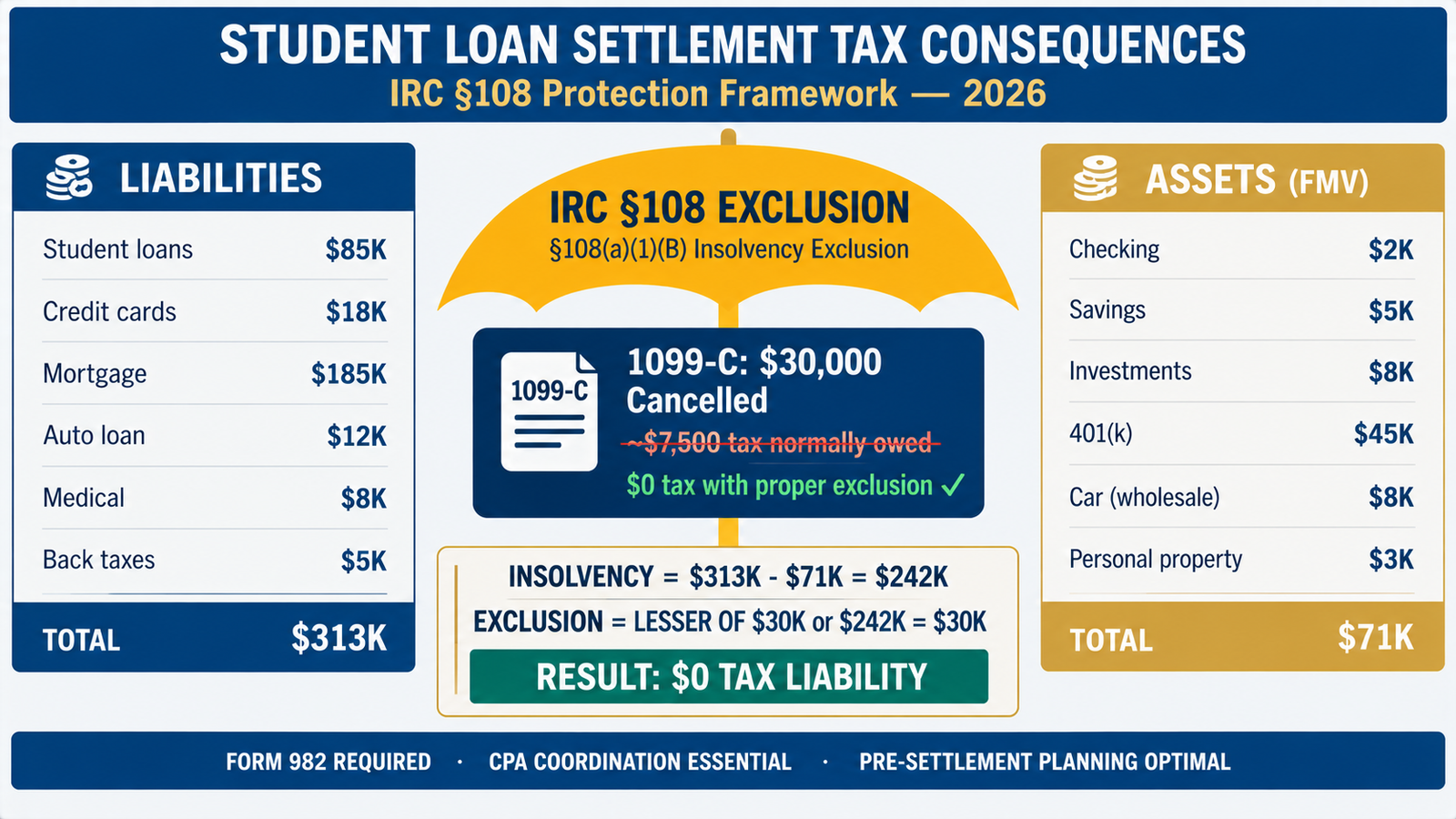
Example calculation for borrower with $30.000 cancelled debt from settlement: ASSETS: Checking $2.000 + Savings $5.000 + Investment account $8.000 + 401(k) $45.000 + Car (liquidation value) $8.000 + Personal property $3.000 = Total assets $71.000. LIABILITIES: Student loan being settled (full pre-cancellation balance) $50.000 + Other student loans $35.000 + Credit cards $18.000 + Auto loan $12.000 + Mortgage $185.000 + Medical bills $8.000 + Back taxes $5.000 = Total liabilities $313.000. INSOLVENCY = $313.000 – $71.000 = $242.000. Since insolvency ($242.000) exceeds cancelled debt ($30.000), the ENTIRE $30.000 cancelled debt is excluded from gross income under IRC §108(a)(1)(B). Form 982 must be filed claiming this exclusion.
Partial insolvency scenarios
If insolvency amount is LESS than cancelled debt amount, only partial exclusion applies: Example: $40.000 cancelled debt, insolvency amount $25.000 → $25.000 excluded under §108(a)(1)(B), remaining $15.000 included in gross income. Tax planning considerations for partial insolvency: (1) ensure complete liability accounting (including contingent liabilities) to maximize insolvency amount; (2) ensure proper fair market value measurement of assets (not inflated values); (3) consider timing of settlement to coincide with lowest asset / highest liability position; (4) consider sequencing of multiple settlements across tax years; (5) consider other income reduction opportunities in year of settlement.
Form 982 preparation and filing
IRS Form 982 (Reduction of Tax Attributes Due to Discharge of Indebtedness) is the required form for claiming irc 108 student loans exclusions. Proper Form 982 preparation and timely filing is essential for claiming the exclusion.
Form 982 purpose and requirements
Form 982 serves two purposes: (1) claim the §108 exclusion for cancelled debt income; (2) report the required tax attribute reduction under §108(b) when applicable. Form 982 must be filed with the borrower’s tax return for the year in which cancellation of debt income is excluded. Failure to file Form 982 may result in IRS treating cancelled debt as fully taxable despite available exclusions — the exclusion must be CLAIMED through proper filing, not automatically applied.
Form 982 key sections for insolvency exclusion
For IRC §108(a)(1)(B) insolvency exclusion, key Form 982 sections: Part I, Line 1b (check box for insolvency exclusion); Part I, Line 2 (total amount of discharged indebtedness excluded from gross income); Part II (reduction of tax attributes, if applicable — including net operating losses, general business credit, minimum tax credit, capital loss carryovers, basis of property, passive activity loss and credit carryovers, foreign tax credit carryovers). Tax attribute reduction order under §108(b)(2) is specific — follow proper ordering. Supporting documentation (insolvency calculation worksheet) typically retained with tax records rather than filed with return, but available for IRS examination.
Insolvency worksheet documentation
While not filed with return, insolvency worksheet documentation is critical for defending exclusion claim if examined: (1) detailed asset list with fair market value and supporting valuations (brokerage statements, Kelley Blue Book for vehicles, home appraisals or recent comparable sales); (2) complete liability list with supporting documentation (statements, credit reports, promissory notes); (3) measurement date (typically settlement execution date); (4) calculation showing net worth and insolvency amount; (5) comparison to cancelled debt amount showing exclusion basis. Documentation should be contemporaneous with settlement, not reconstructed years later.
Form 982 for bankruptcy exclusion
For IRC §108(a)(1)(A) bankruptcy exclusion, Form 982 Part I, Line 1a (check box for Title 11 bankruptcy). Supporting documentation: bankruptcy discharge order showing specific debts discharged. Tax attribute reduction under §108(b) follows specific ordering rules. Bankruptcy exclusion is more straightforward than insolvency in some respects (no financial calculation required) but tax attribute reduction may be more significant depending on borrower’s tax situation.
Filing deadlines and amendments
Form 982 filing: (1) filed with timely original tax return for year 1099-C issued (typically April 15 following year of settlement, extended to October 15 with extension); (2) if 1099-C received after return filed, amended return (Form 1040-X) with Form 982 attached may be filed within 3 years of original return filing deadline; (3) failure to file Form 982 or amended return within statute of limitations may permanently preclude claiming exclusion. Act promptly on receiving 1099-C to ensure timely filing.
State tax conformity considerations
In addition to federal tax analysis, student loan settlement tax implications include state tax considerations. Most but not all states conform to federal §108 exclusions.
State conformity to federal §108
State income tax treatment of cancelled debt income varies: (1) most states adopt federal starting point (federal adjusted gross income or taxable income) and inherit federal §108 exclusions; (2) some states have specific decoupling from certain federal provisions; (3) some states (9 states) have no personal income tax (Alaska, Florida, Nevada, New Hampshire, South Dakota, Tennessee, Texas, Washington, Wyoming) — no state tax on cancelled debt regardless; (4) specific state treatment should be verified with state tax resources or CPA familiar with state. California, Pennsylvania, and some other states have specific conformity considerations that may differ from federal treatment.
State-specific analysis required
For states with income tax, verify specific treatment: (1) does state conform to federal IRC §108 exclusions? (most do, but some have specific exceptions); (2) does state have its own cancelled debt income rules? (some do); (3) does state have insolvency exclusion equivalent? (if conforming to federal, yes); (4) does state have specific bankruptcy exclusion rules? (varies); (5) is state tax reporting required separately from federal 1099-C reporting? (varies). State-specific CPA familiar with state tax rules essential for accurate state tax planning.
California specific considerations
California is major state with substantial private student loan borrower population. California generally conforms to federal §108 exclusions through state tax code, though specific conformity dates and provisions should be verified. California tax reporting for cancelled debt follows federal 1099-C framework. California FTB (Franchise Tax Board) provides state-specific guidance on cancellation of debt treatment. For California residents with substantial private student loan settlement, state tax planning should coordinate with federal tax planning.
High-income borrower considerations
Borrowers with high nominal income (SoFi prime borrowers, Navient refinance borrowers, high-balance NCSLT loans from professional school) have specific student loan settlement tax consequences considerations. High income does NOT preclude insolvency exclusion when properly calculated.
Income vs insolvency distinction
Important distinction for high-income borrowers: income (annual earnings) is DIFFERENT from insolvency (net worth position). Insolvency exclusion depends on balance sheet position at measurement date (liabilities exceeding assets), not annual income flow. High-income borrowers often have substantial insolvency due to: (1) large student loan balances from professional school education; (2) mortgage and other debt commitments; (3) relatively limited liquid assets compared to debt obligations; (4) retirement accounts (which may be discounted for insolvency purposes); (5) contingent liabilities from guarantees and co-signed debts. Insolvency calculation often supports substantial exclusion even for borrowers with $150.000+ annual income.
Retirement account treatment
Retirement account valuation for insolvency calculation is somewhat unsettled area with important high-income implications: (1) traditional view: retirement accounts valued at current balance; (2) some commentators argue discounted value appropriate for working-age borrowers (reflecting early withdrawal penalties and ordinary income taxation); (3) IRS has not provided clear guidance supporting significant discount; (4) conservative approach uses current balance; (5) aggressive approach uses discounted value with proper documentation; (6) consult CPA familiar with insolvency calculation for position. For high-income borrowers with substantial retirement accounts, retirement account treatment can significantly affect insolvency amount available.
Contingent liability inclusion
Contingent liabilities inclusion often significant for high-income borrowers: (1) co-signed debts (parent cosigner on children’s loans, spousal cosigner, business guarantees) — contingent liability for the borrower; (2) pending lawsuit potential liability; (3) tax liability arising from the cancellation itself; (4) business guarantee obligations; (5) alimony or support obligations if applicable. Specific documentation and reasonable valuation of contingent liabilities can substantially increase insolvency amount. Contingent liability analysis requires sophisticated understanding of §108(d)(3) framework and judicial precedent.
High-income tax planning strategies
For high-income borrowers who cannot establish complete insolvency exclusion: (1) sequence multiple settlements across tax years to spread cancellation income; (2) time settlement to coincide with lower-income years (job transitions, sabbaticals, educational leave); (3) coordinate with other tax events (business losses, investment losses, charitable deductions) in settlement year; (4) consider retirement account contribution to reduce AGI in settlement year; (5) HSA contributions where applicable; (6) specific business expense timing if self-employed; (7) tax loss harvesting on investments. Multiple strategies may combine to minimize tax impact even when complete exclusion unavailable.
Related resources — complete settlement cluster
Private Student Loan Settlement 2026: Complete Guide (PILAR)
The 7-path master framework covering all private student loan settlement mechanisms — the complete cluster pilar.
How to Settle Private Student Loans 2026
Complete 7-step process framework — tax planning integration critical at Step 7.
Settlement vs Bankruptcy Student Loans 2026
Comparative framework including tax implications across both paths.
CPA coordination and pre-settlement planning
Proper CPA coordination is essential for optimal student loan settlement tax implications outcomes. Pre-settlement tax planning typically produces materially better outcomes than post-settlement tax scrambling.
Pre-settlement CPA consultation
Pre-settlement CPA consultation should address: (1) current insolvency position analysis establishing baseline documentation; (2) projected insolvency position at anticipated settlement date; (3) tax implications of settlement amount and timing; (4) coordination with other tax events in settlement year; (5) state tax implications specific to borrower’s state; (6) Form 982 preparation planning; (7) documentation requirements for insolvency defense if examined; (8) multi-year planning if multiple settlements anticipated. Pre-settlement planning allows strategy optimization; post-settlement planning limits options.
Timing coordination with CPA
Settlement timing coordination with tax planning: (1) settlement year typically dictates 1099-C year; (2) consider borrower’s income trajectory (lower income year typically better); (3) consider other asset/liability events (asset sales, debt payoffs, inheritance timing); (4) consider state residency timing if planning move to tax-free state; (5) consider other income reduction opportunities in settlement year; (6) consider sequencing multiple settlements across tax years to spread income or coordinate with maximum insolvency position. Flexibility in settlement timing (where available) can produce substantial tax savings.
Documentation during settlement year
Documentation to maintain during settlement year: (1) complete asset and liability snapshot immediately before settlement execution (contemporaneous insolvency calculation); (2) settlement agreement with cancellation amount and date; (3) 1099-C upon receipt (typically following January); (4) supporting documents for asset valuations (brokerage statements, Blue Book printouts, recent appraisals); (5) supporting documents for liability amounts (statements, promissory notes, judgment copies); (6) tax return preparation files for Form 982 and insolvency worksheet. Documentation preparation during settlement year supports clean tax filing in following year.
Post-settlement tax filing coordination
Post-settlement tax filing coordination: (1) receive 1099-C in January following settlement year; (2) provide to CPA with all supporting documentation; (3) CPA prepares Form 982 with proper exclusion claim; (4) CPA prepares insolvency worksheet documentation for records; (5) tax return filed by April 15 (or October 15 with extension); (6) retain all documentation for 7-year IRS examination period; (7) response planning if IRS examination occurs. Proper execution of this sequence provides maximum tax protection on settlement cancelled debt income.
Attorney-CPA coordination for complex situations
For complex situations, coordinated attorney-CPA team provides optimal outcome: (1) settlement attorney handles negotiation and settlement agreement; (2) CPA handles tax planning and preparation; (3) coordination on timing, documentation, and strategy; (4) bankruptcy attorney involved if coordinated bankruptcy strategy considered; (5) state tax specialist if multi-state issues; (6) business attorney if business ownership issues. Private Student Relief’s attorney-backed partner provider framework typically includes referral coordination with qualified CPAs for proper tax planning integration.
Common myths about settlement tax consequences
Myth 1
“Settlement always creates massive tax liability — it’s not worth it”
Reality: For most settlement borrowers, IRC §108(a)(1)(B) insolvency exclusion eliminates ALL or MOST of the tax liability on cancelled debt income. The insolvency calculation compares total liabilities to fair market value of total assets — many settlement borrowers are substantially insolvent at settlement date (large student loan balances, other debts, limited liquid assets). Example: Borrower with $242.000 insolvency amount and $30.000 cancelled debt excludes entire $30.000 from gross income — zero tax impact. Even high-income borrowers often qualify for substantial exclusion through proper calculation including contingent liabilities and discounted retirement account treatment. Settlement tax impact should not be feared — it should be planned for with proper CPA coordination. Fear of unknown tax consequences often prevents borrowers from pursuing settlement that would substantially improve their financial situation.
Myth 2
“My income is too high for insolvency exclusion”
Reality: Insolvency exclusion depends on BALANCE SHEET (liabilities vs assets), not INCOME (annual earnings). Many high-income borrowers are substantially insolvent due to large debt commitments relative to assets. Insolvency calculation includes ALL debts (student loans at full pre-cancellation balance, mortgage, auto, credit cards, back taxes, medical, business guarantees, contingent liabilities) at face value; assets at fair market value (which may be substantially less than book value or purchase price). For many professional borrowers with high education debt and limited time to accumulate assets, insolvency position is substantial despite nominal income. Proper insolvency calculation with CPA coordination typically supports significant exclusion. High income does not preclude §108(a)(1)(B) exclusion — the calculation determines eligibility.
Myth 3
“If I don’t file Form 982, the exclusion applies automatically”
Reality: IRC §108 exclusions must be AFFIRMATIVELY CLAIMED through proper Form 982 filing — they do not apply automatically. If 1099-C is received and Form 982 is not filed claiming applicable exclusion, IRS typically treats cancelled debt as fully taxable. The 1099-C creates presumption of taxable cancellation of debt income under IRC §61(a)(12); Form 982 is the mechanism to overcome that presumption by claiming applicable §108 exclusion. Failure to file Form 982 can result in substantial unexpected tax bill and potential penalties. Always coordinate with CPA upon receiving 1099-C to ensure proper Form 982 preparation and filing with timely tax return. If 1099-C received after return filed, amended return with Form 982 within 3-year limitations period may be filed.
Myth 4
“The temporary ARPA exclusion covers all private student loan settlement”
Reality: The American Rescue Plan Act (ARPA) 2021 §9675 expanded IRC §108(f)(5) temporary exclusion for student loan discharges — but this provision has SPECIFIC requirements that typically do NOT cover ordinary private student loan settlement. The expanded exclusion primarily applies to federal student loan discharge events (death discharge, disability discharge, closed school discharge, borrower defense to repayment, income-driven repayment forgiveness) and some specific private loan situations. Ordinary private student loan settlement outside these specific categories typically does not qualify for §108(f) exclusion. For most private settlement situations, IRC §108(a)(1)(B) insolvency exclusion is the applicable framework. Also, ARPA temporary provisions have specific sunset dates that may have passed — verify current status with CPA. Do not rely on ARPA exclusion for private settlement — verify applicable exclusion with proper analysis.
Frequently asked questions
1. Are student loan settlements taxable?
Are student loan settlements taxable: The cancelled debt portion of a student loan settlement is GENERALLY taxable under IRC §61(a)(12) as cancellation of debt income — reported on IRS Form 1099-C. HOWEVER, Internal Revenue Code §108 provides exclusions that typically eliminate most or all tax liability for settlement borrowers. Most commonly applicable: IRC §108(a)(1)(B) insolvency exclusion — excludes cancelled debt to the extent borrower was insolvent (total liabilities exceeded total assets) immediately before cancellation. For borrowers whose settlement is coordinated with bankruptcy, IRC §108(a)(1)(A) provides complete exclusion. Form 982 must be filed with tax return claiming the exclusion. CPA consultation before settlement execution establishes documentation framework and optimizes tax outcome. For most borrowers properly coordinated with CPA, settlement tax impact is minimal or zero.
2. What are the student loan settlement tax consequences?
Student loan settlement tax consequences: (1) lender issues Form 1099-C for cancelled debt amount $600 or more; (2) cancelled debt generally taxable under IRC §61(a)(12); (3) IRC §108 exclusions available; (4) most commonly IRC §108(a)(1)(B) insolvency exclusion — excludes cancelled debt to extent borrower was insolvent (liabilities exceeded assets at fair market value) immediately before cancellation; (5) IRC §108(a)(1)(A) complete exclusion if debt discharged in Chapter 7 or Chapter 13 bankruptcy; (6) Form 982 required to claim exclusions; (7) state tax implications vary by state (most states conform to federal); (8) possible tax attribute reduction under §108(b) depending on exclusion claimed. CPA consultation essential for accurate planning. Most borrowers with proper insolvency documentation have zero or minimal tax liability on cancelled debt income.
3. What is a 1099-C for student loan settlement?
IRS Form 1099-C (Cancellation of Debt) is the information return lenders are required to file reporting cancelled debt of $600 or more. For 1099-c student loan settlement: the lender (Sallie Mae Bank, Navient/Earnest, Discover/Firstmark, SoFi, Citizens, Ascent, NCSLT trust, debt buyer) sends 1099-C to borrower and IRS reporting the cancelled debt amount (difference between full balance and settlement payment). Form shows: Box 1 date of identifiable event; Box 2 amount of debt cancelled; Box 4 debt description; Box 5 whether debtor was personally liable; Box 6 identifiable event code. Borrower must report cancelled debt on tax return either as taxable income or by filing Form 982 claiming applicable IRC §108 exclusion. 1099-C typically issued January following settlement year.
4. How do I avoid taxes on settled student loans?
To minimize or avoid taxes on settled student loans: (1) establish insolvency documentation BEFORE settlement execution — complete balance sheet showing total liabilities exceed fair market value of total assets; (2) claim IRC §108(a)(1)(B) insolvency exclusion on Form 982 with tax return for settlement year; (3) include all liabilities (student loans at full pre-cancellation balance, mortgage, auto, credit cards, back taxes, medical, contingent liabilities); (4) use fair market value for assets (not inflated values); (5) coordinate settlement timing with CPA for optimal tax year; (6) consider sequencing multiple settlements across tax years; (7) coordinate with other tax events (business losses, retirement contributions, HSA contributions); (8) consider bankruptcy coordination if §108(a)(1)(A) complete exclusion available. CPA consultation before settlement essential for optimal outcome. For many borrowers, proper insolvency documentation produces zero tax liability on cancelled debt.
5. What is IRC §108 for student loans?
IRC 108 student loans framework: Internal Revenue Code §108 provides exclusions from gross income for discharged indebtedness, including cancelled student loan debt from settlement. Key exclusions: §108(a)(1)(A) bankruptcy exclusion (complete exclusion for debt discharged in Title 11 bankruptcy); §108(a)(1)(B) insolvency exclusion (excludes cancelled debt to extent borrower was insolvent — total liabilities exceeded fair market value of assets); §108(f) educational loan exclusion (specific requirements, primarily federal programs); §108(a)(2) ordering rules when multiple exclusions could apply; §108(b) tax attribute reduction rules. For most private student loan settlement situations, §108(a)(1)(B) insolvency exclusion is primary applicable framework. Claim through Form 982 filing with tax return.
6. How do I calculate insolvency for student loan settlement?
Insolvency calculation for IRC §108(a)(1)(B) exclusion: INSOLVENCY = TOTAL LIABILITIES – FAIR MARKET VALUE OF TOTAL ASSETS, measured immediately before debt cancellation. ASSETS include: cash and equivalents at face value; investment accounts at market value; retirement accounts at current value (some commentators argue discounted value); real estate at fair market value; vehicles at wholesale value; personal property at liquidation value; business interests at reasonable valuation. LIABILITIES include: all student loans (settled loan at pre-cancellation balance); credit cards; auto loans; mortgage; medical debt; back taxes; judgments; business debts if personally liable; contingent liabilities (co-signed debts, guarantees). Exclusion = LESSER of cancelled debt amount OR insolvency amount. Positive net worth = no insolvency exclusion. Measurement at specific point (immediately before cancellation). CPA assistance recommended for proper calculation and documentation.
7. When should I consult a CPA for settlement tax planning?
CPA consultation timing for settlement: (1) PRE-SETTLEMENT (ideal) — before executing settlement to establish insolvency baseline, plan timing, coordinate with other tax events, and document strategy; (2) SETTLEMENT YEAR — maintain contemporaneous documentation of asset/liability position at settlement date; (3) UPON 1099-C RECEIPT (January following settlement year) — provide to CPA with all documentation for Form 982 preparation; (4) TAX FILING (April 15 or October 15 with extension) — ensure proper Form 982 filing with return claiming applicable §108 exclusion; (5) POST-FILING — retain documentation for 7-year IRS examination period; (6) IF EXAMINED — coordinate CPA response to IRS examination questions. Pre-settlement CPA consultation provides most benefit; post-settlement CPA engagement still valuable but with reduced optimization options. For most settlement borrowers, CPA fees ($300-$1.500 depending on complexity) are small investment relative to tax impact being managed.
Settlement with Tax Planning Integrated
Free specialist review including IRC §108 tax planning coordination for your settlement.
Complete settlement framework across all major lenders (Sallie Mae Bank NYSE:SLM, Navient/Earnest Operations LLC, Discover/Firstmark Services, SoFi Bank NA, Citizens Bank NA, Ascent, NCSLT trusts, third-party debt buyers) with integrated tax planning coordination. IRC §108 exclusion framework including §108(a)(1)(A) bankruptcy exclusion and §108(a)(1)(B) insolvency exclusion with Form 982 preparation methodology. Insolvency calculation including fair market value asset analysis (checking/savings, retirement accounts at discounted value, home equity, vehicles at liquidation value, personal property) and complete liability accounting (student loans at pre-cancellation balance, mortgage, auto, credit cards, back taxes, medical, contingent liabilities including co-signed debts and guarantees). State tax conformity analysis. 1099-C issuer timing coordination across lenders. CPA coordination through partner network. Free eligibility review with attorney-backed partner provider — no upfront fees.
Get a free eligibility review →
5-minute review · No obligation · Zero upfront fees · Since 2015 · 48 states served
About the author
Henry Silva — Private Student Loan Debt Specialist
10+ years coordinating student loan settlement tax consequences analysis with CPAs across all major private student loan settlement scenarios. Deep expertise in Internal Revenue Code §108 framework including §108(a)(1)(A) Title 11 bankruptcy exclusion providing complete exclusion for debts discharged in Chapter 7 or Chapter 13 bankruptcy regardless of insolvency position, §108(a)(1)(B) insolvency exclusion providing exclusion to the extent debtor was insolvent (total liabilities exceeding fair market value of total assets) immediately before debt cancellation, §108(a)(1)(C) qualified farm indebtedness exclusion (not applicable to student loans), §108(a)(1)(D) qualified real property business indebtedness exclusion (not applicable), §108(a)(1)(E) qualified principal residence indebtedness exclusion (not applicable), §108(a)(2) priority and ordering rules when multiple exclusions could apply, §108(b) tax attribute reduction rules including net operating losses, general business credit carryforwards, minimum tax credit, capital loss carryovers, basis of property, passive activity loss and credit carryovers, foreign tax credit carryovers, §108(d)(3) insolvency definition, §108(f) educational loan forgiveness exclusion including §108(f)(1) specific government forgiveness programs and §108(f)(5) ARPA temporary expanded exclusion with specific sunset date considerations. IRC §61(a)(12) cancellation of debt income baseline. Treas. Reg. §1.6050P-1 identifiable event rules for 1099-C issuance including 3-year nonpayment presumption. Form 1099-C issuer timing analysis across all major lenders including specific transition considerations for Discover (July 2024 Carlyle+KKR acquisition with Firstmark Services servicing) and NCSLT (trust-specific issuance across 15 trusts). Form 982 preparation methodology including Part I exclusion claim with specific box selection for applicable exclusion category and Part II tax attribute reduction following §108(b)(2) ordering rules. Insolvency calculation methodology including fair market value asset analysis across cash and equivalents, investment accounts at current market value, retirement accounts (with unsettled discounting analysis for working-age borrowers), real estate, vehicles at wholesale/liquidation value, personal property at liquidation value, business ownership interests, and complete liability accounting including all student loan debt at pre-cancellation balance, credit cards, auto loans, mortgage, personal loans, medical debt, back taxes, judgments, child support arrears, business debts, and contingent liabilities including co-signed debts, guarantees, pending lawsuit potential liability, and tax liability from cancellation itself. State tax conformity analysis across all 50 states with specific focus on California FTB (Franchise Tax Board) framework, Pennsylvania conformity considerations, and 9 states with no personal income tax (Alaska, Florida, Nevada, New Hampshire, South Dakota, Tennessee, Texas, Washington, Wyoming). High-income borrower analysis including SoFi prime borrower profile with substantial retirement accounts and contingent liability analysis, Navient refinance consolidation balances, professional school education debt relative to asset accumulation stage. Multi-year tax planning for sequenced settlement scenarios. Pre-settlement CPA consultation coordination establishing contemporaneous insolvency documentation, projected insolvency analysis at anticipated settlement date, timing coordination with income trajectory and other tax events, state tax implications, and documentation strategy for potential IRS examination defense. Henry works with Private Student Relief’s attorney-backed partner provider network coordinating with qualified CPAs for integrated tax planning across settlement execution ensuring borrowers maximize IRC §108 exclusion opportunities and minimize or eliminate tax liability on cancelled debt income.
Legal Disclaimer and Sources
This article is provided for informational purposes only and does not constitute legal, tax, or financial advice. Private Student Relief is a consulting and matching organization operated by Joco (555 Anton Blvd, Suite 368, Costa Mesa, CA 92626) — not a law firm, CPA firm, tax preparation service, debt settlement company, or loan provider. Debt validation services are performed by an attorney-backed partner provider (Panamerican Consulting LLC, Las Vegas, NV) under independent business credentials. Ratings, BBB accreditation, and AADR (American Association for Debt Resolution) membership referenced on the PSR website belong to the partner provider. Tax consequences depend on individual circumstances including income, assets, liabilities, filing status, state of residence, prior tax events, and other factors. CPA consultation strongly recommended for actual tax filing and insolvency calculation. This article provides general framework; specific tax situations require individualized analysis. Since 2015. 48 states served. Not available in South Carolina or Mississippi.
Internal Revenue Code references: IRC §61(a)(12) (cancellation of debt income — baseline taxable income); IRC §108(a)(1)(A) (Title 11 bankruptcy exclusion — complete exclusion for debts discharged in bankruptcy); IRC §108(a)(1)(B) (insolvency exclusion — excludes cancelled debt to extent debtor insolvent immediately before cancellation); IRC §108(a)(1)(C) (qualified farm indebtedness exclusion); IRC §108(a)(1)(D) (qualified real property business indebtedness exclusion); IRC §108(a)(1)(E) (qualified principal residence indebtedness exclusion); IRC §108(a)(2) (priority and ordering rules); IRC §108(b) (tax attribute reduction); IRC §108(b)(2) (ordering of attribute reduction — NOLs, general business credit, minimum tax credit, capital loss carryovers, basis of property, passive activity losses and credits, foreign tax credit); IRC §108(d)(3) (insolvency definition); IRC §108(f) (educational loan forgiveness exclusion); IRC §108(f)(1) (general exclusion for specific government forgiveness programs); IRC §108(f)(5) (American Rescue Plan Act 2021 temporary expanded exclusion); IRC §221(d)(1) (qualified education loan definition — relevant to §523(a)(8)(B) categorization); IRC §61 (gross income definition); IRC §165 (deductible losses); American Rescue Plan Act 2021 §9675 (temporary §108(f)(5) expansion).
IRS Forms and Regulations: Form 1099-C (Cancellation of Debt) — information return filed by lenders for cancelled debt $600 or more; Form 982 (Reduction of Tax Attributes Due to Discharge of Indebtedness) — required form for claiming §108 exclusions and reporting attribute reduction; Form 1040 (individual income tax return); Form 1040-X (amended individual income tax return); Treasury Regulation §1.6050P-1 (identifiable event rules for 1099-C issuance including 3-year nonpayment presumption under §1.6050P-1(b)(2)(iv)); Treasury Regulation §1.108-1 (general IRC §108 regulations); IRS Publication 4681 (Canceled Debts, Foreclosures, Repossessions, and Abandonments). IRS examination authority under IRC §7602 and related provisions.
Bankruptcy Code references (relevant to §108(a)(1)(A) exclusion coordination): 11 U.S.C. §523(a)(8) (student loan discharge exceptions); 11 U.S.C. §707(b)(2) (Chapter 7 means test); 11 U.S.C. §1328 (Chapter 13 discharge). Key bankruptcy precedent affecting §523(a)(8) analysis and consequent §108(a)(1)(A) applicability: Homaidan v. Sallie Mae Inc. 992 F.3d 100 (2d Cir. 2021); Crocker v. Navient Solutions LLC 941 F.3d 206 (5th Cir. 2019); McDaniel v. Navient Solutions LLC 973 F.3d 1083 (10th Cir. 2020); Brunner v. New York State Higher Education Services Corp. 831 F.2d 395 (2d Cir. 1987); In re Rosenberg 594 B.R. 22 (Bankr. S.D.N.Y. 2020); DOJ November 2022 undue hardship guidance.
State tax considerations: Most states conform to federal §108 exclusions through state tax code conformity provisions, though specific conformity dates and provisions vary by state and may differ from federal treatment on specific points. 9 states have no personal income tax: Alaska, Florida, Nevada, New Hampshire, South Dakota, Tennessee, Texas, Washington, Wyoming. California Franchise Tax Board (FTB) provides state-specific guidance on cancellation of debt treatment. State-specific CPA consultation essential for accurate state tax planning.
Student loan settlement tax consequences analysis requires case-by-case evaluation coordinating 1099-C issuance analysis across specific lender/trust/debt buyer, IRC §108 exclusion framework application with primary focus on §108(a)(1)(B) insolvency exclusion for settlement situations, contemporaneous insolvency calculation documentation at settlement execution date including fair market value asset analysis and complete liability accounting, Form 982 preparation and timely filing with tax return for year of 1099-C issuance, state tax conformity analysis specific to borrower’s state of residence, timing coordination with other income and tax events for optimization, multi-year planning for sequenced settlement scenarios, bankruptcy coordination evaluation for §108(a)(1)(A) complete exclusion where applicable, and 7-year IRS examination response planning. This article provides general framework information; specific tax planning and preparation must be performed with qualified CPA familiar with borrower’s complete tax situation. Pre-settlement CPA consultation strongly recommended for optimal outcomes. Last reviewed: October 2026.