

Informational content only. Not legal, tax, or financial advice. Private Student Relief is a consulting organization, not a law firm. Debt validation services are executed by an attorney-backed partner provider. This article provides educational framework for evaluating settlement services; specific company recommendations should be independently verified. Last reviewed: October 2026.
Written by Henry Silva
Private Student Loan Debt Specialist · 10+ years evaluating student loan settlement companies market, regulatory framework, and consumer protection standards. Deep expertise in Credit Repair Organizations Act (CROA) 15 U.S.C. §1679 et seq., FTC Telemarketing Sales Rule 16 CFR §310.4(a)(5) advance fee ban, state debt settlement regulatory frameworks, attorney-backed vs non-attorney service models, legitimate fee structures, red flag identification, and complaint resource utilization (CFPB consumer complaint database, state attorney general consumer protection divisions, BBB). Last reviewed: October 2026.
Choosing among student loan settlement companies is one of the most consequential decisions borrowers face when seeking private student loan debt relief. The industry includes legitimate attorney-backed providers delivering real value, non-attorney services operating within consumer protection frameworks, and unfortunately, scam operations that take fees without delivering results and may actually harm borrower outcomes. For borrowers with private student loans from Sallie Mae Bank, Navient/Earnest, Discover/Firstmark, SoFi Bank NA, Citizens Bank, Ascent, NCSLT trusts, or third-party debt buyers, selecting the right service — or choosing to pursue DIY settlement — materially affects both financial outcome and consumer protection. This complete 2026 guide covers how to evaluate student loan settlement companies: regulatory framework (CROA, FTC Rule 310, state laws), attorney-backed vs non-attorney models, legitimate fee structures, red flags to avoid, how to verify credentials and complaints, when DIY settlement works, when professional representation produces materially better outcomes, and the specific framework behind Private Student Relief’s attorney-backed partner provider model.
Quick Answer
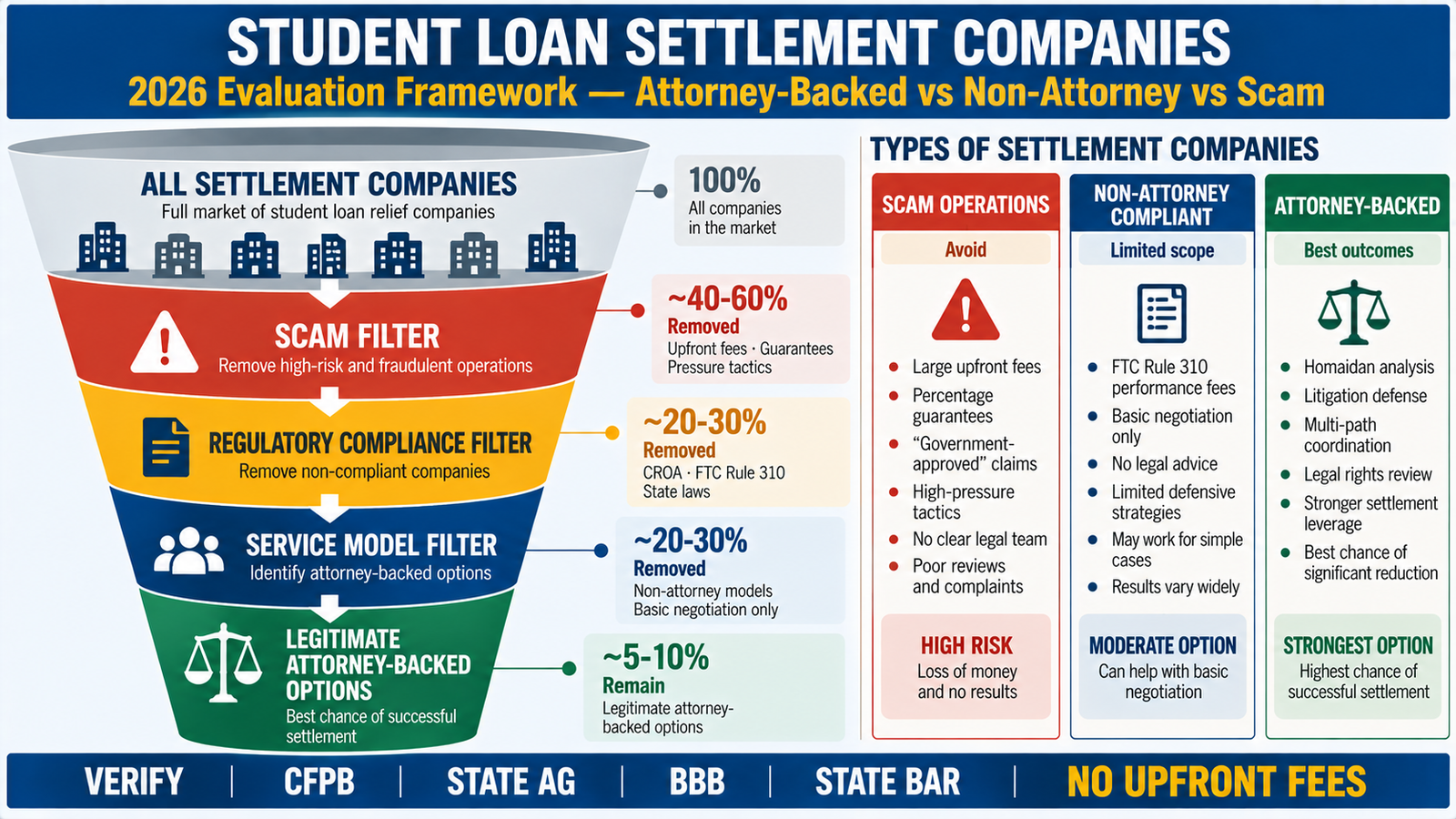
Student loan settlement companies fall into three categories: (1) attorney-backed providers where licensed attorneys execute settlement work (often most legitimate framework); (2) non-attorney services operating within FTC Telemarketing Sales Rule 16 CFR §310.4(a)(5) framework prohibiting advance fees for debt settlement services; (3) scam operations violating regulatory frameworks. To evaluate student loan settlement companies: (A) verify attorney credentials or non-attorney compliance; (B) understand fee structure (attorneys may charge differently; non-attorneys cannot charge fees before settlement is reached); (C) check Credit Repair Organizations Act (CROA) 15 U.S.C. §1679 et seq. compliance including required written contracts and 3-day cancellation rights; (D) verify complaints via CFPB consumer complaint database, state attorney general consumer protection divisions, BBB; (E) understand realistic settlement expectations (40-60% charged-off accounts, 25-45% with defensive leverage) — companies promising specific percentages before analysis are red flags; (F) confirm specific services included (negotiation only vs full defensive leverage integration vs multi-path coordination). Red flags: large upfront fees before any work (violates FTC Rule 310 for non-attorneys); specific percentage promises; “government-approved” claims (none exist for private loans); pressure tactics; instructions to stop paying without hardship justification; unclear fee structures. Private Student Relief operates through attorney-backed partner provider (Panamerican Consulting LLC, Las Vegas NV) with transparent framework and no upfront fees.
Read the complete evaluation framework below.
In this complete evaluation guide:
The 3 categories of student loan settlement companies
Attorney-backed, non-attorney compliant, scam operations
Regulatory framework — CROA, FTC Rule 310, state laws
Consumer protection rules governing the industry
Attorney-backed vs non-attorney service models
Different structures, different regulatory frameworks
Legitimate fee structures
How legitimate services charge for their work
Red flags to avoid
Warning signs of scam or problematic operations
How to verify a company’s legitimacy
CFPB, state AG, BBB, bar association verification
DIY vs professional representation decision
When companies help, when DIY settlement works
The 3 categories of student loan settlement companies
The student loan settlement companies market in 2026 includes three fundamentally different categories, each with distinct regulatory frameworks and consumer protection implications. Understanding which category a specific company falls into is the first step in evaluation.
Category 1: Attorney-backed providers
Attorney-backed providers employ licensed attorneys to execute settlement negotiations, defensive leverage analysis, and settlement agreement drafting. These providers operate under state bar regulations governing attorney practice. Key characteristics: (1) licensed attorney directly handles or supervises settlement work; (2) attorney-client relationship with associated privilege and ethical obligations; (3) state bar supervision and disciplinary accountability; (4) fee structures typically follow legal services models (retainer, hourly, flat fee, success-based depending on jurisdiction); (5) can provide legal advice regarding defensive leverage, bankruptcy analysis, litigation defense, and settlement strategy. Attorney-backed providers can integrate sophisticated defensive leverage analysis including Homaidan v. Sallie Mae 992 F.3d 100 (2d Cir. 2021) §523(a)(8) framework, chain of assignment under Article III standing doctrine, statute of limitations analysis, and coordinated multi-path strategy. Private Student Relief operates through attorney-backed partner provider framework (Panamerican Consulting LLC, Las Vegas NV).
Category 2: Non-attorney compliant services
Non-attorney debt settlement services operate within specific regulatory framework. Under FTC Telemarketing Sales Rule 16 CFR §310.4(a)(5), non-attorney debt settlement providers cannot charge fees before settlement is actually reached — the “advance fee ban.” They can only charge fees after demonstrating they have renegotiated, settled, reduced, or otherwise altered the terms of at least one debt; the consumer has made at least one payment under the renegotiated agreement; and the fee bears the same proportional relationship to the total fee for settling the entire debt as the individual debt amount bears to the entire debt amount. Non-attorney services are also subject to CROA, state debt settlement laws, and state consumer protection laws. These services can perform legitimate work but have more limited scope than attorney-backed services (cannot provide legal advice, cannot represent in litigation, more limited defensive leverage integration).
Category 3: Scam operations
Unfortunately, the industry also includes operations that violate regulatory frameworks and harm consumers. These may: (1) charge large upfront fees in violation of FTC Rule 310; (2) make specific percentage promises before analysis; (3) claim “government-approved” status or special relationships with lenders; (4) use high-pressure sales tactics; (5) instruct borrowers to stop paying without appropriate hardship justification; (6) collect payments and perform minimal actual work; (7) misrepresent attorney involvement; (8) create false sense of urgency. Scam operations often target vulnerable borrowers through aggressive marketing. CFPB consumer complaint database, state attorney general consumer protection divisions, BBB complaints, and litigation records help identify problematic operations before engagement.
Regulatory framework — CROA, FTC Rule 310, state laws
Multiple regulatory frameworks govern private student loan settlement companies, creating specific consumer protection standards. Understanding these frameworks helps borrowers identify compliance (indicator of legitimacy) and non-compliance (indicator of potential problems).
Credit Repair Organizations Act (CROA) 15 U.S.C. §1679 et seq.
CROA governs credit repair organizations (CROs) which includes some entities providing debt settlement services. Key CROA requirements: (1) written contracts required with specific disclosure elements including statement of consumer rights (CROA §1679c); (2) three business day cancellation right (CROA §1679e); (3) prohibition on receiving payment before services fully performed (CROA §1679b(b)); (4) prohibition on making false or misleading representations (CROA §1679b(a)(3)); (5) prohibition on advising consumers to make untrue statements to credit bureaus (CROA §1679b(a)(1)). Private right of action for violations (CROA §1679g). Legitimate services provide proper CROA disclosures and respect cancellation rights. Services avoiding CROA compliance or using high-pressure tactics to prevent cancellation are red flags.
FTC Telemarketing Sales Rule 16 CFR §310.4(a)(5)
FTC Telemarketing Sales Rule includes specific provisions for debt relief services. Under 16 CFR §310.4(a)(5), it is an abusive telemarketing practice for debt relief services to request or receive payment of any fee or consideration before: (1) renegotiating, settling, reducing, or otherwise altering the terms of at least one debt per the agreement; (2) the consumer making at least one payment under the renegotiated agreement; and (3) the fee bearing the same proportional relationship to total fees as individual debt bears to total debt. This “advance fee ban” applies to telemarketed debt relief services (which includes most debt settlement company solicitations). Exceptions exist for attorneys providing legal services in states permitting different fee structures. Services charging large upfront fees in non-attorney context typically violate FTC Rule 310.
State debt settlement regulations
State regulations add additional requirements and vary significantly: (1) some states require debt settlement companies to register and post bonds; (2) some states cap fees debt settlement companies can charge; (3) some states prohibit debt settlement services entirely in certain forms; (4) some states have specific disclosure requirements beyond federal law; (5) some states require specific contract elements and cancellation rights. Private Student Relief is not available in South Carolina or Mississippi due to specific state regulatory considerations. Legitimate services comply with state requirements in each state they serve; non-compliance in a state typically means the company does not serve consumers in that state.
Attorney practice rules
Attorney-backed services operate under state bar rules governing attorney practice. Key considerations: (1) attorneys must be licensed in state where legal services are provided (or affiliated with attorneys licensed in those states); (2) attorney-client privilege applies to communications about settlement strategy; (3) ethical rules govern fee arrangements, conflicts of interest, and client representation; (4) state bar disciplinary processes provide accountability; (5) legal malpractice coverage protects clients. These attorney practice rules provide significant consumer protection beyond general consumer protection law. Attorney-backed providers typically operate through specific attorney practice framework with proper licensing and ethical compliance.
Attorney-backed vs non-attorney service models
Understanding the distinction between attorney-backed and non-attorney service models is critical when choosing among legit student loan settlement companies. Each has different capabilities, regulatory frameworks, and appropriate use cases.
Attorney-backed service model
Attorney-backed services employ licensed attorneys who directly handle or supervise settlement work. Key capabilities: (1) legal analysis of defensive leverage including bankruptcy, chain of assignment, statute of limitations, Homaidan v. Sallie Mae framework; (2) litigation defense if lender files lawsuit; (3) bankruptcy consultation and filing coordination if settlement doesn’t resolve; (4) settlement agreement drafting with proper legal protections; (5) FDCPA counterclaim preservation for debt collection violations; (6) cosigner release coordination with proper legal protections; (7) IRC §108 tax planning coordination. Attorney-backed services typically most appropriate for: larger balance accounts; complex defensive leverage situations; accounts in or approaching litigation; situations requiring coordinated multi-path strategy; situations where cosigner protection is critical.
Non-attorney service model
Non-attorney debt settlement services operate under FTC Rule 310 framework with specific limitations. Capabilities: (1) negotiation with lenders based on hardship presentation; (2) settlement arrangement coordination; (3) savings account coordination for accumulating settlement funds; (4) basic settlement framework guidance. Limitations: (1) cannot provide legal advice; (2) cannot represent in litigation; (3) cannot provide bankruptcy analysis beyond general information; (4) more limited defensive leverage integration (cannot analyze specific legal precedents applied to specific accounts); (5) cannot represent in court proceedings. Non-attorney services may be appropriate for: smaller balance accounts with straightforward hardship situations; borrowers who have performed their own defensive leverage analysis; situations where basic settlement negotiation (not complex legal strategy) is adequate.
Hybrid models
Some services operate hybrid models combining attorney and non-attorney elements. Common hybrid structures: (1) consulting organization matching consumers with attorney-backed partner provider for actual settlement work (Private Student Relief operates this model with Panamerican Consulting LLC as the attorney-backed partner provider); (2) non-attorney front-end intake with attorney back-end execution for complex cases; (3) non-attorney for most work with attorney referral for litigation defense; (4) attorney network affiliate structures with varying degrees of integration. Hybrid models can provide efficient service delivery with proper attorney involvement for legal aspects. Transparency about the structure is critical — consumers should understand exactly who is performing what role.
The consulting + partner provider model (PSR example)
Private Student Relief operates as a consulting and matching organization (Joco, 555 Anton Blvd Suite 368, Costa Mesa CA 92626) — not itself a law firm or debt settlement company. PSR provides educational resources, eligibility review, and consumer matching with attorney-backed partner provider (Panamerican Consulting LLC, Las Vegas NV) that performs actual settlement work including debt validation services, defensive leverage analysis, settlement negotiation, and settlement agreement execution. BBB accreditation and AADR (American Association for Debt Resolution) membership referenced in PSR materials belong to the attorney-backed partner provider. This structure provides transparent framework: consumer understands who performs what role, and attorney-backed partner provider operates under proper legal framework while PSR provides consulting and matching function. Model operates with no upfront fees — consumers pay only when settlement is actually reached.
Legitimate fee structures
Fee structures used by legitimate student loan debt settlement companies vary based on service model and regulatory framework. Understanding what constitutes legitimate fee structures helps identify red flags.
Non-attorney fee structures (FTC Rule 310 compliant)
Non-attorney debt settlement services must comply with FTC Rule 310 advance fee ban. Legitimate structures: (1) performance-based fees charged only after settlement reached and consumer makes payment under renegotiated agreement; (2) proportional fee relationship between individual debt settlement and total debt; (3) typical fees 15-25% of debt enrolled (percentage of balance, not savings) OR 20-30% of savings (debt reduction amount); (4) savings account arrangements for accumulating settlement funds (consumer controls account; funds for settlement payment and fees). Non-attorney services charging large upfront fees before any settlement reached violate FTC Rule 310 — this is per se illegal practice regardless of what the company calls the fees.
Attorney fee structures
Attorney fee structures vary by state and type of legal work. Legitimate structures include: (1) hourly billing (typical rates $200-500+/hour depending on experience and jurisdiction); (2) flat fee arrangements for defined scope (settlement negotiation for specific account); (3) retainer arrangements with hours applied against retainer; (4) hybrid retainer plus hourly structures; (5) in some jurisdictions and situations, contingency or success-based fees. Attorney fee structures must comply with state bar ethical rules governing fees. Attorney-backed services typically more transparent about fee structure and provide written engagement agreements specifying scope, fees, and attorney responsibilities.
The no-upfront-fees model
Some providers (including Private Student Relief’s attorney-backed partner provider framework) operate under no-upfront-fees model where consumers pay only when settlement is actually reached and executed. This model provides consumer protection against paying for services that don’t produce results. Framework: (1) initial eligibility review provided at no cost; (2) analysis and strategy preparation performed before fee payment; (3) fees charged only when settlement agreement executed and payment made; (4) fees typically proportional to settlement outcome. This model aligns provider and consumer incentives (providers paid when consumers benefit) and complies with regulatory frameworks.
What NOT to pay for
Consumers should avoid paying for: (1) “enrollment fees” charged before any work (non-attorney services charging these likely violate FTC Rule 310); (2) “setup fees” or “monthly maintenance fees” without clear service deliverable; (3) “government program enrollment” (no government settlement programs exist for private student loans); (4) specific percentage settlement guarantees (legitimate providers cannot guarantee specific outcomes before analysis); (5) credit repair services bundled with settlement (CROA regulates these differently; be aware of what you’re paying for); (6) “legal review” fees from non-attorney services (if attorney isn’t actually involved, this is misleading). Clear service deliverables and fee structures are essential.
Red flags to avoid
Recognizing red flags in student loan settlement companies helps borrowers avoid problematic operations before engagement. These warning signs indicate either regulatory non-compliance or practices harmful to consumer outcomes.
Fee-related red flags
Fee structure red flags: (1) large upfront fees ($3.000-$10.000+) before any work performed — non-attorney services charging these violate FTC Rule 310; (2) “enrollment fees” or “setup fees” charged before any settlement reached; (3) monthly maintenance fees without clear service deliverable; (4) fee structures that aren’t clearly explained in writing; (5) fees that bear no relationship to actual work performed; (6) attempts to collect fees before settlement is actually executed; (7) multiple separate fees for what should be bundled service. Legitimate fee structures are clear, written, and tied to actual deliverables.
Marketing-related red flags
Marketing red flags: (1) specific settlement percentage promises before analysis (“we guarantee 50% off your loans”); (2) claims of “government-approved” status (no government settlement programs for private loans); (3) claims of special relationships with specific lenders not supported by actual lender relationships; (4) use of federal government logos or implied federal endorsement; (5) marketing claims that student loans can be “forgiven” or “eliminated” without proper qualification; (6) celebrity endorsements that may not reflect actual service quality; (7) marketing targeting specific vulnerable populations with promises inappropriate to their situations.
Sales process red flags
Sales process red flags: (1) high-pressure tactics creating artificial urgency (“this offer expires today”); (2) pressure to sign contracts without time for review; (3) resistance to providing written contract for review; (4) resistance to answering specific questions about services or fees; (5) refusal to allow attorney review of contracts before signing; (6) use of fear-based messaging (lawsuits, wage garnishment, bank levies) without factual basis for specific situation; (7) sales representatives claiming to be attorneys when they aren’t; (8) pressure to make immediate financial commitments.
Service process red flags
Service process red flags: (1) instructions to stop paying lenders immediately without hardship justification (may create problems rather than opportunities); (2) requests to make settlement payments to the company rather than to lenders directly or to dedicated settlement accounts; (3) delays or unresponsiveness after fee payment; (4) inability to provide specific status updates on individual accounts; (5) requests for additional fees not disclosed in initial agreement; (6) instructions to cut off communication with lenders (may harm settlement opportunities); (7) failure to provide written settlement agreements for consumer review before execution; (8) inability to identify specific attorney performing work when attorney-backed service claimed.
How to verify a company’s legitimacy
Before engaging best student loan settlement companies, verify legitimacy through multiple resources. Verification process typically takes 1-2 hours and provides substantial protection against problematic engagement.
CFPB consumer complaint database
The Consumer Financial Protection Bureau (CFPB) maintains a public consumer complaint database at consumerfinance.gov/complaint. Search by company name for complaints and company responses. Analysis: (1) complaint volume relative to company size; (2) complaint patterns (specific recurring issues); (3) company response quality and resolution patterns; (4) regulatory actions or enforcement activity. Some complaints are expected for any active business — the question is pattern and resolution quality.
State attorney general consumer protection
State attorney general consumer protection divisions maintain complaint records and sometimes publicly list problem companies or ongoing investigations. Check: (1) your own state attorney general consumer protection division; (2) attorney general in state where company is headquartered; (3) FTC consumer complaint resources at reportfraud.ftc.gov; (4) FTC enforcement action records (ftc.gov/legal-library). Enforcement actions or ongoing investigations are significant warning signs. Settled enforcement actions should be reviewed for current compliance context.
BBB accreditation and complaints
Better Business Bureau (BBB) at bbb.org provides accreditation ratings and complaint information. Note: BBB accreditation requires payment and application compliance but does not independently verify service quality. BBB rating patterns are useful indicators but should be combined with other verification. Look at: (1) overall BBB rating; (2) complaint pattern analysis; (3) company response quality; (4) accreditation status and continuity. For attorney-backed services, BBB accreditation may belong to the attorney-backed partner provider rather than the consulting organization (as with Private Student Relief’s partner provider framework).
Attorney licensing verification
For attorney-backed services, verify attorney credentials through state bar websites: (1) each state bar maintains public directory of licensed attorneys; (2) search by attorney name and law firm name; (3) check license status (active, inactive, suspended); (4) check disciplinary history; (5) check malpractice insurance status if available. Many state bars allow public search at [state] bar website. Example: for Nevada attorneys, Nevada State Bar at nvbar.org. Legitimate attorney-backed services provide specific attorney credentials upon request.
Independent reviews and research
Additional verification resources: (1) independent review sites (be aware of fake reviews on both positive and negative sides); (2) consumer protection organizations like National Consumer Law Center (NCLC) resources; (3) legitimate journalism investigations; (4) legal practitioner opinions from local bankruptcy or consumer debt attorneys. Combining multiple verification resources provides balanced picture. No single resource is definitive, but patterns across multiple resources tell meaningful stories.
Related resources — complete settlement framework ecosystem
Private Student Loan Settlement 2026: Complete Guide (PILAR)
The 7-path master framework covering all private student loan settlement mechanisms.
How to Settle Private Student Loans 2026
Complete 7-step process framework for DIY or professional-represented settlement execution.
SoFi Student Loan Settlement 2026 Guide
Lender-specific framework for SoFi Bank NA with distinctive prime borrower settlement dynamics.
DIY vs professional representation decision
A critical question when considering how to choose student loan settlement company is whether to engage professional services at all or pursue DIY settlement. Both are legitimate paths; the right choice depends on specific circumstances.
When DIY settlement works well
DIY settlement works well for: (1) smaller balance accounts (under $10.000) where professional fees would exceed benefit; (2) straightforward pre-litigation hardship situations without complex defensive leverage; (3) single-account situations without coordination complexity; (4) borrowers with legal background familiar with debt negotiation; (5) borrowers with time and willingness to execute each step carefully; (6) accounts where simple settlement in standard ranges (not deep discount) is adequate; (7) borrowers comfortable with negotiation. Even DIY settlement should include CPA consultation for IRC §108 tax planning.
When professional representation produces materially better outcomes
Professional representation produces materially better outcomes for: (1) larger balance accounts ($30.000+) where percentage improvements have substantial dollar impact; (2) complex defensive leverage situations (Homaidan analysis, chain of assignment challenges, multi-Circuit precedent application); (3) accounts in or approaching litigation; (4) NCSLT-held debt requiring Third Circuit precedent analysis; (5) multiple accounts requiring coordinated strategy; (6) borrowers whose lack of comparative knowledge limits negotiation effectiveness; (7) situations where cosigner protection is critical (especially SoFi loans with no formal cosigner release program); (8) situations requiring sophisticated tax planning. Attorney-backed professional representation often pays for itself through better settlement outcomes plus value of time saved and consumer protection.
The hybrid approach
Many borrowers benefit from hybrid approach: (1) initial free eligibility review from legitimate attorney-backed provider; (2) decision based on complexity and value analysis; (3) DIY execution with limited professional consultation for complex elements; (4) professional representation only for most complex or highest-value aspects. This approach combines consumer control with strategic professional involvement at critical points. Private Student Relief’s attorney-backed partner provider framework supports this hybrid approach — initial free review helps borrowers understand their specific situation and make informed decisions about engagement level.
Questions to ask before engaging any service
Before engaging any private student loan settlement companies, ask these specific questions. Legitimate providers answer directly; evasive or incomplete answers are warning signs.
About the service structure
Service structure questions: (1) Are you a law firm, attorney-backed service, non-attorney service, or consulting organization with attorney-backed partner provider? (2) If attorney-backed, which specific attorneys will handle my case and in which state are they licensed? (3) If consulting + partner provider model, who is the partner provider and what is their relationship structure? (4) Where is your business physically located (not just mailing address)? (5) In which states do you provide services and in which states are you not available (and why)? (6) How long has your organization been operating? (7) What is your organization’s regulatory framework (CROA, FTC Rule 310, state debt settlement regulations, attorney practice rules)?
About fees and payment
Fee and payment questions: (1) What exactly do you charge and when? (2) Do you charge any fees before settlement is reached? (3) If so, what service do those fees represent? (4) How do your fees comply with FTC Telemarketing Sales Rule 16 CFR §310.4(a)(5)? (5) Will I receive written contract specifying fees and services? (6) What happens if no settlement is reached? (7) What’s your refund policy? (8) Can I cancel within 3 business days under CROA? (9) Are there any additional fees beyond what’s disclosed in the initial agreement?
About services and strategy
Services and strategy questions: (1) What specific services are included — negotiation only, or full defensive leverage integration? (2) Do you analyze loan characteristics for Homaidan v. Sallie Mae §523(a)(8) qualification? (3) Do you integrate statute of limitations analysis? (4) Do you perform chain of assignment analysis for transferred debt? (5) How do you handle cosigner release in settlement agreements? (6) Do you provide IRC §108 tax planning coordination? (7) What happens if lender files lawsuit — do you provide litigation defense? (8) Can you provide bankruptcy consultation if settlement doesn’t resolve? (9) What’s your typical timeline from engagement to settlement execution?
About expected outcomes
Expected outcomes questions: (1) What’s the realistic settlement range for my type of situation? (2) What factors affect whether I’ll achieve the lower vs higher end of that range? (3) Can you provide specific examples of outcomes for similar situations? (4) What are the risks if settlement isn’t successfully reached? (5) How will settlement affect my credit score and when will scores recover? (6) What tax implications should I plan for? (7) Will I need to coordinate with CPA for proper tax filing? (8) What’s your success rate with similar situations?
Common myths about settlement companies
Myth 1
“All settlement companies are scams”
Reality: The student loan settlement companies market includes legitimate attorney-backed providers delivering real value, non-attorney services operating within consumer protection frameworks, AND scam operations. The challenge is identifying which category a specific company falls into — not avoiding the entire industry. Legitimate services provide meaningful value through sophisticated defensive leverage integration, legal expertise, and coordinated multi-path strategies that produce materially better outcomes than DIY approaches for complex situations. Verification through CFPB, state attorney general, BBB, and attorney licensing resources enables identification of legitimate services. Private Student Relief’s attorney-backed partner provider framework is one example of transparent legitimate structure.
Myth 2
“Any attorney can handle private student loan settlement effectively”
Reality: Private student loan settlement requires specialized knowledge — not every attorney has this expertise. Key specialized knowledge includes: Homaidan v. Sallie Mae 992 F.3d 100 (2d Cir. 2021) §523(a)(8) framework and application across lenders; Article III standing doctrine (Lujan/Spokeo/TransUnion) for chain of assignment challenges; state-specific statute of limitations analysis for written contract debt; NCSLT trust framework and Third Circuit precedent; lender-specific operational frameworks (Sallie Mae, Navient, Discover/Firstmark, SoFi, Citizens, Ascent); IRC §108 tax planning coordination. Attorneys without specific private student loan settlement experience may provide suboptimal representation despite excellent credentials in other areas. Specialized attorney-backed services (like Private Student Relief’s attorney-backed partner provider framework) employ attorneys with specific private student loan expertise.
Myth 3
“If a company is BBB-accredited, they must be legitimate”
Reality: BBB accreditation is one indicator but not sufficient alone. BBB accreditation requires payment and application compliance but does not independently verify service quality or regulatory compliance. BBB rating patterns are useful but should be combined with CFPB consumer complaint database review, state attorney general consumer protection records, FTC enforcement records, and attorney licensing verification where applicable. Comprehensive verification across multiple resources provides better protection than relying on any single source. Note that for consulting + partner provider models (like Private Student Relief’s framework), BBB accreditation typically belongs to the attorney-backed partner provider rather than the consulting organization — this is proper structure, not a red flag.
Myth 4
“Government-approved settlement programs exist for private student loans”
Reality: No government-approved settlement program exists for private student loans. Private student loans are commercial debt from private lenders — the federal government has no role in private loan settlement. Federal programs (PSLF under 20 U.S.C. §1087e(m), income-driven repayment forgiveness, federal death discharge under 20 U.S.C. §1087/§1087dd) apply only to federal loans, not private loans. Any company claiming “government-approved” status for private loan settlement is misrepresenting the situation — this is a significant red flag indicating potential scam operation. Legitimate private loan settlement operates through negotiation with lenders based on defensive leverage, hardship, and settlement economics — not through any government program.
Frequently asked questions
1. How do I choose student loan settlement companies?
How to choose student loan settlement company: (1) understand which of 3 categories the company falls into — attorney-backed, non-attorney compliant, or scam operation; (2) verify through multiple resources (CFPB consumer complaint database, state attorney general consumer protection, BBB, attorney licensing verification where applicable); (3) understand the fee structure and ensure compliance with FTC Rule 310 for non-attorney services; (4) ask specific questions about services, strategy, timeline, and expected outcomes; (5) require written contract with CROA-compliant disclosures and cancellation rights; (6) avoid red flags including large upfront fees, percentage guarantees, “government-approved” claims, pressure tactics; (7) consider whether DIY is appropriate for your specific situation. Attorney-backed services with transparent frameworks, no upfront fees, and sophisticated defensive leverage integration typically produce materially better outcomes for complex situations.
2. Are student loan settlement companies legit?
Legit student loan settlement companies do exist in the market — attorney-backed providers and non-attorney compliant services operating within regulatory frameworks. However, the industry also includes scam operations that violate regulatory frameworks. Legitimacy indicators: (1) proper regulatory compliance (CROA, FTC Rule 310 for non-attorneys, attorney practice rules for attorney-backed); (2) transparent fee structure tied to actual deliverables; (3) written contracts with required disclosures and cancellation rights; (4) specific attorney credentials verifiable through state bar; (5) complaint patterns indicating ongoing legitimate operations rather than systematic consumer harm; (6) specific service deliverables rather than vague promises. Private Student Relief’s attorney-backed partner provider framework (Panamerican Consulting LLC, Las Vegas NV) is one example of legitimate transparent structure.
3. How much do student loan settlement companies charge?
Fee structures vary by service model: Non-attorney services (FTC Rule 310 compliant) typically charge 15-25% of enrolled debt OR 20-30% of savings, payable only after settlement reached and consumer makes payment under renegotiated agreement — advance fees before settlement are prohibited. Attorney services vary: hourly ($200-500+/hour depending on experience and jurisdiction), flat fee for defined scope, retainer arrangements, or in some jurisdictions contingency/success-based fees. Private Student Relief’s attorney-backed partner provider operates no-upfront-fees model where consumers pay only when settlement actually reached and executed. Services charging large upfront fees before any work in non-attorney context violate FTC Rule 310 — red flag indicating potential scam operation.
4. Should I use a settlement company or do it myself?
DIY settlement is appropriate for: smaller balance accounts ($10.000 or less); straightforward pre-litigation hardship situations; single-account situations; borrowers with debt negotiation experience; situations where standard range settlement is adequate. Professional representation produces materially better outcomes for: larger balance accounts ($30.000+); complex defensive leverage situations (Homaidan analysis, chain of assignment, multi-Circuit precedent); accounts in or approaching litigation; NCSLT-held debt; multiple accounts; situations requiring cosigner protection or sophisticated tax planning. Hybrid approach also viable: free initial eligibility review from legitimate attorney-backed provider, then decision based on specific situation. The right answer depends on individual circumstances.
5. What are the main red flags in student loan settlement companies?
Main red flags: (1) large upfront fees ($3.000-$10.000+) before any work — violates FTC Rule 310 for non-attorney services; (2) specific settlement percentage promises before analysis (legitimate providers cannot guarantee outcomes); (3) claims of “government-approved” status (no government settlement programs for private loans); (4) high-pressure tactics creating artificial urgency; (5) instructions to stop paying lenders without hardship justification; (6) resistance to providing written contract for review; (7) refusal to allow attorney review of contracts; (8) sales representatives claiming to be attorneys when they aren’t; (9) unclear fee structures or additional fees not disclosed initially; (10) inability to identify specific attorney performing work when attorney-backed service claimed. Multiple red flags indicate problematic operation.
6. What regulations protect consumers from settlement company scams?
Multiple consumer protection regulations: (1) FTC Telemarketing Sales Rule 16 CFR §310.4(a)(5) prohibits advance fees for non-attorney debt relief services; (2) Credit Repair Organizations Act (CROA) 15 U.S.C. §1679 et seq. requires written contracts, specific disclosures, and three-day cancellation rights, prohibits payment before services fully performed; (3) state debt settlement laws vary but often include registration, bonding, fee caps, and additional disclosures; (4) state attorney general consumer protection laws provide general unfair/deceptive practices enforcement; (5) attorney practice rules govern attorney-backed services under state bar regulation; (6) FDCPA 15 U.S.C. §1692 et seq. governs third-party debt collectors. Private right of action under CROA (§1679g) and FDCPA (§1692k); FTC enforcement authority; state attorney general enforcement. These frameworks provide substantial consumer protection — but only when consumers understand and exercise their rights.
7. How do I report a problematic settlement company?
Multiple reporting resources: (1) CFPB consumer complaint database at consumerfinance.gov/complaint — federal consumer financial complaint processing with company response requirement; (2) FTC consumer complaint at reportfraud.ftc.gov — FTC enforcement intake for deceptive practices; (3) your state attorney general consumer protection division — state enforcement authority; (4) attorney general in state where company is headquartered; (5) BBB complaint for business reputation record; (6) state bar if attorney-backed service has attorney conduct concerns; (7) private attorney for CROA (§1679g) or FDCPA (§1692k) civil action if damages warrant. Document everything (correspondence, contracts, payments, communications) for complaint filings and potential civil actions. Multiple reporting channels increase likelihood of enforcement response.
Looking for a Legitimate Settlement Service?
Free specialist review with attorney-backed partner provider framework.
Private Student Relief operates as consulting and matching organization (Joco, 555 Anton Blvd Suite 368, Costa Mesa CA 92626) connecting borrowers with attorney-backed partner provider (Panamerican Consulting LLC, Las Vegas NV) that performs actual settlement work. Transparent framework with no upfront fees — pay only when settlement actually reached and executed. Attorney-backed defensive leverage integration including Homaidan v. Sallie Mae 992 F.3d 100 (2d Cir. 2021) §523(a)(8) analysis, chain of assignment under Article III standing (Lujan/Spokeo/TransUnion), statute of limitations analysis by state, NCSLT Third Circuit precedent, lender-specific operational frameworks across all major private student lenders (Sallie Mae Bank NYSE:SLM, Navient/Earnest Operations LLC, Discover/Firstmark Services, SoFi Bank NA, Citizens Bank NA, Ascent). Free eligibility review — no obligation.
Get a free eligibility review →
5-minute review · No obligation · Zero upfront fees · Since 2015 · 48 states served
About the author
Henry Silva — Private Student Loan Debt Specialist
10+ years evaluating student loan settlement companies market structure, regulatory framework compliance, and consumer protection outcomes. Deep expertise in Credit Repair Organizations Act (CROA) 15 U.S.C. §1679 et seq. requirements including written contracts under §1679c, three business day cancellation rights under §1679e, payment restrictions under §1679b(b), prohibition on false representations under §1679b(a)(3), and private right of action under §1679g; FTC Telemarketing Sales Rule 16 CFR §310.4(a)(5) debt relief advance fee ban including proportional fee requirements and attorney exceptions; state debt settlement regulations across all 50 states with specific focus on registration requirements, bonding, fee caps, disclosure requirements, and prohibited practices (particularly relevant to Private Student Relief’s unavailability in South Carolina and Mississippi); attorney practice rules governing attorney-backed services including state bar licensing requirements, attorney-client privilege framework, ethical rules on fees and conflicts of interest, state bar disciplinary processes; FDCPA 15 U.S.C. §1692 et seq. governing third-party debt collectors with private right of action under §1692k. Verification framework expertise: CFPB consumer complaint database at consumerfinance.gov/complaint; state attorney general consumer protection divisions; FTC consumer complaint resources at reportfraud.ftc.gov and FTC enforcement action records at ftc.gov/legal-library; BBB accreditation and complaint analysis distinguishing legitimate complaint patterns from systematic consumer harm indicators; attorney licensing verification through state bar public directories including license status, disciplinary history, and malpractice insurance. Service model expertise: attorney-backed providers with licensed attorney direct handling or supervision of settlement work; non-attorney compliant services operating under FTC Rule 310 performance-based fee structures; hybrid consulting + partner provider models (such as Private Student Relief’s framework with Panamerican Consulting LLC as attorney-backed partner provider based in Las Vegas NV). Red flag identification: fee structure red flags (upfront fees violating FTC Rule 310, unexplained enrollment fees, inappropriate maintenance fees); marketing red flags (percentage guarantees, “government-approved” claims, false federal endorsement implications); sales process red flags (high-pressure tactics, resistance to contract review, misrepresentation of attorney involvement); service process red flags (instructions to stop paying without justification, requests for payments to company rather than lenders, unresponsiveness after fee payment). Henry works with Private Student Relief’s attorney-backed partner provider network to help borrowers evaluate settlement options with full transparency and consumer protection framework compliance.
Legal Disclaimer and Sources
This article is provided for informational purposes only and does not constitute legal, tax, or financial advice. Private Student Relief is a consulting and matching organization operated by Joco (555 Anton Blvd, Suite 368, Costa Mesa, CA 92626) — not a law firm, debt settlement company, debt consolidation company, or loan provider. Debt validation services are performed by an attorney-backed partner provider (Panamerican Consulting LLC, Las Vegas, NV) under independent business credentials. Ratings, BBB accreditation, and AADR (American Association for Debt Resolution) membership referenced on the PSR website belong to the partner provider. This article provides general educational framework for evaluating settlement services; specific company evaluations should be performed through independent verification using CFPB consumer complaint database, state attorney general consumer protection resources, BBB complaint analysis, and attorney licensing verification where applicable. Individual service experiences vary. Since 2015. 48 states served. Not available in South Carolina or Mississippi.
Federal consumer protection law references: Credit Repair Organizations Act (CROA) 15 U.S.C. §1679 et seq. — §1679b(a)(1) prohibition on advising untrue statements to credit bureaus, §1679b(a)(3) prohibition on false or misleading representations, §1679b(b) prohibition on payment before services fully performed, §1679c written contract and disclosure requirements, §1679e three business day cancellation right, §1679g private right of action for violations; FTC Telemarketing Sales Rule 16 CFR §310.4(a)(5) debt relief service advance fee ban; Fair Debt Collection Practices Act (FDCPA) 15 U.S.C. §1692 et seq. — §1692e deceptive practices, §1692f unfair practices, §1692g debt validation requirements, §1692k private right of action.
Enforcement and complaint resources: Consumer Financial Protection Bureau (CFPB) consumer complaint database at consumerfinance.gov/complaint; FTC consumer complaint intake at reportfraud.ftc.gov; FTC enforcement action records at ftc.gov/legal-library; state attorney general consumer protection divisions (resources vary by state); state bar associations for attorney licensing verification (resources vary by state).
Federal student loan references (relevant to comparison framework): HEA 20 U.S.C. §1001 et seq.; PSLF 20 U.S.C. §1087e(m); death discharge §1087/§1087dd. These federal programs apply only to federal loans, not private loans — no government settlement program exists for private student loans.
Bankruptcy Code references (relevant to defensive leverage): 11 U.S.C. §523(a)(8) student loan discharge exceptions; key precedent Homaidan v. Sallie Mae Inc. 992 F.3d 100 (2d Cir. 2021) — binding in Second Circuit (CT, NY, VT), persuasive elsewhere; Crocker v. Navient Solutions LLC 941 F.3d 206 (5th Cir. 2019) — binding in Fifth Circuit (TX, LA, MS); McDaniel v. Navient Solutions LLC 973 F.3d 1083 (10th Cir. 2020) — binding in Tenth Circuit (CO, KS, NM, OK, UT, WY). Article III standing precedent for chain of assignment challenges: Lujan v. Defenders of Wildlife 504 U.S. 555 (1992); Spokeo, Inc. v. Robins 578 U.S. 330 (2016); TransUnion LLC v. Ramirez 594 U.S. 413 (2021). Internal Revenue Code: IRC §108(a)(1)(A) bankruptcy exclusion; §108(a)(1)(B) insolvency exclusion; Form 982.
Student loan settlement companies evaluation requires case-by-case analysis of service model structure, regulatory compliance framework, fee structure legitimacy, verifiable credentials, complaint patterns, and specific services included relative to borrower situation needs. This article provides general framework for evaluating providers; specific service engagement decisions should combine framework application with independent verification across multiple consumer protection resources. Legitimate services vary significantly in scope and appropriate use case — DIY settlement is appropriate for some situations while attorney-backed professional representation produces materially better outcomes for complex situations. Last reviewed: October 2026.