

Informational content only. Not legal, tax, or financial advice. Private Student Relief is a consulting organization, not a law firm. Debt validation services are executed by an attorney-backed partner provider. SoFi student loan settlement outcomes depend on loan characteristics, account status, borrower circumstances, and jurisdiction. Last reviewed: October 2026.
Written by Henry Silva
Private Student Loan Debt Specialist · 10+ years negotiating sofi student loan settlement outcomes across SoFi’s evolution from refinance-focused startup through national bank charter transition. Deep expertise in SoFi Bank NA (NMLS #696891, national bank charter received January 2022), SoFi’s distinctive borrower profile (prime/super-prime credit, high-income professionals), absence of formal cosigner release program, in-house direct servicing framework (no third-party servicer transition), defensive leverage integration under 11 U.S.C. §523(a)(8) with Homaidan v. Sallie Mae 992 F.3d 100 (2d Cir. 2021) framework, Article III standing analysis (Lujan/Spokeo/TransUnion), and IRC §108 tax planning. Last reviewed: October 2026.
A sofi student loan settlement is a negotiated agreement with SoFi Bank NA (NMLS #696891) to resolve private student loan debt — typically for refinanced loans originated by SoFi plus limited in-school originations. For borrowers struggling with SoFi private student loan balances, settlement typically produces 35-55% discount from the full balance for charged-off accounts. SoFi has distinctive characteristics affecting settlement dynamics: focus on prime and super-prime borrowers (high-income professionals, strong credit scores); national bank charter received January 2022 affecting operational framework; in-house direct servicing (no third-party servicer transition like Discover); absence of formal cosigner release program (distinctive from Sallie Mae, Citizens, and some other major lenders). This complete 2026 guide covers how SoFi student loan settlement actually works, realistic outcomes by account status, 6 proven paths to successful settlement, defensive leverage integration using Homaidan precedent, SoFi-specific operational framework, IRC §108 tax planning, and the complete framework for executing a SoFi settlement that protects borrower interests.
Quick Answer
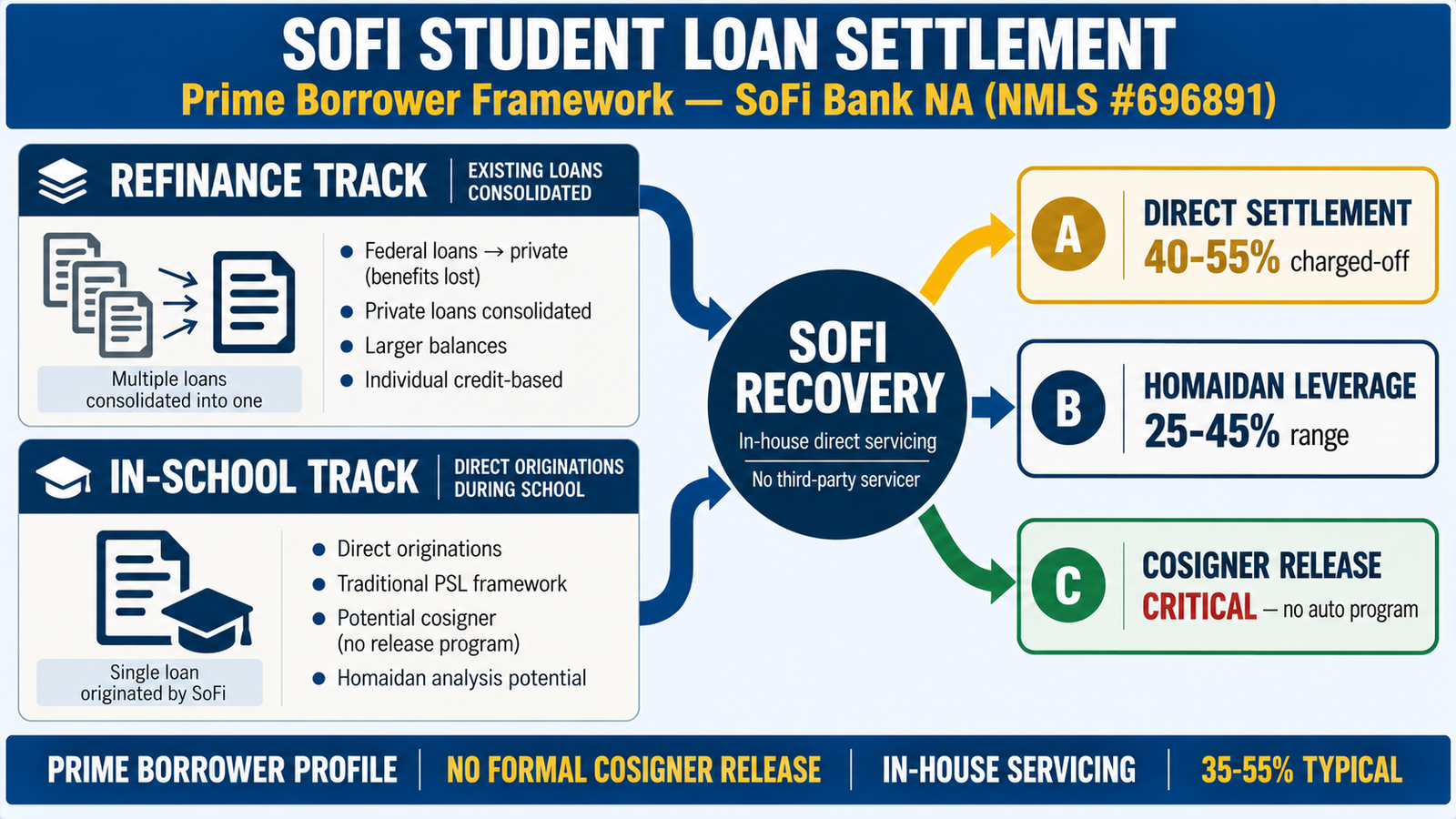
A SoFi student loan settlement is a negotiated written agreement with SoFi Bank NA (NMLS #696891, national bank charter received January 2022) where the borrower pays a reduced lump sum in full satisfaction of the private student loan debt — typically 35-55% of balance for charged-off accounts. SoFi has distinctive characteristics affecting settlement: prime and super-prime borrower focus (high-income professionals); in-house direct servicing (no third-party servicer); absence of formal cosigner release program; national bank charter affecting operational framework. Six proven paths produce successful outcomes in 2026: (1) direct settlement through SoFi recovery department on charged-off accounts — typical range 40-55%; (2) hardship accommodation and modification before charge-off — 50-70% range or modification alternative; (3) defensive settlement with Homaidan v. Sallie Mae 992 F.3d 100 (2d Cir. 2021) §523(a)(8) bankruptcy alternative leverage — often 25-45%; (4) chain of assignment settlement for SoFi loans transferred to third-party debt buyers — 20-40%; (5) refinance debt settlement where original loan was federal consolidated/refinanced through SoFi — defensive leverage opportunities; (6) structured settlement with 3-6 month payment plan. The forgiven settlement portion is reported on IRS Form 1099-C but typically excluded from taxable income under IRC §108(a)(1)(B) insolvency exclusion.
Read the complete SoFi settlement framework below.
In this complete SoFi settlement guide:
SoFi’s distinctive framework and settlement implications
Bank charter, prime borrower focus, in-house servicing
Path 1: Direct SoFi settlement through recovery department
40-55% range outcomes for charged-off accounts
Path 2: Hardship accommodation and modification
Pre-charge-off window with modification alternatives
Path 3: Defensive settlement with Homaidan leverage
25-45% range using §523(a)(8) bankruptcy alternative
Path 4: Chain of assignment for transferred SoFi debt
Debt buyer settlement with documentation leverage
Path 5: Refinance debt settlement considerations
Federal-to-private refinance implications and leverage
Path 6: Structured settlement with payment plan
3-6 month structure when lump sum unavailable
SoFi’s distinctive framework and settlement implications
Understanding how to settle SoFi loans in 2026 requires understanding SoFi’s distinctive business model and operational framework. Unlike Sallie Mae (traditional in-school originator) or Discover (now transitioned to Carlyle+KKR with Firstmark), SoFi has unique characteristics that affect settlement dynamics.
SoFi corporate background and bank charter
SoFi (Social Finance, Inc.) was founded in 2011 with initial focus on student loan refinancing — refinancing federal and private student loans into new SoFi private loans at lower rates for high-credit borrowers. The company expanded into mortgages, personal loans, investment products, and other financial services over subsequent years. In January 2022, SoFi received a national bank charter and became SoFi Bank NA (NMLS #696891), fundamentally changing its regulatory framework. Prior to bank charter, SoFi operated as a lender with various state licenses; the national bank charter brought OCC supervision and expanded operational capabilities.
Prime and super-prime borrower focus
SoFi’s distinctive borrower profile is heavily concentrated in prime and super-prime credit tiers — high-income professionals (doctors, lawyers, MBAs, engineers), strong credit scores, substantial earning potential. This differs from traditional in-school lenders (Sallie Mae, Discover historical) which originated across broader credit spectrum including undergraduate students with cosigners. The prime borrower profile affects settlement dynamics in several ways: (1) borrowers often have better alternative options (401(k) loans, home equity, family resources, high income supporting payment plans); (2) SoFi’s recovery operations are calibrated to prime borrower patterns rather than general consumer debt patterns; (3) settlement discussions often involve substantially higher balance amounts than traditional private student loans.
In-house direct servicing
Unlike former Discover loans now serviced by Firstmark Services (Nelnet subsidiary), SoFi operates in-house direct servicing of its loan portfolio. SoFi handles customer-facing operations, hardship accommodation, collections, and recovery through its own operational framework. This means: (1) no servicing transition created documentation gaps supporting leverage; (2) SoFi retains complete operational and financial authority over settlement decisions; (3) settlement discussions occur directly with SoFi personnel; (4) consistency in operational framework since SoFi retains both ownership and servicing.
Absence of formal cosigner release program
A distinctive SoFi characteristic is the absence of a formal cosigner release program. Many major private student lenders (Sallie Mae, Citizens Bank, Ascent, others) offer formal cosigner release after specific requirements (typically 24-48 consecutive on-time payments, credit score thresholds, income verification). SoFi has historically not offered a formal cosigner release program, meaning cosigners remain obligated for the full loan term unless the loan is paid in full, refinanced away from SoFi, or settled. This has specific settlement implications: (1) cosigner release language in settlement agreement is critical since cosigner cannot otherwise be released; (2) cosigners of SoFi loans have strong motivation to coordinate with primary borrower on settlement; (3) family dynamics around cosigner protection often drive settlement timing and strategy.
Path 1: Direct SoFi settlement through recovery department
Direct settlement through SoFi recovery department is the most common path for former SoFi charged-off accounts in 2026, typically producing 40-55% range outcomes. SoFi’s in-house recovery operations handle settlement authority for charged-off accounts without third-party servicer coordination.
SoFi recovery operational structure
SoFi recovery operates as part of SoFi Bank NA’s loan servicing framework. Operations are structured with: customer service team for current accounts handling hardship and modification requests; collections team for delinquent accounts prior to charge-off; recovery department for charged-off accounts with settlement authority. The in-house nature means SoFi retains direct financial and operational decision-making authority — no third-party servicer intermediary. Recovery representatives have authority within established ranges; outside normal ranges typically requires supervisor escalation to SoFi recovery management.
Settlement authority ranges
SoFi recovery department settlement authority typically ranges: recently charged-off accounts (6-12 months post charge-off) 45-55%; moderately aged (12-24 months) 40-50%; older charged-off accounts (24+ months) 35-50%. SoFi settlement discussions are often characterized by professional operational framework reflecting SoFi’s prime borrower focus — negotiations tend to be structured and documented rather than high-pressure collection tactics. Approaching settlement from defensive leverage position supports movement toward the lower end of normal ranges.
Larger balance considerations
SoFi loans often carry larger balances than traditional in-school private student loans due to SoFi’s refinance focus (consolidated balances from multiple original loans) and prime borrower profile (graduate and professional school loans). Larger balances have both benefits and challenges: (1) percentage improvements translate to larger dollar savings justifying professional representation; (2) SoFi may have higher scrutiny on larger settlement amounts; (3) escalation to supervisor authority more common on larger balances; (4) lump sum funding requirements proportionally larger. For larger balance SoFi settlements ($100.000+), professional representation typically produces materially better outcomes.
Settlement agreement documentation
Proper sofi bank settlement agreement must document: (1) exact settlement amount and payment deadline; (2) specific account identification with SoFi loan number; (3) “full and final satisfaction” release language extinguishing all further obligations; (4) tradeline update instructions to Experian, Equifax, TransUnion; (5) critical cosigner release language (since SoFi has no formal cosigner release program, settlement is often the cosigner’s primary release opportunity); (6) 1099-C reporting disclosure; (7) release of any pending collection activities. Settlement agreement should explicitly reference SoFi Bank NA (post-2022 charter) rather than previous SoFi entities for post-charter accounts.
Path 2: Hardship accommodation and modification
Pre-charge-off hardship accommodation and modification represents an important path for SoFi loan resolution in late delinquency window. SoFi has developed hardship accommodation programs reflecting its prime borrower profile — programs often focus on temporary accommodation during income disruption rather than long-term discount.
SoFi hardship accommodation programs
SoFi hardship accommodation typically includes: (1) short-term deferment during documented hardship (unemployment, medical, family emergency); (2) reduced payment arrangements for defined period; (3) interest-only payment arrangements for defined period; (4) extended repayment term modification (reducing monthly payment at cost of longer term and more total interest); (5) unemployment-specific protection programs. SoFi hardship programs generally require specific documentation and have defined program parameters rather than fully customized arrangements. Programs are designed to help borrowers through temporary hardship rather than long-term debt reduction.
Pre-litigation settlement window
For borrowers whose situation exceeds hardship accommodation scope — permanent income reduction, bankruptcy consideration, major medical catastrophe — pre-charge-off settlement window (days 120-170 of delinquency) often produces 50-70% range outcomes. SoFi has operational incentive to resolve accounts before charge-off to avoid regulatory capital impact and recovery operations costs. Approaching SoFi during this window with documented permanent hardship and lump sum funding capability can produce favorable settlement before full charge-off damage occurs.
Modification vs settlement decision
Decision framework for modification vs settlement: (1) if hardship is temporary (6-12 months) and permanent payment capacity will return — modification preserves credit and manages through hardship period; (2) if hardship is permanent (long-term income reduction, disability, major life change) — settlement provides lasting resolution; (3) if available lump sum funding exceeds what sustained lower payments could cover — settlement often economically preferred; (4) if cosigner protection is priority and settlement provides cosigner release while modification does not — settlement priority may apply; (5) if credit damage from charge-off is unacceptable — modification preserves credit at cost of continued debt. Analysis requires balancing short-term credit impact with long-term financial resolution.
Path 3: Defensive settlement with Homaidan leverage
Defensive settle sofi student loans approach using Homaidan v. Sallie Mae leverage produces the deepest SoFi settlement discounts — often 25-45% range. While Homaidan directly involved Sallie Mae loans, the Second Circuit’s §523(a)(8)(A)(ii) analysis applies to private student loans with similar characteristics, including SoFi-originated loans.
Homaidan framework applied to SoFi loans
Homaidan v. Sallie Mae Inc. 992 F.3d 100 (2d Cir. 2021) established that “educational benefit” under 11 U.S.C. §523(a)(8)(A)(ii) is narrow. Direct-to-consumer loans without school certification of cost of attendance do NOT qualify as “educational benefit” and are therefore dischargeable WITHOUT undue hardship showing. This framework applies to SoFi loans with similar characteristics regardless of originating lender. The precedent is binding in Second Circuit (CT, NY, VT), persuasive elsewhere, and routinely applied by bankruptcy courts to similar private loans from other originators.
Which SoFi loans qualify for Homaidan analysis
SoFi-originated loans potentially qualifying for Homaidan analysis: (1) SoFi refinance loans that consolidated original loans beyond qualified education loan criteria; (2) SoFi loans exceeding “cost of attendance” limit for enrollment period; (3) SoFi loans for non-title IV eligible programs; (4) SoFi loans failing other IRC §221(d)(1) qualified education loan requirements. Note that SoFi’s prime borrower focus means many SoFi loans refinanced qualified federal student loans — refinance of qualified loans typically preserves qualified status. However, SoFi loans that refinanced non-qualified loans or that failed qualified education loan criteria at origination may qualify for Homaidan framework.
Related Circuit precedents
Beyond Homaidan, related Circuit precedents reinforce the §523(a)(8) framework applicable to SoFi loans: Crocker v. Navient Solutions LLC 941 F.3d 206 (5th Cir. 2019) binding in Fifth Circuit (TX, LA, MS); McDaniel v. Navient Solutions LLC 973 F.3d 1083 (10th Cir. 2020) binding in Tenth Circuit (CO, KS, NM, OK, UT, WY); In re Rosenberg 594 B.R. 22 (Bankr. S.D.N.Y. 2020) moderating Brunner undue hardship application; DOJ November 2022 guidance on undue hardship analysis. Combined citation of these precedents creates substantial national defensive leverage for SoFi settlement discussions.
Prime borrower bankruptcy considerations
SoFi’s prime borrower profile creates specific bankruptcy consideration: (1) means test under 11 U.S.C. §707(b)(2) may be more challenging for high-income professional borrowers; (2) Chapter 13 may be more appropriate than Chapter 7 for borrowers above means test threshold; (3) Chapter 13 §523(a)(8) analysis still applies at discharge (11 U.S.C. §1328); (4) prime borrower profile often means more assets to protect in bankruptcy planning. These considerations affect how bankruptcy alternative threat is presented in settlement discussions. For prime borrowers, bankruptcy alternative is viable but requires careful planning — professional representation particularly valuable in these scenarios.
Path 4: Chain of assignment for transferred SoFi debt
While SoFi retains in-house servicing of current and most charged-off accounts, some former SoFi accounts may be transferred to third-party debt buyers for continued collection — particularly older charged-off accounts. Chain of assignment analysis supports sofi loan settlement leverage when SoFi loans have been transferred.
SoFi bank charter transition considerations
The January 2022 SoFi bank charter transition created potential documentation considerations for loans originated under pre-charter structure. Loans originated before January 2022 were made by pre-bank SoFi entities (various state licensed lenders); loans originated after January 2022 are made by SoFi Bank NA. For loans spanning this transition, chain of assignment analysis should verify: (1) proper transfer documentation if applicable; (2) continuity of lender rights across entity transition; (3) servicing authority documentation for post-charter servicing of pre-charter loans. Most SoFi loans transferred smoothly across the charter transition, but documentation review can identify specific concerns on individual accounts.
Third-party debt buyer transfers
If a SoFi loan has been transferred to a third-party debt buyer after charge-off, chain of assignment leverage under Article III standing doctrine (Lujan v. Defenders of Wildlife 504 U.S. 555 (1992), Spokeo, Inc. v. Robins 578 U.S. 330 (2016), TransUnion LLC v. Ramirez 594 U.S. 413 (2021)) typically produces 20-40% range settlements. Analysis should verify: (1) proper assignment documentation from SoFi to debt buyer; (2) complete chain through any intermediate holders; (3) original promissory note production capability; (4) specific account identification across chain. Each additional transfer creates additional documentation requirements that debt buyers may struggle to meet.
Identifying current holder
Before approaching SoFi settlement, identify current holder: (1) check credit reports from Experian, Equifax, TransUnion for current furnisher; (2) request debt validation under FDCPA §1692g if contacted; (3) analyze any correspondence for named plaintiff or current creditor; (4) note whether contact is from SoFi directly (indicating SoFi retains ownership) or from a third-party debt buyer. Settlement authority rests with current legal owner — settlement with wrong party doesn’t resolve the debt.
Path 5: Refinance debt settlement considerations
SoFi’s business model centers on student loan refinancing — many SoFi borrowers refinanced original federal or private loans into new SoFi private loans. This creates specific settlement considerations distinctive from other private student loan lenders.
Federal-to-private refinance implications
When federal student loans are refinanced into SoFi private loans, borrowers lose federal benefits permanently: (1) loss of PSLF eligibility (Public Service Loan Forgiveness under 20 U.S.C. §1087e(m)); (2) loss of income-driven repayment forgiveness; (3) loss of federal death discharge under 20 U.S.C. §1087/§1087dd; (4) loss of federal disability discharge; (5) loss of federal deferment and forbearance protections. In settlement discussions, this loss is already incurred — settlement cannot restore federal benefits. However, this history can be relevant to settlement discussions: (1) if borrower was induced to refinance federal loans and now cannot access federal relief, this may support hardship narrative; (2) if refinance occurred during period of federal rate reductions when SoFi private rates seemed competitive, settlement discussions can reference the particular circumstances; (3) borrowers facing significant hardship after refinancing often have substantial justification for settlement accommodation.
Private-to-private refinance
For SoFi loans that refinanced original private student loans (consolidated multiple Sallie Mae, Navient, Discover, or other private loans into single SoFi loan), the refinance transferred all debt to SoFi — settlement with SoFi fully resolves the consolidated balance. However, this creates distinctive dynamics: (1) settlement amount reflects the entire consolidated balance (larger than any individual original loan); (2) defensive leverage analysis applies to the SoFi loan characteristics, not original loan characteristics (though original loan Homaidan characteristics may transfer analytical framework); (3) cosigner situations from original loans typically do not transfer to SoFi refinance (which is typically individual borrower credit-based) — but this means SoFi cosigner status reflects SoFi’s own origination requirements, not inherited cosigner relationships.
In-school SoFi originations
SoFi also originates some in-school private student loans alongside its refinance focus. These loans more closely resemble traditional private student loan originations and follow similar settlement framework. In-school SoFi loans may have stronger Homaidan analysis potential depending on specific characteristics (direct-to-consumer characteristics, cost of attendance verification, school certification documentation). Analysis of in-school SoFi loans should examine specific origination documentation for Homaidan qualification factors.
Path 6: Structured settlement with payment plan
When full lump sum funding isn’t available, structured settlement with payment plan becomes an alternative sofi student loan settlement path. SoFi typically accepts payment plans in 3-6 month range for settlement amounts, though total settlement typically increases 10-20% versus straight lump sum.
Typical SoFi structured settlement terms
SoFi structured settlement typical terms: (1) 3-6 month payment plans with monthly payments totaling settlement amount; (2) initial down payment of 20-30% with balance paid over defined period; (3) automatic payment setup required; (4) default consequences specified (reversion to full balance, accelerated collection); (5) interest-free or minimal interest on payment plan amount. SoFi’s prime borrower focus means payment plan options may extend somewhat longer than other lenders when payment capacity is well-documented. Longer payment plans occasionally available but typically require escalation and increase total settlement amount further.
Default risk considerations
Structured settlement carries significant default risk: if borrower misses a payment during the plan period, SoFi typically reverses the settlement and reverts to full balance (potentially with accelerated collection). This creates financial exposure throughout the payment period. Borrowers should only commit to structured settlement with high confidence in payment capacity throughout the term. Lump sum settlement, when possible, eliminates this risk entirely while typically producing better total cost.
Related resources — complete SoFi resolution ecosystem
Private Student Loan Settlement 2026: Complete Guide (PILAR)
The 7-path master framework covering all private student loan settlement mechanisms including SoFi and other major lenders.
How to Settle Private Student Loans 2026
Complete 7-step process framework applicable to SoFi settlement execution.
Discover Student Loan Settlement 2026 Guide
Lender-specific framework comparison for Discover (Carlyle+KKR with Firstmark servicing) versus SoFi (in-house direct servicing).
IRC §108 tax planning for SoFi settlement
The forgiven portion of sofi student loan settlement is reported on IRS Form 1099-C and generally taxable as ordinary income. However, Internal Revenue Code §108 provides important exclusions that typically eliminate most or all of this tax liability for borrowers in settlement situations.
Insolvency exclusion application
IRC §108(a)(1)(B) excludes cancelled debt from taxable income to the extent the borrower was insolvent (total liabilities exceeded total assets) immediately before the debt cancellation. For many borrowers in SoFi default situations, insolvency is documented despite high nominal income — mortgage, auto, credit card, and other student loan debt combined with student loan balances often exceeds assets. The exclusion amount equals the lesser of: cancelled debt amount, or amount by which liabilities exceeded assets at time of cancellation. Documentation requires Form 982 filing with tax return claiming the exclusion.
Prime borrower tax considerations
SoFi’s prime borrower profile creates distinctive tax considerations: (1) high nominal income may suggest tax liability but insolvency calculation (total liabilities vs total assets) may still support exclusion; (2) retirement account values should be considered at discounted value reflecting early withdrawal penalties for working-age borrowers; (3) illiquid assets (homes, business ownership) should be considered at realistic liquidation values; (4) contingent liabilities (potential lawsuit judgments, cosigner exposure) should be included in liability calculation. Proper insolvency calculation often supports substantial IRC §108(a)(1)(B) exclusion even for high-income professional borrowers.
Bankruptcy exclusion for coordinated resolution
IRC §108(a)(1)(A) excludes debt cancelled in Chapter 7 or Chapter 13 bankruptcy entirely from taxable income — regardless of insolvency analysis. For borrowers whose SoFi resolution is part of broader bankruptcy strategy, this exclusion provides complete tax protection on cancelled debt income. CPA consultation before finalizing settlement provides optimal tax outcome.
Decision framework for SoFi settlement
By current loan status
Which sofi student loan settlement path applies depends on current loan status: Current but struggling — pursue SoFi hardship accommodation first (Path 2); Recently delinquent (90-180 days) — pre-litigation settlement (Path 2) in 50-70% range OR hardship programs; Charged-off (180+ days) still with SoFi — direct settlement (Path 1) in 40-55% range; Loans with Homaidan characteristics — defensive settlement (Path 3) in 25-45% range; Transferred to third-party debt buyer — chain of assignment settlement (Path 4) in 20-40% range; Federal loans refinanced into SoFi — consider refinance history in settlement discussions (Path 5); Limited lump sum funding — structured settlement (Path 6) as backup.
By loan origination type
Loan origination type affects strategy: SoFi refinance of federal loans — federal benefits already lost; refinance context relevant to hardship narrative; typical settlement framework applies; SoFi refinance of private loans — single consolidated balance; defensive leverage analysis to current SoFi loan characteristics; cosigner situations typically individual rather than inherited; SoFi in-school originations — most similar to traditional private student loans; strongest Homaidan analysis potential depending on specific characteristics; SoFi loans originated post-January 2022 (bank charter) — SoFi Bank NA framework; standard settlement operations; SoFi loans originated pre-January 2022 — may have charter transition documentation considerations; standard settlement operations continue.
Multi-path coordination
Effective SoFi settlement typically combines multiple paths: Path 1 (direct SoFi settlement) + Path 3 (Homaidan leverage where applicable) + Path 5 (refinance history context) + IRC §108 tax planning. For prime borrowers with substantial balances, professional representation particularly valuable to coordinate across paths and manage the sophisticated analysis SoFi settlement often requires.
Common SoFi settlement myths
Myth 1
“SoFi doesn’t negotiate settlement because they’re a bank now”
Reality: SoFi Bank NA (NMLS #696891, national bank charter since January 2022) actively negotiates settlement on charged-off accounts through its recovery department. The bank charter did not eliminate settlement operations — it brought OCC supervision and expanded operational capabilities while settlement framework continued. For charged-off accounts, SoFi settles in 40-55% range typically, with deeper discounts available using Homaidan defensive leverage. Settlement framework is active and well-developed in 2026.
Myth 2
“My income is too high for SoFi to accept settlement”
Reality: High nominal income does not disqualify borrowers from SoFi settlement. SoFi’s prime borrower focus means most borrowers have high income — settlement framework is calibrated to this profile. What matters for settlement is current ability to pay (cash flow analysis) and insolvency position (asset-liability analysis), not nominal income alone. High-income borrowers often have substantial other debt (mortgage, auto, credit cards, other student loans) and limited liquid assets, supporting both settlement hardship narrative and IRC §108(a)(1)(B) insolvency exclusion for tax purposes. Prime borrower status does not preclude settlement.
Myth 3
“My SoFi cosigner will be released automatically after settlement”
Reality: SoFi does not have a formal cosigner release program, meaning cosigners are not released automatically through payment history. Settlement is often the cosigner’s primary release opportunity — but ONLY if the settlement agreement includes explicit cosigner release language. Settlement without cosigner release provisions may leave cosigner exposed to continued collection. ALWAYS require explicit cosigner release language in SoFi settlement agreements for cosigned loans. Never execute SoFi settlement that leaves cosigner exposed.
Myth 4
“Homaidan doesn’t apply to SoFi loans because they’re refinance loans”
Reality: Homaidan v. Sallie Mae 992 F.3d 100 (2d Cir. 2021) applies to private student loans with specific characteristics regardless of originating lender or whether the loan was originally refinanced. SoFi loans that refinanced non-qualified loans, that exceed cost of attendance, that fail IRC §221(d)(1) qualified education loan requirements, or that have direct-to-consumer characteristics may qualify under Homaidan framework. Analysis requires examination of specific SoFi loan documentation — refinance origin doesn’t automatically disqualify Homaidan analysis. Combined with Crocker v. Navient (5th Cir. 2019) and McDaniel v. Navient (10th Cir. 2020), the §523(a)(8) discharge framework has substantial national application including to applicable SoFi loans.
Frequently asked questions
1. What is a SoFi student loan settlement?
A sofi student loan settlement is a negotiated written agreement with SoFi Bank NA (NMLS #696891, national bank charter received January 2022) in which the borrower pays a reduced lump sum in full satisfaction of the private student loan debt. Typical outcomes: 40-55% for charged-off accounts through SoFi recovery department; 25-45% with Homaidan v. Sallie Mae 992 F.3d 100 (2d Cir. 2021) §523(a)(8) bankruptcy alternative leverage; 20-40% with chain of assignment challenges for debt-buyer-transferred accounts; 50-70% in pre-litigation window with documented hardship. The forgiven portion is reported on IRS Form 1099-C but typically excluded from taxable income under IRC §108(a)(1)(B) insolvency exclusion.
2. How do I settle SoFi loans?
How to settle SoFi loans: (1) confirm current loan status (current, delinquent, charged-off); (2) identify current holder (SoFi retains most loans in-house, but some charged-off accounts may be transferred to debt buyers); (3) analyze loan characteristics for Homaidan §523(a)(8) qualification; (4) prepare documented financial hardship presentation including insolvency calculation; (5) secure lump sum funding; (6) contact SoFi customer service, hardship team, or recovery department depending on status; (7) present specific written settlement offer with supporting documentation; (8) negotiate counter-offers to reach favorable terms; (9) obtain written settlement agreement with all required elements including critical cosigner release language (SoFi has no formal cosigner release program); (10) execute payment and verify tradeline updates. Legal representation typically produces materially better outcomes than DIY approach for larger SoFi balances.
3. Will SoFi settle for less than 50%?
Yes, SoFi settles below 50% in multiple scenarios: (1) older charged-off accounts (24+ months) often settle in 35-50% range; (2) accounts with Homaidan v. Sallie Mae §523(a)(8) leverage often settle in 30-45% range; (3) accounts combined with insolvency documentation and bankruptcy alternative often settle in 25-35% range; (4) accounts transferred to debt buyers where chain of assignment challenges reveal documentation gaps often settle in 25-40% range. Below-50% settlements require proper leverage — not merely requesting low percentage. Professional representation typically needed to access these ranges, particularly for SoFi’s typically larger balance accounts.
4. Does SoFi have a cosigner release program?
No. Unlike Sallie Mae, Citizens Bank, Ascent, and some other major private student lenders, SoFi does not have a formal cosigner release program. Cosigners of SoFi loans remain obligated for the full loan term unless the loan is: (1) paid in full; (2) refinanced away from SoFi (new lender releases SoFi cosigner by replacing the loan); (3) settled with cosigner release language in the settlement agreement. For SoFi loans with cosigners, settlement is often the cosigner’s primary release opportunity. This makes cosigner release language in SoFi settlement agreements particularly critical — never execute SoFi settlement that leaves cosigner exposed.
5. Can I settle SoFi loans that refinanced federal loans?
Yes. Once federal loans are refinanced into SoFi private loans, they become private debt subject to private settlement framework. The federal benefits (PSLF under 20 U.S.C. §1087e(m), income-driven repayment forgiveness, federal death discharge under §1087/§1087dd, federal disability discharge, federal deferment protections) are permanently lost through refinancing. However, this does not prevent settlement — the SoFi private loan can be settled through standard private student loan settlement framework. The refinance history can be relevant to settlement discussions as hardship context, but settlement itself follows private loan framework. Note: borrowers considering refinancing federal loans should carefully weigh benefit loss before refinancing; this is irreversible once completed.
6. How does SoFi’s bank charter affect settlement?
SoFi’s national bank charter (received January 2022, operating as SoFi Bank NA with NMLS #696891) did not fundamentally change settlement operations. The charter brought OCC supervision and expanded SoFi’s operational capabilities (including deposit-taking and other banking services) while loan servicing and settlement framework continued. For settlement purposes: (1) SoFi still has in-house recovery operations with settlement authority; (2) settlement ranges remain similar to pre-charter periods; (3) loans originated pre-charter and post-charter are settled through the same recovery operations; (4) OCC regulatory framework may enhance compliance-oriented settlement operations (favorable from borrower perspective). The charter transition itself has not materially changed what SoFi settlement looks like for borrowers.
7. How long does SoFi student loan settlement take?
Typical SoFi settlement timeline: initial contact 1-2 weeks; first counter-offer exchange 2-3 weeks; final agreement negotiation 2-4 weeks; written agreement review and execution 1-2 weeks; payment processing and release documentation 1-2 weeks; credit tradeline updates 30-60 days post-payment. Total timeline typically 2-4 months from initial engagement to full completion. Faster timelines (6-8 weeks) occur with proper preparation: defensive leverage ready (Homaidan analysis complete), funding confirmed, reasonable opening offer, professional representation coordinating. SoFi’s larger typical balance amounts and prime borrower profile sometimes extend timelines on larger settlements (4-6 months) as more careful analysis and escalation may be required.
Need a SoFi Student Loan Settlement?
Free specialist review of all 6 settlement paths for your SoFi loans.
Direct settlement through SoFi Bank NA (NMLS #696891, national bank charter since January 2022) recovery operations, hardship accommodation and modification coordination, defensive settlement using Homaidan v. Sallie Mae 992 F.3d 100 (2d Cir. 2021) §523(a)(8) bankruptcy alternative leverage, chain of assignment settlement for debt-buyer-transferred SoFi accounts, refinance history context analysis for federal-to-private refinanced loans, pre-litigation and structured settlement options, critical cosigner release language coordination (SoFi has no formal cosigner release program), IRC §108 tax planning for high-income professional borrowers. Free eligibility review with attorney-backed partner provider — no upfront fees.
Get a free eligibility review →
5-minute review · No obligation · Zero upfront fees · Since 2015 · 48 states served
About the author
Henry Silva — Private Student Loan Debt Specialist
10+ years negotiating sofi student loan settlement outcomes across SoFi’s evolution from refinance-focused startup through national bank charter transition. Deep expertise in SoFi Bank NA (NMLS #696891, national bank charter received January 2022 with OCC supervision), SoFi’s distinctive business model centered on student loan refinancing for prime and super-prime borrowers (high-income professionals including doctors, lawyers, MBAs, engineers), in-house direct servicing framework (no third-party servicer transition unlike former Discover loans now serviced by Firstmark), absence of formal cosigner release program (distinctive from Sallie Mae, Citizens Bank, Ascent cosigner release programs), SoFi hardship accommodation programs including deferment, reduced payment arrangements, interest-only payment arrangements, and extended repayment term modifications, SoFi recovery department settlement authority ranges, larger balance consideration frameworks for consolidated SoFi refinance loans, and federal-to-private refinance implications including PSLF loss (20 U.S.C. §1087e(m)), income-driven repayment forgiveness loss, federal death discharge loss (20 U.S.C. §1087/§1087dd), and federal disability discharge loss. Defensive leverage integration: bankruptcy discharge analysis under 11 U.S.C. §523(a)(8) with Homaidan v. Sallie Mae Inc. 992 F.3d 100 (2d Cir. 2021) direct-to-consumer precedent applicable to SoFi loans with similar characteristics, Crocker v. Navient 941 F.3d 206 (5th Cir. 2019), McDaniel v. Navient 973 F.3d 1083 (10th Cir. 2020), Brunner v. New York State HESC 831 F.2d 395 (2d Cir. 1987) framework for qualified loans, In re Rosenberg 594 B.R. 22 (Bankr. S.D.N.Y. 2020) updated application, DOJ November 2022 undue hardship guidance; means test analysis under 11 U.S.C. §707(b)(2) particularly relevant for prime borrower profile with potential Chapter 13 coordination under 11 U.S.C. §1328. Article III standing doctrine (Lujan v. Defenders of Wildlife 504 U.S. 555 (1992), Spokeo, Inc. v. Robins 578 U.S. 330 (2016), TransUnion LLC v. Ramirez 594 U.S. 413 (2021)) for chain of assignment challenges on transferred SoFi debt. Statute of limitations analysis across all 50 states; FDCPA 15 U.S.C. §1692g validation and §1692e counterclaim coordination; IRC §108(a)(1)(A) bankruptcy and §108(a)(1)(B) insolvency tax exclusion with Form 982 preparation particularly relevant for high-income professional borrower insolvency documentation accounting for retirement account discounting and contingent liability inclusion; critical cosigner release coordination given SoFi’s absence of formal cosigner release program. Henry works with Private Student Relief’s attorney-backed partner provider network to review individual SoFi scenarios across all 6 settlement mechanisms with particular focus on larger balance accounts where sophisticated analysis and coordination produce materially better outcomes.
Legal Disclaimer and Sources
This article is provided for informational purposes only and does not constitute legal, tax, or financial advice. Private Student Relief is a consulting and matching organization operated by Joco (555 Anton Blvd, Suite 368, Costa Mesa, CA 92626) — not a law firm, debt settlement company, debt consolidation company, or loan provider. Debt validation services are performed by an attorney-backed partner provider (Panamerican Consulting LLC, Las Vegas, NV) under independent business credentials. Ratings, BBB accreditation, and AADR (American Association for Debt Resolution) membership referenced on the PSR website belong to the partner provider. SoFi student loan settlement outcomes depend on loan characteristics, current account status, defensive leverage opportunities, lump sum funding capability, borrower jurisdiction, and other factors. Individual results vary. Since 2015. 48 states served. Not available in South Carolina or Mississippi.
SoFi background: SoFi (Social Finance, Inc.) founded 2011 with initial focus on student loan refinancing; expanded into mortgages, personal loans, investment products over subsequent years; received national bank charter January 2022 and became SoFi Bank NA (NMLS #696891); operates under OCC supervision as national bank. SoFi’s distinctive characteristics affecting settlement: prime and super-prime borrower focus (high-income professionals); in-house direct servicing (no third-party servicer transition); absence of formal cosigner release program (distinctive from Sallie Mae, Citizens Bank, Ascent); refinance-focused business model with some in-school originations.
Bankruptcy Code references: 11 U.S.C. §523(a)(8) (student loan discharge exceptions with §523(a)(8)(A)(i) governmental unit, §523(a)(8)(A)(ii) educational benefit, §523(a)(8)(B) qualified education loan categories); 11 U.S.C. §362 (automatic stay); 11 U.S.C. §707(b)(2) (means test particularly relevant for prime borrower profile); 11 U.S.C. §1328 (Chapter 13 discharge). Key bankruptcy precedent applicable to SoFi loans: Homaidan v. Sallie Mae Inc. 992 F.3d 100 (2d Cir. 2021) — binding in Second Circuit (CT, NY, VT), persuasive elsewhere, establishing that direct-to-consumer private education loans without school certification of cost of attendance do not meet §523(a)(8)(A)(ii) “educational benefit” criteria and are dischargeable without undue hardship; similar framework applied in Crocker v. Navient Solutions LLC 941 F.3d 206 (5th Cir. 2019) and McDaniel v. Navient Solutions LLC 973 F.3d 1083 (10th Cir. 2020); Brunner v. New York State Higher Education Services Corp. 831 F.2d 395 (2d Cir. 1987) undue hardship test; In re Rosenberg 594 B.R. 22 (Bankr. S.D.N.Y. 2020). Article III standing precedent: Lujan v. Defenders of Wildlife 504 U.S. 555 (1992); Spokeo, Inc. v. Robins 578 U.S. 330 (2016); TransUnion LLC v. Ramirez 594 U.S. 413 (2021). Federal Rules of Civil Procedure: FRCP 60(b)(4) (void judgment); FRCP 12(b)(6) (failure to state claim). Internal Revenue Code: IRC §221(d)(1) (qualified education loan definition); IRC §108(a)(1)(A) (bankruptcy exclusion); IRC §108(a)(1)(B) (insolvency exclusion); Form 982 (reduction of tax attributes due to discharge of indebtedness). FDCPA: 15 U.S.C. §1692g (debt validation); 15 U.S.C. §1692e (deceptive practices); 15 U.S.C. §1692f (unfair practices). Federal tax reporting: IRS Form 1099-C (cancellation of debt). Federal student loan references (relevant to refinance considerations): HEA 20 U.S.C. §1001 et seq.; PSLF 20 U.S.C. §1087e(m); death discharge §1087/§1087dd.
Statute of limitations for written contract debt (private student loans including SoFi-originated) by state: Texas 4 years under Tex. Civ. Prac. & Rem. Code §16.004(a)(3); New York 3 years under CPLR §214(2) per Consumer Credit Fairness Act (CCFA) effective April 7, 2022; Pennsylvania 4 years under 42 Pa.C.S. §5525; Ohio 6 years under Ohio R.C. §2305.06 (reduced 2021); Illinois 10 years under 735 ILCS 5/13-206; Georgia 6 years under O.C.G.A. §9-3-24; California 4 years under CCP §337; Florida 5 years under Fla. Stat. §95.11(2)(b); Delaware 3 years under 10 Del. C. §8106.
Lender information current as of October 2026 per publicly available documentation: SoFi Bank NA NMLS #696891 (national bank charter received January 2022, OCC supervision, in-house direct servicing, absence of formal cosigner release program). Specific servicer and operational details subject to change and should be verified directly through current account documentation.
SoFi student loan settlement strategy requires case-by-case analysis coordinating loan characteristics, current account status, origination type (refinance vs in-school), Homaidan §523(a)(8) qualification analysis, chain of assignment history (particularly for debt-buyer-transferred accounts and bank charter transition considerations), borrower jurisdiction, defensive leverage opportunities, lump sum funding capability (particularly significant for larger balance SoFi loans), IRC §108 tax exclusion qualification with high-income professional borrower insolvency documentation, critical cosigner release coordination given absence of formal cosigner release program, and coordinated multi-path approach. This article provides general framework information; specific settlement negotiations, Homaidan bankruptcy-alternative analysis, chain of assignment challenges, cosigner release strategy, FDCPA counterclaim preservation, and coordinated multi-path approaches must be evaluated for each borrower’s individual SoFi situation by counsel or consulting resources familiar with the complete sofi student loan settlement framework. Last reviewed: October 2026.