

Informational content only. Not legal, tax, or financial advice. Private Student Relief is a consulting organization, not a law firm. Debt validation services are executed by an attorney-backed partner provider. Litigation defense requires representation by state-licensed counsel. NCSLT lawsuit defense availability depends on loan characteristics, chain of assignment history, documentation evidence, borrower jurisdiction, and specific circumstances. Last reviewed: October 2026.
Written by Henry Silva
Private Student Loan Debt Specialist · 10+ years experience in ncslt lawsuit defense coordination for borrowers facing National Collegiate Student Loan Trusts collection actions. Expertise includes chain of assignment challenges under Article III standing (Lujan v. Defenders of Wildlife 504 U.S. 555, Spokeo, Inc. v. Robins 578 U.S. 330, TransUnion LLC v. Ramirez 594 U.S. 413), Third Circuit March 19, 2024 “covered persons” decision analysis and SCOTUS cert denial December 2024, 2017 CFPB-NCSLT consent order history, Transworld Systems administration challenges, statute of limitations defense across all 50 states, FDCPA debt validation leverage under 15 U.S.C. §1692g, motion to dismiss practice, motion to vacate default judgments under FRCP 60(b)(4), and bankruptcy discharge under 11 U.S.C. §523(a)(8) with Homaidan v. Sallie Mae Second Circuit precedent for NCSLT-held pre-2014 Sallie Mae-originated loans. Last reviewed: October 2026.
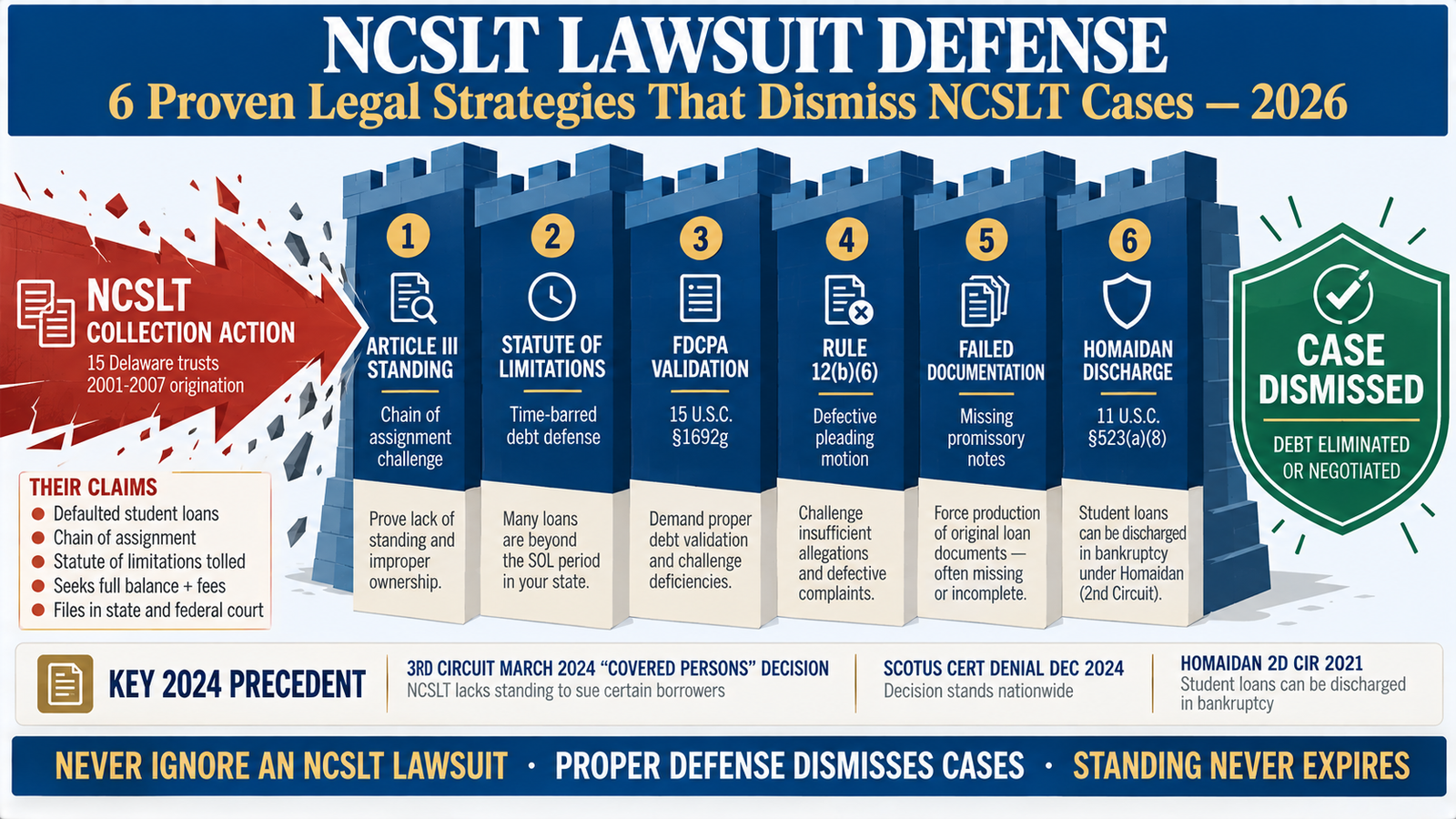
If you’ve been sued by National Collegiate Student Loan Trusts (NCSLT), you may have one of the strongest defensive positions available to any private student loan borrower. NCSLT trusts hold substantial portfolios of pre-2014 Sallie Mae-originated private loans (particularly 2001-2007 origination period) but face systematic challenges proving ownership, standing, and documentation in enforcement actions. The Third Circuit’s March 19, 2024 “covered persons” decision under the Consumer Financial Protection Act and SCOTUS cert denial December 2024 have further weakened NCSLT’s position. This complete 2026 ncslt lawsuit defense guide covers the 6 proven defenses that produce real case dismissals: Article III standing challenges on chain of assignment grounds, statute of limitations expiration, FDCPA debt validation under 15 U.S.C. §1692g, defective pleading under Rule 12(b)(6), failure to produce original documentation, and bankruptcy discharge under 11 U.S.C. §523(a)(8) with Homaidan v. Sallie Mae precedent. Many NCSLT cases are dismissed when defenses are properly raised.
Quick Answer
NCSLT lawsuit defense works through 6 proven legal strategies that produce real case dismissals: (1) Article III standing challenges on chain of assignment grounds — NCSLT trusts must prove complete chain from original Sallie Mae origination through securitization vehicles to the specific trust seeking enforcement; documentation gaps are common and support dismissal (Lujan v. Defenders of Wildlife 504 U.S. 555, Spokeo, Inc. v. Robins 578 U.S. 330, TransUnion LLC v. Ramirez 594 U.S. 413). (2) Statute of limitations expiration — NCSLT loans are typically from 2001-2007 origination period, meaning many are well past state SOL (3-15 years by state); SOL defense dismisses time-barred lawsuits. (3) FDCPA debt validation under 15 U.S.C. §1692g — Transworld Systems and other NCSLT collection agents must validate debt; failure supports dismissal and FDCPA counterclaim. (4) Defective pleading under FRCP Rule 12(b)(6) — NCSLT complaints often fail to allege required elements including proper standing documentation. (5) Failure to produce original documentation — original promissory notes and allonge chain often missing after multiple securitization transfers. (6) Bankruptcy discharge under 11 U.S.C. §523(a)(8) with Homaidan v. Sallie Mae 992 F.3d 100 (2d Cir. 2021) precedent — many NCSLT-held loans qualify for non-qualified discharge WITHOUT undue hardship. Third Circuit’s March 19, 2024 “covered persons” decision and SCOTUS cert denial December 2024 further weakened NCSLT’s position. Even default judgments entered against NCSLT defendants can often be vacated under FRCP 60(b)(4) when standing was never established. NCSLT trusts hold pre-2014 Sallie Mae-originated loans particularly from 2001-2007 period.
Read the complete 2026 NCSLT defense framework below.
In this complete NCSLT defense guide:
What NCSLT is and why borrowers face lawsuits
Structure, portfolio history, administration
NCSLT’s systematic weaknesses
Why NCSLT lawsuits are frequently vulnerable to dismissal
Defense 1: Chain of assignment / Article III standing
The most powerful NCSLT defense
Defense 2: Statute of limitations
Old NCSLT debt often time-barred
Defense 3: FDCPA debt validation
Transworld Systems validation failures
Defense 4: Defective pleading (Rule 12(b)(6))
Form complaints that fail to state claim
Defense 5: Failure to produce documentation
Missing promissory notes and allonge chain
Defense 6: Bankruptcy discharge via Homaidan
Non-qualified discharge for NCSLT-held debt
Vacating NCSLT default judgments
FRCP 60(b)(4) motion for old default judgments
What NCSLT is and why borrowers face lawsuits
Understanding what National Collegiate Student Loan Trusts (NCSLT) actually are, how they came to hold private student loan debt, and how they attempt enforcement is foundational to effective ncslt lawsuit defense. NCSLT is not a traditional lender — it is a structured investment vehicle that acquired loans through securitization transactions.
NCSLT structure overview
NCSLT consists of 15 Delaware statutory trusts formed between 2001 and 2007 that acquired private student loans primarily originated by Sallie Mae and sold into securitization vehicles. The trusts are passive investment entities with no employees or offices — administration is handled by various service providers. Investors in the trusts received securities backed by the student loan payment streams. The structure was common for consumer debt securitization in the pre-2008 financial crisis era.
Portfolio composition
NCSLT trusts hold pre-2014 Sallie Mae-originated private student loans, particularly from the 2001-2007 origination period. These were primarily: direct-to-consumer undergraduate loans; graduate program loans; non-traditional educational loans. The loans share characteristics that often support Homaidan non-qualified discharge analysis — particularly direct-to-consumer origination without proper school certification. Portfolio size has decreased over time through payment, charge-off, and litigation outcomes.
Administration and collection activity
Transworld Systems Inc. has historically served as a major administrator and collection agent for NCSLT trusts, though other service providers have been involved over time. Collection activity typically involves: initial collection letters and calls; sometimes transfer to third-party collection agencies; filing of individual collection lawsuits against borrowers; obtaining default judgments against non-appearing defendants; wage garnishment and bank levy enforcement of judgments. The volume of NCSLT litigation has been substantial over the past 15 years.
The 2017 CFPB consent order history
In 2017, the Consumer Financial Protection Bureau (CFPB) and NCSLT trusts entered into a consent order addressing alleged violations in debt collection practices including: lawsuits filed on time-barred debt; cases filed without proper documentation; alleged robo-signing of affidavits in collection cases. The 2017 consent order established CFPB oversight of NCSLT collection practices. Subsequent proceedings including the Third Circuit March 19, 2024 “covered persons” decision continued to clarify the legal framework.
Third Circuit 2024 and SCOTUS cert denial
The Third Circuit’s March 19, 2024 decision addressed whether NCSLT trusts are “covered persons” under the Consumer Financial Protection Act — a question central to CFPB enforcement authority over NCSLT. SCOTUS cert denial December 2024 left Third Circuit precedent in place. These developments affect how NCSLT operates and what defenses are available. Various stipulated resolutions and continued litigation have followed through 2026, generally supporting borrower defensive positions.
NCSLT’s systematic weaknesses
NCSLT trusts face systematic challenges in enforcement actions that create powerful defensive opportunities for borrowers. These weaknesses are inherent to the structure and history of NCSLT, making ncslt lawsuit defense often one of the strongest defensive positions available in private student loan litigation.
Complex chain of ownership
Each NCSLT trust acquired loans through multi-step securitization process: original Sallie Mae origination → initial pooling into securitization vehicle → transfer to specific NCSLT trust → appointment of various service providers. Each step required documentation. In practice, documentation was often incomplete or inadequate — original promissory notes were lost or never properly transferred; assignment documentation was bulk rather than specific; allonge chains were incomplete. These documentation gaps create standing challenges that often support dismissal.
Age of debt
NCSLT loans are from 2001-2007 origination period, meaning most are now 18-25+ years old. Even accounting for repayment periods and defaults extending the enforcement window, many NCSLT debts are approaching or past state SOL limits (3-15 years depending on state). The age itself creates documentation challenges — records from early 2000s were often inadequately preserved through multiple securitization transfers.
Direct-to-consumer origination
Many NCSLT-held loans were originated by Sallie Mae as direct-to-consumer loans — meaning they were made directly to students without the school’s certification of cost of attendance that would be typical of traditional private student loans. This origination style is central to Homaidan v. Sallie Mae analysis, which held that direct-to-consumer loans do NOT qualify as “educational benefit” under §523(a)(8)(A)(ii) and are dischargeable without undue hardship. The direct-to-consumer characteristic that NCSLT portfolios include supports non-qualified discharge analysis.
Passive trust structure
NCSLT trusts have no employees, no offices, no ongoing business operations — they are passive investment vehicles. All actions require authorization from trustees and administration through service providers. This structural passivity creates challenges for enforcement: witnesses lacking personal knowledge of loan origination; documents produced through administrators rather than original creators; limited institutional capacity for complex litigation defense. In Rules of Evidence terms, authentication and foundation requirements are often difficult to meet.
Historical collection practice issues
The 2017 CFPB consent order documented systematic collection practice issues at NCSLT including lawsuits filed on time-barred debt, cases filed without proper documentation, and alleged robo-signing of affidavits in collection cases. These historical practices created legal exposure and informed subsequent oversight. Current borrowers facing NCSLT lawsuits often find similar issues in their specific cases — supporting both defensive position and potential FDCPA counterclaim.
Defense 1: Chain of assignment / Article III standing
Chain of assignment challenges on Article III standing grounds are the most powerful ncslt lawsuit defense available. NCSLT trusts must prove complete chain of ownership from original Sallie Mae origination to the specific trust seeking enforcement — and documentation gaps commonly support dismissal on standing grounds.
Required chain of ownership
For NCSLT to have standing to sue on a specific loan, it must prove: (1) original Sallie Mae origination of the specific loan to the borrower; (2) initial pooling or sale from Sallie Mae to securitization vehicle; (3) transfer from securitization vehicle to the specific NCSLT trust; (4) continued ownership by that specific trust through to the lawsuit filing date; (5) specific loan inclusion in each transfer (not just bulk portfolio language). Each step requires documentation. Any gap creates standing challenge.
Article III standing framework
Article III standing requires: (1) concrete and particularized injury; (2) causal connection to defendant conduct; (3) redressable by court decision. Framework established in Lujan v. Defenders of Wildlife 504 U.S. 555 (1992), refined in Spokeo, Inc. v. Robins 578 U.S. 330 (2016), and TransUnion LLC v. Ramirez 594 U.S. 413 (2021). TransUnion specifically emphasized courts must verify Article III standing at every stage of litigation. Standing is jurisdictional and can be raised at any time — including after judgment through motion to vacate under FRCP 60(b)(4).
Common NCSLT documentation defects
Common documentation defects supporting standing challenges: (1) missing or incomplete original promissory note; (2) blank endorsements without proper allonge chain; (3) bulk assignment documentation lacking specific loan identification; (4) servicing records inconsistent with asserted ownership; (5) gaps between Sallie Mae origination records and NCSLT trust records; (6) missing documentation of specific securitization vehicle transfers; (7) inconsistencies in trust name variations across documents. Each defect supports dismissal argument.
Discovery to expose chain defects
Strategic discovery exposes chain of assignment weaknesses: production of complete chain of title documentation from original Sallie Mae origination through current NCSLT ownership; production of specific pooling and servicing agreements for the securitization; identification of all parties in the chain and their respective dates of ownership; verification of specific loan inclusion in each transfer; deposition testimony about chain of ownership from administrators with personal knowledge. NCSLT often cannot produce complete documentation — supporting motion to dismiss on standing grounds.
Motion to dismiss on standing
Motion to dismiss for lack of standing can be filed: (1) at the outset based on defective pleading showing inadequate standing allegations; (2) after discovery based on NCSLT’s failure to produce complete chain documentation; (3) as part of motion for summary judgment combining standing with other defenses. Successful standing motion produces dismissal — often with prejudice when NCSLT cannot cure the defect. Combined with SOL expiration (common for old NCSLT debt), the practical result is permanent elimination of debt enforcement.
Defense 2: Statute of limitations
Statute of limitations defense is particularly powerful against NCSLT given the age of the underlying debt. Most NCSLT loans are from 2001-2007 origination period, placing many well past state SOL limits even accounting for defaults occurring years after origination.
SOL analysis for NCSLT debt
SOL analysis for NCSLT debt follows written contract SOL for the applicable state (3-15 years by state). Common state SOL: Texas 4 years; New York 3 years (CPLR §214(2) per CCFA April 7, 2022); Pennsylvania 4 years; California 4 years; Florida 5 years; Ohio 6 years; Illinois 10 years; Delaware 3 years. Accrual typically begins on date of first default or last payment. For NCSLT debt originated 2001-2007 that defaulted in the following years, SOL has often expired even in longer-SOL states.
Governing law clause considerations
Original Sallie Mae loan contracts governing NCSLT-held loans may contain governing law clauses specifying particular state law. State borrowing statutes may apply shorter SOL between forum state and governing law state. Loan contract review for governing law analysis is essential first step. Delaware law (NCSLT trusts’ state of formation) has 3-year SOL which may apply through governing law clause or borrowing statute analysis — potentially supporting earlier SOL expiration.
Revival avoidance critical
For NCSLT debt approaching or past SOL, revival avoidance is critical: NEVER make any payment (even small payments restart SOL in most states); NEVER provide written acknowledgment of debt validity; NEVER promise to pay; avoid responding to NCSLT or Transworld Systems communications without consulting counsel first. NCSLT collection agents may employ tactics designed to trigger revival on time-barred debt — small payment requests, settlement letters requiring borrower response, hardship applications. All require careful SOL consideration before any response.
FDCPA leverage for time-barred NCSLT debt
When NCSLT files lawsuit on time-barred debt (either directly or through collection agents), FDCPA leverage is substantial: 15 U.S.C. §1692e prohibits deceptive practices including false representation of debt enforceability; 15 U.S.C. §1692g requires debt validation; successful FDCPA counterclaims support statutory damages up to $1,000 per violation, actual damages, attorney fees. Combined motion to dismiss on SOL grounds plus FDCPA counterclaim creates strong defensive position often producing favorable settlement to avoid both dismissal and FDCPA judgment risk.
Defense 3: FDCPA debt validation
The Fair Debt Collection Practices Act provides powerful validation rights that often support ncslt lawsuit defense, particularly when Transworld Systems or other third-party collectors are involved in administering NCSLT collection.
Debt validation request under 15 U.S.C. §1692g
Within 30 days of initial collector communication, borrower can send written debt validation request under 15 U.S.C. §1692g. The request requires collector to: (1) verify debt amount; (2) identify current creditor (the specific NCSLT trust); (3) provide verification including original creditor identification; (4) halt collection activity until validation is provided. For NCSLT debt, collector often must coordinate with multiple parties to provide proper validation — frequently failing to do so adequately.
Validation failure patterns for NCSLT debt
Common validation failures for NCSLT debt: validation letters providing only loan balance without underlying origination documentation; failure to specifically identify current NCSLT trust owner; incomplete chain of assignment documentation; conflicting information between validation and credit report; failure to respond within reasonable time; validation sent after collection activity continued despite dispute. Each failure supports dismissal and FDCPA counterclaim.
FDCPA counterclaim framework
Successful FDCPA counterclaims against NCSLT or its collection agents may support: 15 U.S.C. §1692g damages for validation failures; 15 U.S.C. §1692e damages for false or misleading representations; 15 U.S.C. §1692f damages for unfair practices; statutory damages up to $1,000 per violation; actual damages (emotional distress, lost wages, etc.); attorney fees and costs. Even modest FDCPA counterclaim recoveries create settlement leverage because collectors prefer to dismiss and avoid FDCPA judgment risk.
Defense 4: Defective pleading (Rule 12(b)(6))
NCSLT collection lawsuits typically use form complaints that often fail to allege required elements of their cause of action. Motion to dismiss for failure to state a claim under FRCP 12(b)(6) and equivalent state rules provides important dismissal pathway.
Required elements for breach of contract
Breach of contract claim for NCSLT collection typically requires alleging: (1) existence of valid contract with specific terms; (2) NCSLT’s standing to enforce the contract (ownership chain from Sallie Mae to specific trust); (3) borrower’s breach of specific contract terms; (4) damages caused by breach. Form complaints often omit: specific contract terms; detailed standing allegations tracing ownership from original Sallie Mae; specific breach allegations beyond general default claims; damages calculations with supporting documentation.
Standing allegations in NCSLT complaints
NCSLT complaints frequently contain inadequate standing allegations: conclusory statement that NCSLT “owns” the debt without supporting documentation; general reference to securitization transfer without specific identification of this loan; name variations (NCSLT 2003-1, NCSLT 2004-2, etc.) that must match actual trust holding the specific loan. Insufficient standing allegations support Rule 12(b)(6) motion to dismiss even before discovery exposes documentation gaps.
Alternative pleadings
NCSLT complaints often include alternative claims (account stated, unjust enrichment, open account) as fallback positions. These typically fail at the pleading stage: account stated requires prior transactions between parties (NCSLT never had direct transactions with the borrower); unjust enrichment requires NCSLT to have conferred benefit on borrower (they never did); open account requires ongoing commercial relationship. Motion to dismiss alternative claims narrows the issues and eliminates fallback positions.
Defense 5: Failure to produce documentation
NCSLT lawsuits frequently founder on documentation production because original promissory notes and complete assignment chains have often been lost or inadequately preserved through multiple securitization transfers.
Original promissory note requirements
Many jurisdictions require production of original promissory note or legally sufficient copy with proper chain of transfer documentation. For NCSLT-held loans, original notes originated with Sallie Mae in 2001-2007 and have been transferred multiple times through securitization structures. Original notes are often lost or cannot be produced. Lost note affidavits may be allowed in some circumstances but typically require strict proof — NCSLT’s lost note affidavits are often inadequate.
Allonge and endorsement chain
Even where original notes are produced, allonge and endorsement chain must trace from original Sallie Mae to current NCSLT trust. Common defects: blank endorsements (not naming specific transferee); missing endorsements for intermediate transfers; endorsements with inadequate authority documentation; discrepancies between endorsement chain and asserted ownership. Each defect supports dismissal.
Business records authentication
NCSLT typically relies on business records from administrators (Transworld Systems and others) to prove the debt. Business records exception to hearsay requires proper authentication by witness with personal knowledge. For NCSLT, this creates challenges: administrators typically lack personal knowledge of original Sallie Mae origination; records from previous owners may not be admissible through current administrator; chain of custody for records across multiple transfers is often inadequate. Motion in limine or evidentiary objections can exclude unauthenticated records.
Defense 6: Bankruptcy discharge via Homaidan
Many NCSLT-held loans qualify for bankruptcy discharge WITHOUT undue hardship showing under Homaidan v. Sallie Mae precedent — because NCSLT portfolios contain substantial direct-to-consumer loans that fall outside §523(a)(8)’s categorical exceptions.
Homaidan analysis for NCSLT loans
Homaidan v. Sallie Mae Inc. 992 F.3d 100 (2d Cir. 2021) directly addressed Sallie Mae-originated private loans — the exact type held by NCSLT trusts. The Second Circuit held that direct-to-consumer loans without school certification do NOT qualify as “educational benefit” under §523(a)(8)(A)(ii) and are dischargeable WITHOUT undue hardship. NCSLT portfolios contain substantial numbers of these direct-to-consumer loans — supporting non-qualified discharge analysis for many NCSLT-held debts.
Which NCSLT loans qualify for non-qualified discharge
NCSLT loans potentially dischargeable without undue hardship: (1) direct-to-consumer loans without school certification of cost of attendance; (2) loans exceeding school-certified cost of attendance; (3) loans for non-Title IV eligible programs; (4) loans to less-than-half-time students; (5) loans failing other IRC §221(d)(1) requirements. The age of NCSLT loans (2001-2007 origination) and the direct-to-consumer characteristics of many Sallie Mae loans from that period support broad non-qualified discharge availability.
Documentation burden on NCSLT in bankruptcy
In §523(a)(8) adversary proceeding, the current holder (NCSLT) bears burden of proving qualified education loan status for each §523(a)(8) categorical exception claimed. NCSLT often cannot produce complete original origination documentation (school certifications, cost of attendance calculations, enrollment verification from 2001-2007 time period). Documentation gaps that create standing issues in collection litigation also create burden-of-proof issues in bankruptcy — supporting discharge.
Automatic stay stops NCSLT lawsuit
Bankruptcy filing immediately halts any pending NCSLT lawsuit through automatic stay under 11 U.S.C. §362. Collection activities, wage garnishments, and bank levies all stop immediately. The §523(a)(8) adversary proceeding then addresses dischargeability of the specific NCSLT debt — typically producing complete discharge for qualifying loans. For borrowers primarily seeking ncslt dismissed outcomes, bankruptcy filing provides immediate protection while permanent resolution develops.
Vacating NCSLT default judgments
Many borrowers have old NCSLT default judgments entered against them from past lawsuits where they didn’t appear or raise defenses. These judgments often can be vacated under FRCP 60(b)(4) when standing was never properly established — providing permanent relief from wage garnishment, bank levies, and other post-judgment collection activity.
FRCP 60(b)(4) void judgment standard
FRCP 60(b)(4) provides motion to vacate judgment that is “void.” Judgments entered when the court lacked jurisdiction (including when plaintiff lacked standing) are void and can be vacated at any time — no time limit on 60(b)(4) motions. This is critical for old NCSLT default judgments: standing challenges preserved years or even decades later can produce vacation of the judgment, restoring borrower’s financial position.
Standing analysis for old NCSLT judgments
Standing analysis for old NCSLT default judgments typically reveals the same defects present in current cases: inadequate chain of assignment documentation; missing original promissory notes; incomplete allonge chains. Default judgments entered without proper standing documentation are void. The 2017 CFPB consent order and subsequent Third Circuit March 19, 2024 developments have strengthened borrower positions in challenging old NCSLT judgments.
Impact on garnishment and levies
Vacation of NCSLT default judgment produces comprehensive relief: order setting aside judgment; order quashing any outstanding wage garnishments; order releasing any bank account freezes; potential order for return of amounts already collected post-judgment. Successful vacation restores borrower’s financial position substantially. The practical impact is often substantial — ending years of garnishment and restoring full income.
Related resources — complete NCSLT ecosystem
The 7-path master framework covering all private student loan forgiveness mechanisms available in 2026.
How to Get Your Student Loans Dismissed 2026
6 proven legal defenses for case dismissal when facing private student loan lawsuits.
Private Student Loan SOL by State 2026
Complete 50-state SOL guide particularly relevant for old NCSLT debt from 2001-2007 origination.
Common NCSLT lawsuit myths
Myth 1
“NCSLT lawsuits cannot be defeated”
Reality: NCSLT lawsuits are frequently dismissed when defenses are properly raised. Chain of assignment challenges on Article III standing grounds are often successful given documented NCSLT weaknesses in proving ownership through complete chain from Sallie Mae origination. SOL defense dismisses time-barred lawsuits (common given 2001-2007 origination period). FDCPA validation failures support dismissal and counterclaim. Rule 12(b)(6) motions address defective pleading. Bankruptcy discharge under Homaidan precedent eliminates qualifying NCSLT debt. The Third Circuit March 19, 2024 decision and SCOTUS cert denial December 2024 further strengthened borrower positions.
Myth 2
“If NCSLT sent me a letter, they must own my loan”
Reality: NCSLT collection letters do not establish ownership — only completed chain of assignment documentation does. NCSLT trusts frequently assert ownership of loans that: were never properly transferred to the specific trust; have missing documentation gaps in the chain; involve name variations between different NCSLT trusts creating confusion about which trust actually holds specific loans. FDCPA validation request forces NCSLT to prove ownership rather than merely assert it. Many validation attempts fail — supporting dismissal of any subsequent lawsuit.
Myth 3
“My old NCSLT judgment can’t be challenged now”
Reality: Old NCSLT default judgments can often be vacated under FRCP 60(b)(4) when standing was never properly established — regardless of how long ago the judgment was entered. Standing is jurisdictional and has no time limit for challenge. If original NCSLT lawsuit did not have adequate chain of assignment documentation, the default judgment is void and vacation is available even decades later. Many borrowers facing ongoing wage garnishment from old NCSLT judgments have standing-based vacation available.
Myth 4
“If I ignore the NCSLT lawsuit, it will go away”
Reality: Ignoring an NCSLT lawsuit is the worst possible response — it typically results in default judgment with wage garnishment, bank levies, and property liens. The judgment can remain enforceable for extended periods (often 20 years, renewable). While vacation under FRCP 60(b)(4) may be available later for void judgments, defending the original lawsuit properly is substantially more effective. ALWAYS respond to NCSLT lawsuits with timely answer raising all available defenses (standing, SOL, FDCPA, documentation).
Frequently asked questions
1. What is NCSLT and why are they suing me?
NCSLT (National Collegiate Student Loan Trusts) consists of 15 Delaware statutory trusts formed between 2001 and 2007 that acquired private student loans primarily originated by Sallie Mae. The trusts hold pre-2014 Sallie Mae-originated loans particularly from 2001-2007 origination period. NCSLT files individual collection lawsuits against borrowers who have defaulted on these loans. However, NCSLT trusts face systematic challenges proving ownership through complete chain of assignment from original Sallie Mae origination — supporting ncslt lawsuit defense through Article III standing challenges. Transworld Systems Inc. has historically served as a major administrator and collection agent for NCSLT, and the 2017 CFPB consent order documented systematic collection practice issues.
2. Can an NCSLT lawsuit be dismissed?
Yes, NCSLT lawsuits are frequently dismissed when defenses are properly raised. The 6 proven defenses: (1) Article III standing challenges on chain of assignment grounds — NCSLT must prove complete chain from Sallie Mae origination to specific trust, and documentation gaps are common; (2) SOL expiration — NCSLT loans from 2001-2007 are often time-barred under state SOL (3-15 years); (3) FDCPA debt validation failures under 15 U.S.C. §1692g; (4) defective pleading under FRCP 12(b)(6) for inadequate standing allegations; (5) failure to produce original promissory notes and complete allonge chain; (6) bankruptcy discharge under Homaidan v. Sallie Mae precedent for direct-to-consumer loans. Third Circuit March 19, 2024 “covered persons” decision and SCOTUS cert denial December 2024 further strengthened borrower positions. Properly raised defenses often produce dismissal with prejudice.
3. What should I do if NCSLT files a lawsuit against me?
Immediate steps when NCSLT files lawsuit: (1) do NOT ignore the lawsuit — default judgment with wage garnishment follows non-appearance; (2) do NOT contact NCSLT or Transworld Systems without consulting counsel first; (3) do NOT make any payment or acknowledgment that could restart SOL; (4) consult attorney with specific NCSLT defense experience immediately; (5) respond timely to lawsuit with answer raising all affirmative defenses including Article III standing, SOL, FDCPA validation, Rule 12(b)(6) deficiency, documentation failures; (6) demand full discovery including complete chain of assignment documentation from original Sallie Mae to current NCSLT trust; (7) consider FDCPA counterclaim against third-party collection agents involved; (8) evaluate bankruptcy discharge option under Homaidan if other defenses face challenges. Timing is critical — answer deadlines are typically 20-30 days from service.
4. I have an old NCSLT default judgment — can anything be done?
Yes, old NCSLT default judgments can often be vacated under FRCP 60(b)(4) when standing was never properly established in the original case. Standing is jurisdictional and has no time limit for challenge — judgments entered without proper chain of assignment documentation are void and can be vacated years or decades later. If NCSLT’s original lawsuit lacked adequate chain of assignment documentation (common), vacation is available. Vacation produces comprehensive relief: order setting aside judgment, order quashing wage garnishments, order releasing bank account freezes, potential order for return of amounts already collected post-judgment. For borrowers currently facing ongoing wage garnishment from old NCSLT judgments, 60(b)(4) motion to vacate is often an effective path to relief.
5. Does bankruptcy discharge NCSLT debt?
Many NCSLT-held loans qualify for bankruptcy discharge under 11 U.S.C. §523(a)(8) with Homaidan v. Sallie Mae 992 F.3d 100 (2d Cir. 2021) precedent — WITHOUT requiring undue hardship showing. NCSLT portfolios include substantial numbers of direct-to-consumer Sallie Mae loans that are directly addressed by Homaidan analysis as non-qualified for the educational benefit exception. Loans exceeding cost of attendance, loans for non-Title IV programs, and loans failing other IRC §221(d)(1) requirements also qualify for non-qualified discharge. Bankruptcy filing immediately halts any pending NCSLT lawsuit through automatic stay under 11 U.S.C. §362. §523(a)(8) adversary proceeding addresses dischargeability of specific NCSLT debt. For borrowers with multiple debts including NCSLT, Chapter 7 or 13 bankruptcy with Homaidan discharge analysis often produces comprehensive debt resolution.
6. What is the Third Circuit’s March 19, 2024 “covered persons” decision?
The Third Circuit’s March 19, 2024 decision addressed whether NCSLT trusts qualify as “covered persons” under the Consumer Financial Protection Act — a question central to CFPB enforcement authority over NCSLT collection practices. The decision clarified the legal framework for CFPB oversight of NCSLT. SCOTUS cert denial December 2024 left Third Circuit precedent in place. For borrowers facing NCSLT lawsuits, this precedent generally supports defensive positions by: establishing clearer regulatory oversight; confirming CFPB consumer protection authority over NCSLT practices; providing legal framework for ongoing supervision. Various stipulated resolutions and continued litigation have followed through 2026, generally strengthening borrower defensive positions in NCSLT collection matters.
7. Can I settle with NCSLT instead of fighting the lawsuit?
Settlement is sometimes an option, though NCSLT’s defensive vulnerabilities often support better outcomes through litigation defense. If settlement is pursued, approach from defensive leverage position: identify chain of assignment weaknesses; verify SOL analysis; conduct FDCPA validation; raise Rule 12(b)(6) deficiencies — then negotiate from strength. Settlement outcomes with NCSLT when borrower has strong defensive position often reach 10-25% of balance (substantial discounts reflecting weak NCSLT litigation position). Settlement agreement must contain: full satisfaction release language; dismissal with prejudice; credit tradeline update specification; 1099-C handling. For borrowers with multiple debts, bankruptcy may produce comprehensive discharge superior to individual NCSLT settlement. IRC §108 tax exclusion analysis essential for settlement over significant threshold. Private Student Relief partner network coordinates these resources through attorney-backed partner provider.
Being Sued by NCSLT?
Free specialist review of all 6 proven NCSLT defenses that produce case dismissals.
Article III standing challenges on chain of assignment grounds from Sallie Mae origination through NCSLT trust acquisition under Lujan/Spokeo/TransUnion precedent, statute of limitations defense for 2001-2007 origination debt across all 50 states, FDCPA debt validation leverage against Transworld Systems and other NCSLT collection agents under 15 U.S.C. §1692g, Rule 12(b)(6) defective pleading motions, documentation failure defenses for missing promissory notes and incomplete allonge chains, bankruptcy discharge analysis under 11 U.S.C. §523(a)(8) with Homaidan v. Sallie Mae precedent for non-qualified direct-to-consumer loans, FRCP 60(b)(4) motion to vacate old NCSLT default judgments where standing was never established, and coordinated multi-defense strategy leveraging Third Circuit March 19, 2024 “covered persons” decision for maximum ncslt lawsuit defense outcomes. Free eligibility review with attorney-backed partner provider — no upfront fees.
Get a free eligibility review →
5-minute review · No obligation · Zero upfront fees · Since 2015 · 48 states served
About the author
Henry Silva — Private Student Loan Debt Specialist
10+ years experience in ncslt lawsuit defense coordination for borrowers facing National Collegiate Student Loan Trusts enforcement actions. Expertise includes Article III standing challenge framework (Lujan v. Defenders of Wildlife 504 U.S. 555 (1992), Spokeo, Inc. v. Robins 578 U.S. 330 (2016), TransUnion LLC v. Ramirez 594 U.S. 413 (2021)), chain of assignment analysis for the 15 Delaware statutory NCSLT trusts formed 2001-2007 acquiring pre-2014 Sallie Mae-originated loans, Transworld Systems Inc. administration challenges, 2017 CFPB-NCSLT consent order history and compliance analysis, Third Circuit March 19, 2024 “covered persons” decision under Consumer Financial Protection Act and SCOTUS cert denial December 2024, statute of limitations defense across all 50 states (particularly powerful for 2001-2007 origination debt), FDCPA debt validation leverage under 15 U.S.C. §1692g with coordinated FDCPA counterclaim under §1692e and §1692f for deceptive and unfair practices, motion to dismiss practice under FRCP 12(b)(6) and equivalent state rules for defective pleading, business records authentication challenges for records produced through administrators lacking personal knowledge, lost note affidavit challenges, allonge and endorsement chain defects, bankruptcy discharge under 11 U.S.C. §523(a)(8) with Homaidan v. Sallie Mae 992 F.3d 100 (2d Cir. 2021) precedent for non-qualified direct-to-consumer loans (particularly applicable to NCSLT portfolios), Crocker v. Navient Solutions LLC 941 F.3d 206 (5th Cir. 2019), McDaniel v. Navient Solutions LLC 973 F.3d 1083 (10th Cir. 2020), Brunner v. New York State Higher Education Services Corp. 831 F.2d 395 (2d Cir. 1987) framework for qualified loans, In re Rosenberg 594 B.R. 22 (Bankr. S.D.N.Y. 2020) moderated application, DOJ November 2022 undue hardship guidance, 11 U.S.C. §362 automatic stay application to halt pending NCSLT litigation, FRCP 60(b)(4) motion to vacate old NCSLT default judgments where standing was never established (no time limit on jurisdictional challenges), coordinated multi-defense strategy, settlement negotiation from defensive leverage positions when litigation defense warrants, and IRC §108(a)(1)(B) insolvency and IRC §108(a)(1)(A) bankruptcy tax exclusion analysis with Form 982 preparation. Henry works with Private Student Relief’s attorney-backed partner provider network to coordinate NCSLT-specific defense across all 6 proven mechanisms producing case dismissals and judgment vacations.
Legal Disclaimer and Sources
This article is provided for informational purposes only and does not constitute legal, tax, or financial advice. Private Student Relief is a consulting and matching organization operated by Joco (555 Anton Blvd, Suite 368, Costa Mesa, CA 92626) — not a law firm, debt settlement company, debt consolidation company, or loan provider. Debt validation services are performed by an attorney-backed partner provider (Panamerican Consulting LLC, Las Vegas, NV) under independent business credentials. Ratings, BBB accreditation, and AADR membership referenced on the PSR website belong to the partner provider. NCSLT lawsuit defense requires representation by state-licensed counsel admitted in the applicable jurisdiction — this article does not create attorney-client relationship. Individual case outcomes depend on specific facts, documentation, jurisdiction, and procedural posture. Since 2015. 48 states served. Not available in South Carolina or Mississippi.
NCSLT structure and history: National Collegiate Student Loan Trusts consist of 15 Delaware statutory trusts formed between 2001 and 2007 that acquired private student loans primarily originated by Sallie Mae and sold into securitization vehicles. The trusts hold pre-2014 Sallie Mae-originated loans particularly from 2001-2007 origination period. Transworld Systems Inc. has historically served as a major administrator and collection agent. The 2017 Consumer Financial Protection Bureau consent order with NCSLT addressed alleged violations in debt collection practices including lawsuits filed on time-barred debt, cases filed without proper documentation, and alleged robo-signing of affidavits. The Third Circuit’s March 19, 2024 decision addressed whether NCSLT trusts qualify as “covered persons” under the Consumer Financial Protection Act (12 U.S.C. §5481(6)) regarding CFPB enforcement authority. SCOTUS cert denial December 2024 left Third Circuit precedent in place.
Federal legal framework: Article III standing precedent — Lujan v. Defenders of Wildlife 504 U.S. 555 (1992); Spokeo, Inc. v. Robins 578 U.S. 330 (2016); TransUnion LLC v. Ramirez 594 U.S. 413 (2021). Federal Rules of Civil Procedure: FRCP 12(b)(6) failure to state claim; FRCP 60(b)(4) void judgment vacation (no time limit on jurisdictional challenges). Bankruptcy Code: 11 U.S.C. §523(a)(8) student loan discharge exceptions with subsections (A)(i) governmental unit, (A)(ii) educational benefit, (B) qualified education loan; 11 U.S.C. §362 automatic stay; 11 U.S.C. §524 discharge injunction; 11 U.S.C. §707(b)(2) means test; 11 U.S.C. §1328 Chapter 13 discharge. Bankruptcy precedent: Homaidan v. Sallie Mae Inc. 992 F.3d 100 (2d Cir. 2021) non-qualified discharge for direct-to-consumer loans; Brunner v. New York State Higher Education Services Corp. 831 F.2d 395 (2d Cir. 1987) undue hardship three-prong test; Crocker v. Navient Solutions LLC 941 F.3d 206 (5th Cir. 2019); McDaniel v. Navient Solutions LLC 973 F.3d 1083 (10th Cir. 2020); In re Rosenberg 594 B.R. 22 (Bankr. S.D.N.Y. 2020) moderated Brunner application; DOJ November 2022 undue hardship guidance. Internal Revenue Code: IRC §221(d)(1) qualified education loan definition with 5 requirements (qualified higher education expenses, eligible educational institution, half-time enrollment, cost of attendance limit, reasonable period); IRC §108(a)(1)(A) bankruptcy exclusion; IRC §108(a)(1)(B) insolvency exclusion; IRS Form 982 and Form 1099-C. FDCPA: 15 U.S.C. §1692 et seq. including §1692g debt validation (30-day request period after initial collector communication), §1692e deceptive practices (including false representation of debt enforceability on time-barred debt), §1692f unfair practices; successful FDCPA actions support statutory damages up to $1,000 per violation, actual damages, and attorney fees. FCRA: 15 U.S.C. §1681c 7-year credit reporting limit from original delinquency date. Consumer Financial Protection Act: 12 U.S.C. §5481(6) covered persons definition.
Statute of limitations for written contract debt (private student loans) by state (verify current statutes): Texas 4 years under Tex. Civ. Prac. & Rem. Code §16.004(a)(3); New York 3 years under CPLR §214(2) per Consumer Credit Fairness Act (CCFA) effective April 7, 2022 (previously 6 years under CPLR §213(2)); Pennsylvania 4 years under 42 Pa.C.S. §5525; Ohio 6 years under Ohio R.C. §2305.06 (reduced from 8 years in 2021); Illinois 10 years under 735 ILCS 5/13-206; Georgia 6 years under O.C.G.A. §9-3-24; California 4 years under CCP §337; Florida 5 years under Fla. Stat. §95.11(2)(b); Delaware 3 years under 10 Del. C. §8106 (particularly relevant given NCSLT Delaware trust formation); District of Columbia 3 years under D.C. Code §12-301; Massachusetts 6 years under M.G.L. c.260 §2; New Jersey 6 years under N.J.S.A. §2A:14-1; Virginia 5 years under Va. Code §8.01-246(2); Michigan 6 years under MCL §600.5807(8); Washington 6 years under RCW §4.16.040; Kentucky 15 years under KRS §413.090. Original Sallie Mae loan contract governing law clause may apply different state law. State borrowing statutes may apply shorter SOL between forum state and governing law state. Each loan requires individual SOL analysis.
Lender information current as of October 2026 per publicly available documentation: NCSLT (National Collegiate Student Loan Trusts) — 15 Delaware statutory trusts formed 2001-2007 holding pre-2014 Sallie Mae-originated loans; Transworld Systems Inc. historical major administrator and collection agent; Sallie Mae Bank NYSE:SLM original lender; Sallie Mae 2014 split created Navient Corporation NYSE:NAVI; Navient subsequent acquisitions include Earnest Operations LLC 2017 ($155M); Navient December 2021 Aidvantage transfer representing federal servicing exit; Navient January 2022 state attorneys general settlement $1.85B. NCSLT portfolios include direct-to-consumer Sallie Mae loans directly addressed by Homaidan v. Sallie Mae precedent supporting non-qualified discharge analysis.
NCSLT lawsuit defense requires case-by-case review coordinating: Article III standing analysis with complete chain of assignment review from Sallie Mae origination through specific NCSLT trust; statute of limitations analysis with original loan contract governing law clause review; FDCPA validation request process with coordinated counterclaim consideration; Rule 12(b)(6) motion practice for defective pleading; business records authentication challenges and lost note affidavit analysis; allonge and endorsement chain documentation review; bankruptcy discharge analysis under Homaidan precedent for direct-to-consumer loans; FRCP 60(b)(4) motion to vacate old default judgments where standing was never established; and coordinated multi-defense strategy leveraging Third Circuit March 19, 2024 “covered persons” precedent. This article provides general framework information; specific NCSLT defense requires evaluation of individual case facts, documentation, applicable state law, procedural posture, and borrower circumstances by counsel admitted in the applicable jurisdiction. For borrowers currently facing NCSLT lawsuits, immediate professional consultation is essential given answer deadline constraints (typically 20-30 days from service). Last reviewed: October 2026.