

Informational content only. Not legal, tax, or financial advice. Private Student Relief is a consulting organization, not a law firm. Debt validation services are executed by an attorney-backed partner provider. Wage garnishment defense depends on jurisdiction, specific loan characteristics, judgment status, income sources, and borrower circumstances. State-licensed counsel representation required for formal garnishment challenges. Last reviewed: October 2026.
Written by Henry Silva
Private Student Loan Debt Specialist · 10+ years experience in private student loan wage garnishment defense across all 50 states. Expertise includes Consumer Credit Protection Act 15 U.S.C. §1673 federal limits (25% of disposable earnings or amount above 30x federal minimum wage), state wage garnishment prohibitions (Texas, Pennsylvania, North Carolina, South Carolina), state exemption analysis, head-of-household protections (Florida, others), Social Security protection under 42 U.S.C. §407, veterans benefits protection under 38 U.S.C. §5301, claim of exemption procedures, pre-garnishment defenses through lawsuit defense (SOL, Article III standing, Rule 12(b)(6), FDCPA), motion to vacate underlying default judgments under FRCP 60(b)(4), bankruptcy automatic stay under 11 U.S.C. §362 for immediate garnishment termination, Homaidan discharge analysis under 11 U.S.C. §523(a)(8) for post-stay permanent resolution, and coordinated defensive framework across Sallie Mae, Navient/Earnest, Discover/Firstmark, SoFi, Citizens, Ascent, NCSLT trusts, and third-party debt buyers. Last reviewed: October 2026.
If you’re facing private student loan wage garnishment, you have more defensive options than most borrowers realize. Unlike federal student loans (which can garnish administratively), private student loan garnishment requires lawsuit, court judgment, and separate garnishment proceeding — creating multiple intervention points. This 2026 complete guide covers the 6 proven defenses that stop or reduce garnishment: federal Consumer Credit Protection Act 15 U.S.C. §1673 limits (25% of disposable earnings or amount above 30x federal minimum wage); state garnishment prohibitions (Texas, Pennsylvania, North Carolina, South Carolina prohibit most consumer wage garnishment); state exemption claims (head-of-household in Florida, varying limits elsewhere); protected income under federal law (Social Security under 42 U.S.C. §407, veterans benefits under 38 U.S.C. §5301); bankruptcy automatic stay under 11 U.S.C. §362 for immediate garnishment termination; and motion to vacate underlying judgment under FRCP 60(b)(4) when original lawsuit lacked proper standing. Pre-garnishment lawsuit defense is substantially easier than post-garnishment recovery — immediate action when sued is essential.
Quick Answer
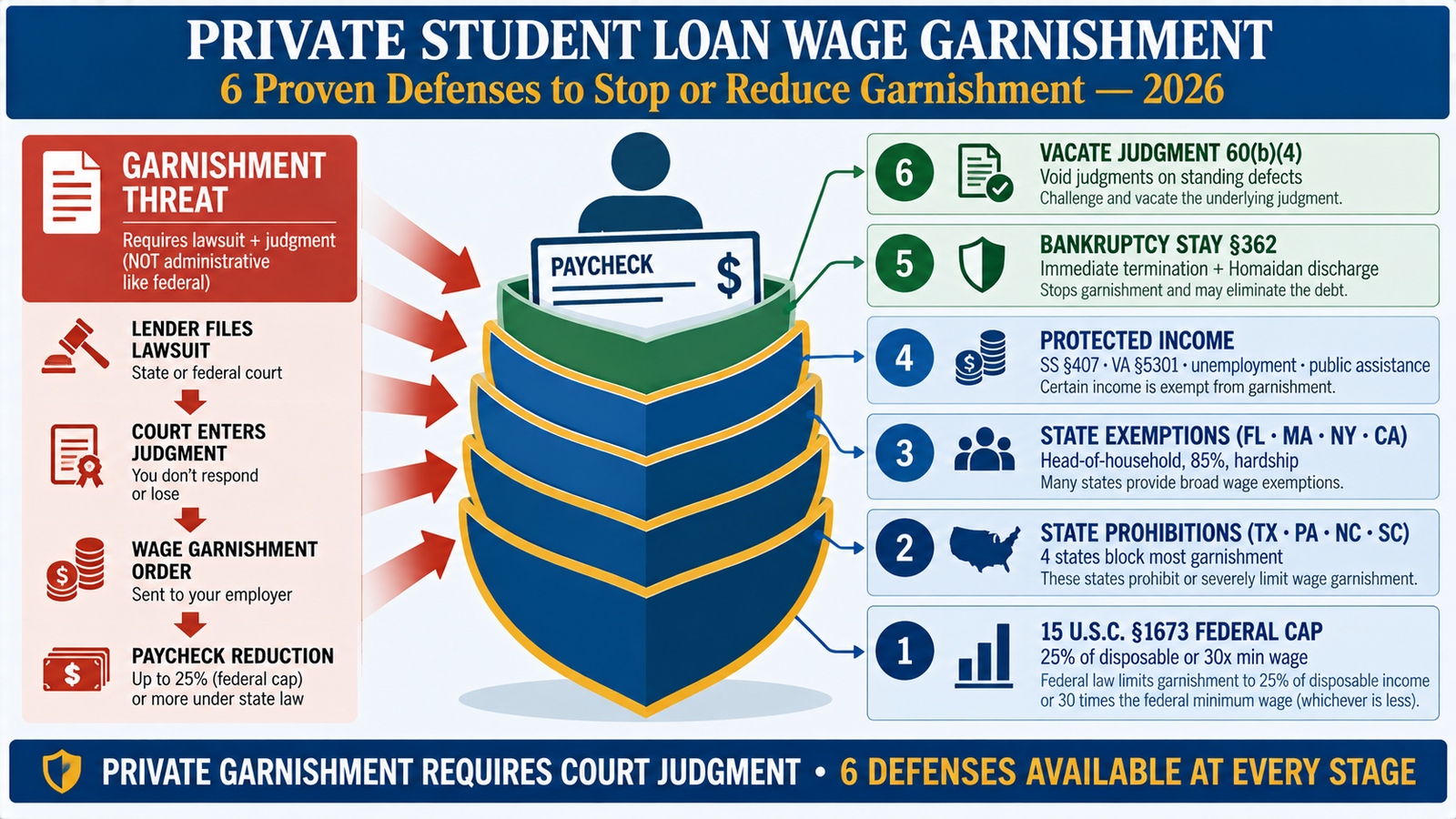
Private student loan wage garnishment requires lawsuit, court judgment, and separate garnishment proceeding — unlike federal student loans which can garnish administratively. This multi-step requirement creates 6 proven defensive opportunities: (1) Federal Consumer Credit Protection Act 15 U.S.C. §1673 caps garnishment at lesser of 25% of disposable earnings or amount by which weekly earnings exceed 30 times federal minimum wage ($217.50/week at $7.25 federal minimum). (2) Four states prohibit most consumer debt wage garnishment entirely: Texas (except specific debt types), Pennsylvania (very limited), North Carolina (very limited), South Carolina (very limited). (3) State exemption claims — many states provide additional protections beyond federal limits (Florida head-of-household 100% exemption on earnings below $750/week, Massachusetts 85% of earnings, others vary); claim of exemption procedure typically available post-garnishment order. (4) Protected income immune from garnishment regardless of judgment — Social Security benefits under 42 U.S.C. §407, veterans benefits under 38 U.S.C. §5301, unemployment benefits (state-protected), workers’ compensation (state-protected), public assistance (state-protected); separate account funding essential. (5) Bankruptcy automatic stay under 11 U.S.C. §362 upon filing immediately halts garnishment nationwide — Chapter 7 filing provides stay plus potential Homaidan discharge of underlying debt under 11 U.S.C. §523(a)(8). (6) Motion to vacate underlying judgment under FRCP 60(b)(4) when original lawsuit lacked proper standing — chain of assignment defects common in NCSLT and debt buyer cases, standing jurisdictional with no time limit for challenge. Pre-garnishment lawsuit defense (SOL, standing, FDCPA, Rule 12(b)(6)) is substantially easier than post-garnishment recovery — timely answer to lawsuits is critical.
Read the complete 2026 garnishment defense framework below.
In this complete garnishment defense guide:
How private student loan garnishment actually works
Multi-step process and intervention points
Defense 1: Federal CCPA 15 U.S.C. §1673 limits
25% cap or 30x minimum wage protection
Defense 2: State garnishment prohibitions
Texas, Pennsylvania, North Carolina, South Carolina
Defense 3: State exemption claims
Head-of-household and other state protections
Defense 4: Protected income
Social Security, VA benefits, and other federal protections
Defense 5: Bankruptcy automatic stay
11 U.S.C. §362 immediate garnishment termination
Defense 6: Vacating the underlying judgment
FRCP 60(b)(4) for void judgments
Pre-garnishment lawsuit defense (most important)
Why timely lawsuit response matters more than any defense below
How private student loan garnishment actually works
Understanding how private student loan wage garnishment works is essential before analyzing defenses. The multi-step process creates specific intervention points, each with distinct defensive opportunities.
The critical distinction from federal loans
Federal student loans can garnish wages ADMINISTRATIVELY under 20 U.S.C. §1095a — no lawsuit, no court judgment, no judicial process required. The U.S. Department of Education or its contractors can issue administrative wage garnishment orders directly to employers. Private student loans operate under completely different legal framework — garnishment is a JUDICIAL process requiring lawsuit, judgment, and separate garnishment proceeding. This fundamental distinction creates substantial defensive opportunities for private loan borrowers that federal borrowers don’t have.
The 5-step garnishment process
Private student loan wage garnishment requires: (1) Lender files lawsuit — complaint filed in court of appropriate jurisdiction naming borrower as defendant; (2) Service of process — borrower served with summons and complaint through legally sufficient means; (3) Judgment entered — court enters judgment either after litigation or by default if borrower fails to appear/defend; (4) Separate garnishment proceeding — judgment creditor files motion for writ of garnishment with court; (5) Employer served with garnishment order — writ served on employer requiring withholding from employee wages per court order. Each step creates intervention opportunity.
Timeline considerations
Typical timeline from first missed payment to active garnishment: default declaration at 90-120 days; charge-off at 180 days; collection activity 6-24 months before lawsuit; lawsuit filing with 20-30 day answer deadline; judgment entry 30-180 days after service (default judgment faster); writ of garnishment typically weeks to months post-judgment; employer compliance begins approximately 1-2 pay periods after service. Total timeline from default to active garnishment typically 18-36 months — providing substantial intervention opportunities throughout.
Who files these lawsuits
Private student loan garnishment lawsuits come from: original lenders (Sallie Mae Bank, Navient/Earnest, Discover/Firstmark Services post-2024 Carlyle/KKR acquisition, SoFi, Citizens, Ascent); third-party debt collectors acting on original lender’s behalf; debt buyers who purchased charged-off debt (often at steep discount creating settlement motivation); NCSLT (National Collegiate Student Loan Trusts) holding pre-2014 Sallie Mae-originated loans particularly from 2001-2007 origination period. Each plaintiff type has different defensive considerations — chain of assignment particularly powerful against assigned debt.
What garnishment actually looks like
When garnishment is active: employer withholds specified amount from each paycheck (typically percentage, subject to federal/state limits); withheld funds forwarded to court or creditor per court order; borrower sees reduced net pay on each pay statement; garnishment continues until judgment is fully satisfied (which may take years at maximum legal withholding); multiple creditors cannot stack garnishments beyond federal/state limits (first-in-time typically prevails up to maximum); employer must comply or face contempt and potential personal liability. The practical impact can be severe — 25% withholding from monthly income significantly affects household budgets.
Defense 1: Federal CCPA 15 U.S.C. §1673 limits
The Consumer Credit Protection Act provides baseline federal protection against excessive wage garnishment. These limits apply to private student loan wage garnishment nationwide — state law may provide additional protections but cannot reduce federal limits.
The federal cap formula
Under 15 U.S.C. §1673(a), consumer debt garnishment is limited to the LESSER of: (1) 25% of borrower’s disposable earnings for the week; OR (2) the amount by which borrower’s disposable earnings for that week exceed 30 times the federal minimum wage. At current $7.25/hour federal minimum wage, 30x minimum wage equals $217.50 per week. The second calculation produces greater protection for lower-income earners. For borrowers earning near federal minimum wage, the second calculation may result in zero garnishment.
“Disposable earnings” definition
15 U.S.C. §1672(b) defines “disposable earnings” as compensation remaining after amounts required by law to be withheld — includes: federal income tax withholding; FICA (Social Security and Medicare); state income tax withholding; local income tax withholding; required state disability insurance. Does NOT include: health insurance premiums (voluntary); 401(k) contributions (voluntary); union dues (unless required by employment); charitable contributions. The distinction matters significantly — “disposable earnings” is typically 15-25% less than gross wages depending on tax situation.
Example calculations
Example 1 — Higher earner: Gross weekly wages $1,200; withholdings total $300; disposable earnings $900. Garnishment calculation: 25% of $900 = $225; vs ($900 – $217.50) = $682.50. Lesser applies = $225 maximum weekly garnishment. Example 2 — Lower earner: Gross weekly wages $400; withholdings $60; disposable earnings $340. Garnishment calculation: 25% of $340 = $85; vs ($340 – $217.50) = $122.50. Lesser applies = $85 maximum weekly garnishment. Example 3 — Near minimum wage: Gross weekly $300; withholdings $40; disposable $260. Calculation: 25% = $65; vs ($260 – $217.50) = $42.50. Lesser applies = $42.50 maximum weekly garnishment.
Enforcement of federal limits
Federal CCPA limits apply automatically — employer is required to apply the limit regardless of court order amount. Garnishment orders in excess of federal limits are automatically reduced to federal maximum. However, employers sometimes make errors in calculation or application. Borrowers should verify garnishment amounts against federal and state limits — excessive withholding supports claim of exemption or motion to court. Department of Labor’s Wage and Hour Division enforces CCPA violations.
State law supplementation
Federal CCPA sets FLOOR protections. State law may provide ADDITIONAL protections but cannot reduce federal protections. Many states provide stronger protections — Massachusetts protects 85% of disposable earnings (versus federal 75%); New York uses lesser of 10% of gross wages or 25% of disposable earnings; some states have head-of-household exemptions (Florida); some states prohibit garnishment entirely for consumer debt (TX, PA, NC, SC). State analysis is essential when federal cap doesn’t provide adequate relief.
Defense 2: State garnishment prohibitions
Four states prohibit most consumer debt wage garnishment entirely — making stop private student loan garnishment dramatically easier for borrowers residing in these states.
Texas
Texas constitutional protection under Tex. Const. Art. XVI §28 and Tex. Civ. Prac. & Rem. Code §63.004 prohibits most consumer debt wage garnishment entirely. Exceptions include: child support; spousal support (alimony); federal taxes; student loans but ONLY federal student loans (not private); defaulted federally-guaranteed student loans. Private student loan creditors CANNOT garnish wages in Texas regardless of judgment amount. This protection is one of the strongest consumer protections in any state. Private student loan creditors in Texas typically pursue other collection methods (bank levy, property liens) that may be subject to other state protections.
Pennsylvania
Pennsylvania under 42 Pa.C.S. §8127 prohibits wage attachment for most consumer debts. Exceptions include: child/spousal support; federal and state taxes; some judgments for board/lodging; limited specific obligations. Private student loan creditors generally CANNOT garnish Pennsylvania wages for consumer debt judgments. Pennsylvania’s 4-year statute of limitations under 42 Pa.C.S. §5525 combined with wage garnishment prohibition makes Pennsylvania one of the strongest consumer protection jurisdictions. Private loan creditors in Pennsylvania pursue other collection methods subject to Pennsylvania’s exemption framework.
North Carolina
North Carolina under N.C. Gen. Stat. §1-362 and related provisions provides very limited wage garnishment availability for consumer debt. Exceptions include: child/spousal support; taxes; federal student loan debt; limited specific obligations. Private student loan creditors generally cannot garnish wages in North Carolina for consumer debt. North Carolina’s 3-year SOL under N.C. Gen. Stat. §1-52 combined with limited garnishment makes it another strong consumer protection state. Private creditors pursue other collection methods subject to North Carolina exemption framework.
South Carolina
South Carolina under S.C. Code §15-39-410 and related provisions provides very limited consumer debt wage garnishment. Exceptions similar to other prohibition states: support obligations, taxes, federal student loans. Note that PSR does not serve South Carolina — borrowers in South Carolina should contact South Carolina-licensed consumer attorneys directly for garnishment defense coordination. Despite PSR’s non-service in South Carolina, the state’s garnishment protection is noted here for completeness and because many borrowers unknowingly cross state lines or seek general information.
Residence timing matters
Garnishment protections typically apply based on CURRENT state of residence, not original loan origination state or borrower’s historical residence. A borrower who lived in Illinois during loan origination but now resides in Texas benefits from Texas garnishment prohibition. However, specific procedural considerations may apply — judgments from other states may need domestication (recognition) in the new state, which creates additional defensive opportunities. Residence changes should be documented for garnishment defense purposes.
Defense 3: State exemption claims
Even in states that permit wage garnishment for consumer debt, state exemption claims often provide substantial additional protections beyond federal CCPA limits.
Florida head-of-household exemption
Florida provides one of the strongest state garnishment protections under Fla. Stat. §222.11. Head-of-household (defined as person providing more than one-half support for dependent) earning less than $750/week is 100% exempt from garnishment for consumer debt. Head-of-household earning more than $750/week may still exempt earnings but subject to written waiver provisions. The protection extends to disposable earnings. Claim of exemption procedure requires timely filing after garnishment order — typically within 20 days. Florida head-of-household exemption often eliminates garnishment entirely for middle-income earners with dependents.
Massachusetts 85% exemption
Massachusetts under M.G.L. c.246 §28 protects 85% of gross wages (versus federal 75% of disposable earnings). This substantially reduces garnishment compared to federal baseline. Massachusetts calculation is based on GROSS wages rather than disposable earnings — in many cases providing stronger protection than federal formula. Claim of exemption procedure available post-garnishment order. Combined with Massachusetts’ consumer protection laws under M.G.L. c.93A, Massachusetts provides strong overall garnishment defense framework.
New York stronger limits
New York CPLR §5231 limits garnishment to lesser of: 10% of gross wages; OR 25% of disposable earnings; OR amount by which disposable earnings exceed 30 times greater of federal minimum wage or New York minimum wage. New York minimum wage varies by region ($15-16/hour in 2026, substantially above federal $7.25). The regional minimum wage calculation provides significantly stronger protection than federal baseline — 30x NY minimum wage approximately $450-480/week versus federal $217.50. New York Consumer Credit Fairness Act (CCFA effective April 7, 2022) also reduced SOL to 3 years, providing additional defensive framework.
California 25% cap plus hardship
California CCP §706.050 applies 25% cap on disposable earnings consistent with federal. Additionally, California provides claim of exemption under CCP §703.070 for financial hardship — if garnishment would prevent paying essential expenses, borrower can file claim of exemption. Court review of hardship exemption claim may result in reduced or eliminated garnishment. California’s 4-year SOL under CCP §337 combined with hardship exemption availability provides strong overall framework.
Claim of exemption procedure
Claim of exemption typically requires: timely filing after garnishment order (usually 20-30 days from notice); written claim with supporting documentation (income, expenses, dependents, state-specific exemption basis); court hearing on claim; employer continues withholding pending ruling (though held in trust in some jurisdictions). State-specific procedures vary significantly — missed deadlines typically waive exemption claim. Professional representation strongly recommended given procedural complexity and short deadlines.
Defense 4: Protected income
Certain income sources are immune from garnishment regardless of judgment status under federal and state law. Properly protecting these income sources is critical defensive framework for private student loan wage garnishment situations.
Social Security benefits (42 U.S.C. §407)
Social Security benefits are protected from garnishment under 42 U.S.C. §407. This protection applies to: Social Security retirement benefits; Social Security Disability Insurance (SSDI); Supplemental Security Income (SSI); Social Security survivor benefits. The protection is nearly absolute for consumer debt — including private student loans. Exceptions limited to: federal tax levies; child support; federal student loan defaults (but not private); some court-ordered victim restitution. For borrowers receiving Social Security as income source, these benefits CANNOT be garnished for private student loan debt.
Veterans benefits (38 U.S.C. §5301)
Veterans benefits are protected from garnishment under 38 U.S.C. §5301. Protection includes: VA disability compensation; VA pension; GI Bill benefits (for current recipient; different rules for already-received funds); survivor benefits. Protection applies regardless of judgment or creditor type. Private student loan creditors cannot access veterans benefits through garnishment. VA benefits provide reliable income source immune from consumer debt collection.
Unemployment and workers’ compensation
State unemployment insurance benefits are generally protected under state law. All 50 states exempt unemployment benefits from garnishment for most consumer debt. Workers’ compensation benefits are similarly protected under state workers’ compensation laws. These protections provide income security during periods when borrowers are already financially vulnerable. Protection applies to current benefit payments — once deposited into bank accounts, additional protections may apply but are more complex.
Public assistance programs
Public assistance programs are generally protected: TANF (Temporary Assistance for Needy Families); SNAP (food stamps); state cash assistance programs; Section 8 housing assistance; LIHEAP (energy assistance); WIC. These benefits serve essential household needs and are protected from garnishment under federal and state law. Direct deposit of benefits provides some automatic protection — bank account rules under Treasury Department regulations provide protected status for direct-deposited federal benefits.
Account funding essential
For protected income to maintain protection, funding into bank accounts requires care: direct deposit of federal benefits (Social Security, VA) receives automatic 2-month lookback protection under 31 C.F.R. §212 — banks must identify and protect direct-deposited federal benefits; mixing protected and unprotected funds in same account may complicate protection claims; separate accounts for protected income (one account for Social Security only) provides clearest protection documentation. Consultation with attorney about optimal account structure recommended for borrowers facing or anticipating garnishment.
Defense 5: Bankruptcy automatic stay
Bankruptcy filing provides the most immediate and comprehensive garnishment termination available — the automatic stay under 11 U.S.C. §362 halts garnishment nationwide upon filing, often within hours of court filing.
The automatic stay under 11 U.S.C. §362
Upon filing bankruptcy petition, 11 U.S.C. §362(a) automatically stays: “the enforcement, against the debtor or against property of the estate, of a judgment obtained before the commencement of the case” and “any act to collect, assess, or recover a claim against the debtor.” Wage garnishment falls squarely within these prohibited actions. The stay takes effect automatically at the moment of filing — no court order required, no notice period, no employer compliance requirement delay. The protection is nationwide and applies to all creditors regardless of pending proceedings.
Practical garnishment termination
Practical implementation: borrower files Chapter 7 or Chapter 13 petition; immediately notifies employer and judgment creditor of filing with case number; employer must stop garnishment immediately upon notice (continuing garnishment post-notice violates §362); creditor must cease all collection activity. Violations of the stay support actual damages, attorney fees, and in some cases punitive damages under 11 U.S.C. §362(k). The practical reality is that properly executed bankruptcy filing provides immediate garnishment termination.
Chapter 7 with Homaidan discharge
Chapter 7 bankruptcy with §523(a)(8) adversary proceeding under Homaidan v. Sallie Mae 992 F.3d 100 (2d Cir. 2021) precedent provides: (1) immediate stay of garnishment upon filing; (2) potential discharge of underlying private student loan debt WITHOUT undue hardship for direct-to-consumer loans, loans exceeding cost of attendance, Residency Loans, loans failing IRC §221(d)(1) requirements, and other non-qualified loans; (3) if discharge succeeds, permanent elimination of debt and garnishment cannot resume. Total timeline typically 6-9 months from filing to discharge. See complete bankruptcy discharge guide.
Chapter 13 alternative
Chapter 13 provides: immediate automatic stay including garnishment termination; structured 3-5 year repayment plan addressing all debts; potential discharge of private student loans at end of plan (depending on §523(a)(8) analysis); codebtor stay under 11 U.S.C. §1301 protecting cosigners from collection during plan. Chapter 13 may be preferred when: Chapter 7 means test fails under 11 U.S.C. §707(b)(2); significant non-exempt assets would be lost in Chapter 7; borrower prefers structured repayment approach; cosigner protection critical during plan period.
Important bankruptcy considerations
Bankruptcy is comprehensive legal process with significant implications: credit impact (though often less severe than ongoing default); property exemption analysis required; attorney representation strongly recommended; filing fees and attorney fees (though fee waivers available in some circumstances); 10-year presence on credit report for Chapter 7, 7 years for Chapter 13. Decision to file bankruptcy for garnishment termination must balance immediate relief against broader implications. Consultation with bankruptcy attorney familiar with §523(a)(8) specifically essential.
Defense 6: Vacating the underlying judgment
Garnishment requires valid underlying judgment. If the underlying judgment can be vacated, garnishment cannot continue — this is particularly powerful for old default judgments where original lawsuit lacked proper standing.
FRCP 60(b)(4) void judgment standard
Federal Rules of Civil Procedure 60(b)(4) provides motion to vacate judgment that is “void.” Judgments entered when the court lacked jurisdiction — including when plaintiff lacked standing — are void and can be vacated at any time. 60(b)(4) has no time limit (unlike other 60(b) grounds which have 1-year limits). State courts have equivalent procedures. Standing challenges are jurisdictional and cannot be waived — a void judgment is void regardless of how much time has passed.
Standing analysis for old garnishment judgments
Many old garnishment judgments were entered without proper standing — particularly NCSLT trust and debt buyer judgments where chain of assignment from original lender was inadequately documented. Article III standing framework (Lujan v. Defenders of Wildlife 504 U.S. 555 (1992), Spokeo, Inc. v. Robins 578 U.S. 330 (2016), TransUnion LLC v. Ramirez 594 U.S. 413 (2021)) requires plaintiff to prove ownership from original lender. Documentation gaps that exist today likely existed when original judgment was entered — supporting vacation motion. See NCSLT lawsuit defense guide for detailed standing framework.
Impact of vacation on garnishment
Successful vacation produces comprehensive relief: order setting aside judgment; order quashing writ of garnishment; order releasing any funds held by employer or court; potential order for return of amounts previously garnished (depending on jurisdiction and case facts); restoration of borrower’s financial position. Vacation often also supports FDCPA counterclaim against creditor for enforcement of void judgment. Combined with inability to re-litigate underlying claim due to SOL expiration, vacation often produces permanent relief.
Procedure and timeline
Motion to vacate procedure: motion filed in original court entering judgment; supporting documentation showing standing defect (chain of assignment gaps, inadequate original documentation); creditor response typically includes attempt to supplement original record; hearing on motion; court ruling. Timeline typically 60-180 days from filing to resolution. During pendency, garnishment typically continues unless court issues stay (which may be sought separately). Representation by attorney with specific NCSLT or debt buyer defense experience strongly recommended.
Pre-garnishment lawsuit defense (most important)
The single most important defense against private student loan wage garnishment is NEVER reaching garnishment in the first place — through timely lawsuit response raising all available defenses.
The lawsuit stage decision tree
When served with lawsuit, options narrow rapidly: timely answer with all defenses preserves ALL defensive opportunities; late answer may still preserve some defenses but adds procedural complexity; no answer produces default judgment with full enforcement rights (garnishment, levy, liens). Pre-judgment defense is dramatically easier than post-judgment challenges. The 20-30 day answer deadline is the most critical window in debt collection defense — missing it produces default judgment that then requires FRCP 60(b)(4) motion for void judgment or similar relief.
Affirmative defenses to raise in answer
Comprehensive answer should raise: (1) Statute of limitations — time-barred debt supports complete dismissal (see 50-state SOL guide); (2) Article III standing / chain of assignment — plaintiff must prove ownership from original lender; (3) FDCPA debt validation — third-party collectors must validate under 15 U.S.C. §1692g; (4) Rule 12(b)(6) failure to state claim — defective pleading supports dismissal; (5) Failure to produce documentation — original promissory notes and complete assignment chain required; (6) Discharge in bankruptcy — if prior bankruptcy discharged the debt under 11 U.S.C. §523(a)(8). ALL defenses should be raised to preserve options.
Settlement as prevention
Settlement during lawsuit (post-filing but pre-judgment) often produces substantially better terms than post-garnishment settlement. Settlement benefits: avoids judgment entry and associated enforcement rights; eliminates garnishment risk entirely; produces defined resolution amount; avoids credit damage from judgment (settlement typically reports “paid” or “settled” not “judgment”). Settlement from defensive leverage position (combined with SOL, standing, and other defenses raised) often produces 20-40% of balance outcomes. See complete settlement guide.
The cost comparison
Cost comparison across intervention stages: Pre-lawsuit — hardship contact free; settlement potential 20-40% of balance; no legal fees. During lawsuit (pre-judgment) — answer preparation and defense (attorney fees); potential dismissal; settlement 20-40% of balance; defensive leverage substantial. Post-judgment pre-garnishment — motion to vacate costs (attorney fees); settlement 30-50% of balance; more complex procedural posture. Post-garnishment — same procedural options but with active income impact; claim of exemption or vacation required; emergency financial situation increases decision pressure. Early intervention produces best outcomes at lowest cost.
Related resources — complete garnishment ecosystem
Default consequences, timeline, and 7 proven paths out — the pilar framework.
Private Student Loan Bankruptcy Discharge 2026
Automatic stay for immediate garnishment termination plus Homaidan discharge analysis.
6 proven NCSLT defenses including FRCP 60(b)(4) vacation of old default judgments.
Private Student Loan SOL by State 2026
Complete 50-state SOL guide for time-barred lawsuit defense.
Common wage garnishment myths
Myth 1
“Private student loan creditors can garnish my wages like federal loans”
Reality: Private student loan creditors cannot garnish wages administratively. Unlike federal loans (which can garnish via administrative order under 20 U.S.C. §1095a), private loan garnishment requires lawsuit, court judgment, and separate garnishment proceeding. This fundamental distinction creates substantial defensive opportunities throughout the process — lawsuit defense, judgment challenges, exemption claims, and bankruptcy stays all available. The multi-step requirement provides multiple intervention points that federal borrowers don’t have.
Myth 2
“If I’m already being garnished, nothing can be done”
Reality: Even active garnishment can often be stopped or reduced through multiple mechanisms: bankruptcy automatic stay under 11 U.S.C. §362 provides immediate termination; motion to vacate underlying judgment under FRCP 60(b)(4) for standing defects; claim of exemption for state protections (head-of-household, hardship, protected income); state garnishment prohibition if borrower resides in TX, PA, NC, SC; verification of garnishment calculation against federal/state limits. Multiple defensive options remain even post-garnishment — the key is immediate professional consultation rather than resignation.
Myth 3
“All my income can be garnished if I owe private student loan debt”
Reality: Federal law protects substantial income from garnishment regardless of judgment status. Social Security benefits (42 U.S.C. §407), veterans benefits (38 U.S.C. §5301), unemployment compensation, workers’ compensation, and public assistance are generally immune from private student loan garnishment. Direct deposit of federal benefits receives automatic 2-month lookback protection under 31 C.F.R. §212. Even wages subject to garnishment are capped at federal 25% of disposable earnings (or amount above 30x federal minimum wage, whichever is less), with many states providing stronger protections. Protected income is not reduced by any debt.
Myth 4
“Changing jobs will stop the garnishment”
Reality: Changing jobs provides only temporary garnishment pause until creditor locates new employer — typically weeks to months. Once new employer is identified, garnishment resumes under new order. Changing jobs may also create employment complications and doesn’t address the underlying judgment. Addressing the underlying judgment through bankruptcy, motion to vacate, settlement, or exemption claim provides permanent resolution. Job change as garnishment avoidance strategy typically creates more problems than it solves. Professional strategic resolution more effective than evasion.
Frequently asked questions
1. Can private student loan lenders garnish my wages?
Yes, but only after lawsuit, court judgment, and separate garnishment proceeding — unlike federal student loans which can garnish administratively. The multi-step requirement means: lender must file lawsuit; borrower must be properly served; judgment must be entered (often default judgment if borrower doesn’t appear); creditor must obtain writ of garnishment; employer must be served with order. Each step creates intervention opportunity. Additionally, federal law under Consumer Credit Protection Act 15 U.S.C. §1673 caps garnishment at lesser of 25% of disposable earnings or amount above 30 times federal minimum wage. Four states (Texas, Pennsylvania, North Carolina, South Carolina) prohibit most consumer debt wage garnishment entirely. State exemption claims (head-of-household in Florida, 85% in Massachusetts, others) often provide additional protections.
2. How can I stop private student loan wage garnishment?
Six proven defenses to stop private student loan garnishment: (1) federal Consumer Credit Protection Act 15 U.S.C. §1673 limits (25% cap or 30x minimum wage); (2) state garnishment prohibitions (Texas, Pennsylvania, North Carolina, South Carolina); (3) state exemption claims (Florida head-of-household, Massachusetts 85%, New York stronger limits, California hardship); (4) protected income (Social Security under 42 U.S.C. §407, veterans benefits under 38 U.S.C. §5301, unemployment, workers’ comp, public assistance); (5) bankruptcy automatic stay under 11 U.S.C. §362 for immediate termination with potential Homaidan discharge of underlying debt; (6) motion to vacate underlying judgment under FRCP 60(b)(4) when original lawsuit lacked proper standing. Multiple defenses can be combined for maximum protection. Immediate professional consultation essential — defensive opportunities narrow with time.
3. How much can be garnished from my paycheck for private student loan debt?
Federal cap under 15 U.S.C. §1673(a): lesser of (a) 25% of disposable earnings, OR (b) amount by which disposable earnings exceed 30 times federal minimum wage ($217.50/week at $7.25 federal minimum). “Disposable earnings” means wages after required withholdings (federal income tax, FICA, state income tax, mandatory disability insurance) — not after voluntary deductions (health insurance, 401(k), charity). State law may provide stronger protection: Massachusetts protects 85% of gross wages; Florida head-of-household earning under $750/week is 100% exempt; New York uses regional minimum wage ($15-16/hour) producing stronger protection. Texas, Pennsylvania, North Carolina, and South Carolina prohibit most consumer debt wage garnishment entirely. Calculation examples: $900 weekly disposable earnings = $225 maximum federal garnishment; $340 disposable = $85 maximum; $260 disposable = $42.50 maximum (second formula applies for lower earners).
4. Does filing bankruptcy stop private student loan wage garnishment?
Yes, immediately. The automatic stay under 11 U.S.C. §362(a) halts garnishment nationwide upon bankruptcy filing — no court order required, no notice period, no delay. Chapter 7 or Chapter 13 both trigger automatic stay. Practical implementation: file bankruptcy petition; immediately notify employer and creditor with case number; employer must stop garnishment upon notice (continuing violates §362); creditor must cease all collection activity. Stay violations support actual damages, attorney fees, potential punitive damages. Chapter 7 with §523(a)(8) adversary proceeding under Homaidan v. Sallie Mae 992 F.3d 100 (2d Cir. 2021) precedent may also discharge the underlying debt permanently (6-9 month total timeline). Chapter 13 provides stay plus structured 3-5 year repayment with codebtor protection under 11 U.S.C. §1301. Bankruptcy decision balances immediate relief against broader implications — consultation with bankruptcy counsel familiar with §523(a)(8) essential.
5. Can my Social Security benefits be garnished for private student loan debt?
No. Social Security benefits are protected from garnishment under 42 U.S.C. §407. Protection applies to: Social Security retirement; Social Security Disability Insurance (SSDI); Supplemental Security Income (SSI); Social Security survivor benefits. Protection is nearly absolute for consumer debt including private student loans. Limited exceptions: federal tax levies; child support; federal (not private) student loan defaults; some court-ordered victim restitution. Direct deposit of Social Security into bank accounts receives automatic 2-month lookback protection under 31 C.F.R. §212 — banks must identify and protect direct-deposited federal benefits. Veterans benefits are similarly protected under 38 U.S.C. §5301. Unemployment, workers’ compensation, and public assistance protected under state and federal law.
6. What should I do if I’m being sued for a private student loan debt?
Immediate steps when served with lawsuit: (1) note the answer deadline (typically 20-30 days from service); (2) do NOT miss deadline (default judgment follows automatically); (3) do NOT contact creditor without consulting counsel first; (4) consult attorney with specific private student loan defense experience immediately; (5) prepare answer raising ALL available affirmative defenses — statute of limitations, Article III standing / chain of assignment, FDCPA debt validation, Rule 12(b)(6) failure to state claim, documentation failures, discharge in prior bankruptcy if applicable; (6) demand full discovery; (7) consider FDCPA counterclaim against third-party collection agents; (8) evaluate settlement from defensive leverage position; (9) consider bankruptcy if comprehensive discharge available under Homaidan. Timely answer preserves all defensive opportunities — missed deadline requires FRCP 60(b)(4) motion or similar post-judgment relief which is substantially more complex.
7. If I live in Texas, can my wages be garnished for private student loan debt?
Generally no. Texas constitutional protection under Tex. Const. Art. XVI §28 and statutory protection under Tex. Civ. Prac. & Rem. Code §63.004 prohibits most consumer debt wage garnishment. Exceptions limited to: child support; spousal support; federal taxes; federal student loan defaults (but NOT private student loans); some specific obligations. Private student loan creditors generally CANNOT garnish wages in Texas regardless of judgment amount. This protection is one of the strongest consumer protections in any state. Private student loan creditors in Texas typically pursue alternative collection methods — bank levy (subject to Texas exemption framework), property liens, or settlement negotiation. Combined with Texas 4-year SOL under Tex. Civ. Prac. & Rem. Code §16.004(a)(3), Texas provides comprehensive consumer protection framework for private student loan borrowers. Pennsylvania (42 Pa.C.S. §8127), North Carolina (N.C. Gen. Stat. §1-362), and South Carolina (S.C. Code §15-39-410) provide similar wage garnishment prohibitions.
Facing Wage Garnishment for Private Student Loans?
Free specialist review of all 6 defenses to stop or reduce garnishment.
Federal Consumer Credit Protection Act 15 U.S.C. §1673 cap verification (25% of disposable earnings or 30x federal minimum wage, whichever is less); state garnishment prohibition analysis (Texas, Pennsylvania, North Carolina, South Carolina residents); state exemption claim preparation (Florida head-of-household, Massachusetts 85%, New York stronger limits, California hardship); protected income analysis (Social Security 42 U.S.C. §407, veterans benefits 38 U.S.C. §5301, unemployment, workers’ compensation, public assistance) with 31 C.F.R. §212 direct deposit protection; bankruptcy automatic stay evaluation under 11 U.S.C. §362 with Homaidan discharge analysis for underlying debt; motion to vacate underlying judgment preparation under FRCP 60(b)(4) for standing defects in NCSLT and debt buyer cases; pre-garnishment lawsuit defense coordination (SOL, Article III standing, FDCPA validation, Rule 12(b)(6)); and coordinated private student loan wage garnishment defense across Sallie Mae, Navient/Earnest, Discover/Firstmark, SoFi, Citizens, Ascent, NCSLT trusts, and debt buyers. Free eligibility review with attorney-backed partner provider — no upfront fees.
Get a free eligibility review →
5-minute review · No obligation · Zero upfront fees · Since 2015 · 48 states served
About the author
Henry Silva — Private Student Loan Debt Specialist
10+ years experience in private student loan wage garnishment defense coordination across all 50 states. Expertise includes Consumer Credit Protection Act 15 U.S.C. §1673 federal cap analysis (25% of disposable earnings or amount above 30x federal minimum wage per week), disposable earnings calculation under 15 U.S.C. §1672(b), state wage garnishment prohibition analysis for Texas (Tex. Const. Art. XVI §28, Tex. Civ. Prac. & Rem. Code §63.004), Pennsylvania (42 Pa.C.S. §8127), North Carolina (N.C. Gen. Stat. §1-362), and South Carolina (S.C. Code §15-39-410) residents, state exemption analysis including Florida head-of-household 100% exemption below $750/week under Fla. Stat. §222.11, Massachusetts 85% gross wage protection under M.G.L. c.246 §28, New York stronger limits under CPLR §5231 with regional minimum wage calculation, California hardship exemption under CCP §703.070 and §706.050 cap, protected income under 42 U.S.C. §407 (Social Security retirement, SSDI, SSI, survivor benefits), 38 U.S.C. §5301 (VA disability compensation, pension, survivor benefits), state unemployment and workers’ compensation protection, public assistance program protection (TANF, SNAP, Section 8, LIHEAP, WIC), 31 C.F.R. §212 direct deposit federal benefit 2-month lookback bank account protection, bankruptcy automatic stay under 11 U.S.C. §362 for immediate garnishment termination with Homaidan v. Sallie Mae 992 F.3d 100 (2d Cir. 2021) discharge analysis under 11 U.S.C. §523(a)(8), Chapter 13 codebtor stay under 11 U.S.C. §1301 for cosigner protection, FRCP 60(b)(4) motion to vacate void judgments for standing defects (particularly for NCSLT and debt buyer judgments) under Article III standing framework (Lujan v. Defenders of Wildlife 504 U.S. 555 (1992), Spokeo, Inc. v. Robins 578 U.S. 330 (2016), TransUnion LLC v. Ramirez 594 U.S. 413 (2021)), pre-garnishment lawsuit defense coordination raising statute of limitations, Article III standing / chain of assignment challenges, FDCPA debt validation under 15 U.S.C. §1692g with coordinated counterclaim under §1692e deceptive practices and §1692f unfair practices, Rule 12(b)(6) failure to state claim motions, settlement negotiation from defensive leverage positions, and comprehensive multi-mechanism defensive framework across Sallie Mae Bank NYSE:SLM, Navient Corporation NYSE:NAVI, Earnest Operations LLC, Discover student loan portfolio (Carlyle Group and KKR acquisition July 2024, Firstmark Services servicing), SoFi Bank NA NMLS #696891, Citizens Bank NA NYSE:CFG, Ascent Student Loans, NCSLT (National Collegiate Student Loan Trusts), and third-party debt buyers. Henry works with Private Student Relief’s attorney-backed partner provider network to coordinate garnishment defense across all 6 proven mechanisms for maximum borrower protection.
Legal Disclaimer and Sources
This article is provided for informational purposes only and does not constitute legal, tax, or financial advice. Private Student Relief is a consulting and matching organization operated by Joco (555 Anton Blvd, Suite 368, Costa Mesa, CA 92626) — not a law firm, debt settlement company, debt consolidation company, or loan provider. Debt validation services are performed by an attorney-backed partner provider (Panamerican Consulting LLC, Las Vegas, NV) under independent business credentials. Ratings, BBB accreditation, and AADR membership referenced on the PSR website belong to the partner provider. Private student loan wage garnishment defense requires representation by state-licensed counsel admitted in the applicable jurisdiction — this article does not create attorney-client relationship. Individual case outcomes depend on specific facts, income sources, state of residence, judgment status, and procedural posture. Since 2015. 48 states served. Not available in South Carolina or Mississippi.
Federal statutes referenced: Consumer Credit Protection Act 15 U.S.C. §1673(a) (wage garnishment limits — lesser of 25% of disposable earnings or amount above 30x federal minimum wage); 15 U.S.C. §1672(b) (disposable earnings definition); Social Security Act 42 U.S.C. §407 (protection of Social Security benefits from garnishment); Veterans benefits 38 U.S.C. §5301 (protection of VA benefits from garnishment); Treasury Department regulations 31 C.F.R. §212 (direct deposit federal benefit 2-month lookback bank protection); Bankruptcy Code 11 U.S.C. §362(a) automatic stay; 11 U.S.C. §362(k) stay violation remedies; 11 U.S.C. §523(a)(8) student loan discharge exceptions; 11 U.S.C. §524 discharge injunction; 11 U.S.C. §707(b)(2) means test; 11 U.S.C. §1301 Chapter 13 codebtor stay; 11 U.S.C. §1328 Chapter 13 discharge; Federal Rules of Civil Procedure FRCP 12(b)(6) failure to state claim, FRCP 60(b)(4) void judgment vacation; Fair Debt Collection Practices Act 15 U.S.C. §1692 et seq. including §1692g debt validation, §1692e deceptive practices, §1692f unfair practices; Fair Credit Reporting Act 15 U.S.C. §1681c (7-year reporting), 15 U.S.C. §1681b (employment screening). Federal student loan administrative garnishment under 20 U.S.C. §1095a (noted for distinction from private loan judicial process requirement).
Key precedent referenced: Homaidan v. Sallie Mae Inc. 992 F.3d 100 (2d Cir. 2021) non-qualified discharge for direct-to-consumer loans; Brunner v. New York State Higher Education Services Corp. 831 F.2d 395 (2d Cir. 1987) undue hardship three-prong test; Crocker v. Navient Solutions LLC 941 F.3d 206 (5th Cir. 2019); McDaniel v. Navient Solutions LLC 973 F.3d 1083 (10th Cir. 2020); In re Rosenberg 594 B.R. 22 (Bankr. S.D.N.Y. 2020) moderated Brunner application; DOJ November 2022 undue hardship guidance; Article III standing precedent — Lujan v. Defenders of Wildlife 504 U.S. 555 (1992), Spokeo, Inc. v. Robins 578 U.S. 330 (2016), TransUnion LLC v. Ramirez 594 U.S. 413 (2021). NCSLT Third Circuit March 19, 2024 “covered persons” decision under Consumer Financial Protection Act 12 U.S.C. §5481(6); SCOTUS cert denial December 2024.
State wage garnishment statutes referenced (verify current statutes): Texas constitutional protection Tex. Const. Art. XVI §28 and statutory protection Tex. Civ. Prac. & Rem. Code §63.004 (prohibits most consumer debt wage garnishment); Pennsylvania 42 Pa.C.S. §8127 (prohibits most consumer debt wage attachment); North Carolina N.C. Gen. Stat. §1-362 (very limited consumer debt wage garnishment); South Carolina S.C. Code §15-39-410 (very limited consumer debt wage garnishment); Florida Fla. Stat. §222.11 (head-of-household 100% exemption below $750/week); Massachusetts M.G.L. c.246 §28 (85% of gross wages protected); New York CPLR §5231 (lesser of 10% gross or 25% disposable or 30x NY minimum wage); California CCP §706.050 (25% cap on disposable earnings) and CCP §703.070 (hardship exemption claim). State statute of limitations for written contract debt (private student loans): Texas 4 years under Tex. Civ. Prac. & Rem. Code §16.004(a)(3); New York 3 years under CPLR §214(2) per Consumer Credit Fairness Act (CCFA) effective April 7, 2022; Pennsylvania 4 years under 42 Pa.C.S. §5525; Ohio 6 years under Ohio R.C. §2305.06; Illinois 10 years under 735 ILCS 5/13-206; California 4 years under CCP §337; Florida 5 years under Fla. Stat. §95.11(2)(b).
Lender information current as of October 2026 per publicly available documentation: Sallie Mae Bank NYSE:SLM; Navient Corporation NYSE:NAVI (2014 Sallie Mae split; 2017 Earnest acquisition $155M; December 2021 Aidvantage transfer federal exit; January 2022 state attorneys general settlement $1.85B); Earnest Operations LLC (Navient subsidiary since 2017); Discover student loan portfolio acquired by Carlyle Group and KKR consortium July 2024 with servicing transitioned to Firstmark Services (Nelnet NYSE:NNI subsidiary); SoFi Bank NA NMLS #696891 (chartered as national bank 2022, no cosigner release historically); Citizens Bank NA NYSE:CFG (cosigner release after 36 consecutive on-time payments); Ascent Student Loans. NCSLT (National Collegiate Student Loan Trusts) holds pre-2014 Sallie Mae-originated loans particularly from 2001-2007 origination period; 15 Delaware statutory trusts; Transworld Systems Inc. historical major administrator and collection agent.
Private student loan wage garnishment defense requires case-by-case review coordinating: current state of residence analysis for applicable prohibition or exemption framework; federal CCPA 15 U.S.C. §1673 calculation verification; state exemption claim preparation with timely filing (typically 20-30 days from garnishment notice); protected income analysis with account structure optimization; underlying judgment review for standing defects supporting FRCP 60(b)(4) vacation motion; bankruptcy analysis under 11 U.S.C. §362 automatic stay with Homaidan discharge potential under §523(a)(8); pre-garnishment lawsuit defense across SOL, Article III standing, FDCPA validation, Rule 12(b)(6) deficiency; settlement negotiation from defensive leverage positions; and coordinated multi-mechanism approach. For borrowers facing active garnishment, imminent garnishment following judgment, or pending lawsuits with garnishment risk, immediate professional consultation is essential given rapidly compounding financial impact and narrowing defensive opportunities. Last reviewed: October 2026.