

Informational content only. Not legal, tax, or financial advice. Private Student Relief is a consulting organization, not a law firm. Debt validation services are executed by an attorney-backed partner provider. Cosigner protection and coordinated resolution depend on loan contract terms, lender release program availability, borrower and cosigner specific circumstances, and jurisdiction. Last reviewed: October 2026.
Written by Henry Silva
Private Student Loan Debt Specialist · 10+ years experience in cosigner private student loan default protection and coordinated resolution strategy across all major private student loan lenders. Expertise includes joint and several liability analysis, cosigner release program coordination across Sallie Mae, Citizens Bank NA NYSE:CFG (36-month release program), Discover/Firstmark Services (post-2024 Carlyle Group and KKR acquisition), SoFi Bank NA NMLS #696891 (no cosigner release historically), Ascent Student Loans, and Earnest Operations LLC, Chapter 13 codebtor stay under 11 U.S.C. §1301 for cosigner protection during bankruptcy plans, Homaidan v. Sallie Mae 992 F.3d 100 (2d Cir. 2021) discharge analysis affecting cosigner liability under §523(a)(8), death and disability discharge contract analysis, settlement negotiation with full satisfaction release for both parties, life insurance planning for cosigner protection, FDCPA leverage under 15 U.S.C. §1692 for third-party collection on cosigners, and comprehensive multi-party defensive framework. Last reviewed: October 2026.
If you’re facing cosigner private student loan default — whether you’re the primary borrower whose default is damaging a cosigner (typically a parent, spouse, or family member) or you’re the cosigner facing collection activity for debt you didn’t primarily benefit from — understanding joint and several liability and coordinated protection strategies is essential. Cosigners are jointly and severally liable for the FULL balance, not a portion, meaning default triggers identical consequences for both parties: credit damage (100-200 point score drop); collection calls, letters, and lawsuits; wage garnishment exposure if judgment entered against cosigner; bank levy and asset seizure risk. This 2026 complete guide covers the 6 proven protection paths that work for both parties: cosigner release programs (where available), Chapter 13 codebtor stay under 11 U.S.C. §1301, Homaidan bankruptcy discharge analysis, coordinated settlement with full satisfaction release, death/disability discharge contract analysis with life insurance planning, and FDCPA leverage for third-party collection on cosigners. Family relationships don’t have to be destroyed by default — strategic coordination preserves both financial outcomes and personal relationships.
Quick Answer
Cosigner private student loan default triggers joint and several liability — meaning cosigners are responsible for the FULL balance (not a portion) with identical consequences as primary borrowers: credit damage (100-200 point score drop under FCRA 15 U.S.C. §1681c 7-year reporting); collection activities (calls, letters, lawsuits from original lender or debt buyers); wage garnishment exposure if judgment entered against cosigner (subject to Consumer Credit Protection Act 15 U.S.C. §1673 limits and state protections); bank levy and asset seizure risk; cosigner relationship strain. However, 6 proven protection paths exist: (1) Cosigner release programs — Citizens Bank NA NYSE:CFG offers release after 36 consecutive on-time principal and interest payments; Sallie Mae Bank NYSE:SLM typically 12+ consecutive on-time payments; Discover/Firstmark Services (post-2024 Carlyle Group/KKR acquisition) varies by product; SoFi Bank NA NMLS #696891 historically no cosigner release; Ascent Student Loans product-specific. Release typically requires loan in current status — once default occurs, release unavailable. (2) Chapter 13 bankruptcy codebtor stay under 11 U.S.C. §1301 provides temporary cosigner protection during 3-5 year plan — automatic stay halts collection against cosigner during plan period. (3) Chapter 7 bankruptcy by primary borrower with Homaidan v. Sallie Mae 992 F.3d 100 (2d Cir. 2021) discharge under 11 U.S.C. §523(a)(8) — successful discharge may extinguish debt entirely including cosigner liability (depends on specific case). (4) Coordinated settlement with full satisfaction release language naming BOTH parties — single resolution protecting both; settlement should always address cosigner specifically. (5) Death and disability discharge per contract terms — some contracts discharge both parties upon borrower death; others continue cosigner liability requiring life insurance planning. (6) FDCPA leverage under 15 U.S.C. §1692g for third-party collection on cosigners — validation requirements and §1692e deceptive practice protection apply equally to cosigners. Coordinated strategy addressing both parties produces materially better outcomes than borrower-only approach.
Read the complete 2026 cosigner protection framework below.
In this complete cosigner protection guide:
Understanding joint and several liability
What cosigning actually means legally and financially
Default consequences for cosigners
Identical impact on credit, collection, and assets
Path 1: Cosigner release programs
Lender-specific release opportunities
Path 2: Chapter 13 codebtor stay
11 U.S.C. §1301 cosigner protection
Path 3: Homaidan bankruptcy discharge
Chapter 7 discharge impact on cosigner
Path 4: Coordinated settlement
Full satisfaction release for both parties
Path 5: Death and disability discharge
Contract-based discharge and life insurance planning
Path 6: FDCPA leverage for cosigners
15 U.S.C. §1692g validation protection
Preserving family relationships through default resolution
Communication framework and expectations management
Understanding joint and several liability
Joint and several liability is the foundational concept behind cosigner private student loan default. Understanding this legal framework explains why cosigners face identical consequences as borrowers and shapes every protection strategy.
What “joint and several” actually means
Joint and several liability means: (1) Each party is liable for the FULL balance — not a share or portion; (2) Creditor can pursue any party, in any order, for the full amount — no requirement to pursue primary borrower first; (3) Partial payment by one party does NOT reduce other party’s liability except by the actual amount paid; (4) No automatic right to force other party to contribute except through separate lawsuit between parties (contribution action); (5) No requirement for creditor to notify both parties of all collection activities. The practical effect: cosigner’s assets, income, and credit are fully exposed from the moment of default, regardless of borrower’s situation.
The creditor’s strategic choice
Creditors often pursue cosigners strategically — not borrowers. If cosigner has stronger financial position (higher income, more assets, better credit worth protecting), creditor may focus collection activity on cosigner. Common patterns: parent cosigner with retirement savings and home equity targeted ahead of recent-graduate borrower with limited assets; spouse cosigner with stable employment targeted ahead of unemployed borrower; grandparent cosigner on Social Security targeted (though Social Security itself is protected under 42 U.S.C. §407). This strategic targeting can seem unfair but reflects creditor’s economic reality — collecting from whoever can actually pay.
Scope of cosigner obligation
Cosigner obligation includes: original loan principal; accrued interest; default interest (typically higher rate after default declaration); late fees stacking on each missed payment; collection costs when permitted by contract; attorney fees when permitted by contract; court costs if judgment entered. A $40,000 original balance can become $55,000-$70,000+ obligation through default accumulation — all of which cosigner is equally responsible for. The scope often surprises cosigners who thought their liability was limited.
Why cosigning happens anyway
Cosigning typically occurs because student (future borrower) lacks sufficient credit history or income to qualify independently for the loan amount needed. Common scenarios: 18-year-old undergraduate with no credit history needs parent cosigner; graduate student without significant income needs working-adult cosigner; borrower seeking lower interest rate uses cosigner with stronger credit profile. The economic logic that drives cosigning (expanding access to education financing) can create significant financial exposure for cosigners that often isn’t fully understood at signing.
Cosigner contribution rights
If cosigner pays debt that borrower was primarily responsible for, cosigner has contribution rights against borrower under state law — meaning cosigner can sue borrower for reimbursement of amounts paid. Practical reality: contribution lawsuits between family members are rare and often economically pointless (borrower who couldn’t pay original debt usually can’t pay cosigner either). Contribution rights exist in theory but rarely provide meaningful protection. Coordinated resolution strategy serves both parties better than contribution litigation.
Default consequences for cosigners
Understanding specific consequences cosigners face when cosigner private student loan default occurs enables effective protection planning and realistic communication between parties.
Credit damage parity
Negative credit reporting applies identically to borrower and cosigner: 30-day late (-50-100 points typical); 60-day late (-30-50 additional); 90-day late (-30-50 additional); default/charge-off reporting (-30-100 additional). Cosigners with excellent credit (750+ scores) frequently see dramatic drops to 500-600 range through default sequence. Impact extends beyond credit score: insurance rates (auto, home, life) may increase; employment screening may be affected in financial services and other industries; housing applications become more difficult; utility deposits may be required; existing credit lines may be reduced or closed. The 7-year FCRA 15 U.S.C. §1681c retention period applies equally to cosigner credit damage.
Collection activities
Cosigners are subject to all collection activities: phone calls (multiple daily from original lender and/or third-party collectors); written demand letters; email communications; employer verification contacts in some cases; lawsuit filings naming cosigner as co-defendant or sole defendant. Third-party collection on cosigners is subject to FDCPA 15 U.S.C. §1692 protections — including validation requirements under §1692g, prohibition of harassing contact under §1692d, prohibition of deceptive practices under §1692e. Many cosigners experience collection activity for years without resolution.
Lawsuit and judgment exposure
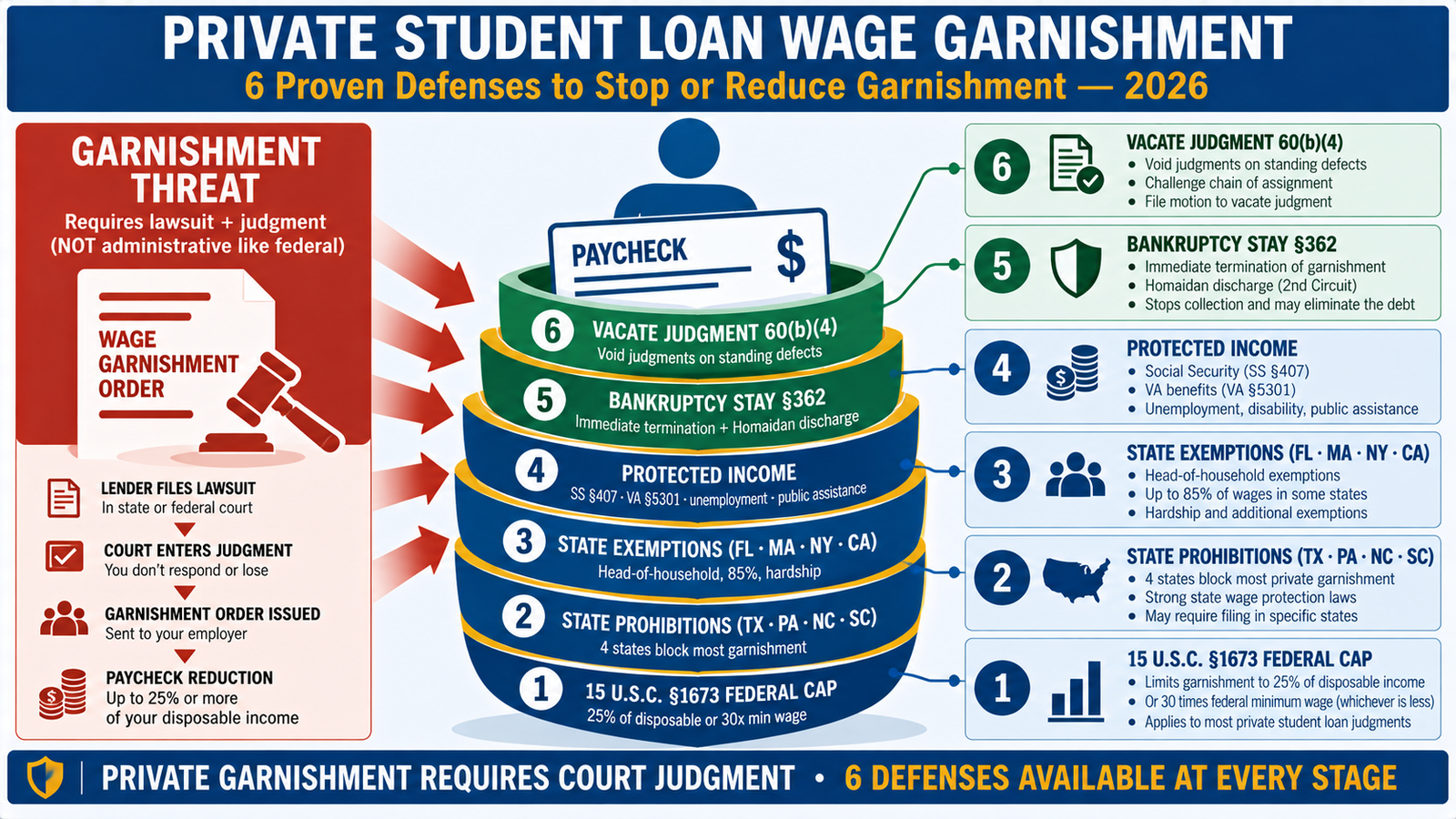
Cosigners can be sued directly or alongside primary borrower. Judgment entered against cosigner enables: wage garnishment (subject to Consumer Credit Protection Act 15 U.S.C. §1673 federal cap of 25% of disposable earnings or amount above 30x federal minimum wage, with state protections including Texas/Pennsylvania/North Carolina/South Carolina garnishment prohibitions and various state exemptions); bank account levy through writs of execution; property liens on real estate; income execution for self-employed cosigners. See complete wage garnishment defense guide for defensive framework applicable to cosigner situations.
Retirement account considerations
Qualified retirement accounts receive specific protection: ERISA-protected 401(k) and employer-sponsored retirement plans generally cannot be garnished for consumer debt; IRA accounts receive bankruptcy exemption under 11 U.S.C. §522(n) up to $1,512,350 (2026 inflation-adjusted limit); state retirement account exemptions vary. However, once retirement funds are withdrawn, protections may be lost — withdrawn 401(k) funds in regular bank accounts may be subject to levy. For cosigners with substantial retirement savings, protection analysis should consider withdrawal timing carefully.
Social Security and government benefits
Social Security benefits are protected from private student loan garnishment under 42 U.S.C. §407 — applies to retirement, SSDI, SSI, and survivor benefits. Veterans benefits protected under 38 U.S.C. §5301. For cosigners (particularly older parent cosigners) receiving these benefits as primary income, protection is substantial. However, direct deposit account rules under 31 C.F.R. §212 provide only 2-month lookback protection — benefits accumulated beyond this period mixed with other funds may lose protection. Account structure matters for maintaining protection.
Family relationship strain
Beyond financial consequences, cosigner default often creates severe family relationship strain. Common dynamics: parent cosigner’s resentment of borrower’s inability to pay; borrower’s guilt or avoidance of parent cosigner; marital stress when spouse is cosigner; grandparent-grandchild relationship affected; sibling-sibling cosigning creating conflict. Communication breakdowns compound financial problems — borrowers who stop communicating with cosigners often make situation worse. Early transparent communication, even about bad news, preserves relationships better than avoidance.
Path 1: Cosigner release programs
Cosigner release programs — where available — provide the cleanest path to cosigner release private student loan protection. Release removes cosigner from loan obligation entirely, protecting them from future default consequences. However, release typically requires loan in current status — once default occurs, release availability narrows dramatically.
Citizens Bank NA NYSE:CFG 36-month program
Citizens Bank offers cosigner release after specific requirements met: 36 consecutive on-time principal and interest payments; borrower creditworthiness criteria (credit score, income verification, debt-to-income ratio); no active hardship forbearance during qualifying period; borrower demonstrated ability to pay independently. Release requires borrower to initiate application and provide documentation. Once approved, cosigner is removed from loan obligation entirely. Citizens Bank’s cosigner release is one of the more structured and accessible programs in the private student loan market.
Sallie Mae Bank NYSE:SLM programs
Sallie Mae historically offers cosigner release after specific requirements that vary by loan origination date and product: typically 12+ consecutive on-time principal and interest payments; borrower creditworthiness criteria; income verification; no active forbearance or deferment. Specific requirements may vary — current Sallie Mae guidance should be verified for each loan. Pre-2014 loans (now typically held by NCSLT trusts) may have different cosigner release provisions depending on original Sallie Mae contract terms.
Discover/Firstmark Services (post-2024)
Discover student loan portfolio was acquired by Carlyle Group and KKR consortium in July 2024, with servicing transitioned to Firstmark Services (Nelnet NYSE:NNI subsidiary). Cosigner release programs continue under original Discover contract terms, administered through Firstmark. Specific release availability varies by Discover loan product (Undergraduate, MBA, Law, Health Professions, Residency, refinance). Borrowers should verify current cosigner release options with Firstmark Services directly or through consulting resources familiar with post-2024 Discover administration.
SoFi Bank NA NMLS #696891 (no cosigner release)
SoFi has historically NOT offered cosigner release program. Cosigners on SoFi loans typically remain on the obligation for the full loan term unless the loan is refinanced with another lender (releasing SoFi cosigner but adding new lender cosigner if required) or paid in full. This policy creates specific long-term exposure for SoFi cosigners. For SoFi loans in default or approaching default, cosigner protection requires alternative paths — bankruptcy coordination, settlement, or other mechanisms rather than release.
Ascent Student Loans
Ascent Student Loans offers cosigner release with specific requirements that vary by product. For college loans originated June 5, 2023 or later, contractual §523(a)(8) discharge waiver language creates specific considerations for bankruptcy coordination (though legal enforceability of such waivers remains disputed). Pre-June 2023 Ascent loans follow standard private loan analysis including cosigner release program availability. Specific product and origination date analysis essential.
Timing is critical
Critical timing consideration: cosigner release programs typically require loan in CURRENT status. Once default occurs (90-120 days delinquent), release availability typically ends. For borrowers close to meeting cosigner release requirements, prioritizing on-time payments to reach release threshold may be strategically important even if other debts are challenging. Reaching release threshold protects cosigner from ALL future default consequences — a powerful outcome worth significant short-term sacrifice. Borrowers should calculate exact timing to release eligibility and prioritize accordingly.
Path 2: Chapter 13 codebtor stay
Chapter 13 bankruptcy provides unique cosigner protection through codebtor stay under 11 U.S.C. §1301 — a powerful tool unavailable in Chapter 7 bankruptcy.
The §1301 codebtor stay
11 U.S.C. §1301(a) provides that after a Chapter 13 petition is filed, “a creditor may not act, or commence or continue any civil action, to collect all or any part of a consumer debt of the debtor from any individual that is liable on such debt with the debtor.” This codebtor stay provides automatic protection for cosigners during the Chapter 13 case — including collection calls, lawsuits, garnishment, and all other collection activity. The stay operates automatically upon case filing with no additional court action required.
Scope and limitations
Codebtor stay scope and limitations: (1) Applies only to CONSUMER debt (private student loans qualify); (2) Protects individual codebtors (cosigners who are natural persons, not business entities); (3) Debt must have been incurred for consumer purposes (education financing qualifies); (4) Stay continues through Chapter 13 plan period (typically 3-5 years); (5) Creditor may seek relief from stay under §1301(c) in limited circumstances. The practical effect: cosigner receives extended protection during the entire Chapter 13 plan period.
What happens during plan period
During Chapter 13 plan period: cosigner receives protection from collection activity; debtor (primary borrower) makes payments through plan trustee including payments on private student loan; plan payments may be substantially less than contract payments depending on means test and plan feasibility; cosigner credit may continue to show the account but with current status if plan payments are current; cosigner should maintain documentation of borrower’s plan performance for personal records.
End-of-plan considerations
Codebtor stay terminates at end of Chapter 13 plan period (typically 3-5 years). Post-plan outcomes depend on §523(a)(8) analysis: if plan successfully pays debt in full, both borrower and cosigner protected; if remaining balance exists at plan completion AND loan qualifies for non-qualified discharge under Homaidan analysis, remaining balance may discharge for borrower but cosigner liability may continue depending on specific case facts; if loan does not qualify for discharge, remaining balance survives plan and both parties remain liable. Pre-plan analysis of §523(a)(8) outcome essential for understanding end-game.
When Chapter 13 makes sense for cosigner protection
Chapter 13 particularly appropriate for cosigner protection when: cosigner relationship is critical (parent-child, spouse); borrower cannot qualify for Chapter 7 due to means test under 11 U.S.C. §707(b)(2); borrower has significant non-exempt assets that would be lost in Chapter 7; cosigner has substantial assets or income that creditor is actively pursuing; coordinated resolution with structured payment framework serves family interests. Chapter 13 is more complex than Chapter 7 — bankruptcy counsel analysis essential for case-specific recommendation.
Path 3: Homaidan bankruptcy discharge
Chapter 7 bankruptcy with Homaidan v. Sallie Mae 992 F.3d 100 (2d Cir. 2021) non-qualified discharge analysis under 11 U.S.C. §523(a)(8) can produce complete debt elimination — with potential cosigner implications depending on specific case facts.
Homaidan analysis for private loans
Homaidan established that many private student loans qualify for non-qualified discharge under 11 U.S.C. §523(a)(8) WITHOUT undue hardship showing. Loans potentially discharged: direct-to-consumer loans without school certification of cost of attendance; loans exceeding school-certified cost of attendance; Residency Loans and other loans for non-Title IV programs; refinance loans failing qualified education loan status; loans failing IRC §221(d)(1) requirements. See complete bankruptcy discharge guide.
Chapter 7 impact on cosigner liability
Chapter 7 by primary borrower impact on cosigner is nuanced: discharge of underlying debt for borrower does NOT automatically discharge cosigner — cosigner’s separate liability as co-obligor continues unless cosigner also files bankruptcy; however, if §523(a)(8) adversary proceeding establishes that the debt is non-qualified under Homaidan (not a “qualified education loan” at all), the debt itself may be unenforceable against both parties as a matter of substantive law, not just as personal discharge to debtor. This distinction is case-specific and requires bankruptcy counsel analysis.
Separate cosigner bankruptcy consideration
When Chapter 7 discharge for borrower doesn’t fully protect cosigner, cosigner may need to consider their own bankruptcy filing: cosigner analysis of Chapter 7 eligibility under means test; cosigner’s own §523(a)(8) analysis of the private student loan debt (as co-obligor); timing coordination between borrower and cosigner filings. For many families, coordinated separate filings produce best outcomes. However, cosigner bankruptcy creates its own consequences — this strategy requires careful analysis of overall financial situations for both parties.
Timing coordination for family protection
Strategic timing considerations: if cosigner can obtain cosigner release before any default (meeting lender requirements), release eliminates cosigner liability without bankruptcy; if release not available but Chapter 13 by borrower provides §1301 codebtor stay, cosigner gets temporary protection during plan period; if Chapter 7 by borrower will succeed in Homaidan discharge, cosigner’s situation improves materially even if separate action needed; if neither release nor successful bankruptcy likely for borrower, cosigner may need to pursue separate protection path. Family protection strategy requires looking at both parties together.
Path 4: Coordinated settlement
Settlement coordinated to protect both borrower and cosigner is often the most practical resolution — producing clean exit for both parties with manageable financial impact.
Full satisfaction release requirement
Settlement agreement must contain explicit full satisfaction release language naming BOTH parties — not just the primary borrower. Standard language should include: “Creditor releases and discharges [Borrower Name] and [Cosigner Name], jointly and severally, from any and all claims, demands, obligations, debts, and causes of action arising from or related to [Loan Account Number], with payment of [Settlement Amount] constituting full and final satisfaction of the obligation.” Missing cosigner from release leaves cosigner fully liable even after borrower’s payment — a common and costly settlement mistake.
Settlement economics for both parties
Settlement typically produces 40-60% discount from balance post-charge-off. Where source of settlement funds matters for family dynamics: borrower-funded settlement may require borrower cooperation and ability to pay lump sum; cosigner-funded settlement (common when cosigner has stronger financial position) requires cosigner commitment; split funding between parties requires explicit agreement about contribution and future expectations; family loan to fund settlement raises its own considerations. Clear agreement about funding source before settlement execution prevents later conflict.
Credit tradeline updates
Settlement agreement should specify credit tradeline update instructions for BOTH parties’ credit reports: borrower account reported as “paid,” “settled,” or “settled for less than full balance” (settlement-specific terminology); cosigner account reported identically; account closed on both reports; no continued delinquency reporting post-settlement date. Credit tradeline specifications must be explicit — many settlements fail to specify this detail, resulting in continued negative reporting. Verification of actual credit report updates post-settlement essential.
1099-C tax implications for both parties
Forgiven portion is reported on IRS Form 1099-C and generally taxable. For jointly held debt, 1099-C may be issued to either party or both — specific allocation varies by lender practice. Tax planning should address both parties: IRC §108(a)(1)(B) insolvency exclusion may apply to one or both parties; separate CPA consultation for each party’s tax position recommended; Form 982 filing to claim exclusions where applicable; coordinated tax planning essential for comprehensive outcome. See complete settlement guide.
Settlement negotiation leverage from cosigner position
Settlement leverage often improves when creditor recognizes risk of BOTH parties being judgment-proof: borrower in financial distress with limited collection potential; cosigner with asset protection strategies in place or limited collection potential. Creditor’s economic analysis of likely collection outcomes influences settlement willingness. Coordinated presentation of both parties’ financial realities often produces better settlement outcomes than individual negotiation. Transparent presentation of circumstances is often more effective than appearing to hide assets.
Path 5: Death and disability discharge
Death and disability discharge provisions in private student loan contracts can protect both parties from debt — though specific terms vary and life insurance planning is often essential for complete protection.
Death discharge contract analysis
Private student loan death discharge varies significantly by contract: some contracts discharge debt upon borrower death AND release cosigner from further liability; other contracts discharge borrower’s obligation but CONTINUE cosigner liability for remaining balance; some contracts have different provisions for primary borrower death vs cosigner death. Original loan contract review essential for understanding specific death discharge terms. Older NCSLT-held loans (2001-2007 origination) may have different provisions than modern contracts.
Life insurance planning for cosigner protection
When loan contract would continue cosigner liability post-borrower-death, life insurance on borrower provides essential protection: term life insurance with death benefit sufficient to pay off outstanding balance; cosigner (or trust for cosigner’s benefit) as beneficiary; policy maintained for duration of loan or until cosigner release achieved; cost-benefit analysis of insurance premium vs cosigner protection; coordination with other estate planning. Term life insurance for 20-30 year old borrower is typically inexpensive — several hundred dollars annually for substantial coverage. This simple protection is often overlooked.
Disability discharge considerations
Disability discharge for primary borrower (Total and Permanent Disability per contract terms) may: discharge borrower’s obligation; release or continue cosigner liability depending on contract; require specific documentation and application process through lender. For Discover Residency Loans and Health Professions Loans (now serviced by Firstmark Services post-2024 Carlyle/KKR acquisition), specific disability provisions may reflect borrower’s profession. Review of specific contract terms essential for understanding both borrower and cosigner implications.
Estate planning coordination
For borrowers with significant private student loan debt and cosigners who could face continued liability post-death, estate planning should: document loan terms for estate administrators; include life insurance planning to cover cosigner exposure; coordinate with overall estate plan including will, trust structures; communicate with cosigner about documentation and expectations. Open communication between borrower and cosigner about these contingencies — difficult as it may be — protects everyone’s interests.
Path 6: FDCPA leverage for cosigners
The Fair Debt Collection Practices Act protects cosigners equally with primary borrowers when third-party collectors are involved. FDCPA leverage provides defensive framework and potential counterclaim recovery.
Cosigner protection under FDCPA
FDCPA 15 U.S.C. §1692 et seq. applies to third-party debt collectors (collection agencies, debt buyers, attorneys collecting debt for others) regardless of whether debtor is primary borrower or cosigner. Cosigners receive full FDCPA protections including: debt validation under 15 U.S.C. §1692g; prohibition of harassment under §1692d; prohibition of deceptive practices under §1692e; prohibition of unfair practices under §1692f; restrictions on timing and manner of communication. Cosigner complaints are frequently among the most compelling FDCPA cases because collectors often use aggressive tactics on cosigners who weren’t primary beneficiaries of the loan.
Debt validation requests from cosigners
Cosigner can send FDCPA debt validation request under 15 U.S.C. §1692g within 30 days of initial collector communication. Request requires collector to: verify debt amount; identify current creditor; provide verification including original creditor identification; halt collection activity until validation is provided. Validation failures by collectors on cosigner-directed requests support dismissal and FDCPA counterclaim. For NCSLT trust-held debt or debt buyer-held debt, validation often fails due to chain of assignment documentation gaps.
Cease and desist letters
Under 15 U.S.C. §1692c(c), cosigner can send written cease and desist letter instructing third-party collector to stop all further contact. After receipt, collector may only contact to: advise cosigner that further efforts are being terminated; notify cosigner that specific remedies may be invoked (such as lawsuit); confirm invocation of specific remedy. This substantially reduces harassment while preserving defensive position. Cease and desist does NOT eliminate underlying debt or stop lawsuits — but prevents collection call harassment.
FDCPA counterclaim framework for cosigners
When collectors violate FDCPA in cosigner collection activities, counterclaims may support: statutory damages up to $1,000 per violation; actual damages (emotional distress, lost wages, medical expenses from stress-related illness); attorney fees and costs; punitive damages in some jurisdictions. Successful FDCPA counterclaims create settlement leverage because collectors prefer to dismiss and avoid FDCPA judgment risk. Cosigner FDCPA cases often involve particularly compelling fact patterns — elderly parent cosigners, cosigners in financial distress, cosigners experiencing health issues from collection stress.
Related resources — complete cosigner ecosystem
Private Student Loan Default 2026: Complete Guide (CLUSTER PILAR)
Default consequences, timeline, and 7 proven paths out — the pilar framework.
Private Student Loan Wage Garnishment Defense 2026
6 proven defenses against garnishment applicable to both borrowers and cosigners.
Private Student Loan Settlement 2026
Complete settlement framework with full satisfaction release for both parties.
Private Student Loan Bankruptcy Discharge 2026
Homaidan deep-dive with Chapter 7 vs 13 selection for cosigner coordination.
Preserving family relationships through default resolution
The financial consequences of cosigner default often cause lasting damage to family relationships. Strategic communication and expectation management can preserve relationships even when financial outcomes are difficult.
Early communication principles
Early transparent communication principles: inform cosigner BEFORE missing payments if possible — proactive communication preserves trust; acknowledge the shared responsibility and impact rather than defensive explanations; present concrete plan or request for cosigner input rather than just problem; avoid blame framing in either direction; acknowledge cosigner’s financial exposure openly. Many borrowers avoid cosigner communication out of shame or hope the situation will resolve itself — this avoidance typically makes relationships worse than honest early communication.
Shared decision-making framework
Both parties have legitimate stake in resolution strategy. Shared decision-making approach: both parties involved in professional consultations where appropriate; both parties see financial information and defensive analysis; both parties agree on resolution strategy (settlement, bankruptcy, hardship program, etc.); both parties understand ongoing responsibilities. This collaborative approach prevents one party making decisions that affect both without consultation. Professional advisors (attorney, CPA, consulting organization) can facilitate difficult conversations.
Resetting expectations
Reset expectations between parties: original cosigning assumptions (“I’ll never need to pay anything”) were often unrealistic from the start; current reality must be addressed rather than avoided; future financial support (if any) should be explicitly discussed and documented; cosigner’s own financial future and retirement planning deserves protection; borrower’s commitment to resolution and future financial behavior matters for family trust rebuilding. These conversations are difficult but necessary — avoiding them doesn’t make problems go away.
Rebuilding after resolution
Post-resolution rebuilding: credit rebuilding for both parties takes 2-7 years depending on resolution path; family relationship rebuilding requires time and consistent demonstration of changed behavior; financial planning should address underlying issues that led to default (budgeting, income challenges, education decisions); documentation of resolution for future reference. Many families emerge from cosigner default experiences with stronger relationships through the shared challenge — but only when communication remained honest throughout.
Common cosigner default myths
Myth 1
“As a cosigner, I’m only responsible if the primary borrower can’t pay”
Reality: Cosigners are jointly and severally liable for the FULL balance from the moment of default — not after borrower’s resources are exhausted. Creditor can pursue cosigner immediately and exclusively if cosigner has stronger financial position. There is no requirement for creditor to pursue primary borrower first. Cosigners frequently become the primary collection target when they have better income, assets, or credit worth protecting. The scope of exposure often surprises cosigners who thought their role was contingent or secondary.
Myth 2
“If the primary borrower files bankruptcy, I’m automatically released as cosigner”
Reality: Primary borrower’s bankruptcy discharge does NOT automatically discharge cosigner liability. Discharge is personal to the debtor who filed. However: Chapter 13 provides §1301 codebtor stay (temporary protection during 3-5 year plan); successful Homaidan non-qualified discharge may establish debt as unenforceable against both parties as substantive legal matter (case-specific); cosigner may need separate bankruptcy filing for complete protection. For comprehensive family protection, coordinated bankruptcy strategy considering both parties’ circumstances is essential. Bankruptcy counsel familiar with §523(a)(8) adversary proceeding and cosigner coordination required.
Myth 3
“I can be removed as cosigner just by asking the lender”
Reality: Cosigner removal (release) typically requires meeting specific lender requirements: consecutive on-time payments (12 months for some lenders, 36 months for Citizens Bank); borrower creditworthiness criteria including credit score, income verification, debt-to-income ratio; no active hardship forbearance during qualifying period; application through lender’s formal process. Release is NOT available on request — it requires meeting the specific program requirements while loan is current. Once default occurs, release availability typically ends. SoFi Bank NA historically offered no cosigner release at all. Each lender’s program has specific requirements that must be verified.
Myth 4
“If the primary borrower dies, I’m automatically released from the debt”
Reality: Death discharge for primary borrower varies significantly by loan contract. Some contracts discharge debt entirely upon borrower death AND release cosigner. Other contracts discharge borrower’s obligation but CONTINUE cosigner liability for remaining balance — meaning cosigner must continue paying post-borrower-death. For loans where contract would continue cosigner liability, life insurance on borrower with cosigner as beneficiary provides essential protection — typically inexpensive term life insurance for young borrower. Review of specific loan contract death discharge terms is critical for understanding cosigner’s exposure. Older NCSLT-held loans (2001-2007 origination) may have different provisions than modern contracts.
Frequently asked questions
1. What happens to a cosigner when the primary borrower defaults?
Cosigner private student loan default triggers identical consequences as primary borrower default due to joint and several liability: severe credit damage (100-200 point score drop under FCRA 15 U.S.C. §1681c 7-year reporting); collection activities (calls, letters, lawsuits from original lender or debt buyers subject to FDCPA 15 U.S.C. §1692 protections); lawsuit exposure with potential wage garnishment (subject to Consumer Credit Protection Act 15 U.S.C. §1673 limits and state protections including TX/PA/NC/SC prohibitions); bank account levy risk; property lien exposure; family relationship strain. Cosigners can be pursued immediately and exclusively if they have stronger financial position — creditor is not required to pursue primary borrower first.
2. How can I protect my cosigner from private student loan default?
Six proven protection paths for cosigners: (1) Cosigner release programs — pursue release while loan is current (Citizens Bank 36 months, Sallie Mae 12+ months, Discover/Firstmark varies, SoFi historically no release, Ascent product-specific); (2) Chapter 13 bankruptcy codebtor stay under 11 U.S.C. §1301 for temporary cosigner protection during 3-5 year plan; (3) Chapter 7 Homaidan discharge may extinguish debt entirely including cosigner liability depending on case specifics; (4) Coordinated settlement with full satisfaction release naming BOTH parties; (5) Death and disability discharge per contract terms with life insurance planning for cosigner protection; (6) FDCPA leverage under 15 U.S.C. §1692g for third-party collection on cosigners. Coordinated strategy addressing both parties produces materially better outcomes than borrower-only approach.
3. Does the lender have to notify my cosigner of default?
Yes, lenders typically must notify cosigners of default and material account changes under both loan contract terms and applicable law. Standard practice includes: notice of initial delinquency; notice at various delinquency milestones (60, 90, 120 days); notice of default declaration; notice of charge-off; notice of referral to third-party collection; notice of lawsuit filing. However, notification varies by lender practice and specific contract terms. Cosigners should proactively monitor their credit reports and may want to contact lenders directly to confirm receiving notifications. Missed notifications don’t eliminate cosigner liability but may affect specific procedural rights. If lender fails to provide required notification, cosigner should document this failure as it may support defensive arguments.
4. Can I be removed as cosigner on a private student loan?
Cosigner release (removal) is sometimes available through lender’s formal release program if loan is current and specific requirements are met. Common requirements across lenders: consecutive on-time principal and interest payments (varies by lender — 12 months for some, 36 months for Citizens Bank); borrower creditworthiness criteria including credit score, income verification, debt-to-income ratio; no active hardship forbearance during qualifying period; borrower’s demonstrated ability to pay independently; application through lender’s formal process. Specific availability varies by lender: Citizens Bank NA NYSE:CFG has structured 36-month program; Sallie Mae Bank NYSE:SLM typically 12+ months; Discover/Firstmark Services (post-2024 Carlyle/KKR acquisition) varies by product; SoFi Bank NA NMLS #696891 historically NO cosigner release; Ascent product-specific. Release is NOT available on default — timing is critical. Alternative removal options: loan refinance (replaces loan entirely with new lender), full payoff, bankruptcy discharge establishing debt unenforceability.
5. If I file bankruptcy, will my cosigner be protected?
Depends on bankruptcy chapter and specific case facts. Chapter 13 provides automatic codebtor stay under 11 U.S.C. §1301 that halts collection against cosigner during 3-5 year plan period — strong temporary protection. If plan successfully pays debt in full, both parties protected. If remaining balance survives plan, cosigner liability may continue depending on §523(a)(8) analysis. Chapter 7 provides automatic stay only during the case (approximately 3-4 months), then discharge is personal to debtor — does NOT automatically discharge cosigner. However, if §523(a)(8) adversary proceeding establishes debt is non-qualified under Homaidan v. Sallie Mae 992 F.3d 100 (2d Cir. 2021), the debt itself may be unenforceable against both parties as substantive legal matter. For complete cosigner protection, cosigner may need separate bankruptcy filing. Coordinated bankruptcy strategy with specific §523(a)(8) analysis essential — consult bankruptcy counsel familiar with private student loan discharge.
6. What happens to my cosigner if I settle the private student loan?
Settlement outcome for cosigner depends entirely on settlement agreement terms. Settlement must contain explicit full satisfaction release language naming BOTH parties — not just primary borrower. Standard required language: “Creditor releases and discharges [Borrower Name] AND [Cosigner Name], jointly and severally, from any and all claims, demands, obligations, debts, and causes of action arising from or related to [Loan Account Number].” Missing cosigner from release leaves cosigner fully liable for the full original balance even after borrower’s settlement payment — a common and costly settlement mistake. Settlement agreement should also specify: credit tradeline update instructions for both parties’ credit reports; 1099-C handling (both parties may receive 1099-C); dismissal of any pending lawsuit against both parties. Review settlement agreement carefully before signing — professional representation strongly recommended. See complete settlement guide.
7. If the primary borrower dies, am I still responsible for the private student loan?
Depends entirely on specific loan contract terms. Some private student loan contracts discharge debt entirely upon borrower death AND release cosigner from further obligation — complete relief. Other contracts discharge borrower’s obligation but CONTINUE cosigner liability for remaining balance — meaning cosigner must continue paying the full remaining balance post-borrower-death. Review of specific loan contract death discharge terms is CRITICAL for understanding exposure. For contracts that would continue cosigner liability, protective planning options: term life insurance on borrower with cosigner (or trust for cosigner’s benefit) as beneficiary — typically inexpensive for young borrower; pursue cosigner release while loan is current to eliminate future exposure; estate planning coordination for comprehensive protection. Older NCSLT-held loans (2001-2007 origination) may have different provisions than modern contracts — individual contract review essential. For borrowers with cosigners who could face continued liability, this planning is often overlooked but represents one of the most cost-effective protection measures available.
Protect Your Cosigner — or Yourself as Cosigner
Free specialist review of all 6 protection paths for coordinated cosigner resolution.
Cosigner release program analysis for Citizens Bank NA NYSE:CFG (36-month program), Sallie Mae Bank NYSE:SLM, Discover/Firstmark Services (post-2024 Carlyle Group and KKR acquisition), SoFi Bank NA NMLS #696891 (no release), Ascent Student Loans product-specific, and Earnest Operations LLC; Chapter 13 bankruptcy codebtor stay evaluation under 11 U.S.C. §1301 for temporary cosigner protection during 3-5 year plan; Chapter 7 bankruptcy with Homaidan v. Sallie Mae 992 F.3d 100 (2d Cir. 2021) discharge analysis under 11 U.S.C. §523(a)(8) affecting both parties; coordinated settlement negotiation with full satisfaction release language naming BOTH parties and appropriate 1099-C handling; death and disability discharge contract analysis with life insurance planning for cosigner protection; FDCPA leverage under 15 U.S.C. §1692g for third-party collection on cosigners with §1692e and §1692f counterclaim potential; family relationship preservation through coordinated communication framework; and comprehensive cosigner private student loan default protection strategy. Free eligibility review with attorney-backed partner provider — no upfront fees.
Get a free eligibility review →
5-minute review · No obligation · Zero upfront fees · Since 2015 · 48 states served
About the author
Henry Silva — Private Student Loan Debt Specialist
10+ years experience in cosigner private student loan default protection and coordinated resolution strategy across all major private student loan lenders including Sallie Mae Bank NYSE:SLM, Navient Corporation NYSE:NAVI, Earnest Operations LLC (Navient subsidiary since 2017 $155M acquisition), Discover student loan portfolio (acquired by Carlyle Group and KKR consortium July 2024 with servicing transitioned to Firstmark Services, a Nelnet NYSE:NNI subsidiary), SoFi Bank NA NMLS #696891 (chartered as national bank 2022, no cosigner release historically), Citizens Bank NA NYSE:CFG (36-month cosigner release program), Ascent Student Loans (including June 5, 2023+ contractual §523(a)(8) discharge waiver loans), NCSLT (National Collegiate Student Loan Trusts) following Third Circuit March 19, 2024 “covered persons” decision and SCOTUS cert denial December 2024, and third-party debt buyers. Expertise includes joint and several liability analysis, cosigner release program coordination across major lenders with varying requirements, Chapter 13 codebtor stay under 11 U.S.C. §1301 for cosigner protection during 3-5 year plan period, Chapter 7 bankruptcy with Homaidan v. Sallie Mae 992 F.3d 100 (2d Cir. 2021) discharge analysis under 11 U.S.C. §523(a)(8) and impact on cosigner liability, Crocker v. Navient Solutions LLC 941 F.3d 206 (5th Cir. 2019), McDaniel v. Navient Solutions LLC 973 F.3d 1083 (10th Cir. 2020), Brunner v. New York State Higher Education Services Corp. 831 F.2d 395 (2d Cir. 1987) framework for qualified loans, In re Rosenberg 594 B.R. 22 (Bankr. S.D.N.Y. 2020) moderated application, DOJ November 2022 undue hardship guidance, coordinated settlement negotiation with full satisfaction release language naming both parties and appropriate 1099-C handling, death and disability discharge contract analysis with life insurance planning for cosigner protection, estate planning coordination, FDCPA leverage under 15 U.S.C. §1692g for debt validation and §1692e deceptive practices and §1692f unfair practices in third-party collection on cosigners, cease and desist procedures under 15 U.S.C. §1692c(c), Consumer Credit Protection Act 15 U.S.C. §1673 wage garnishment analysis for cosigner judgment exposure, state wage garnishment prohibition analysis (Texas, Pennsylvania, North Carolina, South Carolina) and exemption framework (Florida head-of-household, Massachusetts 85%, others), protected income analysis under 42 U.S.C. §407 (Social Security) and 38 U.S.C. §5301 (VA benefits), retirement account protection, IRC §108(a)(1)(B) insolvency and IRC §108(a)(1)(A) bankruptcy tax exclusion analysis for both parties with Form 982 preparation, FRCP 60(b)(4) motion to vacate void judgments for standing defects affecting both parties, family relationship preservation framework through coordinated communication strategy, and comprehensive multi-party defensive framework. Henry works with Private Student Relief’s attorney-backed partner provider network to coordinate cosigner-specific analysis across all 6 proven protection paths for both borrower and cosigner.
Legal Disclaimer and Sources
This article is provided for informational purposes only and does not constitute legal, tax, or financial advice. Private Student Relief is a consulting and matching organization operated by Joco (555 Anton Blvd, Suite 368, Costa Mesa, CA 92626) — not a law firm, debt settlement company, debt consolidation company, or loan provider. Debt validation services are performed by an attorney-backed partner provider (Panamerican Consulting LLC, Las Vegas, NV) under independent business credentials. Ratings, BBB accreditation, and AADR membership referenced on the PSR website belong to the partner provider. Cosigner protection and coordinated resolution strategy require case-by-case review by counsel admitted in the applicable jurisdiction — this article does not create attorney-client relationship. Individual case outcomes depend on specific loan contract terms, lender release program availability, borrower and cosigner specific financial circumstances, bankruptcy analysis, and jurisdiction. Since 2015. 48 states served. Not available in South Carolina or Mississippi.
Federal statutes referenced: Fair Debt Collection Practices Act 15 U.S.C. §1692 et seq. including §1692g debt validation, §1692e deceptive practices, §1692f unfair practices, §1692c(c) cease and desist, §1692d harassment prohibition; Fair Credit Reporting Act 15 U.S.C. §1681c (7-year reporting limit from original delinquency); Consumer Credit Protection Act 15 U.S.C. §1673 (wage garnishment limits — lesser of 25% of disposable earnings or amount above 30x federal minimum wage); Social Security Act 42 U.S.C. §407 (Social Security benefits protection); Veterans benefits 38 U.S.C. §5301 (VA benefits protection); Treasury Department regulations 31 C.F.R. §212 (direct deposit federal benefit 2-month lookback bank account protection); Bankruptcy Code 11 U.S.C. §362 automatic stay; 11 U.S.C. §523(a)(8) student loan discharge exceptions with §523(a)(8)(A)(i) governmental unit, (A)(ii) educational benefit, (B) qualified education loan categories; 11 U.S.C. §524 discharge injunction; 11 U.S.C. §522(n) retirement account exemption (IRA exemption limit $1,512,350 as 2026 inflation-adjusted); 11 U.S.C. §707(b)(2) means test; 11 U.S.C. §1301 Chapter 13 codebtor stay; 11 U.S.C. §1328 Chapter 13 discharge; Federal Rules of Civil Procedure FRCP 12(b)(6) failure to state claim, FRCP 60(b)(4) void judgment vacation; Internal Revenue Code IRC §221(d)(1) qualified education loan definition, §108(a)(1)(A) bankruptcy exclusion, §108(a)(1)(B) insolvency exclusion, Form 982, Form 1099-C.
Key precedent referenced: Homaidan v. Sallie Mae Inc. 992 F.3d 100 (2d Cir. 2021) non-qualified discharge for direct-to-consumer loans; Brunner v. New York State Higher Education Services Corp. 831 F.2d 395 (2d Cir. 1987) undue hardship three-prong test; Crocker v. Navient Solutions LLC 941 F.3d 206 (5th Cir. 2019); McDaniel v. Navient Solutions LLC 973 F.3d 1083 (10th Cir. 2020); In re Rosenberg 594 B.R. 22 (Bankr. S.D.N.Y. 2020) moderated Brunner application; DOJ November 2022 undue hardship guidance. NCSLT Third Circuit March 19, 2024 “covered persons” decision under Consumer Financial Protection Act 12 U.S.C. §5481(6); SCOTUS cert denial December 2024.
Lender cosigner release program information current as of October 2026 per publicly available documentation: Citizens Bank NA NYSE:CFG (cosigner release after 36 consecutive on-time principal and interest payments plus creditworthiness criteria); Sallie Mae Bank NYSE:SLM (typically 12+ consecutive on-time payments plus requirements, varies by loan origination date and product); Discover student loan portfolio acquired by Carlyle Group and KKR consortium July 2024 with servicing transitioned to Firstmark Services (Nelnet NYSE:NNI subsidiary) — release programs continue under original Discover contract terms varying by product (Undergraduate, MBA, Law, Health Professions, Residency, refinance); SoFi Bank NA NMLS #696891 (chartered as national bank 2022, no cosigner release historically); Ascent Student Loans (release varies by product; college loans originated June 5, 2023 or later contain contractual §523(a)(8) discharge waiver language though legal enforceability of such waivers remains disputed); Earnest Operations LLC (Navient subsidiary since 2017 $155M acquisition). NCSLT (National Collegiate Student Loan Trusts) holds pre-2014 Sallie Mae-originated loans particularly from 2001-2007 origination period; 15 Delaware statutory trusts; cosigner release provisions may vary based on original Sallie Mae contract terms depending on origination date. Current cosigner release program availability should be verified directly with lender or servicer, or through consulting resources familiar with specific lender practices.
Cosigner protection and coordinated resolution requires case-by-case review coordinating: specific loan contract analysis for joint and several liability terms, cosigner release program availability, death and disability discharge provisions, and governing law; current loan status and both parties’ financial circumstances analysis; cosigner release program qualification analysis if loan is current; Chapter 13 bankruptcy codebtor stay evaluation if structured plan serves family interests; Chapter 7 bankruptcy with Homaidan non-qualified discharge analysis affecting both parties; coordinated settlement negotiation with full satisfaction release language naming both parties; death and disability discharge contract analysis with life insurance planning where cosigner liability would continue; FDCPA validation and defensive framework for third-party collection on cosigners; wage garnishment and asset protection analysis for both parties; tax planning with CPA for any settlement using IRC §108 exclusions for both parties; family relationship preservation framework through coordinated communication; and comprehensive multi-party defensive strategy. For families facing active collection activity on cosigners, imminent collection following borrower default, or pending lawsuits with cosigner exposure, immediate professional consultation is essential given rapidly compounding consequences for both parties and narrowing defensive opportunities. Last reviewed: October 2026.