

Informational content only. Not legal, tax, or financial advice. Private Student Relief is a consulting organization, not a law firm. Debt validation services are executed by an attorney-backed partner provider. Default consequences and recovery options depend on loan characteristics, lender terms, borrower circumstances, state law, and specific circumstances. Last reviewed: October 2026.
Written by Henry Silva
Private Student Loan Debt Specialist · 10+ years experience analyzing private student loan default situations across Sallie Mae Bank NYSE:SLM, Navient Corporation NYSE:NAVI, Earnest Operations LLC, Discover student loan portfolio (Carlyle Group and KKR acquisition July 2024, Firstmark Services administration), SoFi Bank NA NMLS #696891, Citizens Bank NA NYSE:CFG, Ascent Student Loans, NCSLT trusts, and third-party debt buyers. Expertise in default timeline analysis (delinquency, charge-off, acceleration, lawsuit), 10 default consequences (credit damage, wage garnishment, bank levy, cosigner impact, lawsuit, judgment, interest acceleration, tax implications, employment effects, security clearance), 7 proven paths out of default (settlement, bankruptcy discharge under 11 U.S.C. §523(a)(8) with Homaidan precedent, statute of limitations defense, chain of assignment challenges, cure through hardship programs, discharge mechanisms, strategic negotiation), coordinated multi-mechanism strategy, and FDCPA leverage under 15 U.S.C. §1692g for borrower protection. Last reviewed: October 2026.
If you’re facing private student loan default, you need to know two things: the consequences are serious and expand rapidly if ignored, but 7 real paths out of default produce actual relief for borrowers who act strategically. This 2026 pilar guide covers everything you need: the default timeline (delinquency → charge-off → default → acceleration → lawsuit), 10 specific consequences including wage garnishment and bank levy exposure, lender-specific default triggers for Sallie Mae, Navient, Earnest, Discover/Firstmark Services, SoFi, Citizens, Ascent, and NCSLT trust portfolios, the critical cosigner impact framework, and the 7 proven paths out of default — settlement with 40-60% discounts, bankruptcy discharge under 11 U.S.C. §523(a)(8) with Homaidan v. Sallie Mae precedent (many defaulted loans qualify for discharge WITHOUT undue hardship), statute of limitations defense for older defaulted debt, chain of assignment challenges for assigned debt, hardship program utilization, discharge mechanisms, and coordinated multi-mechanism strategy. Many borrowers in default have substantially more options than they realize.
Quick Answer
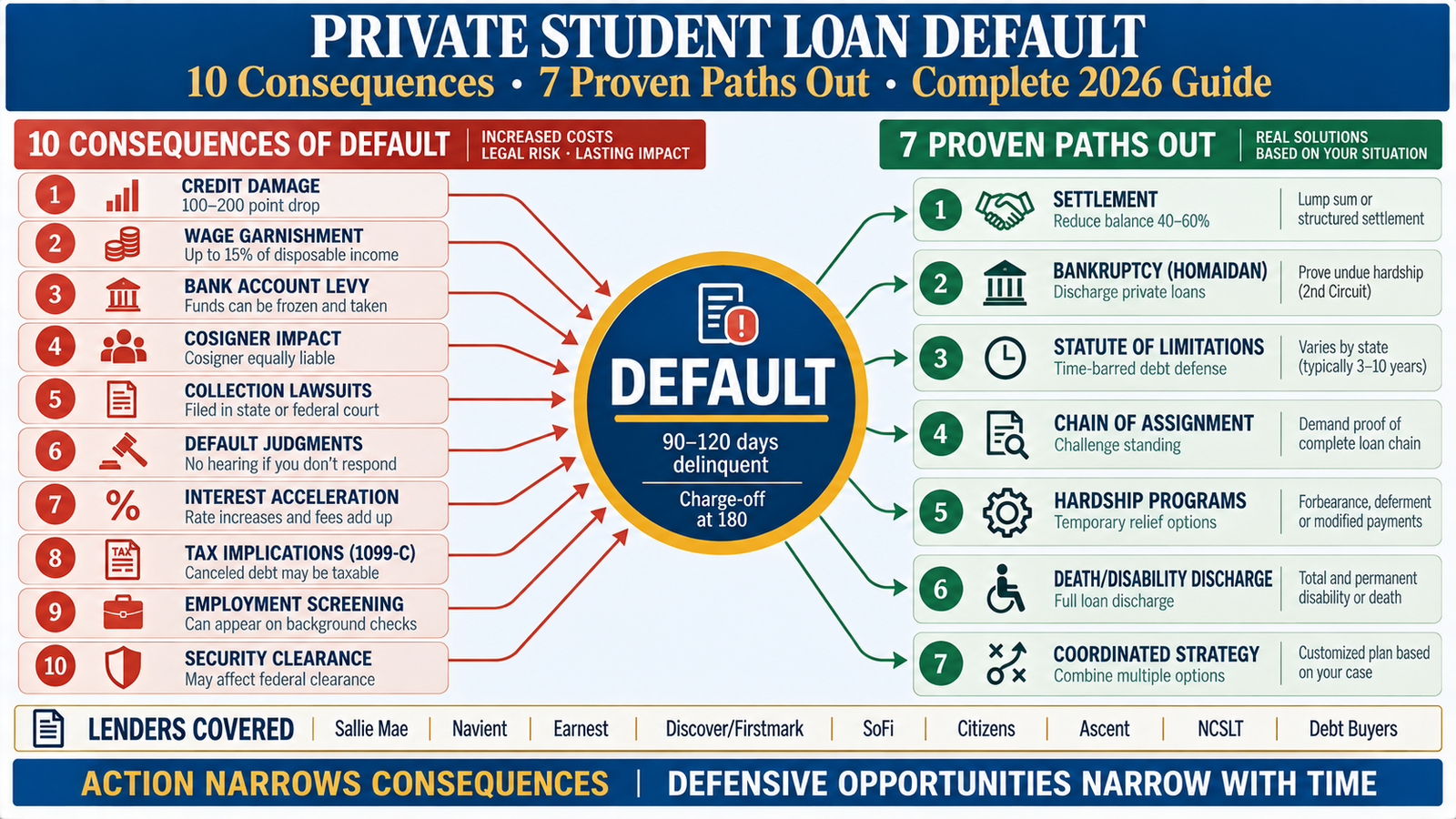
Private student loan default occurs when a borrower fails to meet loan contract repayment obligations — typically after 90-120 days of missed payments depending on lender, with “charge-off” occurring at 180 days when the lender writes the loan off as uncollectible but retains collection rights. Default triggers 10 serious consequences: (1) severe credit damage (100-200 point score drop); (2) wage garnishment via court judgment (up to 25% of disposable earnings under federal law); (3) bank account levy and asset seizure through writs of execution; (4) cosigner liability and credit damage (cosigners jointly responsible for full balance); (5) collection lawsuits (Sallie Mae, Navient, Discover/Firstmark Services, NCSLT trusts, debt buyers all file suit); (6) default judgments if borrower fails to appear or defend; (7) interest acceleration and penalty fees adding to balance; (8) tax implications on any debt cancellation (IRS Form 1099-C); (9) employment screening issues in some industries; (10) security clearance complications. However, 7 proven paths out of default exist: (1) settlement — typically 40-60% discount from balance after default/charge-off; (2) bankruptcy discharge under 11 U.S.C. §523(a)(8) with Homaidan v. Sallie Mae 992 F.3d 100 (2d Cir. 2021) precedent — many defaulted private loans qualify for non-qualified discharge WITHOUT undue hardship showing; (3) statute of limitations defense for older defaulted debt (3-15 years by state); (4) chain of assignment challenges for debt assigned to third parties under Article III standing precedent; (5) hardship forbearance and modified payment plans; (6) death/disability discharge per contract terms; (7) coordinated multi-mechanism strategy combining defenses. Action is critical — the consequences expand rapidly when ignored, but defensive and resolution options narrow when time passes. Immediate professional consultation is essential for borrowers facing default or active collection activity.
Read the complete 2026 private student loan default pilar framework below.
In this complete default pilar guide:
What default means for private student loans
Legal definition and critical distinctions from federal default
The default timeline: delinquency to lawsuit
Day-by-day progression and intervention points
Lender-specific default triggers and timelines
Sallie Mae, Navient, Discover/Firstmark, SoFi, Citizens, Ascent, NCSLT
The 10 consequences of default
Credit, garnishment, levy, cosigner, lawsuit, and more
Cosigner impact deep dive
Joint liability and credit damage mechanics
The 7 paths out of default
Settlement, bankruptcy, SOL, chain of assignment, hardship, discharge, coordinated strategy
Immediate action framework if facing default
Priority sequence and critical mistakes to avoid
What default means for private student loans
Understanding private student loan default requires important distinctions from federal student loan default. The terms, timelines, and consequences differ substantially — misunderstanding this distinction has caused many borrowers to miss critical intervention opportunities.
Default is a contract concept
For private student loans, “default” is defined by the specific loan contract — typically occurring after a specified number of missed payments (commonly 90-120 days). Unlike federal loans which have statutory default definitions and standardized consequences, private loan default varies by lender and specific contract terms. Reading the actual loan contract for default definitions, cure provisions, acceleration triggers, and remedy terms is essential first step.
Private vs federal default distinctions
Critical differences from federal default: (1) No federal rehabilitation program — private loans have no equivalent to federal Fresh Start or Loan Rehabilitation (though some private lenders offer their own cure programs); (2) No wage garnishment without court judgment — unlike federal loans which can garnish administratively, private loan garnishment requires lawsuit and judgment; (3) No tax refund offset — private creditors cannot access federal tax refunds (unlike federal collectors); (4) Lawsuit route — private creditors must file lawsuits to pursue enforcement, which creates defensive opportunities not available for federal collection; (5) FDCPA protections — third-party collection on private loans is subject to Fair Debt Collection Practices Act (federal collection is largely exempt).
Charge-off vs default
Charge-off is accounting treatment — not debt elimination. When a lender “charges off” a loan (typically after 180 days of delinquency per bank regulatory requirements), the lender writes it off as uncollectible for accounting purposes but retains full legal collection rights. Charge-off triggers: tax reporting; collection transfer or sale to third parties; credit reporting update; potential acceleration of full balance. Default typically precedes charge-off but both affect borrower significantly. Both status designations persist on credit reports (7 years under FCRA 15 U.S.C. §1681c from original delinquency).
Why private default matters strategically
Default fundamentally changes the strategic landscape: (1) Settlement becomes possible at substantially better terms (40-60% discounts common post-default/charge-off versus 20-30% pre-default); (2) Statute of limitations clock typically starts at default or last payment; (3) FDCPA protections activate for third-party collection; (4) Chain of assignment defenses become relevant if debt is sold; (5) Bankruptcy discharge analysis under Homaidan precedent remains available; (6) Lawsuit exposure increases with potential defensive opportunities. The strategic question is not whether default is bad (it is) but what to do about it and when.
The default timeline: delinquency to lawsuit
Understanding the private student loan default timeline enables strategic intervention at optimal points. Each phase presents different opportunities and risks.
Day 1-30: Early delinquency
First missed payment triggers early delinquency. Lender typically sends courtesy notices and may call. Credit reporting generally does not begin until 30 days late. Opportunities during this phase: hardship forbearance contact; modified payment plan discussion; immediate cure through late payment. Credit damage minimal if cured quickly. Important: contact lender BEFORE missing payment when possible — proactive hardship contact typically produces better outcomes than reactive post-missed-payment contact.
Day 30-90: Progressive delinquency
30-day late reporting begins (significant credit damage, 50-100 point score drop). 60-day late reporting (additional 30-50 point damage). 90-day late reporting (severe credit damage, approaching 100-150 point total drop). Lender collection activity intensifies — multiple calls daily, written demand letters, hardship program offers may become available. Cosigner typically notified during this phase if applicable. Opportunities: hardship forbearance; modified payment plan; partial cure through catch-up payment; settlement discussions may begin for the delinquent amount.
Day 90-120: Default declaration
Most private loan contracts declare default at 90-120 days of continuous delinquency. Default triggers: potential acceleration of full balance due (if contract permits); transfer to specialized collection department; credit reporting as default/collection; cosigner credit damage identical to borrower; reduced hardship program availability (many programs only available pre-default). Lender may initiate settlement discussions aggressively during this phase. Written cure demand often issued giving borrower specified time to catch up.
Day 180: Charge-off
At approximately 180 days of continuous delinquency, bank regulatory requirements typically require charge-off. Charge-off triggers: accounting write-off (but debt remains legally enforceable); potential transfer to third-party debt collector; potential sale of debt to debt buyer; credit reporting update to “charged off” status; Form 1099-C may issue (though typically only if lender ceases collection — if sold to collector, no 1099-C typically); settlement discounts expand to 40-55% range typically available. FDCPA protections fully apply to any third-party collector involved.
Post-charge-off: Collection and litigation
Post-charge-off collection activity can continue indefinitely subject to state SOL (3-15 years by state) for lawsuit filing. Common patterns: internal collection by original lender for 6-24 months; transfer to third-party collection agencies; sale to debt buyers (often NCSLT or similar structured trusts for older Sallie Mae loans); initiation of lawsuits during this phase; obtaining default judgments if borrower doesn’t appear or defend; post-judgment enforcement including wage garnishment, bank levy, property liens. Each transfer creates documentation and standing considerations that may support defensive positions.
The acceleration clause
Most private student loan contracts contain acceleration clauses allowing lender to declare entire remaining balance immediately due upon default. Acceleration affects: SOL analysis (accrual may occur on acceleration date in some states); lawsuit damages (lender can seek full balance not just missed payments); settlement calculations; bankruptcy analysis. When acceleration is declared is often significant for defensive timeline analysis. The specific language and triggers in the loan contract must be reviewed.
Lender-specific default triggers and timelines
Different private student loan lenders apply different default triggers, cure provisions, and collection patterns. Understanding your specific lender’s practices is important for strategic planning.
Sallie Mae Bank NYSE:SLM
Sallie Mae typically declares default at 120+ days of continuous delinquency. Pre-default hardship forbearance available (typically 3-month increments, cumulative limits). Post-charge-off, Sallie Mae may: retain internal collection for 12-24 months; transfer to internal special assets department; sell to third-party debt buyers (particularly older loans). Lawsuit filing patterns vary by state and portfolio holdings. Settlement outcomes post-charge-off typically 40-55% discount from balance.
Navient Corporation NYSE:NAVI
Navient (which split from Sallie Mae in 2014 and holds substantial legacy private student loan portfolios) follows similar default patterns to Sallie Mae. Specific considerations: Navient’s January 2022 state attorneys general settlement $1.85B provided certain borrowers specific relief; Navient’s December 2021 Aidvantage transfer removed Navient from federal servicing but private loans remain; Earnest Operations LLC (Navient subsidiary since 2017 $155M acquisition) handles certain Navient-related private loans. Settlement outcomes typically similar to Sallie Mae patterns.
Discover student loans (Firstmark Services administration post-2024)
Discover student loan portfolio acquired by Carlyle Group and KKR consortium in July 2024, with servicing transitioned to Firstmark Services (Nelnet NYSE:NNI subsidiary). Default patterns: 120+ days delinquency triggers default under original Discover contract terms; Firstmark administers collection; may transfer to third-party collectors or specialized servicing. The 2024 ownership transition creates chain of assignment considerations for defensive framework. Settlement outcomes vary by portfolio and account status.
SoFi Bank NA NMLS #696891
SoFi became national bank by charter in 2022. Default typically declared at 120+ days delinquency. SoFi features: no cosigner release policy historically; variable hardship program availability; refinance portfolio with substantial average balances. Collection patterns include internal collection and potential sale to third parties. Settlement patterns vary — SoFi often less flexible than legacy lenders.
Citizens Bank NA NYSE:CFG
Citizens Bank offers cosigner release after 36 months of consecutive on-time principal and interest payments. Default declared at approximately 120+ days delinquency. Hardship programs available with documentation. Post-charge-off collection may involve internal special assets or third-party transfer. Settlement outcomes typically follow bank sector patterns.
Ascent Student Loans (post-June 2023 waiver note)
Ascent Student Loans has specific contractual consideration: college loans originated June 5, 2023 or later contain contractual §523(a)(8) discharge waiver language. This may limit bankruptcy discharge analysis for those specific loans though legal enforceability of such waivers remains disputed. Pre-June 2023 Ascent loans follow standard private loan analysis. Default patterns similar to other private lenders.
NCSLT trusts (National Collegiate Student Loan Trusts)
NCSLT trusts hold pre-2014 Sallie Mae-originated loans particularly from 2001-2007 origination period. These loans are generally already in default — NCSLT acquired them from original lenders. Transworld Systems Inc. historically served as major administrator. The 2017 CFPB consent order established oversight; Third Circuit March 19, 2024 “covered persons” decision and SCOTUS cert denial December 2024 further clarified framework. NCSLT lawsuits face strong defensive opportunities through chain of assignment challenges.
Third-party debt buyers
After charge-off, defaulted debt may be sold to third-party debt buyers for a fraction of face value (often 2-10% of balance). The debt buyer’s economics (purchased at steep discount) create strong settlement motivation. Chain of assignment analysis is particularly important for debt-buyer-held debt — missing documentation often supports standing challenges. FDCPA protections fully apply. Settlement outcomes with debt buyers often 10-25% of balance (reflecting their cost basis and litigation risk).
The 10 consequences of default
Understanding the full scope of private student loan default consequences is essential — these consequences expand rapidly if ignored and affect areas of life borrowers may not initially consider.
Consequence 1: Severe credit damage
Credit score typically drops 100-200 points through default sequence: 30-day late (-50-100); 60-day late (-30-50 additional); 90-day late (-30-50 additional); default/charge-off reporting (-30-100 additional). Negative reporting persists under FCRA 15 U.S.C. §1681c for 7 years from original delinquency. Impact extends beyond credit: insurance rates, housing applications, employment screening, utility deposits. Credit rebuilding after default typically requires 2-7 years depending on resolution path.
Consequence 2: Wage garnishment
Post-judgment wage garnishment allows creditor to collect from employer directly. Federal law under Consumer Credit Protection Act 15 U.S.C. §1673 limits garnishment to lesser of: 25% of disposable earnings; or amount by which weekly earnings exceed 30 times federal minimum wage. State law may provide additional protections (some states prohibit wage garnishment for consumer debt, including Texas, Pennsylvania, North Carolina, South Carolina). Garnishment requires court judgment first — properly defending the lawsuit can prevent garnishment entirely.
Consequence 3: Bank account levy
Post-judgment bank levy (writ of execution) allows creditor to seize funds from borrower’s bank accounts. Impact: entire account balance may be frozen or seized; essential expenses (rent, utilities, food) become immediately difficult; recovery of levied funds requires exemption claims and legal process. Protections include: state exemption laws (varies by state); federal exemption for Social Security, veterans benefits, and other protected income under 42 U.S.C. §407 and similar provisions. Prevention through lawsuit defense is substantially easier than post-levy recovery.
Consequence 4: Cosigner impact
Cosigners are jointly and severally liable for the full balance — not just a portion. Default triggers: cosigner credit damage identical to borrower; cosigner subject to all collection activities (calls, letters, lawsuits); cosigner wage garnishment possible if judgment entered against cosigner; cosigner asset exposure through bank levy or property lien. Many cosigner relationships (parent-child, spouse, partner) suffer severe strain through default consequences. Cosigner protection strategies include release programs where available, early communication, and coordinated resolution planning.
Consequence 5: Collection lawsuits
Private student loan debt in default is frequently litigated. Lawsuits may come from: original lender (Sallie Mae, Navient/Earnest, Discover/Firstmark, SoFi, Citizens, Ascent); third-party debt collectors acting on behalf of original lender; debt buyers who purchased charged-off debt; NCSLT trusts holding older securitized debt. Lawsuits require formal legal response typically within 20-30 days of service. Default judgments entered against non-appearing defendants carry same enforcement power as fully litigated judgments.
Consequence 6: Default judgments
When borrowers fail to respond to lawsuits (often because they’re overwhelmed or didn’t receive proper notice), default judgments are entered automatically. Default judgments enable: immediate enforcement through garnishment, levy, and liens; renewable enforcement periods (often 10-20 years, renewable); credit reporting of judgment separate from original debt reporting. However, old default judgments can often be vacated under FRCP 60(b)(4) when original lawsuit lacked proper standing — this is particularly common with NCSLT and debt buyer judgments. Standing challenges are jurisdictional and have no time limit.
Consequence 7: Interest acceleration and penalty fees
Default typically triggers: late fees stacking on each missed payment; default interest rate (often 2-5% higher than regular rate); acceleration of entire remaining balance due immediately; post-judgment interest rates applied if lawsuit succeeds. These additions can substantially increase the total debt — a $40,000 balance may become $55,000-$70,000+ over 24-36 months of default accumulation. Settlement calculations should account for the fully accelerated balance, not the original principal.
Consequence 8: Tax implications
If private student loan debt is forgiven, canceled, or settled, the forgiven amount is generally taxable income reported on IRS Form 1099-C. Exceptions include: IRC §108(a)(1)(A) bankruptcy exclusion; IRC §108(a)(1)(B) insolvency exclusion (common for borrowers in default); IRC §108(f) specific student loan discharge exclusion for certain federal programs (does not generally apply to private loans). Insolvency exclusion requires IRS Form 982 filing. Tax planning is essential component of default resolution — CPA consultation strongly recommended before any settlement.
Consequence 9: Employment screening issues
Some employers conduct credit checks as part of background screening — particularly in financial services, government, and positions involving money handling. Default and judgments appearing on credit reports may affect: employment offers (though some states restrict credit-based employment decisions); promotions in regulated industries; professional licensing in some fields. Federal Fair Credit Reporting Act 15 U.S.C. §1681b requires written consent for employer credit checks and disclosure of adverse actions.
Consequence 10: Security clearance complications
For borrowers in positions requiring federal security clearance (military, intelligence, defense contractor, federal law enforcement), significant debt and default status create specific challenges. Adjudicative Guidelines for Determining Eligibility for Access to Classified Information include financial considerations: “Financial Considerations” guideline evaluates financial stability. Default and judgments may trigger: adjudicative review of clearance; conditional clearance with monitoring; clearance denial in severe cases. Resolution of financial issues typically supports clearance maintenance.
Cosigner impact deep dive
The cosigner impact of defaulted on private student loans deserves special attention because cosigner relationships (typically parent-child, spouse, or close family) are often damaged permanently when default consequences hit cosigners alongside primary borrowers.
Joint and several liability
Private student loan cosigners are jointly and severally liable — meaning: cosigner can be pursued for the full balance (not just a share); creditor can collect from borrower, cosigner, or both simultaneously; cosigner has no automatic right to force borrower to pay first; cosigner’s assets and income are fully exposed to collection. Many cosigners don’t fully understand this scope when signing. The practical consequence is that default affects cosigner immediately and completely, not after borrower resources are exhausted.
Credit damage parity
Negative credit reporting applies identically to borrower and cosigner: same 30/60/90/120-day late reporting; same default/charge-off reporting; same 7-year FCRA retention period. Many cosigners with excellent credit (750+ scores) see dramatic drops to 500-600 range when default occurs. Rebuilding cosigner credit requires same resolution path as borrower credit. Early communication with cosigners about default risk preserves relationships even when financial damage occurs.
Cosigner release options
Some lenders offer cosigner release after specific requirements met: Citizens Bank — 36 consecutive on-time principal and interest payments plus creditworthiness criteria; Sallie Mae — typically 12+ consecutive on-time payments plus requirements; Discover/Firstmark Services — varies by loan product and origination; SoFi — historically no cosigner release policy; Ascent — specific requirements by product. Release requires borrower to meet qualifying criteria while loan is current — once default occurs, release typically unavailable. Borrowers close to meeting cosigner release requirements should prioritize meeting them before default, when possible.
Death discharge and cosigner protection
Private student loan contracts typically include death discharge for the primary borrower — but cosigner liability may continue in some cases. Review of specific loan contract terms essential: some contracts discharge both parties upon borrower death; others continue cosigner liability for remaining balance; life insurance planning may be appropriate for cosigner protection. For older NCSLT-held loans, specific contract analysis required given multiple generations of loan terms over 2001-2007 origination period.
Coordinated resolution for cosigner protection
When default occurs, coordinated resolution should address both borrower and cosigner exposure: settlement agreements must release both parties with full satisfaction language; bankruptcy filing by borrower alone does not discharge cosigner unless cosigner also files (Chapter 13 codebtor stay under 11 U.S.C. §1301 provides temporary protection but not discharge); SOL defense protects both parties if raised properly; chain of assignment defenses may dismiss case against both. Comprehensive strategy considering both parties produces better outcomes than borrower-only approach.
The 7 paths out of default
Despite the serious consequences, 7 proven paths out of private student loan default exist. The right path depends on specific circumstances — defensive leverage, financial capacity, and overall debt situation.
Path 1: Settlement negotiation
Settlement typically produces best outcomes post-default/charge-off: pre-charge-off (90-180 days delinquent) 20-40% discount; charged-off accounts (180+ days) 40-55% discount; older charged-off accounts 50-60% discount; accounts with strong defensive leverage sometimes 10-30% of balance. Settlement requires: hardship documentation preparation; written initial offer; multiple negotiation rounds; written settlement agreement with full satisfaction release, credit tradeline update instructions, and 1099-C handling specification; lump sum payment via traceable method. Never pay without executed written agreement. See complete settlement guide.
Path 2: Bankruptcy discharge via Homaidan
Many defaulted private student loans qualify for bankruptcy discharge WITHOUT undue hardship showing under Homaidan v. Sallie Mae 992 F.3d 100 (2d Cir. 2021) precedent. Potentially dischargeable: direct-to-consumer loans without school certification; loans exceeding cost of attendance; loans for non-Title IV programs; residency loans; refinance loans failing qualified education loan status. Chapter 7 adversary proceeding under 11 U.S.C. §523(a)(8) produces complete discharge in approximately 6-9 months total. Automatic stay under §362 immediately halts collection activity. See complete bankruptcy discharge guide.
Path 3: Statute of limitations defense
Older defaulted debt may be past state SOL (3-15 years by state): Texas 4 years; New York 3 years (CCFA April 7, 2022); Pennsylvania 4 years; California 4 years; Florida 5 years; Ohio 6 years; Illinois 10 years. SOL expiration means debt cannot be enforced through lawsuit — effectively uncollectible through litigation. Critical: avoid revival events (payments, written acknowledgments) that restart SOL clock. SOL is affirmative defense that must be raised in answer to lawsuit. See complete 50-state SOL guide.
Path 4: Chain of assignment challenges
For debt assigned to third parties (NCSLT trusts, debt buyers, specialized collectors), Article III standing challenges under Lujan v. Defenders of Wildlife 504 U.S. 555 (1992), Spokeo, Inc. v. Robins 578 U.S. 330 (2016), and TransUnion LLC v. Ramirez 594 U.S. 413 (2021) often support dismissal. Current holder must prove complete chain of ownership from original lender — documentation gaps are common and support standing motions. Even old default judgments may be vacated under FRCP 60(b)(4) when standing was never established. See NCSLT lawsuit defense guide.
Path 5: Hardship forbearance and modified payment plans
Lender hardship programs provide temporary relief that may stabilize situation while comprehensive strategy develops: hardship forbearance (3-12 months payment suspension with interest accrual); modified payment plans (reduced payments, interest-only periods); extended repayment terms; graduated payment schedules. Programs vary by lender and typically require documentation. Hardship programs provide payment relief but do NOT forgive debt — they are bridge strategy, not permanent resolution. Pre-default hardship contact typically produces better options than post-default.
Path 6: Death and disability discharge
Private student loan contracts typically include death discharge upon borrower death (contract-based). Disability discharge available in some contracts for Total and Permanent Disability. Documentation requirements vary by lender. For borrowers facing serious health conditions, documentation of discharge availability important for financial planning. Death/disability discharge produces actual debt elimination (not just payment relief).
Path 7: Coordinated multi-mechanism strategy
The strongest default resolution typically combines multiple mechanisms strategically: SOL analysis across all debts; chain of assignment review for assigned debt; FDCPA validation of third-party collection; Homaidan analysis for bankruptcy option; settlement negotiation from defensive leverage positions; coordinated execution preserving all defensive positions. This multi-mechanism approach typically produces materially better outcomes than any single mechanism alone. Professional coordination (consulting organization + attorney-backed partner provider + CPA) is essential for complex situations.
Complete default resolution ecosystem — related guides
Private Student Loan Forgiveness 2026: Complete Guide (PILAR)
The 7-path master framework covering all private student loan forgiveness mechanisms available in 2026.
Private Student Loan Settlement 2026
Complete settlement framework with 40-60% discount outcomes for charged-off accounts.
Private Student Loan Bankruptcy Discharge 2026
Homaidan deep-dive with Chapter 7 vs 13 selection for complete debt elimination.
Private Student Loan SOL by State 2026
Complete 50-state SOL guide for time-barred defaulted debt analysis.
How to Get Your Student Loans Dismissed 2026
6 proven legal defenses for case dismissal when facing collection lawsuits.
Immediate action framework if facing default
Priority 1: Don’t ignore
The worst response to default is no response. Collection activity escalates when ignored: calls intensify; lawsuit risk increases; default judgments enter automatically on non-appearance; cosigner impact compounds; defensive opportunities narrow. Even if resolution isn’t immediately apparent, taking first action (consultation, documentation gathering, validation request) stops the escalation trajectory. “I’ll deal with it later” is the most expensive mistake in default situations.
Priority 2: Document everything
Gather and preserve: original loan contract (critical for governing law clause, acceleration provisions, cure terms, discharge availability); all payment history records; all correspondence with lender/collector; any lawsuit documents; credit reports showing default/collection tradelines; cosigner relationship documentation if applicable. Complete documentation enables effective strategy development and preserves defensive positions.
Priority 3: Protect SOL defense
For older defaulted debt, avoid revival events: NO payments (even small payments restart SOL in most states); NO written acknowledgment of debt validity; NO promises to pay; NO settlement without professional guidance (settlement discussions themselves can revive); consult counsel BEFORE any communication with creditors on old debt. SOL defense can be lost in a single phone call acknowledging the debt.
Priority 4: Respond to lawsuits immediately
If served with lawsuit: note the answer deadline (typically 20-30 days from service); do NOT miss the deadline (default judgment follows automatically); consult attorney with specific private student loan defense experience immediately; prepare answer raising ALL available affirmative defenses (SOL, standing, FDCPA validation, Rule 12(b)(6)); never ignore a lawsuit regardless of overall debt situation. Timely answer preserves all defensive opportunities.
Priority 5: Professional consultation
Complex default situations benefit from professional analysis coordinating: consulting organization for strategy framework and resource coordination; attorney-backed partner provider for legal review and representation if needed; CPA for tax planning around any settlement; bankruptcy counsel if Homaidan discharge analysis warranted. Private student relief consulting matches borrowers with appropriate resources based on specific situation. Free initial consultation should always be available — never pay upfront fees for debt relief evaluation.
Common private student loan default myths
Myth 1
“Default means I have no options”
Reality: Default is actually when the best resolution options become available. Settlement discounts expand substantially post-default/charge-off (40-60% versus 20-30% pre-default). SOL analysis becomes relevant. Chain of assignment defenses apply to assigned debt. FDCPA protections activate for third-party collection. Homaidan bankruptcy discharge analysis remains fully available. The 7 proven paths out of default produce real outcomes — but require strategic action, not resignation.
Myth 2
“Lenders can garnish my wages automatically after default”
Reality: Unlike federal student loans (which can garnish administratively), private student loan garnishment requires lawsuit, court judgment, and separate garnishment proceeding. This multi-step process creates substantial defensive opportunities: lawsuit defense (SOL, standing, FDCPA); challenging the judgment; opposing the garnishment order; claiming state and federal exemptions (Social Security protected under 42 U.S.C. §407, veterans benefits, etc.). Prevention through lawsuit defense is substantially easier than post-garnishment recovery. Four states (Texas, Pennsylvania, North Carolina, South Carolina) prohibit most wage garnishment for consumer debt entirely.
Myth 3
“Private student loans can’t be discharged in bankruptcy”
Reality: This outdated myth is substantially incorrect. Following Homaidan v. Sallie Mae 992 F.3d 100 (2d Cir. 2021), many private student loans qualify for bankruptcy discharge WITHOUT undue hardship showing. Direct-to-consumer loans, loans exceeding cost of attendance, loans for non-Title IV programs, residency loans, and loans failing IRC §221(d)(1) requirements may qualify for non-qualified discharge. Chapter 7 adversary proceeding under 11 U.S.C. §523(a)(8) typically produces discharge in 6-9 months. Bankruptcy counsel with specific §523(a)(8) experience should evaluate each defaulted loan situation.
Myth 4
“My cosigner is only responsible for a portion of the debt”
Reality: Cosigners are jointly and severally liable for the FULL balance — not a portion or share. Default triggers identical consequences for cosigner (credit damage, collection activity, lawsuit exposure, wage garnishment, bank levy) regardless of borrower’s situation. Lender can pursue borrower, cosigner, or both simultaneously. This liability continues until debt is fully resolved. Coordinated resolution strategy protecting both parties is essential. Life insurance on borrower is sometimes used to protect cosigner from death-related liability where contract permits continued cosigner responsibility.
Frequently asked questions
1. When am I considered in default on my private student loans?
Private student loan default is defined by your specific loan contract — typically occurring after 90-120 days of continuous missed payments. Unlike federal loans which have statutory default definitions, private loan default varies by lender. Review your loan contract for the specific default definition, cure provisions, acceleration triggers, and remedy terms. Most contracts also contain acceleration clauses that make the entire balance immediately due upon default. Charge-off (accounting write-off) typically occurs around 180 days of delinquency per bank regulatory requirements — but charge-off does not eliminate the debt, only writes it off for accounting while retaining collection rights.
2. What happens when I default on private student loans?
Private student loan default triggers 10 serious consequences: (1) severe credit damage (100-200 point score drop); (2) wage garnishment via court judgment (up to 25% of disposable earnings federally, with state variations); (3) bank account levy through writs of execution; (4) cosigner liability and identical credit damage; (5) collection lawsuits from original lender or debt buyers; (6) default judgments if borrower fails to appear; (7) interest acceleration and penalty fees; (8) tax implications on debt cancellation (Form 1099-C); (9) employment screening complications in some industries; (10) security clearance challenges for government/defense positions. However, 7 proven paths out of default also exist — settlement (40-60% discount), bankruptcy discharge under Homaidan precedent, SOL defense, chain of assignment challenges, hardship programs, discharge mechanisms, and coordinated multi-mechanism strategy.
3. Can my wages be garnished for private student loan default?
Yes, but only after lender obtains court judgment. Unlike federal student loans (which can garnish administratively), private student loan garnishment requires: (1) lender filing lawsuit; (2) borrower served with process; (3) court judgment entered (often default judgment if borrower doesn’t appear); (4) separate garnishment proceeding; (5) employer served with garnishment order. Federal law limits garnishment under Consumer Credit Protection Act 15 U.S.C. §1673 to lesser of 25% of disposable earnings or amount above 30x federal minimum wage. Four states (Texas, Pennsylvania, North Carolina, South Carolina) prohibit most wage garnishment for consumer debt. State protections and exemption claims may further limit garnishment. Prevention through lawsuit defense (SOL, standing challenges, Rule 12(b)(6)) is substantially easier than post-garnishment recovery.
4. How does default affect my cosigner?
Default affects cosigners immediately and severely. Cosigners are jointly and severally liable for the FULL balance — not just a share. Impact: identical negative credit reporting (100-200 point score drop); subject to all collection activities (calls, letters, lawsuits); exposure to wage garnishment and bank levy if judgment entered against cosigner; permanent damage to credit for 7 years under FCRA. Many parent-child cosigner relationships suffer severe strain through default consequences. Protection strategies: pursue cosigner release where available (Citizens Bank after 36 payments, others vary); maintain early communication; coordinate resolution strategy addressing both parties. Settlement and bankruptcy must address both borrower and cosigner specifically — borrower-only resolution often leaves cosigner fully exposed.
5. Can I get out of private student loan default?
Yes, 7 proven paths out of default produce real outcomes: (1) settlement — typically 40-60% discount from balance post-charge-off; (2) bankruptcy discharge under 11 U.S.C. §523(a)(8) with Homaidan v. Sallie Mae 992 F.3d 100 (2d Cir. 2021) precedent — many defaulted loans qualify for non-qualified discharge WITHOUT undue hardship; (3) statute of limitations defense — older defaulted debt may be time-barred (3-15 years by state); (4) chain of assignment challenges under Article III standing for assigned debt; (5) hardship forbearance and modified payment plans; (6) death and disability discharge; (7) coordinated multi-mechanism strategy. The right path depends on specific circumstances. Professional consultation through private student relief consulting coordinates analysis across all paths for comprehensive strategy.
6. How long does private student loan default stay on my credit report?
Under Fair Credit Reporting Act 15 U.S.C. §1681c, negative credit reporting for default and related items remains for 7 years from the date of original delinquency (not from charge-off date or default declaration). After 7 years, the negative tradeline must be removed from credit reports regardless of whether debt is resolved. Note that credit reporting and statute of limitations are separate systems with different timelines — a debt may still be legally enforceable (SOL hasn’t expired) after it falls off credit reports (7 years passed), or vice versa. Credit rebuilding after default typically requires 2-7 years depending on resolution path and subsequent credit behavior. Settlement produces “settled for less than full balance” tradeline (better than ongoing default but still negative); bankruptcy produces discharge tradeline (also negative but definitive resolution).
7. What should I do first if I’m in default on my private student loans?
Immediate action priorities: (1) don’t ignore — consequences escalate rapidly when ignored; (2) document everything — gather original loan contract, payment history, correspondence, lawsuit documents, credit reports, cosigner information; (3) protect SOL defense — do NOT make any payment, written acknowledgment, or promise to pay without professional guidance (these actions can revive SOL on older debt); (4) respond to any lawsuits immediately — answer deadline typically 20-30 days from service, default judgment follows missed deadline; (5) consult professional resources — consulting organization for strategy framework, attorney-backed partner provider for legal review, bankruptcy counsel for Homaidan analysis if warranted, CPA for tax planning. Free initial consultation should always be available — never pay upfront fees for debt relief evaluation. Private Student Relief coordinates these resources through attorney-backed partner provider.
Facing Private Student Loan Default?
Free specialist review of all 7 paths out of default for your situation.
Settlement negotiation with Sallie Mae Bank NYSE:SLM, Navient/Earnest Operations LLC, Discover/Firstmark Services (post-2024 Carlyle Group and KKR acquisition), SoFi Bank NA NMLS #696891, Citizens Bank NA NYSE:CFG, Ascent Student Loans, and third-party debt buyers typically producing 40-60% discounts from charged-off balances; bankruptcy discharge analysis under 11 U.S.C. §523(a)(8) with Homaidan v. Sallie Mae precedent for non-qualified direct-to-consumer loans; statute of limitations defense across all 50 states; chain of assignment challenges for NCSLT trusts and debt buyers under Lujan/Spokeo/TransUnion precedent; hardship program qualification; cosigner impact protection with coordinated strategy; FDCPA leverage under 15 U.S.C. §1692g for third-party collection; and coordinated multi-mechanism approach for maximum private student loan default resolution outcomes. Free eligibility review with attorney-backed partner provider — no upfront fees.
Get a free eligibility review →
5-minute review · No obligation · Zero upfront fees · Since 2015 · 48 states served
About the author
Henry Silva — Private Student Loan Debt Specialist
10+ years experience analyzing private student loan default situations across all major lenders including Sallie Mae Bank NYSE:SLM, Navient Corporation NYSE:NAVI, Earnest Operations LLC (Navient subsidiary since 2017 $155M acquisition), Discover student loan portfolio (acquired by Carlyle Group and KKR consortium July 2024 with servicing transitioned to Firstmark Services, a Nelnet NYSE:NNI subsidiary), SoFi Bank NA NMLS #696891 (chartered as national bank 2022), Citizens Bank NA NYSE:CFG, Ascent Student Loans (including June 5, 2023+ contractual §523(a)(8) discharge waiver loans), NCSLT (National Collegiate Student Loan Trusts) following Third Circuit March 19, 2024 “covered persons” decision and SCOTUS cert denial December 2024, and third-party debt buyers. Expertise includes default timeline analysis across delinquency progression, charge-off at 180 days per bank regulatory requirements, acceleration clause application, lender-specific default triggers and cure provisions, 10 default consequences analysis (credit damage under FCRA 15 U.S.C. §1681c, wage garnishment under Consumer Credit Protection Act 15 U.S.C. §1673, bank levy and writ of execution analysis, cosigner joint and several liability, collection lawsuits and default judgments, interest acceleration and penalty fees, IRC §108 tax implications, employment screening under FCRA 15 U.S.C. §1681b, security clearance financial considerations), coordinated 7-path resolution strategy including settlement negotiation producing 40-60% discounts post-charge-off, bankruptcy discharge analysis under 11 U.S.C. §523(a)(8) with Homaidan v. Sallie Mae 992 F.3d 100 (2d Cir. 2021) precedent for non-qualified direct-to-consumer loans, Crocker v. Navient Solutions LLC 941 F.3d 206 (5th Cir. 2019), McDaniel v. Navient Solutions LLC 973 F.3d 1083 (10th Cir. 2020), Brunner v. New York State Higher Education Services Corp. 831 F.2d 395 (2d Cir. 1987) framework for qualified loans, In re Rosenberg 594 B.R. 22 (Bankr. S.D.N.Y. 2020) moderated application, statute of limitations analysis across all 50 states (3-15 years by state), chain of assignment challenges under Article III standing framework (Lujan v. Defenders of Wildlife 504 U.S. 555 (1992), Spokeo, Inc. v. Robins 578 U.S. 330 (2016), TransUnion LLC v. Ramirez 594 U.S. 413 (2021)), FDCPA leverage under 15 U.S.C. §1692g for debt validation and §1692e/f for deceptive and unfair practices, cosigner protection strategy coordinating release programs and coordinated resolution, IRC §108(a)(1)(B) insolvency and IRC §108(a)(1)(A) bankruptcy tax exclusion analysis with Form 982 preparation, FRCP 60(b)(4) motion to vacate old default judgments where standing was never established, and multi-mechanism strategy for maximum debt resolution outcomes. Henry works with Private Student Relief’s attorney-backed partner provider network to coordinate default-specific analysis across all 7 proven resolution paths.
Legal Disclaimer and Sources
This article is provided for informational purposes only and does not constitute legal, tax, or financial advice. Private Student Relief is a consulting and matching organization operated by Joco (555 Anton Blvd, Suite 368, Costa Mesa, CA 92626) — not a law firm, debt settlement company, debt consolidation company, or loan provider. Debt validation services are performed by an attorney-backed partner provider (Panamerican Consulting LLC, Las Vegas, NV) under independent business credentials. Ratings, BBB accreditation, and AADR membership referenced on the PSR website belong to the partner provider. Private student loan default consequences, resolution options, and timing depend on loan characteristics, lender terms, borrower circumstances, state law, cosigner situation, and specific facts. Individual results vary. Since 2015. 48 states served. Not available in South Carolina or Mississippi.
Federal statutes referenced: Consumer Credit Protection Act 15 U.S.C. §1673 (wage garnishment limits — lesser of 25% of disposable earnings or amount above 30x federal minimum wage); Fair Credit Reporting Act 15 U.S.C. §1681c (7-year reporting limit from original delinquency), 15 U.S.C. §1681b (employment screening consent and disclosure requirements); Fair Debt Collection Practices Act 15 U.S.C. §1692 et seq. including §1692g debt validation, §1692e deceptive practices, §1692f unfair practices; Social Security Act 42 U.S.C. §407 (protection from garnishment); Bankruptcy Code 11 U.S.C. §523(a)(8) student loan discharge exceptions with §523(a)(8)(A)(i) governmental unit, (A)(ii) educational benefit, (B) qualified education loan categories; 11 U.S.C. §362 automatic stay; 11 U.S.C. §524 discharge injunction; 11 U.S.C. §707(b)(2) means test; 11 U.S.C. §1301 Chapter 13 codebtor stay; 11 U.S.C. §1328 Chapter 13 discharge; Federal Rules of Civil Procedure FRCP 12(b)(6) failure to state claim, FRCP 60(b)(4) void judgment vacation; Internal Revenue Code IRC §221(d)(1) qualified education loan definition, §108(a)(1)(A) bankruptcy exclusion, §108(a)(1)(B) insolvency exclusion, Form 982, Form 1099-C.
Key precedent referenced: Homaidan v. Sallie Mae Inc. 992 F.3d 100 (2d Cir. 2021) non-qualified discharge for direct-to-consumer loans; Brunner v. New York State Higher Education Services Corp. 831 F.2d 395 (2d Cir. 1987) undue hardship three-prong test; Crocker v. Navient Solutions LLC 941 F.3d 206 (5th Cir. 2019); McDaniel v. Navient Solutions LLC 973 F.3d 1083 (10th Cir. 2020); In re Rosenberg 594 B.R. 22 (Bankr. S.D.N.Y. 2020) moderated Brunner application; DOJ November 2022 undue hardship guidance; Article III standing precedent — Lujan v. Defenders of Wildlife 504 U.S. 555 (1992), Spokeo, Inc. v. Robins 578 U.S. 330 (2016), TransUnion LLC v. Ramirez 594 U.S. 413 (2021). NCSLT Third Circuit March 19, 2024 “covered persons” decision under Consumer Financial Protection Act 12 U.S.C. §5481(6); SCOTUS cert denial December 2024.
Statute of limitations for written contract debt (private student loans) by state (verify current statutes): Texas 4 years under Tex. Civ. Prac. & Rem. Code §16.004(a)(3); New York 3 years under CPLR §214(2) per Consumer Credit Fairness Act (CCFA) effective April 7, 2022; Pennsylvania 4 years under 42 Pa.C.S. §5525; Ohio 6 years under Ohio R.C. §2305.06; Illinois 10 years under 735 ILCS 5/13-206; Georgia 6 years under O.C.G.A. §9-3-24; California 4 years under CCP §337; Florida 5 years under Fla. Stat. §95.11(2)(b); Delaware 3 years under 10 Del. C. §8106; Kentucky 15 years under KRS §413.090. Original loan contract governing law clause may apply different state law. State borrowing statutes may apply shorter SOL between forum state and governing law state. Four states prohibit most consumer debt wage garnishment: Texas, Pennsylvania, North Carolina, South Carolina.
Lender information current as of October 2026 per publicly available documentation: Sallie Mae Bank NYSE:SLM; Navient Corporation NYSE:NAVI (2014 Sallie Mae split; 2017 Earnest acquisition $155M; December 2021 Aidvantage transfer federal exit; January 2022 state attorneys general settlement $1.85B); Earnest Operations LLC (Navient subsidiary since 2017); Discover student loan portfolio acquired by Carlyle Group and KKR consortium July 2024 with servicing transitioned to Firstmark Services (Nelnet NYSE:NNI subsidiary); SoFi Bank NA NMLS #696891 (chartered as national bank 2022, no cosigner release historically); Citizens Bank NA NYSE:CFG (cosigner release after 36 consecutive on-time payments); Ascent Student Loans (June 5, 2023+ college loans contain contractual §523(a)(8) discharge waiver language). NCSLT (National Collegiate Student Loan Trusts) holds pre-2014 Sallie Mae-originated loans particularly from 2001-2007 origination period; 15 Delaware statutory trusts; Transworld Systems Inc. historical major administrator and collection agent.
Private student loan default resolution requires case-by-case review coordinating: specific loan contract analysis for default definition, cure provisions, acceleration clauses, discharge availability, and governing law; current default status analysis; applicable state SOL analysis with revival event review; Homaidan non-qualified discharge analysis for bankruptcy option; chain of assignment review for assigned debt; FDCPA validation of third-party collection; settlement calculation from defensive leverage positions; cosigner impact and coordinated protection strategy; tax planning with CPA for any settlement using IRC §108 exclusions and Form 982; and coordinated multi-mechanism approach. This article provides general framework information; specific default resolution requires evaluation of individual facts, documentation, applicable state law, and borrower circumstances by consulting resources, attorney-backed partner providers, bankruptcy counsel where warranted, and CPAs. For borrowers facing active collection, lawsuits, garnishment, or imminent default escalation, immediate professional consultation is essential given rapidly compounding consequences and narrowing defensive opportunities. Last reviewed: October 2026.